The Pristine Dwarf Galaxy Survey -- VII. The metallicity distributions of 12 Milky Way faint satellites
Pith reviewed 2026-06-28 00:09 UTC · model grok-4.3
The pith
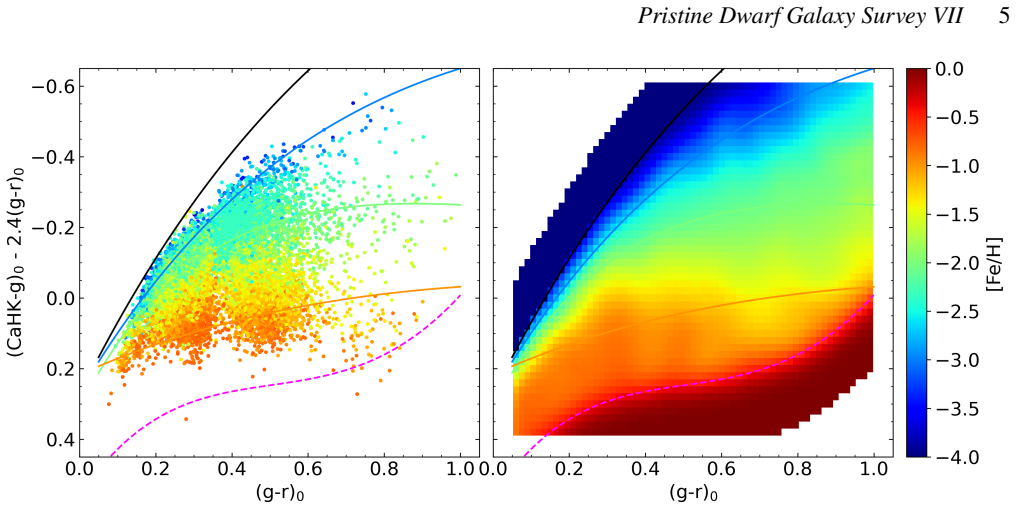
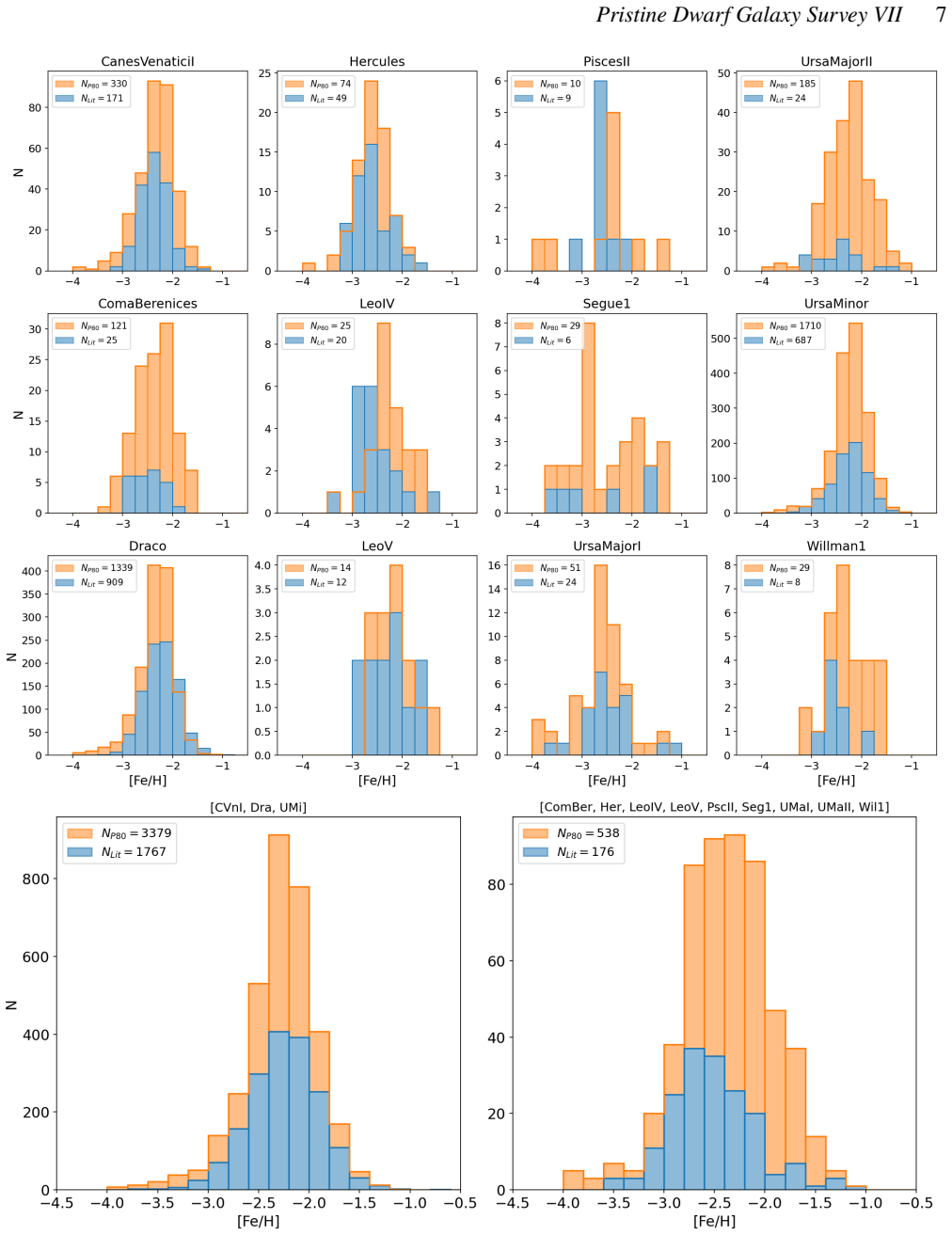
Narrow-band CaHK photometry produces complete metallicity distributions for 12 faint Milky Way satellites and shows ultra-faint systems scatter around [Fe/H] of -2.3.
A machine-rendered reading of the paper's core claim, the machinery that carries it, and where it could break.
Core claim
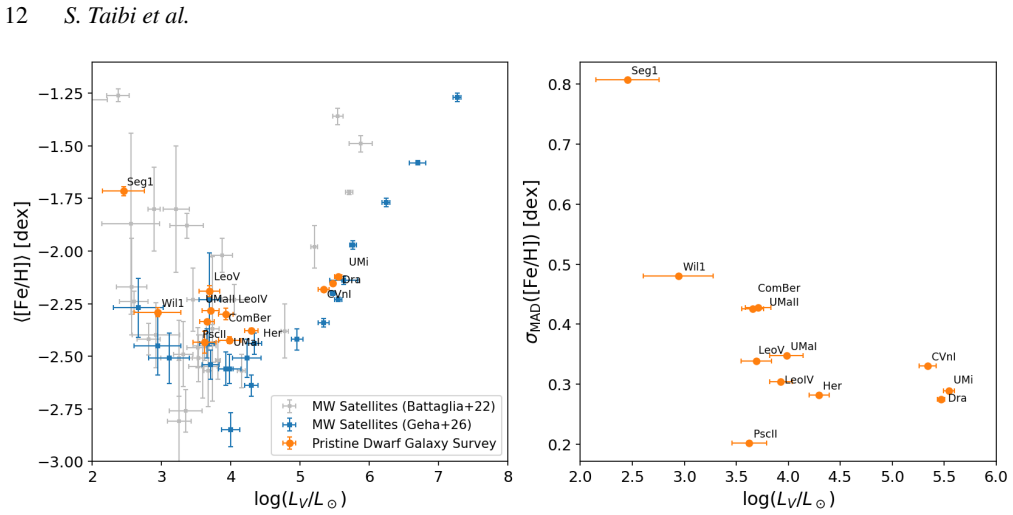
The central claim is that CaHK-based photometric metallicities enable the construction of complete metallicity distributions for faint satellites where spectroscopy alone is limited by small samples and contaminants, delivering previously inaccessible average metallicities, dispersions, and evidence that ultra-faint systems scatter around [Fe/H] ~-2.3 rather than following the brighter-dwarf luminosity-metallicity trend.
What carries the argument
The central mechanism is the derivation of photometric metallicities from narrow-band CaHK photometry combined with broad-band g and r data, which refines membership probabilities and constructs the metallicity distribution functions.
If this is right
- Ultra-faint dwarfs show average metallicities around [Fe/H] = -2.3 and scatter rather than extending the linear luminosity-metallicity relation of brighter systems.
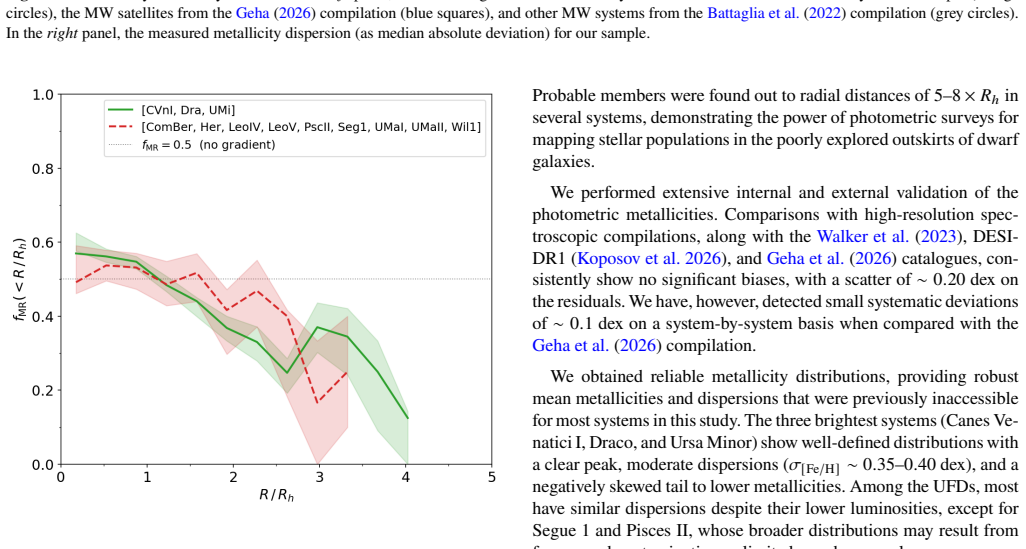
- Metallicity gradients are detected in massive satellites but absent in ultra-faint dwarfs inside 2.5 half-light radii.
- 170 candidate extremely metal-poor stars are identified across all 12 systems.
- The photometric approach doubles the number of probable members compared with prior spectroscopy and can complement future spectroscopic surveys.
Where Pith is reading between the lines
- The same CaHK strategy could be extended to still fainter or more distant satellites to test whether the -2.3 dex scatter persists at lower luminosities.
- Absence of gradients in ultra-faint systems may point to more efficient early mixing or different assembly paths than in classical dwarfs.
- Photometric pre-selection of extremely metal-poor candidates offers an efficient route to target high-resolution spectroscopic follow-up.
Load-bearing premise
The photometric metallicities from CaHK are accurate and unbiased enough to refine membership probabilities and produce reliable distributions, even in the ultra-faint regime with small numbers and contaminants.
What would settle it
Follow-up spectroscopy on a large subset of the 3917 candidate members, especially the 170 extremely metal-poor candidates, would return metallicities or membership assignments that differ systematically from the photometric values.
Figures
read the original abstract
Spectroscopic studies of ultra-faint dwarf galaxies are typically limited to small samples of stars due to the scarcity of sufficiently bright targets. The small number statistics and possible presence of contaminants still hamper solid determinations of their metallicity distribution function. In this work, we characterise the metallicity distributions of 12 Milky Way faint satellites by exploiting deep narrow-band CaHK photometry from the Pristine dwarf galaxy survey. In order to derive accurate stellar photometric metallicities, we combined it with deep broad-band g and r photometry from Mu\~noz et al. (2018) and Pan-STARRS1, covering each system out to 5-8 times their half-light radius Rh, and reaching magnitudes as faint as g~23. Membership probabilities were determined incorporating the available spatial, photometric, astrometric, and spectroscopic information, further refined using the derived photometric metallicities. We identified 3917 probable member stars across the 12 systems, more than doubling the numbers recovered by previous spectroscopic studies. We deliver complete metallicity distributions that yield robust average metallicities and dispersions previously inaccessible for most of the systems examined in this study. We identify 170 candidate extremely metal-poor stars distributed across all systems, and confirm a departure from the linear luminosity-metallicity relation in the ultra-faint regime, with systems scattering around [Fe/H]~-2.3 dex. Given the extensive mass coverage of our sample, we were able to investigate the presence of metallicity gradients, finding clear evidence of radial variations in massive systems, but none in the ultra-faint dwarfs within 2.5xRh. The photometric strategy presented in this paper will continue to serve as an effective complement to future spectroscopic surveys.
Editorial analysis
A structured set of objections, weighed in public.
Referee Report
Summary. The paper claims to derive photometric metallicities for stars in 12 Milky Way faint satellites using Pristine CaHK narrow-band photometry combined with broad-band g,r data, determine membership probabilities (incorporating spatial/photometric/astrometric/spectroscopic data and further refined by the photometric [Fe/H]), identify 3917 probable members (more than doubling prior spectroscopic samples) and 170 EMP candidates, deliver complete MDFs yielding robust averages and dispersions, confirm a departure from the linear luminosity-metallicity relation in the ultra-faint regime (systems scattering around [Fe/H] ~ -2.3), and find radial metallicity gradients in massive systems but none in UFDs within 2.5 Rh.
Significance. If the CaHK photometric [Fe/H] calibration is shown to be unbiased and the membership refinement does not introduce circularity, the work would provide a substantial increase in the number of metallicity measurements for these systems, enabling previously inaccessible MDF statistics, a large EMP candidate sample, and tests of the L-Z relation and gradients across a wide mass range. This would be a valuable observational contribution to understanding chemical evolution in the faintest dwarfs.
major comments (2)
- [Membership determination (abstract and methods)] Membership determination section (as described in the abstract): refining probabilities with the derived photometric [Fe/H] values creates a potential circularity risk for the reported MDFs, average metallicities, dispersions, and EMP counts (170 stars). If the CaHK calibration has metallicity-dependent scatter or bias below [Fe/H] ~ -2.5 (common in UFD regimes with small-N statistics), this step could preferentially retain or exclude stars and artificially shape the distributions. The paper must quantify this by comparing MDFs with/without the metallicity-refinement step and by validating the photometric [Fe/H] against any available spectroscopic [Fe/H] for overlapping stars.
- [Results on L-Z relation and gradients] Results on luminosity-metallicity relation and gradients: the claimed departure from the linear L-Z relation (scatter around [Fe/H] ~ -2.3) and the presence/absence of gradients within 2.5 Rh are load-bearing for the conclusions, but the manuscript provides no details on how photometric [Fe/H] uncertainties are propagated into these fits, nor on the statistical significance of the scatter or gradient detections. This is especially critical for the UFD subsample where small number statistics dominate.
minor comments (2)
- [Abstract / Methods] The abstract states that membership incorporates 'spatial, photometric, astrometric, and spectroscopic information' but does not specify the exact weighting or exclusion criteria applied; a dedicated methods subsection with explicit equations or decision trees would improve clarity.
- [Abstract] No mention of completeness corrections or magnitude-dependent error bars on the photometric [Fe/H] in the provided abstract; these should be addressed when presenting the MDFs and EMP candidate list.
Simulated Author's Rebuttal
We thank the referee for their careful reading and constructive comments. We address each major comment below and indicate the revisions we will incorporate.
read point-by-point responses
-
Referee: [Membership determination (abstract and methods)] Membership determination section (as described in the abstract): refining probabilities with the derived photometric [Fe/H] values creates a potential circularity risk for the reported MDFs, average metallicities, dispersions, and EMP counts (170 stars). If the CaHK calibration has metallicity-dependent scatter or bias below [Fe/H] ~ -2.5 (common in UFD regimes with small-N statistics), this step could preferentially retain or exclude stars and artificially shape the distributions. The paper must quantify this by comparing MDFs with/without the metallicity-refinement step and by validating the photometric [Fe/H] against any available spectroscopic [Fe/H] for overlapping stars.
Authors: We agree that the potential impact of the refinement step on the final MDFs requires explicit quantification. The initial membership probabilities are derived from spatial, photometric, astrometric and spectroscopic information independently of the CaHK-based [Fe/H] values; the photometric metallicity is applied only as a subsequent refinement. In the revised manuscript we will add a direct comparison of the MDFs (including mean, dispersion and EMP counts) obtained with and without the metallicity-refinement step. We will also include a validation of the photometric [Fe/H] calibration against all available spectroscopic [Fe/H] measurements for stars in these systems, with particular attention to the regime below [Fe/H] ~ -2.5. revision: yes
-
Referee: [Results on L-Z relation and gradients] Results on luminosity-metallicity relation and gradients: the claimed departure from the linear L-Z relation (scatter around [Fe/H] ~ -2.3) and the presence/absence of gradients within 2.5 Rh are load-bearing for the conclusions, but the manuscript provides no details on how photometric [Fe/H] uncertainties are propagated into these fits, nor on the statistical significance of the scatter or gradient detections. This is especially critical for the UFD subsample where small number statistics dominate.
Authors: We acknowledge that the manuscript would benefit from explicit description of the statistical procedures. In the revised version we will detail how photometric [Fe/H] uncertainties are propagated into the luminosity-metallicity fits and radial-gradient analyses (via Monte Carlo resampling or weighted least-squares methods). We will also report quantitative measures of statistical significance for the observed scatter around the L-Z relation and for the gradient detections (or lack thereof), with separate discussion of the UFD subsample to reflect the small-number regime. revision: yes
Circularity Check
No significant circularity; observational measurement paper
full rationale
This paper reports photometric metallicity distributions and membership for dwarf galaxies using CaHK and broad-band photometry. No equations, model derivations, or parameter fits are presented that reduce to inputs by construction. Membership refinement incorporates photometric metallicities as one input among spatial, astrometric, and spectroscopic data; this is standard data processing and does not match any enumerated circularity pattern (self-definitional, fitted-input prediction, self-citation load-bearing, etc.). The central results (MDFs, averages, EMP counts, L-Z departure) are direct measurements against external benchmarks and remain self-contained.
Axiom & Free-Parameter Ledger
Reference graph
Works this paper leans on
-
[1]
Stellar Populations and Structural Properties of Ultra Faint Dwarf Galaxies, Canes Venatici I, Bo \"o tes I, Canes Venatici II, and Leo IV. , keywords =. doi:10.1088/0004-637X/744/2/96 , archivePrefix =. 1110.2882 , primaryClass =
work page internal anchor Pith review Pith/arXiv arXiv doi:10.1088/0004-637x/744/2/96
-
[2]
The Pristine survey I: Mining the Galaxy for the most metal-poor stars
The Pristine survey - I. Mining the Galaxy for the most metal-poor stars. , keywords =. doi:10.1093/mnras/stx1068 , archivePrefix =. 1705.01113 , primaryClass =
work page internal anchor Pith review Pith/arXiv arXiv doi:10.1093/mnras/stx1068
-
[3]
Data Release 1 and an all-sky metallicity catalogue based on Gaia DR3 BP/RP spectro-photometry
The Pristine survey: XXIII. Data Release 1 and an all-sky metallicity catalogue based on Gaia DR3 BP/RP spectro-photometry. , keywords =. doi:10.1051/0004-6361/202347633 , archivePrefix =. 2308.01344 , primaryClass =
-
[4]
Gaia early DR3 systemic motions of Local Group dwarf galaxies and orbital properties with a massive Large Magellanic Cloud. , keywords =. doi:10.1051/0004-6361/202141528 , archivePrefix =. 2106.08819 , primaryClass =
-
[5]
The observed properties of dwarf galaxies in and around the Local Group
The Observed Properties of Dwarf Galaxies in and around the Local Group. , keywords =. 2012. doi:10.1088/0004-6256/144/1/4 , archivePrefix =. 1204.1562 , primaryClass =
work page internal anchor Pith review Pith/arXiv arXiv doi:10.1088/0004-6256/144/1/4 2012
-
[6]
A MegaCam Survey of Outer Halo Satellites. I. Description of the Survey. , keywords =. doi:10.3847/1538-4357/aac168 , archivePrefix =. 1806.06889 , primaryClass =
work page internal anchor Pith review Pith/arXiv arXiv doi:10.3847/1538-4357/aac168
-
[7]
A MegaCam Survey of Outer Halo Satellites. III. Photometric and Structural Parameters. , keywords =. doi:10.3847/1538-4357/aac16b , archivePrefix =. 1806.06891 , primaryClass =
work page internal anchor Pith review Pith/arXiv arXiv doi:10.3847/1538-4357/aac16b
-
[8]
The Pan-STARRS1 Photometric System
The Pan-STARRS1 Photometric System. , keywords =. doi:10.1088/0004-637X/750/2/99 , archivePrefix =. 1203.0297 , primaryClass =
work page internal anchor Pith review Pith/arXiv arXiv doi:10.1088/0004-637x/750/2/99
-
[9]
The Pan-STARRS1 Surveys. arXiv e-prints , keywords =. doi:10.48550/arXiv.1612.05560 , archivePrefix =. 1612.05560 , primaryClass =
work page internal anchor Pith review Pith/arXiv arXiv doi:10.48550/arxiv.1612.05560
-
[10]
arXiv , author =:2208.00211 , journal =
Gaia Data Release 3. Summary of the content and survey properties. , keywords =. doi:10.1051/0004-6361/202243940 , archivePrefix =. 2208.00211 , primaryClass =
-
[11]
Cross-match of Gaia sources with variable objects from the literature
Gaia Data Release 3. Cross-match of Gaia sources with variable objects from the literature. , keywords =. doi:10.1051/0004-6361/202244367 , archivePrefix =. 2207.01946 , primaryClass =
-
[12]
The Kinematics of the Ultra-Faint Milky Way Satellites: Solving the Missing Satellite Problem
The Kinematics of the Ultra-faint Milky Way Satellites: Solving the Missing Satellite Problem. , keywords =. doi:10.1086/521816 , archivePrefix =. 0706.0516 , primaryClass =
work page internal anchor Pith review Pith/arXiv arXiv doi:10.1086/521816
-
[13]
Magellan/M2FS and MMT/Hectochelle Spectroscopy of Dwarf Galaxies and Faint Star Clusters within the Galactic Halo. , keywords =. doi:10.3847/1538-4365/acdd79 , archivePrefix =. 2312.12738 , primaryClass =
-
[14]
The celestial reference frame (Gaia-CRF3)
Gaia Early Data Release 3. The celestial reference frame (Gaia-CRF3). , keywords =. doi:10.1051/0004-6361/202243483 , archivePrefix =. 2204.12574 , primaryClass =
-
[15]
The Dartmouth Stellar Evolution Database
The Dartmouth Stellar Evolution Database. , keywords =. doi:10.1086/589654 , archivePrefix =. 0804.4473 , primaryClass =
work page internal anchor Pith review Pith/arXiv arXiv doi:10.1086/589654
-
[16]
Revised and New Proper Motions for Confirmed and Candidate Milky Way Dwarf Galaxies. , keywords =. doi:10.3847/1538-3881/aba4ab , archivePrefix =. 2007.05011 , primaryClass =
-
[17]
Proper motions of Milky Way Ultra-Faint satellites with ${\it Gaia}$ DR2 $\times$ DES DR1
Proper Motions of Milky Way Ultra-faint Satellites with Gaia DR2 DES DR1. , keywords =. doi:10.3847/1538-4357/ab0aee , archivePrefix =. 1806.02345 , primaryClass =
work page internal anchor Pith review Pith/arXiv arXiv doi:10.3847/1538-4357/ab0aee
-
[18]
Gaia Universe Model Snapshot : A statistical analysis of the expected contents of the Gaia catalogue
Gaia Universe model snapshot. A statistical analysis of the expected contents of the Gaia catalogue. , keywords =. doi:10.1051/0004-6361/201118646 , archivePrefix =. 1202.0132 , primaryClass =
work page internal anchor Pith review Pith/arXiv arXiv doi:10.1051/0004-6361/201118646
-
[19]
Measuring Reddening with Sloan Digital Sky Survey Stellar Spectra and Recalibrating SFD. , keywords =. doi:10.1088/0004-637X/737/2/103 , archivePrefix =. 1012.4804 , primaryClass =
work page internal anchor Pith review Pith/arXiv arXiv doi:10.1088/0004-637x/737/2/103
-
[20]
Maps of Dust Infrared Emission for Use in Estimation of Reddening and Cosmic Microwave Background Radiation Foregrounds. , keywords =. doi:10.1086/305772 , archivePrefix =. astro-ph/9710327 , primaryClass =
work page internal anchor Pith review Pith/arXiv arXiv doi:10.1086/305772
-
[21]
Pristine dwarf galaxy survey - I. A detailed photometric and spectroscopic study of the very metal-poor Draco II satellite. , keywords =. doi:10.1093/mnras/sty1986 , archivePrefix =. 1807.10655 , primaryClass =
work page internal anchor Pith review Pith/arXiv arXiv doi:10.1093/mnras/sty1986
-
[22]
Stellar Abundances for Galactic Archaeology Database. IV. Compilation of stars in dwarf galaxies. , keywords =. doi:10.1093/pasj/psx059 , archivePrefix =. 1703.10009 , primaryClass =
work page internal anchor Pith review Pith/arXiv arXiv doi:10.1093/pasj/psx059
-
[23]
DESI Early Data Release Milky Way Survey value-added catalogue. , keywords =. doi:10.1093/mnras/stae1842 , archivePrefix =. 2407.06280 , primaryClass =
-
[24]
The Open Journal of Astrophysics , keywords =
DESI Data Release 1: Stellar Catalogue. The Open Journal of Astrophysics , keywords =. doi:10.33232/001c.155260 , archivePrefix =. 2505.14787 , primaryClass =
-
[25]
Multi-element Abundance Measurements from Medium-resolution Spectra. III. Metallicity Distributions of Milky Way Dwarf Satellite Galaxies. , keywords =. doi:10.1088/0004-637X/727/2/78 , archivePrefix =. 1011.4937 , primaryClass =
work page internal anchor Pith review Pith/arXiv arXiv doi:10.1088/0004-637x/727/2/78
-
[26]
The Universal Stellar Mass-Stellar Metallicity Relation for Dwarf Galaxies
The Universal Stellar Mass-Stellar Metallicity Relation for Dwarf Galaxies. , keywords =. doi:10.1088/0004-637X/779/2/102 , archivePrefix =. 1310.0814 , primaryClass =
work page internal anchor Pith review Pith/arXiv arXiv doi:10.1088/0004-637x/779/2/102
-
[27]
, year = 1955, month = feb, volume =
Sculptor-Type Systems in the Local Group of Galaxies. , year = 1955, month = feb, volume =. doi:10.1086/126754 , adsurl =
-
[28]
Draco, a flawless dwarf galaxy*. , keywords =. doi:10.1111/j.1365-2966.2006.11356.x , archivePrefix =. astro-ph/0612263 , primaryClass =
-
[29]
Cats and Dogs, Hair and A Hero: A Quintet of New Milky Way Companions
Cats and Dogs, Hair and a Hero: A Quintet of New Milky Way Companions. , keywords =. doi:10.1086/509718 , archivePrefix =. astro-ph/0608448 , primaryClass =
work page internal anchor Pith review Pith/arXiv arXiv doi:10.1086/509718
-
[30]
A New Milky Way Dwarf Satellite in Canes Venatici
A New Milky Way Dwarf Satellite in Canes Venatici. , keywords =. doi:10.1086/505216 , archivePrefix =. astro-ph/0604354 , primaryClass =
work page internal anchor Pith review Pith/arXiv arXiv doi:10.1086/505216
-
[31]
A Curious New Milky Way Satellite in Ursa Major
A Curious Milky Way Satellite in Ursa Major. , keywords =. doi:10.1086/508628 , archivePrefix =. astro-ph/0606633 , primaryClass =
work page internal anchor Pith review Pith/arXiv arXiv doi:10.1086/508628
-
[32]
The Distribution of Alpha Elements in Ultra-Faint Dwarf Galaxies
The Distribution of Alpha Elements in Ultra-faint Dwarf Galaxies. , keywords =. doi:10.1088/0004-637X/767/2/134 , archivePrefix =. 1302.6594 , primaryClass =
work page internal anchor Pith review Pith/arXiv arXiv doi:10.1088/0004-637x/767/2/134
-
[33]
The Keck/DEIMOS Stellar Archive. I. Uniform Velocities and Metallicities for 78 Milky Way Dwarf Galaxies and Globular Clusters. , keywords =. doi:10.3847/1538-4357/ae290d , archivePrefix =. 2602.10200 , primaryClass =
work page internal anchor Pith review Pith/arXiv arXiv doi:10.3847/1538-4357/ae290d
-
[34]
Dynamical Masses and Metallicities for a Uniform Sample of Milky Way Satellites
The Keck/DEIMOS Stellar Archive: II. Dynamical Masses and Metallicities for a Uniform Sample of Milky Way Satellites. arXiv e-prints , keywords =. doi:10.48550/arXiv.2602.10202 , archivePrefix =. 2602.10202 , primaryClass =
-
[35]
The Draco Dwarf Spheroidal Galaxy in the First Year of Dark Energy Spectroscopic Instrument Data. , keywords =. doi:10.3847/1538-4357/ae0a37 , archivePrefix =. 2509.21822 , primaryClass =
-
[36]
The Faintest Dwarf Galaxies. , keywords =. doi:10.1146/annurev-astro-091918-104453 , archivePrefix =. 1901.05465 , primaryClass =
-
[37]
The Origin of the 300 km s$^{-1}$ Stream Near Segue 1
The Origin of the 300 km s ^ -1 Stream near Segue 1. , keywords =. doi:10.3847/1538-4357/aad9f9 , archivePrefix =. 1804.08622 , primaryClass =
work page internal anchor Pith review Pith/arXiv arXiv doi:10.3847/1538-4357/aad9f9
-
[38]
Metallicity Distribution Functions of 13 Ultra-faint Dwarf Galaxy Candidates from Hubble Space Telescope Narrowband Imaging. , keywords =. doi:10.3847/1538-4357/ad0030 , archivePrefix =. 2306.06260 , primaryClass =
-
[39]
Stellar metallicity gradients of Local Group dwarf galaxies. , keywords =. doi:10.1051/0004-6361/202243508 , archivePrefix =. 2206.08988 , primaryClass =
-
[40]
Carbon-enhanced metal-poor stars: the most pristine objects?
Carbon-enhanced metal-poor stars: the most pristine objects?. , keywords =. doi:10.1051/0004-6361/201220989 , archivePrefix =. 1303.1791 , primaryClass =
work page internal anchor Pith review Pith/arXiv arXiv doi:10.1051/0004-6361/201220989
-
[41]
Measures of Location and Scale for Velocities in Clusters of Galaxies---A Robust Approach. , keywords =. doi:10.1086/115487 , adsurl =
-
[42]
Turning the Tides on the Ultra-Faint Dwarf Spheroidal Galaxies: Coma Berenices and Ursa Major II
Turning the Tides on the Ultra-faint Dwarf Spheroidal Galaxies: Coma Berenices and Ursa Major II. , keywords =. doi:10.1088/0004-6256/140/1/138 , archivePrefix =. 0910.3946 , primaryClass =
work page internal anchor Pith review Pith/arXiv arXiv doi:10.1088/0004-6256/140/1/138
-
[43]
Ursa Major II - Reproducing the observed properties through tidal disruption
Ursa Major II - reproducing the observed properties through tidal disruption. , keywords =. doi:10.1093/mnras/stt925 , archivePrefix =. 1305.5535 , primaryClass =
work page internal anchor Pith review Pith/arXiv arXiv doi:10.1093/mnras/stt925
-
[44]
The Star Formation Histories of Local Group Dwarf Galaxies. I. Hubble Space Telescope/Wide Field Planetary Camera 2 Observations. , keywords =. doi:10.1088/0004-637X/789/2/147 , archivePrefix =. 1404.7144 , primaryClass =
work page internal anchor Pith review Pith/arXiv arXiv doi:10.1088/0004-637x/789/2/147
-
[45]
Multiple chemodynamic stellar populations of the Ursa Minor dwarf spheroidal galaxy. , keywords =. doi:10.1093/mnras/staa1419 , archivePrefix =. 2002.09503 , primaryClass =
-
[46]
The star formation and chemical evolution histories of the Ursa Minor dwarf spheroidal galaxy. , keywords =. doi:10.1093/pasj/psaf106 , archivePrefix =. 2505.13161 , primaryClass =
-
[47]
The Extended Stellar Distribution in the Outskirts of the Ursa Minor Dwarf Spheroidal Galaxy. , keywords =. doi:10.3847/2041-8213/ae0cb3 , archivePrefix =. 2509.20914 , primaryClass =
-
[48]
The Dark Matter Content of Milky Way Dwarf Spheroidal Galaxies: Draco, Sextans, and Ursa Minor. , keywords =. doi:10.3847/1538-4357/ae07ce , archivePrefix =. 2507.02284 , primaryClass =
-
[49]
Narrowband Ca Photometry for Dwarf Spheroidal Galaxies. I. Chemostructural Study on Draco, Sextans, and Canes Venatici I. , keywords =. doi:10.3847/1538-4365/ab6441 , archivePrefix =. 2001.11138 , primaryClass =
-
[50]
The extended 'stellar halo' of the Ursa Minor dwarf galaxy. , keywords =. doi:10.1093/mnras/stad2427 , archivePrefix =. 2301.13214 , primaryClass =
-
[51]
Identification of a Group III CEMP-no Star in the Dwarf Spheroidal Galaxy Canes Venatici I. , keywords =. doi:10.3847/1538-4357/ab7daf , archivePrefix =. 1910.10038 , primaryClass =
-
[52]
The Quenching of the Ultra-Faint Dwarf Galaxies in the Reionization Era
The Quenching of the Ultra-faint Dwarf Galaxies in the Reionization Era. , keywords =. doi:10.1088/0004-637X/796/2/91 , archivePrefix =. 1410.0681 , primaryClass =
work page internal anchor Pith review Pith/arXiv arXiv doi:10.1088/0004-637x/796/2/91
-
[53]
The HST Legacy Archival Uniform Reduction of Local Group Imaging (LAURELIN). I. Photometry and Star Formation Histories for 36 Ultra-faint Dwarf Galaxies. , keywords =. doi:10.3847/1538-4357/ae00c8 , archivePrefix =. 2505.18252 , primaryClass =
-
[54]
The formation of the milky way halo and its dwarf satellites: a NLTE-1D abundance analysis. IV. Segue 1, Triangulum II, and Coma Berenices UFDs. , keywords =. doi:10.1093/mnras/stab786 , archivePrefix =. 2103.08435 , primaryClass =
-
[55]
A New Milky Way Dwarf Galaxy in Ursa Major
A New Milky Way Dwarf Galaxy in Ursa Major. , keywords =. doi:10.1086/431760 , archivePrefix =. astro-ph/0503552 , primaryClass =
work page internal anchor Pith review Pith/arXiv arXiv doi:10.1086/431760
-
[56]
A New Milky Way Companion: Unusual Globular Cluster or Extreme Dwarf Satellite?
A New Milky Way Companion: Unusual Globular Cluster or Extreme Dwarf Satellite?. , keywords =. doi:10.1086/430214 , archivePrefix =. astro-ph/0410416 , primaryClass =
work page internal anchor Pith review Pith/arXiv arXiv doi:10.1086/430214
-
[57]
Abundance ratios of red giants in low mass ultra faint dwarf spheroidal galaxies
Abundance ratios of red giants in low-mass ultra-faint dwarf spheroidal galaxies. , keywords =. doi:10.1051/0004-6361/201527181 , archivePrefix =. 1510.05401 , primaryClass =
work page internal anchor Pith review Pith/arXiv arXiv doi:10.1051/0004-6361/201527181
-
[58]
The Star Formation History and Extended Structure of the Hercules Milky Way Satellite
The Star Formation History and Extended Structure of the Hercules Milky Way Satellite. , keywords =. doi:10.1088/0004-637X/704/2/898 , archivePrefix =. 0906.4017 , primaryClass =
work page internal anchor Pith review Pith/arXiv arXiv doi:10.1088/0004-637x/704/2/898
-
[59]
The Hercules satellite: a stellar stream in the Milky Way halo?
The Hercules Satellite: A Stellar Stream in the Milky Way Halo?. , keywords =. doi:10.1088/0004-637X/721/2/1333 , archivePrefix =. 1008.0014 , primaryClass =
work page internal anchor Pith review Pith/arXiv arXiv doi:10.1088/0004-637x/721/2/1333
-
[60]
Stellar Substructures around the Hercules Dwarf Spheroidal Galaxy
Stellar Substructures Around the Hercules Dwarf Spheroidal Galaxy. , keywords =. doi:10.1088/0004-637X/804/2/134 , archivePrefix =. 1503.03896 , primaryClass =
work page internal anchor Pith review Pith/arXiv arXiv doi:10.1088/0004-637x/804/2/134
-
[61]
Uncovering the orbit of the hercules dwarf galaxy. , keywords =. doi:10.1093/mnras/staa1553 , archivePrefix =. 1912.00156 , primaryClass =
-
[62]
The edges of the dwarf galaxy Hercules
The Pristine dwarf galaxy survey-V. The edges of the dwarf galaxy Hercules. , keywords =. doi:10.1093/mnras/stad2227 , archivePrefix =. 2304.13046 , primaryClass =
-
[63]
Signatures of Tidal Disruption of the Hercules Ultrafaint Dwarf Galaxy. , keywords =. doi:10.3847/1538-4357/ad2f27 , archivePrefix =. 2403.00921 , primaryClass =
-
[64]
Big fish, small fish: Two New Ultra-Faint Satellites of the Milky Way
Big Fish, Little Fish: Two New Ultra-faint Satellites of the Milky Way. , keywords =. doi:10.1088/2041-8205/712/1/L103 , archivePrefix =. 1002.0504 , primaryClass =
work page internal anchor Pith review Pith/arXiv arXiv doi:10.1088/2041-8205/712/1/l103 2041
-
[65]
Leo V: A Companion of a Companion of the Milky Way Galaxy
Leo V: A Companion of a Companion of the Milky Way Galaxy?. , keywords =. doi:10.1086/592962 , archivePrefix =. 0807.2831 , primaryClass =
work page internal anchor Pith review Pith/arXiv arXiv doi:10.1086/592962
-
[66]
High-Resolution Spectroscopy of Extremely Metal-Poor Stars in the Least Evolved Galaxies: Leo IV
High-resolution Spectroscopy of Extremely Metal-poor Stars in the Least Evolved Galaxies: Leo IV. , keywords =. doi:10.1088/0004-637X/716/1/446 , archivePrefix =. 1001.3137 , primaryClass =
work page internal anchor Pith review Pith/arXiv arXiv doi:10.1088/0004-637x/716/1/446
-
[67]
Spectroscopic Confirmation of the Dwarf Galaxies Hydra II and Pisces II and the Globular Cluster Laevens 1. , keywords =. doi:10.1088/0004-637X/810/1/56 , archivePrefix =. 1506.01021 , primaryClass =
work page internal anchor Pith review Pith/arXiv arXiv doi:10.1088/0004-637x/810/1/56
-
[68]
Very Large Telescope Spectroscopy of Ultra-faint Dwarf Galaxies. I. Bo \"o tes I, Leo IV, and Leo V. , keywords =. doi:10.3847/1538-4357/ac1353 , archivePrefix =. 2101.00013 , primaryClass =
-
[69]
Tidal Signatures in the Faintest Milky Way Satellites: The Detailed Properties of Leo V, Pisces II, and Canes Venatici II. , keywords =. doi:10.1088/0004-637X/756/1/79 , archivePrefix =. 1111.6608 , primaryClass =
work page internal anchor Pith review Pith/arXiv arXiv doi:10.1088/0004-637x/756/1/79
-
[70]
Dynamical evidence for a strong tidal interaction between the Milky Way and its satellite, Leo V
Dynamical evidence for a strong tidal interaction between the Milky Way and its satellite, Leo V. , keywords =. doi:10.1093/mnras/stx067 , archivePrefix =. 1608.05710 , primaryClass =
work page internal anchor Pith review Pith/arXiv arXiv doi:10.1093/mnras/stx067
-
[71]
Signatures of Tidal Disruption in Ultra-faint Dwarf Galaxies: A Combined HST, Gaia, and MMT/Hectochelle Study of Leo V. , keywords =. doi:10.3847/1538-4357/ab45ec , archivePrefix =. 1907.07233 , primaryClass =
-
[72]
A CEMP-no star in the ultra-faint dwarf galaxy Pisces II
A CEMP-no star in the ultra-faint dwarf galaxy Pisces II. , keywords =. doi:10.1051/0004-6361/201833548 , archivePrefix =. 1807.01542 , primaryClass =
work page internal anchor Pith review Pith/arXiv arXiv doi:10.1051/0004-6361/201833548
-
[73]
Satellite group infall into the Milky Way: Exploring the Crater-Leo case with new HST proper motions. , keywords =. doi:10.1051/0004-6361/202449985 , archivePrefix =. 2404.16110 , primaryClass =
-
[74]
The Least Luminous Galaxy: Spectroscopy of the Milky Way Satellite Segue 1
The Least-Luminous Galaxy: Spectroscopy of the Milky Way Satellite Segue 1. , keywords =. doi:10.1088/0004-637X/692/2/1464 , archivePrefix =. 0809.2781 , primaryClass =
work page internal anchor Pith review Pith/arXiv arXiv doi:10.1088/0004-637x/692/2/1464
-
[75]
A Complete Spectroscopic Survey of the Milky Way Satellite Segue 1: The Darkest Galaxy
A Complete Spectroscopic Survey of the Milky Way Satellite Segue 1: The Darkest Galaxy. , keywords =. doi:10.1088/0004-637X/733/1/46 , archivePrefix =. 1007.4198 , primaryClass =
work page internal anchor Pith review Pith/arXiv arXiv doi:10.1088/0004-637x/733/1/46
-
[76]
A Complete Spectroscopic Survey of the Milky Way Satellite Segue 1: Dark Matter Content, Stellar Membership, and Binary Properties from a Bayesian Analysis. , keywords =. doi:10.1088/0004-637X/738/1/55 , archivePrefix =. 1008.4585 , primaryClass =
work page internal anchor Pith review Pith/arXiv arXiv doi:10.1088/0004-637x/738/1/55
-
[77]
MNRAS , archivePrefix = "arXiv", eprint =
A Keck/DEIMOS spectroscopic survey of faint Galactic satellites: searching for the least massive dwarf galaxies. , keywords =. doi:10.1111/j.1365-2966.2007.12055.x , archivePrefix =. 0705.4622 , primaryClass =
-
[78]
Willman 1 - a probable dwarf galaxy with an irregular kinematic distribution
Willman 1 A Probable Dwarf Galaxy with an Irregular Kinematic Distribution. , keywords =. doi:10.1088/0004-6256/142/4/128 , archivePrefix =. 1007.3499 , primaryClass =
work page internal anchor Pith review Pith/arXiv arXiv doi:10.1088/0004-6256/142/4/128
-
[79]
Willman 1 Revisited: The Kinematics, Chemistry, and Orbital Properties of a Potentially-Disrupting Dwarf Galaxy. arXiv e-prints , keywords =. doi:10.48550/arXiv.2602.20272 , archivePrefix =. 2602.20272 , primaryClass =
work page internal anchor Pith review Pith/arXiv arXiv doi:10.48550/arxiv.2602.20272
-
[80]
Segue 1: An Unevolved Fossil Galaxy from the Early Universe
Segue 1: An Unevolved Fossil Galaxy from the Early Universe. , keywords =. doi:10.1088/0004-637X/786/1/74 , archivePrefix =. 1403.6116 , primaryClass =
work page internal anchor Pith review Pith/arXiv arXiv doi:10.1088/0004-637x/786/1/74
discussion (0)
Sign in with ORCID, Apple, or X to comment. Anyone can read and Pith papers without signing in.