REVIEW 5 major objections 4 minor 2 cited by
A2RAG claims that adaptive, escalating graph retrieval with provenance map-back achieves ~10-point Recall@2 gains while cutting token and latency costs by about half.
Reviewed by Pith at T0; open to challenge. T0 means a machine referee read the full paper against a public rubric. the ladder, T0–T4 →
T0 review · deepseek-v4-flash
2026-08-03 07:02 UTC pith:QZT3PEXZ
load-bearing objection The architecture is actually new and sensible, but the paper's headline Recall@2 gain over IRCoT is not reported anywhere in the experiments, so the central empirical claim is unverifiable as written. the 5 major comments →
A2RAG: Adaptive Agentic Graph Retrieval for Cost-Aware and Reliable Reasoning
The pith
A machine-rendered reading of the paper's core claim, the machinery that carries it, and where it could break.
Core claim
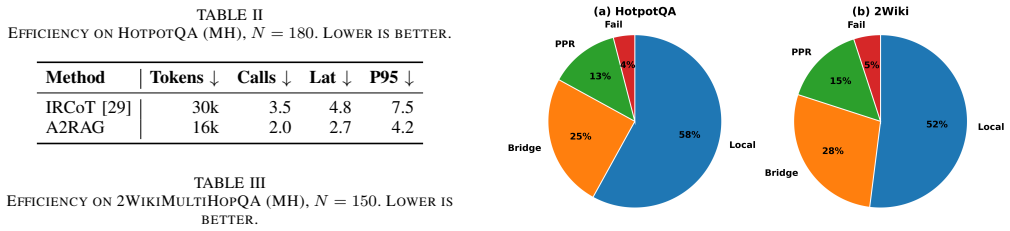
The central claim is that retrieval for multihop questions should be a controlled escalation process rather than a fixed pipeline: start with the local neighborhood of query entities; if evidence is insufficient, search for compact bridge nodes that connect multiple seeds; only if that fails, run global personalized-PageRank diffusion and map the top-scoring graph nodes back to the original text chunks. This policy lets an easy query stop after a cheap local stage, lets a medium-hard query discover mid-range connectors, and reserves global diffusion plus text recovery for hard or lossy-graph cases. The reported evidence-level result is that this design raises small-budget evidence recall by
What carries the argument
The carrying mechanism is the agentic retriever's monotonic escalation hierarchy—local 1-hop expansion, then K-hop bridge discovery, then a degree-normalized Personalized PageRank fallback—where each stage runs a sufficiency check before escalating, plus a provenance map-back function π that returns the source chunks for high-scoring graph nodes. The escalation policy provides controllability and cost-awareness, and the map-back is the step that recovers fine-grained qualifiers lost during graph extraction. On top, the adaptive control loop (a coverage gate, a Triple-Check verification of relevance, grounding, and query adequacy, and failure-aware query rewriting with bounded retries) decide
Load-bearing premise
The framework assumes that even when a knowledge graph misses fine-grained details, its connectivity structure—who connects to whom—is largely correct, so graph-based routing will point to the right source regions; if extraction produces fragmented or spurious edges, the escalation chain effectively becomes flat text retrieval and the reported recall and cost advantages would not transfer.
What would settle it
Take a multihop QA set and rewire a percentage of knowledge-graph edges while preserving degree distribution and leaving the text corpus untouched; if A2RAG's Recall@2 remains near its reported level rather than falling toward the text-only baseline, the claim that structural routing drives the gain is falsified. A more targeted version deletes only nodes whose mentions carry numeric or temporal qualifiers and checks whether the provenance map-back still recovers the missing facts.
If this is right
- Easy queries, which the authors observe can be the majority, terminate after local expansion and avoid paying for global operations.
- Because final evidence is always text sourced through map-back, answers stay auditable even when the knowledge graph omits numeric or temporal qualifiers.
- Under simulated random graph deletion, evidence recall degrades more gracefully than graph-only retrieval and remains above text-only retrieval until the graph becomes very sparse.
- The efficiency gain comes from replacing repeated LLM prompting with bounded graph-native actions: only a minority of queries ever reach global diffusion.
- Aligning query relation phrases to edge types (relation seeding) contributes a large part of the recall gain, especially at small evidence budgets.
Where Pith is reading between the lines
- The paper itself states that public-benchmark experiments run on 200-question subsets, so the quantitative gains are best read as proof-of-mechanism until full-dataset runs are reported.
- The stage-termination distribution suggests a learned difficulty classifier could predict the terminal stage from the query text, potentially allowing the controller to skip even the local stage for a large fraction of questions.
- Random deletion is the paper's robustness test; a harder test would delete exactly the qualifier-bearing nodes and edges that motivate map-back, to see whether the claimed resilience narrows.
- If the reported roughly 60/40 easy-to-hard workload split generalizes, retrieval budgets could be tiered proportionally, allocating most resources to bridge and global stages only for the hard tail.
Editorial analysis
A structured set of objections, weighed in public.
Referee Report
Summary. The paper proposes A2RAG, an adaptive and agentic GraphRAG framework that couples a closed-loop controller (gating, Triple-Check verification, failure-aware rewriting) with a progressive retriever (local 1-hop, bridge discovery, PPR-based global fallback, and provenance map-back). The authors claim that A2RAG improves Recall@2 substantially (abstract: +9.9/+11.8 absolute gains over iterative baselines such as IRCoT) and reduces token usage and latency by about 50%, based on experiments on 200-question subsets of HotpotQA and 2WikiMultiHopQA plus an unreported production dataset.
Significance. If the stated retrieval and cost gains are reproducible, the A2RAG design is a valuable engineering contribution: it provides a concrete, termination-guaranteed escalation policy for graph-based retrieval and a principled map-back mechanism for coping with extraction loss. The framework is clearly described and the efficiency story is mechanistically plausible. However, as written, the manuscript does not substantiate the headline Recall@2 gain over IRCoT, the main results lack error bars or significance tests, and the production-dataset claim is not documented. These gaps currently prevent the paper from supporting its central contribution, but they are fixable within the manuscript's scope.
major comments (5)
- [Abstract, §I, §IV-B, Tables I–III] The central claim of +9.9/+11.8 absolute Recall@2 gains 'relative to iterative multihop baselines such as IRCoT' is never directly reported. Table I reports Recall@2 only for NoRAG, Naive RAG, and LightRAG; IRCoT appears only in Tables II/III, which contain token counts, LLM calls, and latency but no Recall@2. The largest Recall@2 gap in Table I is +5.6/+6.2 over LightRAG(mix), not +9.9/+11.8. The authors must supply the IRCoT Recall@2 values on the same 200-question subsets, with identical chunking and gold-evidence mapping, or revise the claim accordingly. This is the paper's primary quantitative evidence for retrieval effectiveness and cannot be left implicit.
- [§IV-A, Table I] All headline numbers come from 200-question subsets with no error bars, confidence intervals, or significance tests. A 5–6 point Recall@2 difference on 200 instances is plausibly within sampling variability. The authors should report variance across bootstrap samples or multiple seeds, and for the main comparisons provide a significance test or interval. Without this, it is not possible to know whether A2RAG is actually superior to LightRAG, nor whether the abstract's claimed margins are real.
- [§IV-B, 'Production-level Dataset' paragraph] The production-dataset result — approximately 15% Recall@5 improvement over LightRAG(mix), and 67.7 vs 46.5 under 20% KG node/edge removal — is stated without any methodology: no dataset size, query count, sampling procedure, indexing details, or evaluation protocol. Since this dataset is used to motivate the two 'challenges' in the introduction, the claim must be documented (or moved to clearly labeled preliminary observations) before it can be weighed as evidence.
- [§III-B.2, §IV-A.3] The Triple-Check validators (Vrel, Vgrd, Vans) are implemented with the same backbone LLM (gpt-4o-mini) that generates the candidate answer and performs rewriting. This creates a self-confirmation risk for the acceptance/rewrite loop: the verifier may be biased toward its own generations. The paper mentions that NLI models are possible, but does not report which instantiation was used or provide any calibration/agreement analysis. Please report validator details and, ideally, validate a sample against an external judge or NLI model to ensure the verification loop is meaningful.
- [§I Challenge 2, §IV-F, §IV-G] The framework's robustness to extraction loss rests on the assumption that 'even when fine-grained details are missing, the graph's connectivity structure is often largely correct' (Section I). The only stress test (Figure 5/6) deletes random nodes/edges. Random deletion does not model the fragmented or spuriously connected graphs produced by imperfect extraction — the very situation the motivation describes. The paper explicitly acknowledges in Section IV-G that A2RAG assumes a 'minimally informative graph backbone.' A targeted robustness test (e.g., adding spurious edges, merging/splitting alias nodes, or missing bridge nodes) is needed to validate the central design principle. Without it, the map-back component's advantage over flat text retrieval under realistic extraction errors is not established.
minor comments (4)
- [§IV-C, Tables II/III] The tables show 'Lat↓ P95↓' but the text says 'mean latency (P95 ...)'. Please clarify the units and the exact definition of P95, and state how the mean and tail were computed across queries.
- [Figures 1–3] The framework diagrams are referenced but appear to be placeholders in the text; please ensure the figures are included and legible, with call-outs that explain the flow.
- [§I] Several phrases have spacing/formatting errors, e.g., 'the systemalwaysapplies complex retrieval' and 'anadaptive-and-agentic'. Please copy-edit.
- [§IV-G] The limitations paragraph is honest, but the 'production-level' dataset remains undescribed; please add a separate data/appendix subsection with full details.
Circularity Check
No significant circularity: the core retrieval gains are empirical comparisons against external benchmarks; the abstract's IRCoT Recall@2 numbers are missing from the tables, which is a reporting gap rather than a circular reduction.
full rationale
A2RAG's claimed contribution is empirical: it defines a fixed retrieval pipeline (gated controller, local-to-bridge-to-PPR escalation, provenance map-back) and measures EM/F1 and Recall@K on HotpotQA and 2WikiMultiHopQA. No quantity is obtained by fitting a parameter to the target metric, and no equation makes a predicted output equal to an input by construction. The headline +9.9/+11.8 Recall@2 gains over 'iterative multihop baselines such as IRCoT' are not actually present in Table I: IRCoT appears only in the efficiency comparison (Tables II/III), where Recall@2 is not reported. This is a serious verifiability/completeness problem, but it is not circularity. The use of the same backbone LLM for generation and possibly for the Triple-Check validators introduces a mild self-confirmation risk, but it does not make the results true by definition. Several references are self-citations [2,5,6,9,20], but none supplies a load-bearing theoretical premise or uniqueness theorem for the central public-benchmark results. The paper explicitly discloses its limitations (subsets, seed sensitivity, graph-backbone assumption), so the empirical claims are externally checkable rather than definitionally forced. No circular step is established under the required standard.
Axiom & Free-Parameter Ledger
free parameters (7)
- τ_g (gating threshold) =
not reported
- I_max (max retry rounds) =
2–3
- K (bridge hop budget) =
not reported (K ≥ 2)
- α (PPR teleport probability) =
not reported
- top-L (PPR map-back nodes) =
not reported
- entity/relation seed matching thresholds =
high-confidence only
- LLM prompts for TripleCheck/Rewrite =
not provided
axioms (5)
- domain assumption The knowledge graph's connectivity structure is largely correct even when fine-grained details are missing.
- domain assumption Offline map-back function π is available and covers the provenance chunks that contain gold evidence.
- domain assumption TripleCheck validators (NLI/LLM) reliably assess relevance, grounding, and adequacy.
- standard math Personalized PageRank fixed point r = αp0 + (1−α)P^T r exists and is computed accurately.
- domain assumption The 200-question sampled subsets are representative of the full benchmarks and of the production workload.
read the original abstract
Graph Retrieval-Augmented Generation (Graph-RAG) enhances multihop question answering by organizing corpora into knowledge graphs and routing evidence through relational structure. However, practical deployments face two persistent bottlenecks: (i) mixed-difficulty workloads where one-size-fits-all retrieval either wastes cost on easy queries or fails on hard multihop cases, and (ii) extraction loss, where graph abstraction omits fine-grained qualifiers that remain only in source text. We present A2RAG, an adaptive-and-agentic GraphRAG framework for cost-aware and reliable reasoning. A2RAG couples an adaptive controller that verifies evidence sufficiency and triggers targeted refinement only when necessary, with an agentic retriever that progressively escalates retrieval effort and maps graph signals back to provenance text to remain robust under extraction loss and incomplete graphs. Experiments on HotpotQA and 2WikiMultiHopQA demonstrate that A2RAG achieves +9.9/+11.8 absolute gains in Recall@2, while cutting token consumption and end-to-end latency by about 50% relative to iterative multihop baselines.
Figures



Forward citations
Cited by 2 Pith papers
-
RAIDS: Rethinking Data Systems as Responsible Intelligent Infrastructure
RAIDS proposes making responsibility an execution-level property in data systems via composable operator contracts and a preservation objective.
-
LARGER: Lexically Anchored Repository Graph Exploration and Retrieval
LARGER boosts file localization accuracy for repository-level coding agents by integrating lexically anchored graph expansion directly into standard search loops, yielding gains of up to 13.9 points on LocBench.
Reference graph
Works this paper leans on
-
[1]
Palm: Scal- ing language modeling with pathways,
A. Chowdhery, S. Narang, J. Devlin, M. Bosma, G. Mishra, A. Roberts, P. Barham, H. W. Chung, C. Sutton, S. Gehrmannet al., “Palm: Scal- ing language modeling with pathways,”Journal of Machine Learning Research, vol. 24, no. 240, pp. 1–113, 2023
2023
-
[2]
Graphy’our data: Towards end-to-end modeling, exploring and generating report from raw data,
L. Lai, C. Luo, Y . Lou, M. Ju, and Z. Yang, “Graphy’our data: Towards end-to-end modeling, exploring and generating report from raw data,” inCompanion of the 2025 International Conference on Management of Data, 2025, pp. 147–150
2025
-
[3]
CodeT5+: Open code large language models for code understanding and generation,
Y . Wang, H. Le, A. Gotmare, N. Bui, J. Li, and S. Hoi, “CodeT5+: Open code large language models for code understanding and generation,” in Proceedings of the 2023 Conference on Empirical Methods in Natural Language Processing. Association for Computational Linguistics, 2023
2023
-
[4]
Learning transferable visual models from natural language supervi- sion,
A. Radford, J. W. Kim, C. Hallacy, A. Ramesh, G. Goh, S. Agarwal, G. Sastry, A. Askell, P. Mishkin, J. Clark, G. Krueger, and I. Sutskever, “Learning transferable visual models from natural language supervi- sion,” inProceedings of the 38th International Conference on Machine Learning, ser. Proceedings of Machine Learning Research, vol. 139. PMLR, 2021, p...
2021
-
[5]
Tabular-textual question answering: From parallel program generation to large language models,
X. Tang, L. Chen, W. Yang, Z. Yang, M. Ju, X. Shu, Z. Yang, and Y . Tang, “Tabular-textual question answering: From parallel program generation to large language models,”World Wide Web, vol. 28, no. 4, p. 42, 2025
2025
-
[6]
An experimental evaluation of llm on image classification,
J. Wu, X. Tang, Z. Yang, K. Hao, L. Lai, and Y . Liu, “An experimental evaluation of llm on image classification,” inAustralasian Database Conference, 2024, pp. 506–518
2024
-
[7]
Chain-of-thought prompting elicits reasoning in large language models,
J. Wei, X. Wang, D. Schuurmans, M. Bosma, B. Ichter, F. Xia, E. H. Chi, Q. V . Le, and D. Zhou, “Chain-of-thought prompting elicits reasoning in large language models,” inAdvances in Neural Information Processing Systems (NeurIPS), 2022
2022
-
[8]
React: Synergizing reasoning and acting in language models,
S. Yao, J. Zhao, D. Yu, N. Du, I. Shafran, K. R. Narasimhan, and Y . Cao, “React: Synergizing reasoning and acting in language models,” inInternational Conference on Learning Representations (ICLR), 2023
2023
-
[9]
Machine learning methods in weather and climate applications: A survey,
L. Chen, B. Han, X. Wang, J. Zhao, W. Yang, and Z. Yang, “Machine learning methods in weather and climate applications: A survey,”Applied Sciences, vol. 13, no. 21, p. 12019, 2023
2023
-
[10]
A survey on hallucination in large language models: Principles, taxonomy, challenges, and open questions,
L. Huang, W. Yu, W. Ma, W. Zhong, Z. Feng, H. Wang, Q. Chen, W. Peng, X. Feng, B. Qin, and T. Liu, “A survey on hallucination in large language models: Principles, taxonomy, challenges, and open questions,” 2023
2023
-
[11]
Retrieval-augmented generation for knowledge-intensive NLP tasks,
P. Lewis, E. Perez, A. Piktus, F. Petroni, V . Karpukhin, N. Goyal, H. K ¨uttler, M. Lewis, W. Yih, T. Rockt ¨aschel, S. Riedel, and D. Kiela, “Retrieval-augmented generation for knowledge-intensive NLP tasks,” in Advances in Neural Information Processing Systems (NeurIPS), 2020
2020
-
[12]
Retrieval-augmented generation for large language models: A survey,
Y . Gao, Y . Xiong, X. Gao, K. Jia, J. Pan, Y . Bi, Y . Dai, J. Sun, M. Wang, and H. Wang, “Retrieval-augmented generation for large language models: A survey,” 2023
2023
-
[13]
Dense passage retrieval for open-domain question answer- ing,
V . Karpukhin, B. Oguz, S. Min, P. Lewis, L. Wu, S. Edunov, D. Chen, and W. Yih, “Dense passage retrieval for open-domain question answer- ing,” inProceedings of the 2020 Conference on Empirical Methods in Natural Language Processing (EMNLP). Association for Computa- tional Linguistics, 2020, pp. 6769–6781
2020
-
[14]
Leveraging passage retrieval with genera- tive models for open domain question answering,
G. Izacard and E. Grave, “Leveraging passage retrieval with genera- tive models for open domain question answering,” inProceedings of the 16th Conference of the European Chapter of the Association for Computational Linguistics (EACL), 2021
2021
-
[15]
From local to global: A graph RAG approach to query- focused summarization,
D. Edge, H. Trinh, N. Cheng, J. Bradley, A. Chao, A. Mody, S. Truitt, and J. Larson, “From local to global: A graph RAG approach to query- focused summarization,”CoRR, vol. abs/2404.16130, 2024
Pith/arXiv arXiv 2024
-
[16]
Graph retrieval-augmented generation: A survey,
B. Peng, Y . Zhu, Y . Liu, X. Bo, H. Shi, C. Hong, Y . Zhang, and S. Tang, “Graph retrieval-augmented generation: A survey,” 2025
2025
-
[17]
Graph chain-of-thought: Augmenting large language models by reasoning on graphs,
B. Jin, C. Xie, J. Zhang, K. K. Roy, Y . Zhang, Z. Li, R. Li, X. Tang, S. Wang, Y . Meng, and J. Han, “Graph chain-of-thought: Augmenting large language models by reasoning on graphs,” inFindings of the Association for Computational Linguistics: ACL 2024, 2024
2024
-
[18]
Scaling graph chain-of-thought reasoning: A multi-agent framework with efficient llm serving,
C. Huan, Z. Meng, Y . Liu, Z. Yang, Y . Zhu, Y . Yun, S. Li, R. Gu, X. Wu, H. Zhang, C. Hong, S. Ma, G. Chen, and C. Tian, “Scaling graph chain-of-thought reasoning: A multi-agent framework with efficient llm serving,” 2025
2025
-
[19]
Lightrag: Simple and fast retrieval-augmented generation,
Z. Guo, L. Xia, Y . Yu, T. Ao, and C. Huang, “Lightrag: Simple and fast retrieval-augmented generation,” inFindings of the Conference on Empirical Methods in Natural Language Processing (EMNLP), 2025
2025
-
[20]
Aefa: An ensemble framework for fraud detection in the forex market,
W. Wang, J. Yu, Z. Yang, M. Ju, S. Yu, J. Wu, L. Liu, Y . Liu, J. Shepherd, and W. Zhang, “Aefa: An ensemble framework for fraud detection in the forex market,” inInternational Conference on Advanced Data Mining and Applications, 2025, pp. 34–49
2025
-
[21]
Hotpotqa: A dataset for diverse, explainable multi-hop question answering,
Z. Yang, P. Qi, S. Zhang, Y . Bengio, W. W. Cohen, R. Salakhutdinov, and C. D. Manning, “Hotpotqa: A dataset for diverse, explainable multi-hop question answering,” inProceedings of EMNLP, 2018
2018
-
[22]
Constructing a multi-hop qa dataset for comprehensive evaluation of reasoning steps,
X. Ho, A.-K. D. Nguyen, S. Sugawara, and A. Aizawa, “Constructing a multi-hop qa dataset for comprehensive evaluation of reasoning steps,” inProceedings of COLING, 2020
2020
-
[23]
Adaptive-rag: Learning to adapt retrieval-augmented large language models through question complexity,
S. Jeong, J. Baek, S. Cho, S. J. Hwang, and J. C. Park, “Adaptive-rag: Learning to adapt retrieval-augmented large language models through question complexity,” inProceedings of the 2024 Conference of the North American Chapter of the Association for Computational Linguis- tics: Human Language Technologies (NAACL), 2024
2024
-
[24]
Self-rag: Learning to retrieve, generate, and critique through self-reflection,
A. Asai, Z. Wu, Y . Wang, A. Sil, and H. Hajishirzi, “Self-rag: Learning to retrieve, generate, and critique through self-reflection,”arXiv preprint arXiv:2310.11511, 2023
Pith/arXiv arXiv 2023
-
[25]
Adaptive retrieval-augmented generation for conversational systems,
X. Wang, P. Sen, R. Li, and E. Yilmaz, “Adaptive retrieval-augmented generation for conversational systems,”Findings of the Association for Computational Linguistics: NAACL 2025, 2025
2025
-
[26]
P. L. Mufei Li, Siqi Miao, “Simple is effective: The roles of graphs and large language models in knowledge-graph-based retrieval-augmented generation,”arXiv preprint arXiv:2410.20724, 2024
Pith/arXiv arXiv 2024
-
[27]
The pagerank citation ranking: Bringing order to the web,
L. Page, S. Brin, R. Motwani, and T. Winograd, “The pagerank citation ranking: Bringing order to the web,” Stanford Digital Library Technolo- gies Project, Tech. Rep. 1999-66, 1999
1999
-
[28]
Topic-sensitive pagerank,
T. H. Haveliwala, “Topic-sensitive pagerank,” inProceedings of the 11th International Conference on World Wide Web (WWW), 2002
2002
-
[29]
Interleav- ing retrieval with chain-of-thought reasoning for knowledge-intensive multi-step questions,
H. Trivedi, N. Balasubramanian, T. Khot, and A. Sabharwal, “Interleav- ing retrieval with chain-of-thought reasoning for knowledge-intensive multi-step questions,” inProceedings of the 61st Annual Meeting of the Association for Computational Linguistics (ACL), 2023
2023
-
[30]
From louvain to leiden: guaranteeing well-connected communities,
V . A. Traag, L. Waltman, and N. J. van Eck, “From louvain to leiden: guaranteeing well-connected communities,”Scientific Reports, vol. 9, no. 1, p. 5233, 2019
2019
discussion (0)
Sign in with ORCID, Apple, or X to comment. Anyone can read and Pith papers without signing in.