REVIEW 4 major objections 3 minor 78 references
Quantum-statistical transport phenomena in memristive computing architectures
T0 review · 4 major / 3 minor · reviewed 2026-08-14 · deepseek-v4-flash
Pith's one-line read This paper argues that the variability of memristive devices is a quantum effect: coherent electron waves in disordered oxides set a fundamental lower bound on how reliably these memories can be programmed.
desk verdict A serious, well-contextualized quantum-disorder framework for memristor variability, but the quantum-limit claim is conditional on an unmeasured L_phi ~ L and the data do not yet distinguish it from classical disorder. read the letter →
The pith
A machine-rendered reading of the paper's core claim, the machinery that carries it, and where it could break.
The reading
What carries the argument
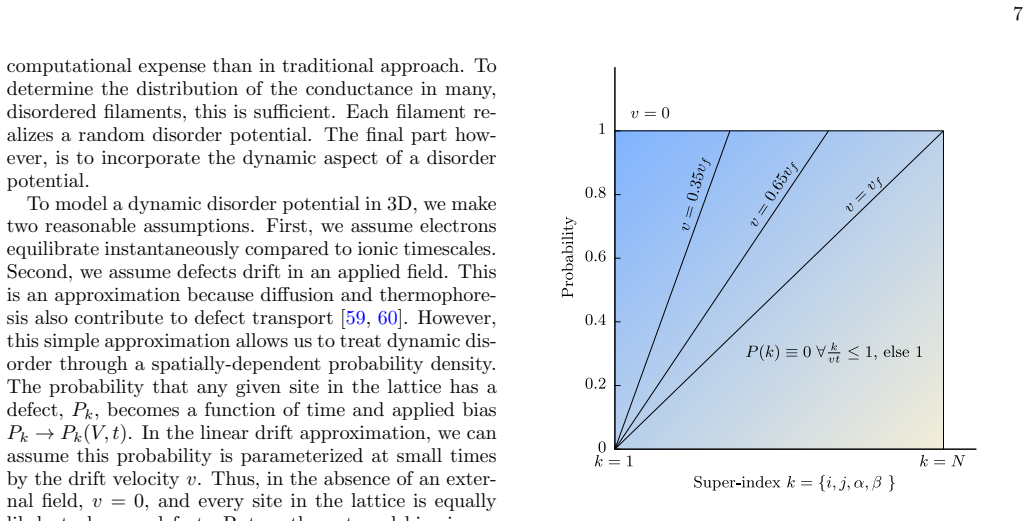
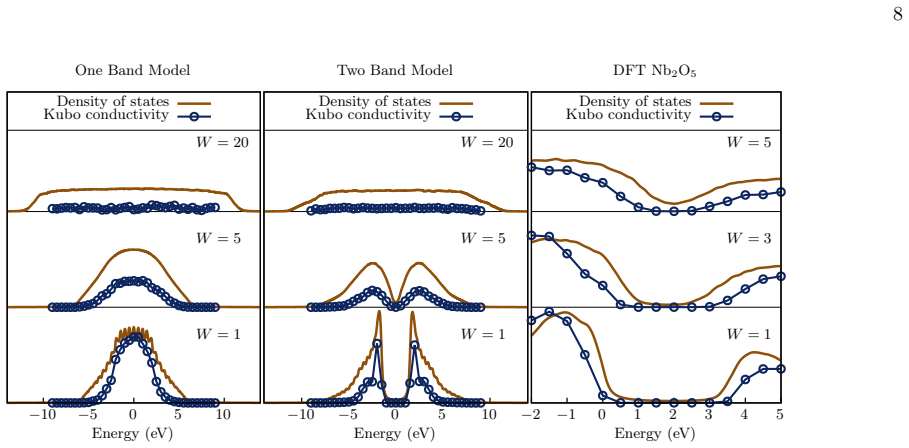
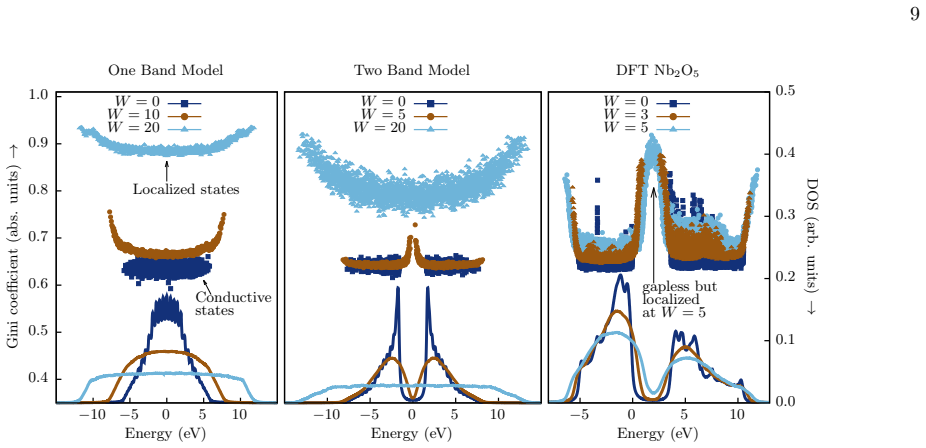
The machinery is a disordered tight-binding Hamiltonian $H = H_t + H_s + H_h$ whose kinetic part comes from first-principles electronic structure and whose disorder is a random potential of width $W$; transport is computed with a finite-size Kubo conductivity formula, with the velocity matrix elements carrying the interference effects. Dynamic disorder is implemented by making the site-defect probability $P_k(V,t)$ drift with an ionic velocity $v$, so the Hamiltonian becomes bias- and time-dependent without simulating ionic motion. The quantitative anchor is the universal conductance-fluctuation result for phase-coherent disordered conductors: when $L \to L_\phi$, conductance is log-normally distributed with normalized variance $\sigma \approx 2/(3\langle g\rangle)$. A Gini-coefficient metric built on the eigenstate-coupling matrix $\varphi_{mn} = \sum_r |\langle m|r\rangle\langle r|n\rangle|^2$ is used to identify which mid-gap states are transport-silent, locating the mobility edge in the disordered oxide.
What would settle it
Measure $L_\phi$ directly in the active oxide layer, for example through the magnetoconductance signature of weak localization, and compare it with the transport length: if $L_\phi$ is much smaller at operating temperature, the quantum variance bound is not operative. A complementary test is to sweep the mean conductance $\langle g \rangle$ of a device population and check whether $\mathrm{Var}(\log g)$ tracks $2/(3\langle g\rangle)$; a clear departure would indicate classical filament or percolation statistics dominate.
Extended reading notes
Core claim
The central claim is that phase-coherent electron transport in disordered oxides, not classical defect dynamics alone, determines the conductance statistics and switching behavior of memristive devices. Filamentary devices are modeled as quasi-one-dimensional quantum wires with dynamic disorder: because the transport length approaches the phase-coherence length, their conductance follows the universal log-normal distribution of disordered media, and the normalized variance obeys $\sigma \approx 2/(3\langle g\rangle)$. Non-filamentary devices differ only in dimensionality: in three-dimensional amorphous niobium oxide, disorder localizes mid-gap states, so the turn-on voltage is set by the mobility edge and hysteresis appears when the disorder potential itself drifts under bias. This unified framework leads the authors to conclude that there is a fundamental quantum limit on the reliability of memristive devices, and that the intrinsic stochasticity of these devices is an unavoidable consequence of electron coherence at the nanoscale.
Load-bearing premise
The argument stands or falls on whether the electron phase-coherence length $L_\phi$ is actually comparable to the device transport length; the paper infers this indirectly from temperature trends, but if $L_\phi$ is much shorter than the transport path, transport is effectively classical and the universal log-normal bound does not apply.
Editorial extensions
If this is right
- In filamentary RRAMs, variability cannot be engineered away below the quantum bound; reducing $\sigma$ requires making the phase-coherence length short compared with the transport length, for example by increasing inelastic scattering.
- Device-to-device and cycle-to-cycle variability should follow the same statistical law, because both are instantiations of the same disorder ensemble; one device cycled many times can therefore predict population-level yield.
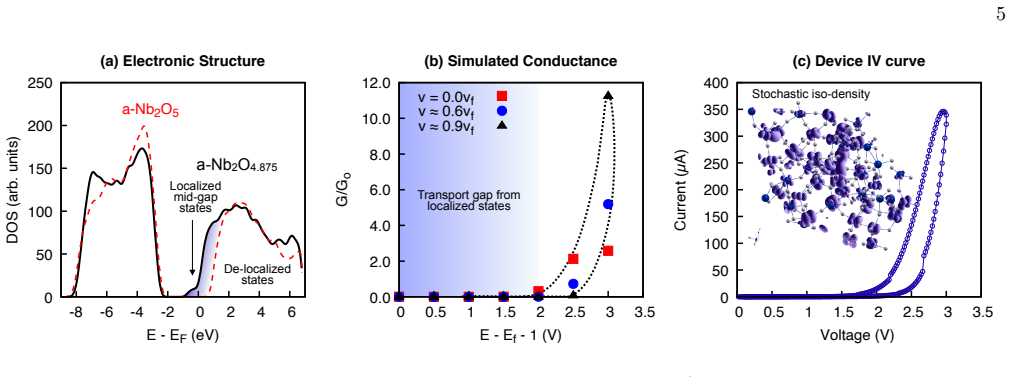
- Hysteretic switching does not require a physical filament: in non-filamentary systems, dynamic disorder plus a mobility edge produces multiple conductance states at one bias, so turn-on voltage is a localization quantity.
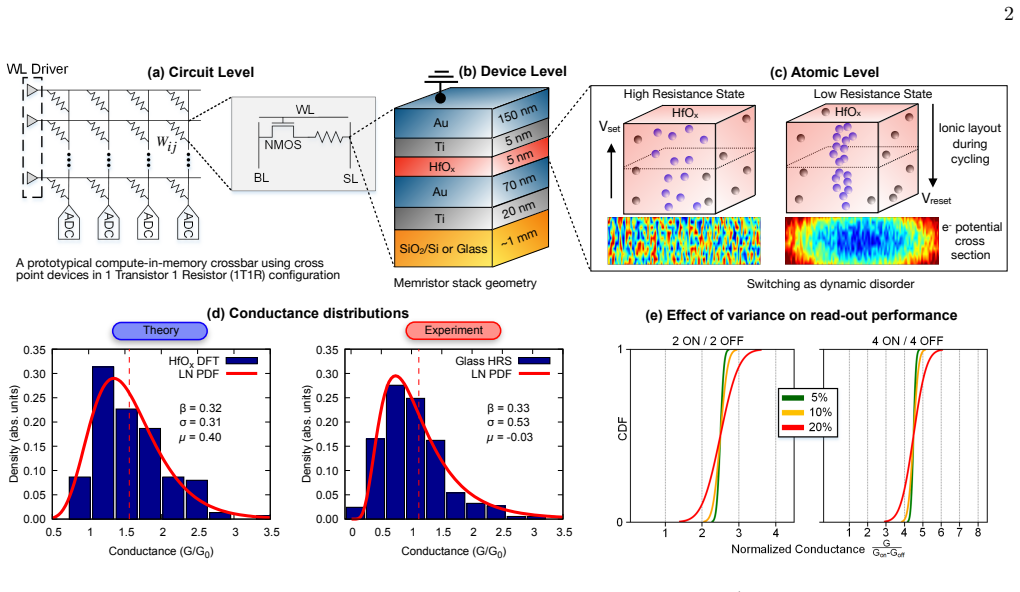
- Crossbar read accuracy degrades as more devices contribute to a column sum, because the intrinsic quantum variance accumulates; this connects a single-device quantum property to compute-in-memory reliability.
- The unavoidable stochasticity can be repurposed: a neural network whose synaptic weights are drawn from a log-normal distribution with variance tied to mean conductance is a concrete, biologically inspired design enabled by this physics.
Reading between the lines
- If the paper is right, conductance variance across different device materials, temperatures, and device sizes should collapse onto a universal curve when plotted against mean conductance; measuring a clear departure would separate quantum from classical contributions.
- A direct experimental test follows from temperature: because heating shrinks $L_\phi$, the paper's logic predicts cryogenic operation should increase variance through longer phase coherence; a dedicated variance-versus-temperature study on hafnia would settle this.
- The dynamic-disorder Kubo machinery could be reused for other ionic systems, such as electrochemical metallization cells, and would imply that hysteresis should appear in any disordered solid with bias-accessible metastable configurations—a broad, testable generalization.
- If the quantum limit is real, stochastic-computing designers could tune the disorder strength $W$ or the temperature to set the noise level of a memristive synapse deliberately, making the apparent variability a design parameter.
Signed reviews
Editorial analysis
A structured set of objections, weighed in public.
Referee Report
Summary. The paper proposes a quantum-statistical framework for transport variability in memristive devices, treating filamentary HfOx and non-filamentary Nb2O5-x as disordered Anderson systems. Using DFT-derived tight-binding Hamiltonians with stochastic disorder potentials and a finite-size Kubo formula, the authors predict log-normal conductance distributions for filamentary devices and dynamic-disorder-induced hysteresis for non-filamentary devices. They claim that electron phase coherence sets a fundamental lower bound on memristive variability, with circuit-level consequences for compute-in-memory architectures.
Significance. If established, the central claim would be significant: it would connect a long-standing device-engineering problem, cycle-to-cycle and device-to-device conductance variability, to universal phase-coherent transport in disordered media, and would give a concrete design rule (control of L_phi relative to L) for mitigating variability. The paper has genuine strengths: the kinetic Hamiltonian is constructed from first-principles electronic structure, the Kubo-formula implementation is benchmarked against a known Anderson localization transition, and the experimental conductance histograms are presented directly. These strengths make the framework worth taking seriously. However, the central identification of log-normality with quantum interference, and the quantitative lower-bound claim, are not yet supported by the evidence presented; both require additional experimental or theoretical input before the headline conclusion can be accepted.
major comments (4)
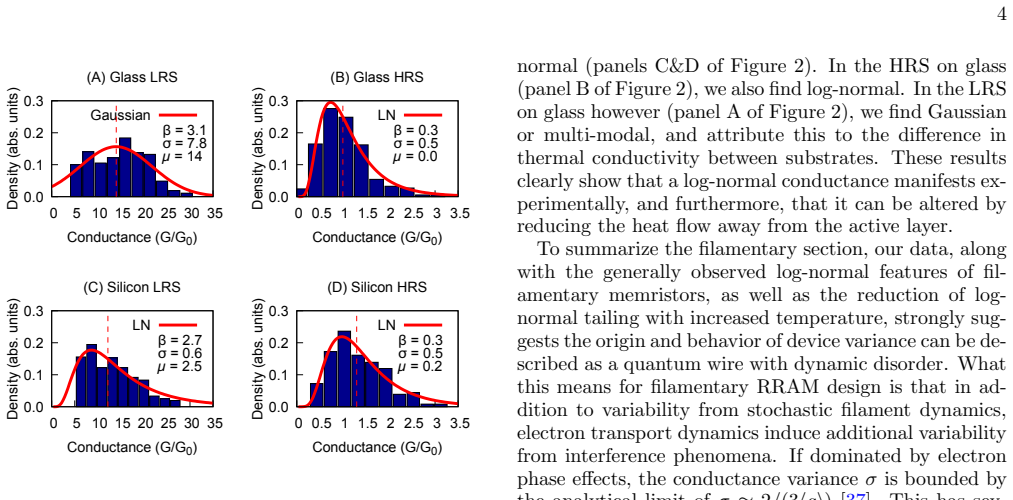
- [Section III, p. 3] The entire phase-coherence argument hinges on the conditional statement in Section III that 'if the transport length L approaches the phase coherence length L_phi, the transmission probability for electrons will approach a universal distribution,' but no measurement or quantitative estimate of L_phi is provided for the HfOx stacks studied. The cited substrate- and temperature-dependent trends from other groups are suggestive, but they do not establish L_phi ~ L in these devices; if L_phi is much shorter than the ~5 nm active layer, transport is effectively incoherent and the universal log-normal distribution and the variance bound sigma ~ 2/(3<g>) do not apply. This is the load-bearing assumption for the paper's central claim, so it must be addressed, ideally by an experimental estimate of L_phi or by a direct phase-coherence probe such as universal conductance fluctuation measurements.
- [Section III, Figs. 1d and 2] The paper never compares the fitted log-normal parameters with the quoted theoretical bound sigma ~ 2/(3<g>) [37]. The fits in Figure 2 report sigma values (e.g., sigma = 0.5 for Glass HRS and sigma = 0.6 for Silicon LRS) and mu values, but no evaluation of <g> and no statement of whether the observed sigma is above, below, or consistent with the bound is given. Without this quantitative comparison, the assertion that observed variability sits near a fundamental quantum limit is not demonstrated even under the assumed L ~ L_phi condition.
- [Section IV, Fig. 3b] The non-filamentary hysteresis result rests on conductance values averaged over only five disorder realizations at W = 3 eV, with no error bars shown. The claim that 'dynamic disorder gives rise to multiple conductance states at a given energy' requires that the spread between the v/v_f = 0.6 and 0.9 curves exceed the statistical uncertainty of the disorder average; with five realizations this is not established. The comparison with the experimental IV curve in panel c is therefore qualitative.
- [Section III, discussion of trap-assisted tunneling] Log-normal conductance is not a unique signature of phase-coherent transport, and the manuscript itself cites trap-assisted tunneling as a classical mechanism that also yields log-normal behavior. The paper does not provide a discriminating test—e.g., magnetoconductance correlations, UCF amplitude vs. sample size, or an explicit L_phi measurement—so the identification of the observed log-normal distributions as quantum interference is underdetermined. This degeneracy should be acknowledged and broken by a direct experimental prediction.
minor comments (3)
- [Figure 1d] The parameters alpha, beta, and mu printed in the legend of Figure 1d are not defined in the caption or in the text; please define them and state whether they correspond to the log-normal/Gaussian expression used in Section III.
- [Section V A] The results depend on the choice of disorder width W and normalized defect velocity v/v_f; the manuscript calibrates the maximum W against the FWHM of the Hartree potential from twenty AIMD quenches, but it should report how sensitive Figures 1d and 3b are to W and v/v_f, since these are the main free parameters.
- [Section VI] The phrase 'quantum non-determinism' in Section VI overstates the case: the conductance fluctuations described are deterministic functions of the disorder realization, not fundamentally non-deterministic; this wording should be softened.
Circularity Check
Non-filamentary hysteresis is inserted via bias-dependent disorder rather than derived; the filamentary quantum-limit claim is externally grounded and not circular.
-
self definitional
[Section IV (Fig. 3b) and Section V A (Eq. 5 and calibration of vf)]
"By assuming a greater vacancy transport (disorder potential redistribution), a single operating bias can have multiple conductance states. ... To implement this approach, one chooses an arbitrary measurement time and a velocity. This defines the disorder potential. ... We calibrate a limiting velocity vf by the equilibration times for IV curves in our a-Nb2O5−x devices."
The Hamiltonian in Eq. (5) is explicitly constructed to be bias/time dependent: H(V,t) = Ht + sum Θ P(V,t), with P(V,t) fixed by a chosen drift velocity v. The simulated conductance is Eq. (6) evaluated at hand-selected v/vf values (with vf calibrated from the same devices' IV equilibration times). Therefore the appearance of multiple conductance states at a single bias is an input of the model, not an output of the quantum transport calculation. The claim that "dynamic disorder gives rise to multiple conductance states" restates the model construction rather than predicting hysteresis from first principles.
full rationale
The filamentary analysis is largely self-contained: the DFT-derived kinetic Hamiltonian and the disorder strength W calibrated from Hartree-potential distributions are independent of the conductance histograms, the log-normal fits are descriptive, and the variance bound sigma ~ 2/(3<g>) and universal log-normal character are imported from external published theory (Nieuwenhuizen/van Rossum, Abrikosov), not from self-citation. The unmeasured L ~ L_phi premise is an evidential gap, not circularity. The one genuine construction-reduction is the non-filamentary hysteresis: the model achieves multiple conductance states by explicitly parametrizing the disorder potential by a bias-dependent drift velocity, so the simulated hysteretic spread is effectively put in by hand. Overall, the central "quantum limit on reliability" claim retains independent content, but one of the two headline phenomena (hysteresis in non-filamentary devices) is partially self-definitional.
Assumptions & free parameters
free parameters (4)
- Disorder strength W =
3 eV and 5 eV for Nb2O5-x; HfOx value deferred to supplement
- Normalized defect velocity v/v_f =
0, 0.6, 0.9
- Log-normal and Gaussian fit parameters (mu, sigma, beta) =
For example, mu=0.0, sigma=0.5, beta=0.3 for glass HRS
- Limiting ion velocity v_f =
3 nm/s
assumptions (6)
- domain assumption Electrons equilibrate instantaneously compared with ionic timescales.
- domain assumption Defect drift is linear and diffusion and thermophoresis are neglected.
- ad hoc to paper Uniform random disorder potential of width W centered at zero adequately represents amorphous oxide disorder.
- domain assumption Transport length L approaches phase coherence length L_phi in the active layers.
- domain assumption Ergodic hypothesis maps device-to-device and cycle-to-cycle variability to the same disorder ensemble.
- standard math Finite-size Kubo formula with eigenstate velocity matrix elements captures the Anderson localization transition.
Cite this review
Pith. "Pith review of Quantum-statistical transport phenomena in memristive computing architectures." pith.science (2026). https://pith.science/paper/R2MFVXLP
@misc{pith2026190808070,
  author       = {Pith},
  title        = {Pith review of: Quantum-statistical transport phenomena in memristive computing architectures},
  year         = {2026},
  howpublished = {\url{https://pith.science/paper/R2MFVXLP}},
  note         = {Machine review of arXiv:1908.08070}
}
read the original abstract
The advent of reliable, nanoscale memristive components is promising for next generation compute-in-memory paradigms, however, the intrinsic variability in these devices has prevented widespread adoption. Here we show coherent electron wave functions play a pivotal role in the nanoscale transport properties of these emerging, non-volatile memories. By characterizing both filamentary and non-filamentary memristive devices as disordered Anderson systems, the switching characteristics and intrinsic variability arise directly from the universality of electron transport in disordered media. Our framework suggests localization phenomena in nanoscale, solid-state memristive systems are directly linked to circuit level performance. We discuss how quantum conductance fluctuations in the active layer set a lower bound on device variability. This finding implies there is a fundamental quantum limit on the reliability of memristive devices, and electron coherence will play a decisive role in surpassing or maintaining Moore's Law with these systems.
Figures
Figures from the paper (3 more)
Reference graph
Works this paper leans on
-
[37]
S. Datta, Electronic Transport in Mesoscopic Systems , Cambridge Studies in Semiconductor Physics and Mi- croelectronic Engineering (Cambridge University Press, 1995)
work page 1995
-
[1]
Basic quantum properties of disordered systems at the nanoscale are an immutable source of variabil- ity
-
[2]
The ergodic hypothesis ensures that device-to- device variability is the same as cycle-to-cycle vari- ability, as each are just different instantiations of disorder
-
[3]
The logarithm of the conductance, not the resis- tance, obeys the central limit theorem. So while the classical conception of neuromorphics is to accelerate matrix operations using a well-defined state, there is an additional, and possibly more important abil- ity of a truly neuromorphic system; that is the ability to fall into non-deterministic states. An...
-
[4]
F. Williams and T. Kilburn, Electronic digital computers, Nature 162, 487 (1948)
work page 1948
-
[5]
V. K. Sangwan and M. C. Hersam, Neuromorphic na- noelectronic materials, Nature nanotechnology 15, 517 (2020)
work page 2020
-
[6]
G. Indiveri, B. Linares-Barranco, R. Legenstein, G. Deli- georgis, and T. Prodromakis, Integration of nanoscale memristor synapses in neuromorphic computing archi- tectures, Nanotechnology 24, 384010 (2013)
work page 2013
-
[7]
J. R. Powell, The Quantum Limit to Moore’s Law, Pro- ceedings of the IEEE 96, 1247 (2008)
work page 2008
Show all 78 references
-
[8]
Waser, H
R. Waser, H. Keller, and U. Erb, Nanoelectronics and information technology: Advanced electronic materials and novel devices, MRS BULLETIN (2004)
2004
-
[9]
J. J. Yang, M. D. Pickett, X. Li, D. A. Ohlberg, D. R. Stewart, and R. S. Williams, Memristive switching mech- anism for metal/oxide/metal nanodevices, Nature Nan- otechnology 3, 429 (2008)
2008
-
[10]
J. Zhu, T. Zhang, Y. Yang, and R. Huang, A comprehen- sive review on emerging artificial neuromorphic devices, Applied Physics Reviews 7, 011312 (2020)
2020
-
[11]
J. J. Yang, F. Miao, M. D. Pickett, D. A. Ohlberg, D. R. Stewart, C. N. Lau, and R. S. Williams, The mechanism of electroforming of metal oxide memristive switches, Nanotechnology 20, 215201 (2009)
2009
-
[12]
W. Sun, B. Gao, M. Chi, Q. Xia, J. J. Yang, H. Qian, and H. Wu, Understanding memristive switching via in situ characterization and device modeling, Nature Com- munications 10, 1 (2019)
2019
-
[13]
M. D. Pickett, G. Medeiros-Ribeiro, and R. S. Williams, A scalable neuristor built with Mott memristors, Nature materials 12, 114 (2013)
2013
-
[14]
del Valle, Y
J. del Valle, Y. Kalcheim, J. Trastoy, A. Charnukha, D. N. Basov, and I. K. Schuller, Electrically induced multiple metal-insulator transitions in oxide nanodevices, Physical Review Applied 8, 054041 (2017)
2017
-
[15]
Waser, R
R. Waser, R. Dittmann, G. Staikov, and K. Szot, Redox- based resistive switching memories–nanoionic mecha- nisms, prospects, and challenges, Advanced Materials21, 2632 (2009)
2009
-
[16]
D. B. Strukov, G. S. Snider, D. R. Stewart, and R. S. Williams, The missing memristor found, Nature 453, 80 (2008)
2008
-
[17]
Wang and X
H. Wang and X. Yan, Overview of Resistive Random Ac- cess Memory (RRAM): Materials, Filament Mechanisms, Performance Optimization, and Prospects, physica sta- tus solidi (RRL)–Rapid Research Letters 13, 1900073 (2019)
2019
-
[18]
del Valle, P
J. del Valle, P. Salev, Y. Kalcheim, and I. K. Schuller, A caloritronics-based Mott neuristor, Scientific Reports 10, 1 (2020)
2020
-
[19]
Molas, G
G. Molas, G. Sassine, C. Nail, D. A. Robayo, J.-F. Nodin, C. Cagli, J. Coignus, P. Blaise, and E. Nowak, Resistive memories (RRAM) variability: Challenges and solutions, ECS Transactions 86, 35 (2018)
2018
-
[20]
X. Lian, X. Shen, L. Lu, N. He, X. Wan, S. Samanta, and Y. Tong, Resistance Switching Statistics and Mech- anisms of Pt Dispersed Silicon Oxide-Based Memristors, Micromachines 10, 369 (2019)
2019
-
[21]
Panda, P
D. Panda, P. P. Sahu, and T. Y. Tseng, A collective study on modeling and simulation of resistive random access memory, Nanoscale Research Letters 13, 8 (2018)
2018
-
[22]
W. Yi, S. E. Savel’Ev, G. Medeiros-Ribeiro, F. Miao, M.-X. Zhang, J. J. Yang, A. M. Bratkovsky, and R. S. Williams, Quantized conductance coincides with state in- stability and excess noise in tantalum oxide memristors, Nature communications 7, 1 (2016)
2016
-
[23]
one-sided
K. A. Muttalib and P. W¨ olfle, “one-sided” log-normal distribution of conductances for a disordered quantum wire, Phys. Rev. Lett. 83, 3013 (1999)
1999
-
[24]
Abrikosov, The paradox with the static conductivity of a one-dimensional metal, Solid State Communications 37, 997 (1981)
A. Abrikosov, The paradox with the static conductivity of a one-dimensional metal, Solid State Communications 37, 997 (1981)
1981
-
[25]
Sze, Y.-H
V. Sze, Y.-H. Chen, T.-J. Yang, and J. S. Emer, Effi- cient processing of deep neural networks: A tutorial and survey, Proceedings of the IEEE 105, 2295 (2017)
2017
-
[26]
M. Horowitz, 1.1 computing’s energy problem (and what we can do about it), in 2014 IEEE International Solid- State Circuits Conference Digest of Technical Papers (ISSCC) (IEEE, 2014) pp. 10–14
2014
-
[27]
Y.-H. Chen, T. Krishna, J. S. Emer, and V. Sze, Eyeriss: An energy-efficient reconfigurable accelerator for deep convolutional neural networks, IEEE Journal of Solid- State Circuits 52, 127 (2017)
2017
-
[28]
Zahoor, T
F. Zahoor, T. Z. Azni Zulkifli, and F. A. Khanday, Re- sistive random access memory (rram): an overview of materials, switching mechanism, performance, multilevel cell (mlc) storage, modeling, and applications, Nanoscale research letters 15, 1 (2020)
2020
-
[29]
D. Z. Gao, J. Strand, M. S. Munde, and A. L. Shluger, Mechanisms of oxygen vacancy aggregation in sio2 and hfo2, Frontiers in Physics 7, 43 (2019)
2019
-
[30]
R. H. Walden, Analog-to-digital converter survey and analysis, IEEE Journal on Selected Sreas in Communi- cations 17, 539 (1999)
1999
-
[31]
J. S. Lee, S. Lee, and T. W. Noh, Resistive switching phenomena: A review of statistical physics approaches, Applied Physics Reviews 2, 031303 (2015)
2015
-
[32]
Y. Li, S. Long, Y. Liu, C. Hu, J. Teng, Q. Liu, H. Lv, J. Su˜ n´ e, and M. Liu, Conductance quantization in resis- tive random access memory, Nanoscale research letters 10, 1 (2015)
2015
-
[33]
W. Yi, S. E. Savel’Ev, G. Medeiros-Ribeiro, F. Miao, M.-X. Zhang, J. J. Yang, A. M. Bratkovsky, and R. S. 12 Williams, Quantized conductance coincides with state in- stability and excess noise in tantalum oxide memristors, Nature communications 7, 1 (2016)
2016
-
[34]
Degraeve, A
R. Degraeve, A. Fantini, N. Raghavan, L. Goux, S. Clima, Y.-Y. Chen, A. Belmonte, S. Cosemans, B. Govoreanu, D. Wouters, et al., Hourglass concept for rram: a dynamic and statistical device model, in Proceed- ings of the 21th International Symposium on the Phys- ical and Failu...
2014
-
[35]
Karpov and D
V. Karpov and D. Niraula, Log-normal statistics in fila- mentary RRAM devices and related systems, IEEE Elec- tron Device Letters 38, 1240 (2017)
2017
-
[36]
M. P. Houng, Y. H. Wang, and W. J. Chang, Cur- rent transport mechanism in trapped oxides: A gener- alized trap-assisted tunneling model, Journal of Applied Physics 86, 1488 (1999)
1999
-
[38]
Chandrashekar and T
C. Chandrashekar and T. Busch, Quantum percolation and transition point of a directed discrete-time quantum walk, Scientific Reports 4, 6583 (2014)
2014
-
[39]
Y. Lu, A. Alvarez, C.-H. Kao, J.-S. Bow, S.-Y. Chen, and I.-W. Chen, An electronic silicon-based memristor with a high switching uniformity, Nature Electronics 2, 66 (2019)
2019
-
[40]
T. M. Nieuwenhuizen and M. C. W. van Rossum, Inten- sity distributions of waves transmitted through a multiple scattering medium, Phys. Rev. Lett. 74, 2674 (1995)
1995
-
[41]
Basnet, D
P. Basnet, D. G. Pahinkar, M. P. West, C. Perini, S. Graham, and E. Vogel, Substrate Dependent Resis- tive Switching in Amorphous-HfO x Memristors: An Ex- perimental and Computational Investigation, Journal of Materials Chemistry C (2020)
2020
-
[42]
Fantini, L
A. Fantini, L. Goux, R. Degraeve, D. Wouters, N. Ragha- van, G. Kar, A. Belmonte, Y.-Y. Chen, B. Govoreanu, and M. Jurczak, Intrinsic switching variability in HfO 2 RRAM, in 2013 5th IEEE International Memory Work- shop (IEEE, 2013) pp. 30–33
2013
-
[43]
Beilliard, F
Y. Beilliard, F. Paquette, F. Brousseau, S. Ecoffey, F. Al- ibart, and D. Drouin, Investigation of resistive switch- ing and transport mechanisms of Al 2O3/TiO2−x mem- ristors under cryogenic conditions (1.5K), AIP Advances 10, 025305 (2020)
2020
-
[44]
S. R. Bradley, A. L. Shluger, and G. Bersuker, Electron- injection-assisted generation of oxygen vacancies in mon- oclinic hfo2, Phys. Rev. Applied 4, 064008 (2015)
2015
-
[45]
S. R. Bradley, G. Bersuker, and A. L. Shluger, Modelling of oxygen vacancy aggregates in monoclinic hfo2: can they contribute to conductive filament formation?, Jour- nal of Physics: Condensed Matter 27, 415401 (2015)
2015
-
[46]
Funck, A
C. Funck, A. Marchewka, C. B¨ aumer, P. C. Schmidt, P. M¨ uller, R. Dittmann, M. Martin, R. Waser, and S. Menzel, A theoretical and experimental view on the temperature dependence of the electronic conduction through a schottky barrier in a resistively switching srtio3-based m...
2018
-
[47]
P. A. Lee and A. D. Stone, Universal conductance fluc- tuations in metals, Phys. Rev. Lett. 55, 1622 (1985)
1985
-
[48]
G. D. Birkhoff, Proof of the ergodic theorem, Proceedings of the National Academy of Sciences 17, 656 (1931)
1931
-
[49]
J. v. Neumann, Proof of the quasi-ergodic hypothesis, Proceedings of the National Academy of Sciences 18, 70 (1932)
1932
-
[50]
C. C. Moore, Ergodic theorem, ergodic theory, and sta- tistical mechanics, Proceedings of the National Academy of Sciences 112, 1907 (2015)
2015
-
[51]
Buzs´ aki and K
G. Buzs´ aki and K. Mizuseki, The log-dynamic brain: how skewed distributions affect network operations, Nature Reviews Neuroscience 15, 264 (2014)
2014
-
[52]
Rajan and L
K. Rajan and L. F. Abbott, Eigenvalue spectra of random matrices for neural networks, Phys. Rev. Lett.97, 188104 (2006)
2006
-
[53]
J. C. Shank, M. B. Tellekamp, M. J. Wahila, S. Howard, A. S. Weidenbach, B. Zivasatienraj, L. F. Piper, and W. A. Doolittle, Scalable memdiodes exhibiting rectifi- cation and hysteresis for neuromorphic computing, Sci- entific Reports 8, 12935 (2018)
2018
-
[54]
Tuller, Ionic conduction and applications, Springer Handbook of Electronic and Photonic Materials , 1 (2017)
H. Tuller, Ionic conduction and applications, Springer Handbook of Electronic and Photonic Materials , 1 (2017)
2017
-
[55]
Wohlmuth, V
D. Wohlmuth, V. Epp, P. Bottke, I. Hanzu, B. Bitschnau, I. Letofsky-Papst, M. Kriechbaum, H. Amenitsch, F. Hofer, and M. Wilkening, Order vs. disorder—a huge increase in ionic conductivity of nanocrystalline lialo 2 embedded in an amorphous-like matrix of lithium alumi- nate, ...
2014
-
[56]
Wohlmuth, V
D. Wohlmuth, V. Epp, B. Stanje, A.-M. Welsch, H. Behrens, and M. Wilkening, High-energy mechan- ical treatment boosts ion transport in nanocrystalline li2b4o7, Journal of the American Ceramic Society 99, 1687 (2016)
2016
-
[57]
Andersson and A
S. Andersson and A. Wadsley, Crystallographic shear and diffusion paths in certain higher oxides of niobium, tung- sten, molybdenum and titanium, Nature211, 581 (1966)
1966
-
[58]
C. Nico, T. Monteiro, and M. Gra¸ ca, Niobium oxides and niobates physical properties: Review and prospects, Progress in Materials Science 80, 1 (2016)
2016
-
[59]
Kaviani, V
M. Kaviani, V. V. Afanas’ev, and A. L. Shluger, Interac- tions of hydrogen with amorphous hafnium oxide, Phys. Rev. B 95, 075117 (2017)
2017
-
[60]
The Supplemental Material includes references [67-75]
See Supplemental Material at [URL will be inserted by publisher] for details of the first-principles modeling, the wannierization, the variation of the hartree potential, and the scaling analysis. The Supplemental Material includes references [67-75]
-
[61]
D. B. Strukov, G. S. Snider, D. R. Stewart, and R. S. Williams, The missing memristor found, nature 453, 80 (2008)
2008
-
[62]
Basnet, D
P. Basnet, D. G. Pahinkar, M. P. West, C. J. Perini, S. Graham, and E. M. Vogel, Substrate dependent resis- tive switching in amorphous-hfo x memristors: An ex- perimental and computational investigation, Journal of Materials Chemistry C 8, 5092 (2020)
2020
-
[63]
M. P. West, P. Basnet, D. G. Pahinkar, R. H. Mont- gomery, S. Graham, and E. M. Vogel, Impact of the thermal environment on the analog temporal response of hfox-based neuromorphic devices, Applied Physics Let- ters 116, 063504 (2020)
2020
-
[64]
Steinr¨ uck, C
H.-G. Steinr¨ uck, C. J. Takacs, H.-K. Kim, D. G. Mack- anic, B. Holladay, C. Cao, S. Narayanan, E. M. Dufresne, Y. Chushkin, B. Ruta, et al. , Concentration and veloc- ity profiles in a polymeric lithium-ion battery electrolyte, Energy & Environmental Science 13, 4312 (2020)
2020
-
[65]
Nomura and A
K. Nomura and A. H. MacDonald, Quantum transport 13 of massless dirac fermions, Phys. Rev. Lett. 98, 076602 (2007)
2007
-
[66]
Markos, Numerical analysis of the anderson localiza- tion, arXiv preprint cond-mat/0609580 (2006)
P. Markos, Numerical analysis of the anderson localiza- tion, arXiv preprint cond-mat/0609580 (2006)
2006 arXiv
-
[67]
D. J. Thouless, Electrons in disordered systems and the theory of localization, Physics Reports 13, 93 (1974)
1974
-
[68]
Ceriani and P
L. Ceriani and P. Verme, The origins of the Gini index: extracts from Variabilit` a e Mutabilit` a (1912) by Corrado Gini, The Journal of Economic Inequality 10, 421 (2012)
1912
-
[69]
Baranovski, Charge transport in disordered solids with applications in electronics, Vol
S. Baranovski, Charge transport in disordered solids with applications in electronics, Vol. 17 (John Wiley & Sons, 2006)
2006
-
[70]
Momma and F
K. Momma and F. Izumi, Vesta 3 for three-dimensional visualization of crystal, volumetric and morphology data, Journal of applied crystallography 44, 1272 (2011)
2011
-
[71]
Schwarz, P
K. Schwarz, P. Blaha, and G. K. Madsen, Electronic structure calculations of solids using the wien2k package for material sciences, Computer physics communications 147, 71 (2002)
2002
-
[72]
A. A. Mostofi, J. R. Yates, G. Pizzi, Y.-S. Lee, I. Souza, D. Vanderbilt, and N. Marzari, An updated version of wannier90: A tool for obtaining maximally-localised wannier functions, Computer Physics Communications 185, 2309 (2014)
2014
-
[73]
C. Nico, T. Monteiro, and M. P. Gra¸ ca, Niobium oxides and niobates physical properties: Review and prospects, Progress in Materials Science 80, 1 (2016)
2016
-
[74]
M. J. Wahila, G. Paez, C. N. Singh, A. Regoutz, S. Sallis, M. J. Zuba, J. Rana, M. B. Tellekamp, J. E. Boschker, T. Markurt, J. E. N. Swallow, L. A. H. Jones, T. D. Veal, W. Yang, T.-L. Lee, F. Rodolakis, J. T. Sadowski, D. Prendergast, W.-C. Lee, W. A. Doolittle, and L. F. J....
2019
-
[75]
P. E. Bl¨ ochl, Projector augmented-wave method, Phys. Rev. B 50, 17953 (1994)
1994
-
[76]
Kresse and J
G. Kresse and J. Hafner, Ab initio molecular dynamics for liquid metals, Phys. Rev. B 47, 558 (1993)
1993
-
[77]
J. P. Perdew, A. Ruzsinszky, G. I. Csonka, O. A. Vydrov, G. E. Scuseria, L. A. Constantin, X. Zhou, and K. Burke, Restoring the density-gradient expansion for exchange in solids and surfaces, Phys. Rev. Lett. 100, 136406 (2008)
2008
-
[78]
A. V. Krukau, O. A. Vydrov, A. F. Izmaylov, and G. E. Scuseria, Influence of the exchange screening parameter on the performance of screened hybrid functionals, The Journal of chemical physics 125, 224106 (2006)
2006
Reviewed August 14, 2026 · model on record in the stance chip above.
Discussion (0). Continue with ORCID to comment.