REVIEW 3 major objections 7 minor 1 cited by
Language models need a periodic sleep stage that expands capacity, distills short-term memories into long-term parameters, and self-improves by generating synthetic dreams.
Reviewed by Pith at T0; open to challenge. T0 means a machine referee read the full paper against a public rubric. the ladder, T0–T4 →
T0 review · grok-4.5
2026-07-13 07:43 UTC pith:R3S7Z76P
load-bearing objection Solid empirical package for sleep-style consolidation, but almost every strong result rides on the Hope/CMS multi-frequency backbone rather than a clean Sleep isolation. the 3 major comments →
Language Models Need Sleep: Learning to Self-Modify and Consolidate Memories
The pith
A machine-rendered reading of the paper's core claim, the machinery that carries it, and where it could break.
Core claim
A periodic Sleep stage—first expanding lower-frequency parameters and distilling a smaller-self into them via generalized on-policy distillation plus RL imitation, then generating a curriculum of synthetic dreams—enables continual transfer of fragile in-context knowledge into stable long-term parameters while supporting recursive self-improvement without human supervision.
What carries the argument
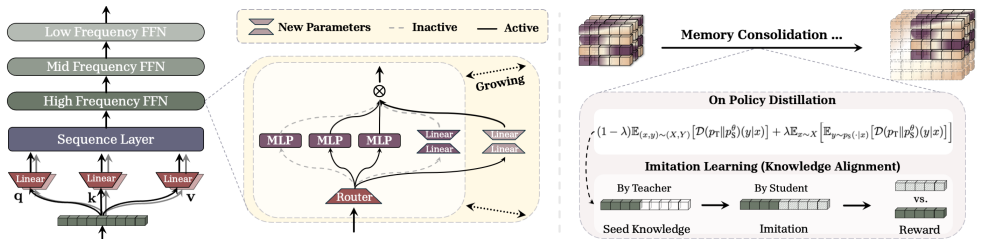
Knowledge Seeding: an upward self-distillation in which a smaller, higher-frequency version of the model (teacher) is distilled into newly expanded low-rank experts inside a larger, lower-frequency student, combining on-policy token-level divergence with an RL imitation reward that aligns both semantic and token-level continuations.
Load-bearing premise
That gradually adding and then freezing low-rank experts, while resetting the high-frequency adapters after each consolidation, is enough to keep old knowledge intact across many sleep cycles without unbounded growth or eventual interference.
What would settle it
Run a long multi-cycle continual stream (dozens of sequential tasks or languages) with the full Sleep schedule and measure whether accuracy on the earliest tasks stays within a few points of the single-task baseline; a sharp drop after many consolidations would falsify the capacity-and-freeze premise.
Editorial analysis
A structured set of objections, weighed in public.
Referee Report
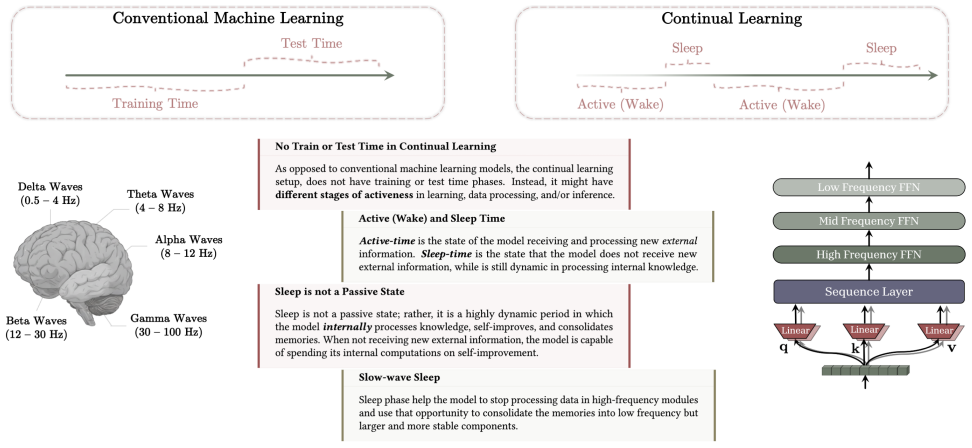
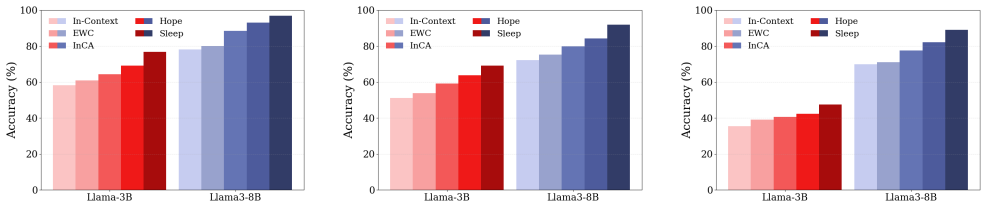
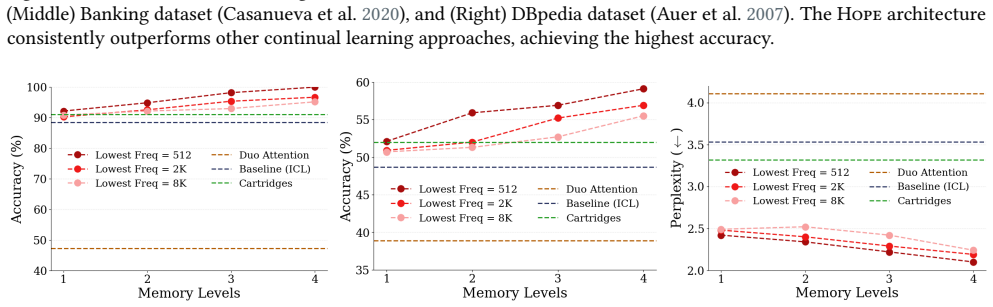
Summary. The paper proposes a Sleep paradigm for continual LLM learning, replacing the train/test split with wake and sleep phases. Sleep has two stages: (1) Memory Consolidation via Knowledge Seeding—an upward distillation that expands lower-frequency sparse MoE experts with low-rank adapters and transfers knowledge from a smaller-self (higher-frequency) state using Generalized Knowledge Distillation (on-policy mix) plus an RL Learning-to-Imitate objective with semantic and Levenshtein rewards; (2) Dreaming—an RL self-improvement loop that generates synthetic dreams, scores them by SFT gradient importance, injects random-expert novelty, and updates via ReSTEM/SEAL-style rewards. Built on Nested Learning Continuum Memory Systems (multi-frequency MLP blocks), the method is evaluated on class-incremental classification (CLINC, Banking, DBpedia), long-context QA/retrieval, continual novel-language translation, BABILong, SQuAD knowledge incorporation, few-shot ARC, and math reasoning (AIME/HMMT), with ablations on imitation learning, expansion, dreaming, and selection.
Significance. If the gains are attributable to Sleep rather than the Nested Learning substrate, the work would be a meaningful contribution to lifelong LLM adaptation: it gives a concrete offline mechanism for moving fragile in-context knowledge into stable parameters, pairs capacity expansion with freeze-and-reset, and combines on-policy distillation with imitation learning in a way that is distinct from concurrent fixed-capacity OPSD recipes. Strengths include multi-task external benchmarks, component ablations that generally move in the claimed direction (Tables 1–4, Figures 3–6), and explicit positioning against SEAL and later OPSD literature. The wake/sleep lifecycle framing is useful even if some design choices remain heuristic.
major comments (3)
- [§4 Empirical Results; Table 3; Figures 3–6] Central claim isolation (§4, Figs. 3–6, Table 3): Almost all positive continual, long-context, and BABILong results are reported on Hope/CMS multi-frequency backbones with nested update frequencies and sparse MoE experts (§2.2, §3.2–3.3). The pure-Transformer rows in Table 3 (knowledge incorporation) improve modestly over SEAL (48.1 vs 46.7 single-passage) and remain weaker than the four-level variant. Without a controlled ablation that applies the same Knowledge Seeding + Dreaming schedule, expansion/freeze/reset recipe, and multi-task sequences to a standard frozen Transformer or LoRA-only backbone, it is not possible to attribute gains to Sleep as stated for general “Language Models” rather than to the Nested Learning continuum-memory substrate on which Sleep is defined.
- [§3.2 Parameter Expansion; §3.3 Knowledge Seeding] Multi-cycle capacity and interference (§3.2–3.3): Knowledge Seeding repeatedly adds low-rank experts to lower-frequency blocks, freezes old parameters, consolidates, then resets high-frequency low-rank adapters. The premise that this prevents interference across many sleep cycles without unbounded growth or eventual collapse is load-bearing for continual learning, yet experiments use short task sequences (e.g., two languages in CTNL; class-incremental splits) without long multi-cycle stress tests that track parameter growth, retention of early tasks after many consolidations, or collapse under repeated Dreaming. A multi-cycle retention curve or capacity budget analysis is needed to support the claim that expansion + freeze + reset is sufficient.
- [§3.4 Dreaming; Table 3; Table 1] Dreaming vs. consolidation contribution (Table 3, Table 1 ablations): Removing Dreaming drops SQuAD accuracy sharply (35.7/36.2 vs 48.1/44.3), while consolidation-only ablations on math (Table 1/2) still beat SFT/GRPO. The paper asserts that the two-step design is more robust to CF than iterative self-improvement alone, but does not report a head-to-head multi-task continual sequence where Dreaming is applied without prior Knowledge Seeding (or vice versa) under matched compute. That comparison is needed to justify the NREM/REM-style ordering as more than a convenient stack of SEAL-style self-edits on top of CMS.
minor comments (7)
- [§2.1 Notation] Notation: θ vs 𝜽 and frequency superscripts are dense; a short glossary of C^(ℓ), f_ℓ, SKS, LTI, GKD would help §2–3.
- [§3.3 Learning to Imitate] Eq. (3)–(4): semantic reward is described as a frozen RM giving 0/1, but the RM is not named or validated; absolute reward uses Levenshtein with threshold z0—state default z0 and sensitivity.
- [Figure 1] Figure 1 caption discusses Hope architecture but the main text introduces CMS first; align figure labels with §2.2 terminology.
- [Appendix A.4] Appendix A.4 on concurrent OPSD is thorough but long; a short main-text paragraph summarizing the four positioning axes would improve accessibility.
- [Tables 1–2] Table 1 vs Table 2: both titled for math reasoning with overlapping Qwen3-8B rows; clarify which is ablation-only vs full comparison.
- [Appendix B.5] Efficiency note (B.5): SFT is 4× cheaper per step; the wall-clock-to-target claim is useful—report absolute GPU-hours for Sleep vs SFT/GRPO on AIME.
- [Abstract; §1] Typos/style: “asmaller-self”, “alargernetwork”, “upwarddistillation”, and similar missing spaces appear in the abstract and §1; clean for camera-ready.
Circularity Check
No derivation-by-construction circularity; empirical method paper whose results rest on external benchmarks, with only non-load-bearing self-citation of the Nested Learning substrate.
full rationale
The paper proposes an architectural/training procedure (periodic parameter expansion + Knowledge Seeding via GKD-style on-policy distillation plus RL imitation, followed by Dreaming) and evaluates it on external, publicly defined benchmarks (CLINC, Banking, DBpedia, RULER MK-NIAH, LongHealth, QASPER, MTOB/Manchu CTNL, BABILong, SQuAD, ARC, AIME/HMMT). There is no closed-form prediction, uniqueness theorem, or fitted parameter that is later re-labeled as a derived result; the objectives L_KS and the dreaming reward are optimization targets, not claims that force the reported accuracies by construction. The Continuum Memory System / Hope multi-frequency backbone is taken from Behrouz et al. (2025) (self-citation), but it functions as a reusable substrate on which Sleep is defined, not as the measured target whose correctness is assumed. Table 3 even reports a pure-Transformer Sleep variant, and all gains are measured against independent baselines (ICL, EWC, InCA, SEAL, GRPO, SFT, Cartridges). No step reduces Eq. X to Eq. Y by definition or by an unverified self-citation chain. The architectural entanglement noted by the skeptic is a validity/isolation concern, not circularity under the stated criteria.
Axiom & Free-Parameter Ledger
free parameters (6)
- on-policy mix λ and distillation/LTI mix α
- semantic/absolute reward mix γ and Levenshtein threshold z0
- low-rank expansion rank d_low and expert count schedule
- memory update frequencies / chunk sizes C^(ℓ) and number of sleep stages
- dream count m, top-k importance selection, random sample count b
- LoRA rank/alpha and SFT/RL step budgets in Dreaming
axioms (6)
- ad hoc to paper Human NREM/REM sleep functions (consolidation then integration/exploration) are a valid design template for LLM offline phases.
- domain assumption Continuum Memory System: modules with ordered update frequencies form a short-to-long-term memory hierarchy (Nested Learning).
- domain assumption Catastrophic forgetting is primarily a limited-capacity / interference problem solvable by expanding new experts and freezing old ones.
- domain assumption On-policy distillation plus imitation rewards transfer usable knowledge into newly unlocked parameters without needing external labeled sleep data.
- domain assumption Gradient-norm/importance scoring of synthetic dreams plus random-expert injection yields useful self-improvement curricula without destructive drift.
- standard math Standard optimization and PEFT facts (SGD/Adam-style updates, LoRA, MoE routing) behave as usual under the proposed schedule.
invented entities (4)
-
Sleep paradigm (wake vs sleep lifecycle for continual learners)
no independent evidence
-
Knowledge Seeding / Self-Knowledge Seeding (upward distillation into expanded parameters)
no independent evidence
-
Learning-to-Imitate (LTI) reward combining semantic and Levenshtein alignment
no independent evidence
-
Dreaming curriculum with gradient-based dream selection and random-expert novelty
no independent evidence
read the original abstract
The past few decades have witnessed significant advances in the design of machine learning algorithms, from early studies on task-specific shallow models to more general deep Large Language Models (LLMs). Despite showing promising results in tasks that require instant prediction or in-context learning, existing models lack the ability to continually learn and effectively transfer their temporal in-context knowledge to their long-term parameters. Inspired by human learning process, we introduce a ''Sleep'' paradigm that allows the models to continually learn, distill their short-term fragile memories into stable long-term knowledge with replay, and recursively improve themselves with ''Dreaming'' process. In more detail, sleep consists of two stages: (1) Memory Consolidation: an upward distillation process, called Knowledge Seeding, where the memories of a smaller-self are distilled into a larger network to provide more capacity while preserving the knowledge. As a proof of concept, we present a new Generalized Distillation process for {Knowledge Seeding} (i.e., the combination of on-policy distillation with Reinforcement Learning (RL)-based imitation learning); (2) Dreaming: a self-improvement phase, where the model uses RL to generate a curriculum of synthetic data to rehearse new knowledge and refine existing capabilities without human supervision. Our experiments on long-horizon, continual learning, knowledge incorporation, and few-shot generalization tasks support the importance of the sleep stage.
Figures
Forward citations
Cited by 1 Pith paper
-
Recursive Self-Improvement in AI: From Bounded Self-Refinement to Autonomous Research Loops
A survey of 1,250 papers organizes AI self-improvement along two axes—what is improved and loop closure—finding that demonstrated self-improvement strength tracks a verification hierarchy from formal verifiers down to...
Reference graph
Works this paper leans on
-
[1]
Loss of recent memory after bilateral hippocampal lesions
William Beecher Scoville and Brenda Milner. “Loss of recent memory after bilateral hippocampal lesions”. In: Journal of neurology, neurosurgery, and psychiatry20.1 (1957), p. 11
1957
-
[2]
1987.url: https://people.idsia.ch/ ~juergen/diploma1987ocr.pdf
Jürgen Schmidhuber.Evolutionary Principles in Self-Referential Learning. 1987.url: https://people.idsia.ch/ ~juergen/diploma1987ocr.pdf
1987
-
[3]
Self-improving reactive agents based on reinforcement learning, planning and teaching
Long-Ji Lin. “Self-improving reactive agents based on reinforcement learning, planning and teaching”. In:Machine Learning8.3–4 (1992), pp. 293–321
1992
-
[4]
Learning to control fast-weight memories: An alternative to recurrent nets. Accepted for publication in
Juergen Schmidhuber. “Learning to control fast-weight memories: An alternative to recurrent nets. Accepted for publication in”. In:Neural Computation(1992)
1992
-
[5]
Why there are complementary learning systems in the hippocampus and neocortex: insights from the successes and failures of connectionist models of learning and memory
James L. McClelland, Bruce L. McNaughton, and Randall C. O’Reilly. “Why there are complementary learning systems in the hippocampus and neocortex: insights from the successes and failures of connectionist models of learning and memory”. In:Psychological Review102.3 (1995), pp. 419–457
1995
-
[6]
Retrograde amnesia and memory consolidation: a neurobiological perspective
Larry R Squire and Pablo Alvarez. “Retrograde amnesia and memory consolidation: a neurobiological perspective”. In:Current opinion in neurobiology5.2 (1995), pp. 169–177
1995
-
[7]
Synaptic tagging and long-term potentiation
Uwe Frey and Richard GM Morris. “Synaptic tagging and long-term potentiation”. In:Nature385.6616 (1997), pp. 533–536
1997
-
[8]
The plastic human brain cortex
Alvaro Pascual-Leone, Amir Amedi, Felipe Fregni, and Lotfi B Merabet. “The plastic human brain cortex”. In:Annu. Rev. Neurosci.28.1 (2005), pp. 377–401
2005
-
[9]
Sleep-dependent memory consolidation
Robert Stickgold. “Sleep-dependent memory consolidation”. In:Nature437.7063 (2005), pp. 1272–1278
2005
-
[10]
Reverse replay of behavioural sequences in hippocampal place cells during the awake state
David J Foster and Matthew A Wilson. “Reverse replay of behavioural sequences in hippocampal place cells during the awake state”. In:Nature440.7084 (2006), pp. 680–683
2006
-
[11]
Sleep function and synaptic homeostasis
Giulio Tononi and Chiara Cirelli. “Sleep function and synaptic homeostasis”. In:Sleep medicine reviews10.1 (2006), pp. 49–62
2006
-
[12]
Dbpedia: A nucleus for a web of open data
Sören Auer, Christian Bizer, Georgi Kobilarov, Jens Lehmann, Richard Cyganiak, and Zachary Ives. “Dbpedia: A nucleus for a web of open data”. In:international semantic web conference. Springer. 2007, pp. 722–735
2007
-
[13]
Coordinated memory replay in the visual cortex and hippocampus during sleep
Daoyun Ji and Matthew A Wilson. “Coordinated memory replay in the visual cortex and hippocampus during sleep”. In:Nature neuroscience10.1 (2007), pp. 100–107
2007
-
[14]
Plasticity in the developing brain: implications for rehabilitation
Michael V Johnston. “Plasticity in the developing brain: implications for rehabilitation”. In:Developmental disabilities research reviews15.2 (2009), pp. 94–101
2009
-
[15]
Replay of rule-learning related neural patterns in the prefrontal cortex during sleep
Adrien Peyrache, Mehdi Khamassi, Karim Benchenane, Sidney I Wiener, and Francesco P Battaglia. “Replay of rule-learning related neural patterns in the prefrontal cortex during sleep”. In:Nature neuroscience12.7 (2009), pp. 919–926
2009
-
[16]
Memory, sleep and dreaming: experiencing consolidation
Erin J Wamsley and Robert Stickgold. “Memory, sleep and dreaming: experiencing consolidation”. In:Sleep medicine clinics6.1 (2011), p. 97
2011
-
[17]
About sleep’s role in memory
Björn Rasch and Jan Born. “About sleep’s role in memory”. In:Physiological reviews(2013)
2013
-
[18]
The role of sleep in emotional brain function
Andrea N Goldstein and Matthew P Walker. “The role of sleep in emotional brain function”. In:Annual review of clinical psychology10.1 (2014), pp. 679–708
2014
-
[19]
Distilling the knowledge in a neural network
Geoffrey Hinton, Oriol Vinyals, and Jeff Dean. “Distilling the knowledge in a neural network”. In:arXiv preprint arXiv:1503.02531(2015)
Pith/arXiv arXiv 2015
-
[20]
Human-level control through deep reinforcement learning
Volodymyr Mnih, Koray Kavukcuoglu, David Silver, Andrei A. Rusu, Joel Veness, Marc G. Bellemare, Alex Graves, Martin Riedmiller, Andreas K. Fidjeland, Georg Ostrovski, et al. “Human-level control through deep reinforcement learning”. In:Nature518.7540 (2015), pp. 529–533
2015
-
[21]
Memory consolidation
Larry R Squire, Lisa Genzel, John T Wixted, and Richard G Morris. “Memory consolidation”. In:Cold Spring Harbor perspectives in biology7.8 (2015), a021766
2015
-
[22]
Sequence-level knowledge distillation
Yoon Kim and Alexander M Rush. “Sequence-level knowledge distillation”. In:Proceedings of the 2016 conference on empirical methods in natural language processing. 2016, pp. 1317–1327
2016
-
[23]
What learning systems do intelligent agents need? Complementary learning systems theory updated
Dharshan Kumaran, Demis Hassabis, and James L. McClelland. “What learning systems do intelligent agents need? Complementary learning systems theory updated”. In:Trends in Cognitive Sciences20.7 (2016), pp. 512–534
2016
-
[24]
SQuAD: 100,000+ Questions for Machine Comprehension of Text
Pranav Rajpurkar, Jian Zhang, Konstantin Lopyrev, and Percy Liang. “SQuAD: 100,000+ Questions for Machine Comprehension of Text”. In:Proceedings of the 2016 Conference on Empirical Methods in Natural Language Processing. Ed. by Jian Su, Kevin Duh, and Xavier Carreras. Association for Computational Linguistics, 2016.url: https: //aclanthology.org/D16-1264/. 14
2016
-
[25]
Model-Agnostic Meta-Learning for Fast Adaptation of Deep Networks
Chelsea Finn, Pieter Abbeel, and Sergey Levine. “Model-Agnostic Meta-Learning for Fast Adaptation of Deep Networks”. In:Proceedings of the 34th International Conference on Machine Learning. Ed. by Doina Precup and Yee Whye Teh. Proceedings of Machine Learning Research. PMLR, 2017.url: https://proceedings.mlr.press/ v70/finn17a.html
2017
-
[26]
Neuroscience-inspired artificial intelligence
Demis Hassabis, Dharshan Kumaran, Christopher Summerfield, and Matthew Botvinick. “Neuroscience-inspired artificial intelligence”. In:Neuron95.2 (2017), pp. 245–258
2017
-
[27]
Overcoming catastrophic forgetting in neural networks
James Kirkpatrick, Razvan Pascanu, Neil Rabinowitz, Joel Veness, Guillaume Desjardins, Andrei A Rusu, Kieran Milan, John Quan, Tiago Ramalho, Agnieszka Grabska-Barwinska, et al. “Overcoming catastrophic forgetting in neural networks”. In:Proceedings of the national academy of sciences114.13 (2017), pp. 3521–3526
2017
-
[28]
REM sleep selectively prunes and maintains new synapses in development and learning
Wei Li, Lei Ma, Guang Yang, and Wen-Biao Gan. “REM sleep selectively prunes and maintains new synapses in development and learning”. In:Nature neuroscience20.3 (2017), pp. 427–437
2017
-
[29]
Attention is All you Need
Ashish Vaswani, Noam Shazeer, Niki Parmar, Jakob Uszkoreit, Llion Jones, Aidan N Gomez, Łukasz Kaiser, and Illia Polosukhin. “Attention is All you Need”. In:Advances in Neural Information Processing Systems. Ed. by I. Guyon, U. Von Luxburg, S. Bengio, H. Wallach, R. Fergus, S. Vishwanathan, and R. Garnett. Vol. 30. Cur- ran Associates, Inc., 2017.url: htt...
2017
-
[30]
Recurrent world models facilitate policy evolution
David Ha and Jürgen Schmidhuber. “Recurrent world models facilitate policy evolution”. In:Advances in Neural Information Processing Systems (NeurIPS). Vol. 31. 2018, pp. 2451–2463
2018
-
[31]
David Ha and Jürgen Schmidhuber. “World models”. In:arXiv preprint arXiv:1803.101222.3 (2018), p. 440
Pith/arXiv arXiv 2018
-
[32]
Measuring catastrophic forgetting in neural networks
Ronald Kemker, Marc McClure, Angelina Abitino, Tyler Hayes, and Christopher Kanan. “Measuring catastrophic forgetting in neural networks”. In:Proceedings of the AAAI conference on artificial intelligence. Vol. 32. 1. 2018
2018
-
[33]
An Evaluation Dataset for Intent Classification and Out-of-Scope Prediction
Stefan Larson, Anish Mahendran, Joseph J Peper, Christopher Clarke, Andrew Lee, Parker Hill, Jonathan K Kummerfeld, Kevin Leach, Michael A Laurenzano, Lingjia Tang, et al. “An Evaluation Dataset for Intent Classification and Out-of-Scope Prediction”. In:Proceedings of the 2019 Conference on Empirical Methods in Natural Language Processing and the 9th Inte...
2019
-
[34]
Fast transformer decoding: One write-head is all you need
Noam Shazeer. “Fast transformer decoding: One write-head is all you need”. In:arXiv preprint arXiv:1911.02150 (2019)
Pith/arXiv arXiv 1911
-
[35]
Language models are few-shot learners
Tom Brown, Benjamin Mann, Nick Ryder, Melanie Subbiah, Jared D Kaplan, Prafulla Dhariwal, Arvind Neelakantan, Pranav Shyam, Girish Sastry, Amanda Askell, et al. “Language models are few-shot learners”. In:Advances in neural information processing systems33 (2020), pp. 1877–1901
2020
-
[36]
Efficient Intent Detection with Dual Sentence Encoders
Inigo Casanueva, Tadas Temcinas, Daniela Gerz, Matthew Henderson, and Ivan Vulic. “Efficient Intent Detection with Dual Sentence Encoders”. In:ACL 2020(2020), p. 38
2020
-
[37]
Can sleep protect memories from catastrophic forgetting?
Oscar C. González, Yury Sokolov, Giri P. Krishnan, Jean Erik Delanois, and Maxim Bazhenov. “Can sleep protect memories from catastrophic forgetting?” In:eLife9 (2020), e51005
2020
-
[38]
Dream to control: Learning behaviors by latent imagination
Danijar Hafner, Timothy Lillicrap, Jimmy Ba, and Mohammad Norouzi. “Dream to control: Learning behaviors by latent imagination”. In:International Conference on Learning Representations (ICLR). 2020
2020
-
[39]
Transformers are rnns: Fast au- toregressive transformers with linear attention
Angelos Katharopoulos, Apoorv Vyas, Nikolaos Pappas, and François Fleuret. “Transformers are rnns: Fast au- toregressive transformers with linear attention”. In:International conference on machine learning. PMLR. 2020, pp. 5156–5165
2020
-
[40]
A dataset of information- seeking questions and answers anchored in research papers
Pradeep Dasigi, Kyle Lo, Iz Beltagy, Arman Cohan, Noah A Smith, and Matt Gardner. “A dataset of information- seeking questions and answers anchored in research papers”. In:arXiv preprint arXiv:2105.03011(2021)
Pith/arXiv arXiv 2021
-
[41]
Stepwise synaptic plasticity events drive the early phase of memory consolidation
Akihiro Goto, Ayaka Bota, Ken Miya, Jingbo Wang, Suzune Tsukamoto, Xinzhi Jiang, Daichi Hirai, Masanori Murayama, Tomoki Matsuda, Thomas J. McHugh, Takeharu Nagai, and Yasunori Hayashi. “Stepwise synaptic plasticity events drive the early phase of memory consolidation”. In:Science374.6569 (2021), pp. 857–863.doi: 10.1126/science.abj9195 . eprint: https://...
-
[42]
McGraw-Hill, 2021
Eric R Kandell, Jojhn D Koester, Sarah H Mack, and Steven Siegelbaum.Principles of neural science. McGraw-Hill, 2021
2021
-
[43]
The power of scale for parameter-efficient prompt tuning
Brian Lester, Rami Al-Rfou, and Noah Constant. “The power of scale for parameter-efficient prompt tuning”. In: arXiv preprint arXiv:2104.08691(2021)
Pith/arXiv arXiv 2021
-
[44]
Prefix-Tuning: Optimizing Continuous Prompts for Generation
Xiang Lisa Li and Percy Liang. “Prefix-Tuning: Optimizing Continuous Prompts for Generation”. In:Proceedings of the 59th Annual Meeting of the Association for Computational Linguistics and the 11th International Joint Conference on Natural Language Processing (Volume 1: Long Papers). Ed. by Chengqing Zong, Fei Xia, Wenjie Li, and Roberto 15 Navigli. Onlin...
-
[45]
What learning algorithm is in-context learning? investigations with linear models
Ekin Akyürek, Dale Schuurmans, Jacob Andreas, Tengyu Ma, and Denny Zhou. “What learning algorithm is in-context learning? investigations with linear models”. In:arXiv preprint arXiv:2211.15661(2022)
Pith/arXiv arXiv 2022
-
[46]
Recurrent memory transformer
Aydar Bulatov, Yury Kuratov, and Mikhail Burtsev. “Recurrent memory transformer”. In:Advances in Neural Information Processing Systems35 (2022), pp. 11079–11091
2022
-
[47]
LoRA: Low-Rank Adaptation of Large Language Models
Edward J Hu, yelong shen, Phillip Wallis, Zeyuan Allen-Zhu, Yuanzhi Li, Shean Wang, Lu Wang, and Weizhu Chen. “LoRA: Low-Rank Adaptation of Large Language Models”. In:International Conference on Learning Representations. 2022.url:https://openreview.net/forum?id=nZeVKeeFYf9
2022
-
[48]
A modern self-referential weight matrix that learns to modify itself
Kazuki Irie, Imanol Schlag, Róbert Csordás, and Jürgen Schmidhuber. “A modern self-referential weight matrix that learns to modify itself”. In:International Conference on Machine Learning. PMLR. 2022.url: https://proceedings. mlr.press/v162/irie22b.html
2022
-
[49]
Sleep-like unsupervised replay reduces catastrophic forgetting in artificial neural networks
Timothy Tadros, Giri P. Krishnan, Ramyaa Ramyaa, and Maxim Bazhenov. “Sleep-like unsupervised replay reduces catastrophic forgetting in artificial neural networks”. In:Nature Communications13.1 (2022), p. 7742
2022
-
[50]
STaR: Bootstrapping Reasoning With Reasoning
Eric Zelikman, Yuhuai Wu, Jesse Mu, and Noah Goodman. “STaR: Bootstrapping Reasoning With Reasoning”. In: Advances in Neural Information Processing Systems. Ed. by S. Koyejo, S. Mohamed, A. Agarwal, D. Belgrave, K. Cho, and A. Oh. Curran Associates, Inc., 2022.url: https://proceedings.neurips.cc/paper_files/paper/2022/ file/639a9a172c044fbb64175b5fad42e9a...
2022
-
[51]
Josh Achiam, Steven Adler, Sandhini Agarwal, Lama Ahmad, Ilge Akkaya, Florencia Leoni Aleman, Diogo Almeida, Janko Altenschmidt, Sam Altman, Shyamal Anadkat, et al. “Gpt-4 technical report”. In:arXiv preprint arXiv:2303.08774(2023)
Pith/arXiv arXiv 2023
-
[52]
Gqa: Training generalized multi-query transformer models from multi-head checkpoints
Joshua Ainslie, James Lee-Thorp, Michiel De Jong, Yury Zemlyanskiy, Federico Lebrón, and Sumit Sanghai. “Gqa: Training generalized multi-query transformer models from multi-head checkpoints”. In:arXiv preprint arXiv:2305.13245(2023)
Pith/arXiv arXiv 2023
-
[53]
Adapting language models to compress contexts
Alexis Chevalier, Alexander Wettig, Anirudh Ajith, and Danqi Chen. “Adapting language models to compress contexts”. In:arXiv preprint arXiv:2305.14788(2023)
Pith/arXiv arXiv 2023
-
[54]
In-context autoencoder for context compression in a large language model
Tao Ge, Jing Hu, Lei Wang, Xun Wang, Si-Qing Chen, and Furu Wei. “In-context autoencoder for context compression in a large language model”. In:arXiv preprint arXiv:2307.06945(2023)
Pith/arXiv arXiv 2023
-
[55]
Mixture of cluster-conditional lora experts for vision-language instruction tuning
Yunhao Gou, Zhili Liu, Kai Chen, Lanqing Hong, Hang Xu, Aoxue Li, Dit-Yan Yeung, James T Kwok, and Yu Zhang. “Mixture of cluster-conditional lora experts for vision-language instruction tuning”. In:arXiv preprint arXiv:2312.12379(2023)
Pith/arXiv arXiv 2023
-
[56]
Mamba: Linear-time sequence modeling with selective state spaces
Albert Gu and Tri Dao. “Mamba: Linear-time sequence modeling with selective state spaces”. In:arXiv preprint arXiv:2312.00752(2023)
Pith/arXiv arXiv 2023
-
[57]
Lorahub: Efficient cross-task generalization via dynamic lora composition
Chengsong Huang, Qian Liu, Bill Yuchen Lin, Tianyu Pang, Chao Du, and Min Lin. “Lorahub: Efficient cross-task generalization via dynamic lora composition”. In:arXiv preprint arXiv:2307.13269(2023)
Pith/arXiv arXiv 2023
-
[58]
Llmlingua: Compressing prompts for accelerated inference of large language models
Huiqiang Jiang, Qianhui Wu, Chin-Yew Lin, Yuqing Yang, and Lili Qiu. “Llmlingua: Compressing prompts for accelerated inference of large language models”. In:arXiv preprint arXiv:2310.05736(2023)
Pith/arXiv arXiv 2023
-
[59]
Yucheng Li. “Unlocking context constraints of llms: Enhancing context efficiency of llms with self-information-based content filtering”. In:arXiv preprint arXiv:2304.12102(2023)
Pith/arXiv arXiv 2023
-
[60]
CodeGen: An Open Large Language Model for Code with Multi-Turn Program Synthesis
Erik Nijkamp, Bo Pang, Hiroaki Hayashi, Lifu Tu, Huan Wang, Yingbo Zhou, Silvio Savarese, and Caiming Xiong. “CodeGen: An Open Large Language Model for Code with Multi-Turn Program Synthesis”. In:The Eleventh Interna- tional Conference on Learning Representations. 2023.url:https://openreview.net/forum?id=iaYcJKpY2B_
2023
-
[61]
Memgpt: Towards llms as operating systems
Charles Packer, Sarah Wooders, Kevin Lin, Vivian Fang, Shishir G Patil, Ion Stoica, and Joseph E Gonzalez. “Memgpt: Towards llms as operating systems”. In:arXiv preprint arXiv:2310.08560(2023)
Pith/arXiv arXiv 2023
-
[62]
Are emergent abilities of large language models a mirage?
Rylan Schaeffer, Brando Miranda, and Sanmi Koyejo. “Are emergent abilities of large language models a mirage?” In:Advances in neural information processing systems36 (2023), pp. 55565–55581
2023
-
[63]
Visionllm: Large language model is also an open-ended decoder for vision-centric tasks
Wenhai Wang, Zhe Chen, Xiaokang Chen, Jiannan Wu, Xizhou Zhu, Gang Zeng, Ping Luo, Tong Lu, Jie Zhou, Yu Qiao, et al. “Visionllm: Large language model is also an open-ended decoder for vision-centric tasks”. In:Advances in Neural Information Processing Systems36 (2023), pp. 61501–61513
2023
-
[64]
H2o: Heavy-hitter oracle for efficient generative inference of large language models
Zhenyu Zhang, Ying Sheng, Tianyi Zhou, Tianlong Chen, Lianmin Zheng, Ruisi Cai, Zhao Song, Yuandong Tian, Christopher Ré, Clark Barrett, et al. “H2o: Heavy-hitter oracle for efficient generative inference of large language models”. In:Advances in Neural Information Processing Systems36 (2023), pp. 34661–34710. 16
2023
-
[65]
Marah Abdin, Jyoti Aneja, Harkirat Behl, Sébastien Bubeck, Ronen Eldan, Suriya Gunasekar, Michael Harrison, Rus- sell J Hewett, Mojan Javaheripi, Piero Kauffmann, et al. “Phi-4 technical report”. In:arXiv preprint arXiv:2412.08905 (2024)
Pith/arXiv arXiv 2024
-
[66]
On-Policy Distillation of Language Models: Learning from Self-Generated Mistakes
Rishabh Agarwal, Nino Vieillard, Yongchao Zhou, Piotr Stanczyk, Sabela Ramos Garea, Matthieu Geist, and Olivier Bachem. “On-Policy Distillation of Language Models: Learning from Self-Generated Mistakes”. In:The Twelfth International Conference on Learning Representations. 2024.url: https://openreview.net/forum?id= 3zKtaqxLhW
2024
-
[67]
The Surprising Effectiveness of Test-Time Training for Few-Shot Learning
Ekin Akyürek, Mehul Damani, Adam Zweiger, Linlu Qiu, Han Guo, Jyothish Pari, Yoon Kim, and Jacob Andreas. “The Surprising Effectiveness of Test-Time Training for Few-Shot Learning”. In:Forty-second International Conference on Machine Learning. 2024
2024
-
[68]
In-context language learning: Architectures and algorithms
Ekin Akyürek, Bailin Wang, Yoon Kim, and Jacob Andreas. “In-context language learning: Architectures and algorithms”. In:arXiv preprint arXiv:2401.12973(2024)
Pith/arXiv arXiv 2024
-
[69]
Simple linear attention language models balance the recall-throughput tradeoff
Simran Arora, Sabri Eyuboglu, Michael Zhang, Aman Timalsina, Silas Alberti, James Zou, Atri Rudra, and Christo- pher Re. “Simple linear attention language models balance the recall-throughput tradeoff”. In:Forty-first International Conference on Machine Learning. 2024.url:https://openreview.net/forum?id=e93ffDcpH3
2024
-
[70]
xLSTM: Extended Long Short-Term Memory
Maximilian Beck, Korbinian Pöppel, Markus Spanring, Andreas Auer, Oleksandra Prudnikova, Michael Kopp, Günter Klambauer, Johannes Brandstetter, and Sepp Hochreiter. “xLSTM: Extended Long Short-Term Memory”. In: arXiv preprint arXiv:2405.04517(2024)
Pith/arXiv arXiv 2024
-
[71]
Titans: Learning to memorize at test time
Ali Behrouz, Peilin Zhong, and Vahab Mirrokni. “Titans: Learning to memorize at test time”. In:arXiv preprint arXiv:2501.00663(2024)
Pith/arXiv arXiv 2024
-
[72]
Dated Data: Tracing Knowledge Cutoffs in Large Language Models
Jeffrey Cheng, Marc Marone, Orion Weller, Dawn Lawrie, Daniel Khashabi, and Benjamin Van Durme. “Dated Data: Tracing Knowledge Cutoffs in Large Language Models”. In:First Conference on Language Modeling. 2024.url: https://openreview.net/forum?id=wS7PxDjy6m
2024
-
[73]
A Survey on In-context Learning
Qingxiu Dong, Lei Li, Damai Dai, Ce Zheng, Jingyuan Ma, Rui Li, Heming Xia, Jingjing Xu, Zhiyong Wu, Baobao Chang, Xu Sun, Lei Li, and Zhifang Sui. “A Survey on In-context Learning”. In:Proceedings of the 2024 Conference on Empirical Methods in Natural Language Processing. Ed. by Yaser Al-Onaizan, Mohit Bansal, and Yun-Nung Chen. Miami, Florida, USA: Asso...
doi:10.18653/v1/ 2024
-
[74]
The llama 3 herd of models
Abhimanyu Dubey, Abhinav Jauhri, Abhinav Pandey, Abhishek Kadian, Ahmad Al-Dahle, Aiesha Letman, Akhil Mathur, Alan Schelten, Amy Yang, Angela Fan, et al. “The llama 3 herd of models”. In:arXiv e-prints(2024), arXiv–2407
2024
-
[75]
RULER: What’s the Real Context Size of Your Long-Context Language Models?
Cheng-Ping Hsieh, Simeng Sun, Samuel Kriman, Shantanu Acharya, Dima Rekesh, Fei Jia, and Boris Ginsburg. “RULER: What’s the Real Context Size of Your Long-Context Language Models?” In:First Conference on Language Modeling. 2024.url:https://openreview.net/forum?id=kIoBbc76Sy
2024
-
[76]
Simple and Scalable Strategies to Continually Pre-train Large Language Models
Adam Ibrahim, Benjamin Thérien, Kshitij Gupta, Mats Leon Richter, Quentin Gregory Anthony, Eugene Belilovsky, Timothée Lesort, and Irina Rish. “Simple and Scalable Strategies to Continually Pre-train Large Language Models”. In:Transactions on Machine Learning Research(2024).issn: 2835-8856.url: https://openreview.net/forum?id= DimPeeCxKO
2024
-
[77]
Knowledge injection via prompt distillation
Kalle Kujanpää, Harri Valpola, and Alexander Ilin. “Knowledge injection via prompt distillation”. In:arXiv preprint arXiv:2412.14964(2024)
Pith/arXiv arXiv 2024
-
[78]
Babilong: Testing the limits of llms with long context reasoning-in-a-haystack
Yury Kuratov, Aydar Bulatov, Petr Anokhin, Ivan Rodkin, Dmitry Sorokin, Artyom Sorokin, and Mikhail Burtsev. “Babilong: Testing the limits of llms with long context reasoning-in-a-haystack”. In:Advances in Neural Information Processing Systems37 (2024), pp. 106519–106554
2024
-
[79]
Mixlora: Enhancing large language models fine-tuning with lora-based mixture of experts
Dengchun Li, Yingzi Ma, Naizheng Wang, Zhengmao Ye, Zhiyuan Cheng, Yinghao Tang, Yan Zhang, Lei Duan, Jie Zuo, Cal Yang, et al. “Mixlora: Enhancing large language models fine-tuning with lora-based mixture of experts”. In:arXiv preprint arXiv:2404.15159(2024)
Pith/arXiv arXiv 2024
-
[80]
Snapkv: Llm knows what you are looking for before generation
Yuhong Li, Yingbing Huang, Bowen Yang, Bharat Venkitesh, Acyr Locatelli, Hanchen Ye, Tianle Cai, Patrick Lewis, and Deming Chen. “Snapkv: Llm knows what you are looking for before generation”. In:Advances in Neural Information Processing Systems37 (2024), pp. 22947–22970
2024
discussion (0)
Sign in with ORCID, Apple, or X to comment. Anyone can read and Pith papers without signing in.