REVIEW 3 major objections 5 minor 31 references
Rethinking Medical Landmark Localization with Prototype Learning-based Progressive Offset Correction
T0 review · 3 major / 5 minor · reviewed 2026-08-14 · deepseek-v4-flash
Pith's one-line read PPOC-LL, a compact landmark-localization network, claims to beat the previous state of the art on three medical-imaging benchmarks by correcting landmark positions stepwise through prototype-guided patch matching.
desk verdict The method is a clean integration of known ideas with honest ablations, but the state-of-the-art claim rests on baseline comparisons that are currently unverifiable: a corrupted Table 1 and a likely unfair 'ResNet18 for all models' protocol. read the letter →
The pith
A machine-rendered reading of the paper's core claim, the machinery that carries it, and where it could break.
The reading
What carries the argument
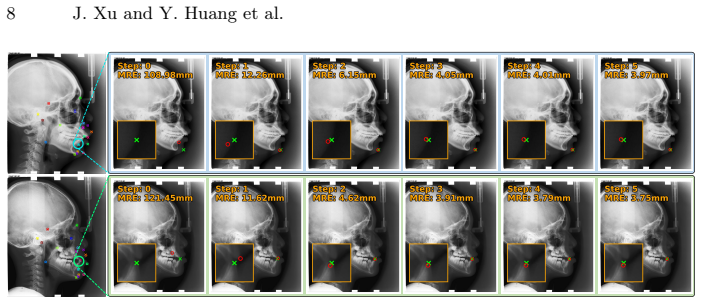
The load-bearing object is the re-centered, multi-scale local patch paired with a per-landmark learnable prototype. The patch gives the model a changing receptive field as refinement proceeds, from coarse to fine, and the prototype supplies a semantic reference that makes local matching robust to texture changes and anatomical similarity. The offset is not regressed directly; it is the expectation of a fixed offset field under the softmax of cosine similarities between the prototype and patch features. The third mechanism is the error-aware reliability regularizer, which converts the current Euclidean error into a soft target and supervises the peak of the matching distribution, so confidence is tied to actual localization error.
What would settle it
Re-run the two best methods on the same test images with several random seeds and the paper's stated training settings; if the reported CE-Test1 mean radial error difference between PPOC-LL and the previous best does not reproduce within about 0.03 mm, the ranking claim is not stable.
Extended reading notes
Core claim
The central claim is that progressive offset correction with prototype-based local matching offers a better trade-off than global single-pass heatmap regression or heavy cascaded refinement. In PPOC-LL, each refinement step re-centers a patch on the current predicted location, selects a pyramid level and patch size from a hand-set radius schedule, computes a cosine-similarity map between the patch features and one learnable prototype per landmark, softmax-normalizes it, and updates the coordinate by the expectation under a fixed offset field. A reliability regularizer predicts the current error from the peak of the matching distribution, which stabilizes training. The authors report PPOC-LL as best or second-best across all tested thresholds, with lower standard deviations than the previous best method and the best fully-supervised result on the IUGC benchmark.
Load-bearing premise
The central result depends on the comparison methods in Table 1 being set up fairly and their reported numbers being correct, since the headline gains over the previous best are as small as 0.05 mm on one test set.
Editorial extensions
If this is right
- On the CE, FHU, and IUGC benchmarks, the stated mean radial errors are lower than the previous best method's, so if the numbers hold, PPOC-LL is the best reported fully-supervised landmark localizer on these test sets.
- The accuracy plateau at five or six refinement steps means the schedule is not sensitive to extra iterations, so deployment can choose the step count by compute budget.
- The small mean-error differences and lower standard deviations imply at least as much of a practical advantage from consistency and model size as from raw accuracy.
- On IUGC, PPOC-LL uses no unlabeled data yet is reported comparable to semi-supervised methods, suggesting the refinement mechanics recover some of the benefit of additional data.
- The tolerance parameter for the reliability regularizer is stable across a wide range, so the method does not require precise per-dataset tuning of that term.
Reading between the lines
- The prototype-matching readout is not tied to the three tested anatomies and could be applied to other tasks with repetitive local structure, such as spine or retinal keypoints, as a direct extension of the same expectation-over-offset-field idea.
- The predicted reliability from the regularizer is a natural candidate for an uncertainty or quality-control signal at deployment, though the paper does not evaluate it in that role.
- The hand-set radius schedules could be replaced by a learned search-range policy; the reported insensitivity to iteration count suggests such a policy would mainly help early steps.
- Because the reported gains over the previous best are near 0.05-0.23 units, an independent reimplementation with identical evaluation protocol is the quickest way to confirm the ordering; the larger margin may be parameter economy rather than a big accuracy lead.
Signed reviews
Editorial analysis
A structured set of objections, weighed in public.
Referee Report
Summary. The paper proposes PPOC-LL, a prototype-learning-based progressive offset correction framework for medical landmark localization. The method combines a multi-scale dynamic perception strategy for coarse-to-fine patch refinement, similarity-driven prototype learning for offset prediction, and an error-aware reliability regularizer that supervises per-step matching confidence. Experiments are reported on two public datasets (cephalograms, CE; intrapartum ultrasound, IUGC) and one private fetal heart ultrasound dataset (FHU). The authors claim that PPOC-LL achieves MREs of 1.09 mm, 1.43 mm, and 7.34 px on CE-Test1, CE-Test2, and FHU, respectively, surpassing the previous state-of-the-art NFDP while maintaining a favorable model size. Ablations on CE attribute consistent gains to the progressive refinement paradigm and the reliability regularization.
Significance. The proposed architecture is parameter-economic and the design of progressive offset correction with prototype-based local matching is well motivated and internally coherent. The ablation study in Table 2 shows monotonic improvements from each proposed component, which supports the internal validity of the method. The evaluation spans two imaging modalities and three datasets, and the reported model-size/accuracy trade-off in Fig. 3 is attractive. However, the central claim of state-of-the-art performance currently rests on comparison tables whose formatting is corrupted in the provided version, and on baseline adaptations whose fairness is not documented. If the tables are corrected and the comparison protocol is made verifiable, this would be a solid and practical contribution to medical landmark localization.
major comments (3)
- [Section 3, Table 1] Table 1 is severely corrupted in the provided manuscript: the PPOC-LL rows contain repeated labels and duplicated numeric values across the SDR columns (e.g., 'PPOC-LL PPOC-LL PPOC-LL PPOC-LL 1.09 1.09 1.09 1.09 0.87 88.49 88.49 88.49 88.49 ...'), and the NFDP row shows the same value repeated multiple times (e.g., '7.57 6.62 6.62 6.62 6.62 22.19 22.19 22.19 22.19 32.83 51.93 66.85'). Similar duplication artifacts also appear in Table 2 (e.g., '1.26 1.26 1.26 1.26 82.14 82.14 ...') and Table 3 (e.g., '1.09 1.09 1.09 1.09 0.87 0.87 0.87 0.87 88.49 ...'). Because the paper's central claim is the reported superiority over NFDP by margins as small as 0.05 mm in MRE, the exact compared numbers must be verifiable. The authors should provide a clean, correctly formatted version of all tables, and ideally release the underlying per-run results.
- [Section 3, Implementation Details] The statement 'ResNet18 is used as the backbone for all models' is problematic for several baselines. HRNet is a high-resolution multi-branch architecture, SHG is a stacked hourglass network, and DSNT is a fully convolutional coordinate regression design; these are not backbone-plus-head architectures, and replacing their native encoders with ResNet18 changes their inductive biases and can materially affect accuracy. Since the reported gains over NFDP are only 0.05 mm, 0.03 mm, and 0.23 px on CE-Test1, CE-Test2, and FHU, comparison fairness is load-bearing. The authors need to describe exactly how each baseline was adapted to ResNet18, provide configuration files or code, or use the baselines' original architectures for the comparison.
- [Section 3, Implementation Details and Table 1] No significance testing or seed-wise variance is reported for the comparison in Table 1. The text says PPOC-LL and ablation variants were repeated with three random seeds and averaged, but the small values shown next to the MREs are described as 'standard deviation of radial errors on the test set' (i.e., across test images), not across training runs. For the baseline methods, no per-seed results or variance measures are provided at all. A MRE difference of 0.05 mm between PPOC-LL and NFDP on CE-Test1 could plausibly fall within run-to-run variation. The authors should report per-seed breakdowns or appropriate significance tests (e.g., paired tests or bootstrap confidence intervals) for the main comparisons.
minor comments (5)
- [Section 2, first paragraph] The word 'progressivly' is a typo and should be 'progressively'.
- [Section 2.1, paragraph 3] The phrase 'centered at the xt' should be 'centered at xt' (remove the definite article before the variable) for formal clarity.
- [Section 3, Table 1 caption] The caption says 'The best results are shown in bolded'; this should be 'shown in bold'.
- [Section 3, Implementation Details] The explanation that 'the small values shown in the right-down corner indicate the standard deviation of radial errors on the test set' is ambiguous, because in Tables 1–3 these values appear immediately after the MRE in the same cell or column (e.g., '1.09 0.87') rather than in a corner. Please clarify the notation or provide a separate column for standard deviation.
- [Section 3, Table 2 and Table 3] The formatting corruption that affects Table 1 also appears to affect Tables 2 and 3, with repeated numeric values across SDR columns. These tables should be reformatted so that each cell contains a single value.
Circularity Check
No material circularity: PPOC-LL's central claims are grounded in external benchmarks and standard supervised training.
full rationale
The paper's derivation chain is self-contained against external data rather than reducing to its own inputs. The proposed reliability target in Eq. 6 is constructed from ground-truth localization error with a tolerance parameter gamma, which is a training signal for the reliability regularizer, not a quantity presented as a prediction; the coordinate supervision L_c and heatmap loss L_hm likewise use standard ground-truth annotations. The patch sampling schedule, prototype vectors, and offset field are learned or fixed geometric constructions, and hyperparameters such as T and gamma are selected on validation data, which is standard practice. The paper does not fit a parameter to a subset of data and then 'predict' the same or a closely related quantity. The few self-citations in the introduction and baseline descriptions are background references and are not load-bearing for the method's correctness or for the claimed superiority. Concerns about baseline fairness and the visibly corrupted formatting of Table 1 affect verifiability and are legitimate correctness risks, but they are not circularity: the comparison protocol is external, not derived from the method's assumptions. No self-definitional step, imported uniqueness theorem, or ansatz smuggled via citation was found. Therefore the circularity score is 0.
Assumptions & free parameters
free parameters (4)
- Refinement steps T =
T=5 (CE), 6 (IUGC), 6 (FHU)
- Tolerance parameter gamma =
gamma=3 (CE), 3 (IUGC), 8 (FHU)
- Search radius schedule R_t =
{112,80,48,48,28} for 512x512 inputs; {119,56,20,20,12,8} for 256x256 inputs
- Loss weights lambda_1, lambda_2, lambda_3 =
1, 20, 0.2
assumptions (5)
- domain assumption The ground-truth landmark annotations in CE, IUGC, and FHU are accurate and consistent across annotators.
- domain assumption A single learnable prototype per landmark is a sufficient semantic reference across subjects and acquisition conditions.
- domain assumption The peak probability of the local matching distribution is a meaningful proxy for localization reliability.
- standard math The linear coordinate conversion in Eq. 1 correctly maps patch offsets to normalized input coordinates.
- domain assumption Iterative re-centering of patches on the current estimate converges for the tested landmarks.
Cite this review
Pith. "Pith review of Rethinking Medical Landmark Localization with Prototype Learning-based Progressive Offset Correction." pith.science (2026). https://pith.science/paper/R3YZVKEK
@misc{pith2026260809182,
  author       = {Pith},
  title        = {Pith review of: Rethinking Medical Landmark Localization with Prototype Learning-based Progressive Offset Correction},
  year         = {2026},
  howpublished = {\url{https://pith.science/paper/R3YZVKEK}},
  note         = {Machine review of arXiv:2608.09182}
}
read the original abstract
Accurate landmark localization in medical images is a fundamental step for quantitative clinical measurement and downstream analysis. Existing localization methods have advanced, among which multi-stage refinement is a superior solution. Although this strategy mitigates the anatomical ambiguity inherent in single-stage global predictions, its high computational cost limits practical applicability. In this work, we propose a parameter-economic model, PPOC-LL, which leverages Prototype learning-based Progressive Offset Correction for Landmark Localization. Our contribution is three-fold. First, to drive coarse-to-fine landmark optimization, we introduce a multi-scale dynamic perception strategy for patch-level feature pyramid modeling. Second, to effectively handle anatomically similar patterns, we design a similarity-driven prototype learning mechanism that captures informative local semantics for robust offset prediction. Last, to stabilize the model learning and improve the overall performance, we incorporate a novel error-aware reliability regularization via tolerance-based balancing. We collected a large validation cohort, including two public and one private datasets spanning X-ray and ultrasound modalities, covering cephalometric, symphysis-fetal head, and fetal heart landmarks. Extensive experiments demonstrate that PPOC-LL achieves satisfactory performance with a favorable trade-off between accuracy and model complexity.
Figures


Figures from the paper (1 more)
Reference graph
Works this paper leans on
-
[1]
Medical image analysis53, 156–164 (2019)
Alansary, A., Oktay, O., Li, Y., et al.: Evaluating reinforcement learning agents for anatomical landmark detection. Medical image analysis53, 156–164 (2019)
2019
-
[2]
Medical Image Analysis p
Bai, J., Tang, Y., et al.: Iugc: A benchmark of landmark detection in end-to-end intrapartum ultrasound biometry. Medical Image Analysis p. 103960 (2026)
2026
-
[3]
In: 2020 IEEE 17th International Symposium on Biomedical Imaging (ISBI)
Chen, C., Yang, X., Huang, R., et al.: Region proposal network with graph prior and iou-balance loss for landmark detection in 3d ultrasound. In: 2020 IEEE 17th International Symposium on Biomedical Imaging (ISBI). pp. 1–5. IEEE (2020)
2020
-
[4]
In: 2023 45th Annual In- ternational Conference of the IEEE EMBC
Chen, J., Che, H., et al.: An automatic cephalometric landmark detection method based on heatmap regression and monte carlo dropout. In: 2023 45th Annual In- ternational Conference of the IEEE EMBC. pp. 1–4. IEEE (2023)
2023
-
[5]
In: International Conference on Medical Im- age Computing and Computer-Assisted Intervention
Chen, R., Ma, Y., et al.: Cephalometric landmark detection by attentive feature pyramid fusion and regression-voting. In: International Conference on Medical Im- age Computing and Computer-Assisted Intervention. pp. 873–881. Springer (2019)
2019
-
[6]
In: Intrapartum Ultrasound Grand Challenge, pp
Deng, B., Chen, Y., Peng, Z.: A two-stage semi-supervised ensemble framework for automated angle of progression measurement in intrapartum ultrasound. In: Intrapartum Ultrasound Grand Challenge, pp. 88–99. Springer (2025)
2025
-
[7]
Knowledge-Based Systems265, 110332 (2023)
He, T., et al.: Cascade-refine model for cephalometric landmark detection in high- resolution orthodontic images. Knowledge-Based Systems265, 110332 (2023)
2023
-
[8]
IEEE Journal of Biomedical and Health Informatics26(1), 345–358 (2021)
Hu, X., Wang, L., Yang, X., Zhou, X., Xue, W., et al.: Joint landmark and structure learning for automatic evaluation of developmental dysplasia of the hip. IEEE Journal of Biomedical and Health Informatics26(1), 345–358 (2021)
2021
Show all 31 references
-
[9]
Medical Image Analysis102, 103552 (2025)
Huang, Y., Chang, A., Dou, H., et al.: Flip learning: Weakly supervised erase to segment nodules in breast ultrasound. Medical Image Analysis102, 103552 (2025)
2025
-
[10]
Huang, Y., Yang, X., Liu, L., Zhou, H., Chang, A., Zhou, X., et al.: Segment anything model for medical images? Medical Image Analysis92, 103061 (2024)
2024
-
[11]
IEEE transactions on medical imaging43(7), 2679–2692 (2024) 10 J
Huang, Z., et al.: Landmark localization from medical images with generative dis- tribution prior. IEEE transactions on medical imaging43(7), 2679–2692 (2024) 10 J. Xu and Y. Huang et al
2024
-
[12]
103953 (2026)
Jonkers, J., Coopman, F., et al.: Reliable uncertainty quantification for 2d/3d anatomicallandmarklocalizationusingmulti-outputconformalprediction.Medical Image Analysis p. 103953 (2026)
2026
-
[13]
In: Annual con- ference on medical image understanding and analysis
Khan, R., Khalid, M.A., et al.: Enhancing cephalometric landmark detection with a two-stage cascaded cnn on multi-resolution multi-modal data. In: Annual con- ference on medical image understanding and analysis. pp. 3–18. Springer (2024)
2024
-
[14]
Neurocomputing470, 182–189 (2022)
Lee, M., Chung, M., Shin, Y.G.: Cephalometric landmark detection via global and local encoders and patch-wise attentions. Neurocomputing470, 182–189 (2022)
2022
-
[15]
International Journal of Computer Vision132(4), 1242–1257 (2024)
Li, Y., Tan, G., Gou, C.: Cascaded iterative transformer for jointly predicting facial landmark, occlusion probability and head pose. International Journal of Computer Vision132(4), 1242–1257 (2024)
2024
-
[16]
Medical image analysis79, 102461 (2022)
Liang, J., Yang, X., Huang, Y., Li, H., He, S., et al.: Sketch guided and progressive growing gan for realistic and editable ultrasound image synthesis. Medical image analysis79, 102461 (2022)
2022
-
[17]
In: Intrapartum Ultrasound Grand Challenge, pp
Liu, X., Hu, J., Li, Y., Chen, X., Wang, Y.: Noisy student-based self-training en- hances landmark detection in intrapartum ultrasound. In: Intrapartum Ultrasound Grand Challenge, pp. 1–13. Springer (2025)
2025
-
[18]
In: Intrapartum Ultra- sound Grand Challenge, pp
Ma, C., Li, Y., Guo, B., Jiao, J., Huang, Y., Wang, Y., Guo, Y.: Unlabeled data- driven fetal landmark detection in intrapartum ultrasound. In: Intrapartum Ultra- sound Grand Challenge, pp. 14–23. Springer (2025)
2025
-
[19]
In: Proceedings of the IEEE/CVF Conference on Computer Vision and Pattern Recognition
McCouat, J., Voiculescu, I.: Contour-hugging heatmaps for landmark detection. In: Proceedings of the IEEE/CVF Conference on Computer Vision and Pattern Recognition. pp. 20597–20605 (2022)
2022
-
[20]
In: European conference on computer vision
Newell, A., Yang, K., Deng, J.: Stacked hourglass networks for human pose esti- mation. In: European conference on computer vision. pp. 483–499. Springer (2016)
2016
-
[21]
arXiv preprint arXiv:1801.07372 (2018)
Nibali, A., He, Z., Morgan, S., Prendergast, L.: Numerical coordinate regression with convolutional neural networks. arXiv preprint arXiv:1801.07372 (2018)
2018 arXiv
-
[22]
IEEE Journal of Biomedical and Health Infor- matics25(3), 806–817 (2020)
Oh, K., Oh, I.S., Lee, D.W., et al.: Deep anatomical context feature learning for cephalometric landmark detection. IEEE Journal of Biomedical and Health Infor- matics25(3), 806–817 (2020)
2020
-
[23]
In: Proceedings of the European conference on computer vision (ECCV)
Sun, X., Xiao, B., Wei, F., et al.: Integral human pose regression. In: Proceedings of the European conference on computer vision (ECCV). pp. 529–545 (2018)
2018
-
[24]
Tang, Y., Zhou, Z., Lu, Y., Bai, J., et al.: Heatmap regression for automated angle ofprogressionmeasurement:Thebaselinemethodfortheiugc2025.In:Intrapartum Ultrasound Grand Challenge, pp. 105–117. Springer (2025)
2025
-
[25]
Medical image analysis31, 63–76 (2016)
Wang, C.W., Huang, C.T., Lee, J.H., et al.: A benchmark for comparison of dental radiography analysis algorithms. Medical image analysis31, 63–76 (2016)
2016
-
[26]
IEEE transactions on pattern analysis and machine intelligence43(10), 3349–3364 (2020)
Wang, J., Sun, K., Cheng, T., Jiang, B., et al.: Deep high-resolution representation learning for visual recognition. IEEE transactions on pattern analysis and machine intelligence43(10), 3349–3364 (2020)
2020
-
[27]
IEEE transactions on pattern analysis and machine intelligence40(12), 3067–3074 (2017)
Wu, Y., Hassner, T., Kim, K., Medioni, G., Natarajan, P.: Facial landmark de- tection with tweaked convolutional neural networks. IEEE transactions on pattern analysis and machine intelligence40(12), 3067–3074 (2017)
2017
-
[28]
In: Intrapartum Ultrasound Grand Challenge, pp
Yang,Z.,etal.:Dsnt-deepunet:Acoordinatepredictionmethodforintrapartumul- trasound. In: Intrapartum Ultrasound Grand Challenge, pp. 33–46. Springer (2025)
2025
-
[29]
Medical Image Analysis68, 101904 (2021)
Zeng, M., et al.: Cascaded convolutional networks for automatic cephalometric landmark detection. Medical Image Analysis68, 101904 (2021)
2021
-
[30]
IEEE Journal of Biomedical and Health Informatics25(10), 3854–3864 (2021)
Zhou,G.Q.,Miao,J.,Yang,X.,Li,R.,Huo,E.Z.,etal.:Learnfine-grainedadaptive loss for multiple anatomical landmark detection in medical images. IEEE Journal of Biomedical and Health Informatics25(10), 3854–3864 (2021)
2021
-
[31]
arXiv preprint arXiv:1904.07850 (2019)
Zhou, X., et al.: Objects as points. arXiv preprint arXiv:1904.07850 (2019)
2019 arXiv
Reviewed August 14, 2026 · model on record in the stance chip above.
Discussion (0). Continue with ORCID to comment.