Doeblin Curves
Pith reviewed 2026-06-26 15:46 UTC · model grok-4.3
The pith
Doeblin curves quantify contraction for Markov kernels even when the standard Doeblin coefficient is zero.
A machine-rendered reading of the paper's core claim, the machinery that carries it, and where it could break.
Core claim
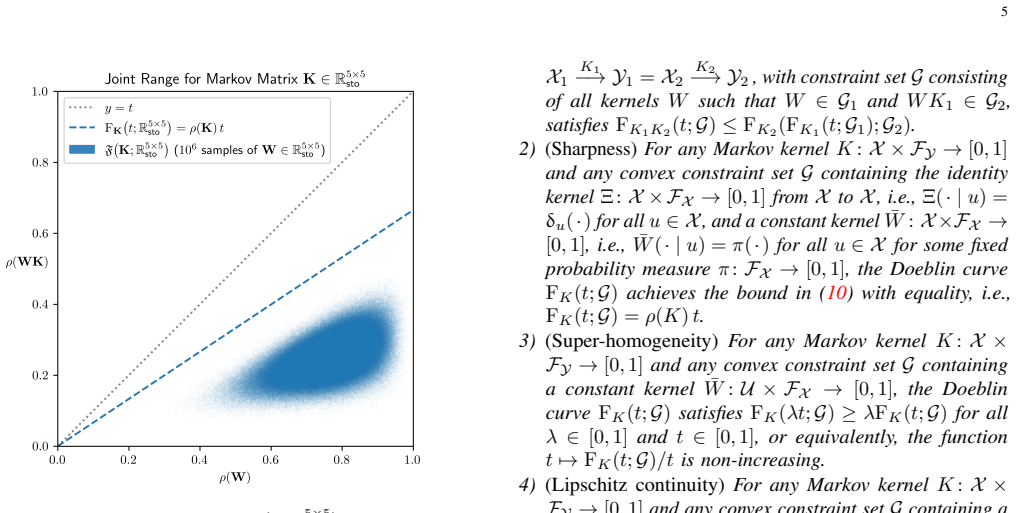
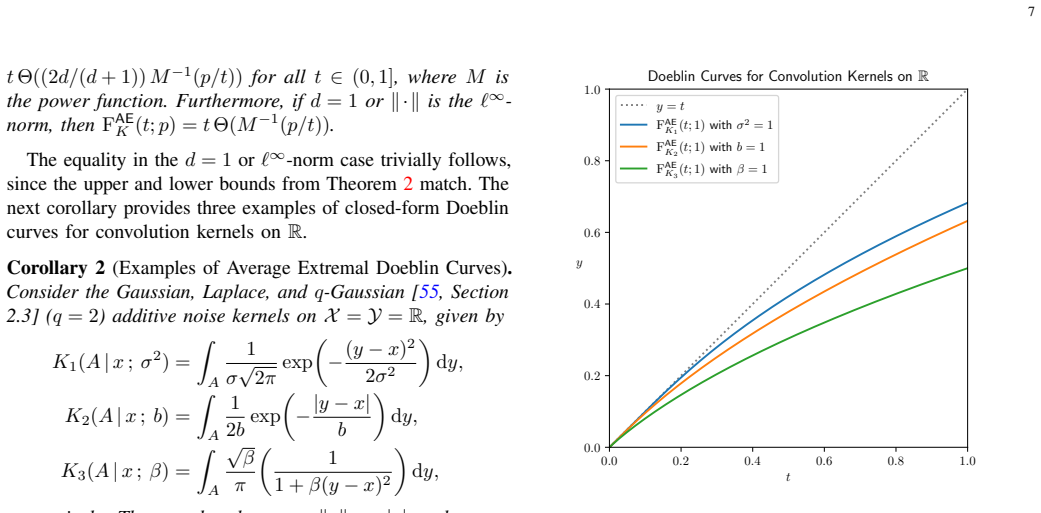
A Doeblin curve is a nonlinear function that quantifies the contraction behavior of a Markov kernel on collections of input distributions at specific levels of divergence and power. Through a new variational characterization of Doeblin coefficients, the paper derives properties, upper and lower bounds, and power-constrained versions of these curves, showing that they deliver non-vacuous contraction guarantees for channels whose ordinary Doeblin coefficient equals zero.
What carries the argument
Doeblin curve: a nonlinear function that quantifies contraction of a Markov kernel on collections of input distributions at fixed divergence and power levels.
If this is right
- Generalization bounds for noisy iterative optimization extend to wider domains and group settings.
- Error bounds for reliable computation with noisy circuits apply beyond single-instance cases.
- Differential privacy guarantees for online iterative algorithms capture finer contraction at specific operating points.
- Power-constrained versions of the curves allow contraction statements under input restrictions.
Where Pith is reading between the lines
- The variational characterization may permit numerical approximation of contraction rates for channels too large for direct Doeblin-coefficient computation.
- Doeblin curves could be composed across product channels to obtain joint contraction statements without separate coefficient calculations.
- The same nonlinear viewpoint might adapt to other distance measures such as Renyi divergence or Wasserstein distance where linear coefficients also vanish.
Load-bearing premise
Concepts of nonlinear information contraction are enough to define Doeblin curves that still produce usable multi-way contraction bounds when the ordinary Doeblin coefficient is zero.
What would settle it
An explicit channel whose Doeblin coefficient is zero and whose Doeblin curve remains flat (no contraction) at the divergence and power values relevant to a target application would show the claimed non-vacuous bounds do not hold.
Figures
read the original abstract
Recent research on Doeblin coefficients has shed light on their usefulness as a multi-way generalization of the Dobrushin contraction coefficient for TV distance, in a separate vein from their classic role in the theory of Markov chain ergodicity. However, strong conditions, such as being bounded away from 0, are typically necessary for Doeblin coefficients to establish the existence of information contraction. Building on recently formulated concepts of nonlinear information contraction, we aim to propose a finer-grained Doeblin-based characterization of multi-way contraction behavior which yields non-vacuous contraction guarantees even for channels whose Doeblin coefficient is 0. To this end, we introduce the notion of a Doeblin curve -- a nonlinear function which quantifies the contraction behavior of a Markov kernel on collections of input distributions at specific levels of divergence and power. Through the course of our analysis, we develop a new variational characterization of Doeblin coefficients, present several properties of Doeblin curves, define several versions of power-constrained Doeblin curves, and derive upper and lower bounds using our aforementioned variational characterization. We then utilize these results in diverse areas, including generalization bounds for noisy iterative optimization, error bounds for reliable computation with noisy circuits, and differential privacy guarantees for online iterative algorithms. In particular, we extend results in these areas to broader domains or group settings, leveraging Doeblin curves to reveal finer-grained contraction phenomena than Doeblin coefficients.
Editorial analysis
A structured set of objections, weighed in public.
Referee Report
Summary. The paper introduces Doeblin curves, defined as nonlinear functions that quantify multi-way contraction of a Markov kernel on collections of input distributions at fixed divergence and power levels. Building on nonlinear information contraction ideas, it provides a new variational characterization of Doeblin coefficients, derives properties and bounds for (power-constrained) Doeblin curves, and applies the framework to obtain generalization bounds for noisy optimization, error bounds for noisy circuits, and differential privacy guarantees for iterative algorithms, claiming non-vacuous contraction even when the ordinary Doeblin coefficient is zero.
Significance. If the central claims hold, the work would meaningfully extend contraction-coefficient techniques to kernels with vanishing global Doeblin coefficient by replacing a single scalar with a curve indexed by divergence level; the listed applications would then cover broader regimes than standard Doeblin-coefficient arguments permit.
major comments (2)
- [§3] §3 (variational characterization): the manuscript must exhibit an explicit channel example (or general construction) in which the Doeblin curve evaluated at a positive divergence level yields a contraction factor strictly less than 1 while the ordinary Doeblin coefficient is exactly zero; without this, the non-vacuous guarantee asserted in the abstract remains unverified.
- [§4–5] §4–5 (properties and bounds): the upper and lower bounds derived from the variational form must be shown to be strictly tighter than the trivial bound of 1 at the operating points used in the applications; if the bounds collapse to the classical Doeblin coefficient when the latter is zero, the claimed extension fails.
minor comments (2)
- Notation for the power-constrained variants should be introduced once and used consistently; several symbols appear to be redefined across sections.
- [§6–8] The applications in §6–8 would benefit from a short table comparing the new bounds against the classical Doeblin-coefficient bounds on the same examples.
Simulated Author's Rebuttal
We thank the referee for the thorough review and valuable suggestions. We address the two major comments point by point below and will incorporate the requested clarifications and examples into a revised manuscript.
read point-by-point responses
-
Referee: [§3] §3 (variational characterization): the manuscript must exhibit an explicit channel example (or general construction) in which the Doeblin curve evaluated at a positive divergence level yields a contraction factor strictly less than 1 while the ordinary Doeblin coefficient is exactly zero; without this, the non-vacuous guarantee asserted in the abstract remains unverified.
Authors: We agree that an explicit example is required to verify the non-vacuous claim. The variational characterization in §3 already implies the existence of such kernels (by taking collections of distributions at positive divergence where the multi-way contraction is strictly less than the global Doeblin coefficient of zero), but we did not include a concrete construction. In the revision we will add a specific example, e.g., a carefully parameterized binary erasure channel or a constructed finite-state kernel whose Doeblin coefficient vanishes while the curve at a chosen positive divergence level yields a factor <1, computed directly from the variational form. revision: yes
-
Referee: [§4–5] §4–5 (properties and bounds): the upper and lower bounds derived from the variational form must be shown to be strictly tighter than the trivial bound of 1 at the operating points used in the applications; if the bounds collapse to the classical Doeblin coefficient when the latter is zero, the claimed extension fails.
Authors: We accept that the applications in §6–8 must be accompanied by explicit verification that the derived bounds are strictly less than 1 at the relevant operating points. The power-constrained Doeblin curves are designed precisely so that they remain <1 at positive divergence levels even when the ordinary coefficient is zero; however, the current text does not numerically or analytically confirm this at the exact parameter values used in the generalization, circuit, and DP bounds. In the revision we will insert short calculations or plots in §4–5 (and cross-references in the applications) demonstrating that the variational upper and lower bounds are strictly tighter than 1 at those points. revision: yes
Circularity Check
No circularity: Doeblin curves defined from independent nonlinear contraction concepts
full rationale
The paper builds explicitly on 'recently formulated concepts of nonlinear information contraction' to introduce Doeblin curves as a nonlinear function quantifying contraction on collections of input distributions. It develops a new variational characterization, properties, power-constrained versions, and bounds, then applies them to generalization, computation, and privacy. No quoted equations or steps reduce the target contraction guarantee to a fitted parameter, self-definition, or self-citation chain by construction. The variational form is presented as a development enabling finer-grained analysis when the standard Doeblin coefficient is zero, without evidence that it collapses to the ordinary infimum. The derivation chain remains self-contained with independent content.
Axiom & Free-Parameter Ledger
axioms (1)
- domain assumption Nonlinear information contraction concepts recently formulated in the literature
invented entities (1)
-
Doeblin curve
no independent evidence
Reference graph
Works this paper leans on
-
[1]
On Doeblin curves and their properties,
W. Lu, A. Makur, and J. Singh, “On Doeblin curves and their properties,” inProceedings of the IEEE International Symposium on Information Theory (ISIT), Athens, Greece, July 7–12 2024, pp. 2544–2549
2024
-
[2]
Information-type measures of difference of probability distri- butions and indirect observations,
I. Csiszár, “Information-type measures of difference of probability distri- butions and indirect observations,”Studia Scientiarum Mathematicarum Hungarica, vol. 2, pp. 299–318, 1967
1967
-
[3]
A class of measures of informativity of observation channels,
I. Csiszár, “A class of measures of informativity of observation channels,” Periodica Mathematica Hungarica, vol. 2, no. 1–4, pp. 191–213, March 1972
1972
-
[4]
A connection between correlation and contingency,
H. O. Hirschfeld, “A connection between correlation and contingency,” Mathematical Proceedings of the Cambridge Philosophical Society, vol. 31, no. 4, pp. 520—-524, October 1935
1935
-
[5]
Central limit theorem for nonstationary Markov chains. i,
R. L. Dobrushin, “Central limit theorem for nonstationary Markov chains. i,”Theory of Probability & Its Applications, vol. 1, no. 1, pp. 65–80, 1956
1956
-
[6]
On measures of dependence,
A. Rényi, “On measures of dependence,”Acta Mathematica Academiae Scientiarum Hungarica, vol. 10, no. 3–4, pp. 441–451, September 1959
1959
-
[7]
Spreading of sets in product spaces and hypercontraction of the Markov operator,
R. Ahlswede and P. Gács, “Spreading of sets in product spaces and hypercontraction of the Markov operator,”The Annals of Probability, vol. 4, no. 6, pp. 925–939, December 1976
1976
-
[8]
J. E. Cohen, J. H. B. Kemperman, and G. Zb ˘aganu,Comparisons of Stochastic Matrices with Applications in Information Theory, Statistics, Economics and Population Sciences. Boston, MA, USA: Birkhäuser, 1998
1998
-
[9]
Signal propagation and noisy circuits,
W. S. Evans and L. J. Schulman, “Signal propagation and noisy circuits,” IEEE Transactions on Information Theory, vol. 45, no. 7, pp. 2367–2373, November 1999
1999
-
[10]
On hypercon- tractivity and a data processing inequality,
V . Anantharam, A. A. Gohari, S. Kamath, and C. Nair, “On hypercon- tractivity and a data processing inequality,” inProceedings of the IEEE International Symposium on Information Theory (ISIT), Honolulu, HI, USA, June 29–July 4 2014, pp. 3022–3026
2014
-
[11]
Bounds between contraction coefficients,
A. Makur and L. Zheng, “Bounds between contraction coefficients,” in Proceedings of the 53rd Annual Allerton Conference on Communication, Control, and Computing, Monticello, IL, USA, September 29–October 2 2015, pp. 1422–1429
2015
-
[12]
Strong data processing inequalities and Φ-Sobolev inequalities for discrete channels,
M. Raginsky, “Strong data processing inequalities and Φ-Sobolev inequalities for discrete channels,”IEEE Transactions on Information Theory, vol. 62, no. 6, pp. 3355–3389, June 2016
2016
-
[13]
Strong data-processing inequalities for channels and Bayesian networks,
Y . Polyanskiy and Y . Wu, “Strong data-processing inequalities for channels and Bayesian networks,” inConvexity and Concentration, E. Carlen, M. Madiman, and E. M. Werner, Eds. New York, NY , USA: Springer, 2017, pp. 211–249
2017
-
[14]
Strong data processing inequal- ities for input constrained additive noise channels,
F. P. Calmon, Y . Polyanskiy, and Y . Wu, “Strong data processing inequal- ities for input constrained additive noise channels,”IEEE Transactions on Information Theory, vol. 64, no. 3, pp. 1879–1892, March 2018
2018
-
[15]
Information contraction and decomposition,
A. Makur, “Information contraction and decomposition,” Sc.D. Thesis in Electrical Engineering and Computer Science, Massachusetts Institute of Technology, Cambridge, MA, USA, May 2019
2019
-
[16]
Comparison of contraction coefficients for f-divergences,
A. Makur and L. Zheng, “Comparison of contraction coefficients for f-divergences,”Problems of Information Transmission, vol. 56, no. 2, pp. 103–156, April 2020
2020
-
[17]
Universal features for high-dimensional learning and inference,
S.-L. Huang, A. Makur, G. W. Wornell, and L. Zheng, “Universal features for high-dimensional learning and inference,”Foundations and Trends in Communications and Information Theory, vol. 21, no. 1–2, pp. 1–299, February 2024
2024
-
[18]
Contraction coefficients of product symmetric channels,
D. Lee and A. Makur, “Contraction coefficients of product symmetric channels,” inProceedings of the 60th Annual Allerton Conference on Communication, Control, and Computing, Urbana, IL, USA, September 24–27 2024, pp. 1–8
2024
-
[19]
Doeblin coefficients and related measures,
A. Makur and J. Singh, “Doeblin coefficients and related measures,” IEEE Transactions on Information Theory, vol. 70, no. 7, pp. 4667–4692, July 2024
2024
-
[20]
Sur les propriétés asymptotiques de mouvement régis par certains types de chaînes simples,
W. Doeblin, “Sur les propriétés asymptotiques de mouvement régis par certains types de chaînes simples,”Bulletin Mathématique de la Société Roumaine des Sciences, vol. 39, no. 1, pp. 57–115, 1937, in French
1937
-
[21]
Exposé de la théorie des chaînes simples constantes de Markov à un nombre fini d’états,
W. Doeblin, “Exposé de la théorie des chaînes simples constantes de Markov à un nombre fini d’états,”Revue Mathématique de l’Union Interbalkanique, vol. 2, pp. 77–105, 1938, in French
1938
-
[22]
Approximation of sojourn-times via maximal couplings: motif frequency distributions,
M. E. Lladser and S. R. Chestnut, “Approximation of sojourn-times via maximal couplings: motif frequency distributions,”Journal of Mathematical Biology, vol. 69, no. 1, pp. 147–182, July 2014
2014
-
[23]
General state space Markov chains and MCMC algorithms,
G. O. Roberts and J. S. Rosenthal, “General state space Markov chains and MCMC algorithms,”Probability Surveys, vol. 1, pp. 20–71, 2004
2004
-
[24]
Mathematical aspects of mixing times in Markov chains,
R. Montenegro and P. Tetali, “Mathematical aspects of mixing times in Markov chains,”Foundations and Trends in Theoretical Computer Science, vol. 1, no. 3, pp. 237–354, 2006
2006
-
[25]
Dissipation of information in channels with input constraints,
Y . Polyanskiy and Y . Wu, “Dissipation of information in channels with input constraints,”IEEE Transactions on Information Theory, vol. 62, no. 1, pp. 35–55, January 2016
2016
-
[26]
A stable limit theorem for Markov chains,
S. R. Kimbleton, “A stable limit theorem for Markov chains,”The Annals of Mathematical Statistics, vol. 40, no. 4, pp. 1467–1473, August 1969
1969
-
[27]
Iterated random maps and some classes of Markov processes,
R. Bhattacharya and E. C. Waymire, “Iterated random maps and some classes of Markov processes,” inStochastic Processes: Theory and Methods, ser. Handbook of Statistics, D. N. Shanbhag and C. R. Rao, Eds. Amsterdam, Netherlands: Elsevier, 2001, vol. 19, pp. 145–170
2001
-
[28]
Occupancy distributions in Markov chains via Doeblin’s ergodicity coefficient,
S. Chestnut and M. E. Lladser, “Occupancy distributions in Markov chains via Doeblin’s ergodicity coefficient,” inProceedings of the 21st International Meeting on Probabilistic, Combinatorial, and Asymptotic Methods in the Analysis of Algorithms, Vienna, Austria, June 28–July 2 2010, pp. 79–92. 41
2010
-
[29]
Coding for positive rate in the source model key agreement problem,
A. Gohari, O. Günlü, and G. Kramer, “Coding for positive rate in the source model key agreement problem,”IEEE Transactions on Information Theory, vol. 66, no. 10, pp. 6303–6323, October 2020
2020
-
[30]
Coding theorems for noisy permutation channels,
A. Makur, “Coding theorems for noisy permutation channels,”IEEE Transactions on Information Theory, vol. 66, no. 11, pp. 6723–6748, November 2020
2020
-
[31]
Change detection of Markov kernels with unknown pre and post change kernel,
H. Chen, J. Tang, and A. Gupta, “Change detection of Markov kernels with unknown pre and post change kernel,” inProceedings of the 61st IEEE Conference on Decision and Control (CDC), Cancún, Mexico, December 6–9 2022, pp. 4814–4820
2022
-
[32]
Finite-time analysis of round-robin Kullback-Leibler upper confidence bounds for optimal adaptive allocation with multiple plays and Markovian rewards,
V . Moulos, “Finite-time analysis of round-robin Kullback-Leibler upper confidence bounds for optimal adaptive allocation with multiple plays and Markovian rewards,” inProceedings of the Advances in Neural Information Processing Systems 33 (NeurIPS), December 6–12 2020, pp. 7863–7874
2020
-
[33]
Minorization conditions and convergence rates for Markov chain Monte Carlo,
J. S. Rosenthal, “Minorization conditions and convergence rates for Markov chain Monte Carlo,”Journal of the American Statistical Association, vol. 90, no. 430, pp. 558–566, June 1995
1995
-
[34]
Éléments d’une théorie générale des chaînes simples constantes de Markoff,
W. Doeblin, “Éléments d’une théorie générale des chaînes simples constantes de Markoff,”Annales scientifiques de l’École Normale Supérieure, Serie 3, vol. 57, pp. 61–111, 1940
1940
-
[35]
Prefixes and the entropy rate for long- range sources,
I. Kontoyiannis and Y . M. Suhov, “Prefixes and the entropy rate for long- range sources,” inProceedings of the IEEE International Symposium on Information Theory (ISIT), Trondheim, Norway, June 27–July 1 1994, p. 194
1994
-
[36]
Comparison of channels: Criteria for domination by a symmetric channel,
A. Makur and Y . Polyanskiy, “Comparison of channels: Criteria for domination by a symmetric channel,”IEEE Transactions on Information Theory, vol. 64, no. 8, pp. 5704–5725, August 2018
2018
-
[37]
On an extension of the notion of f-divergence,
A. A. Gushchin, “On an extension of the notion of f-divergence,”Theory of Probability & Its Applications, vol. 52, no. 3, pp. 439–455, 2008
2008
-
[38]
Information processing equalities and the information–risk bridge,
R. C. Williamson and Z. Cranko, “Information processing equalities and the information–risk bridge,”Journal of Machine Learning Research, vol. 25, no. 103, 2024
2024
-
[39]
An operational approach to information leakage,
I. Issa, A. B. Wagner, and S. Kamath, “An operational approach to information leakage,”IEEE Transactions on Information Theory, vol. 66, no. 3, pp. 1625–1657, March 2020
2020
-
[40]
Bounds on maximal leakage over Bayesian networks,
A. Makur and J. Singh, “Bounds on maximal leakage over Bayesian networks,” inProceedings of the IEEE International Symposium on Information Theory (ISIT), Ann Arbor, MI, USA, June 22–27 2025, pp. 1–6
2025
-
[41]
Generalization bounds for noisy iterative algorithms using properties of additive noise channels,
H. Wang, R. Gao, and F. P. Calmon, “Generalization bounds for noisy iterative algorithms using properties of additive noise channels,”Journal of Machine Learning Research, vol. 24, no. 1, pp. 1–43, January 2023
2023
-
[42]
Local differential privacy is equivalent to contraction of an f-divergence,
S. Asoodeh, M. Aliakbarpour, and F. P. Calmon, “Local differential privacy is equivalent to contraction of an f-divergence,” inProceedings of the IEEE International Symposium on Information Theory (ISIT), Melbourne, Australia, July 12–20 2021, pp. 545–550
2021
-
[43]
LOCO: Adaptive exploration in reinforcement learning via local estimation of contraction coefficients,
M. Diaz, L. Paull, and P. S. Castro, “LOCO: Adaptive exploration in reinforcement learning via local estimation of contraction coefficients,” inSelf-Supervision for Reinforcement Learning Workshop - ICLR, May 7 2021, pp. 1–18
2021
-
[44]
Hiriart-Urruty and C
J.-B. Hiriart-Urruty and C. Lemaréchal,Fundamentals of Convex Analysis, ser. Grundlehren Text Editions. Berlin, Heidelberg, Germany: Springer, 2001
2001
-
[45]
Çinlar,Probability and Stochastics
E. Çinlar,Probability and Stochastics. New York, NY , USA: Springer, 2011
2011
-
[46]
Polyanskiy and Y
Y . Polyanskiy and Y . Wu,Information Theory: From Coding to Learning. Cambridge, UK: Cambridge University Press, 2025
2025
-
[47]
Thorisson,Coupling, Stationarity, and Regeneration
H. Thorisson,Coupling, Stationarity, and Regeneration. New York, NY , USA: Springer New York, 2000
2000
-
[48]
On properties of Doeblin coefficients,
A. Makur and J. Singh, “On properties of Doeblin coefficients,” in Proceedings of the IEEE International Symposium on Information Theory (ISIT), Taipei, Taiwan, June 25–30 2023, pp. 72–77
2023
-
[49]
Kallenberg,Foundations of Modern Probability, 3rd ed
O. Kallenberg,Foundations of Modern Probability, 3rd ed. Cham, Switzerland: Springer, 2021
2021
-
[50]
Towards the general definition of the amount of information,
I. M. Gelfand, A. N. Kolmogorov, and A. M. Yaglom, “Towards the general definition of the amount of information,”Doklady Akademii Nauk SSSR, vol. 111, pp. 745–748, 1956, in Russian
1956
-
[51]
On a Gel’fand-Yaglom-Peres theorem for f- divergences,
G. L. Gilardoni, “On a Gel’fand-Yaglom-Peres theorem for f- divergences,” November 2009, arXiv:0911.1934 [cs.IT]. [Online]. Available: https://arxiv.org/abs/0911.1934
Pith/arXiv arXiv 2009
-
[52]
Ueber die kleinste kugel, die eine räumliche figur einschliesst
H. Jung, “Ueber die kleinste kugel, die eine räumliche figur einschliesst.” Journal für die reine und angewandte Mathematik, vol. 123, pp. 241–257, 1901, in German
1901
-
[53]
On the exact value of Jung constants of Orlicz sequence spaces,
Y . Q. Yan, “On the exact value of Jung constants of Orlicz sequence spaces,”Collectanea Mathematica, vol. 55, no. 2, pp. 163–170, 2004
2004
-
[54]
Convex regions and projections in Minkowski spaces,
F. Bohnenblust, “Convex regions and projections in Minkowski spaces,” Annals of Mathematics, vol. 39, no. 2, pp. 301–308, April 1938
1938
-
[55]
On a q-central limit theorem consistent with nonextensive statistical mechanics,
S. Umarov, C. Tsallis, and S. Steinberg, “On a q-central limit theorem consistent with nonextensive statistical mechanics,”Milan Journal of Mathematics, vol. 76, pp. 307–328, 2008
2008
-
[56]
Non-convex learning via stochastic gradient Langevin dynamics: a nonasymptotic analysis,
M. Raginsky, A. Rakhlin, and M. Telgarsky, “Non-convex learning via stochastic gradient Langevin dynamics: a nonasymptotic analysis,” in Proceedings of the 2017 Conference on Learning Theory, Amsterdam, Netherlands, July 7–10 2017, pp. 1674–1703
2017
-
[57]
Probabilistic logics and the synthesis of reliable organisms from unreliable components,
J. von Neumann, “Probabilistic logics and the synthesis of reliable organisms from unreliable components,” inAutomata Studies, ser. Annals of Mathematics Studies, C. E. Shannon and J. McCarthy, Eds. Princeton, NJ, USA: Princeton University Press, 1956, vol. 34, pp. 43–98
1956
-
[58]
On the maximum tolerable noise for reliable computation by formulas,
B. Hajek and T. Weller, “On the maximum tolerable noise for reliable computation by formulas,”IEEE Transactions on Infomation Theory, vol. 37, no. 2, pp. 388–391, March 1991
1991
-
[59]
On the maximum tolerable noise of k-input gates for reliable computation by formulas,
W. S. Evans and L. J. Schulman, “On the maximum tolerable noise of k-input gates for reliable computation by formulas,”IEEE Transactions on Information Theory, vol. 49, no. 11, pp. 3094–3098, November 2003
2003
-
[60]
Reliable computation by large-alphabet formulas in the presence of noise,
A. K. Tan, M. H. Ho, and I. L. Chuang, “Reliable computation by large-alphabet formulas in the presence of noise,”IEEE Transactions on Information Theory, vol. 70, no. 12, December 2024
2024
-
[61]
D. A. Levin, Y . Peres, and E. L. Wilmer,Markov Chains and Mixing Times, 1st ed. Providence, RI, USA: American Mathematical Society, 2009
2009
-
[62]
Limiting privacy breaches in privacy preserving data mining,
A. Evfimievski, J. Gehrke, and R. Srikant, “Limiting privacy breaches in privacy preserving data mining,” inProceedings of the 22nd ACM SIGMOD-SIGACT-SIGART Symposium on Principles of Database Sys- tems, San Diego, CA, USA, June 9–11 2003, pp. 211–222
2003
-
[63]
What can we learn privately?
S. P. Kasiviswanathan, H. K. Lee, K. Nissim, S. Raskhodnikova, and A. Smith, “What can we learn privately?”SIAM Journal on Computing, vol. 40, no. 3, pp. 793–826, 2011
2011
-
[64]
Three variants of differential privacy: Lossless conversion and applications,
S. Asoodeh, J. Liao, F. P. Calmon, O. Kosut, and L. Sankar, “Three variants of differential privacy: Lossless conversion and applications,” IEEE Journal on Selected Areas in Information Theory, vol. 2, no. 1, pp. 208–222, March 2021
2021
-
[65]
RAPPOR: Randomized aggregatable privacy-preserving ordinal response,
U. Erlingsson, V . Pihur, and A. Korolova, “RAPPOR: Randomized aggregatable privacy-preserving ordinal response,” inProceedings of the 2014 ACM SIGSAC Conference on Computer and Communications Security, Scottsdale, AZ, USA, November 3–7 2014, pp. 1054–1067
2014
-
[66]
LDP-Fed: Federated learning with local differential privacy,
S. Truex, L. Liu, K.-H. Chow, M. E. Gursoy, and W. Wei, “LDP-Fed: Federated learning with local differential privacy,” inProceedings of the Third ACM International Workshop on Edge Systems, Analytics and Networking, Heraklion, Greece, April 27 2020, pp. 61–66
2020
-
[67]
The algorithmic foundations of differential privacy,
C. Dwork and A. Roth, “The algorithmic foundations of differential privacy,”Foundations and Trends® in Theoretical Computer Science, vol. 9, no. 3–4, pp. 211–407, 2014
2014
-
[68]
The composition theorem for differential privacy,
P. Kairouz, S. Oh, and P. Viswanath, “The composition theorem for differential privacy,” inProceedings of the 32nd International Conference on Machine Learning (ICML), Lille, France, July 6–11 2015, pp. 1376– 1385
2015
-
[69]
Privacy amplification of iterative algorithms via contraction coefficients,
S. Asoodeh, M. Diaz, and F. P. Calmon, “Privacy amplification of iterative algorithms via contraction coefficients,” inProceedings of the IEEE International Symposium on Information Theory (ISIT), Los Angeles, CA, USA, June 21–26 2020, pp. 896–901
2020
-
[70]
Uncertainty, information, and sequential experiments,
M. H. DeGroot, “Uncertainty, information, and sequential experiments,” The Annals of Mathematical Statistics, vol. 33, no. 2, June 1962
1962
-
[71]
Approximation in Sobolev spaces of nonlinear expressions involving the gradient,
P. Hajłasz and J. Malý, “Approximation in Sobolev spaces of nonlinear expressions involving the gradient,”Arkiv för Matematik, vol. 40, no. 2, pp. 245–274, October 2002
2002
-
[72]
S. P. Boyd and L. Vandenberghe,Convex Optimization. New York, NY , USA: Cambridge University Press, 2009
2009
-
[73]
Talagrand meets Talagrand: Upper and lower bounds on expected soft maxima of Gaussian processes with finite index sets,
Y . Chu and M. Raginsky, “Talagrand meets Talagrand: Upper and lower bounds on expected soft maxima of Gaussian processes with finite index sets,” inProceedings of the 37th International Conference on Algorithmic Learning Theory, Toronto, ON, Canada, February 23–26 2026, pp. 1–17
2026
-
[74]
M. J. Wainwright,High-Dimensional Statistics: A Non-Asymptotic Viewpoint. Cambridge, UK: Cambridge University Press, 2019
2019
-
[75]
The contraction principle as a particular case of Kleene’s fixed point theorem,
A. Baranga, “The contraction principle as a particular case of Kleene’s fixed point theorem,”Discrete Mathematics, vol. 98, no. 1, pp. 75–79, December 1991
1991
-
[76]
Individual privacy accounting via a Rényi filter,
V . Feldman and T. Zrnic, “Individual privacy accounting via a Rényi filter,” inProceedings of the Advances in Neural Information Processing Systems 34 (NeurIPS), December 6–14 2021, pp. 28 080–28 091
2021
-
[77]
Learning with user-level privacy,
D. Levy, Z. Sun, K. Amin, S. Kale, A. Kulesza, M. Mohri, and A. T. Suresh, “Learning with user-level privacy,” inProceedings of the Advances in Neural Information Processing Systems 34 (NeurIPS), December 6–14 2021, pp. 12 466–12 479. 42
2021
-
[78]
Rudin,Principles of Mathematical Analysis, 3rd ed
W. Rudin,Principles of Mathematical Analysis, 3rd ed. New York, NY , USA: McGraw-Hill, 1976
1976
-
[79]
On the spectral norm of Gaussian random matrices,
R. Van Handel, “On the spectral norm of Gaussian random matrices,” Transactions of the American Mathematical Society, vol. 369, no. 11, pp. 8161–8178, November 2017
2017
-
[80]
Vershynin,High-Dimensional Probability, 1st ed
R. Vershynin,High-Dimensional Probability, 1st ed. Cambridge, UK: Cambridge University Press, 2018
2018
discussion (0)
Sign in with ORCID, Apple, or X to comment. Anyone can read and Pith papers without signing in.