REVIEW 4 major objections 5 minor 30 references
Soft Robotic Dynamic In-Hand Pen Spinning
T0 review · 4 major / 5 minor · reviewed 2026-08-12 · deepseek-v4-flash
Pith's one-line read The SWIFT system shows that a soft three-finger hand can learn to spin a pen dynamically by optimizing eight interaction primitives through real-world trial and error, reaching 100% success on three pens and generalizing to a brush and a…
desk verdict A genuinely new soft-hand dynamic manipulation result whose headline success rates are not as clean as the abstract implies; the evaluation protocol needs scrutiny before you trust the 10/10 numbers. read the letter →
The pith
A machine-rendered reading of the paper's core claim, the machinery that carries it, and where it could break.
The reading
What carries the argument
The carrying mechanism is the reduction of pen spinning to an eight-parameter primitive space: six servo-target changes $s \in \mathbb{R}^6$ (two per finger on the tendon-driven MOE soft hand, each finger actuated by two servos pulling four tendons), a catch delay $d$, and a grasp displacement $g$ along the pen's length. These parameters are executed open-loop and scored by $r = r_{\mathrm{rot}} - \lambda p_{\mathrm{fall}}$, where the reward accumulates the pen's rotation around the camera's $z$-axis while the pen is tracked, and the penalty counts frames where the pen is displaced from the fingers. CMA-ES, a gradient-free evolution strategy, updates the parameter distribution from each batch of real-world trials, so the search itself carries the reasoning that previous systems put into simulation or analytic models. The result is a small search space that still includes the grasp point, which the ablations show is necessary for reliable spinning across different weight distributions.
What would settle it
Run the same 130-sample optimization on visually identical pens while shifting the manual reset slot by 5–10 mm along the pen's length, and check whether the 10/10 success rate collapses; if it does, the learned skill depends on the fixed reset geometry rather than on a general dynamic manipulation capability.
Extended reading notes
Core claim
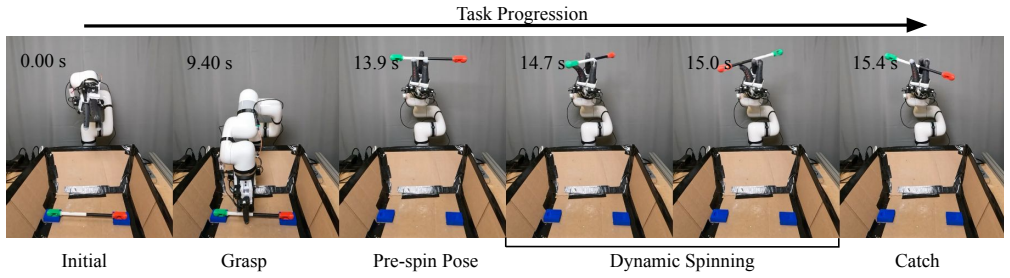
The central claim is that dynamic pen spinning, usually reserved for high-speed rigid hands with analytic models or simulation-trained policies, can be learned by a soft three-finger hand from scratch in the real world. The paper demonstrates this with the SWIFT system: it optimizes an eight-dimensional action $(s,d,g)$, where $s$ are six servo angle changes, $d$ is a catch delay, and $g$ is a horizontal grasp offset along the pen. Trials are self-labeled through a camera-based objective that rewards rotation of the pen's major axis around the $z$-axis and penalizes frames where the pen is not near the fingers. After about 130 sampled actions per object, the optimized parameters succeed on all three pens (10/10 each), and the same procedure produces 10/10 on a brush and 5/10 on a screwdriver. The author's interpretation is that compliance, rather than being a limitation for fast manipulation, lets the system interact safely and repeatably while the search finds the timing and contact that make the spin work.
Load-bearing premise
The whole loop assumes every trial starts from a repeatable grasp, which is achieved by a human manually placing the pen in a fixed slot and the arm following a fixed motion sequence; if that setup variation is larger than the differences the optimizer is meant to find, the learned parameters will not transfer.
Editorial extensions
If this is right
- With the full eight-parameter optimization, the system reaches 10/10 success on three visually identical pens that differ in total mass and center-of-mass offset, after about 130 sampled actions per pen.
- Removing the grasp-location parameter from the search reduces success to at most 7/10 on one pen and 0/10 on the other two, so searching over where to grasp is a necessary part of the discovered solution.
- Action parameters found for one pen transfer poorly to another (pen 1's solution gives 7/10 on pen 3 and 0/10 on pen 2), so each object needs its own short optimization run.
- The same method spins a brush successfully in 10/10 trials and a screwdriver in 5/10 trials, indicating the approach is not limited to symmetric, uniformly weighted cylinders.
- Because everything is learned from real-world interactions with a camera-based reward, the approach sidesteps the sim-to-real gap that prior pen-spinning systems had to overcome.
Reading between the lines
- Inference: the optimized grasp displacement $g$ likely tracks each pen's center-of-mass offset; a direct test would be to check whether $g$ changes in the same direction as the COM positions shown for the three pens.
- Inference: the same eight-parameter recipe could be applied to other fast in-hand tricks (coin flip, pencil twirl, finger pass) by changing the rotation axis in the reward and reusing CMA-ES, provided the task can be captured by a similarly small primitive family.
- Inference: the manual reset and human success labels are currently hidden supervision; replacing the fixed slot with visual servoing and deriving a binary success signal from the drop penalty would make the loop fully autonomous and reveal how much of the 130-sample efficiency depends on the reset procedure.
- Inference: if this scaling holds, precise dynamic models and high-speed closed-loop control are not prerequisites for fast soft manipulation; the hand's compliance can absorb the errors of open-loop primitives.
Signed reviews
Editorial analysis
A structured set of objections, weighed in public.
Referee Report
Summary. The paper presents SWIFT, a system that uses a three-finger soft robotic hand (MOE) attached to a 6-DOF arm to learn a "Thumbaround"-style pen spinning skill entirely from real-world trials. The action space is compressed to eight parameters: six servo-target changes, a catch delay, and a horizontal grasp offset. CMA-ES optimizes these parameters using a camera-based proxy reward that combines accumulated rotation around the hand's m3 finger with a fall penalty. The authors report 10/10 success on three visually identical pens with different mass distributions after 130 sampled actions per object, and 10/10 and 5/10 on a brush and a screwdriver respectively. They also report ablations showing that optimizing the grasp offset is important and that parameters tuned for one pen do not transfer to another. The claimed novelty is that a soft hand can learn a fast, dynamic in-hand manipulation skill without simulation, precise object models, or closed-loop high-speed control.
Significance. If the claims hold, this would be a meaningful step for soft robotic manipulation, which has mostly been limited to quasi-static tasks. The paper's strengths are its real-world, trial-and-error optimization approach; a deliberately compact task-specific parameterization; and the public release of videos, data, and code. The system also demonstrates a plausible use of CMA-ES on a physical platform where simulation would be difficult due to soft-body contact dynamics. However, the evaluation protocol currently undermines the headline claims: the paper describes trials as "self-labeled" while later stating that a human observer labels success, and the generalization results are based on a manually selected successful sample rather than the optimized policy. These issues are load-bearing for the central contribution of autonomous, self-supervised learning, and they must be resolved before the reported success rates can be interpreted as policy performance.
major comments (4)
- [Abstract, §V-B] The abstract and contribution (2) describe the trials as "self-labeled" and the process as "self-supervised autonomous." In §V-B, however, the authors state: "a human observer labels trials a success or failure." These statements are in direct tension. If the human labels are used only for the reported success rates and not for optimization, the text must say so explicitly and avoid "self-labeled." If human labels are used to select or update parameters, the process is not autonomous and the contribution claim should be revised. This distinction is load-bearing for the paper's central claim.
- [§V-A] For the brush and screwdriver, the authors "chose the first manually observed success for evaluation, rather than directly using the stored value of CMA-ES." Selecting a parameter sample because a human observed a success, and then scoring that same sample 10/10 or 5/10, is a selection-biased estimate of the learned policy. It does not measure the performance of the CMA-ES incumbent, the final mean, or the best-by-objective parameter. The paper should report the success rates of the final CMA-ES policy (e.g., the incumbent after the last generation), and clearly separate optimization samples from evaluation trials.
- [Table I, §V-A] It is not specified whether the 10-trial success rates for the three pens are obtained from the CMA-ES incumbent, from the best-by-objective sample, or from a manually selected successful sample as in the generalization experiments. If the pen rows also use a manually selected favorable trial, the 10/10 claims overstate the reliability of the learned policy. The authors should state the exact parameter selection rule for every row and, ideally, report success rates for both the objective-best and the final mean parameter sets.
- [§IV-D, §V-B] The objective in Eq. (1) is an indirect proxy: it accumulates z-axis rotation while the filtered point cloud exceeds a threshold, and the penalty counts frames with insufficient points. This proxy may score a trial as good even when the pen does not complete a full rotation around the finger or is caught in a way the human would not call a success. Since "success" is defined in §III as a full rotation without dropping, the mismatch between the proxy and the human label should be quantified (e.g., agreement rate between high reward and human success), or the objective should be redesigned to directly encode the success criterion. At minimum, the paper should clarify whether the human labels influenced the optimization or only the final evaluation.
minor comments (5)
- [§IV-A] There is a typo: "The sot robot hand consists..." should be "The soft robot hand consists...".
- [§IV-D] The sentence "The camera has setup to have its z-axis pointing..." is ungrammatical; it should be "The camera was set up with its z-axis pointing...".
- [§IV-D] The definition of the rotation angle θt_z is not precise: the text says the first principal component is projected onto the x, y, and z planes to compute Euler angles, but it is unclear how the sign and branch of the z-axis rotation are resolved. Please specify the exact convention used.
- [§V-A] The phrase "130 sampled actions per object" in the abstract is inconsistent with the generalization protocol, where optimization stops at the first generation with observed successes (reported as generation 4, i.e., about 52 samples). The per-object sample counts should be stated explicitly for the pen experiments and for the brush/screwdriver experiments separately.
- [Table I] The row label "Initialization ∅" is confusing: the row reports the success rate of the fixed hand-crafted initialization, not of an empty parameter set. Renaming it to "Hand-crafted initialization (no optimization)" would make the table easier to interpret.
Circularity Check
No circularity: the learned spinning parameters are evaluated against an external human-labeled success criterion, and no equation or claimed result reduces to its inputs.
full rationale
SWIFT is an empirical learning system, not a derivation. The 8-D action parameterization (s,d,g) is hypothesized, CMA-ES optimizes the camera-based reward r = r_rot - lambda p_fall in Eq. (1), and success is defined externally as a full rotation without dropping and labeled by a human observer in Section V-B. The reward is an approximate proxy for success, but the paper does not define success as the reward, and the final Table I success rates are measured from repeated trials, not read off the optimization objective. The 'first manually observed success' selection for the brush and screwdriver is a statistical/selection concern about how representative the reported rates are, but it is not a circularity: the selected parameter is still executed and scored independently against the human-defined success criterion. Self-citations to the authors' MOE hand ([7], [28]) supply hardware and prior proprioception work, but the spinning result is not derived from those citations. No uniqueness theorem, ansatz-by-citation, or renaming pattern is present. The paper's claims are therefore self-contained empirical claims with no by-construction equivalence between inputs and outputs.
Assumptions & free parameters
free parameters (5)
- Spinning servo targets s (6 values) =
Not reported; optimized by CMA-ES
- Catch delay d =
Not reported; optimized by CMA-ES
- Grasp location offset g =
Not reported; optimized by CMA-ES
- Reward penalty weight lambda =
Not stated in the paper
- Point-cloud drop threshold n =
Not stated in the paper
assumptions (5)
- domain assumption The object is long, cylindrically symmetric, has a well-defined major axis, and its mass and size are within the hand's manipulation capabilities.
- domain assumption The manual fixturing and pre-programmed arm motions produce repeatable grasps.
- domain assumption The reward computed from RGB-D observations (SAM v2 segmentation, PCA on point cloud) is a sufficient proxy for the spinning behavior.
- domain assumption CMA-ES with population size 13 and 10 generations is sufficient to find good parameters.
- domain assumption The RGB-D camera's z-axis is roughly aligned with finger m3, so the reward's z-rotation about the camera axis approximates rotation about the finger.
Cite this review
Pith. "Pith review of Soft Robotic Dynamic In-Hand Pen Spinning." pith.science (2026). https://pith.science/paper/R6DUIMUY
@misc{pith2026241112734,
  author       = {Pith},
  title        = {Pith review of: Soft Robotic Dynamic In-Hand Pen Spinning},
  year         = {2026},
  howpublished = {\url{https://pith.science/paper/R6DUIMUY}},
  note         = {Machine review of arXiv:2411.12734}
}
read the original abstract
Dynamic in-hand manipulation remains a challenging task for soft robotic systems that have demonstrated advantages in safe compliant interactions but struggle with high-speed dynamic tasks. In this work, we present SWIFT, a system for learning dynamic tasks using a soft and compliant robotic hand. Unlike previous works that rely on simulation, quasi-static actions and precise object models, the proposed system learns to spin a pen through trial-and-error using only real-world data without requiring explicit prior knowledge of the pen's physical attributes. With self-labeled trials sampled from the real world, the system discovers the set of pen grasping and spinning primitive parameters that enables a soft hand to spin a pen robustly and reliably. After 130 sampled actions per object, SWIFT achieves 100% success rate across three pens with different weights and weight distributions, demonstrating the system's generalizability and robustness to changes in object properties. The results highlight the potential for soft robotic end-effectors to perform dynamic tasks including rapid in-hand manipulation. We also demonstrate that SWIFT generalizes to spinning items with different shapes and weights such as a brush and a screwdriver which we spin with 10/10 and 5/10 success rates respectively. Videos, data, and code are available at https://soft-spin.github.io.
Figures


Figures from the paper (4 more)


Reference graph
Works this paper leans on
-
[1]
The complexities of grasping in the wild,
Y . C. Nakamura, D. M. Troniak, A. Rodriguez, M. T. Mason, and N. S. Pollard, “The complexities of grasping in the wild,” in 2017 IEEE-RAS 17th International Conference on Humanoid Robotics (Humanoids) , pp. 233–240, IEEE, 2017. 1
work page 2017
-
[2]
A system for general in-hand object re-orientation,
T. Chen, J. Xu, and P. Agrawal, “A system for general in-hand object re-orientation,” in Conference on Robot Learning, pp. 297–307, PMLR, 2022. 1
work page 2022
-
[3]
B. Sundaralingam and T. Hermans, “Geometric in-hand regrasp plan- ning: Alternating optimization of finger gaits and in-grasp manip- ulation,” in 2018 IEEE International Conference on Robotics and Automation (ICRA), pp. 231–238, IEEE, 2018. 1
work page 2018
-
[4]
Surprisingly Robust In-Hand Manipulation: An Empirical Study
A. Bhatt, A. Sieler, S. Puhlmann, and O. Brock, “Surprisingly robust in-hand manipulation: An empirical study,” arXiv preprint arXiv:2201.11503, 2022. 1, 2
work page Pith review arXiv 2022
-
[5]
Dexterous soft hands linearize feedback- control for in-hand manipulation,
A. Sieler and O. Brock, “Dexterous soft hands linearize feedback- control for in-hand manipulation,” in 2023 IEEE/RSJ International Conference on Intelligent Robots and Systems (IROS), pp. 8757–8764, IEEE, 2023. 1
work page 2023
-
[6]
Ultragentle manipulation of delicate structures using a soft robotic gripper,
N. R. Sinatra, C. B. Teeple, D. M. V ogt, K. K. Parker, D. F. Gruber, and R. J. Wood, “Ultragentle manipulation of delicate structures using a soft robotic gripper,” Science Robotics, vol. 4, no. 33, p. eaax5425,
-
[7]
Moe-hair: Toward soft and compliant contact-rich hair manipulation and care,
U. Yoo, N. Dennler, M. Mataric, S. Nikolaidis, J. Oh, and J. Ichnowski, “Moe-hair: Toward soft and compliant contact-rich hair manipulation and care,” in Companion of the 2024 ACM/IEEE International Con- ference on Human-Robot Interaction , pp. 1163–1167, 2024. 1
work page 2024
-
[8]
Robust proprioceptive grasping with a soft robot hand,
B. S. Homberg, R. K. Katzschmann, M. R. Dogar, and D. Rus, “Robust proprioceptive grasping with a soft robot hand,” Autonomous robots, vol. 43, pp. 681–696, 2019. 1
work page 2019
Show all 30 references
-
[9]
Dual-arm control for coordinated fast grabbing and tossing of an object: Proposing a new approach,
M. Bombile and A. Billard, “Dual-arm control for coordinated fast grabbing and tossing of an object: Proposing a new approach,” IEEE Robotics & Automation Magazine , vol. 29, no. 3, pp. 127–138, 2022. 1
2022
-
[10]
Flingbot: The unreasonable effectiveness of dynamic manipulation for cloth unfolding,
H. Ha and S. Song, “Flingbot: The unreasonable effectiveness of dynamic manipulation for cloth unfolding,” in Conference on Robot Learning, pp. 24–33, PMLR, 2022. 1, 2
2022
-
[11]
Dynamic manipulation like normal- type pen spinning by a high-speed robot hand and a high-speed vision system,
S. Nakatani and Y . Yamakawa, “Dynamic manipulation like normal- type pen spinning by a high-speed robot hand and a high-speed vision system,” in 2023 IEEE/ASME International Conference on Advanced Intelligent Mechatronics (AIM) , pp. 636–642, IEEE, 2023. 1, 2
2023
-
[12]
Lessons from learning to spin “pens
J. Wang, Y . Yuan, H. Che, H. Qi, Y . Ma, J. Malik, and X. Wang, “Lessons from learning to spin “pens”,” in 8th Annual Conference on Robot Learning. 1, 2
-
[13]
Influence of antagonistic tensions on distributed friction forces of multiseg- ment tendon-driven continuum manipulators with irregular geometry,
Y . Liu, U. Yoo, S. Ha, S. F. Atashzar, and F. Alambeigi, “Influence of antagonistic tensions on distributed friction forces of multiseg- ment tendon-driven continuum manipulators with irregular geometry,” IEEE/ASME Transactions on Mechatronics , vol. 27, no. 5, pp. 2418– 2428...
2021
-
[14]
Tube acceleration: robust dexterous throwing against release uncertainty,
Y . Liu and A. Billard, “Tube acceleration: robust dexterous throwing against release uncertainty,” IEEE Transactions on Robotics , 2024. 2
2024
-
[15]
Tossing- bot: Learning to throw arbitrary objects with residual physics,
A. Zeng, S. Song, J. Lee, A. Rodriguez, and T. Funkhouser, “Tossing- bot: Learning to throw arbitrary objects with residual physics,” IEEE Transactions on Robotics , vol. 36, no. 4, pp. 1307–1319, 2020
2020
-
[16]
Softoss: Learning to throw objects with a soft robot,
D. Bianchi, M. G. Antonelli, C. Laschi, A. M. Sabatini, and E. Falotico, “Softoss: Learning to throw objects with a soft robot,” IEEE Robotics & Automation Magazine , 2023. 2
2023
-
[17]
Gomp-fit: Grasp- optimized motion planning for fast inertial transport,
J. Ichnowski, Y . Avigal, Y . Liu, and K. Goldberg, “Gomp-fit: Grasp- optimized motion planning for fast inertial transport,” in 2022 interna- tional conference on robotics and automation (ICRA) , pp. 5255–5261, IEEE, 2022. 2
2022
-
[18]
Efficiently learning single-arm fling motions to smooth garments,
L. Y . Chen, H. Huang, E. Novoseller, D. Seita, J. Ichnowski, M. Laskey, R. Cheng, T. Kollar, and K. Goldberg, “Efficiently learning single-arm fling motions to smooth garments,” in The International Symposium of Robotics Research , pp. 36–51, Springer, 2022. 2
2022
-
[19]
Robots of the lost arc: Self-supervised learning to dynamically manip- ulate fixed-endpoint cables,
H. Zhang, J. Ichnowski, D. Seita, J. Wang, H. Huang, and K. Goldberg, “Robots of the lost arc: Self-supervised learning to dynamically manip- ulate fixed-endpoint cables,” in 2021 IEEE International Conference on Robotics and Automation (ICRA) , pp. 4560–4567, IEEE, 2021
2021
-
[20]
Itera- tive residual policy: for goal-conditioned dynamic manipulation of deformable objects,
C. Chi, B. Burchfiel, E. Cousineau, S. Feng, and S. Song, “Itera- tive residual policy: for goal-conditioned dynamic manipulation of deformable objects,” The International Journal of Robotics Research , vol. 43, no. 4, pp. 389–404, 2024
2024
-
[21]
Dynamic high-speed knotting of a rope by a manipulator,
Y . Yamakawa, A. Namiki, and M. Ishikawa, “Dynamic high-speed knotting of a rope by a manipulator,” International Journal of Ad- vanced Robotic Systems , vol. 10, no. 10, p. 361, 2013. 2
2013
-
[22]
Dynamic pen spinning using a high-speed multifingered hand with high-speed tactile sensor,
T. Ishihara, A. Namiki, M. Ishikawa, and M. Shimojo, “Dynamic pen spinning using a high-speed multifingered hand with high-speed tactile sensor,” in2006 6th IEEE-RAS International Conference on Humanoid Robots, pp. 258–263, IEEE, 2006. 2
2006
-
[23]
Eureka: Human- level reward design via coding large language models,
Y . J. Ma, W. Liang, G. Wang, D.-A. Huang, O. Bastani, D. Ja- yaraman, Y . Zhu, L. Fan, and A. Anandkumar, “Eureka: Human- level reward design via coding large language models,” arXiv preprint arXiv:2310.12931, 2023. 2
2023 arXiv
-
[24]
Rbo hand 3: A platform for soft dexterous manipulation,
S. Puhlmann, J. Harris, and O. Brock, “Rbo hand 3: A platform for soft dexterous manipulation,” IEEE Transactions on Robotics, vol. 38, no. 6, pp. 3434–3449, 2022. 2
2022
-
[25]
Control of soft robots with inertial dynamics,
D. A. Haggerty, M. J. Banks, E. Kamenar, A. B. Cao, P. C. Curtis, I. Mezi ´c, and E. W. Hawkes, “Control of soft robots with inertial dynamics,” Science robotics, vol. 8, no. 81, p. eadd6864, 2023. 2
2023
-
[26]
Softsling: A soft robotic arm control strategy to throw objects with circular run-ups,
D. Bianchi, G. Campinoti, C. Comitini, C. Laschi, A. Rizzo, A. M. Sabatini, and E. Falotico, “Softsling: A soft robotic arm control strategy to throw objects with circular run-ups,” IEEE Robotics and Automation Letters, 2024. 2
2024
-
[27]
Nonlinear system iden- tification of soft robot dynamics using koopman operator theory,
D. Bruder, C. D. Remy, and R. Vasudevan, “Nonlinear system iden- tification of soft robot dynamics using koopman operator theory,” in 2019 International Conference on Robotics and Automation (ICRA) , pp. 6244–6250, IEEE, 2019. 2
2019
-
[28]
Poe: Acoustic soft robotic proprioception for omnidirectional end-effectors,
U. Yoo, Z. Lopez, J. Ichnowski, and J. Oh, “Poe: Acoustic soft robotic proprioception for omnidirectional end-effectors,” arXiv preprint arXiv:2401.09382, 2024. 2
2024 arXiv
-
[29]
Sam 2: Segment anything in images and videos,
N. Ravi, V . Gabeur, Y .-T. Hu, R. Hu, C. Ryali, T. Ma, H. Khedr, R. R¨adle, C. Rolland, L. Gustafson, et al., “Sam 2: Segment anything in images and videos,” arXiv preprint arXiv:2408.00714 , 2024. 3
2024 arXiv
-
[30]
Adapting arbitrary normal mutation distributions in evolution strategies: the covariance matrix adaptation,
N. Hansen and A. Ostermeier, “Adapting arbitrary normal mutation distributions in evolution strategies: the covariance matrix adaptation,” in Proceedings of IEEE International Conference on Evolutionary Computation, pp. 312–317, 1996. 3, 4
1996
Reviewed August 12, 2026 · model on record in the stance chip above.
Discussion (0). Continue with ORCID to comment.