REVIEW 5 minor 1 cited by
Probabilistic Models with Deep Neural Networks
T0 review · 0 major / 5 minor · reviewed 2026-08-14 · deepseek-v4-flash
Pith's one-line read This review claims that variational inference, implemented through stochastic computational graphs and two Monte Carlo gradient estimators, is the bridge that lets deep neural networks be used as components of probabilistic models.
desk verdict A solid tutorial review of deep probabilistic modeling that makes no new claims but delivers a coherent, mostly correct synthesis; worth a serious referee and acceptance with minor copyediting. read the letter →
The pith
A machine-rendered reading of the paper's core claim, the machinery that carries it, and where it could break.
The reading
What carries the argument
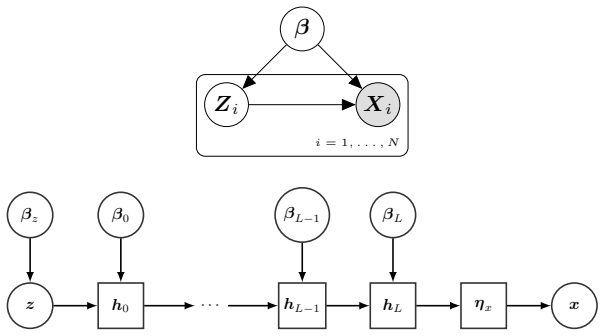
The central object is the stochastic computational graph (SCG), a computational graph extended with stochastic nodes whose outputs are random samples; the paper uses it to unify model specification, ELBO construction, and gradient computation. The reparameterization trick writes a sample from $q(r|\nu)$ as a deterministic function $t(\epsilon;\nu)$ of fixed noise $\epsilon$, so the gradient can pass through the graph; the score-function estimator instead uses $\nabla_\nu \ln q(r|\nu)$, trading broad applicability for higher variance. Amortized inference, the third mechanism, replaces data-set-sized local variational parameters with a shared network $s(x_i|\theta)$, so inference on a new point is one forward pass.
What would settle it
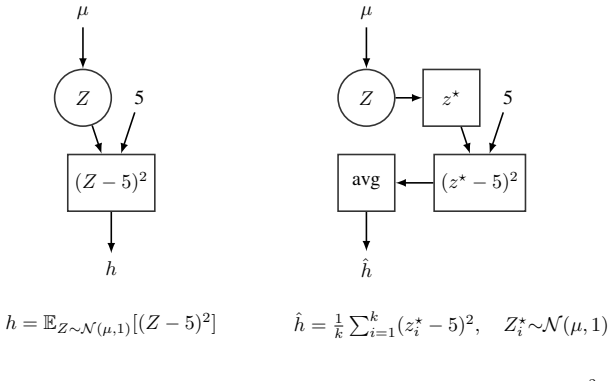
Take a variational family with parameter-dependent support, such as $Z \sim \text{Uniform}(0,\nu)$, and compare $\nabla_\nu \mathbb{E}_Z[(Z-5)^2]$ with the score-function estimate $\mathbb{E}_Z[(Z-5)^2 \nabla_\nu \ln q(Z|\nu)]$; because $\mathbb{E}[\nabla_\nu \ln q]$ is not zero for such a family, the two quantities differ, directly contradicting the unconditional unbiasedness claimed for Equations (20) and (23).
Extended reading notes
Core claim
The central claim is that the barrier to using deep neural networks within probabilistic models was computational, not conceptual, and that variational inference removes it. For conjugate exponential models, variational inference offers closed-form updates; for non-conjugate deep models, two Monte Carlo gradient estimators make the ELBO trainable: the pathwise gradient, which reparameterizes the randomness so gradients move inside the expectation, and the score-function gradient, which multiplies the objective by the gradient of the log-density of the variational distribution. The paper further claims that amortized inference, learning a function that maps each observation to its local variational parameters, gives the variational autoencoder its two neural networks, encoder and decoder, and keeps the number of variational parameters from growing with the data set. Together these elements establish that deep neural networks can be treated as ordinary differentiable components inside a probabilistic model and trained by the same automatic differentiation engines that power deep learning.
Load-bearing premise
The load-bearing premise is that the approximate distribution $q$ and the model are regular enough that derivatives can be moved inside the expectation, and that the expected score $\mathbb{E}_q[\nabla_\nu \ln q(r|\nu)]$ is exactly zero; if either condition fails, the paper's claimed unbiased gradient estimates are not unbiased.
Editorial extensions
If this is right
- Bayesian models need no longer be confined to conjugate exponential families; any differentiable likelihood expressible as a graph can be placed inside a latent variable model.
- Models with discrete latent variables cannot use the plain reparameterization trick and must fall back on score-function estimators, implicit reparameterization, or related relaxations.
- Amortized inference makes variational parameters scale with the number of model parameters rather than the number of data points, enabling training on large data sets.
- Probabilistic programming tools can implement deep probabilistic models by sampling from stochastic nodes and passing the samples through ordinary computational graphs, hiding gradient calculus from the user.
Reading between the lines
- A natural next step is a hybrid inference engine that applies closed-form variational message passing to conjugate parts of a model and black-box gradient estimators to the neural-network parts; the paper explicitly identifies this mixed strategy as an open need.
- The paper's framing implies a concrete benchmark: on a non-Gaussian posterior that admits implicit reparameterization, compare pathwise gradient variance against score-function estimators with control variates; the paper does not carry out that comparison.
- If the tutorial's unified account is accepted, variational inference can serve as the common curriculum bridge between deep learning and Bayesian modeling, rather than treating deep generative models as a disjoint topic.
Signed reviews
Editorial analysis
A structured set of objections, weighed in public.
Referee Report
Summary. This paper is a review/tutorial whose central claim is to provide a coherent overview of the key concepts and methods needed to integrate deep neural networks into probabilistic models. The authors build up from latent variable models in the conjugate exponential family, through mean-field variational inference, stochastic variational inference, and variational message passing, and then introduce deep latent variable models and stochastic computational graphs. The core technical sections derive the two standard black-box variational inference gradient estimators—pathwise (reparameterization) gradients and score-function (REINFORCE) gradients—and explain how amortized inference, as in variational autoencoders, makes optimization feasible. The paper is accompanied by online code implementing the running examples, and it closes with a discussion of open issues such as mixed inference strategies, discrete latent variables, and interpretability.
Significance. If the pedagogical claims hold, this paper is a useful synthesis for researchers and practitioners moving between probabilistic graphical models and deep learning. I found the mathematical exposition of Section 5.1 to be a correct presentation of the standard estimators from Kingma and Welling (2013) and Ranganath et al. (2014), and the progression from conjugate exponential models to deep latent variable models is logical and well motivated. The concrete running examples with PCA, non-linear PCA, and VAEs on Iris and MNIST, together with pseudo-code for stochastic computational graphs, are a genuine strength that distinguishes this review from purely abstract surveys. The discussion of open issues in Section 6 is balanced and appropriately cautious. I found no load-bearing technical error: the omitted regularity conditions in the unbiasedness claims are standard tutorial shorthand, and the typographical issues are local. The paper is not a novel research contribution, but as a review it is readable, accurate, and likely to be useful.
minor comments (5)
- [Section 4.1] The sentence beginning 'For instance, different examples of this approach are given in Johnson et al. (2016), along with extensions of instance, provides different examples...' is garbled: it appears to be a partially duplicated and merged sentence. This should be rewritten to clearly attribute the extensions of Gaussian mixture models, latent linear dynamical systems, and latent switching linear dynamical systems to Johnson et al. (2016).
- [Example 4] The update for the global mean parameter contains a typographical self-reference: 'µβ,t+1 = (1 − ρt)µβ,t+1 + ρt(...)' should read 'µβ,t+1 = (1 − ρt)µβ,t + ρt(...)'. As written, the update is not well defined and would confuse a reader trying to implement the stochastic variational inference scheme.
- [Algorithm 5] The entropy term of the ELBO uses the symbols h'_{1,µ} and h'_{1,σ}, which are never defined; the text and the surrounding code indicate that these should be hz,1,µ and hz,1,σ, the mean and scale produced by the encoder network. In addition, the last line 'LI = LI − ∑_i lnpN(α_i|λα_i,µ,λ^2_α_i,σ) + lnpN(β_i|λβ_i,µ,λ^2_β_i,σ)' has a sign inconsistency: the β entropy term should also be subtracted, as it correctly is in Algorithm 4. The pseudo-code should be corrected so that the defined ELBO matches the expression in the text.
- [Section 5.1, Equations (20) and (24)] The unbiasedness of the pathwise and score-function gradient estimators is stated without the standard regularity conditions. In particular, the step E_q[∇_ν ln q(r|ν)] = 0 requires the support of q not to depend on ν (or vanishing boundary terms), and the interchange of differentiation and expectation requires a dominated-convergence argument. These conditions hold for the Gaussian variational families used in the paper's examples, so the presentation is acceptable for a tutorial, but a one-sentence caveat would make the mathematical claims more precise.
- [General presentation] There are several small typos, including 'Unversity' in the author affiliation, 'maxizimed' in Section 5.2, and 'econder' in the caption of Figure 10. These are cosmetic but should be corrected before final publication.
Circularity Check
No circularity: the tutorial's derivations are standard and self-contained, and its self-citations are contextual rather than load-bearing.
full rationale
The paper's central claim is pedagogical: to review how deep neural networks can be integrated into probabilistic models and how variational inference, reparameterized and score-function gradient estimators, and amortized inference make such models trainable. None of the paper's own derived equations feeds back into an input. Equation (20) is obtained from the reparameterization identity (19) plus the score identity E_q[grad_nu ln q] = 0; Equation (23) is the standard log-derivative/REINFORCE identity. Both derivations are shown in the text and mirror the cited external works (Kingma and Welling, 2013; Ranganath et al., 2014); they do not rely on the paper's conclusions. The self-citations (Masegosa et al. 2017a,b; Cabañas et al. 2019; Cózar et al. 2019) appear only as contextual instances of LVMs, distributed inference, and probabilistic programming tools; none is invoked as an authority for the correctness of the reviewed gradient estimators. No uniqueness theorem, fitted parameter renamed as a prediction, or ansatz smuggled via self-citation occurs. The only caveat is in Section 5.1, where the unbiasedness of the estimators is stated without explicit regularity conditions (interchange of differentiation and expectation, and support-independence for the score identity); this is standard tutorial shorthand, not a circular reduction. Minor editorial errors do not affect the derivation chain. Therefore the paper is self-contained against external benchmarks and receives no circularity score.
Assumptions & free parameters
assumptions (5)
- domain assumption The model is in the conjugate exponential family with complete conditionals as in Eq. (1).
- domain assumption The variational distribution factorizes fully (mean-field) as in Eq. (5).
- standard math Differentiation and expectation can be interchanged, and E_q[∇_ν ln q] = 0, for the variational families considered.
- domain assumption The reparameterization trick is applicable to the chosen variational distributions, as in Eq. (19).
- standard math Stochastic approximation converges to a stationary point when the Robbins-Monro conditions on the learning rate hold.
Cite this review
Pith. "Pith review of Probabilistic Models with Deep Neural Networks." pith.science (2026). https://pith.science/paper/R77QLZ6U
@misc{pith2026190803442,
  author       = {Pith},
  title        = {Pith review of: Probabilistic Models with Deep Neural Networks},
  year         = {2026},
  howpublished = {\url{https://pith.science/paper/R77QLZ6U}},
  note         = {Machine review of arXiv:1908.03442}
}
read the original abstract
Recent advances in statistical inference have significantly expanded the toolbox of probabilistic modeling. Historically, probabilistic modeling has been constrained to (i) very restricted model classes where exact or approximate probabilistic inference were feasible, and (ii) small or medium-sized data sets which fit within the main memory of the computer. However, developments in variational inference, a general form of approximate probabilistic inference originated in statistical physics, are allowing probabilistic modeling to overcome these restrictions: (i) Approximate probabilistic inference is now possible over a broad class of probabilistic models containing a large number of parameters, and (ii) scalable inference methods based on stochastic gradient descent and distributed computation engines allow to apply probabilistic modeling over massive data sets. One important practical consequence of these advances is the possibility to include deep neural networks within a probabilistic model to capture complex non-linear stochastic relationships between random variables. These advances in conjunction with the release of novel probabilistic modeling toolboxes have greatly expanded the scope of application of probabilistic models, and allow these models to take advantage of the recent strides made by the deep learning community. In this paper we review the main concepts, methods and tools needed to use deep neural networks within a probabilistic modeling framework.
Figures

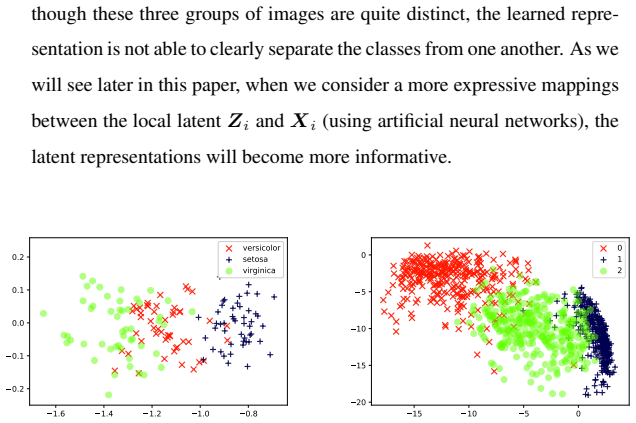

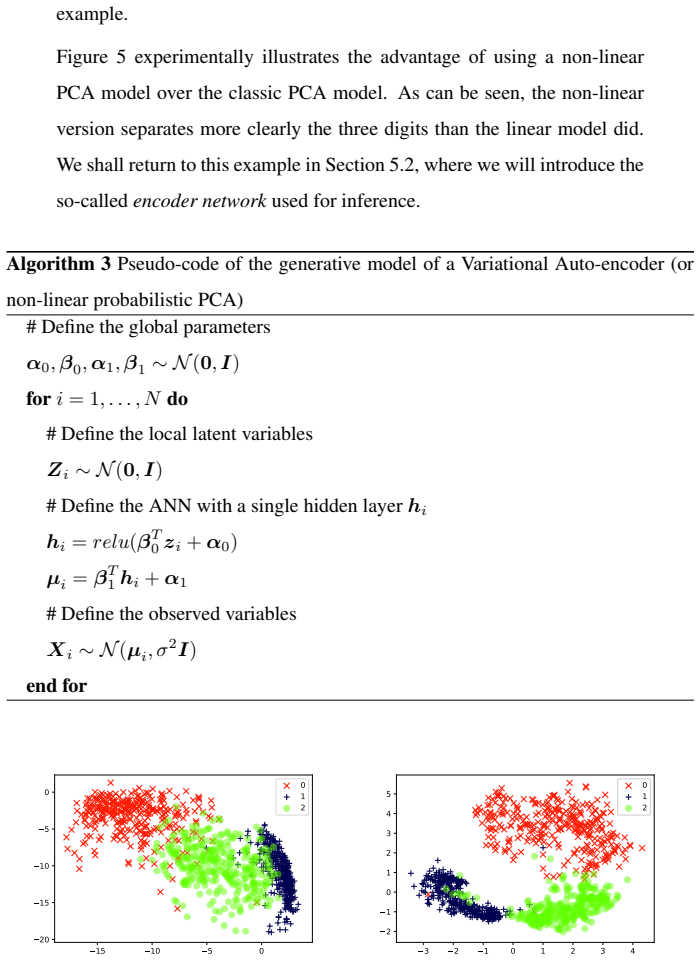
Figures from the paper (7 more)



Forward citations
Cited by 1 Pith paper
-
InferPy: Probabilistic Modeling with Deep Neural Networks Made Easy
InferPy provides a compact, high-level Python API for hierarchical probabilistic models with deep neural networks, built on TensorFlow Probability and Keras.
Reference graph
Works this paper leans on
-
[4]
p. 177–86. Caba˜nas R, Salmer´on A, Masegosa AR. InferPy: Probabilistic modeling with Tensor- Flow made easy. Knowledge-Based Systems 2019;168:25–7. Card D, Tan C, Smith NA. A neural framework for generalized topic models. arXiv preprint arXiv:170509296 2017;. 39 Chen T, Li M, Li Y, Lin M, Wang N, Wang M, Xiao T, Xu B, Zhang C, Zhang Z. Mxnet: A flexible a...
work page 2019
-
[5]
p. 2980–8. C´ozar J, Caba˜nas R, Salmer´on A, Masegosa AR. InferPy: Probabilistic modeling with deep neural networks made easy. arXiv preprint arXiv:190811161 2019;. Dayan P, Hinton GE, Neal RM, Zemel RS. The Helmholtz machine. Neural Compu- tation 1995;7(5):889–904. Dillon JV, Langmore I, Tran D, Brevdo E, Vasudevan S, Moore D, Patton B, Alemi A, Hoffman...
work page 2019
-
[8]
p. 167–81. Grathwohl W, Choi D, Wu Y, Roeder G, Duvenaud D. Backpropagation through the void: Optimizing control variates for black-box gradient estimation. arXiv preprint arXiv:171100123 2017;. Gregor K, Danihelka I, Graves A, Rezende DJ, Wierstra D. Draw: A recurrent neural network for image generation. arXiv preprint arXiv:150204623 2015;. Griewank A. ...
work page 2017
-
[14]
p. 2539–47. Lauritzen SL. Propagation of probabilities, means, and variances in mixed graphical association models. Journal of the American Statistical Association 1992;87(420):1098–108. LeCun Y, Bottou L, Bengio Y, Haffner P. Gradient-based learning applied to document recognition. Proceedings of the IEEE 1998;86(11):2278–324. Li M, Zhang T, Chen Y, Smol...
work page 1992
-
[15]
p. 661–70. Linderman SW, Miller AC, Adams RP, Blei DM, Paninski L, Johnson MJ. Recurrent switching linear dynamical systems. arXiv preprint arXiv:161008466 2016;. Louizos C, Shalit U, Mooij JM, Sontag D, Zemel R, Welling M. Causal effect inference with deep latent-variable models. In: Advances in Neural Information Processing Systems
work page 2016
-
[17]
p. 362–9. Mnih A, Gregor K. Neural variational inference and learning in belief networks. arXiv preprint arXiv:14020030 2014;. Mnih A, Rezende DJ. Variational inference for Monte Carlo objectives. arXiv preprint arXiv:160206725 2016;. Murphy KP. Machine Learning: A Probabilistic Perspective. MIT Press,
work page 2014
-
[20]
p. 814–22. Rezende DJ, Mohamed S, Wierstra D. Stochastic backpropagation and approximate inference in deep generative models. arXiv preprint arXiv:14014082 2014;. Robbins H, Monro S. A stochastic approximation method. The Annals of Mathematical Statistics 1951;22(3):400–7. Ruiz F, Titsias M, Blei D. The generalized reparameterization gradient. In: Advance...
work page 2014
-
[21]
Learning deep generative models
Salakhutdinov R. Learning deep generative models. Annual Review of Statistics and Its Application 2015;2:361–85. Salmer´on A, Cano A, Moral S. Importance sampling in Bayesian networks using prob- ability trees. Computational Statistics & Data Analysis 2000;34(4):387–413. Salvatier J, Wiecki TV, Fonnesbeck C. Probabilistic programming in Python using PyMC3...
work page 2015
Show all 27 references
-
[22]
p. 3528–36. Semeniuta S, Severyn A, Barth E. A hybrid convolutional variational autoencoder for text generation. arXiv preprint arXiv:170202390 2017;. 45 Sohn K, Lee H, Yan X. Learning structured output representation using deep condi- tional generative models. In: Advances in...
2017
-
[23]
p. 3483–91. Tipping ME, Bishop CM. Probabilistic principal component analysis. Journal of the Royal Statistical Society: Series B (Statistical Methodology) 1999;61(3):611–22. Titsias M, L´azaro-Gredilla M. Doubly stochastic variational Bayes for non-conjugate inference. In: In...
1999
-
[24]
p. 1971–9. Tran D, Hoffman MW, Moore D, Suter C, Vasudevan S, Radul A. Simple, distributed, and accelerated probabilistic programming. In: Advances in Neural Information Processing Systems
1971
-
[26]
p. 2627–36. Wainwright MJ, Jordan MI. Graphical models, exponential families, and variational inference. Foundations and Trends R© in Machine Learning 2008;1(1–2):1–305. Williams RJ. Simple statistical gradient-following algorithms for connectionist rein- forcement learning. M...
2008
-
[27]
p. 478–87. 46 Zhang C, B¨utepage J, Kjellstr¨om H, Mandt S. Advances in variational inference. IEEE Transactions on Pattern Analysis and Machine Intelligence 2018;41:2008–26. Zhou M, Cong Y, Chen B. The Poisson Gamma belief network. In: Advances in Neural Information Processin...
2018
-
[1988]
A survey of manifold learning for images
Pless R, Souvenir R. A survey of manifold learning for images. IPSJ Transactions on Computer Vision and Applications 2009;1:83–94. Plummer M. JAGS: A program for analysis of Bayesian graphical models using Gibbs sampling. In: Proceedings of the 3rd international workshop on di...
2009
-
[2001]
Deep belief networks
Hinton GE. Deep belief networks. Scholarpedia 2009;4(5):5947. Hinton GE. A practical guide to training restricted Boltzmann machines. In: Neural networks: Tricks of the trade. Springer
2009
-
[2003]
Inference of population structure using multi- locus genotype data
Pritchard JK, Stephens M, Donnelly P. Inference of population structure using multi- locus genotype data. Genetics 2000;155(2):945–59. 44 Pu Y, Gan Z, Henao R, Yuan X, Li C, Stevens A, Carin L. Variational autoencoder for deep learning of images, labels and captions. In: Advan...
2000
-
[2006]
Build, compute, critique, repeat: Data analysis with latent variable models
Blei DM. Build, compute, critique, repeat: Data analysis with latent variable models. Annual Review of Statistics and its Application 2014;1:203–32. Blei DM, Ng AY, Jordan MI. Latent Dirichlet allocation. Journal of Machine Learning Research 2003;3(Jan):993–1022. Bottou L. Lar...
2014
-
[2007]
Variational deep embedding: An unsuper- vised and generative approach to clustering
Jiang Z, Zheng Y, Tan H, Tang B, Zhou H. Variational deep embedding: An unsuper- vised and generative approach to clustering. arXiv preprint arXiv:161105148 2016;. Johnson M, Duvenaud DK, Wiltschko A, Adams RP, Datta SR. Composing graphical models with neural networks for stru...
2016
-
[2009]
Automatic differentiation variational inference
Kucukelbir A, Tran D, Ranganath R, Gelman A, Blei DM. Automatic differentiation variational inference. Journal of Machine Learning Research 2017;18(1):430–74. Kulkarni TD, Whitney WF, Kohli P, Tenenbaum J. Deep convolutional inverse graph- ics network. In: Advances in Neural I...
2017
-
[2010]
p. 3–10. Bingham E, Chen JP, Jankowiak M, Obermeyer F, Pradhan N, Karaletsos T, Singh R, Szerlip P, Horsfall P, Goodman ND. Pyro: Deep universal probabilistic program- ming. CoRR 2018; arXiv:1810.09538. Bishop CM. Latent variable models. In: Learning in graphical models. Springer
2018 arXiv
-
[2012]
p. 599–619. Hinton GE, Salakhutdinov RR. Reducing the dimensionality of data with neural net- works. Science 2006;313(5786):504–7. Hoffman MD, Blei DM, Wang C, Paisley J. Stochastic variational inference. Journal of Machine Learning Research 2013;14:1303–47. Hopfield JJ. Artific...
2006
-
[2013]
Likelihood ratio gradient estimation for stochastic systems
Glynn PW. Likelihood ratio gradient estimation for stochastic systems. Communica- tions of the ACM 1990;33(10):75–84. G´omez-Bombarelli R, Wei JN, Duvenaud D, Hern ´andez-Lobato JM, S ´anchez- Lengeling B, Sheberla D, Aguilera-Iparraguirre J, Hirzel TD, Adams RP, Aspuru- Guzik...
1990
-
[2014]
p. 517–22. 40 Ghahramani Z. Probabilistic machine learning and artificial intelligence. Nature 2015;521(7553):452. Gilks WR, Richardson S, Spiegelhalter D. Markov Chain Monte Carlo in practice. Chapman and Hall/CRC,
2015
-
[2015]
Amari SI
URL: http://tensorflow.org/; software available from tensorflow.org. Amari SI. Natural gradient works efficiently in learning. Neural Computation 1998;10(2):251–76. Barndorff-Nielsen O. Information and exponential families in statistical theory. John Wiley & Sons,
1998
-
[2016]
p. 2946–54. Jordan MI, Ghahramani Z, Jaakkola TS, Saul LK. An introduction to variational meth- ods for graphical models. Machine Learning 1999;37(2):183–233. Kingma DP, Welling M. Auto-encoding variational Bayes. arXiv preprint arXiv:13126114 2013;. Kipf TN, Welling M. Variat...
1999
-
[2017]
p. 6446–56. Maddison CJ, Mnih A, Teh YW. The Concrete distribution: A continuous relaxation of discrete random variables. CoRR 2016;abs/1611.00712. URL: http://arxiv. org/abs/1611.00712. arXiv:1611.00712. Masegosa A, Nielsen TD, Langseth H, Ramos-Lopez D, Salmer ´on A, Madsen ...
2016 arXiv
-
[2018]
p. 7608–19. Tran D, Kucukelbir A, Dieng AB, Rudolph M, Liang D, Blei DM. Edward: A library for probabilistic modeling, inference, and criticism. arXiv preprint arXiv:161009787 2016;. Tucker G, Mnih A, Maddison CJ, Lawson J, Sohl-Dickstein J. Rebar: Low-variance, unbiased gradi...
2016
Reviewed August 14, 2026 · model on record in the stance chip above.
Discussion (0). Continue with ORCID to comment.