REVIEW 4 major objections 4 minor 129 references
SigMap, a wireless localization foundation model, uses 3D maps as prompts and cycle-aware CSI masking to transfer across unseen cities with only a tiny fine-tuned head.
Reviewed by Pith at T0; open to challenge. T0 means a machine referee read the full paper against a public rubric. the ladder, T0–T4 →
T0 review · deepseek-v4-flash
2026-08-01 22:30 UTC pith:RAYW5EGA
load-bearing objection Interesting cycle-adaptive masking and map-prompt ideas, but the abstract's zero-shot claim is not supported by the few-shot fine-tuning protocol; needs correction before the numbers can be trusted. the 4 major comments →
Map as a Prompt: Learning Multi-Modal Spatial-Signal Foundation Models for Cross-scenario Wireless Localization
The pith
A machine-rendered reading of the paper's core claim, the machinery that carries it, and where it could break.
Core claim
The paper's central discovery is that two obstacles to a transferable wireless localization model—periodicity-driven shortcut learning in masked pre-training and the absence of environmental geometry in downstream adaptation—can be addressed with explicit structural inductive biases. First, by computing cross-correlation between rows of the channel frequency response and generating shift-aware masks, the pre-training objective forces representations to capture global propagation semantics instead of local repetition. Second, by rendering the environment's 3D map and base station layout as a heterogeneous graph and pooling it into a soft prompt token prepended to the frozen transformer's inpu
What carries the argument
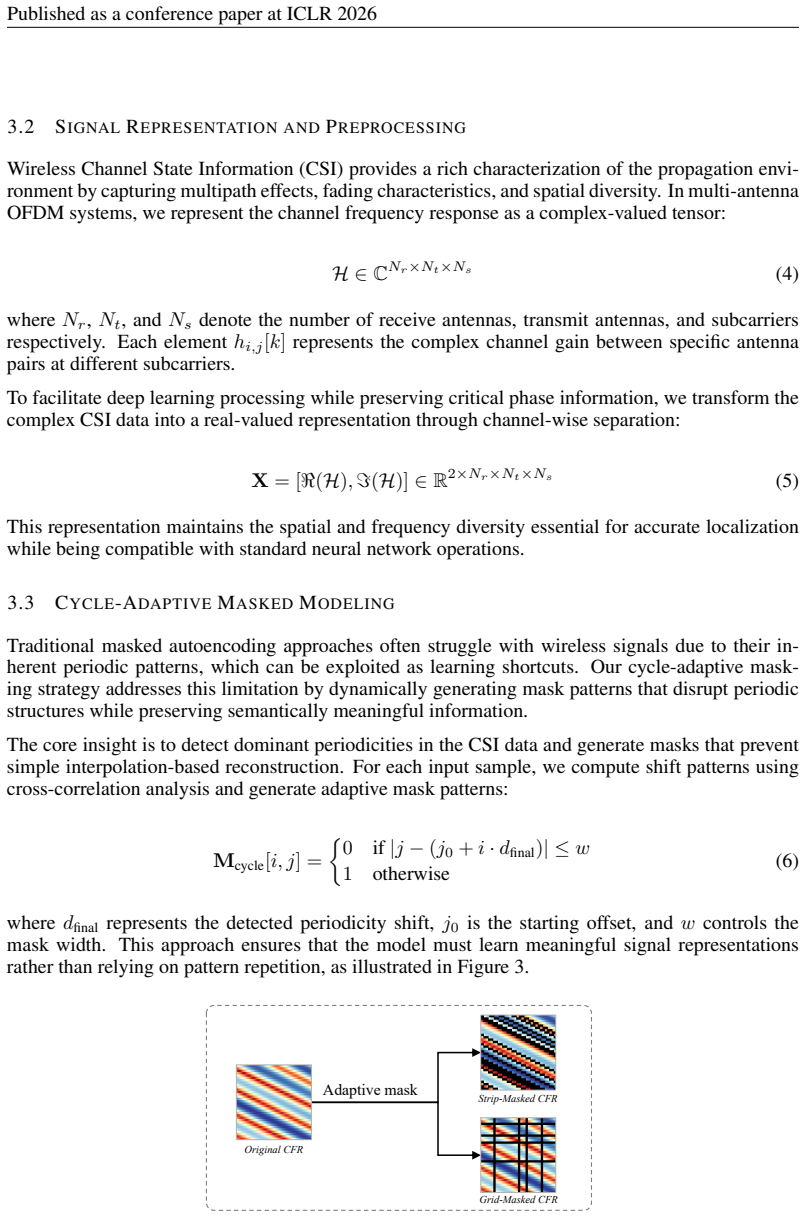
The key machinery is a pair of coupled mechanisms. The cycle-adaptive mask is a binary pattern generated from the row-wise cross-correlation of the CSI matrix; it detects the dominant shift period d and removes diagonal bands of width w, so masked reconstruction cannot be solved by copying neighboring rows. The map-as-prompt token is a single D-dimensional vector produced by a two-layer graph convolution over a Delaunay-triangulated heterogeneous graph of building vertices and base station positions, pooled and projected; it is prepended to the frozen transformer's input so that the environment's geometry modulates attention without updating backbone weights. Together they deliver the paper'
Load-bearing premise
The cross-scenario generalization claim rests on the assumption that representations learned on a single ray-traced urban scenario (DeepMIMO O1, with base stations 3/4/9/10) are general enough that fine-tuning only a 0.085M-parameter head on about 100 labeled samples of a new scene yields the reported accuracy; the paper does not ablate pre-training diversity.
What would settle it
Pre-train on the same O1 data but replace cycle-adaptive masking with random masking (keeping the map prompt) and evaluate on O2 and WAIR-D with 100 fine-tuning samples; if the MAE gap to the full method nearly disappears, the masking mechanism is not the source of generalization. Alternatively, pre-train on O1 and fine-tune on a ray-traced city whose building heights and street widths fall far outside O1's distribution; if CDF@1m collapses below 30% or errors exceed a CNN trained from scratch on the same 100 samples, the cross-scenario claim fails.
If this is right
- Fine-tuning only a 0.085M-parameter head on ~100 labeled samples of an unseen city yields MAEs of 1.03 m (DeepMIMO O2) and 1.88 m (WAIR-D Scenario-2), implying a single pre-trained backbone can serve multiple deployment scenarios.
- Removing the map prompt raises MAE from 1.564 m to 2.275 m (single-BS) and from 0.673 m to 0.789 m (multi-BS), showing the geometric prompt is a direct accuracy source.
- Replacing the cycle-adaptive mask with fixed grid or strip masks degrades multi-BS MAE from 0.673 m to 0.770/0.753 m, indicating masking strategy meaningfully shapes the learned representation.
- Swapping the full 3D mesh for a 2D bird's-eye polygon costs only 8% MAE (1.564 m to 1.692 m), suggesting most of the prompt's benefit comes from topological/LoS structure rather than vertical detail.
Where Pith is reading between the lines
- If the transfer results hold, the most consequential implication is that pre-training diversity may matter less than prompt-side geometry: a model trained on one urban layout can adapt to another with almost no labeled data, shifting the field's focus from bigger pre-training corpora to better environment encoders.
- The 2-D map result hints at a cheaper deployment path: since most of the benefit survives dropping height and facade normals, a satellite or street-level image could serve as a proxy prompt when 3D meshes are unavailable—an extension the paper itself flags for future work.
- The paper reports only the ~100-sample fine-tuning regime, so the prompt mechanism's sample-efficiency curve remains uncharacterized; a natural test is to vary the target-set size from a handful to a few thousand labeled samples.
- Because the map prompt is generated per scene rather than per user, the same frozen backbone and prompt mechanism may transfer to other environment-aware wireless tasks—beam prediction, channel estimation, or coverage mapping—by swapping the task head.
Editorial analysis
A structured set of objections, weighed in public.
Referee Report
Summary. The paper proposes SigMap, a self-supervised wireless-localization foundation model. Pre-training uses a transformer-based masked autoencoder with a proposed "cycle-adaptive" masking strategy that adjusts mask patterns to the periodicity of CSI. For downstream localization, a GNN encodes a Delaunay-triangulated graph of 3D building vertices and base-station positions into a soft prompt token, which is appended to the frozen backbone; only the GNN, projection MLP, and task head are fine-tuned. Experiments on DeepMIMO O1 report strong single-BS and multi-BS localization results, ablations study the masking and map prompt, and cross-scenario results on DeepMIMO O2 and WAIR-D claim strong generalization with minimal fine-tuning. The abstract and conclusion claim state-of-the-art performance and strong zero-shot generalization to unseen environments.
Significance. If the claims were fully supported, SigMap would be a useful contribution: a parameter-efficient, map-conditioned foundation model for wireless localization that transfers across ray-traced environments. The paper has genuine strengths: it ships a reproducibility repository, the cycle-adaptive masking idea is novel and well motivated by CSI structure, and fine-tuning only ~0.085 M parameters while keeping the backbone frozen is a practically meaningful efficiency result. However, the central "zero-shot" claim is not tested by the experiments, several numeric inconsistencies weaken trust in the reported transfer numbers, and the state-of-the-art claim is not backed by comparisons to the foundation-model baselines cited in the introduction. These issues are load-bearing because they concern the paper's headline contribution.
major comments (4)
- [§4.5, Abstract, §5] The abstract claims "strong zero-shot generalization in unseen environments," but the only cross-scenario experiment in §4.5 fine-tunes downstream task heads on approximately 100 labeled samples per target scenario and uses the target scenario's 3D map and base-station positions to generate prompts. This is few-shot adaptation with environment oracle information, not zero-shot inference. No experiment evaluates the frozen encoder on O2 or WAIR-D without any target labels or target map. The claims in the abstract, §1.2, and §5 must be reconciled with the actual protocol, either by adding a true zero-shot experiment or by removing/rephrasing the zero-shot claim throughout.
- [§4.5, Table 4.5] There is a direct numeric inconsistency in the WAIR-D results. The text states that SigMap reaches 1.580 m MAE on WAIR-D Scenario-2 and outperforms LWLM by 44.3%, while the table reports 1.880 m MAE for SigMap. The improvement over LWLM (3.375 m) is 44.3% for 1.880 m but 53.2% for 1.580 m. Both numbers cannot be correct. Additionally, §4.5 says only 0.4% of parameters are updated while §4.6 and Table 5 say 0.7% (0.085 M of 11.815 M ≈ 0.72%). These discrepancies must be fixed before the transfer results can be considered reliable.
- [§4.2, §4.5] The state-of-the-art claim is not adequately supported by the baseline set. The introduction cites LWM, WirelessGPT, CrowdBERT, Signal-guided MAE, and MetaLoc as related foundation-model/meta-learning approaches, but none of these are evaluated. The experiments compare only OMP, CNN, SWiT, and LWLM. For a paper whose contribution is a foundation model, omitting the cited foundation-model baselines is a significant gap. Moreover, no standard deviations or confidence intervals are reported despite §4.1 saying results are averaged over 5 runs, and the cross-scenario table has no from-scratch training baseline under the same 100-sample protocol, so the transfer gain cannot be attributed to pre-training.
- [§3.3, Eq. (6), Appendix B.4] The cycle-adaptive masking mechanism depends on the periodicity shift d_final, but the paper does not specify how d_final is estimated from data. Eq. (6) takes d_final as an input, and Appendix B.4 gives illustrative shifts (d = 8, -3, 0) but provides no detection algorithm, no selection criterion on validation data, and no sensitivity analysis for the mask parameters N_a, N_s, and w. If d_final is tuned on labeled target data, the self-supervised advantage is compromised; if it is estimated from unlabeled CSI, the estimator needs to be described precisely. This is load-bearing for the first innovation claim.
minor comments (4)
- [Table 7] The Train/Val/Test row reads "10,000/1,000/10,00" — likely a typo for "10,000/1,000/1,000" or "10,000/1,000/10,000". Please correct.
- [§2.1] The phrase "each path in equation equation 1" contains a duplicated word. Also, Eq. (11) appears in §4.2 after Table 1 without being referenced in the surrounding text; it should be introduced or removed.
- [Appendix B.2 / §3.2] The notation for the input tensor is inconsistent: Eq. (4) defines H ∈ C^{Nr×Nt×Ns}, Eq. (5) uses X = [Re(H), Im(H)], but Appendix B.2 uses H_s = [|Hs|, angle(Hs)] with dimensions (2, N_ant, N_subc). Please unify the notation and clarify which representation is actually used.
- [§4.5] The table under §4.5 is referred to as "Table 4.5" in the text but is not numbered. Please number it and reference it consistently.
Circularity Check
Advertised zero-shot transfer is evaluated by fine-tuning task heads on target labels; the cross-scenario 'prediction' is therefore few-shot by construction.
specific steps
-
fitted input called prediction
[Abstract & Section 1.2 vs Section 4.5 (Generalization to New Environments)]
"Abstract: 'exhibiting strong zero-shot generalization in unseen environments.' Contribution 3: 'demonstrates strong zero-shot generalization to unseen environments and base station configurations.' Section 4.5: 'In all experiments, only the downstream task heads are fine-tuned using limited target samples (approximately 100 instances per scenario), while the self-supervised backbone remains frozen.'"
The advertised 'zero-shot generalization' is evaluated by fine-tuning the task heads on roughly 100 labeled samples from each target scenario (DeepMIMO O2 and WAIR-D). The reported cross-scenario MAEs in Table 4.5 are therefore produced with target labels in the loop, not by a frozen encoder alone. No experiment omits target data, so the 'zero-shot' result reduces by construction to few-shot adaptation: the claimed prediction is partly fitted to the target scenario. This is load-bearing because the paper's central contribution is cross-scenario transfer without per-scenario labels.
full rationale
The base localization results (Tables 1 and 2) are not circular: they compare SigMap against external baselines on the same benchmark, using standard supervised evaluation, and the masking/map ablations (Tables 3 and 4) are internal comparisons of design choices, not predictions masquerading as fits. There is also no load-bearing self-citation chain: the cited prior methods are external, and no 'uniqueness theorem' is imported from the authors' own work. The significant circularity issue is confined to the headline zero-shot claim. The abstract and contribution list promise 'strong zero-shot generalization to unseen environments,' but Section 4.5 explicitly fine-tunes the task heads on about 100 target instances per unseen scenario and reports only those fine-tuned numbers. Because target labels and target-region map prompts are used, the evidence does not demonstrate zero-shot transfer; it demonstrates few-shot adaptation. That is a real reduction of the advertised prediction by construction, and since it is the paper's central selling point, it warrants a score of 6. The additional text/table discrepancy in Section 4.5 (1.580 m vs. 1.880 m MAE for WAIR-D) further weakens confidence in the reported transfer numbers, though it is a correctness issue rather than a separate circular step.
Axiom & Free-Parameter Ledger
free parameters (2)
- d_final / d (periodicity shift in cycle-adaptive mask) =
unspecified; examples d=8, -3, 0 in App. B.4
- Mask counts and width (N_a, N_s, w) =
N_a=8, N_s=32, w unspecified
axioms (4)
- domain assumption Ray-traced CSI from DeepMIMO/WAIR-D faithfully represents real-world wireless channels for localization
- domain assumption Row-wise cross-correlation between CFR rows can reliably detect CSI periodicity with boundary effects controlled
- domain assumption Delaunay triangulation over building vertices and base-station positions captures the spatial-topological cues relevant to localization
- domain assumption A backbone pre-trained only on DeepMIMO O1 3p5 transfers to other ray-traced scenarios after ~100-sample head fine-tuning
read the original abstract
Accurate and robust wireless localization is a critical enabler for emerging 5G/6G applications, including autonomous driving, extended reality, and smart manufacturing. Despite its importance, achieving precise localization across diverse environments remains challenging due to the complex nature of wireless signals and their sensitivity to environmental changes. Existing data-driven approaches often suffer from limited generalization capability, requiring extensive labeled data and struggling to adapt to new scenarios. To address these limitations, we propose SigMap, a multimodal foundation model that introduces two key innovations: (1) A cycle-adaptive masking strategy that dynamically adjusts masking patterns based on channel periodicity characteristics to learn robust wireless representations; (2) A novel "map-as-prompt" framework that integrates 3D geographic information through lightweight soft prompts for effective cross-scenario adaptation. Extensive experiments demonstrate that our model achieves state-of-the-art performance across multiple localization tasks while exhibiting strong zero-shot generalization in unseen environments, significantly outperforming both supervised and self-supervised baselines by considerable margins.
Figures




Reference graph
Works this paper leans on
-
[1]
arXiv preprint arXiv:2212.02159 , year=
Wair-d: Wireless ai research dataset , author=. arXiv preprint arXiv:2212.02159 , year=
-
[2]
IEEE Journal on Selected Areas in Communications , volume=
MetaLoc: Learning to learn wireless localization , author=. IEEE Journal on Selected Areas in Communications , volume=. 2023 , publisher=
2023
-
[3]
IEEE Sensors Journal , volume=
Robust TDOA-based indoor localization using improved clock-sync-scheme and multilevel constrained ARPF , author=. IEEE Sensors Journal , volume=. 2023 , publisher=
2023
-
[4]
2019 28th Wireless and Optical Communications Conference (WOCC) , pages=
A Cross-region Wireless-synchronization-based TDOA Method for Indoor Positioning Applications , author=. 2019 28th Wireless and Optical Communications Conference (WOCC) , pages=. 2019 , organization=
2019
-
[5]
IEEE Transactions on Vehicular Technology , year=
Signal-guided masked autoencoder for wireless positioning with limited labeled samples , author=. IEEE Transactions on Vehicular Technology , year=
-
[6]
2024 14th International Conference on Indoor Positioning and Indoor Navigation (IPIN) , pages=
Radio foundation models: Pre-training transformers for 5G-based indoor localization , author=. 2024 14th International Conference on Indoor Positioning and Indoor Navigation (IPIN) , pages=. 2024 , organization=
2024
-
[7]
arXiv preprint arXiv:2505.10134 , year=
Large Wireless Localization Model (LWLM): A Foundation Model for Positioning in 6G Networks , author=. arXiv preprint arXiv:2505.10134 , year=
-
[8]
arXiv preprint arXiv:2405.17053 , year=
Wirelessllm: Empowering large language models towards wireless intelligence , author=. arXiv preprint arXiv:2405.17053 , year=
-
[9]
2024 IEEE 6th Advanced Information Management, Communicates, Electronic and Automation Control Conference (IMCEC) , volume=
Map-assisted Wireless TDOA Localization Enhancement Based On CNN , author=. 2024 IEEE 6th Advanced Information Management, Communicates, Electronic and Automation Control Conference (IMCEC) , volume=. 2024 , organization=
2024
-
[10]
IEEE Transactions on Vehicular Technology , year=
CSI-GPT: Integrating generative pre-trained transformer with federated-tuning to acquire downlink massive MIMO channels , author=. IEEE Transactions on Vehicular Technology , year=
-
[11]
arXiv preprint arXiv:1902.06435 , year=
DeepMIMO: A generic deep learning dataset for millimeter wave and massive MIMO applications , author=. arXiv preprint arXiv:1902.06435 , year=
Pith/arXiv arXiv 1902
-
[12]
2013 , publisher=
Auto-encoding variational bayes , author=. 2013 , publisher=
2013
-
[13]
, title =
Alkhateeb, A. , title =. Proc. ITA'2019 , year =
2019
-
[14]
2023 , publisher=
Decarli, Nicol. 2023 , publisher=
2023
-
[15]
2023 , publisher=
Integrated localization and communication for efficient millimeter wave networks , author=. 2023 , publisher=
2023
-
[16]
IEEE Trans
TransLoc: A heterogeneous knowledge transfer framework for fingerprint-based indoor localization , author=. IEEE Trans. Wireless Commun. , volume=. 2021 , publisher=
2021
-
[17]
IEEE Commun
On the ground and in the sky: A tutorial on radio localization in ground-air-space networks , author=. IEEE Commun. Surveys Tuts. , year=
-
[18]
Location-Dependent Performance Analysis for
Chen, Changshan and Jiang, Hao and Pan, Cunhua , journal=. Location-Dependent Performance Analysis for. 2024 , publisher=
2024
-
[19]
Location based joint spectrum sensing and radio resource allocation in cognitive radio enabled
Yang, Qi and Huang, Yi-Feng and Yen, Yin-Chen and Chen, Ling-Yu and Chen, Hsiao-Hwa and Hong, Xue-Min and Shi, Jiang-Hong and Wang, Liangmin , journal=. Location based joint spectrum sensing and radio resource allocation in cognitive radio enabled. 2020 , publisher=
2020
-
[20]
Orientation and location tracking of
Talvitie, Jukka and S. Orientation and location tracking of. 2023 , publisher=
2023
-
[21]
2017 , publisher=
Wymeersch, Henk and Seco-Granados, Gonzalo and Destino, Giuseppe and Dardari, Davide and Tufvesson, Fredrik , journal=. 2017 , publisher=
2017
-
[22]
arXiv preprint arXiv:1807.03748 , year=
Representation learning with contrastive predictive coding , author=. arXiv preprint arXiv:1807.03748 , year=
-
[23]
2024 , publisher=
A survey on information bottleneck , author=. 2024 , publisher=
2024
-
[24]
and Svensson, Tommy and Schindhelm, Kim and Wolfgang, Andreas and Lindberg, Simon and Wymeersch, Henk , journal=
Behravan, Ali and Yajnanarayana, Vijaya and Keskin, Musa Furkan and Chen, Hui and Shrestha, Deep and Abrudan, Traian E. and Svensson, Tommy and Schindhelm, Kim and Wolfgang, Andreas and Lindberg, Simon and Wymeersch, Henk , journal=. Positioning and Sensing in. 2023 , volume=
2023
-
[25]
2024 , volume=
Chen, Hui and Keskin, Musa Furkan and Sakhnini, Adham and Decarli, Nicolò and Pollin, Sofie and Dardari, Davide and Wymeersch, Henk , journal=. 2024 , volume=
2024
-
[26]
and Moghaddam, Mohammad H
Wymeersch, Henk and Chen, Hui and Guo, Hao and Keskin, Musa Furkan and Khorsandi, Bahare M. and Moghaddam, Mohammad H. and Ramirez, Alejandro and Schindhelm, Kim and Stavridis, Athanasios and Svensson, Tommy and Yajnanarayana, Vijaya , journal=. 2025 , volume=
2025
-
[27]
Pan, Guangjin and Gao, Yuan and Gao, Yilin and Zhong, Zhiyong and Yang, Xiaoyu and Guo, Xinyu and Xu, Shugong , journal=
-
[28]
Bommasani, Rishi and Hudson, Drew A and Adeli, Ehsan and Altman, Russ and Arora, Simran and von Arx, Sydney and Bernstein, Michael S and Bohg, Jeannette and Bosselut, Antoine and Brunskill, Emma and others , journal=
-
[29]
Devlin, Jacob and Chang, Ming-Wei and Lee, Kenton and Toutanova, Kristina , booktitle=
-
[30]
Language models are few-shot learners , author=. Proc. NIPS'2020 , volume=
2020
-
[31]
Attention is all you need , author=. Proc. NIPS'2017 , volume=
2017
-
[32]
Hong, Danfeng and Zhang, Bing and Li, Xuyang and Li, Yuxuan and Li, Chenyu and Yao, Jing and Yokoya, Naoto and Li, Hao and Ghamisi, Pedram and Jia, Xiuping and Plaza, Antonio and Gamba, Paolo and Benediktsson, Jon Atli and Chanussot, Jocelyn , journal=
-
[33]
Foundation Model-Based Multimodal Remote Sensing Data Classification , year=
He, Xin and Chen, Yushi and Huang, Lingbo and Hong, Danfeng and Du, Qian , journal=. Foundation Model-Based Multimodal Remote Sensing Data Classification , year=
-
[34]
Nature Communications , year=
Towards Artificial General Intelligence via a Multimodal Foundation Model , author=. Nature Communications , year=
-
[35]
Deep learning-based multi-user positioning in wireless
Chen, Zirui and Zhang, Zhaoyang and Xiao, Zhuoran and Yang, Zhaohui and Jin, Richeng , journal=. Deep learning-based multi-user positioning in wireless. 2023 , publisher=
2023
-
[36]
Klus, Roman and Talvitie, Jukka and Equi, Julia and Fodor, Gabor and Torsner, Johan and Valkama, Mikko , journal=. Robust. 2024 , publisher=
2024
-
[37]
A tutorial on terahertz-band localization for
Chen, Hui and Sarieddeen, Hadi and Ballal, Tarig and Wymeersch, Henk and Alouini, Mohamed-Slim and Al-Naffouri, Tareq Y , journal=. A tutorial on terahertz-band localization for. 2022 , publisher=
2022
-
[38]
A Tutorial on
Italiano, Lorenzo and Tedeschini, Bernardo Camajori and Brambilla, Mattia and Huang, Huiping and Nicoli, Monica and Wymeersch, Henk , journal=. A Tutorial on. 2024 , volume=
2024
-
[39]
Learning to localize: A
Wu, Chi and Yi, Xinping and Wang, Wenjin and You, Li and Huang, Qing and Gao, Xiqi and Liu, Qing , journal=. Learning to localize: A. 2021 , publisher=
2021
-
[40]
2021 , publisher=
Keskin, Musa Furkan and Wymeersch, Henk and Koivunen, Visa , journal=. 2021 , publisher=
2021
-
[41]
and Crouse, Michael B
Comiter, Marcus Z. and Crouse, Michael B. and Kung, H. T. , booktitle=. A Data-Driven Approach to Localization for High Frequency Wireless Mobile Networks , year=
-
[42]
High Accurate Time-of-Arrival Estimation With Fine-Grained Feature Generation for Internet-of-Things Applications , year=
Pan, Guangjin and Wang, Tao and Zhang, Shunqing and Xu, Shugong , journal=. High Accurate Time-of-Arrival Estimation With Fine-Grained Feature Generation for Internet-of-Things Applications , year=
-
[43]
A transformer-based signal denoising network for
Liu, Junchen and Wang, Tianyu and Li, Yuxiao and Li, Cheng and Wang, Yi and Shen, Yuan , journal=. A transformer-based signal denoising network for. 2022 , publisher=
2022
-
[44]
2023 , publisher=
Li, Wei and Meng, Xiangxu and Zhao, Zheng and Liu, Zhihan and Chen, Chuhao and Wang, Huiqiang , journal=. 2023 , publisher=
2023
-
[45]
Deep learning based fingerprint positioning for multi-cell massive
Gong, Xinrui and Lu, An'an and Liu, Xiaofeng and Fu, Xiao and Gao, Xiqi and Xia, Xiang-Gen , journal=. Deep learning based fingerprint positioning for multi-cell massive. 2023 , publisher=
2023
-
[46]
Swin-Loc: Transformer-based
Xu, Xiaodong and Zhu, Fangzhou and Han, Shujun and Yu, Zhongyao and Zhao, Hangyu and Wang, Bizhu and Zhang, Ping , journal=. Swin-Loc: Transformer-based. 2024 , publisher=
2024
-
[47]
Positioning and Sensing in
Behravan, Ali and Yajnanarayana, Vijaya and Keskin, Musa Furkan and Chen, Hui and Shrestha, Deep and Abrudan, Traian E and Svensson, Tommy and Schindhelm, Kim and Wolfgang, Andreas and Lindberg, Simon and others , journal=. Positioning and Sensing in
-
[48]
Wymeersch, Henk and P. Proc. EuCNC (Eur. Conf. Netw. Commun.) & 6G Summit , year=
-
[49]
A simple framework for contrastive learning of visual representations , author=. Proc. ICML‘2020 , pages=. 2020 , organization=
2020
-
[50]
IEEE Transactions on Communications , year=
Angle-delay profile-based and timestamp-aided dissimilarity metrics for channel charting , author=. IEEE Transactions on Communications , year=
-
[51]
Tokens-to-token vit: Training vision transformers from scratch on imagenet , author=. Proc. IEEE/CVF ICCV'2021 , pages=
2021
-
[52]
2023 , volume=
Ruan, Yanlin and Chen, Liang and Zhou, Xin and Liu, Zhaoliang and Liu, Xiaoyan and Guo, Guangyi and Chen, Ruizhi , journal=. 2023 , volume=
2023
-
[53]
2022 , volume=
Chen, Xi and Li, Hang and Zhou, Chenyi and Liu, Xue and Wu, Di and Dudek, Gregory , journal=. 2022 , volume=
2022
-
[54]
Enhancing Indoor Localization With Semi-Crowdsourced Fingerprinting and
Junoh, Suhardi Azliy and Pyun, Jae-Young , journal=. Enhancing Indoor Localization With Semi-Crowdsourced Fingerprinting and. 2024 , volume=
2024
-
[55]
2024 , publisher=
A survey on self-supervised learning: Algorithms, applications, and future trends , author=. 2024 , publisher=
2024
-
[56]
2024 , volume=
Han, Yu and Li, Zan and Zhao, Zhongliang and Braun, Torsten , journal=. 2024 , volume=
2024
-
[57]
Self-Supervised and Invariant Representations for Wireless Localization , year=
Salihu, Artan and Rupp, Markus and Schwarz, Stefan , journal=. Self-Supervised and Invariant Representations for Wireless Localization , year=
-
[58]
Signal-Guided Masked Autoencoder for Wireless Positioning With Limited Labeled Samples , year=
Wang, Ji and Fang, Wei and Xiao, Jian and Zheng, Yi and Zheng, Le and Liu, Fan , journal=. Signal-Guided Masked Autoencoder for Wireless Positioning With Limited Labeled Samples , year=
-
[59]
Radio Foundation Models: Pre-training Transformers for
Ott, Jonathan and Pirkl, Jonas and Stahlke, Maximilian and Feigl, Tobias and Mutschler, Christopher , booktitle=. Radio Foundation Models: Pre-training Transformers for. 2024 , organization=
2024
-
[60]
Yang, Tingting and Zhang, Ping and Zheng, Mengfan and Shi, Yuxuan and Jing, Liwen and Huang, Jianbo and Li, Nan , journal=
-
[61]
Liu, Boxun and Gao, Shijian and Liu, Xuanyu and Cheng, Xiang and Yang, Liuqing , journal=
-
[62]
Large wireless model
Alikhani, Sadjad and Charan, Gouranga and Alkhateeb, Ahmed , journal=. Large wireless model
-
[63]
Liu, Xuanyu and Gao, Shijian and Liu, Boxun and Cheng, Xiang and Yang, Liuqing , journal=
-
[64]
2024 , publisher=
Liu, Boxun and Liu, Xuanyu and Gao, Shijian and Cheng, Xiang and Yang, Liuqing , journal=. 2024 , publisher=
2024
-
[65]
Wireless communications , author=. Aug. 2005 , publisher=
2005
-
[66]
2006 , publisher=
Numerical optimization , author=. 2006 , publisher=
2006
-
[67]
2022 , publisher=
Yassine, Taha and Le Magoarou, Luc , journal=. 2022 , publisher=
2022
-
[68]
Coverage Analysis of Joint Localization and Communication in
Zheng, Pinjun and Ballal, Tarig and Chen, Hui and Wymeersch, Henk and Al-Naffouri, Tareq Y , year=. Coverage Analysis of Joint Localization and Communication in
-
[69]
Ozturk, Cuneyd and Keskin, Musa Furkan and Wymeersch, Henk and Gezici, Sinan , journal=
-
[70]
Mohammadian, Amirhossein and Tellambura, Chintha , journal=. Aug. 2021 , publisher=
2021
-
[71]
Chen, Hui and Aghdam, Sina Rezaei and Keskin, Musa Furkan and Wu, Yibo and Lindberg, Simon and Wolfgang, Andreas and Gustavsson, Ulf and Eriksson, Thomas and Wymeersch, Henk , booktitle=
-
[72]
IEEE Trans
Performance limits and geometric properties of array localization , author=. IEEE Trans. Inf. Theory , volume=. Dec. 2015 , publisher=
2015
-
[73]
Tensor decomposition based beamspace
Wen, Fuxi and Garcia, Nil and Kulmer, Josef and Witrisal, Klaus and Wymeersch, Henk , booktitle=. Tensor decomposition based beamspace. Dec. 2018 , organization=
2018
-
[74]
The Journal of Machine Learning Research , volume=
Manopt, a Matlab toolbox for optimization on manifolds , author=. The Journal of Machine Learning Research , volume=. Jan. 2014 , publisher=
2014
-
[75]
Beamspace Multidimensional
Jiang, Fan and Wen, Fuxi and Ge, Yu and Zhu, Meifang and Wymeersch, Henk and Tufvesson, Fredrik , journal=. Beamspace Multidimensional
-
[76]
Nazari, Mohammad A and Seco-Granados, Gonzalo and Johannisson, Pontus and Wymeersch, Henk , booktitle=. Jun. 2021 , organization=
2021
-
[77]
Localization error bounds for
Ghaseminajm, Fariba and Abu-Shaban, Zohair and Ikki, Salama S and Wymeersch, Henk and Benson, Craig R , journal=. Localization error bounds for. Apr. 2020 , publisher=
2020
-
[78]
End-to-end learning for integrated sensing and communication , author=. Proc. IEEE Int. Conf. Commun. (ICC) , pages=. May. 2022 , organization=
2022
-
[79]
No radio left behind: Radio fingerprinting through deep learning of physical-layer hardware impairments , author=. Oct. 2019 , publisher=
2019
-
[80]
Joint compensation of transmitter and receiver impairments in
Tarighat, Alireza and Sayed, Ali H , journal=. Joint compensation of transmitter and receiver impairments in. Feb. 2007 , publisher=
2007
discussion (0)
Sign in with ORCID, Apple, or X to comment. Anyone can read and Pith papers without signing in.