Directly tracking the re-brightening of a supermassive black hole accretion disk
Pith reviewed 2026-05-20 08:17 UTC · model grok-4.3
The pith
UV and X-ray emissions from a supermassive black hole couple tightly once the accretion rate exceeds one percent of the Eddington limit.
A machine-rendered reading of the paper's core claim, the machinery that carries it, and where it could break.
Core claim
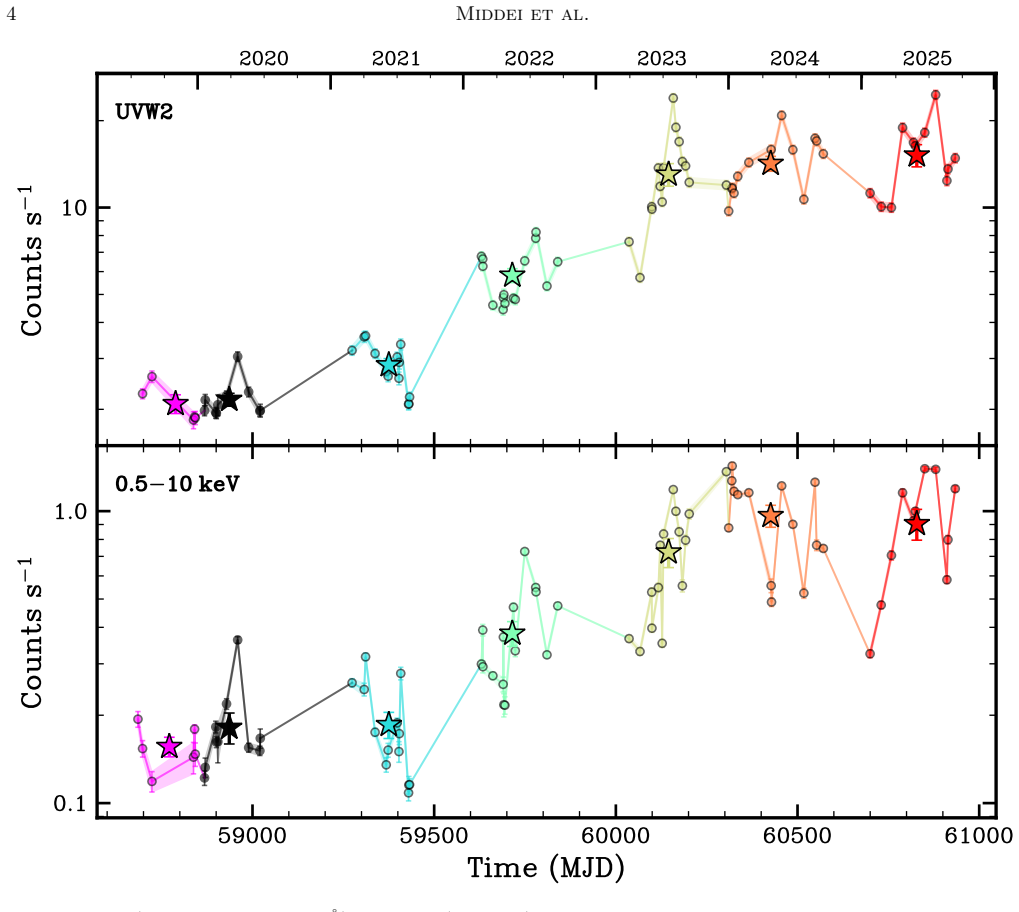
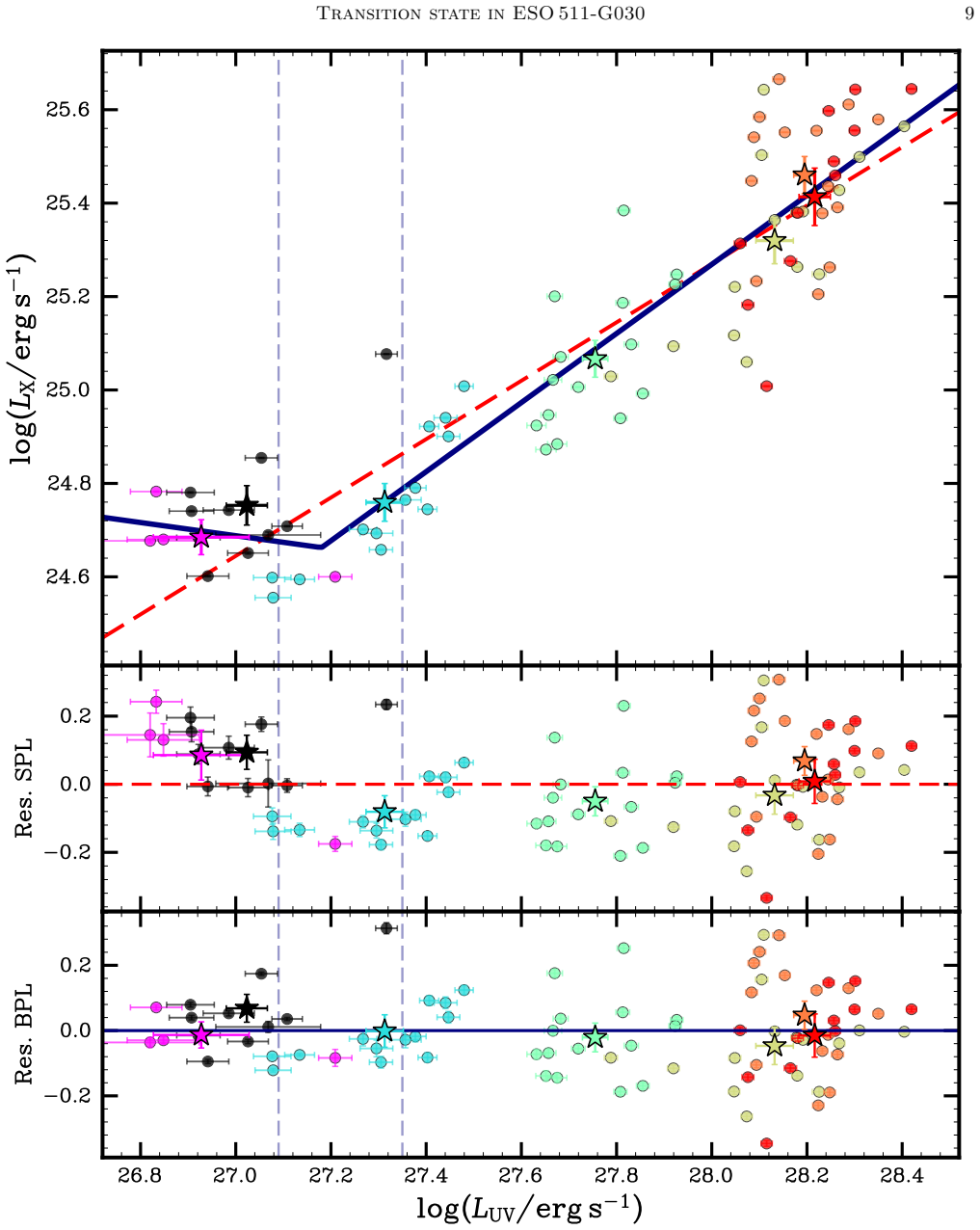
Using six years of simultaneous UV and X-ray monitoring of ESO 511-G030, the authors observe the disk flux rising by more than an order of magnitude. The behavior matches a progressive return of the optically thick disk. At accretion rates above about one percent Eddington the UV and X-ray data follow the established non-linear disk-corona correlation of luminous quasars, while below this threshold the correlation fails as expected if the inner disk evaporates into a geometrically thick hot flow. This provides evidence for an accretion-state transition in supermassive black holes.
What carries the argument
The non-linear correlation between ultraviolet emission from the optically thick accretion disk and X-ray emission from the corona, which holds above approximately one percent of the Eddington accretion rate.
If this is right
- The inner accretion disk evaporates below one percent Eddington into a hot, optically thin flow.
- Accretion flows around supermassive black holes undergo state transitions analogous to those in stellar-mass black holes.
- Radiatively efficient accretion models for active galactic nuclei require revision to account for the observed disk recovery and coupling.
- Low-luminosity active galaxies may lack a standard thin disk in their innermost regions.
Where Pith is reading between the lines
- This observation could be tested by monitoring other low-luminosity AGN to see if the same one-percent threshold appears.
- If confirmed, it would link the behavior of supermassive and stellar black holes more closely than current models assume.
- Future X-ray and UV missions could catch more such re-brightening events to map the transition in detail.
Load-bearing premise
The changes in the spectral energy distribution reflect a real recovery of the optically thick disk rather than a temporary uncovering of a pre-existing disk by some obscuring material.
What would settle it
A future observation showing that the UV-X-ray correlation continues to hold even at accretion rates well below one percent of the Eddington limit would falsify the claimed breakdown and evaporation scenario.
Figures


read the original abstract
Accretion onto supermassive black holes powers the most luminous persistent sources in the Universe, the so-called active galactic nuclei, whose emission is characterized by two distinct spectral components: thermal optical/ultraviolet radiation from an optically thick accretion disk and a power-law X-ray tail from a corona located in the innermost regions of the accretion flow. Yet, how radiatively efficient accretion disks develop and couple to the hot corona remains poorly understood. Using six years of simultaneous ultraviolet and X-ray monitoring of the nearby active galaxy ESO 511-G030, we witness a dramatic evolution of the broadband spectral energy distribution, driven by an increase of the ultraviolet flux from the disk by more than an order of magnitude over a time scale of less than three years. The overall behavior is unlikely to track an uncovering event, and is instead compatible with a progressive recovery of the optically thick component of the accretion flow. At accretion rates higher than approximately one per cent of the Eddington limit, ultraviolet and X-ray data are tightly coupled and follow the well-defined, non-linear correlation between disk and corona found in the more luminous quasars. Below this threshold, the relation apparently breaks down, as expected in case of evaporation of the inner accretion disk into a geometrically thick, optically thin hot flow. This is a strong hint of an accretion-state transition analogous to those observed in stellar-mass black holes, and confirms the need for a paradigm change in the models of radiatively efficient accretion flows around supermassive black holes.
Editorial analysis
A structured set of objections, weighed in public.
Referee Report
Summary. The manuscript reports six years of simultaneous UV and X-ray monitoring of ESO 511-G030, documenting an order-of-magnitude rise in UV disk flux over less than three years. The authors interpret this as progressive recovery of the optically thick accretion disk (rather than an uncovering event) and identify a breakdown in the UV-X-ray correlation below ~1% Eddington, taken as evidence for an accretion-state transition with inner-disk evaporation into a hot flow, analogous to stellar-mass black-hole systems.
Significance. If the central interpretation holds, the work supplies rare direct observational tracking of accretion-disk re-brightening in a supermassive black hole and supplies evidence that the well-known disk-corona correlation in luminous quasars does not extend to low accretion rates. The long-baseline, truly simultaneous multi-wavelength dataset is a clear strength and would constitute a valuable addition to the literature on accretion-state transitions.
major comments (2)
- [Abstract] Abstract: the assertion that the overall behavior is 'unlikely to track an uncovering event' and is instead 'compatible with a progressive recovery of the optically thick component' is load-bearing for the state-transition claim and the reported ~1% Eddington threshold, yet rests on a qualitative assessment without quantitative metrics (e.g., expected reddening, variability coherence, or absorber column-density evolution) to rule out partial covering or variable obscuration.
- [Discussion of accretion-rate threshold] The section discussing the Eddington-ratio threshold: the claimed breakdown below ~1% Eddington and the evaporation scenario are supported only by comparison with existing quasar correlations; no new quantitative modeling, error analysis, or independent derivation of the threshold from the present dataset is shown, leaving the precise location and robustness of the transition dependent on prior relations.
minor comments (1)
- [Figures] Figure captions and axis labels for the light curves and SEDs would benefit from explicit indication of the time intervals used to compute the Eddington ratios.
Simulated Author's Rebuttal
We thank the referee for their careful reading and constructive comments. We address each major comment below and note the revisions planned for the resubmitted manuscript.
read point-by-point responses
-
Referee: [Abstract] Abstract: the assertion that the overall behavior is 'unlikely to track an uncovering event' and is instead 'compatible with a progressive recovery of the optically thick component' is load-bearing for the state-transition claim and the reported ~1% Eddington threshold, yet rests on a qualitative assessment without quantitative metrics (e.g., expected reddening, variability coherence, or absorber column-density evolution) to rule out partial covering or variable obscuration.
Authors: We agree that the distinction between an uncovering event and intrinsic disk recovery is central and would benefit from more quantitative support. The manuscript currently argues for progressive recovery based on the gradual, multi-year UV rise, the absence of abrupt spectral hardening or reddening, and the continued presence of a soft X-ray excess inconsistent with heavy absorption. In the revised manuscript we will add explicit quantitative comparisons, including model predictions for color changes under partial covering and an assessment of UV-X-ray variability coherence across the monitoring baseline, to strengthen this section. revision: yes
-
Referee: [Discussion of accretion-rate threshold] The section discussing the Eddington-ratio threshold: the claimed breakdown below ~1% Eddington and the evaporation scenario are supported only by comparison with existing quasar correlations; no new quantitative modeling, error analysis, or independent derivation of the threshold from the present dataset is shown, leaving the precise location and robustness of the transition dependent on prior relations.
Authors: The ~1% Eddington threshold is identified directly from the point at which the UV-X-ray correlation in our six-year dataset deviates from the established non-linear relation reported for luminous quasars. We will revise the relevant section to include a clearer error analysis on the black-hole mass and bolometric luminosity estimates used to compute the Eddington ratio, and to show explicitly how the transition point is located within the present observations. Full hydrodynamic modeling of disk evaporation lies beyond the scope of this observational work and is not claimed here. revision: partial
Circularity Check
No significant circularity; observational results are data-driven and self-contained
full rationale
The paper reports direct observational results from six years of simultaneous UV/X-ray monitoring of ESO 511-G030, documenting a flux increase and the apparent breakdown of the disk-corona correlation below ~1% Eddington. These findings are compared to pre-existing quasar relations and theoretical expectations for disk evaporation rather than being derived from a fitted parameter or self-citation that reduces the central claim to its own inputs by construction. No self-definitional steps, fitted inputs renamed as predictions, or load-bearing self-citations are present in the provided derivation chain; the analysis remains externally falsifiable via the monitoring data itself.
Axiom & Free-Parameter Ledger
axioms (1)
- domain assumption The observed UV/X-ray correlation above ~1% Eddington follows the same non-linear relation previously established for luminous quasars.
Reference graph
Works this paper leans on
-
[1]
1988, ApJ, 332, 646, doi: 10.1086/166683
Szuszkiewicz, E. 1988, Slim Accretion Disks, ApJ, 332, 646, doi: 10.1086/166683 12Middei et al
-
[2]
Arnaud, K. A. 1996, XSPEC: The First Ten Years, in Astronomical Society of the Pacific Conference Series, Vol. 101, Astronomical Data Analysis Software and Systems V, ed. G. H. Jacoby & J. Barnes, 17
work page 1996
-
[3]
Bohlin, R. C., Savage, B. D., & Drake, J. F. 1978, A survey of interstellar H I from Lalpha absorption measurements. II., ApJ, 224, 132, doi: 10.1086/156357
-
[4]
Bouquin, A. Y. K., Gil de Paz, A., Mu˜ noz-Mateos, J. C., et al. 2018, The GALEX/S 4G Surface Brightness and Color Profiles Catalog. I. Surface Photometry and Color Gradients of Galaxies, ApJS, 234, 18, doi: 10.3847/1538-4365/aaa384
-
[5]
Breeveld, A. A., Landsman, W., Holland, S. T., et al. 2011, An Updated Ultraviolet Calibration for the Swift/UVOT, in American Institute of Physics Conference Series, Vol. 1358, Gamma Ray Bursts 2010, ed. J. E. McEnery, J. L. Racusin, & N. Gehrels (AIP), 373–376, doi: 10.1063/1.3621807
-
[6]
Burrows, D. N., Hill, J. E., Nousek, J. A., et al. 2005, The Swift X-Ray Telescope, SSRv, 120, 165, doi: 10.1007/s11214-005-5097-2
work page internal anchor Pith review doi:10.1007/s11214-005-5097-2 2005
-
[7]
Cai, Z.-Y., & Wang, J.-X. 2023, A universal average spectral energy distribution for quasars from the optical to the extreme ultraviolet, Nature Astronomy, 7, 1506, doi: 10.1038/s41550-023-02088-5
-
[8]
Calderone, G., Nicastro, L., Ghisellini, G., et al. 2017, QSFIT: automatic analysis of optical AGN spectra, MNRAS, 472, 4051, doi: 10.1093/mnras/stx2239 de Vaucouleurs, G., de Vaucouleurs, A., Corwin, Jr., H. G., et al. 1991, Third Reference Catalogue of Bright Galaxies
-
[9]
2007, Modelling the behaviour of accretion flows in X-ray binaries
Done, C., Gierli´ nski, M., & Kubota, A. 2007, Modelling the behaviour of accretion flows in X-ray binaries. Everything you always wanted to know about accretion but were afraid to ask, A&A Rv, 15, 1, doi: 10.1007/s00159-007-0006-1
-
[10]
Foreman-Mackey, D., Hogg, D. W., Lang, D., & Goodman, J. 2013, emcee: The MCMC Hammer, PASP, 125, 306, doi: 10.1086/670067
-
[11]
2004, ApJ, 611, 1005, doi: 10.1086/422091
Gehrels, N., Chincarini, G., Giommi, P., et al. 2004, The Swift Gamma-Ray Burst Mission, ApJ, 611, 1005, doi: 10.1086/422091
-
[12]
Ghosh, R., & Laha, S. 2021, An X-Ray Spectral Study of the Origin of Reflection Features in Bare Seyfert 1 Galaxy ESO 511-G030, ApJ, 908, 198, doi: 10.3847/1538-4357/abd40c
-
[13]
Haardt, F., & Maraschi, L. 1991, A Two-Phase Model for the X-Ray Emission from Seyfert Galaxies, ApJL, 380, L51, doi: 10.1086/186171
-
[14]
1993, X-Ray Spectra from Two-Phase Accretion Disks, ApJ, 413, 507, doi: 10.1086/173020
Haardt, F., & Maraschi, L. 1993, X-Ray Spectra from Two-Phase Accretion Disks, ApJ, 413, 507, doi: 10.1086/173020
-
[15]
Hagen, S., Done, C., Silverman, J. D., et al. 2024, Systematic collapse of the accretion disc across the supermassive black hole population, MNRAS, 534, 2803, doi: 10.1093/mnras/stae2272 HI4PI Collaboration, Ben Bekhti, N., Fl¨ oer, L., et al. 2016, HI4PI: A full-sky H I survey based on EBHIS and GASS, A&A, 594, A116, doi: 10.1051/0004-6361/201629178
-
[16]
Hopkins, P. F., Strauss, M. A., Hall, P. B., et al. 2004, Dust Reddening in Sloan Digital Sky Survey Quasars, AJ, 128, 1112, doi: 10.1086/423291 Ivezi´ c,ˇZ., Kahn, S. M., Tyson, J. A., et al. 2019, LSST: From Science Drivers to Reference Design and Anticipated Data Products, ApJ, 873, 111, doi: 10.3847/1538-4357/ab042c
-
[17]
2026, Multiwavelength properties of changing-state active galactic nuclei: I
Jana, A., Ricci, C., Tortosa, A., et al. 2026, Multiwavelength properties of changing-state active galactic nuclei: I. The evolution of soft excess and X-ray continuum, A&A, 707, A213, doi: 10.1051/0004-6361/202556654
-
[18]
Kang, J.-L., Done, C., Hagen, S., et al. 2025, Systematic collapse of the accretion disc in AGN confirmed by UV photometry and broad-line spectra, MNRAS, 538, 121, doi: 10.1093/mnras/staf145
-
[19]
Kass, R. E., & Raftery, A. E. 1995, Bayes Factors, Journal of the American Statistical Association, 90, 773, doi: 10.1080/01621459.1995.10476572
-
[20]
J., Ricci, C., Trakhtenbrot, B., et al
Koss, M. J., Ricci, C., Trakhtenbrot, B., et al. 2022, BASS. XXII. The BASS DR2 AGN Catalog and Data, ApJS, 261, 2, doi: 10.3847/1538-4365/ac6c05
-
[21]
C., Chakravorty, S., & Kembhavi, A
Laha, S., Guainazzi, M., Dewangan, G. C., Chakravorty, S., & Kembhavi, A. K. 2014, Warm absorbers in X-rays (WAX), a comprehensive high-resolution grating spectral study of a sample of Seyfert galaxies - I. A global view and frequency of occurrence of warm absorbers., MNRAS, 441, 2613, doi: 10.1093/mnras/stu669
-
[22]
1982, ESO/Uppsala survey of the ESO(B) atlas
Lauberts, A. 1982, ESO/Uppsala survey of the ESO(B) atlas
work page 1982
-
[23]
Lusso, E., & Risaliti, G. 2016, The Tight Relation between X-Ray and Ultraviolet Luminosity of Quasars, ApJ, 819, 154, doi: 10.3847/0004-637X/819/2/154
-
[24]
2020, Quasars as standard candles
Lusso, E., Risaliti, G., Nardini, E., et al. 2020, Quasars as standard candles. III. Validation of a new sample for cosmological studies, A&A, 642, A150, doi: 10.1051/0004-6361/202038899
-
[25]
MacLeod, C. L., Ross, N. P., Lawrence, A., et al. 2016, A systematic search for changing-look quasars in SDSS, MNRAS, 457, 389, doi: 10.1093/mnras/stv2997 Transition state in ESO 511-G03013
-
[26]
Maiolino, R., Marconi, A., Salvati, M., et al. 2001, Dust in active nuclei. I. Evidence for “anomalous” properties, A&A, 365, 28, doi: 10.1051/0004-6361:20000177
-
[27]
Middei, R., Petrucci, P.-O., Bianchi, S., et al. 2023, Tracking the spectral properties of ESO 511-G030 across different epochs, A&A, 672, A101, doi: 10.1051/0004-6361/202244022
-
[28]
Narayan, R., & Yi, I. 1995, Advection-dominated Accretion: Underfed Black Holes and Neutron Stars, ApJ, 452, 710, doi: 10.1086/176343
-
[29]
Noda, H., & Done, C. 2018, Explaining changing-look AGN with state transition triggered by rapid mass accretion rate drop, MNRAS, 480, 3898, doi: 10.1093/mnras/sty2032
-
[30]
2025, Markarian 590: the AGN awakens, MNRAS, 540, L14, doi: 10.1093/mnrasl/slaf027
Palit, B., ´Sniegowska, M., Markowitz, A., et al. 2025, Markarian 590: the AGN awakens, MNRAS, 540, L14, doi: 10.1093/mnrasl/slaf027
-
[31]
Palit, B., Rozanska, A., Markowitz, A. G., et al. 2026, The spectral state transition of Mkn 590, a potential link between AGNs and X-ray binaries?, arXiv e-prints, arXiv:2602.17572, doi: 10.48550/arXiv.2602.17572
-
[32]
2024, Changing-look Active Galactic Nuclei
Panda, S., & ´Sniegowska, M. 2024, Changing-look Active Galactic Nuclei. I. Tracking the Transition on the Main Sequence of Quasars, ApJS, 272, 13, doi: 10.3847/1538-4365/ad344f
-
[33]
Polletta, M., Tajer, M., Maraschi, L., et al. 2007, Spectral Energy Distributions of Hard X-Ray Selected Active Galactic Nuclei in the XMM-Newton Medium Deep
work page 2007
-
[34]
Survey, ApJ, 663, 81, doi: 10.1086/518113
-
[35]
Poutanen, J., Lipunova, G., Fabrika, S., Butkevich, A. G., & Abolmasov, P. 2007, Supercritically accreting stellar mass black holes as ultraluminous X-ray sources, MNRAS, 377, 1187, doi: 10.1111/j.1365-2966.2007.11668.x
-
[36]
1984, The typical interstellar extinction in the Small Magellanic Cloud., A&A, 132, 389
Rocca-Volmerange, B. 1984, The typical interstellar extinction in the Small Magellanic Cloud., A&A, 132, 389
work page 1984
-
[37]
Ricci, C., & Trakhtenbrot, B. 2023, Changing-look active galactic nuclei, Nature Astronomy, 7, 1282, doi: 10.1038/s41550-023-02108-4
-
[38]
Spectral Energy Distributions and Multiwavelength Selection of Type 1 Quasars
Richards, G. T., Lacy, M., Storrie-Lombardi, L. J., et al. 2006, Spectral Energy Distributions and Multiwavelength Selection of Type 1 Quasars, ApJS, 166, 470, doi: 10.1086/506525
-
[39]
Roming, P. W. A., Kennedy, T. E., Mason, K. O., et al. 2005, The Swift Ultra-Violet/Optical Telescope, SSRv, 120, 95, doi: 10.1007/s11214-005-5095-4
work page internal anchor Pith review doi:10.1007/s11214-005-5095-4 2005
-
[40]
Ruan, J. J., Anderson, S. F., Eracleous, M., et al. 2019, The Analogous Structure of Accretion Flows in Supermassive and Stellar Mass Black Holes: New Insights from Faded Changing-look Quasars, ApJ, 883, 76, doi: 10.3847/1538-4357/ab3c1a
-
[41]
Runnoe, J. C., Cales, S., Ruan, J. J., et al. 2016, Now you see it, now you don’t: the disappearing central engine of the quasar J1011+5442, MNRAS, 455, 1691, doi: 10.1093/mnras/stv2385
-
[42]
2023, The WISSH quasars project
Saccheo, I., Bongiorno, A., Piconcelli, E., et al. 2023, The WISSH quasars project. XI. The mean spectral energy distribution and bolometric corrections of the most luminous quasars, A&A, 671, A34, doi: 10.1051/0004-6361/202244296
-
[43]
Measuring Reddening with SDSS Stellar Spectra and Recalibrating SFD
Schlafly, E. F., & Finkbeiner, D. P. 2011, Measuring Reddening with Sloan Digital Sky Survey Stellar Spectra and Recalibrating SFD, ApJ, 737, 103, doi: 10.1088/0004-637X/737/2/103
work page internal anchor Pith review doi:10.1088/0004-637x/737/2/103 2011
-
[44]
Shakura, N. I., & Sunyaev, R. A. 1973, Black holes in binary systems. Observational appearance., A&A, 24, 337
work page 1973
-
[45]
Shields, G. A. 1978, Thermal continuum from accretion disks in quasars, Nature, 272, 706, doi: 10.1038/272706a0 ´Sniegowska, M., Czerny, B., Bon, E., & Bon, N. 2020, Possible mechanism for multiple changing-look phenomena in active galactic nuclei, A&A, 641, A167, doi: 10.1051/0004-6361/202038575
-
[46]
Stern, D., McKernan, B., Graham, M. J., et al. 2018, A Mid-IR Selected Changing-look Quasar and Physical Scenarios for Abrupt AGN Fading, ApJ, 864, 27, doi: 10.3847/1538-4357/aac726
-
[47]
Svoboda, J., Guainazzi, M., & Merloni, A. 2017, AGN spectral states from simultaneous UV and X-ray observations by XMM-Newton, A&A, 603, A127, doi: 10.1051/0004-6361/201630181
-
[48]
Trakhtenbrot, B., Ricci, C., Koss, M. J., et al. 2017, BAT AGN Spectroscopic Survey (BASS) - VI. The Γ X-L/LEdd relation, MNRAS, 470, 800, doi: 10.1093/mnras/stx1117
-
[49]
Wang, J.-M., & Zhou, Y.-Y. 1999, Self-similar Solution of Optically Thick Advection-dominated Flows, ApJ, 516, 420, doi: 10.1086/307080
-
[50]
Wilks, S. S. 1938, The Large-Sample Distribution of the Likelihood Ratio for Testing Composite Hypotheses, The Annals of Mathematical Statistics, 9, 60, doi: 10.1214/aoms/1177732360
discussion (0)
Sign in with ORCID, Apple, or X to comment. Anyone can read and Pith papers without signing in.