REVIEW 3 major objections 6 minor 58 references
Learning Point Cloud Representations with Pose Continuity for Depth-Based Category-Level 6D Object Pose Estimation
T0 review · 3 major / 6 minor · reviewed 2026-08-05 · deepseek-v4-flash
Pith's one-line read By teaching a point-cloud network to rank objects by rotation and translation distance rather than only predicting poses, HRC-Pose becomes the most accurate depth-only method for category-level 6D pose estimation on REAL275 and CAMERA25 whi
desk verdict A solid, well-ablated extension of Rank-N-Contrast to multi-task multi-category pose regression, with a real but fixable reporting inconsistency between the main table and the ablation table. read the letter →
The pith
A machine-rendered reading of the paper's core claim, the machinery that carries it, and where it could break.
The reading
What carries the argument
The load-bearing object is the 6D pose-aware hierarchical ranking scheme. Within a category batch, for an anchor i and positive pair (i,j), a sample k is a joint negative if both its rotation and translation distances to i exceed j's; it is a rotation- or translation-specific negative if either one does. Joint negatives enforce strict 6D order, specific negatives broaden batch coverage, and per-category averaging handles multi-category training. Rotation distance sums the cosine distances of the two plane-normal rotation vectors r_x and r_y, with the symmetry axis ignored; translation distance is mean squared error on translations. The contrastive losses built on these rankings — a multi-tas
What would settle it
Train HRC-Pose with the ranking order destroyed — replace the pose-distance ordering in the hierarchical scheme with a random permutation of the same samples while keeping the loss and all other hyperparameters identical. If 5-degree-2cm mAP on REAL275 stays near the reported 49.8 instead of falling toward the 46.5 no-contrastive baseline, the pose-aware ordering is not the active ingredient. A complementary check: hold out part of the pose range (e.g., all mugs with visible handles) during training and test whether the 0.92 embedding-to-pose correlation and the mAP advantage persist on those
Extended reading notes
Core claim
The central claim is that depth-only category-level pose estimators learn fragmented point-cloud features because they treat the 6D pose only as a prediction target, never as a quantity with a continuous ordering. HRC-Pose teaches the ordering directly: a hierarchical ranking contrastive loss ranks point clouds within each category by rotation and translation distance and forces feature similarity to follow the ranking — joint negatives (farther in both rotation and translation) enforce strict 6D order, while rotation/translation-specific negatives broaden coverage. Rotation-aware and translation-aware embeddings are learned by separate encoders and used by separate pose-estimation modules.
Load-bearing premise
The ranking that drives the entire contrastive scheme is computed from two hand-picked distance formulas — cosine distance of the two plane-normal rotation vectors, and mean-squared error between translation vectors — and the method assumes these correctly order objects within every category; if either metric mis-ranks (translation MSE dominated by object scale rather than position, or plane-normal rotation ambiguous for symmetric objects), the network learns continuity under
Editorial extensions
If this is right
- If the reported numbers hold, accurate category-level pose no longer requires RGB: a depth-only pipeline beats most RGB-D baselines on REAL275 and CAMERA25, which matters for untextured objects and unstable lighting in industrial settings.
- The contrastive module adds no inference cost — 122.6 FPS versus 121.5 for HS-Pose on the same machine — so the accuracy gain is a training-time addition, not a runtime trade-off.
- Embeddings whose pairwise distances track true pose differences (Pearson 0.92) should suppress the view-to-view prediction inconsistencies the paper cites as motivation, since nearby poses now map to nearby features.
- The hierarchical ranking loss is target-agnostic; the authors state it can be applied to other regression tasks with multiple correlated targets, and the same design would carry over unchanged.
- Extending the same pose-ranked contrastive framework to RGB-D input is the authors' stated next step and the natural route toward the few remaining RGB-D methods (AG-Pose, SecondPose) that still lead on the strictest thresholds.
Reading between the lines
- The paper infers better generalization from continuity statistics (correlation 0.92, rainbow-like UMAP) but never runs a held-out-pose experiment. A direct test — training on a restricted pose range and testing on the full range — would settle whether the learned smoothness actually transfers to unseen poses; the continuity argument predicts HRC-Pose degrades more gracefully than HS-Pose there.
- The translation ranking uses raw MSE on translation vectors, which is scale-sensitive. Ranking on an object-size-normalized translation distance, or on an IoU-based pose distance, is a natural variant that could matter for categories like bottles with wide intra-class scale variation; the paper does not explore it.
- Because the contrastive loss is decoupled from the pose losses and costs nothing at inference, the hierarchical ranking scheme is effectively a drop-in regularizer for any multi-target geometric regression — object shape parameters, scene flow, camera trajectories — though only poses are demonstrated.
- The margin over CLIPose hints that pose-ranked self-supervision can substitute for the external vision-language semantics CLIPose imports. A testable implication: HRC-Pose should keep its edge in categories where geometry nearly determines pose (bottles, cans) and shrink where semantics matter (mugs, whose handle visibility changes the symmetry treatment).
Editorial analysis
A structured set of objections, weighed in public.
Referee Report
Summary. The paper proposes HRC-Pose, a depth-only category-level 6D pose estimation method. It introduces a hierarchical ranking contrastive learning loss that encourages point-cloud embeddings to reflect rotational and translational pose differences, within each object category, and uses separate rotation-aware and translation-aware encoders feeding dedicated pose estimation sub-modules. Experiments on REAL275 and CAMERA25 report state-of-the-art results among depth-only methods, real-time inference, and ablations supporting the main design choices.
Significance. If the reported results are reproducible, HRC-Pose is a meaningful advance: it is the first depth-only method to surpass 49 mAP at 5 deg/2 cm on REAL275, improves on the previous best HS-Pose by roughly 3 points, runs at 122.6 FPS, and the code is released. The contrastive formulation is a natural and nontrivial extension of Rank-N-Contrast to multi-task, multi-category pose learning, and the ablations are systematic. The main caveats are the unresolved discrepancy between the two 'Ours' rows and the partly by-construction nature of the representation-continuity analysis.
major comments (3)
- [Table 1 vs Table 2, Section 4.2] The central SOTA claim rests on the 'Ours' row, but the same model reports different REAL275 numbers in Table 1 and Table 2. Table 1 gives 49.8/58.6/72.5/85.4, while Table 2 Group 7 ('Ours') gives 49.3/59.1/74.0/86.8. No explanation or error bars are provided. If the runs differ (e.g., random seed), report mean±std over multiple seeds; if they are intended to be identical, one of the tables is wrong. The claimed improvement over HS-Pose is only 3.3 points at 5°2cm, so the discrepancy is large enough to change the ranking versus other reported runs and must be resolved.
- [Section 4.1, Eqs. (8)-(9)] All negative pairs used in the contrastive losses are derived from the hand-picked distance metrics ΔR and Δt. Eq. (9) uses unscaled MSE on translation vectors; although ranking is applied within each category, categories differ in object scale and translation spread, so the ranking order can be dominated by scale rather than by a meaningful notion of pose distance. Eq. (8) also does not specify how the symmetry-axis component is removed for symmetric objects. Because the entire representation-learning contribution depends on these rankings, please include a sensitivity analysis with alternative metrics or normalizations, and clarify the symmetry handling in Eq. (8).
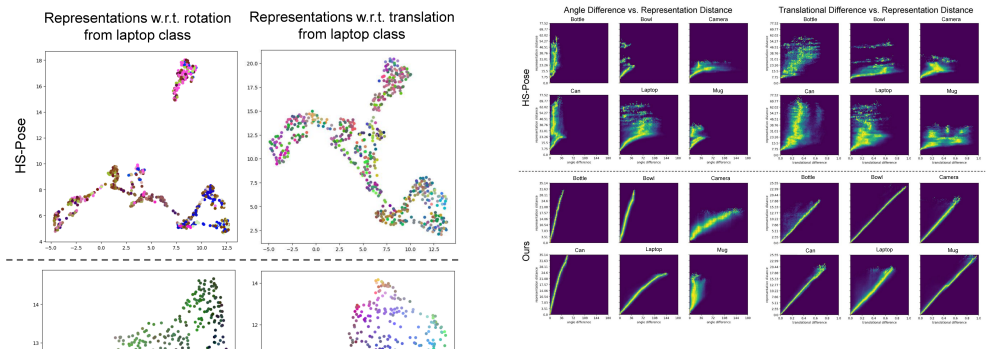
- [Section 4.2, Fig. 4] The high Pearson correlation (0.92 vs 0.20) is presented as evidence that the learned representations 'capture intrinsic continuity.' This is partly by construction: the contrastive loss (Eqs. 1-4) directly enforces monotonicity between pose differences and embedding distances, so Fig. 4 largely verifies that the optimization achieved its objective. The non-circular evidence for the benefit of the module is the pose-estimation accuracy in Table 2. Please reframe the correlation analysis as a sanity check, and add a non-circular evaluation such as a linear probe on held-out poses or a comparison against an equally-trained model without the ranking loss.
minor comments (6)
- [Section 4.2] The text contains repeated typos: 'contractive learning' should be 'contrastive learning'.
- [Table 1 caption] The column header 'CAMERA275' appears to be a typo; the benchmark is CAMERA25.
- [Implementation Details, Section 4.1] The batch size is given as 32, but the paper does not state how the 32 samples are distributed across the six categories. Since contrastive pairs are formed within each category, the expected number of in-class negatives per anchor depends on this distribution; please specify the sampling procedure.
- [Table 2, Group 1] The configurations 'w/o translation in CL' and 'w/o rotation in CL' are ambiguous: it is unclear which of L^R_CL, L^t_CL, or their joint components are disabled. Please state the exact losses used in each row.
- [Fig. 4] The 'average P' value is not defined. Please specify whether it is averaged over the two tasks (rotation and translation), over categories, or both, and report per-task/category values.
- [Table 2, Group 4] Please clarify whether '3D-GCN w CL' is the HS-layer variant used in the main model or the regular 3D-GCN; the text says replacing HS layers by a regular 3D-GCN reduces performance, but the table label is not self-explanatory.
Circularity Check
Held-out pose accuracy is not circular, but the representation-continuity analysis partly re-measures the contrastive training objective; Table 1/Table 2 discrepancy is a reproducibility concern, not circularity.
-
self definitional
[Section 3.2 (after Eq. 4) and Section 4.2 'Analysis on representations from our contrastive learning module']
"By minimizing these loss functions, the feature similarity between f_i and the feature of the closest sample in task space becomes the largest within a batch, followed by the second closest, and so on. This enables the learned point cloud embeddings to capture the intrinsic order of their 6D poses. ... These results confirm that our method produces representations whose pairwise distances align more closely with 6D pose differences, validating the effectiveness of our contrastive learning strategy in capturing the intrinsic continuity and ordering in pose space."
The contrastive losses (Eqs. 1-6) are constructed directly from ground-truth pose-distance rankings: for each anchor-positive pair, the loss pushes away any sample whose pose distance (Eqs. 8-9) is larger. The paper then measures the correlation between pose distances and learned-representation distances and presents the high value (P=0.92) as validation that the representations capture pose continuity. That correlation is not an independent prediction; it is the objective the loss was built to enforce. Reporting it as confirmatory evidence is therefore self-referential. This affects only the representation-analysis claim, not the held-out pose accuracy, which is evaluated on standard benchmarks with independent metrics.
full rationale
The central SOTA claim (Section 4.2, Table 1) is evaluated on held-out REAL275 and CAMERA25 test sets with standard mAP metrics and compared against external baselines, so it does not reduce to the training inputs. No parameter is fitted to the test set, no fitted constant is renamed as a prediction, and no load-bearing result is imported from the authors' own prior work. The only quasi-circular element is the representation-continuity validation (Fig. 3-5, Pearson P=0.92): the contrastive loss was defined to make feature distances order by pose distance, so measuring that ordering in the learned features is largely a check that optimization worked rather than an independent discovery. This is a minor self-confirmatory analysis, not a circular derivation of the empirical benchmarks. The discrepancy between Table 1 'Ours' (49.8/58.6/72.5/85.4) and Table 2 'Ours' (49.3/59.1/74.0/86.8) is a reproducibility/correctness concern outside the circularity definition; it does not by itself indicate that any result is built into the method. Overall circularity is low.
Assumptions & free parameters
free parameters (2)
- lambda =
0.8
- tau =
2
assumptions (3)
- domain assumption NOCS dataset's canonical space and ground-truth poses are reliable for training and evaluation
- domain assumption Rotation representation via two plane normals r_x and r_y, with symmetry-axis rotation ignored for symmetric objects, is sufficient for distance ranking
- domain assumption The chosen distance metrics (cosine-similarity rotation distance and MSE translation distance) define a meaningful continuity ordering for all six object categories
Cite this review
Pith. "Pith review of Learning Point Cloud Representations with Pose Continuity for Depth-Based Category-Level 6D Object Pose Estimation." pith.science (2026). https://pith.science/paper/RCA6TFBF
@misc{pith2026250814358,
  author       = {Pith},
  title        = {Pith review of: Learning Point Cloud Representations with Pose Continuity for Depth-Based Category-Level 6D Object Pose Estimation},
  year         = {2026},
  howpublished = {\url{https://pith.science/paper/RCA6TFBF}},
  note         = {Machine review of arXiv:2508.14358}
}
read the original abstract
Category-level object pose estimation aims to predict the 6D pose and 3D size of objects within given categories. Existing approaches for this task rely solely on 6D poses as supervisory signals without explicitly capturing the intrinsic continuity of poses, leading to inconsistencies in predictions and reduced generalization to unseen poses. To address this limitation, we propose HRC-Pose, a novel depth-only framework for category-level object pose estimation, which leverages contrastive learning to learn point cloud representations that preserve the continuity of 6D poses. HRC-Pose decouples object pose into rotation and translation components, which are separately encoded and leveraged throughout the network. Specifically, we introduce a contrastive learning strategy for multi-task, multi-category scenarios based on our 6D pose-aware hierarchical ranking scheme, which contrasts point clouds from multiple categories by considering rotational and translational differences as well as categorical information. We further design pose estimation modules that separately process the learned rotation-aware and translation-aware embeddings. Our experiments demonstrate that HRC-Pose successfully learns continuous feature spaces. Results on REAL275 and CAMERA25 benchmarks show that our method consistently outperforms existing depth-only state-of-the-art methods and runs in real-time, demonstrating its effectiveness and potential for real-world applications. Our code is at https://github.com/zhujunli1993/HRC-Pose.
Figures


Figures from the paper (1 more)

Reference graph
Works this paper leans on
-
[1]
Pose guided rgbd feature learning for 3d object pose estimation
Vassileios Balntas, Andreas Doumanoglou, Caner Sahin, Juil Sock, Rigas Kouskouridas, and Tae-Kyun Kim. Pose guided rgbd feature learning for 3d object pose estimation. InPro- ceedings of the IEEE international conference on computer vision, pages 3856–3864, 2017. 2, 3, 7
work page 2017
-
[2]
Ove6d: Object viewpoint encoding for depth-based 6d object pose estimation
Dingding Cai, Janne Heikkil ¨a, and Esa Rahtu. Ove6d: Object viewpoint encoding for depth-based 6d object pose estimation. InProceedings of the IEEE/CVF Conference on Computer Vision and Pattern Recognition, pages 6803– 6813, 2022. 1
work page 2022
-
[3]
Shapenet: An information-rich 3d model repository.arXiv preprint arXiv:1512.03012, 2015
Angel X Chang, Thomas Funkhouser, Leonidas Guibas, Pat Hanrahan, Qixing Huang, Zimo Li, Silvio Savarese, Manolis Savva, Shuran Song, Hao Su, et al. Shapenet: An information-rich 3d model repository.arXiv preprint arXiv:1512.03012, 2015. 5
arXiv 2015
-
[4]
Sgpa: Structure-guided prior adapta- tion for category-level 6d object pose estimation
Kai Chen and Qi Dou. Sgpa: Structure-guided prior adapta- tion for category-level 6d object pose estimation. InProceed- ings of the IEEE/CVF International Conference on Com- puter Vision, pages 2773–2782, 2021. 1, 2, 7
work page 2021
-
[5]
Kai Chen, Stephen James, Congying Sui, Yun-Hui Liu, Pieter Abbeel, and Qi Dou. Stereopose: Category-level 6d transparent object pose estimation from stereo images via back-view nocs. In2023 IEEE International Conference on Robotics and Automation (ICRA), pages 2855–2861. IEEE,
-
[6]
A simple framework for contrastive learning of visual representations
Ting Chen, Simon Kornblith, Mohammad Norouzi, and Ge- offrey Hinton. A simple framework for contrastive learning of visual representations. InInternational conference on ma- chine learning, pages 1597–1607. PMLR, 2020. 2, 3
work page 2020
-
[7]
Wei Chen, Xi Jia, Hyung Jin Chang, Jinming Duan, Linlin Shen, and Ales Leonardis. Fs-net: Fast shape-based network for category-level 6d object pose estimation with decoupled rotation mechanism. InProceedings of the IEEE/CVF Con- ference on Computer Vision and Pattern Recognition, pages 1581–1590, 2021. 2, 4, 6, 7
work page 2021
-
[8]
Category level object pose estimation via neu- ral analysis-by-synthesis
Xu Chen, Zijian Dong, Jie Song, Andreas Geiger, and Ot- mar Hilliges. Category level object pose estimation via neu- ral analysis-by-synthesis. InComputer Vision–ECCV 2020: 16th European Conference, Glasgow, UK, August 23–28, 2020, Proceedings, Part XXVI 16, pages 139–156. Springer,
work page 2020
Show all 58 references
-
[9]
Holistic++ scene understanding: Single-view 3d holistic scene parsing and human pose es- timation with human-object interaction and physical com- monsense
Yixin Chen, Siyuan Huang, Tao Yuan, Siyuan Qi, Yixin Zhu, and Song-Chun Zhu. Holistic++ scene understanding: Single-view 3d holistic scene parsing and human pose es- timation with human-object interaction and physical com- monsense. InProceedings of the IEEE/CVF International ...
2019
-
[10]
Secondpose: Se (3)- consistent dual-stream feature fusion for category-level pose estimation
Yamei Chen, Yan Di, Guangyao Zhai, Fabian Manhardt, Chenyangguang Zhang, Ruida Zhang, Federico Tombari, Nassir Navab, and Benjamin Busam. Secondpose: Se (3)- consistent dual-stream feature fusion for category-level pose estimation. InProceedings of the IEEE/CVF Conference on C...
2024
-
[11]
Revisit- ing fully convolutional geometric features for object 6d pose estimation
Jaime Corsetti, Davide Boscaini, and Fabio Poiesi. Revisit- ing fully convolutional geometric features for object 6d pose estimation. InProceedings of the IEEE/CVF International Conference on Computer Vision, pages 2103–2112, 2023. 2
2023
-
[12]
Self-supervised 6d object pose estimation for robot manipulation
Xinke Deng, Yu Xiang, Arsalan Mousavian, Clemens Epp- ner, Timothy Bretl, and Dieter Fox. Self-supervised 6d object pose estimation for robot manipulation. In2020 IEEE In- ternational Conference on Robotics and Automation (ICRA), pages 3665–3671. IEEE, 2020. 1
2020
-
[13]
Gpv-pose: Category-level object pose estimation via geometry-guided point-wise voting
Yan Di, Ruida Zhang, Zhiqiang Lou, Fabian Manhardt, Xi- angyang Ji, Nassir Navab, and Federico Tombari. Gpv-pose: Category-level object pose estimation via geometry-guided point-wise voting. InProceedings of the IEEE/CVF Con- ference on Computer Vision and Pattern Recognition,...
2022
-
[14]
Ppr-net: point-wise pose regression network for instance segmentation and 6d pose es- timation in bin-picking scenarios
Zhikai Dong, Sicheng Liu, Tao Zhou, Hui Cheng, Long Zeng, Xingyao Yu, and Houde Liu. Ppr-net: point-wise pose regression network for instance segmentation and 6d pose es- timation in bin-picking scenarios. In2019 IEEE/RSJ interna- tional conference on intelligent robots and sy...
2019
-
[15]
Notes on noise contrastive estimation and nega- tive sampling.arXiv preprint arXiv:1410.8251, 2014
Chris Dyer. Notes on noise contrastive estimation and nega- tive sampling.arXiv preprint arXiv:1410.8251, 2014. 3
2014 arXiv
-
[16]
Fully convolutional ge- ometric features for category-level object alignment
Qiaojun Feng and Nikolay Atanasov. Fully convolutional ge- ometric features for category-level object alignment. In2020 IEEE/RSJ International Conference on Intelligent Robots and Systems (IROS), pages 8492–8498. IEEE, 2020. 2
2020
-
[17]
6d object pose regression via supervised learning on point clouds
Ge Gao, Mikko Lauri, Yulong Wang, Xiaolin Hu, Jianwei Zhang, and Simone Frintrop. 6d object pose regression via supervised learning on point clouds. In2020 IEEE Inter- national Conference on Robotics and Automation (ICRA), pages 3643–3649. IEEE, 2020. 1
2020
-
[18]
Mask r-cnn
Kaiming He, Georgia Gkioxari, Piotr Doll ´ar, and Ross Gir- shick. Mask r-cnn. InProceedings of the IEEE international conference on computer vision, pages 2961–2969, 2017. 3
2017
-
[19]
Ffb6d: A full flow bidirectional fusion network for 6d pose estimation
Yisheng He, Haibin Huang, Haoqiang Fan, Qifeng Chen, and Jian Sun. Ffb6d: A full flow bidirectional fusion network for 6d pose estimation. InProceedings of the IEEE/CVF con- ference on computer vision and pattern recognition, pages 3003–3013, 2021. 1
2021
-
[20]
Denoising dif- fusion probabilistic models.Advances in neural information processing systems, 33:6840–6851, 2020
Jonathan Ho, Ajay Jain, and Pieter Abbeel. Denoising dif- fusion probabilistic models.Advances in neural information processing systems, 33:6840–6851, 2020. 3
2020
-
[21]
Supervised contrastive learning.Advances in neural information processing systems, 33:18661–18673,
Prannay Khosla, Piotr Teterwak, Chen Wang, Aaron Sarna, Yonglong Tian, Phillip Isola, Aaron Maschinot, Ce Liu, and Dilip Krishnan. Supervised contrastive learning.Advances in neural information processing systems, 33:18661–18673,
-
[22]
Con- trastive representation learning: A framework and review
Phuc H Le-Khac, Graham Healy, and Alan F Smeaton. Con- trastive representation learning: A framework and review. Ieee Access, 8:193907–193934, 2020. 3
2020
-
[23]
Category-level metric scale object shape and pose estimation.IEEE Robotics and Automation Letters, 6(4): 8575–8582, 2021
Taeyeop Lee, Byeong-Uk Lee, Myungchul Kim, and In So Kweon. Category-level metric scale object shape and pose estimation.IEEE Robotics and Automation Letters, 6(4): 8575–8582, 2021. 2
2021
-
[24]
Generative category-level shape and pose estimation with semantic primitives
Guanglin Li, Yifeng Li, Zhichao Ye, Qihang Zhang, Tao Kong, Zhaopeng Cui, and Guofeng Zhang. Generative category-level shape and pose estimation with semantic primitives. InConference on Robot Learning, pages 1390–
-
[25]
Depth-based 6dof object pose estimation using swin transformer
Zhujun Li and Ioannis Stamos. Depth-based 6dof object pose estimation using swin transformer. In2023 IEEE/RSJ International Conference on Intelligent Robots and Systems (IROS), pages 1185–1191. IEEE, 2023. 1, 2
2023
-
[26]
Sar-net: Shape align- ment and recovery network for category-level 6d object pose and size estimation
Haitao Lin, Zichang Liu, Chilam Cheang, Yanwei Fu, Guodong Guo, and Xiangyang Xue. Sar-net: Shape align- ment and recovery network for category-level 6d object pose and size estimation. InProceedings of the IEEE/CVF con- ference on computer vision and pattern recognition, page...
2022
-
[27]
Dualposenet: Category-level 6d object pose and size estimation using dual pose network with re- fined learning of pose consistency
Jiehong Lin, Zewei Wei, Zhihao Li, Songcen Xu, Kui Jia, and Yuanqing Li. Dualposenet: Category-level 6d object pose and size estimation using dual pose network with re- fined learning of pose consistency. InProceedings of the IEEE/CVF International Conference on Computer Visio...
2021
-
[28]
Category-level 6d object pose and size estimation using self- supervised deep prior deformation networks
Jiehong Lin, Zewei Wei, Changxing Ding, and Kui Jia. Category-level 6d object pose and size estimation using self- supervised deep prior deformation networks. InEuropean Conference on Computer Vision, pages 19–34. Springer,
-
[29]
Instance-adaptive and geometric-aware keypoint learning for category-level 6d object pose estimation
Xiao Lin, Wenfei Yang, Yuan Gao, and Tianzhu Zhang. Instance-adaptive and geometric-aware keypoint learning for category-level 6d object pose estimation. InProceedings of the IEEE/CVF Conference on Computer Vision and Pattern Recognition, pages 21040–21049, 2024. 2, 7
2024
-
[30]
Cli- pose: Category-level object pose estimation with pre-trained vision-language knowledge.IEEE Transactions on Circuits and Systems for Video Technology, 2024
Xiao Lin, Minghao Zhu, Ronghao Dang, Guangliang Zhou, Shaolong Shu, Feng Lin, Chengju Liu, and Qijun Chen. Cli- pose: Category-level object pose estimation with pre-trained vision-language knowledge.IEEE Transactions on Circuits and Systems for Video Technology, 2024. 2, 3, 7
2024
-
[31]
Ist-net: Prior-free category-level pose estimation with im- plicit space transformation
Jianhui Liu, Yukang Chen, Xiaoqing Ye, and Xiaojuan Qi. Ist-net: Prior-free category-level pose estimation with im- plicit space transformation. InProceedings of the IEEE/CVF International Conference on Computer Vision, pages 13978– 13988, 2023. 1, 7
2023
-
[32]
Umap: Uniform manifold approximation and projection for dimen- sion reduction.arXiv preprint arXiv:1802.03426, 2018
Leland McInnes, John Healy, and James Melville. Umap: Uniform manifold approximation and projection for dimen- sion reduction.arXiv preprint arXiv:1802.03426, 2018. 6
2018 arXiv
-
[33]
Repre- sentation learning with contrastive predictive coding.arXiv preprint arXiv:1807.03748, 2018
Aaron van den Oord, Yazhe Li, and Oriol Vinyals. Repre- sentation learning with contrastive predictive coding.arXiv preprint arXiv:1807.03748, 2018. 3
2018 arXiv
-
[34]
Pvnet: Pixel-wise voting network for 6dof pose estimation
Sida Peng, Yuan Liu, Qixing Huang, Xiaowei Zhou, and Hu- jun Bao. Pvnet: Pixel-wise voting network for 6dof pose estimation. InProceedings of the IEEE/CVF conference on computer vision and pattern recognition, pages 4561–4570,
-
[35]
Pointnet++: Deep hierarchical feature learning on point sets in a metric space.Advances in neural information processing systems, 30, 2017
Charles Ruizhongtai Qi, Li Yi, Hao Su, and Leonidas J Guibas. Pointnet++: Deep hierarchical feature learning on point sets in a metric space.Advances in neural information processing systems, 30, 2017. 8
2017
-
[36]
Maximum likelihood training of score-based diffusion mod- els.Advances in neural information processing systems, 34: 1415–1428, 2021
Yang Song, Conor Durkan, Iain Murray, and Stefano Ermon. Maximum likelihood training of score-based diffusion mod- els.Advances in neural information processing systems, 34: 1415–1428, 2021. 3
2021
-
[37]
Deep multi-state object pose estimation for augmented reality assembly
Yongzhi Su, Jason Rambach, Nareg Minaskan, Paul Lesur, Alain Pagani, and Didier Stricker. Deep multi-state object pose estimation for augmented reality assembly. In2019 IEEE International Symposium on Mixed and Augmented Reality Adjunct (ISMAR-Adjunct), pages 222–227. IEEE,
-
[38]
Diffusionnocs: Managing symmetry and uncertainty in sim2real multi-modal category-level pose es- timation
Tianyi Ko Muhammad Zubair Irshad Robert Lee Kather- ine Liu Rares Ambrus Koichi Nishiwaki Takuya Ikeda, Sergey Zakharov. Diffusionnocs: Managing symmetry and uncertainty in sim2real multi-modal category-level pose es- timation. 2024. 3
2024
-
[39]
Shape prior deformation for categorical 6d object pose and size estima- tion
Meng Tian, Marcelo H Ang, and Gim Hee Lee. Shape prior deformation for categorical 6d object pose and size estima- tion. InComputer Vision–ECCV 2020: 16th European Con- ference, Glasgow, UK, August 23–28, 2020, Proceedings, Part XXI 16, pages 530–546. Springer, 2020. 2, 5, 7
2020
-
[40]
Shape prior deformation for categorical 6d object pose and size es- timation
Meng Tian, Marcelo H Ang Jr, and Gim Hee Lee. Shape prior deformation for categorical 6d object pose and size es- timation. InProceedings of the European Conference on Computer Vision (ECCV), 2020. 1
2020
-
[41]
Least-squares estimation of transforma- tion parameters between two point patterns.IEEE Transac- tions on Pattern Analysis & Machine Intelligence, 13(04): 376–380, 1991
Shinji Umeyama. Least-squares estimation of transforma- tion parameters between two point patterns.IEEE Transac- tions on Pattern Analysis & Machine Intelligence, 13(04): 376–380, 1991. 2
1991
-
[42]
Normalized object coordinate space for category-level 6d object pose and size estimation
He Wang, Srinath Sridhar, Jingwei Huang, Julien Valentin, Shuran Song, and Leonidas J Guibas. Normalized object coordinate space for category-level 6d object pose and size estimation. InProceedings of the IEEE/CVF Conference on Computer Vision and Pattern Recognition, pages 26...
2019
-
[43]
Attention-guided rgb-d fusion network for category-level 6d object pose estimation
Hao Wang, Weiming Li, Jiyeon Kim, and Qiang Wang. Attention-guided rgb-d fusion network for category-level 6d object pose estimation. In2022 IEEE/RSJ International Conference on Intelligent Robots and Systems (IROS), pages 10651–10658. IEEE, 2022. 2
2022
-
[44]
Category-level 6d object pose estimation via cascaded relation and recurrent recon- struction networks
Jiaze Wang, Kai Chen, and Qi Dou. Category-level 6d object pose estimation via cascaded relation and recurrent recon- struction networks. In2021 IEEE/RSJ International Confer- ence on Intelligent Robots and Systems (IROS), pages 4807–
-
[45]
Contrastive learning based hybrid networks for long- tailed image classification
Peng Wang, Kai Han, Xiu-Shen Wei, Lei Zhang, and Lei Wang. Contrastive learning based hybrid networks for long- tailed image classification. InProceedings of the IEEE/CVF conference on computer vision and pattern recognition, pages 943–952, 2021. 3
2021
-
[46]
Query6dof: Learning sparse queries as implicit shape prior for category-level 6dof pose estimation
Ruiqi Wang, Xinggang Wang, Te Li, Rong Yang, Minhong Wan, and Wenyu Liu. Query6dof: Learning sparse queries as implicit shape prior for category-level 6dof pose estimation. InProceedings of the IEEE/CVF International Conference on Computer Vision, pages 14055–14064, 2023. 1
2023
-
[47]
Distance met- ric learning for large margin nearest neighbor classification
Kilian Q Weinberger and Lawrence K Saul. Distance met- ric learning for large margin nearest neighbor classification. Journal of machine learning research, 10(2), 2009. 2
2009
-
[48]
Learning descriptors for object recognition and 3d pose estimation
Paul Wohlhart and Vincent Lepetit. Learning descriptors for object recognition and 3d pose estimation. InProceedings of the IEEE conference on computer vision and pattern recog- nition, pages 3109–3118, 2015. 2, 3
2015
-
[49]
6d-vnet: End-to-end 6-dof vehicle pose es- timation from monocular rgb images
Di Wu, Zhaoyong Zhuang, Canqun Xiang, Wenbin Zou, and Xia Li. 6d-vnet: End-to-end 6-dof vehicle pose es- timation from monocular rgb images. InProceedings of the IEEE/CVF Conference on Computer Vision and Pattern Recognition Workshops, pages 0–0, 2019. 1
2019
-
[50]
Posecontrast: Class-agnostic object viewpoint estimation in the wild with pose-aware contrastive learning
Yang Xiao, Yuming Du, and Renaud Marlet. Posecontrast: Class-agnostic object viewpoint estimation in the wild with pose-aware contrastive learning. In2021 International Con- ference on 3D Vision (3DV), pages 74–84. IEEE, 2021. 3
2021
-
[51]
6DoF Object Pose Estimation via Differentiable Proxy V ot- ing Loss.arXiv preprint arXiv:2002.03923, 2020
Xin Yu, Zheyu Zhuang, Piotr Koniusz, and Hongdong Li. 6DoF Object Pose Estimation via Differentiable Proxy V ot- ing Loss.arXiv preprint arXiv:2002.03923, 2020. 1
2002 arXiv
-
[52]
3d object instance recognition and pose estimation using triplet loss with dynamic margin
Sergey Zakharov, Wadim Kehl, Benjamin Planche, Andreas Hutter, and Slobodan Ilic. 3d object instance recognition and pose estimation using triplet loss with dynamic margin. In2017 IEEE/RSJ International Conference on Intelligent Robots and Systems (IROS), pages 552–559. IEEE, ...
2017
-
[53]
Rank-n-contrast: learning continuous representa- tions for regression.Advances in Neural Information Pro- cessing Systems, 36, 2024
Kaiwen Zha, Peng Cao, Jeany Son, Yuzhe Yang, and Dina Katabi. Rank-n-contrast: learning continuous representa- tions for regression.Advances in Neural Information Pro- cessing Systems, 36, 2024. 2, 3, 5, 6
2024
-
[54]
Rbp-pose: Residual bounding box projection for category-level pose estimation
Ruida Zhang, Yan Di, Zhiqiang Lou, Fabian Manhardt, Fed- erico Tombari, and Xiangyang Ji. Rbp-pose: Residual bounding box projection for category-level pose estimation. InEuropean Conference on Computer Vision, pages 655–
-
[55]
Ssp-pose: Symmetry-aware shape prior deformation for direct category-level object pose estimation
Ruida Zhang, Yan Di, Fabian Manhardt, Federico Tombari, and Xiangyang Ji. Ssp-pose: Symmetry-aware shape prior deformation for direct category-level object pose estimation. In2022 IEEE/RSJ International Conference on Intelligent Robots and Systems (IROS), pages 7452–7459. IEEE...
2022
-
[56]
Hs-pose: Hybrid scope feature extraction for category-level object pose estimation
Linfang Zheng, Chen Wang, Yinghan Sun, Esha Dasgupta, Hua Chen, Ale ˇs Leonardis, Wei Zhang, and Hyung Jin Chang. Hs-pose: Hybrid scope feature extraction for category-level object pose estimation. InProceedings of the IEEE/CVF Conference on Computer Vision and Pattern Recogni...
2023
-
[57]
Weakly super- vised contrastive learning
Mingkai Zheng, Fei Wang, Shan You, Chen Qian, Chang- shui Zhang, Xiaogang Wang, and Chang Xu. Weakly super- vised contrastive learning. InProceedings of the IEEE/CVF International Conference on Computer Vision, pages 10042– 10051, 2021. 3
2021
-
[672]
Springer, 2022. 1, 5, 7
2022
Reviewed August 5, 2026 · model on record in the stance chip above.
Discussion (0). Sign in to comment.