REVIEW 3 major objections 5 minor 74 references
This paper shows that an η-dependent momentum weight can strip the global-momentum-conservation background from rapidity-even dipolar flow, exposing a collective signal tied to initial-state geometry and transport.
Reviewed by Pith at T0; open to challenge. T0 means a machine referee read the full paper against a public rubric. the ladder, T0–T4 →
T0 review · deepseek-v4-flash
2026-08-01 17:54 UTC pith:RCW5J6K6
load-bearing objection A solid, incremental AMPT/HIJING study that extends GMC-suppressed v1^even to a battery of mixed-harmonic and normalized correlators; the main caveat is that the weighting procedure's preservation of genuine flow is not independently validated, but the paper is honest about this and the conclusions are appropriately cautious. the 3 major comments →
Rapidity-even Dipolar Flow in Relativistic Heavy-Ion Collisions
The pith
A machine-rendered reading of the paper's core claim, the machinery that carries it, and where it could break.
Core claim
After suppressing GMC with an η-dependent weight, the rapidity-even dipolar flow signal in Au+Au collisions at 200 GeV emerges as a clean, transport-sensitive observable. The HIJING baseline, which contains momentum-conservation and jet-like correlations but no collective flow, drops to near zero after the correction, while AMPT exhibits a nonzero v1^even with a sign-changing pT dependence and a strong ordering with partonic scattering strength. The paper therefore establishes that the corrected first-harmonic correlations carry genuine information about the collective dipolar response, and that their mixed-harmonic and normalized forms provide access to correlations among the initial-state
What carries the argument
The central object is the η-dependent weight ω(pT, η) = pT − w(η), where w(η) = ⟨pT²⟩η / ⟨pT⟩η is computed per centrality and pseudorapidity bin. This choice enforces ⟨ω pT⟩ ≈ 0 in each η interval, making the first-harmonic flow vector approximately orthogonal to the transverse-momentum vector and thereby removing the leading global-momentum-conservation contribution locally in pseudorapidity. The weighted Q1 vector is then used in all first-harmonic and mixed-harmonic correlators, while higher harmonics are constructed with unweighted Q vectors.
Load-bearing premise
The GMC suppression is built into the weight definition (⟨ω pT⟩ ≈ 0 by construction), so the HIJING test only demonstrates that a non-flow background vanishes; it does not independently establish that genuine collective dipolar flow survives without bias.
What would settle it
If a model with no collective response (e.g., HIJING after the same η-dependent weighting) were to display a sign-changing pT dependence in v1^even comparable to the AMPT signal, or if the AMPT sign-changing structure persisted when partonic scattering was turned off, the residual signal would be diagnosed as leftover momentum-conservation or recoil rather than dipolar collectivity.
If this is right
- The GMC-suppressed HIJING results show that the η-dependent weighting removes the leading momentum-conservation background, so residual v1 correlations in AMPT can be interpreted as collective dipolar response.
- The sign-changing pT dependence of v1^even in AMPT—negative at low pT and positive at high pT—reproduces the expected constraint that the net transverse momentum from the dipolar flow field vanishes.
- The mixed-harmonic correlators ⟨V1V2V−1V−2⟩ and ⟨V1V3V−1V−3⟩ are sensitive to the partonic scattering cross section, with lower viscosity producing larger correlations, indicating that these observables encode viscous damping of the dipolar response.
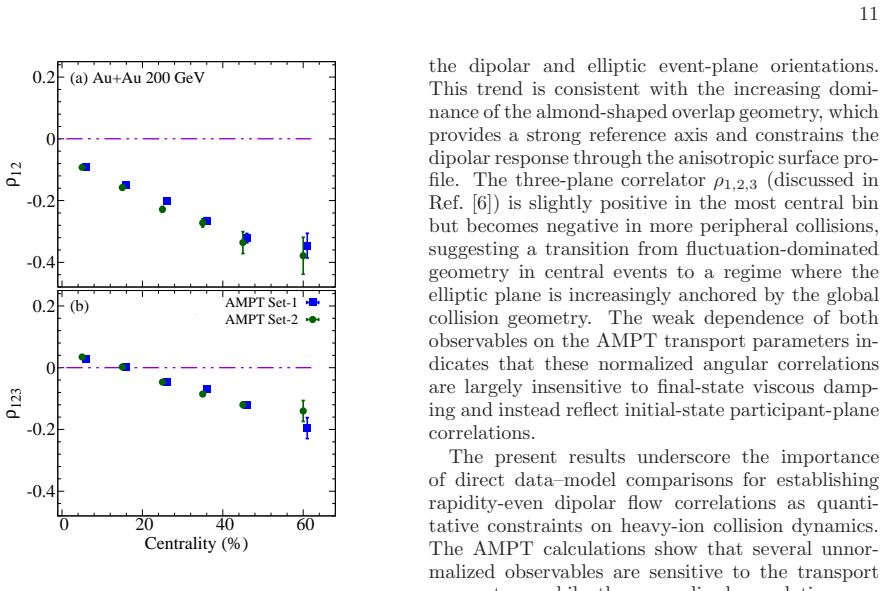
- Normalized correlations β1,2, β1,3, ρ1,2, and ρ1,2,3 show weak dependence on transport parameters and strong centrality trends, suggesting they primarily reflect initial-state eccentricity and event-plane correlations.
- The ratio v1^even / v2^{1/4} retains transport sensitivity unlike the acoustic-scaling ratio v2^{1/4}/v3^{1/9}, indicating that the dipolar response is not fully captured by the simple linear acoustic-scaling ansatz.
Where Pith is reading between the lines
- Because the dipolar eccentricity ε1 is weighted toward the nuclear surface, the same η-dependent GMC-suppression procedure applied to isobaric or light-ion collisions (e.g., 16O+16O) could amplify sensitivity to neutron skins, surface diffuseness, and clustered nuclear configurations beyond what v2 and v3 alone provide.
- The near-zero HIJING baseline after suppression suggests that any residual non-flow in the real data can be monitored by comparing two- and four-particle correlators; a dedicated multi-subevent study with larger event samples could quantify remaining dijet-like recoil contributions to the higher-order mixed-harmonic observables.
- If the normalized event-plane correlations ρ1,2 and ρ1,2,3 are as insensitive to transport as shown here, they may serve as direct experimental constraints on the initial-state participant-plane structure, potentially allowing model-independent extraction of the correlations among ε1, ε2, and ε3.
Editorial analysis
A structured set of objections, weighed in public.
Referee Report
Summary. The paper studies rapidity-even directed flow, v1^even, in Au+Au collisions at sqrt(s_NN)=200 GeV using the AMPT and HIJING models. A pseudorapidity-dependent weight, omega(pT,eta)=pT-w(eta), is used to suppress global momentum conservation (GMC) contributions to first-harmonic observables. The HIJING model is used as a non-collective baseline, and AMPT is run with two partonic cross sections to study transport sensitivity. The analysis covers integrated and differential two- and multi-particle correlators involving v1, v2, and v3, including normalized correlations. The main claims are that the weighting procedure strongly reduces the HIJING GMC background, that AMPT reproduces the sign-changing pT dependence of v1^even and its sensitivity to partonic transport, and that the resulting dipolar-flow correlations are a promising framework for constraining initial-state fluctuations and final-state transport.
Significance. If the central assumption is validated, the paper offers a useful set of observables and a systematic comparison between a non-collective baseline and a transport model. The use of two AMPT settings, a HIJING baseline, and a wide set of correlators is a strength. The paper is also transparent about several limitations: the orthogonality condition in the weight is partly built in, higher-order correlators use a one-subevent method, and normalized differential correlations are not stable with current statistics. However, the significance of the physics conclusions depends on whether the weighting procedure preserves genuine collective dipolar flow. The HIJING baseline alone does not establish this, and the comparison to STAR data may be partially circular if the same weighting scheme was used in the experimental extraction. These issues are load-bearing for the paper's central claim.
major comments (3)
- [Sec. II.B.1, Eqs. (9)-(11); Figs. 3-9] The weight omega(pT,eta)=pT-w(eta) is constructed so that <omega pT>=0. This removes the leading GMC term, but genuine rapidity-even dipolar flow also satisfies <pT v1(pT)> approx 0 (Eq. 4). The weighting therefore projects out a pT-linear component of the collective response, not just the GMC recoil term. The HIJING-ON baseline in Figs. 3-9 demonstrates that a non-collective background is small after weighting, but it does not test whether a known collective dipole would survive the same projection. The paper needs an embedding test: take HIJING events, inject a known dipolar modulation with the expected pT dependence, apply the full weighted analysis chain, and show that v1^even and the mixed correlators are recovered without bias. Without this, the statement that the remaining AMPT signal 'reflects the collective conversion of correlated initial eccentricities' (Sec. III, near Fig. 8)
- [Sec. II.B.1 and Fig. 2] The agreement between AMPT and STAR data in Fig. 2 is the main external anchor for the claim that the weighting preserves genuine flow. It is not stated whether the experimental v1^even extraction in Ref. [42] uses the same eta-dependent weight (or an equivalent GMC subtraction). If it does, the agreement is partly a test of the weighting procedure, not an independent validation of the flow signal. The paper should state the experimental method explicitly. If the experiment uses a different GMC subtraction, that should be explained. If the methods are the same, an independent cross-check is needed, for example comparing the weighted AMPT result to an alternative GMC subtraction based on subevents or on explicit momentum-conservation corrections applied after the flow extraction.
- [Sec. III, Figs. 10-11] The normalized observables beta1,2, beta1,3, rho1,2, and rho1,2,3 are interpreted as being governed primarily by initial-state correlations because of their weak dependence on the AMPT transport setting. This interpretation assumes that the weighting procedure removes approximately the same fraction of the v1 response in both AMPT settings. Since the weight is pT-dependent and the v1(pT) shape changes with sigma_parton, the weak transport dependence of the ratios could be an artifact of the projection. This is closely related to the embedding-test issue above, but it is especially important here because the paper draws a physics conclusion about 'initial-state eccentricity correlations' from these ratios. An injection test, or a cross-check with an unweighted reference flow vector for the normalization, would make this claim robust.
minor comments (5)
- [Author affiliation] Typo in the affiliation: 'Upto n, New York' should be 'Upton, New York'.
- [Fig. 1 caption] The caption labels panel (a) 'HIJING' and shows curves for several centrality intervals, but the meaning of the color/line coding is not described. Please add a legend or a sentence identifying each curve.
- [Eq. (14)] The notation p_k with '0 denotes an integrated particle of reference' is not defined before it is used in Eq. (14). A brief sentence defining the subscript convention would improve readability.
- [Fig. 6] The HIJING-ON baseline is shown only after suppression; it would be informative to also show the HIJING-OFF result in the same panels on a common scale, so the reader can see the magnitude of the raw background relative to the AMPT signal.
- [Appendix A] Equation (A2) is presented as a schematic acoustic-scaling form. The statement that the dipolar response is 'not fully captured by the same simple linear acoustic-scaling ansatz' is therefore somewhat stronger than the evidence supports. Please rephrase as a suggestion or add a concrete test of the assumed v1 scaling.
Circularity Check
GMC suppression is partly built into the weight by construction; the HIJING-ON 'validation' is a tautology, though AMPT and data comparisons remain independent.
specific steps
-
self definitional
[Sec. II.B.1, Eqs. (9)-(11), Fig. 1 and surrounding text]
"ω(pT , η) = pT − w(η), (9) w(η) = ⟨p2 T ⟩η /⟨pT ⟩η. (10) ... This choice gives ⟨ω(pT , η) pT ⟩η ≃ 0, (11) ... The comparison with a fixed midrapidity weight, w(0), is not intended as an independent proof of collective-flow extraction, since the orthogonality condition is largely built into the definition of ω."
The weight is defined to enforce ⟨ω pT⟩≈0, so the leading GMC term −c pT pT in Eq. (5) is removed by construction rather than by a measurement. The HIJING-ON suppression therefore only shows that the projection removes exactly the mode it was designed to remove. Because the genuine dipolar signal itself satisfies ⟨pT v1^{even}(pT)⟩≈0 (Eq. 4), a pT-linear collective response occupies the same subspace that is projected out. The paper's validation of the procedure is thus partly tautological and does not by itself prove that genuine dipolar flow survives without bias.
full rationale
The paper's AMPT results are not fitted to the STAR v1 data; the comparison in Fig. 2 is an external anchor, and the σparton sensitivity, normalized β/ρ correlations, and acoustic-scaling ratios are constructed without tuning to v1 observables. There is no load-bearing self-citation chain: the weighting procedure is attributed to Jia & Mohapatra (Ref. [61]), and the correlator formalism citations are to standard methods. The main circular element is the GMC-suppression step in Sec. II.B.1. The weight is chosen so that ⟨ω pT⟩≈0, which by construction annihilates the leading GMC contribution; the paper itself concedes that the orthogonality condition is 'largely built into the definition of ω.' The HIJING-ON baseline is therefore a consistency check of the construction rather than an independent validation that the weighting preserves the collective dipolar signal. Moreover, the genuine signal is constrained by the same ⟨pT v1⟩≈0 condition, so the projection can suppress part of the collective response. The paper does not provide a positive control (e.g., injecting a known collective dipole into HIJING and verifying its survival). These issues make the GMC-suppression validation partially circular, but they do not reduce the AMPT predictions or the external data comparison to fits. Hence a moderate score of 4.
Axiom & Free-Parameter Ledger
free parameters (2)
- AMPT partonic scattering cross section σ_parton (Set-1) =
9.6 mb (μ=1.27 fm^-1, α_s=0.33)
- AMPT partonic scattering cross section σ_parton (Set-2) =
4.8 mb (μ=1.80 fm^-1, α_s=0.33)
axioms (5)
- domain assumption Global momentum conservation contributes to v1 two-particle correlations as -c pT^a pT^b (Eq. 5)
- ad hoc to paper The η-dependent weight ω=pT−w(η) suppresses GMC while preserving the genuine dipolar flow signal
- domain assumption HIJING with default settings is a valid non-collective baseline with negligible collective flow
- domain assumption Linear-response scaling v_n ~ κ_n ε_n and acoustic damping κ_n ∝ exp(-n^2 β)
- standard math Rotational invariance and standard cumulant/Q-vector formalism for multi-particle correlators
read the original abstract
Rapidity-even directed flow, ($v_{1}^{even}$), provides a sensitive probe of fluctuation-driven dipolar asymmetry in the initial state of relativistic heavy-ion collisions. Its extraction is complicated by large first-harmonic non-flow correlations, particularly those induced by global momentum conservation (GMC). In this work, we study ($v_{1}^{even}$) and its multi-particle correlations in Au+Au collisions at ($\sqrt{s_{NN}}=200$) GeV using the AMPT and HIJING models. An ($\eta$)-dependent weighting procedure is employed to suppress the leading GMC contribution. HIJING is used as a non-collective baseline, while AMPT is used to investigate sensitivity to final-state partonic transport. The GMC-corrected HIJING results are strongly reduced for most ($v_1$)-related observables, indicating that the leading HIJING-like recoil contribution is effectively mitigated. The AMPT calculations reproduce the characteristic sign-changing ($p_T$) dependence of ($v_{1}^{even}$) and show sensitivity to the partonic scattering strength. Mixed-harmonic and normalized correlations involving ($v_1$), ($v_2$), and ($v_3$) suggest that the dipolar mode is correlated with both the elliptic geometry and fluctuation-driven triangular structure. These results demonstrate that GMC-suppressed rapidity-even dipolar-flow correlations provide a promising framework for constraining initial-state fluctuations and final-state transport in heavy-ion collisions.
Figures



Reference graph
Works this paper leans on
-
[1]
Heavy-ion collisions are modeled us- ing Glauber geometry through independent binary nucleon–nucleon interactions
HIJING The HIJING model [47, 48] is a Monte Carlo event generator developed to describe parton and particle production in high-energy hadronic and nu- clear collisions. Heavy-ion collisions are modeled us- ing Glauber geometry through independent binary nucleon–nucleon interactions. HIJING is widely used to study jet and mini-jet production, together with...
-
[2]
AMPT The AMPT model has been extensively used to investigate various aspects of relativistic heavy-ion collisions [46, 51–54]. The model consists of several main components: (i) an initial partonic stage gen- erated by the HIJING model [47, 48], where particle production is governed by the Lund string fragmen- tation function [55], f (z) ∝ z−1(1 − z)a exp...
-
[3]
5 [30, 31, 43]
Momentum-conservation suppression The measurement of rapidity-even directed flow is strongly affected by GMC, which to leading order is given by Eq. 5 [30, 31, 43]. Since this contribution can be comparable to the genuine dipolar-flow sig- nal, it must be suppressed before interpreting veven 1 and its correlations with higher harmonics. In this work, the GMC...
-
[4]
Multi-particle correlations The multi-particle correlation method is em- ployed to quantify flow magnitudes, flow fluctua- tions, mixed-harmonic correlations, and event-plane correlations involving the rapidity-even dipolar har- monic [53, 62–66]. The generic k-particle azimuthal correlator is defined as: Cn1,...,nk |p1,...,pk = ⟨⟨cos (n1φ1 + · · · + nkφk)⟩⟩,...
-
[5]
E. V. Shuryak, Sov. J. Nucl. Phys. 28, 408 (1978)
1978
-
[6]
E. V. Shuryak, Phys. Rept. 61, 71 (1980)
1980
-
[7]
B. Muller, J. Schukraft, and B. Wyslouch, Ann. Rev. Nucl. Part. Sci. 62, 361 (2012), arXiv:1202.3233 [hep-ex]
Pith/arXiv arXiv 2012
-
[8]
S. Voloshin and Y. Zhang, Z. Phys. C 70, 665 (1996), arXiv:hep-ph/9407282
Pith/arXiv arXiv 1996
-
[9]
A. M. Poskanzer and S. A. Voloshin, Phys. Rev. C58, 1671 (1998), arXiv:nucl-ex/9805001 [nucl-ex]
Pith/arXiv arXiv 1998
-
[10]
D. Teaney and L. Yan, Phys. Rev. C83, 064904 (2011), arXiv:1010.1876 [nucl-th]
Pith/arXiv arXiv 2011
-
[11]
R. S. Bhalerao, J.-Y. Ollitrault, and S. Pal, Phys. Lett. B742, 94 (2015), arXiv:1411.5160 [nucl-th]
Pith/arXiv arXiv 2015
-
[12]
L. Yan and J.-Y. Ollitrault, Phys. Lett. B744, 82 (2015), arXiv:1502.02502 [nucl-th]
Pith/arXiv arXiv 2015
-
[13]
P. Bozek and H. Mehrabpour, Phys. Rev. C 101, 064902 (2020), arXiv:2002.08832 [nucl-th]
Pith/arXiv arXiv 2020
-
[14]
B. Alver et al. (PHOBOS), Phys. Rev. C77, 014906 (2008), arXiv:0711.3724 [nucl-ex]
Pith/arXiv arXiv 2008
-
[15]
G. Giacalone, B. Schenke, and C. Shen, Phys. Rev. Lett. 125, 192301 (2020), arXiv:2006.15721 [nucl-th]
Pith/arXiv arXiv 2020
-
[16]
B. Schenke, P. Tribedy, and R. Venu- gopalan, Phys. Rev. C89, 064908 (2014), arXiv:1403.2232 [nucl-th]
Pith/arXiv arXiv 2014
-
[17]
P. Staig and E. Shuryak, Phys. Rev. C84, 034908 (2011), arXiv:1008.3139 [nucl-th]
Pith/arXiv arXiv 2011
-
[18]
U. W. Heinz and P. F. Kolb, Statisti- cal QCD. Proceedings, International Sym- posium, Bielefeld, Germany, August 26- 30, 2001 , Nucl. Phys. A702, 269 (2002), arXiv:hep-ph/0111075 [hep-ph]
Pith/arXiv arXiv 2001
-
[19]
T. Hirano, U. W. Heinz, D. Kharzeev, R. Lacey, and Y. Nara, Phys.Lett. B636, 299 (2006), arXiv:nucl-th/0511046 [nucl-th]
Pith/arXiv arXiv 2006
-
[20]
Huovinen, P
P. Huovinen, P. F. Kolb, U. W. Heinz, P. V. Ru- uskanen, and S. A. Voloshin, Phys. Lett. B503, 58 (2001)
2001
-
[21]
T. Hirano and K. Tsuda, Phys. Rev. C66, 054905 (2002), arXiv:nucl-th/0205043
Pith/arXiv arXiv 2002
-
[22]
P. Romatschke and U. Romatschke, Phys.Rev.Lett. 99, 172301 (2007), arXiv:0706.1522 [nucl-th]
Pith/arXiv arXiv 2007
- [23]
-
[24]
H. Song, S. A. Bass, U. Heinz, T. Hirano, and C. Shen, Phys. Rev. Lett. 106, 192301 (2011), [Erratum: Phys. Rev. Lett.109,139904(2012)], arXiv:1011.2783 [nucl-th]
Pith/arXiv arXiv 2011
-
[25]
J. Qian, U. W. Heinz, and J. Liu, Phys. Rev. C93, 064901 (2016), arXiv:1602.02813 [nucl-th]
Pith/arXiv arXiv 2016
-
[26]
Magdy (STAR), Proceedings, 11th International Workshop on Critical Point and Onset of Deconfine- ment (CPOD2017): Stony Brook, NY, USA, August 7-11, 2017 , PoS CPOD2017, 005 (2018)
N. Magdy (STAR), Proceedings, 11th International Workshop on Critical Point and Onset of Deconfine- ment (CPOD2017): Stony Brook, NY, USA, August 7-11, 2017 , PoS CPOD2017, 005 (2018)
2017
-
[27]
Magdy (STAR), Proceedings, 16th Interna- tional Conference on Strangeness in Quark Matter (SQM 2016): Berkeley, California, United States , J
N. Magdy (STAR), Proceedings, 16th Interna- tional Conference on Strangeness in Quark Matter (SQM 2016): Berkeley, California, United States , J. Phys. Conf. Ser. 779, 012060 (2017)
2016
-
[28]
A. Bilandzic, Eur. Phys. J. C 82, 788 (2022), arXiv:2106.05760 [hep-ph]
Pith/arXiv arXiv 2022
-
[29]
B. Schenke, S. Jeon, and C. Gale, Phys.Lett. B702, 59 (2011), arXiv:1102.0575 [hep-ph]
Pith/arXiv arXiv 2011
-
[30]
D. Teaney and L. Yan, Phys. Rev. C86, 044908 (2012), arXiv:1206.1905 [nucl-th]
Pith/arXiv arXiv 2012
-
[31]
F. G. Gardim, F. Grassi, M. Luzum, and J.- Y. Ollitrault, Phys.Rev.Lett. 109, 202302 (2012), arXiv:1203.2882 [nucl-th]
Pith/arXiv arXiv 2012
-
[32]
R. A. Lacey, D. Reynolds, A. Taranenko, N. N. Ajitanand, J. M. Alexander, F.-H. Liu, Y. Gu, and A. Mwai, J. Phys. G43, 10LT01 (2016), arXiv:1311.1728 [nucl-ex]
Pith/arXiv arXiv 2016
-
[33]
S. Bhatta and V. Bairathi, Eur. Phys. J. C 82, 855 (2022), arXiv:2208.05157 [nucl-ex]
Pith/arXiv arXiv 2022
-
[34]
E. Retinskaya, M. Luzum, and J.-Y. Olli- trault, Phys. Rev. Lett. 108, 252302 (2012), arXiv:1203.0931 [nucl-th]
Pith/arXiv arXiv 2012
-
[35]
J. Jia, S. K. Radhakrishnan, and S. Mo- hapatra, J. Phys. G40, 105108 (2013), arXiv:1203.3410 [nucl-th]
Pith/arXiv arXiv 2013
-
[36]
R. J. M. Snellings, H. Sorge, S. A. Voloshin, F. Q. Wang, and N. Xu, Phys. Rev. Lett. 84, 2803 (2000), arXiv:nucl-ex/9908001
Pith/arXiv arXiv 2000
-
[37]
E. E. Zabrodin, C. Fuchs, L. V. Bravina, and A. Faessler, Phys. Rev. C 63, 034902 (2001), arXiv:nucl-th/0006056
Pith/arXiv arXiv 2001
-
[38]
N. Borghini, P. M. Dinh, and J. Y. Ol- litrault, Phys. Rev. C 66, 014905 (2002), arXiv:nucl-th/0204017
Pith/arXiv arXiv 2002
-
[39]
J. Adams et al. (STAR), Phys. Rev. Lett. 92, 062301 (2004), [Erra- tum: Phys.Rev.Lett. 127, 069901 (2021)], arXiv:nucl-ex/0310029
Pith/arXiv arXiv 2004
-
[40]
B. B. Back et al. (PHOBOS), Phys. Rev. Lett. 97, 012301 (2006), arXiv:nucl-ex/0511045
Pith/arXiv arXiv 2006
-
[41]
N. Magdy and R. Lacey, 14 J. Phys. G 51, 09LT01 (2024), arXiv:2308.11031 [nucl-th]
Pith/arXiv arXiv 2024
-
[42]
K. Shafi and S. Chatter- jee, Eur. Phys. J. C 86, 93 (2026), arXiv:2505.11713 [nucl-th]
arXiv 2026
-
[43]
J. Adam et al. (STAR), Phys. Rev. Lett. 122, 172301 (2019), arXiv:1901.08155 [nucl-ex]
Pith/arXiv arXiv 2019
-
[44]
P. Liu and R. A. Lacey, Phys. Rev. C 98, 021902 (2018), arXiv:1802.06595 [nucl-ex]
Pith/arXiv arXiv 2018
-
[45]
B. Aboona et al. (STAR), Phys. Lett. B 839, 137755 (2023), arXiv:2211.11637 [nucl-ex]
arXiv 2023
-
[46]
J. Adam et al. (STAR), Phys. Lett. B 784, 26 (2018), arXiv:1804.08647 [nucl-ex]
Pith/arXiv arXiv 2018
-
[47]
N. Borghini, P. M. Dinh, J.-Y. Olli- trault, A. M. Poskanzer, and S. A. Voloshin, Phys. Rev. C66, 014901 (2002), arXiv:nucl-th/0202013 [nucl-th]
Pith/arXiv arXiv 2002
-
[48]
N. Magdy, Phys. Rev. C 109, 024906 (2024), arXiv:2401.04083 [nucl-th]
Pith/arXiv arXiv 2024
- [49]
-
[50]
Z.-W. Lin, C. M. Ko, B.-A. Li, B. Zhang, and S. Pal, Phys. Rev. C72, 064901 (2005), arXiv:nucl-th/0411110 [nucl-th]
Pith/arXiv arXiv 2005
-
[51]
Wang and M
X.-N. Wang and M. Gyulassy, Phys. Rev. D44, 3501 (1991)
1991
-
[52]
M. Gyulassy and X.-N. Wang, Comput. Phys. Commun. 83, 307 (1994), arXiv:nucl-th/9502021 [nucl-th]
Pith/arXiv arXiv 1994
-
[53]
Sjostrand and M
T. Sjostrand and M. Bengtsson, Comput. Phys. Commun. 43, 367 (1987)
1987
-
[54]
Andersson, G
B. Andersson, G. Gustafson, G. Ingelman, and T. Sjostrand, Phys. Rept. 97, 31 (1983)
1983
- [55]
-
[56]
M.-W. Nie, P. Huo, J. Jia, and G.- L. Ma, Phys. Rev. C98, 034903 (2018), arXiv:1802.00374 [hep-ph]
Pith/arXiv arXiv 2018
-
[57]
N. Magdy, O. Evdokimov, and R. A. Lacey, J. Phys. G 48, 025101 (2020), arXiv:2002.04583 [nucl-ex]
Pith/arXiv arXiv 2020
-
[58]
N. Magdy, Eur. Phys. J. A 59, 64 (2023), arXiv:2206.05332 [nucl-th]
Pith/arXiv arXiv 2023
-
[59]
S. Ferreres-Sol´ e and T. Sj¨ ostrand, Eur. Phys. J. C 78, 983 (2018), arXiv:1808.04619 [hep-ph]
Pith/arXiv arXiv 2018
-
[60]
J. Xu and C. M. Ko, Phys. Rev. C 83, 034904 (2011), arXiv:1101.2231 [nucl-th]
Pith/arXiv arXiv 2011
-
[61]
B. Zhang, Comput. Phys. Commun. 109, 193 (1998), arXiv:nucl-th/9709009 [nucl-th]
Pith/arXiv arXiv 1998
-
[62]
B.-A. Li and C. M. Ko, Phys. Rev. C52, 2037 (1995), arXiv:nucl-th/9505016 [nucl-th]
Pith/arXiv arXiv 2037
-
[63]
M. Nasim, Phys. Rev. C 95, 034905 (2017), arXiv:1612.01066 [nucl-ex]
Pith/arXiv arXiv 2017
-
[64]
D. Solanki, P. Sorensen, S. Basu, R. Raniwala, and T. K. Nayak, Phys. Lett. B 720, 352 (2013), arXiv:1210.0512 [nucl-ex]
Pith/arXiv arXiv 2013
-
[65]
J. Jia and S. Mohapatra, Eur. Phys. J. C 73, 2510 (2013), arXiv:1203.5095 [nucl-th]
Pith/arXiv arXiv 2013
-
[66]
A. Bilandzic, R. Snellings, and S. Voloshin, Phys. Rev. C83, 044913 (2011), arXiv:1010.0233 [nucl-ex]
Pith/arXiv arXiv 2011
-
[67]
J. Jia, M. Zhou, and A. Trzu- pek, Phys. Rev. C96, 034906 (2017), arXiv:1701.03830 [nucl-th]
Pith/arXiv arXiv 2017
-
[68]
P. Huo, K. Gajdoˇ sov´ a, J. Jia, and Y. Zhou, Phys. Lett. B 777, 201 (2018), arXiv:1710.07567 [nucl-ex]
Pith/arXiv arXiv 2018
-
[69]
C. Zhang, J. Jia, and J. Xu, Phys. Lett. B792, 138 (2019), arXiv:1812.03536 [nucl-th]
Pith/arXiv arXiv 2019
-
[70]
M. Alqahtani and J.-Y. Ollitrault, Phys. Lett. B 877, 140504 (2026), arXiv:2511.09283 [nucl-th]
Pith/arXiv arXiv 2026
-
[71]
N. Magdy, Phys. Rev. C 110, 024906 (2024), arXiv:2405.19169 [hep-ph]
Pith/arXiv arXiv 2024
-
[72]
N. Magdy, Phys. Rev. C 107, 024905 (2023), arXiv:2210.14091 [nucl-th]
Pith/arXiv arXiv 2023
-
[73]
M. Abdallah et al. (STAR), Phys. Rev. Lett. 129, 252301 (2022), arXiv:2201.10365 [nucl-ex]
arXiv 2022
-
[74]
L. Adamczyk et al. (STAR), Phys. Rev. C 88, 014904 (2013), arXiv:1301.2187 [nucl-ex]
Pith/arXiv arXiv 2013
discussion (0)
Sign in with ORCID, Apple, or X to comment. Anyone can read and Pith papers without signing in.