REVIEW 2 major objections 4 minor 13 references
The paper proves that one-bit sign compression of a spectral-LMO optimizer can make a linear objective increase, and that only gradient-side error feedback restores a convergence rate.
Reviewed by Pith at T0; open to challenge. T0 means a machine referee read the full paper against a public rubric. the ladder, T0–T4 →
T0 review · deepseek-v4-flash
2026-08-03 02:01 UTC pith:RE44QH6O
load-bearing objection The negative results are the real contribution and look solid; the empirical 'reversed ordering' is suggestive but rests on schedule choices the paper itself discloses. the 2 major comments →
Sign compression for Muon: SignMuon, MuonSign, and the Limits of Error Feedback
The pith
A machine-rendered reading of the paper's core claim, the machinery that carries it, and where it could break.
Core claim
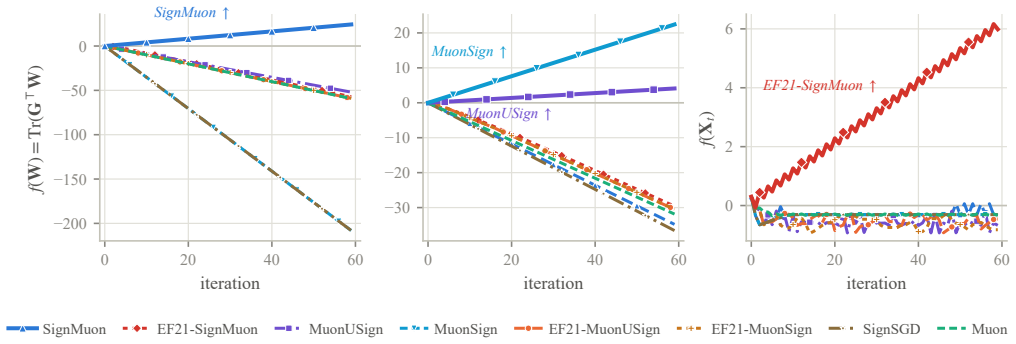
The central discovery is that taking the elementwise sign of a Muon step produces an update that is not steepest descent for any norm, and a single small gradient matrix can make the objective increase monotonically. The mechanism is the same in each placement: the sign operator and the polar factor are each individually descent-generating LMOs, but their composition loses the descent inner product. Error feedback, the standard repair for biased compressors, only works when it targets the gradient rather than the polar factor; the polar factor can move by a constant however small the step size, so EF21-SignMuon diverges for every (L, eta, mu), while EF21-MuonUSign and EF21-MuonSign attain th
What carries the argument
Muon's linear minimization oracle for the spectral norm, polar(M)=UV^T from the singular value decomposition, together with elementwise sign as a one-bit compressor. The arguments turn on two identities: on a linear objective the descent inner product factorizes as -eta<G,s(G)> once momentum cancels, and the scaled sign of a residual, C(Y)=mean|Y| sign(Y), is a Euclidean-contractive compressor while a bare sign is not. The first reduces each divergence theorem to finding one matrix with a negative inner product; the second lets the gradient-targeting EF21 variants inherit a convergence guarantee, while the non-Lipschitz behavior of the polar factor is what makes the output-targeting version
Load-bearing premise
The empirical ranking rests on the unit-gain per-layer step-size heuristic, with the sign-family exponent 1/2 fit from one diagnostic; if that scaling is wrong for some method, its position in the ordering could be a step-size artifact rather than a property of the sign placement.
What would settle it
Compute the three explicit inner products—<G,sign(polar(G))> on the paper's 4x4 G, and <G,polar(sign(G))> and <G,sign(polar(sign(G)))> on its 5x5 G—in exact rational arithmetic; if any is nonnegative, the corresponding divergence theorem is wrong. For the empirical claim, re-tune all six compressed methods with per-layer step sizes chosen independently or by a different a priori rule; if sign-before or both-sides ever beats sign-after by more than seed spread, the practical ordering collapses.
If this is right
- No placement of the sign around the spectral LMO can carry a general descent guarantee; any universal convergence claim for SignMuon at this level of generality is false.
- EF21-SignMuon cannot be repaired by any step-size rule depending only on the smoothness and momentum constants; its divergence is unconditional over those parameters.
- Error feedback restores convergence only when applied to gradient estimates: EF21-MuonUSign and EF21-MuonSign reach the standard O(T^-1/2) squared-gradient-norm rate on smooth nonconvex problems.
- EF21-MuonSign achieves the rate with one bit per parameter on both uplink and downlink, at a factor-sqrt(r) step-size penalty in layer rank.
- At the scales tested, sign-after-the-LMO is the strongest compressed method in practice, matching or nearly matching full-precision Muon despite lacking a theoretical guarantee.
Where Pith is reading between the lines
- This reading suggests that worst-case descent guarantees may be the wrong selection criterion for compressed optimizers at practical scales; robustness to step-size scaling may matter more than universal convergence.
- The failure of output-side error feedback points to a general principle: error feedback works when the tracked target is Lipschitz in the step size, and scalar-magnitude tracking fails for non-Lipschitz geometric maps such as polar factors.
- The unit-gain per-layer step-size rule, including the exponent 1/2 selected from measured growth exponents, is a testable design choice; deriving it from per-layer input-output alignment statistics would give an independent check.
- A natural next step is to ask whether any one-bit compressor can be contractive in the spectral layer norm; the paper shows the scaled sign is not, leaving an open gap for design.
Editorial analysis
A structured set of objections, weighed in public.
Referee Report
Summary. This paper studies one-bit sign compression of the Muon LMO in three placements: after the LMO (SignMuon), before it (MuonUSign), and on both sides (MuonSign). It constructs explicit 4×4 and 5×5 counterexamples on which each placement ascends on a linear objective for every step size and momentum (Theorems 1–3), and builds, for every (L,η,μ), an L-smooth bounded-below function on which EF21-SignMuon — error feedback applied to the LMO output — diverges (Theorem 4). It then proves that error feedback applied to the gradient instead yields EF21-MuonUSign and EF21-MuonSign as exact instances of the EF21-Muon framework, with the scaled-sign compressor shown to be Euclidean-contractive, giving the standard O(T^{-1/2}) nonconvex stationarity rate under the sharp schedule and an O(T^{-1/4}) constant-rate statement for the uplink-only variant. Experiments on centralized and federated CIFAR-10 and on the nanoGPT speedrun report sign-after methods ahead of the provably convergent EF21 variants, which the paper presents as a reversal of the theory.
Significance. The negative results are the paper's principal contribution. If correct, they settle a clean question: no placement of the elementwise sign around the spectral LMO carries a general descent guarantee, and the standard error-feedback repair fails when applied to the oracle output, while gradient-side error feedback restores the standard rate. Theorems 1–3 are explicit, exact-rational, and numerically demonstrated; Theorem 4 is an elaborate but documented construction with symbolic and numerical verification. The reduction of the positive methods to EF21-Muon is transparent, and Lemma 5's contractivity proof is elementary. The paper is also commendably explicit about what its experiments do not cover. The significance is moderated by the fact that the headline empirical reversal is supported mainly by runs of EF21-MuonSign outside its certified schedule and by a step-size heuristic whose cross-family sensitivity is not fully tested; the paper's own disclosures make this gap precise.
major comments (2)
- [§5 / Appendix A.10, “Scope”] The positive guarantee for EF21-MuonSign (Theorem 5(i), Corollary 1) is proved only under the “sharp” schedule η_{t,i}=γ_i ∥g_{t,i}∥_*, and Corollary 2 explicitly excludes EF21-MuonSign because its downlink is not identity. Appendix A.10 states that the experiments run a cosine-annealed constant η0, so the EF21-MuonSign runs are covered by neither Corollary 1 nor Corollary 2. Tables 1–3 then use those runs to support the claim that provably convergent variants trail SignMuon. The observed deficits (94.04 vs 94.60 centralized; 83.99 vs 85.72 federated; 3.3213 vs 3.2881 on nanoGPT) may therefore be an artifact of the step-size schedule rather than an inherent cost of the guarantee. Because the paper's practical conclusion is exactly that the unguaranteed sign-after method beats the certified ones, this needs a direct test: run EF21-MuonSign under its certified sharp schedule (or otherwise
- [§4.1, Eq. (7); Appendix A.17] The unit-gain rule's sign-family exponent a=1/2 is selected from a growth-exponent fit on the same CIFAR network, and Table 11 re-tunes only the three sign-terminated methods under alternative rules. The central empirical comparison, however, is between sign-terminated SignMuon and the lmo-terminated EF21 variants. A misspecified a changes the per-layer distribution of sign-family step sizes relative to the lmo family (λ_sign=n^{-a} vs λ_lmo=sqrt(max(1,m/n))), and since η0 is tuned per method, a global rescale is absorbed but this cross-family per-layer distortion is not. Table 11 does not check whether the SignMuon-vs-EF21 ordering survives re-tuning under a=0 and a=1. Please add a sensitivity analysis that re-tunes at least SignMuon and EF21-MuonUSign/EF21-MuonSign under competing rules and reports the cross-family ordering; otherwise the empirical reversal may be a scaling artifact.
minor comments (4)
- [§4.2 / A.4–A.6] The text asserts that the 4×4 and 5×5 counterexample shapes are “minimal,” and says the appendix bounds the two shapes from below, but I could not locate the lower-bound proof in the reproduced appendix. If it exists elsewhere, please cite it; otherwise soften the claim or add the proof.
- [Table 3] The EF21-MuonSign (X) row reports a validation loss of 5.5198 but leaves the “Steps to 3.35” column empty. Clarify whether the server model never reaches 3.35 and consider showing a dash for readability.
- [A.10 / A.16] The nanoGPT runs use Nesterov momentum and Newton–Schulz LMO approximation, neither of which is covered by Theorem 5. The paper discloses this in A.10, but the nanoGPT comparison would benefit from an explicit sentence in §5.3 stating that the leading compressed method in that table is also outside the certified theory through its momentum rule.
- [A.10, Remark 5] The phrase “the scaled sign is spectrally contractive for no parameter at all” is slightly confusing; it means “is not spectral-norm contractive for any α>0.” Consider rewording.
Circularity Check
No significant circularity: the negative constructions and the positive rate transfer are self-contained; the only in-sample fitting affects experimental heuristics, not the theoretical derivation.
full rationale
The load-bearing derivation chain is not circular. Theorems 1–3 are explicit counterexamples: the paper constructs specific 4×4 and 5×5 gradients and verifies by exact rational arithmetic that ⟨G, s(G)⟩ < 0 for each sign placement, which directly implies ascent on a linear objective by Proposition 1. Theorem 4 is likewise a construction: it builds an L-smooth bounded-below objective whose EF21-SignMuon trajectory enters a wrong-sign limit cycle, with the dependence on (L, η, μ) handled by an explicit rescaling lemma and a realization lemma; no fitted parameter or external theorem is load-bearing there. The positive convergence rates for EF21-MuonUSign and EF21-MuonSign are transferred from Gruntkowska et al. (2025), an external framework with no author overlap, and the paper supplies the two nontrivial transfer ingredients itself: Proposition 2 proves exact trajectory equivalence to the framework, and Lemma 5 proves contractivity of the scaled sign. This is independent support, not a self-citation chain. The only author-overlapping citation (Kravatskiy et al. 2025) appears in related-work comparisons and optional Gluon/KyFan extensions, never as the premise of a central theorem. The unit-gain step-size exponent a = 1/2 is fitted from a growth-exponent measurement on the same CIFAR network, but the paper explicitly labels (7) a heuristic, uses it only to set per-layer step sizes in experiments, and supplies Table 11 showing the sign-family ordering persists under global, unit-gain, and µP rules. That is a methodological limitation, not a derivation that reduces to its input by construction. Likewise, the disclosed mismatch between the sharp schedule required by Corollary 1 and the cosine-annealed constant rate used in experiments (Appendix A.10, 'Scope') weakens the empirical support for EF21-MuonSign's practical ranking but does not make any theoretical result circular. The paper's central claims therefore stand independently of its fitted experimental constants.
Axiom & Free-Parameter Ledger
free parameters (2)
- unit-gain exponent a (sign family) =
1/2
- per-method base step size eta0 =
varies by method (e.g., 0.02 for SignMuon, 0.05 for EF21-MuonUSign, 0.1 for Muon)
axioms (6)
- domain assumption Assumption 1: objective bounded below
- domain assumption Assumption 2: layer-wise smoothness (spectral norm)
- domain assumption Assumption 3: unbiased stochastic gradients with bounded variance
- standard math EF21-Muon framework theorems (Gruntkowska et al. 2025, Thms 19/24)
- domain assumption Exact spectral LMO in theory
- ad hoc to paper Unit-gain spectral scaling criterion as a step-size heuristic
read the original abstract
SignMuon compresses the Muon update to one bit per parameter by taking its elementwise sign, providing the most direct way to run a matrix-aware optimizer under an extremely low communication budget. It outperforms SignSGD in practice, yet it can ascend even on a linear function. Signing the gradient before the Linear Minimization Oracle (LMO), rather than after, does not repair this: we construct a small explicit instance on which sign-before (MuonUSign) and sign-on-both-sides (MuonSign) ascend as well, so no placement of the sign around the oracle descends in general. Error feedback, the standard remedy for a biased compressor, does not rescue SignMuon: when applied to Muon's output, error feedback can fail for every smoothness constant, step size, and momentum. Applied to the gradient, error feedback does work, and EF21-MuonUSign and EF21-MuonSign attain the standard $\mathcal{O}(T^{-1/2})$ rate for the squared gradient norm on smooth nonconvex problems, the latter at one bit in each direction. Experiments then reverse the ordering: across centralized CIFAR-10, federated CIFAR-10, and the nanoGPT speedrun, the strongest compressed method is consistently sign-after-the-LMO, precisely the placement we prove divergent, with the provably convergent variants trailing it. Compressing after the LMO, a heuristic, matters more at these scales than the guarantee does.
Figures


Reference graph
Works this paper leans on
-
[2]
MV”: majority vote; “EF21-P
Identity (51) assumes the input independent ofA, the right model for asinglestep; if theaccumulatedupdate P t ηPt aligns with the activations, its gain isΘ(ηn)rather than Θ(η√n), givinga= 1, theµP ruleη∝1/nfor sign-like updates (Yang et al. 2021). A direct measurement decides between the regimes: we track the realized gain∥Xt −X 0∥F /√mat aconstantstep si...
2021
-
[3]
Either way a constant. Requiring the update’s gain to be a fixed fraction of the weight’s is therefore simply the requirement thatthe per-step gain be the same on every layer, and by (51) that is one formula: ηℓ =η 0 λℓ, λ ℓ = √m ∥P∥F (52) which givesγ(ηℓP) =η 0 exactly, for every shape and both families, so thatη0 isthe per-step RMS gain. One caveat: the...
-
[6]
Gluon:MakingMuon&ScionGreatAgain!(Bridging Theory and Practice of LMO-based Optimizers for LLMs). arXiv:2505.13416. Richtárik, P.; Sokolov, I.; and Fatkhullin, I. 2021. EF21: A New,Simpler,TheoreticallyBetter,andPracticallyFasterEr- rorFeedback. InAdvancesinNeuralInformationProcessing Systems (NeurIPS), volume 34, 4384–4396. Safaryan, M.; and Richtárik, P...
Pith/arXiv arXiv 2021
-
[7]
Beyond the Ideal: Analyzing the Inexact Muon Update. InProceedings of the 29th International Con- ference on Artificial Intelligence and Statistics (AISTATS). arXiv:2510.19933. Sun, T.; Wang, Q.; Li, D.; and Wang, B. 2023. Momentum Ensures Convergence of SIGNSGD under Weaker Assump- tions.InProceedingsofthe40thInternationalConferenceon Machine Learning, v...
arXiv 2023
-
[8]
InInternational Conference on Learning Representations (ICLR)
FedMuon: Federated Learning with Bias-corrected LMO-based Optimization. InInternational Conference on Learning Representations (ICLR). arXiv:2509.26337. Tang, H.; Yu, C.; Lian, X.; Zhang, T.; and Liu, J. 2019. DoubleSqueeze: Parallel Stochastic Gradient Descent with Double-PassError-CompensatedCompression. InProceed- ingsofthe36thInternationalConferenceon...
arXiv 2019
-
[25]
steps to3.35
and the small constant ones on the diagonal (a= 7 25), coupled by the sharedαt. On these targets the estimate enters a period-two cycle in which the time average of the(2,2)-entry is positive although every target value is−7 25, so(Xt)22 travels to−∞, the direction in which the objective increases (Figure 1, right). Nor does the mechanism rest on degenera...
2025
-
[103]
Therefore: ⟨G,S⟩= 1000 − 43 103 + 532 103 =− 42468 103 ≈ −412.31.(24) HereS= sign(O) = sign(polar(G)) =s(G), so⟨G,s(G)⟩=− 42468 103 <0. By Proposition 1, SignMuon strictly ascends, f(X t)−f(X t−1) = 42468 103 ηt >0at every iteration, for everyη t >0, everyµ∈[0,1), and both momentum variants; f(X t)→+∞under any non-summable step size.■ A.5 Proof of Theorem...
2026
-
[2019]
Error Feedback Fixes SignSGD and other Gradient Compression Schemes. InProceedings of the 36th Inter- national Conference on Machine Learning, volume 97 of Proceedings of Machine Learning Research, 3252–3261. PMLR. Kovalev, D. 2025. Understanding Gradient Orthogonaliza- tionforDeepLearningviaNon-EuclideanTrust-RegionOp- timization. arXiv:2503.12645. Krava...
Pith/arXiv arXiv 2025
-
[2020]
InAd- vancesinNeuralInformationProcessingSystems(NeurIPS)
Distributed Training with Heterogeneous Data: Bridging Median- and Mean-Based Algorithms. InAd- vancesinNeuralInformationProcessingSystems(NeurIPS). arXiv:1906.01736. Cutkosky, A.; and Mehta, H. 2020. Momentum Improves Normalized SGD. InProceedings of the 37th International Conference on Machine Learning, volume 119 ofProceed- ings of Machine Learning Res...
Pith/arXiv arXiv 1906
-
[2021]
InAdvances in Neural Information Processing Systems (NeurIPS), volume 34, 17084–17097
Tuning Large Neural Networks via Zero-Shot Hy- perparameter Transfer. InAdvances in Neural Information Processing Systems (NeurIPS), volume 34, 17084–17097. arXiv:2203.03466. Yang, G.; Simon, J. B.; and Bernstein, J. 2023. A Spectral Condition for Feature Learning. arXiv:2310.17813. Zhang,X.;andGao,H.2025. OnProvableBenefitsofMuon in Federated Learning. a...
Pith/arXiv arXiv 2023
-
[2023]
Journal of Machine Learning Research, 24(276): 1–50
On Biased Compression for Distributed Learning. Journal of Machine Learning Research, 24(276): 1–50. Bolatov, A.; Riabinin, A.; Kornilov, N.; Veprikov, A.; Horváth, S.; Takáč, M.; and Beznosikov, A. 2026. Lion- Muon: Alternating Spectral and Sign Descent for Efficient Training. arXiv:2605.19811. Cesista, F. L. 2025. Steepest Descent Under Schatten-p Norms...
Pith/arXiv arXiv 2026
-
[2025]
Jordan, K.; Bernstein, J.; Rappazzo, B.; @fern- bear.bsky.social; Boza, V.; You, J.; Cesista, F.; Koszarsky, B.; and @Grad62304977
Sign-Based Gradient Descent With Heterogeneous Data: Convergence and Byzantine Resilience.IEEE Trans- actions on Neural Networks and Learning Systems, 36(2): 3834–3846. Jordan, K.; Bernstein, J.; Rappazzo, B.; @fern- bear.bsky.social; Boza, V.; You, J.; Cesista, F.; Koszarsky, B.; and @Grad62304977. 2024a. modded-nanogpt: Speedrunning the NanoGPT baseline...
-
[2026]
Communication-Efficient Gluon in Federated Learn- ing. arXiv:2604.10689. Riabinin,A.;Shulgin,E.;Gruntkowska,K.;andRichtárik,P
discussion (0)
Sign in with ORCID, Apple, or X to comment. Anyone can read and Pith papers without signing in.