REVIEW 3 major objections 6 minor 76 references
Happy Young Women, Grumpy Old Men? Emotion-Driven Demographic Biases in Synthetic Face Generation
T0 review · 3 major / 6 minor · reviewed 2026-08-03 · deepseek-v4-flash
Pith's one-line read Adding an emotion to a text-to-image prompt shifts the demographics of the generated faces — negative emotions bias outputs toward White, middle-aged, male-coded faces.
desk verdict First cross-ecosystem, emotion-conditioned audit of face-generation bias; solid scope, but the headline emotion-shift claim may partly be a classifier artifact. read the letter →
The pith
A machine-rendered reading of the paper's core claim, the machinery that carries it, and where it could break.
The reading
What carries the argument
The argument rests on an emotion-conditioned prompt template — 'A photorealistic portrait of a [emotion] person, front-facing' — combined with information-theoretic divergences (Kullback-Leibler, Jensen-Shannon, total variation distance) that compare each emotion's output distribution against the neutral baseline and against global population statistics. The intersectional analysis further computes the joint distribution over gender, race, and age, exposing compounded underrepresentation that single-attribute metrics miss. The demographic labels come from an automated face-attribute classifier, and perceived attractiveness from a separate model.
What would settle it
Take a set of neutral faces generated by the same models, digitally re-render each with different expressions (happy, angry, sad) while preserving identity, and check whether the automated classifier's demographic predictions shift toward White, middle-aged, male for negative expressions. If they do, the emotion-driven demographic shift is at least partly an artifact of the measurement tool. Alternatively, have human annotators label a random sample of the emotion-conditioned faces and see whether human-perceived demographics follow the same valence-driven pattern.
Extended reading notes
Core claim
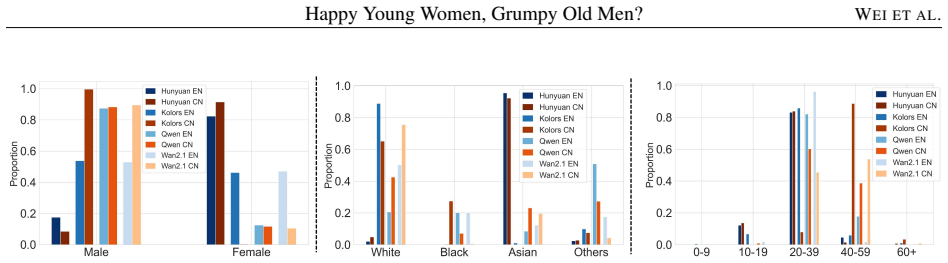
On the paper's own terms, the central discovery is a valence-driven demographic mapping: instructing a model to generate a sad, angry, fearful, or disgusted face moves the output distribution toward White, middle-aged, male appearance, relative to the model's neutral default, and away from Asian and young faces. Happy prompts barely move the distribution, indicating that the neutral default already sits close to the 'happy young woman' prototype in latent space. The direction of these shifts is consistent across all eight models, Western and Chinese alike, and is accompanied by a drop in perceived attractiveness for negative emotions.
Load-bearing premise
The automated classifier's demographic labels (gender, race, age) are accurate on synthetic faces and are not swayed by the facial expression in the image; if angry faces are systematically misread as older and male, the paper's central emotion-shift finding could be a classifier artifact rather than a generator behavior.
Editorial extensions
If this is right
- Emotion prompts are demographic selectors: content creators who routinely generate 'angry' or 'fearful' imagery will, without intending it, populate their visuals disproportionately with White middle-aged men.
- Bias audits that test only neutral prompts understate the representational skew of a model; emotion-conditioned auditing should be part of pre-deployment evaluation.
- Western and Chinese models converge on the same biases, implying shared training data and evaluation standards; regional origin alone does not diversify outputs.
- Negative emotions lower perceived attractiveness of generated faces, reinforcing an association between negative affect and unattractiveness that mirrors the attractiveness halo effect.
- Intersectional near-erasure (e.g., young female Black faces) shows that fixing single-attribute parity would not fix representational diversity.
Reading between the lines
- If the valence-driven demographic shift is real, it suggests the model's latent space ties emotional valence to demographic prototypes (grumpy = old White man, happy = young woman); a direct probe would be to generate 'an angry young Asian woman' and measure whether the model resists the combination.
- The result could be partly an artifact of the attribute classifier: if the classifier reads angry expressions as older and male, the emotion-shift findings would be inflated. Testing same-identity faces with altered expressions would settle this.
- The cross-ecosystem homogenization implies that mitigation efforts on one ecosystem (e.g., dataset documentation for one model family) may propagate globally, and that regional regulation could have outsized effects.
- A practical extension: explicitly grounding demographic terms in emotion prompts (e.g., 'an angry Black woman') could counteract the default shift, providing a user-level mitigation — but it also risks over-correcting or stereotyping.
Editorial analysis
A structured set of objections, weighed in public.
Referee Report
Summary. This paper audits eight text-to-image (T2I) models — four from Western organizations and four from Chinese institutions — by generating 56,000 faces under a neutral prompt and six emotion prompts. Demographic attributes (gender, race, age) are estimated with FairFace and attractiveness with a dedicated model. The paper quantifies bias relative to UN-derived global population statistics and, for emotion effects, relative to each model's neutral-prompt baseline, using KL, JS, and TVD divergences at the marginal and intersectional level. The central claim is that adding an emotion to a prompt does more than change facial expression: negatively valenced emotions (sadness, anger, fear, disgust) consistently shift generated faces toward White, middle-aged, male-coded appearances, while happiness yields the smallest shift from the neutral baseline. The authors also report a broad Western/Chinese homogenization of demographic bias and propose that emotion-conditioned, intersectional, and multilingual audits become standard practice.
Significance. If the central claim holds, this is an important and non-obvious contribution: emotional prompts would act as demographic selectors in T2I models, a dimension that prior audits, focusing on neutral prompts, have missed. The study is strong in scale and design—eight models, 56,000 images, separate validation of FairFace on benchmark and on controlled synthetic faces, and a multi-metric information-theoretic framework. The explicit comparison of Western and Chinese model families is also valuable. However, the main causal interpretation currently rests on an unvalidated assumption—that FairFace's demographic estimates are invariant to facial expression—and the headline quantitative claims lack uncertainty quantification. These issues are addressable with additional validation and re-analysis, but they are load-bearing for the paper's central assertion.
major comments (3)
- [§3.4, §A.2, §4.3] The central emotion-shift claim rests entirely on FairFace demographic labels, but the validation in Appendix A.2 tests synthetic faces generated with explicit demographic prompts and neutral expression only; the benchmark validation in Appendix A.1 does not stratify accuracy by facial expression. If FairFace's age, gender, or race predictions are expression-dependent—e.g., angry faces being classified as older or more male-coded—then the emotion-induced shifts reported in §4.3 and Figure 5 would be classifier artifacts rather than generator behavior. The limitation paragraph acknowledges 'classification errors' generically but does not address this specific differential-bias confound. The paper should either demonstrate emotion-invariance on expression-labelled benchmark or synthetic sets (e.g., stratifying FACES/CFD by expression, or generating emotion-conditioned faces with explicit d
- [§5.3 and §4.3] The phrase 'statistically significant' is used (e.g., §5.3, bullet 3) to describe the emotion-driven increase in male and White faces, but no significance test, confidence interval, or bootstrap procedure is reported anywhere. Tables 1 and 2 report scalar KL/JS/TVD values without uncertainty, despite each condition being only 1,000 samples. The directional claims ('consistently shift,' 'statistically significant') require at least bootstrap CIs or permutation tests over the per-model/per-emotion distributions, particularly because several reported differences are small in absolute magnitude.
- [§4.3.1, Table 2, Eqs. (4)–(5)] The intersectional KL/JS metrics are computed over 2 × 4 × 3 = 24 cells with only 1,000 samples per model and emotion. The paper does not state how zero cells are handled; if P(d|e0)=0 while P(d|e)>0, the KL term in Eq. (4) is undefined, and with near-erasure of combinations such as young×female×Black, such zeros are plausible. Without explicit smoothing (e.g., additive epsilon) or reporting of cell counts, the values in Table 2 — and the ranking of emotions by intersectional shift — may be dominated by sparse-cell noise. The authors should report the smoothing procedure or use a sparse-robust alternative (e.g., smoothed JSD).
minor comments (6)
- [References] The reference [Huber et al.(2023)] contains a placeholder DOI/arXiv id ('arXiv:2304.XXXX') and cannot be verified; [Doh et al.([n. d.])] lacks a year and a stable publication venue. Please complete these citations before publication.
- [§4.2] The text says 'The joint demographic distributions reported in Table 2 further suggest...' but Table 2 reports emotion-conditioned KL/JS divergences, not Western/Chinese joint demographic distributions. The intended pointer is probably Table 1 or Figure 3.
- [Figure 5] The heatmaps show 'mean ΔP' of facial attributes, but the color scale and the precise definition of ΔP (e.g., P(emotion) − P(neutral) averaged over models) are not stated. Please add a legend and explicit definition.
- [Eq. (7)] Equation (7) is not a KL divergence but a pointwise weighted log-ratio for a single category c. Renaming it (e.g., 'per-category shift contribution') would avoid confusion with the proper divergences in Eqs. (1)–(5).
- [§3.5 / Appendix C] The global 'White ≈ 11%' reference value is a constructed quantity from a country-to-race assignment. The construction is described in Appendix C, but the paper could more explicitly flag that this reference is a modeling choice and show sensitivity to alternative assignments, since RQ1's absolute claims depend on it.
- [Reproducibility] The paper does not mention releasing code, prompts, or generated image data. Given the audit's value as a benchmark, sharing the exact prompt templates, generation seeds (if deterministic), and the evaluation pipeline would substantially strengthen reproducibility.
Circularity Check
No significant circularity: the emotion-demographic shifts are an empirical measurement against external references and each model's own neutral baseline; the FairFace expression-invariance gap is a validity threat, not a circular derivation.
full rationale
The paper's derivation chain is empirical. Section 3.3 generates 56,000 images from a fixed prompt template; Section 3.4 obtains gender/race/age from the pretrained FairFace classifier and attractiveness from a model externally validated on CelebA and AHEAD; Section 3.6 defines KL/JS divergences between empirical distributions. Equations (4)-(7) compare emotion-conditioned empirical distributions P_T2I(d|e) against the neutral empirical distribution P_T2I(d|e0). No parameter is fitted to these data, and no output quantity is also an input: the 'emotion-induced shift' is a measured divergence, not a predicted value. The finding that negative emotions shift toward White/male/older faces is a summary of those measured divergences, and the neutral baseline is a reference distribution, not a fitted target. The only near self-citation, the attractiveness estimator of Gulati (2025)/Gulati et al. (2024b), is not load-bearing for the headline demographic result and is externally validated, so it does not raise the circularity score. The real weakness is the unvalidated assumption that FairFace labels are expression-invariant on synthetic faces: Appendix A.2 validates against prompts with explicit demographic attributes but no emotion variation, and Section 6 only generically admits that 'measurements rely on automated classifiers, enabling scalability but potentially introducing classification errors.' That is a measurement-validity/correctness risk, not a circular reduction by construction. I therefore find no circular step.
Assumptions & free parameters
assumptions (5)
- domain assumption FairFace attribute estimates are accurate enough and emotion-invariant on synthetic faces.
- domain assumption Global population statistics, with a country-to-race assignment, are an appropriate reference for evaluating representational bias.
- domain assumption The no-emotion prompt provides a neutral baseline for isolating emotion effects.
- domain assumption The six basic emotions and their valence grouping (happy positive, surprise ambiguous, sad/angry/fear/disgust negative) are valid for prompt-condition classification.
- domain assumption KL/JS divergences computed over sparse intersectional cells with 1,000 samples are meaningful.
Cite this review
Pith. "Pith review of Happy Young Women, Grumpy Old Men? Emotion-Driven Demographic Biases in Synthetic Face Generation." pith.science (2026). https://pith.science/paper/RKXQMC2F
@misc{pith2026260200032,
  author       = {Pith},
  title        = {Pith review of: Happy Young Women, Grumpy Old Men? Emotion-Driven Demographic Biases in Synthetic Face Generation},
  year         = {2026},
  howpublished = {\url{https://pith.science/paper/RKXQMC2F}},
  note         = {Machine review of arXiv:2602.00032}
}
read the original abstract
Synthetic faces from text-to-image (T2I) models pervade digital media, yet their demographic biases under emotionally conditioned prompts remain poorly understood. We aim to systematically audit how emotionally conditioned prompts affect demographic and perceived-attractiveness biases in synthetic faces generated by T2I models, with particular attention to intersectional patterns and cross-ecosystem differences across model families. We audited eight (4 Western and 4 Chinese) T2I models and generated 56,000 faces under seven prompt conditions: a neutral baseline and six emotion conditions. We quantified biases in gender, race, age, and perceived attractiveness using information-theoretic divergence metrics. We further conducted intersectional analyses across combined demographic attributes and compared patterns between the Western and Chinese model groups to assess cross-ecosystem consistency and divergence in bias behavior. All models show strong overrepresentation of young faces, and most also overrepresent White-coded individuals. Intersectional analysis reveals compound underrepresentation or near-erasure of specific demographic combinations, such as young x female x Black faces, which are largely absent across models and are not captured by single-attribute audits. Emotion prompts act as additional demographic selectors: negatively valenced emotions (including sadness and fear) consistently shift outputs toward White, middle-aged, male-coded faces. This produces a valence-driven mapping that is also associated with lower perceived attractiveness in generated faces. These findings indicate that demographic bias in T2I face generation is both pervasive and shaped by emotional conditioning. They underscore the need for intersectional, emotion-conditioned, and multilingual demographic audits as part of standard pre-deployment evaluation practices.
Figures


Figures from the paper (8 more)



Reference graph
Works this paper leans on
-
[1]
[Adolphs(2002)] Ralph Adolphs
2002
-
[5]
doi:10.48550/arXiv.2402.01002 13 Happy Young Women, Grumpy Old Men?WEI ET AL
AI-generated faces influence gender stereotypes and racial homogenization.CoRRabs/2402.01002 (2024). doi:10.48550/arXiv.2402.01002 13 Happy Young Women, Grumpy Old Men?WEI ET AL. [An et al.(2025)] Jiafu An, Difang Huang, Chen Lin, and Mingzhu Tai
-
[7]
Facial trustworthiness dampens own-gender bias in emotion recognition.Psychological Research88, 2 (2024), 458–
2024
-
[10]
[Blais et al.(2008)] Caroline Blais, Rachael E Jack, Christoph Scheepers, Daniel Fiset, and Roberto Caldara
Stereotypes bias social class perception from faces: The roles of race, gender, affect, and attractiveness.Quarterly Journal of Experimental Psychology77, 11 (2024), 2339–2353. [Blais et al.(2008)] Caroline Blais, Rachael E Jack, Christoph Scheepers, Daniel Fiset, and Roberto Caldara
2024
-
[13]
[Chen et al.(2024)] Tianwei Chen, Yusuke Hirota, Mayu Otani, Noa Garcia, and Yuta Nakashima
A framework for bias-aware dataset evaluation in soft facial attribute recognition.Pattern Recognition(2025), 112416. [Chen et al.(2024)] Tianwei Chen, Yusuke Hirota, Mayu Otani, Noa Garcia, and Yuta Nakashima
2025
-
[14]
InProceedings of the IEEE/CVF conference on computer vision and pattern recognition
Would Deep Generative Models Amplify Bias in Future Models?. InProceedings of the IEEE/CVF conference on computer vision and pattern recognition. 10833–10843. [Crenshaw(1991)] Kimberl ´e Crenshaw
1991
-
[17]
Hugging Face model repository.https: //huggingface.co/dataautogpt3/ProteusV0.3
Proteus V0.3 Model Card. Hugging Face model repository.https: //huggingface.co/dataautogpt3/ProteusV0.3. [Doh et al.(2025a)] Miriam Doh, Corinna Canali, and Nuria Oliver. 2025a. What TikTok Claims, What Bold Glam- our Does: A Filter’s Paradox. InProceedings of the 2025 ACM Conference on Fairness, Accountability, and Transparency. 1902–1915. [Doh et al.(20...
arXiv 2025
-
[21]
InIEEE TPAMI
Robust Subjective Visual Property Prediction from Crowdsourced Pairwise Labels. InIEEE TPAMI. [Gulati(2025)] Aditya Gulati. 2025.Judging Books by Their Cover: The Impact of Facial Attractiveness on Hu- mans and AI. PhD thesis. University of Alicante.https://ellisalicante.org/publications/ gulati2025thesis-en/ [Gulati et al.(2025)] Aditya Gulati, Moreno D’...
2025
Show all 76 references
-
[22]
[Gulati et al.(2024a)] Aditya Gulati, Bruno Lepri, and Nuria Oliver
Beauty and the Bias: Exploring the Impact of Attractiveness on Multimodal Large Language Models.AIES(2025). [Gulati et al.(2024a)] Aditya Gulati, Bruno Lepri, and Nuria Oliver. 2024a. Lookism: The overlooked bias in com- puter vision. arXiv:2408.11448 [cs.CV]https://arxiv.org/...
2025 arXiv
-
[24]
[Hess et al.(2000)] Ursula Hess, Pascal Thibault, and Reginald B
The weirdest people in the world? Behavioral and Brain Sciences33, 2-3 (2010), 61–83. [Hess et al.(2000)] Ursula Hess, Pascal Thibault, and Reginald B. Adams Jr
2010
-
[26]
Uncovering bias in large vision-language models at scale with counterfactuals. InProceedings of the 2025 Con- ference of the Nations of the Americas Chapter of the Association for Computational Linguistics: Human Lan- guage Technologies (V olume 1: Long Papers). 5946–5991. [Hu...
2025
-
[27]
[Huber et al.(2023)] Lisa Huber, Philipp R ¨osch, et al
Generative bias: widespread, unex- pected, and uninterpretable biases in generative models and their implications.AI & SOCIETY(2025), 1–13. [Huber et al.(2023)] Lisa Huber, Philipp R ¨osch, et al
2025
-
[29]
InProceedings of the IEEE/CVF Winter Conference on Applications of Computer Vision
Bias and diversity in synthetic-based face recognition. InProceedings of the IEEE/CVF Winter Conference on Applications of Computer Vision. 6215–6226. [Kanade et al.(2000)] Takeo Kanade, Jeffrey F. Cohn, and Yingli Tian
2000
-
[30]
InProceedings F ourth IEEE International Conference on Automatic Face and Gesture Recog- nition
Comprehensive database for facial ex- pression analysis. InProceedings F ourth IEEE International Conference on Automatic Face and Gesture Recog- nition. IEEE, 46–53. [Karkkainen and Joo(2021)] Kimmo Karkkainen and Jungseock Joo
2021
-
[32]
InProceedings of the 2021 acm conference on fairness, accountability, and trans- parency
One label, one billion faces: Usage and consistency of racial categories in computer vision. InProceedings of the 2021 acm conference on fairness, accountability, and trans- parency. 587–597. [Khanal et al.(2025)] Shaleen Khanal, Hongzhou Zhang, and Araz Taeihagh
2021
-
[33]
[Labs(2024)] Black Forest Labs
Development of new generation of artificial intelligence in China: When Beijing’s global ambitions meet local realities.Journal of Contemporary China34, 151 (2025), 19–42. [Labs(2024)] Black Forest Labs
2025
-
[34]
FLUX.https://github.com/black-forest-labs/flux. [Labs et al.(2025)] Black Forest Labs, Stephen Batifol, Andreas Blattmann, Frederic Boesel, Saksham Consul, Cyril Diagne, Tim Dockhorn, Jack English, Zion English, Patrick Esser, Sumith Kulal, Kyle Lacey, Yam Levi, Cheng Li, Domi...
2025
-
[35]
arXiv:2506.15742 [cs.GR]https://arxiv.org/abs/2506.15742 [Leyva et al.(2024)] Roberto Leyva, Victor Sanchez Silva, Gregory Epiphaniou, and Carsten Maple
FLUX.1 Kontext: Flow Matching for In-Context Image Generation and Editing in Latent Space. arXiv:2506.15742 [cs.GR]https://arxiv.org/abs/2506.15742 [Leyva et al.(2024)] Roberto Leyva, Victor Sanchez Silva, Gregory Epiphaniou, and Carsten Maple
2024 arXiv
-
[36]
InProceedings of the IEEE/CVF Conference on Computer Vision and Pattern Recognition Workshops (CVPRW)
Demo- graphic Bias Effects on Face Image Synthesis. InProceedings of the IEEE/CVF Conference on Computer Vision and Pattern Recognition Workshops (CVPRW). 3818–3826. doi:10.1109/CVPRW63382.2024.00386 [Li and Deng(2017)] Shan Li and Weihong Deng
2024
-
[37]
InProceedings of the IEEE Conference on Computer Vision and Pattern Recognition (CVPR)
Reliable crowdsourcing and deep locality-preserving learning for unconstrained facial expression recognition. InProceedings of the IEEE Conference on Computer Vision and Pattern Recognition (CVPR). 2852–2861. [Li et al.(2024)] Zhimin Li, Jianwei Zhang, Qin Lin, Jiangfeng Xiong...
2024
-
[38]
arXiv:2405.08748 [cs.CV] arXiv preprint
Hunyuan-DiT: A Powerful Multi-Resolution Diffusion Transformer with Fine-Grained Chinese Understanding. arXiv:2405.08748 [cs.CV] arXiv preprint. [Liu et al.(2015)] Ziwei Liu, Ping Luo, Xiaogang Wang, and Xiaoou Tang
2015 arXiv
-
[40]
[Luccioni et al.(2023)] Sasha Luccioni, Christopher Akiki, Margaret Mitchell, and Yacine Jernite
Cultural tendencies in generative AI.Nature Human Behaviour(2025), 1–10. [Luccioni et al.(2023)] Sasha Luccioni, Christopher Akiki, Margaret Mitchell, and Yacine Jernite
2025
-
[41]
[Luo et al.(2024)] Yan Luo, Min Shi, Muhammad Osama Khan, Muhammad Muneeb Afzal, Hao Huang, Shuaihang Yuan, Yu Tian, Luo Song, Ava Kouhana, Tobias Elze, et al
Stable bias: Evaluating societal representations in diffusion models.Advances in Neural Information Processing Systems36 (2023), 56338–56351. [Luo et al.(2024)] Yan Luo, Min Shi, Muhammad Osama Khan, Muhammad Muneeb Afzal, Hao Huang, Shuaihang Yuan, Yu Tian, Luo Song, Ava Kouh...
2023
-
[42]
InProceedings of the IEEE/CVF Conference on Computer Vision and Pattern Recognition
Fairclip: Harnessing fairness in vision- language learning. InProceedings of the IEEE/CVF Conference on Computer Vision and Pattern Recognition. 12289–12301. [Ma et al.(2015)] Debbie S Ma, Joshua Correll, and Bernd Wittenbrink
2015
-
[43]
[Majumder(2010)] Partha P Majumder
The Chicago face database: A free stimulus set of faces and norming data.Behavior research methods47, 4 (2015), 1122–1135. [Majumder(2010)] Partha P Majumder
2015
-
[44]
[Matsumoto(1990)] David Matsumoto
The human genetic history of South Asia.Current Biology20, 4 (2010), R184–R187. [Matsumoto(1990)] David Matsumoto
2010
-
[46]
Surveys54, 6 (2021), 1–35
A survey on bias and fairness in machine learning.Comput. Surveys54, 6 (2021), 1–35. [Mehta and Buntain(2024)] Maneet Mehta and Cody Buntain
2021
-
[47]
Emotional Images: Assessing Emotions in Im- ages and Potential Biases in Generative Models.arXiv preprint arXiv:2411.05985(2024). [Metspalu et al.(2011)] Mait Metspalu, Irene Gallego Romero, Bayazit Yunusbayev, Gyaneshwer Chaubey, Chan- dana Basu Mallick, Georgi Hudjashov, Mar...
2024 arXiv
-
[49]
[Mueser et al.(1984)] Kim T
AffectNet: A database for facial expression, valence, and arousal in the wild.IEEE Transactions on Affective Computing10, 1 (2017), 18–31. [Mueser et al.(1984)] Kim T. Mueser, Brian W. Grau, Sarah Sussman, and Anita J. Rosen
2017
-
[52]
Surveys57, 6 (2025), 1–40
Fairness in Deep Learning: A survey on vision and language research.Comput. Surveys57, 6 (2025), 1–40. [Petreski and Hashim(2023)] Davor Petreski and Ibrahim C Hashim
2025
-
[53]
But whose bias are they reflecting?AI & SOCIETY38, 2 (2023), 975–982
Word embeddings are biased. But whose bias are they reflecting?AI & SOCIETY38, 2 (2023), 975–982. [Raji and Buolamwini(2019)] Inioluwa Deborah Raji and Joy Buolamwini
2023
-
[55]
InProceedings of the 2020 Conference on Fairness, Accountability, and Transparency
Closing the AI accountability gap: Defining an end-to-end framework for internal algorithmic auditing. InProceedings of the 2020 Conference on Fairness, Accountability, and Transparency. 33–44. [Rhee(2018)] SC Rhee
2020
-
[56]
[Riccio et al.(2024)] Piera Riccio, Julien Colin, Shirley Ogolla, and Nuria Oliver
Differences between Caucasian and Asian attractive faces.Skin Research and Technol- ogy24, 1 (2018), 73–79. [Riccio et al.(2024)] Piera Riccio, Julien Colin, Shirley Ogolla, and Nuria Oliver
2018
-
[57]
[Ronneberger et al.(2015)] Olaf Ronneberger, Philipp Fischer, and Thomas Brox
Mirror, mirror on the wall, who is the whitest of all? racial biases in social media beauty filters.Social Media+ Society10, 2 (2024), 20563051241239295. [Ronneberger et al.(2015)] Olaf Ronneberger, Philipp Fischer, and Thomas Brox
2024
-
[58]
InInternational Conference on Medical Image Computing and Computer-Assisted Intervention
U-Net: Convolutional Net- works for Biomedical Image Segmentation. InInternational Conference on Medical Image Computing and Computer-Assisted Intervention. Springer, 234–241. [Russell(1980)] James A. Russell
1980
-
[60]
[Shankar et al.(2017)] Shreya Shankar, Yoni Halpern, Eric Breck, James Atwood, and D
Diagnosing gender bias in image recognition systems.Socius 6 (2020), 2378023120967171. [Shankar et al.(2017)] Shreya Shankar, Yoni Halpern, Eric Breck, James Atwood, and D. Sculley
2020
-
[61]
[Sufian et al.(2025)] Abu Sufian, Cosimo Distante, Marco Leo, and Hanan Salam
No classifi- cation without representation: Assessing geodiversity issues in open data sets for the developing world.arXiv preprint arXiv:1711.08536(2017). [Sufian et al.(2025)] Abu Sufian, Cosimo Distante, Marco Leo, and Hanan Salam
2017 arXiv
-
[62]
arXiv:2511.10089 [cs.LG] https://arxiv.org/abs/2511.10089 [Tang et al.(2023)] Zeyu Tang, Jiji Zhang, and Kun Zhang
T2IBias: Uncovering Societal Bias Encoded in the Latent Space of Text-to-Image Generative Models. arXiv:2511.10089 [cs.LG] https://arxiv.org/abs/2511.10089 [Tang et al.(2023)] Zeyu Tang, Jiji Zhang, and Kun Zhang
2023
-
[63]
Surveys55, 13s (2023), 1–37
What-is and how-to for fairness in machine learning: A survey, reflection, and perspective.Comput. Surveys55, 13s (2023), 1–37. [Team(2024)] Kolors Team
2023
-
[64]
Technical Report, Kuaishou Kolors Team.https://github.com/Kwai-Kolors/Kolors/ blob/master/imgs/Kolors_paper.pdf
Kolors: Effective Training of Diffusion Model for Photorealistic Text-to-Image Synthesis. Technical Report, Kuaishou Kolors Team.https://github.com/Kwai-Kolors/Kolors/ blob/master/imgs/Kolors_paper.pdf. [Todorov(2008)] Alexander Todorov
2008
-
[65]
[Vaswani et al.(2017)] Ashish Vaswani, Noam Shazeer, Niki Parmar, Jakob Uszkoreit, Llion Jones, Aidan N Gomez, Lukasz Kaiser, and Illia Polosukhin
Evaluating faces on trustworthiness: An extension of systems for recog- nition of emotions signaling approach/avoidance behaviors.Annals of the New York Academy of Sciences1124, 1 (2008), 208–224. [Vaswani et al.(2017)] Ashish Vaswani, Noam Shazeer, Niki Parmar, Jakob Uszkorei...
2008
-
[66]
InAdvances in Neural Information Processing Systems
Attention Is All You Need. InAdvances in Neural Information Processing Systems. 5998–6008. [Vice et al.(2025)] Jordan Vice, Naveed Akhtar, Richard Hartley, and Ajmal Mian
2025
-
[67]
[Wan et al.(2025)] Team Wan, Ang Wang, Baole Ai, Bin Wen, Chaojie Mao, Chen-Wei Xie, Di Chen, Feiwu Yu, Haiming Zhao, Jianxiao Yang, et al
Quantifying Bias in Text- to-Image Generative Models.IEEE Transactions on Dependable and Secure Computing(2025). [Wan et al.(2025)] Team Wan, Ang Wang, Baole Ai, Bin Wen, Chaojie Mao, Chen-Wei Xie, Di Chen, Feiwu Yu, Haiming Zhao, Jianxiao Yang, et al
2025
-
[68]
[Wang et al.(2019)] Tianlu Wang, Jieyu Zhao, Mark Yatskar, Kai-Wei Chang, and Vicente Ordonez
Wan: Open and advanced large-scale video generative models.arXiv preprint arXiv:2503.20314(2025). [Wang et al.(2019)] Tianlu Wang, Jieyu Zhao, Mark Yatskar, Kai-Wei Chang, and Vicente Ordonez
2025 arXiv
-
[69]
InProceedings of the IEEE/CVF international conference on computer vision
Balanced datasets are not enough: Estimating and mitigating gender bias in deep image representations. InProceedings of the IEEE/CVF international conference on computer vision. 5310–5319. [Wang et al.(2020)] Zeyu Wang, Klint Qinami, Ioannis Christos Karakozis, Kyle Genova, Pr...
2020
-
[70]
In Proceedings of the IEEE/CVF conference on computer vision and pattern recognition
Towards fairness in visual recognition: Effective strategies for bias mitigation. In Proceedings of the IEEE/CVF conference on computer vision and pattern recognition. 8919–8928. [Willis and Todorov(2006)] Jamie Willis and Alexander Todorov
2006
-
[72]
doi:10.3390/jimaging11020035 [Xie et al.(2025)] Enze Xie, Junsong Chen, Yuyang Zhao, Jincheng Yu, Ligeng Zhu, Chengyue Wu, Yujun Lin, Zhekai Zhang, Muyang Li, Junyu Chen, Han Cai, Bingchen Liu, Daquan Zhou, and Song Han
2025 doi
-
[73]
arXiv:2501.18427 [cs.CV] arXiv preprint
SANA 1.5: Efficient Scaling of Training-Time and Inference-Time Compute in Linear Diffusion Transformer. arXiv:2501.18427 [cs.CV] arXiv preprint. [Yang(2025)] Y . Yang
2025 arXiv
-
[74]
Racial bias in AI-generated images.AI and Society40 (2025), 5425–5437. doi:10. 1007/s00146-025-02282-1 [Zhan et al.(2021)] Jiayu Zhan, Meng Liu, Oliver GB Garrod, Christoph Daube, Robin AA Ince, Rachael E Jack, and Philippe G Schyns
2025
-
[75]
a photorealistic portrait of a young Asian female
Modeling individual preferences reveals that face beauty is not universally perceived across cultures.Current Biology31, 10 (2021), 2243–2252. 17 Happy Young Women, Grumpy Old Men?WEI ET AL. A Attribute Estimation A.1 Validation with Human Faces We evaluate the gender and race...
2021
-
[76]
Importantly, such confusions are almost exclu- sively restricted to neighboring age ranges, and we do not observe systematic misclassifications across distant age groups
We observe that FairFace frequently confuses adjacent age groups, with the most pronounced ambiguity occurring between younger categories. Importantly, such confusions are almost exclu- sively restricted to neighboring age ranges, and we do not observe systematic misclassifica...
-
[465]
[Barsoum et al.(2016)] Emad Barsoum, Cha Zhang, Cristian Canton Ferrer, and Zhifeng Zhang
2016
-
[1977]
The halo effect: Evidence for unconscious alteration of judgments.Journal of Personality and Social Psychology35, 4 (1977), 250–256. [Parraga et al.(2025)] Otavio Parraga, Martin D More, Christian M Oliveira, Nathan S Gavenski, Lucas S Kupssinsk¨u, Adilson Medronha, Luis V Mou...
1977
-
[1980]
16 Happy Young Women, Grumpy Old Men?WEI ET AL
A circumplex model of affect.Journal of Personality and Social Psychology 39, 6 (1980), 1161–1178. 16 Happy Young Women, Grumpy Old Men?WEI ET AL. [Schwemmer et al.(2020)] Carsten Schwemmer, Carly Knight, Emily D Bello-Pardo, Stan Oklobdzija, Martijn Schoonvelde, and Jeffrey W...
1980
-
[1984]
[Nisbett and Wilson(1977)] Richard E
Physical attractive- ness and social interaction.Journal of Personality and Social Psychology46, 2 (1984), 403–412. [Nisbett and Wilson(1977)] Richard E. Nisbett and Timothy DeCamp Wilson
1984
-
[1990]
[Mehrabi et al.(2021)] Ninareh Mehrabi, Fred Morstatter, Nripsuta Saxena, Kristina Lerman, and Aram Galstyan
Cultural similarities and differences in display rules.Motivation and emotion14, 3 (1990), 195–214. [Mehrabi et al.(2021)] Ninareh Mehrabi, Fred Morstatter, Nripsuta Saxena, Kristina Lerman, and Aram Galstyan
1990
-
[1991]
[Crenshaw(2013)] Kimberl ´e Crenshaw
Mapping the margins: Intersectionality, identity politics, and violence against women of color.Stanford Law Review43, 6 (1991), 1241–1299. [Crenshaw(2013)] Kimberl ´e Crenshaw
1991
-
[1992]
[Ekman(1993)] Paul Ekman
An argument for basic emotions.Cognition & Emotion6, 3-4 (1992), 169–200. [Ekman(1993)] Paul Ekman
1992
-
[1993]
[Fu et al.(2016)] Yanwei Fu, Timothy M
Facial expression and emotion.American Psychologist48, 4 (1993), 384–392. [Fu et al.(2016)] Yanwei Fu, Timothy M. Hospedales, Tao Xiang, Jiechao Xiong, Shaogang Gong, Yizhou Wang, and Yuan Yao
1993
-
[2000]
[Howard et al.(2025)] Phillip Howard, Kathleen C Fraser, Anahita Bhiwandiwalla, and Svetlana Kiritchenko
Recognizing emotion in facial expressions: The influence of stereotype and context.Journal of Nonverbal Behavior24 (2000), 199–214. [Howard et al.(2025)] Phillip Howard, Kathleen C Fraser, Anahita Bhiwandiwalla, and Svetlana Kiritchenko
2000
-
[2002]
[Agustsson et al.(2017)] Eirikur Agustsson, Radu Timofte, Sergio Escalera, Xavier Baro, Isabelle Guyon, and Rasmus Rothe
Recognizing emotion from facial expressions: psychological and neurological mechanisms.Behavioral and cognitive neuroscience reviews1, 1 (2002), 21–62. [Agustsson et al.(2017)] Eirikur Agustsson, Radu Timofte, Sergio Escalera, Xavier Baro, Isabelle Guyon, and Rasmus Rothe
2002
-
[2006]
Implicit social cognition: Attitudes, self- esteem, and stereotypes.Psychological Review113, 2 (2006), 227–259. [Wu et al.(2025a)] Chenfei Wu, Jiahao Li, Jingren Zhou, Junyang Lin, Kaiyuan Gao, Kun Yan, Sheng-ming Yin, Xiao Xu, Yuxiang Chen, Zecheng Tang, Zekai Zhang, Zhengyi ...
2006 arXiv
-
[2008]
[Buolamwini and Gebru(2018)] Joy Buolamwini and Timnit Gebru
Culture shapes how we look at faces.PloS one3, 8 (2008), e3022. [Buolamwini and Gebru(2018)] Joy Buolamwini and Timnit Gebru
2008
-
[2010]
[Ekman(1992)] Paul Ekman
FACES—A database of facial expressions in young, middle-aged, and older women and men: Development and validation.Behavior research methods42, 1 (2010), 351–362. [Ekman(1992)] Paul Ekman
2010
-
[2011]
[Mollahosseini et al.(2017)] Ali Mollahosseini, Behzad Hasani, and Mohammad H
Shared and unique components of human population structure and genome-wide signals of positive selection in South Asia.The American Journal of Human Genetics89, 6 (2011), 731–744. [Mollahosseini et al.(2017)] Ali Mollahosseini, Behzad Hasani, and Mohammad H. Mahoor
2011
-
[2013]
InFeminist legal theories
Demarginalizing the intersection of race and sex: A black feminist cri- tique of antidiscrimination doctrine, feminist theory and antiracist politics. InFeminist legal theories. Routledge, 23–51. [dataautogpt3(2024)] dataautogpt3
2024
-
[2015]
InProceedings of the International Conference on Computer Vision (ICCV)
Deep Learning Face Attributes in the Wild. InProceedings of the International Conference on Computer Vision (ICCV). 15 Happy Young Women, Grumpy Old Men?WEI ET AL. [Lu et al.(2025)] Jackson G Lu, Lesley Luyang Song, and Lu Doris Zhang
2025
-
[2016]
InProceedings of the ACM International Conference on Multimodal Interaction
Training deep networks for facial expression recognition with crowd-sourced label distribution. InProceedings of the ACM International Conference on Multimodal Interaction. 279–283. [Bjornsdottir and Beacon(2024)] R Thora Bjornsdottir and Elizabeth Beacon
2024
-
[2017]
In2017 12th IEEE International Conference on Automatic Face & Gesture Recognition (FG 2017)
Apparent and Real Age Estimation in Still Images with Deep Residual Regressors on Appa-Real Database. In2017 12th IEEE International Conference on Automatic Face & Gesture Recognition (FG 2017). 87–94. doi:10.1109/FG.2017.20 [AI(2024)] Stability AI
2017 doi
-
[2018]
InConference on fairness, accountability and transparency
Gender shades: Intersectional accuracy disparities in commercial gender classification. InConference on fairness, accountability and transparency. PMLR, 77–91. [Cascone et al.(2025)] Lucia Cascone, Michele Nappi, Chiara Pero, and Xinggang Wang
2025
-
[2019]
InProceedings of the 2019 AAAI/ACM Conference on AI, Ethics, and Society
Actionable auditing: Investigating the impact of publicly naming biased performance results of commercial ai products. InProceedings of the 2019 AAAI/ACM Conference on AI, Ethics, and Society. 429–435. [Raji et al.(2020)] Inioluwa Deborah Raji, Andrew Smart, Rebecca White, Mar...
2019
-
[2020]
InProceedings of the 2020 conference on fairness, accountability, and transparency
Towards a critical race methodology in algorithmic fairness. InProceedings of the 2020 conference on fairness, accountability, and transparency. 501–512. [Henrich et al.(2010)] Joseph Henrich, Steven J Heine, and Ara Norenzayan
2020
-
[2021]
InProceedings of the IEEE/CVF Winter Conference on Applications of Computer Vision
FairFace: Face Attribute Dataset for Balanced Race, Gender, and Age for Bias Measurement and Mitigation. InProceedings of the IEEE/CVF Winter Conference on Applications of Computer Vision. 1548–1558. [Khan and Fu(2021)] Zaid Khan and Yun Fu
2021
-
[2023]
[Huber et al.(2024)] Marco Huber, Anh Thi Luu, Fadi Boutros, Arjan Kuijper, and Naser Damer
Are synthetic faces biased? A systematic evaluation of demographic representation in generative models.arXiv preprint arXiv:2304.XXXX(2023). [Huber et al.(2024)] Marco Huber, Anh Thi Luu, Fadi Boutros, Arjan Kuijper, and Naser Damer
2023
-
[2024]
Online blog / model release announcement.https: //stability.ai/news/introducing-stable-diffusion-3-5
Introducing Stable Diffusion 3.5. Online blog / model release announcement.https: //stability.ai/news/introducing-stable-diffusion-3-5. [AlDahoul et al.(2024)] Nouar AlDahoul, Talal Rahwan, and Yasir Zaki
2024
-
[2025]
[Bagnis et al.(2024)] Arianna Bagnis, Valentina Colonnello, Paolo Maria Russo, and Katia Mattarozzi
Measuring gender and racial biases in large language models: Intersectional evidence from automated resume evaluation.PNAS Nexus4, 3 (2025), pgaf089. [Bagnis et al.(2024)] Arianna Bagnis, Valentina Colonnello, Paolo Maria Russo, and Katia Mattarozzi
2025
Reviewed August 3, 2026 · model on record in the stance chip above.
Discussion (0). Sign in to comment.