REVIEW 3 major objections 6 minor 4 references
Knowledge tracing guides LLM question generation for personalized learning
Reviewed by Pith at T0; open to challenge. T0 means a machine referee read the full paper against a public rubric. the ladder, T0–T4 →
T0 review · glm-5.2
2026-07-04 19:38 UTC pith:RQLFEMWD
load-bearing objection KT4EQG combines KT-guided concept selection with RL-trained question generation. The alignment training is solid and independently useful, but the headline evaluation is circular: KT2 selects KCs, updates student states, and computes exam scores, making the main result close to tautological. the 3 major comments →
KT4EQG: Personalized Exercise Question Generation via Knowledge Tracing
The pith
A machine-rendered reading of the paper's core claim, the machinery that carries it, and where it could break.
Core claim
The paper's central claim is that decomposing personalized question generation into KT-guided concept selection plus alignment-trained question generation yields questions that produce greater predicted learning gains than existing methods, even when those methods are given the correct concept to target. The alignment training phase, using a contrastive verifier as reward signal, prevents the question generator from collapsing to generic questions regardless of the intended concept, a failure mode observed in baselines where one KC accounted for over 35 percent of generated questions.
What carries the argument
The framework rests on three components. First, a tree-structured knowledge tracer (KT2) models student mastery as hidden binary variables over a hierarchy of knowledge concepts, using transition probabilities between parent and child concepts and emission probabilities linking concept mastery to question correctness. The tracer computes an education value for each candidate concept by simulating the student's updated mastery state after successful practice, summed across all concepts. Second, an alignment verifier trained with contrastive learning maps questions and concepts into a shared embedding space to score how well a question matches its intended concept. Third, an LLM question发电机 is
Load-bearing premise
The entire evaluation pipeline runs inside one knowledge tracing model (KT2), which both selects concepts and judges whether learning improved. No real student data validates that the generated questions actually help learners, so the reported gains could partly reflect the model's internal preferences rather than genuine educational benefit.
What would settle it
Deploy KT4EQG in a real classroom with human students: if students who practice KT4EQG-generated questions do not show measurably greater learning gains on held-out assessments than students using questions from baseline generators, the framework's educational value claim would not hold.
If this is right
- If the framework holds in real classrooms, it could enable automated tutoring systems that generate unlimited practice questions tailored to each student's current knowledge gaps, rather than relying on fixed question banks.
- The decomposition into concept selection and question alignment is architecture-agnostic on both sides: any knowledge tracer could drive selection, and any text generator could serve as the question producer, making the approach adaptable to different domains and model scales.
- The finding that alignment training prevents question collapse suggests that RL with a learned verifier reward may be broadly useful for controlling LLM output toward specific semantic targets beyond education.
Where Pith is reading between the lines
- The entire evaluation is simulated within the KT2 model: it selects concepts, updates student states during practice, and computes exam scores. If KT2's internal dynamics do not reflect real learning trajectories, the reported improvements could be artifacts of the model rather than genuine educational gains. A real-world test with human students would be needed to confirm the framework's educatio
- The assumption that students always answer correctly (At*=1) idealizes practice as guaranteed mastery, which may overstate the education value of difficult concepts. In reality, students who fail on a challenging concept might benefit less than the model predicts.
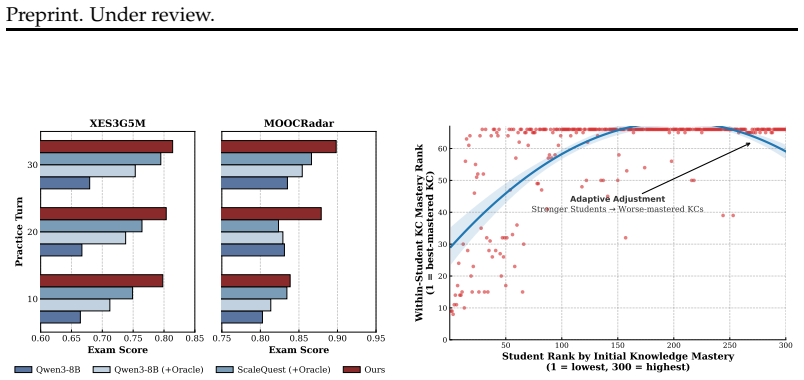
- The adaptive difficulty pattern shown in Figure 3, where weaker students are guided toward better-mastered concepts and stronger students toward challenging ones, emerges naturally from the objective rather than from an explicit difficulty heuristic, which is a non-trivial property of the formulation that could inform other adaptive learning system designs.
Editorial analysis
A structured set of objections, weighed in public.
Referee Report
Summary. The paper proposes KT4EQG, a framework for personalized educational question generation that integrates a knowledge tracing model (KT2) for concept selection with an alignment-trained LLM generator. The method decomposes the problem into (1) selecting the knowledge concept (KC) that maximizes a student's predicted mastery improvement (education value), and (2) generating a question faithfully aligned with that KC via supervised fine-tuning followed by RL with a contrastive alignment reward. Experiments on XES3G5M and MOOCRADAR compare KT4EQG against several LLM-based generators under a simulated multi-round practice evaluation, reporting exam scores computed by the KT model.
Significance. The integration of structured knowledge tracing with open-ended question generation is a reasonable and underexplored direction. The decomposition into education value and alignment value is principled, and the RL-based alignment training with a contrastive verifier is a concrete, reproducible design. The authors provide code, and the ablation study (Table 2) and case study (Table 6) provide useful qualitative evidence for alignment quality. However, the significance of the main empirical claim is substantially tempered by the evaluation methodology: the primary exam score metric is computed by the same KT2 model used for KC selection and state simulation, creating a self-referential evaluation loop that the paper does not fully resolve.
major comments (3)
- §4.2 and Eq. (4): The main evaluation metric (exam score) is computed by KT2, the same model used to select the optimal KC (Step 1, maximizing education value) and to update the student state during multi-round practice. The education value in Eq. (4) is defined as the sum of KT2 posterior mastery probabilities after a correct answer, and the exam score (Eq. 11) is a direct function of those same posteriors. This means KT4EQG selects the KC that maximally increases KT2's mastery posteriors, then is evaluated on KT2's mastery posteriors after those increases. Under this pipeline, the improvement is close to tautological. The paper acknowledges this partially in Appendix D by testing BKT and DKT as alternative evaluators, but Table 5 shows KT4EQG wins only approximately 3/6 modules under each independent evaluator (compared to 6/6 under KT2). Moreover, even in Appendix D, the practice-time
- §3.1, Eq. (2): The assumption that A_t*=1 (students always answer correctly) is a strong idealization that amplifies the circularity concern. Under this assumption, every practice round deterministically increases mastery for the selected KC, which differentially favors KCs selected for high education value (defined as KCs where a correct answer most increases mastery). The paper justifies this as modeling exercises as learning opportunities, but no sensitivity analysis is provided for the case where A_t* is sampled from the model's predicted correctness probability. This would test whether the gains persist when students sometimes answer incorrectly, which is the realistic scenario.
- §4.2, Table 1: The ORACLE baseline (which selects the KC maximizing education value but does not generate real questions) achieves exam scores very close to KT4EQG in several modules (e.g., Application: 0.8274 vs. 0.8036; Counting: 0.8164 vs. 0.8128). Since ORACLE does not involve actual question generation, its performance reflects only the KT2 selection mechanism evaluated within KT2. The small gap between ORACLE and KT4EQG under KT2 evaluation, combined with the larger gap under independent evaluators (Appendix D), suggests that much of KT4EQG's advantage in the main table may stem from the selection mechanism operating within KT2's internal dynamics rather than from the quality of generated questions.
minor comments (6)
- §4.1: The number of exam questions n is not specified in the main text. Please state this in the experimental setup.
- §4.2: The number of practice rounds k used for the main results in Table 1 is not clearly stated. Figure 2 shows k=10,20,30, but Table 1 does not specify which k was used.
- Table 5 (Appendix D): The text states KT4EQG 'remains competitive,' but in several modules KT4EQG is not the best method (e.g., Computation under DKT: 0.8077 vs. ScaleQuest 0.8685; Circuit Design under BKT: 0.6479 vs. PromptCoT 0.6818). The framing should be more precise about where the advantage holds and where it does not.
- §4.5, Figure 3: The y-axis label 'Within-Student KC Mastery Rank' is somewhat ambiguous. Clarify whether rank 1 corresponds to the best-mastered or worst-mastered KC (the text says rank 1 = highest mastery, but this is counterintuitive for a figure showing adaptive difficulty).
- Table 3: The Wine Knowledge module has only 4 candidate KCs and Education Theory has 3. Results on modules with so few KCs may not be very informative about the selection mechanism. Consider discussing this limitation.
- §3.5, Eq. (7): The temperature τ is listed as 0.07 in Appendix C.1 but appears in the axiom ledger as a free parameter. Clarify whether τ was tuned or fixed a priori.
Simulated Author's Rebuttal
We thank the referee for a careful and insightful review. The central concern—self-referential evaluation—is valid and important. We agree to add a sensitivity analysis for the A_t*=1 assumption and to reframe the main claims to properly reflect the independent-evaluator results. We respectfully disagree that the framework lacks significance, and explain why below.
read point-by-point responses
-
Referee: §4.2 and Eq. (4): The main evaluation metric (exam score) is computed by KT2, the same model used for KC selection and state simulation, creating a self-referential evaluation loop. KT4EQG selects KCs that maximally increase KT2 posteriors, then is evaluated on those same posteriors. Appendix D shows KT4EQG wins only ~3/6 modules under BKT and DKT.
Authors: We agree that the self-referential concern is legitimate and that the manuscript does not adequately address it in the main text. We will make the following revisions: (1) We will move the independent-evaluator results (BKT, DKT) from Appendix D into the main paper and discuss the circularity limitation explicitly. (2) We will reframe the main claims to state that KT4EQG achieves consistent improvements under the KT2 evaluator and remains competitive—though not uniformly best—under independent evaluators, rather than claiming universal superiority. (3) We will add a discussion of why the independent-evaluator results are noisier: BKT assumes independent binary states with no concept hierarchy, and DKT uses a flat sequential model, so neither captures the inter-KC dependencies that KT2's tree structure models and that our selection mechanism exploits. This is an architectural mismatch, not a defense of circularity, but it explains why the transfer is imperfect. We acknowledge that the current evidence does not fully resolve the circularity concern, and we will state this as a limitation. revision: yes
-
Referee: §3.1, Eq. (2): The assumption that A_t*=1 (students always answer correctly) is a strong idealization that amplifies circularity. No sensitivity analysis is provided for sampling A_t* from the model's predicted correctness probability.
Authors: This is a fair point. The A_t*=1 assumption was motivated by the pedagogical view that exercises are learning opportunities (students retry until mastery), but we agree that a sensitivity analysis is needed. We will add an experiment where A_t* is sampled from the KT model's predicted correctness probability p(A_t*=1|H, psi(X_t*)=c_t*) at each practice round, rather than being fixed to 1. This will test whether the gains persist when students sometimes answer incorrectly. We expect the absolute exam scores to decrease for all methods (since incorrect answers produce smaller mastery gains in KT2), but the relative ranking should be informative about whether our selection mechanism's advantage is robust to realistic correctness rates. We will report these results in the revised manuscript. revision: yes
-
Referee: §4.2, Table 1: ORACLE achieves exam scores very close to KT4EQG, and since ORACLE does not involve question generation, its performance reflects only the KT2 selection mechanism. The small gap suggests much of KT4EQG's advantage stems from the selection mechanism within KT2's dynamics rather than question generation quality.
Authors: We partially agree with the referee's observation but note an important distinction. The ORACLE baseline assumes perfect concept alignment—it updates the student state using the intended KC without any question generation. The gap between ORACLE and KT4EQG therefore measures the cost of imperfect alignment: when a generated question does not faithfully test the intended KC, the verifier redirects the state update to a different KC, producing a suboptimal practice round. The fact that KT4EQG approaches ORACLE (e.g., 0.8036 vs. 0.8274 on Application) is actually evidence that our alignment-trained generator achieves high concept fidelity. The referee is correct that under independent evaluators (Appendix D), the gap pattern changes, which reinforces the need to present those results prominently. However, we respectfully note that the comparison between KT4EQG and the +ORACLE variants of baselines (e.g., QWEN3-8B+ORACLE: 0.7378 vs. KT4EQG: 0.8036) isolates the question generation quality component, since both receive the same KC selection. This gap persists because baseline generators produce questions that the verifier frequently maps to different KCs (35.3% concentration for QWEN3-8B+ORACLE vs. 5.2% for KT4EQG, as reported in Section 4.6). We will add a clearer discussion of what the ORACLE gap does and does not measure, and will present the +ORACLE comparisons more prominently as evidence for the alignment training contribution. revision: partial
- The fundamental circularity concern cannot be fully resolved within the current framework: any KT model used for both selection and evaluation will share some internal dynamics. A truly independent evaluation would require real student studies or a ground-truth learning outcome measure external to all KT models, which is beyond the scope of this paper. We will acknowledge this as a limitation but cannot eliminate it in revision.
Circularity Check
KT4EQG's exam score metric is computed by the same KT2 model whose education value it optimizes; the 'improvement' is close to tautological under KT2 evaluation.
specific steps
-
self definitional
[Eq. (4) and Eq. (11), with evaluation in §4.2]
"Eq. (4): max Σ_c p(K_c=1|H, ψ(X_t*)=c_t*, A_t*=1) [education value]. §4.2: 'Exam score is defined as the average predicted correctness probability across all exam questions, computed by the KT model after the multi-round practice process.' Eq. (11): p(A_t=1|H,ψ(X_t)=c) = p(K_c=0|H)·ε + p(K_c=1|H)·r_d."
KT4EQG selects the KC c_t* that maximizes Σ_c p(K_c=1|H, ψ(X_t*)=c_t*, A_t*=1) — i.e., the KC that most increases KT2's posterior mastery probabilities assuming a correct answer. The exam score (§4.2) is the average of p(A_t=1|H') across exam questions, which by Eq. (11) equals p(K_c=0|H')·ε + p(K_c=1|H')·r_d — a direct function of the same posterior mastery probabilities. During multi-round practice, the state is updated by assuming A_t*=1 (correct answers), which increases exactly the mastery probabilities that the education value was designed to maximize. So KT4EQG selects KCs that maximally increase KT2's mastery posteriors, then is evaluated on KT2's mastery posteriors after those increases. Under KT2 evaluation, the improvement is close to tautological. Appendix D provides partialcor
-
self citation load bearing
[§3.2 and §3.3, citing Gao et al. (2025) for KT2]
"To compute the objective function in Eq. (2), we adopt KT2 (Gao et al., 2025), a KT algorithm based on a principled probabilistic model for tracking students KC mastery states. [...] The detailed inference process in described in Gao et al. (2025) and Appendix A."
The entire framework — both the education value computation (Step 1) and the exam score evaluation — depends on KT2. The authors cite Gao et al. (2025), which is their own prior work (Xinyi Gao, Qiucheng Wu, Yang Zhang, Kaizhi Qian, Ying Xu, Shiyu Chang — overlapping authorship with this paper). The KC tree structure, the transition/emission probability model, and the upward-downward inference algorithm are all imported from this self-citation. While KT2 itself may be a legitimate model, the fact that the same model is used for both optimization and evaluation creates the circularity identified in step 1. The self-citation is load-bearing because without KT2's specific inference machinery, neither the education value nor the exam score can be computed. This is not independently verified by
full rationale
The paper's central evaluation pipeline has a genuine circularity: KT2 selects the KC that maximizes education value (Eq. 4), which is defined as the sum of KT2 posterior mastery probabilities after a correct answer; KT2 then updates the student state during multi-round practice assuming A_t*=1; and KT2 computes the exam score (Eq. 11), which is a direct function of the same posterior mastery probabilities. The 'improvement' reported in Table 1 is thus KT2 measuring how much its own mastery posteriors increased after it selected KCs designed to maximally increase them. Appendix D mitigates this partially by using BKT and DKT as alternative evaluators, where KT4EQG wins only ~3/6 modules under each — but even there, the practice simulation still uses KT2 for state updates, so the student state after practice remains KT2-internal. The self-citation to KT2 (Gao et al., 2025) is load-bearing but not itself circular — KT2 is a legitimate model with independently estimated parameters. The circularity is in the evaluation pipeline design, not in the model's mathematical validity. Score 6 reflects that the main claim (6/6 modules under KT2) is largely forced by construction, while the independent-evaluator results (Appendix D) provide partial but weakened support.
Axiom & Free-Parameter Ledger
free parameters (5)
- γc (per-KC transition probability)
- r_easy, r_med, r_hard (emission probabilities)
- ε (guess probability)
- τ (temperature for alignment score)
- RL hyperparameters (KL coeff=0.3, entropy coeff=0.03, rollouts=4)
axioms (4)
- domain assumption Each practice question Xt is associated with exactly one KC, ψ(Xt), which is a sufficient statistic for predicting correctness (Eq. 3).
- ad hoc to paper Students always answer the generated question correctly (At*=1).
- domain assumption KC mastery variables follow a tree-structured Markov dependency (Eq. 8-9).
- domain assumption The alignment verifier's embedding-space similarity captures whether a question tests a concept.
read the original abstract
Educational Question Generation (EQG) aims to synthesize customized exercise questions that enhance student learning. An effective EQG system should ideally personalize questions for each student by modeling the student's knowledge state and generating questions that provide the greatest learning benefit. However, few existing EQG approaches are able to achieve such fine-grained personalization. In this paper, we explore how EQG can benefit from knowledge tracing (KT), which models students' knowledge states based on historical performance and predicts future performance. We propose KT4EQG, a personalized EQG framework that generates effective questions for individual students under the guidance of a KT model. Specifically, KT4EQG seeks to maximize a student's potential improvement in overall knowledge mastery by leveraging the KT model to select the most suitable knowledge concept for the student to practice. An LLM-based question generator is then trained to produce a question faithfully grounded in the selected concept. Experimental results on XES3G5M and MOOCRadar show that KT4EQG consistently generates more effective questions than methods with limited or no personalization.
Figures

Reference graph
Works this paper leans on
-
[1]
" write newline "" before.all 'output.state := FUNCTION n.dashify 't := "" t empty not t #1 #1 substring "-" = t #1 #2 substring "--" = not "--" * t #2 global.max substring 't := t #1 #1 substring "-" = "-" * t #2 global.max substring 't := while if t #1 #1 substring * t #2 global.max substring 't := if while FUNCTION format.date year duplicate empty "emp...
-
[2]
\@ifxundefined[1] #1\@undefined \@firstoftwo \@secondoftwo \@ifnum[1] #1 \@firstoftwo \@secondoftwo \@ifx[1] #1 \@firstoftwo \@secondoftwo [2] @ #1 \@temptokena #2 #1 @ \@temptokena \@ifclassloaded agu2001 natbib The agu2001 class already includes natbib coding, so you should not add it explicitly Type <Return> for now, but then later remove the command n...
-
[3]
\@lbibitem[] @bibitem@first@sw\@secondoftwo \@lbibitem[#1]#2 \@extra@b@citeb \@ifundefined br@#2\@extra@b@citeb \@namedef br@#2 \@nameuse br@#2\@extra@b@citeb \@ifundefined b@#2\@extra@b@citeb @num @parse #2 @tmp #1 NAT@b@open@#2 NAT@b@shut@#2 \@ifnum @merge>\@ne @bibitem@first@sw \@firstoftwo \@ifundefined NAT@b*@#2 \@firstoftwo @num @NAT@ctr \@secondoft...
-
[4]
@open @close @open @close and [1] URL: #1 \@ifundefined chapter * \@mkboth \@ifxundefined @sectionbib * \@mkboth * \@mkboth\@gobbletwo \@ifclassloaded amsart * \@ifclassloaded amsbook * \@ifxundefined @heading @heading NAT@ctr thebibliography [1] @ \@biblabel @NAT@ctr \@bibsetup #1 @NAT@ctr @ @openbib .11em \@plus.33em \@minus.07em 4000 4000 `\.\@m @bibit...
discussion (0)
Sign in with ORCID, Apple, or X to comment. Anyone can read and Pith papers without signing in.