REVIEW 3 major objections 4 minor 1 cited by
Classical optimization algorithms for diagonalizing quantum Hamiltonians
T0 review · 3 major / 4 minor · reviewed 2026-08-15 · deepseek-v4-flash
Pith's one-line read A classical optimization algorithm can diagonalize a Hamiltonian without ever getting stuck in a spurious minimum.
desk verdict A clean landscape theorem is buried under an invalid headline example: Example 1's D contains Y Paulis, so it is not diagonal by the paper's own Eq. (2), and the claimed exponential-Lie-algebra family is unproven. read the letter →
The pith
A machine-rendered reading of the paper's core claim, the machinery that carries it, and where it could break.
The reading
What carries the argument
The central object is a parameterized Pauli-basis ansatz $K(r,\theta)=\sum_{j=1}^d r_j e^{i\theta_j} P_j$, whose coefficients $r_j e^{i\theta_j}$ are exactly the Pauli-basis coefficients of $K$ in polar form. The cost $F$ combines $f(r,\theta)$, the squared off-diagonal Pauli coefficients of $K^\dagger H K$, with an orthogonality penalty built from coefficients $\phi_P$ of $K^\dagger K$. The identity that carries the argument is $\sum_j r_j \partial F/\partial r_j = 4F(r,\theta)$, which, together with the explicit gradient formula, forces $F=0$ at any nonzero stationary point; the orthogonality part then forces $K^\dagger K = \|r\|^2 I$, making the stationary $K$ unitary up to scaling.
What would settle it
A concrete falsifier is a numerical scan on a small Hamiltonian, such as the four-qubit XXZ model, with a fixed Pauli ansatz known to contain the exact diagonalizing unitary: run Algorithm 1 from many random initial points and check whether any nonzero stationary point with $F>0$ is reached, since the theorem predicts none. A complementary test would construct a Hamiltonian whose diagonalizing unitary provably lies outside every polynomial-size Pauli ansatz and show the algorithm's output is not a diagonalization, exposing the practical scope limitation.
Extended reading notes
Core claim
The central claim is Theorem 3: any nonzero stationary point $(r_c,\theta_c)$ of the total cost $F(r,\theta)=\sum_{P\in G_1} \mathrm{tr}(K(r,\theta)^\dagger H K(r,\theta) P)^2 + \sum_{P\in G_2} \phi_P(r,\theta)^2$ is a global minimum, and $K(r_c,\theta_c)=\sum_{j=1}^d r_j e^{i\theta_j} P_j$ is unitary up to scaling, giving $H = \|r\|^{-4} K h K^\dagger$ with $h=K^\dagger H K$ diagonal. Hence every nontrivial fixed point of gradient descent with normalization is a genuine diagonalization. The paper also proves convergence under a uniform Kurdyka-Lojasiewicz condition and derives an a posteriori bound that maps small $F$ to closeness of $H$ to $\widetilde{H}=K h_0 K^\dagger$ and of the corresponding eigenspace projectors.
Load-bearing premise
The algorithm must be handed a Pauli-string ansatz $K(r,\theta)$ whose span contains a unitary that diagonalizes $H$, and in every numerical experiment that ansatz and its initialization are taken from the known eigendecomposition of the target Hamiltonian; the paper gives no procedure to discover such an ansatz from $H$ alone.
Editorial extensions
If this is right
- Any nontrivial stationary point of the optimization is a correct diagonalization, so gradient descent with normalization cannot get stuck at spurious minima; the only failure mode is convergence to $r=0$, which the normalization step is designed to avoid.
- The convergence theorem gives sublinear or linear rates under a uniform KL condition, with iteration count $O\left(\epsilon^{-\max\{\alpha-1,0\}} \log(1/\epsilon)\right)$, translating numerical optimization effort into a diagonalization guarantee.
- The a posteriori error bound means a user can certify approximate diagonalization and eigenspace accuracy directly from the final cost function value.
- For Hamiltonians whose diagonalizing unitary is sparse in the Pauli basis, the per-iteration cost is polynomial: $O(d^4 M^2)$ deterministic and $O(d^2 M)$ for the randomized-coordinate variant.
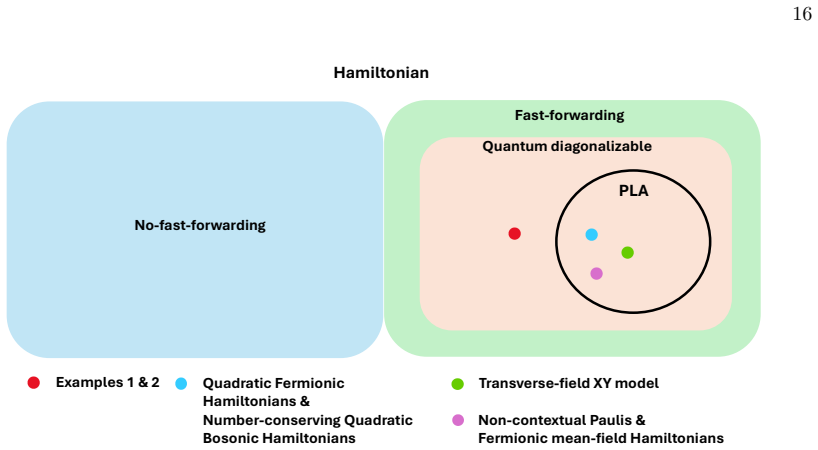
- The constructed family of Hamiltonians shows that quantum-diagonalizable Hamiltonians strictly contain those with polynomially sized Lie algebras, so exponential Lie-algebra dimension alone does not preclude efficient diagonalization.
Reading between the lines
- A natural testable extension is a bootstrap that grows the Pauli ansatz from the terms of $H$ until the stationary-point condition $F=0$ is met, since the paper gives no autonomous procedure for discovering the ansatz.
- The construction of Example 1 suggests a general recipe for generating hard-to-diagonalize-looking Hamiltonians: conjugate a diagonal Pauli-sparse $D$ by products of a few anticommuting Pauli rotations, which may inflate the dynamical Lie algebra to $su(2^n)$ while keeping the eigendecomposition Pauli-sparse.
- The continuation observation that optimal parameters for one Hamiltonian initialize well for nearby parameters points toward a practical parameter-sweep workflow for tunable or time-dependent models, though the paper demonstrates this only numerically.
Signed reviews
Editorial analysis
A structured set of objections, weighed in public.
Referee Report
Summary. The manuscript presents classical optimization algorithms for Hamiltonian diagonalization. Given a Hamiltonian H expressed as a sum of M Pauli strings, the authors parameterize a candidate unitary K(r,θ) = Σ_j r_j e^{iθ_j} P_j and define a cost F(r,θ) consisting of the squared off-diagonal Pauli coefficients of K†HK plus a penalty enforcing K†K ∝ I. They prove (Theorems 2 and 3) that every nonzero stationary point of F is a global minimum and corresponds to a KHK decomposition of H, and they give a posteriori error bounds linking approximate cost minimization to approximate diagonalization. A deterministic gradient-descent-with-normalization algorithm is analyzed under a uniform KL condition (Assumption 1), and a randomized-coordinate variant is proposed with reduced per-iteration cost. The paper also claims a new family of quantum-diagonalizable Hamiltonians with exponentially large Lie algebras but polynomially sparse Pauli decompositions (Examples 1 and 2). Numerical experiments on random sparse Hamiltonians, the XXZ model, and a Hubbard model are reported.
Significance. If all claims were valid, the paper would make a useful contribution: a classically implementable optimization landscape with no spurious stationary points, polynomial per-iteration cost for Hamiltonians with sparse Pauli diagonalizations, and error certificates would complement existing Lie-algebraic and variational diagonalization methods. The algebraic core—the stationary-point argument in Theorems 2 and 3 and the error bound in Lemma 2—appears sound and is the strongest part of the paper. The code is publicly available and the numerical experiments are clearly described. However, the claimed new family of quantum-diagonalizable Hamiltonians is not established as presented, and the polynomial-efficiency claim presupposes a known ansatz containing the diagonalizing unitary; these issues affect the paper's central advertised contributions. The convergence theorem also has a regime where the proof does not support the stated rate.
major comments (3)
- [§IV, Example 1 (Eq. (35)) and Definition 2] The matrix D = I + Σ_{j=1}^n d_j Y_j is not diagonal in the computational basis under the paper's own classification in Eq. (2), which places every Pauli string containing an X or Y factor in the off-diagonal part. Consequently H = U D U† is not an eigen-decomposition and U is not a diagonalizing unitary, so the example does not satisfy Definition 2. This is not a typo: Appendix C uses the Y_j factors in D to obtain X_1, Z_1, Z_1Z_2 and the commutators that generate the set (C1); replacing Y_j by Z_j would break the Lie-algebra argument. The claimed new family of quantum-diagonalizable Hamiltonians with exponentially large Lie algebras, and the discussion in Section VI that this family strictly contains the PLA Hamiltonians, are therefore unsupported.
- [§II–§V, Eq. (4) and Algorithm 1] The optimization problem is only defined relative to a user-supplied Pauli ansatz {P_j}, and the correctness and efficiency claims assume that this ansatz spans a diagonalizing unitary of H with d = poly(n). No procedure is given to construct such an ansatz from H alone; in the Section V experiments the initial K is obtained from an eigensolver and then expanded in Pauli strings, so the ansatz and initialization are derived from the known eigendecomposition. The abstract's claim of polynomial-time efficiency for diagonalizing unknown H is therefore not established; the paper demonstrates polynomial per-iteration cost for a subproblem whose input includes an oracle-like ansatz.
- [Theorem 4 and Appendix A] The convergence-rate derivation is not valid for the claimed range α ∈ [0,1]. In Eqs. (A9)–(A10), the factor 1 − μa F(x_t)^{α−1} is used; when α < 1 and F(x_t) is small, F^{α−1} = 1/F^{1−α} is large and the factor can become negative, so the inequality ε ≤ (1 − μa ε^{α−1})^T F(x_0) used to extract T is meaningless. The stated bound T = O(ε^{−max{α−1,0}} log(1/ε)), which sets the exponent to zero for α ∈ [0,1], does not follow from the proof; a separate argument is needed for the linear-convergence claim in that regime.
minor comments (4)
- [Algorithms 1 and 2] The text contains the typo 'learing rate schedule'; it should read 'learning rate schedule'.
- [§II, Eq. (3) and definition of G1] As written, G1 is defined through K(r,θ) but K depends on the optimization parameters; the definition should clarify that G1 is the fixed set of all off-diagonal Pauli strings that can appear in the symbolic expansion of K†HK, with zero coefficients allowed at particular parameter values.
- [§III.D] The phrase 'quadratically reduces the per-iteration cost from O(d^4 M^2) to O(d^2 M)' is imprecise, since the ratio is O(d^2 M); it would be clearer to say the reduction factor is O(d^2 M).
- [Abstract and §III.D] The randomized-coordinate algorithm is presented as a practical contribution, but Section III.D states that no convergence guarantee is available for it ('deriving a lower bound of the norm of r_{t+1} and a convergence guarantee is still an open issue'); the abstract and conclusion should state this limitation explicitly rather than presenting the variant as fully supported.
Circularity Check
Polynomial-time diagonalization is demonstrated only when the diagonalizing unitary is supplied as the ansatz and/or initialization; the numerical tests construct H from a known U,D or warm-start from an eigensolver. Example 1's non-diagonal D adds a separate correctness flaw.
-
fitted input called prediction
[Section V, Numerical Result, Fig. 1 setup]
"First, we sample a pair of polynomial numbers of Pauli strings, say, ({P_{i_a}}_{i_a∈I_a}, {P_{i_b}}_{i_b∈I_b}) ... a diagonal matrix is constructed as D=∑_{i_a∈I_a} c_{i_a}P_{i_a}, and a unitary matrix is formulated as the product of Pauli rotations, say, U=∏_{i_b∈I_b} exp(i c_{i_b}P_{i_b}). Lastly, with this pair of unitary and diagonal, we construct a Hamiltonian that is represented by UDU†."
The Hamiltonians used to test Algorithm 1 are created by choosing U and D first; the ansatz dimension d in K(r,θ) is then read off from the Pauli support of the chosen U, as in 'the number of parameters in K in (3) is 8,32,8,32'. Thus the algorithm is run inside a parameter manifold defined by a known diagonalizing unitary. The claimed polynomial efficiency for Definition 2 is conditional on this supplied decomposition; no procedure selects the ansatz from H alone.
-
fitted input called prediction
[Section V, Numerical Result, XXZ/Hubbard initialization]
"we compute its eigen-decomposition using an eigensolver, obtain a unitary K, expand K in terms of Pauli strings as (3) and use the coefficients as the initial parameters for the optimization (6) with the Hamiltonian defined by the target value of Δ."
Even when the target Hamiltonian is not constructed from the same U, the initial point is the Pauli expansion of an eigendecomposition computed by an eigensolver for a nearby Hamiltonian. The cost function is then minimized from a point already near a true diagonalization; the experiments therefore do not show that the algorithm can find the ansatz or the solution from H alone. The diagonalization is supplied, up to a parameter perturbation, before optimization begins.
full rationale
The algebraic landscape theorem (Theorem 3) is self-contained: the proof that a nonzero stationary point has F=0 follows from the Euler identity Σ_j r_j ∂F/∂r_j=4F and the sum-of-squares form of F, with no hidden fitted quantity. However, the paper's central algorithmic claim is circular in its setup. No procedure is given to select the Pauli ansatz K(r,θ)=Σ_j r_j e^{iθ_j}P_j (the integer d and the strings P_j) from H alone; Definition 2 assumes H=UDU† with polynomially sparse U,D, and the numerical demonstrations use that known decomposition. The Fig. 1 tests generate H by first sampling U and D, and the XXZ/Hubbard tests initialize from an eigensolver's decomposition of a nearby Hamiltonian. Thus the claimed polynomial-time diagonalization is not computed from H alone; the decomposition is an input by construction. This warrants a score of 7. Separately, Example 1 defines D=I+Σ_j d_jY_j, which contradicts Eq. (2)'s classification of Y-containing strings as off-diagonal; hence the claimed family of quantum-diagonalizable Hamiltonians with exponentially large Lie algebras is unsupported. That is a correctness flaw, not an additional circular step, and I do not count it in the score beyond noting it weakens the breadth claim. The self-citation [20] in Appendix B supports only a secondary perturbation bound and is not load-bearing for the main diagonalization claim, so it does not raise the score further.
Assumptions & free parameters
free parameters (3)
- Ansatz Pauli set {P_j} for K =
d = 8, 32, 8, 32 in Fig. 1; full 4^n basis for XXZ/Hubbard
- Initial coefficients (r0, theta0) =
coefficients of eigendecomposition unitary from classical eigensolver
- KL constants delta_f, mu, alpha and learning-rate schedule a_t =
not reported
assumptions (6)
- standard math The Pauli strings form an orthogonal basis for 2^n x 2^n matrices under the Hilbert-Schmidt inner product; every Hermitian A has expansion A = Σ a_j P_j with a_j = 2^{-n} tr(A P_j).
- domain assumption The target Hamiltonian is expressed as a linear combination of polynomially many Pauli strings, M = O(poly(n)).
- ad hoc to paper A Pauli ansatz set {P_j} that contains the support of a diagonalizing unitary of H is known in advance.
- ad hoc to paper Assumption 1: there exist delta_f > 0, mu > 0, alpha in [0,2) such that ||nabla F||^2 >= 4 mu F^alpha whenever F < delta_f.
- standard math The generating set of [31] (Z1, Z2, X1, X2, Z1Z2 and X2Y3...Zj, Z2Y3...Xj) generates all Pauli strings in the dynamical Lie algebra sense.
- domain assumption The spectral projector bound invoked from [20, Lemma 5] is correct.
Cite this review
Pith. "Pith review of Classical optimization algorithms for diagonalizing quantum Hamiltonians." pith.science (2026). https://pith.science/paper/RRT5FLWZ
@misc{pith2026250617883,
  author       = {Pith},
  title        = {Pith review of: Classical optimization algorithms for diagonalizing quantum Hamiltonians},
  year         = {2026},
  howpublished = {\url{https://pith.science/paper/RRT5FLWZ}},
  note         = {Machine review of arXiv:2506.17883}
}
read the original abstract
Diagonalizing a Hamiltonian, which is essential for simulating its long-time dynamics, is a key primitive in quantum computing and has been proven to yield a quantum advantage for several specific families of Hamiltonians. Yet, despite its importance, only a handful of diagonalization algorithms exist, and correspondingly few families of fast-forwardable Hamiltonians have been identified. This paper introduces classical optimization algorithms for Hamiltonian diagonalization by formulating a cost function that penalizes off-diagonal terms and enforces unitarity via an orthogonality constraint, both expressed in the Pauli operator basis. We pinpoint a class of Hamiltonians that highlights severe drawbacks of existing methods, including exponential per-iteration cost, exponential circuit depth, or convergence to spurious optima. Our approach overcomes these shortcomings, achieving polynomial-time efficiency while provably avoiding suboptimal points. As a result, we broaden the known realm of fast-forwardable systems, showing that quantum-diagonalizable Hamiltonians extend to cases generated by exponentially large Lie algebras. On the practical side, we also present a randomized-coordinate variant that achieves a more efficient per-iteration cost than the deterministic counterpart. We demonstrate the effectiveness of these algorithms through explicit examples and numerical experiments.
Figures


Forward citations
Cited by 1 Pith paper
-
Designing quantum technologies with a quantum computer
A hybrid quantum–classical framework using sQKFF plus Gray encoding and qubit-wise commuting aggregation simulates NV-center spin-defect dynamics and spectra with 18–30% gate-count reductions.
Reference graph
Works this paper leans on
-
[1]
Dong An, Jin-Peng Liu, Daochen Wang, and Qi Zhao. A theory of quantum differential equation solvers: limitations and fast-forwarding.arXiv preprint arXiv:2211.05246, 2022. 23
arXiv 2022
-
[2]
Yosi Atia and Dorit Aharonov. Fast-forwarding of hamiltonians and exponentially precise measure- ments.Nature communications, 8(1):1572, 2017
work page 2017
-
[3]
Dominic W Berry, Andrew M Childs, Richard Cleve, Robin Kothari, and Rolando D Somma. Sim- ulating hamiltonian dynamics with a truncated taylor series.Physical review letters, 114(9):090502, 2015
work page 2015
-
[4]
Xavier Bonet-Monroig, Ryan Babbush, and Thomas E O’Brien. Nearly optimal measurement schedul- ing for partial tomography of quantum states.Physical Review X, 10(3):031064, 2020
work page 2020
-
[5]
Nearly optimal lattice simulation by product formulas.Physical review letters, 123(5):050503, 2019
Andrew M Childs and Yuan Su. Nearly optimal lattice simulation by product formulas.Physical review letters, 123(5):050503, 2019
2019
-
[6]
Theory of trotter error with commutator scaling.Physical Review X, 11(1):011020, 2021
Andrew M Childs, Yuan Su, Minh C Tran, Nathan Wiebe, and Shuchen Zhu. Theory of trotter error with commutator scaling.Physical Review X, 11(1):011020, 2021
2021
-
[7]
Moody T. Chu. Lax dynamics for cartan decomposition with applications to hamiltonian simulation. IMA Journal of Numerical Analysis, 44(3):1406–1434, 2024
work page 2024
-
[8]
Cristina Cirstoiu, Zoe Holmes, Joseph Iosue, Lukasz Cincio, Patrick J Coles, and Andrew Sornborger. Variational fast forwarding for quantum simulation beyond the coherence time.npj Quantum Infor- mation, 6(1):82, 2020
work page 2020
Show all 40 references
-
[9]
Quantum symmetries and cartan decompositions in arbitrary dimensions.Journal of Physics A: Mathematical and Theoretical, 40(10):2439, 2007
Domenico D’Alessandro and Francesca Albertini. Quantum symmetries and cartan decompositions in arbitrary dimensions.Journal of Physics A: Mathematical and Theoretical, 40(10):2439, 2007
2007
-
[10]
A constructive algorithm for the cartan decomposition of su (2n).Journal of mathematical physics, 46(8), 2005
Henrique N S´ a Earp and Jiannis K Pachos. A constructive algorithm for the cartan decomposition of su (2n).Journal of mathematical physics, 46(8), 2005
2005
-
[11]
Overlap-adapt-vqe: practical quantum chemistry on quantum computers via overlap-guided compact ans¨ atze.Communications Physics, 6(1):192, 2023
C´ esar Feniou, Muhammad Hassan, Diata Traor´ e, Emmanuel Giner, Yvon Maday, and Jean-Philip Piquemal. Overlap-adapt-vqe: practical quantum chemistry on quantum computers via overlap-guided compact ans¨ atze.Communications Physics, 6(1):192, 2023
2023
-
[12]
Dequantizing the quantum singular value transformation: hardness and applications to quantum chemistry and the quantum pcp conjecture
Sevag Gharibian and Fran¸ cois Le Gall. Dequantizing the quantum singular value transformation: hardness and applications to quantum chemistry and the quantum pcp conjecture. InProceedings of the 54th annual ACM SIGACT symposium on theory of computing, pages 19–32, 2022
2022
-
[13]
Quantum singular value transformation and beyond: exponential improvements for quantum matrix arithmetics
Andr´ as Gily´ en, Yuan Su, Guang Hao Low, and Nathan Wiebe. Quantum singular value transformation and beyond: exponential improvements for quantum matrix arithmetics. InProceedings of the 51st annual ACM SIGACT symposium on theory of computing, pages 193–204, 2019
2019
-
[14]
fast-forward
implements a double-bracket dynamics to construct a diagonalizing unitary. This technique is constructive and broadly applicable, due to its non-increasing property of the off-diagonal terms. However, the family of Hamiltonians for which the algorithm operates efficiently rema...
2023
-
[15]
Double-bracket quantum algorithms for diagonalization.Quantum, 8:1316, 2024
Marek Gluza. Double-bracket quantum algorithms for diagonalization.Quantum, 8:1316, 2024
2024
-
[16]
Adaptive, problem-tailored variational quantum eigensolver mitigates rough parameter landscapes and barren plateaus.npj Quantum Information, 9(1):19, 2023
Harper R Grimsley, George S Barron, Edwin Barnes, Sophia E Economou, and Nicholas J Mayhall. Adaptive, problem-tailored variational quantum eigensolver mitigates rough parameter landscapes and barren plateaus.npj Quantum Information, 9(1):19, 2023
2023
-
[17]
Fast-forwarding quantum evolution.Quantum, 5:577, 2021
Shouzhen Gu, Rolando D Somma, and Burak S ¸ahino˘ glu. Fast-forwarding quantum evolution.Quantum, 5:577, 2021
2021
-
[18]
How to define quantum mean-field solvable hamiltonians using lie algebras.Quantum Science and Technology, 6(4):044006, 2021
Artur F Izmaylov and Tzu-Ching Yen. How to define quantum mean-field solvable hamiltonians using lie algebras.Quantum Science and Technology, 6(4):044006, 2021
2021
-
[19]
Unitary partitioning approach to the measurement problem in the variational quantum eigensolver method.Journal of chemical theory and computation, 16(1):190–195, 2019
Artur F Izmaylov, Tzu-Ching Yen, Robert A Lang, and Vladyslav Verteletskyi. Unitary partitioning approach to the measurement problem in the variational quantum eigensolver method.Journal of chemical theory and computation, 16(1):190–195, 2019
2019
-
[20]
Cartan decomposition of su (2n) and control of spin systems
Navin Khaneja and Steffen J Glaser. Cartan decomposition of su (2n) and control of spin systems. Chemical Physics, 267(1-3):11–23, 2001
2001
-
[21]
Quantum random power method for ground state computation.arXiv preprint arXiv:2408.08556, 2024
Taehee Ko, Hyowon Park, and Sangkook Choi. Quantum random power method for ground state computation.arXiv preprint arXiv:2408.08556, 2024
2024 arXiv
-
[22]
Fixed depth hamiltonian simulation via cartan decomposition.Physical Review Letters, 129(7):070501, 2022
Efekan K¨ okc¨ u, Thomas Steckmann, Yan Wang, JK Freericks, Eugene F Dumitrescu, and Alexander F Kemper. Fixed depth hamiltonian simulation via cartan decomposition.Physical Review Letters, 129(7):070501, 2022
2022
-
[23]
Guoyin Li and Ting Kei Pong. Calculus of the exponent of kurdyka– lojasiewicz inequality and its applications to linear convergence of first-order methods.Foundations of computational mathematics, 18(5):1199–1232, 2018
2018
-
[24]
Universal quantum simulators.Science, 273(5278):1073–1078, 1996
Seth Lloyd. Universal quantum simulators.Science, 273(5278):1073–1078, 1996
1996
-
[25]
Optimal hamiltonian simulation by quantum signal processing
Guang Hao Low and Isaac L Chuang. Optimal hamiltonian simulation by quantum signal processing. Physical review letters, 118(1):010501, 2017. 24
2017
-
[26]
Hamiltonian simulation in the interaction picture.arXiv preprint arXiv:1805.00675, 2018
Guang Hao Low and Nathan Wiebe. Hamiltonian simulation in the interaction picture.arXiv preprint arXiv:1805.00675, 2018
2018 arXiv
-
[27]
Quantum advantage from energy mea- surements of many-body quantum systems.Quantum, 5:465, 2021
Leonardo Novo, Juani Bermejo-Vega, and Ra´ ul Garc´ ıa-Patr´ on. Quantum advantage from energy mea- surements of many-body quantum systems.Quantum, 5:465, 2021
2021
-
[28]
Extension of exactly-solvable hamiltonians using symmetries of lie algebras.The Journal of Physical Chemistry A, 128(20):4150–4159, 2024
Smik Patel, Tzu-Ching Yen, and Artur F Izmaylov. Extension of exactly-solvable hamiltonians using symmetries of lie algebras.The Journal of Physical Chemistry A, 128(20):4150–4159, 2024
2024
-
[29]
The Trotter step size required for accurate quantum simulation of quantum chemistry.arXiv preprint arXiv:1406.4920, 2014
David Poulin, Matthew B Hastings, Dave Wecker, Nathan Wiebe, Andrew C Doherty, and Matthias Troyer. The Trotter step size required for accurate quantum simulation of quantum chemistry.arXiv preprint arXiv:1406.4920, 2014
2014 arXiv
-
[30]
Efficient construction of involutory linear com- binations of anticommuting pauli generators for large-scale iterative qubit coupled cluster calculations
Ilya G Ryabinkin, Andrew J Jena, and Scott N Genin. Efficient construction of involutory linear com- binations of anticommuting pauli generators for large-scale iterative qubit coupled cluster calculations. Journal of chemical theory and computation, 19(6):1722–1733, 2023
2023
-
[31]
Hamiltonian simulation in the low-energy subspace.npj Quantum Information, 7(1):119, 2021
Burak S ¸ahino˘ glu and Rolando D Somma. Hamiltonian simulation in the low-energy subspace.npj Quantum Information, 7(1):119, 2021
2021
-
[32]
Optimally gener- atingsu(2 N) using pauli strings.arXiv preprint arXiv:2408.03294, 2024
Isaac D Smith, Maxime Cautr` es, David T Stephen, and Hendrik Poulsen Nautrup. Optimally gener- atingsu(2 N) using pauli strings.arXiv preprint arXiv:2408.03294, 2024
2024 arXiv
-
[33]
Unitary circuit synthesis for tomography of generalized coherent states.Journal of Mathematical Physics, 60(11), 2019
Rolando D Somma. Unitary circuit synthesis for tomography of generalized coherent states.Journal of Mathematical Physics, 60(11), 2019
2019
-
[34]
A quantum-inspired classical algorithm for recommendation systems
Ewin Tang. A quantum-inspired classical algorithm for recommendation systems. InProceedings of the 51st annual ACM SIGACT symposium on theory of computing, pages 217–228, 2019
2019
-
[35]
qubit-adapt-vqe: An adaptive algorithm for constructing hardware-efficient ans¨ atze on a quantum processor.PRX Quantum, 2(2):020310, 2021
Ho Lun Tang, VO Shkolnikov, George S Barron, Harper R Grimsley, Nicholas J Mayhall, Edwin Barnes, and Sophia E Economou. qubit-adapt-vqe: An adaptive algorithm for constructing hardware-efficient ans¨ atze on a quantum processor.PRX Quantum, 2(2):020310, 2021
2021
-
[36]
Ordering of Trotterization: Impact on errors in quantum simulation of electronic structure.Entropy, 21(12):1218, 2019
Andrew Tranter, Peter J Love, Florian Mintert, Nathan Wiebe, and Peter V Coveney. Ordering of Trotterization: Impact on errors in quantum simulation of electronic structure.Entropy, 21(12):1218, 2019
2019
-
[37]
Variational-cartan quantum dynamics simulations of excitation dynamics, 2024
Linyun Wan, Jie Liu, Zhenyu Li, and Jinlong Yang. Variational-cartan quantum dynamics simulations of excitation dynamics, 2024
2024
-
[38]
Quspin: a python package for dynamics and exact diagonalisation of quantum many body systems part i: spin chains.SciPost Physics, 2(1):003, 2017
Phillip Weinberg and Marin Bukov. Quspin: a python package for dynamics and exact diagonalisation of quantum many body systems part i: spin chains.SciPost Physics, 2(1):003, 2017
2017
-
[39]
Forestano, M
David Wierichs, Maxwell West, Roy T. Forestano, M. Cerezo, and Nathan Killoran. Recursive cartan decompositions for unitary synthesis, 2025
2025
-
[40]
Classification of dynamical lie algebras of 2-local spin systems on linear, circular and fully connected topologies.npj Quantum Information, 10(1):110, 2024
Roeland Wiersema, Efekan K¨ okc¨ u, Alexander F Kemper, and Bojko N Bakalov. Classification of dynamical lie algebras of 2-local spin systems on linear, circular and fully connected topologies.npj Quantum Information, 10(1):110, 2024
2024
Reviewed August 15, 2026 · model on record in the stance chip above.
Discussion (0). Continue with ORCID to comment.