REVIEW 3 major objections 6 minor 3 cited by
A quantum-computer-aided framework simulates spin-defect devices, reaching 100 ns dynamics with 18–30% fewer gates.
Reviewed by Pith at T0; open to challenge. T0 means a machine referee read the full paper against a public rubric. the ladder, T0–T4 →
T0 review · deepseek-v4-flash
2026-08-03 06:42 UTC pith:DJJY7YTA
load-bearing objection A solid, honest assembly of known methods for simulating NV-center ESR models; the real weakness is the overclaimed 'experimentally realistic conditions' for an uncalibrated single-mode phonon bath, not the algorithm itself. the 3 major comments →
Designing quantum technologies with a quantum computer
The pith
A machine-rendered reading of the paper's core claim, the machinery that carries it, and where it could break.
Core claim
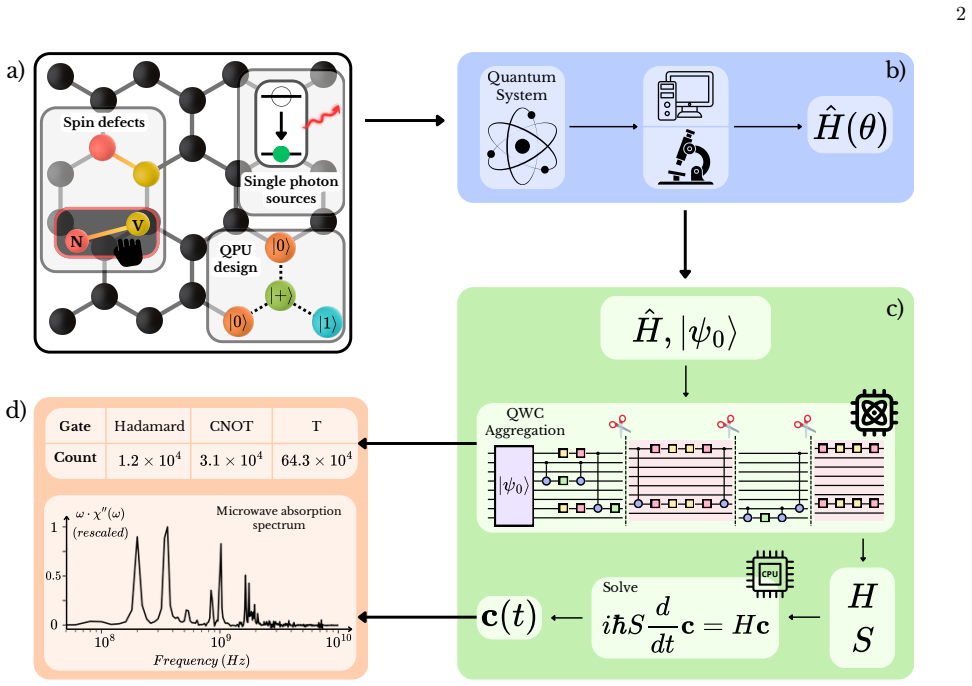
On its own terms, the paper establishes that a hybrid quantum-classical workflow based on sQKFF, QWC aggregation, and Gray-encoded qudit-to-qubit mapping can reproduce the dynamics of nitrogen-vacancy spin ensembles with enough accuracy for operational use. For three NV-center configurations, the sQKFF approximation agrees with classical simulation for autocorrelation functions over tens of nanoseconds, resolves the significant peaks of the microwave absorption spectrum, and tracks the l1-norm of coherence of the electronic-spin subsystem. The paper further shows that increasing the number of reference states improves both accuracy and accessible timescale more reliably than lowering the Tro
What carries the argument
The central mechanism is the multi-reference selected Quantum Krylov Fast-Forwarding (sQKFF) algorithm, which approximates the time-evolved state as a superposition of reference states e^{-imτH}|r⟩, turning the Schrödinger equation into a small linear system whose overlap and Hamiltonian matrices have Toeplitz structure. Gray encoding maps each d-level spin to ⌈log2 d⌉ qubits, and qubit-wise commuting (QWC) aggregation groups Pauli terms into sets shareable under single-qubit rotations, so Trotter exponentials reuse circuit pieces and cancel adjacent adjoints. The Krylov step τ is constrained by the Hamiltonian's 1-norm, and the matrix elements are estimated with Hadamard tests, while the cl
Load-bearing premise
The decisive simplification is that the phonon environment is a single bosonic mode with frequency 5.8 GHz, coupling 1.78 GHz, and a dimension-8 bath prepared in an arbitrary product state; if this does not capture the real NV decoherence, the simulated spectra and coherence times will not carry over to actual devices.
What would settle it
Compute the framework's microwave absorption spectrum and coherence decay for a single NV center under the paper's chosen parameters and compare them to electron-spin-resonance or ODMR measurements at 2 mT; disagreement in resonance positions or T1/T2 beyond the reported Trotter/Krylov error would falsify the single-mode bath assumption. Alternatively, run the algorithm (R=15, εT=0.01922) on the three-NV configuration and check whether the autocorrelation error remains below ~0.01 beyond 5 ns, which would test the reference-state-selection finding.
If this is right
- If the framework holds, quantum computers can compute spin-defect sensor and register observables—coherence functions, absorption spectra, coherence norms—at timescales up to 100 ns, which is the range where dephasing and relaxation set in.
- The 18–30% reductions in gate count and circuit depth make Trotterized evolution shallower, a concrete step toward running these simulations on NISQ processors without error correction.
- Because coherence of the spin subsystem is computable from the already-solved Krylov coefficients, effective T1 and T2 times can be extracted with negligible additional quantum cost.
- The same pipeline transfers to other spin-defect platforms (e.g., h-BN or SiC defects) by substituting Hamiltonian parameters, giving a general quantum-computer-aided design loop.
- Reference-state selection becomes a tunable resource-quality knob, so improving selection criteria could extend accurate simulation further without extra Trotter steps.
Where Pith is reading between the lines
- Extending the naive single-mode bath to a multi-mode phonon spectral density calibrated to experiment would likely change the predicted spectra; testing this is a direct next step the paper leaves open.
- The Krylov-subspace trick for l1-norm coherence should generalize to other subsystem resource measures, such as entanglement negativity or mutual information, making it cheap to scan many time points.
- Shot overhead is the main practical bottleneck; pairing sQKFF with amplitude-estimation Hadamard tests could convert the current O(1/ε²) sampling cost to O(1/ε), at the price of deeper circuits.
- A natural falsification test is to run the exact same Hamiltonian parameters on a real NV ensemble and compare the predicted ODMR line positions with measured ones; systematic offsets would pinpoint where the single-mode bath fails.
Editorial analysis
A structured set of objections, weighed in public.
Referee Report
Summary. The paper proposes a hybrid quantum-classical framework for simulating electron-spin-resonance Hamiltonians of solid-state spin defects on NISQ hardware. It combines Gray-encoded qudit-to-qubit mapping, qubit-wise commuting (QWC) aggregation, and the multi-reference selected quantum Krylov fast-forwarding (sQKFF) algorithm. Three NV-center configurations are studied, with numerical simulations of autocorrelation functions, microwave absorption spectra, and the ℓ1-norm of coherence, benchmarked against QuTiP. The authors report 18–30% reductions in gate counts and circuit depth from QWC aggregation and identify reference-state selection as the primary accuracy factor.
Significance. The combination of previously known techniques into an ESR-specific workflow and its validation on multipartite NV-center models is a useful contribution. The independent QuTiP benchmark for Configurations 1 and 3 is a genuine strength, as is the explicit resource accounting. However, the model uses an uncalibrated single-mode phonon bath and pure-state response functions; the results therefore support a proof-of-principle rather than the stronger claim of device-relevant predictions under experimentally realistic conditions.
major comments (3)
- [§II.A, Eq. (3), Table I] Eq. (3) introduces a spin-boson bath with a single mode at ω=5.8 GHz and coupling λ=1.78 GHz (λ/ω≈0.31), truncated to dimension 8, with the arbitrary initial bath state Ry(π/2)⊗Ry(π/4)⊗Ry(π/8)|000⟩. These values are not derived from any measured phonon spectral density or NV spectroscopy; room-temperature NV decoherence is typically dominated by the 13C nuclear spin bath and a broad phonon spectrum. Since all computed observables—autocorrelation, absorption spectra, and coherence decay—depend on this bath, the abstract and Section V claim of 'experimentally realistic conditions' is unsupported. The demonstration should be reframed as a model-system validation, or the bath should be calibrated to experimental data (e.g., a measured spectral density).
- [§II.D, Eq. (9)] The text states that linear response applies when the system is initially in a stationary state, typically thermal equilibrium, but Eq. (9) evaluates the retarded commutator in an arbitrary pure state |ψ0⟩. This is a zero-temperature/coherent-state response, not the equilibrium absorption spectrum. The resulting spectrum is state-dependent; without a thermal-state calculation (or an explicit statement that the pure-state response is intended) the 'microwave absorption spectra' claim is not physically grounded for ODMR-type measurements.
- [§III, Fig. 6] Fig. 6 shows that the autocorrelation function agrees with QuTiP up to ~100 ns for Configurations 1 and 3, but for Configuration 2 the agreement breaks down at ~5 ns. The abstract's blanket statement that the framework computes autocorrelation functions 'up to ∼100 ns' is therefore overstated. Please qualify the claim to the configurations for which it is demonstrated, or provide additional analysis explaining why Configuration 2 fails.
minor comments (6)
- [§III heading] The section heading contains a typo: 'RESUL TS,' should be 'RESULTS'.
- [Fig. 5] The caption and y-axis label use C^Q_ℓ1 for both QuTiP and sQKFF curves; the sQKFF quantity should be denoted C^K_ℓ1 (as in the text).
- [§II.E, Eq. (15)] The claim that ℓ1-norm coherence can be computed efficiently should be stated more carefully: Eq. (15) still contains a sum over the environment basis Γ, whose size is generally exponential in the number of environment qubits. The efficiency argument relies on the reference states being classically tractable or the environment being small.
- [Table II] The resource reductions are reported for the Hadamard-test circuit, not the full sQKFF pipeline. The abstract's phrase 'Trotterized time-evolution circuits' should be aligned with the actual scope of the metric to avoid overgeneralization.
- [Reproducibility] No code or data repository is provided. For a computational methods paper, releasing the PennyLane/QuTiP scripts or the generated data for the three configurations would substantially strengthen reproducibility.
- [References] Ref. [43] is a URL without complete bibliographic information; please format it consistently with the other references.
Circularity Check
No significant circularity: the derivation is self-contained and benchmarked against an independent classical solver.
full rationale
The paper's central derivation chain is not circular. The ESR Hamiltonian (Eqs. 1-4) is defined from standard spin-defect physics; the Gray encoding, QWC partitioning, and sQKFF algorithm are applied as methods, not fitted to the target observables. The computed autocorrelation functions, microwave absorption spectra, and ℓ1-norm coherence are benchmarked against QuTiP, an independent classical solver, with no parameter of sQKFF optimized against those reference results. The claimed 18-30% resource reductions are obtained by counting gates and depths before and after QWC aggregation, a direct algebraic improvement rather than a fitted prediction. Self-citations ([9,10,31,32,48]) appear only as background or methodological references and are not load-bearing for the numerical claims. The skeptic's concern about the hand-picked single-mode bath parameters (Table I) affects the model's external validity, not circularity, since those parameters are inputs rather than outputs of the derivation. No step reduces to its own assumptions by construction.
Axiom & Free-Parameter Ledger
free parameters (5)
- Phonon mode frequency ω =
5.8 GHz
- Spin-boson coupling λ =
1.78 GHz
- Boson bath dimension =
8
- Initial bath state rotation angles =
π/2, π/4, π/8 (Ry rotations)
- sQKFF hyperparameters =
M=10, τ=πħ/(10||H||_1), R=5/10/15, Trotter steps 9/19/42
axioms (5)
- domain assumption The ESR Hamiltonian (Eqs. 1–4) accurately describes NV-center spin ensembles.
- ad hoc to paper A single phonon mode with S_x coupling captures electron-phonon decoherence in NV centers.
- domain assumption QuTiP ODE solutions (tolerances 1e-5/1e-6) are sufficiently accurate reference for benchmarking sQKFF.
- standard math The sQKFF algorithm from Cortés et al. [41] is correct and its τ bound applies.
- standard math Gray-encoded qudit-to-qubit mapping and QWC aggregation preserve the physics of the original Hamiltonian.
read the original abstract
Interacting spin systems in solids underpin a wide range of quantum technologies, from quantum sensors and single-photon sources to spin-defect-based quantum registers and processors. We develop a quantum-computer-aided framework for simulating such devices using a general many-body electron-spin-resonance Hamiltonian that incorporates zero-field splitting, the Zeeman effect, hyperfine interactions, dipole-dipole spin-spin interactions, and electron-phonon decoherence. Within this framework, we combine Gray-encoded qudit-to-qubit mappings, qubit-wise commuting aggregation, and a multi-reference selected quantum Krylov fast-forwarding hybrid algorithm, aiming to access extended-time dynamics within the constraints of NISQ and early fault-tolerant hardware. Numerical simulations demonstrate the computation of operationally useful quantities including autocorrelation functions up to $\sim100$ ns, together with microwave absorption spectra and the $\ell_1$-norm of coherence, achieving 18-30$\%$ reductions in gate counts and circuit depth for Trotterized time-evolution circuits compared to unoptimized implementations. Using the nitrogen vacancy center in diamond as a testbed, we benchmark the framework against classical simulations and identify the reference-state selection in sQKFF as the primary factor governing accuracy at fixed hardware cost. This methodology provides a flexible blueprint for using quantum computers to design, compare, and optimize solid-state spin-qubit technologies under experimentally realistic conditions.
Figures


Forward citations
Cited by 3 Pith papers
-
Efficient Quantum Circuits for Coherent Conversion Between General First- and Second-Quantized Many-Body Representations
Constructs an explicit unitary Q using the quantum Schur transform to coherently map fixed-N first-quantized states to occupation-number form with poly(N,d,log(1/ε)) gate complexity.
-
Real-time Krylov Diagonalisation for Open Quantum Systems
Real-time Krylov subspace methods are extended to Lindblad open quantum systems and demonstrated on a Kerr resonator for estimating the Liouvillian gap in cat qubit regimes.
-
Real-time Krylov Diagonalisation for Open Quantum Systems
Real-time Krylov subspace methods are adapted to Lindblad open systems and used to extract the Liouvillian gap of a two-photon-driven Kerr resonator in the cat-qubit regime.
Reference graph
Works this paper leans on
-
[1]
M. Maciaszek and B. Baur, Cbvb-nh complexes as preva- lent defects in metal-organic vapor-phase epitaxy-grown hexagonal boron nitride (2025), arXiv:2510.14012 [cond- mat.mtrl-sci]
Pith/arXiv arXiv 2025
-
[2]
T. Vogl, V. Iv´ ady, I. J. Luxmoore, and H. L. Stern, De- fects in hexagonal boron nitride for quantum technologies (2025), arXiv:2510.04344 [cond-mat.mes-hall]
arXiv 2025
-
[3]
O. Rubinas, M. Petrov, E. Bourgeois, J. Hruby, M. Nes- ladek,et al., Electrical readout of spin environments in diamond for quantum sensing (2025), arXiv:2509.26570 [quant-ph]
arXiv 2025
-
[4]
S. G. Carter, I. Tathfif, C. Burgess, B. VanMil, S. De- bata, and P. Dev, The influence of nitrogen doping and annealing on the silicon vacancy in 4h-sic (2025), arXiv:2506.17478 [cond-mat.other]
Pith/arXiv arXiv 2025
-
[5]
J. F. Barry, J. M. Schloss, E. Bauch, M. J. Turner, R. L. Walsworth,et al., Sensitivity optimiza- tion for NV-diamond magnetometry, Rev. Mod. Phys.92, 10.1103/RevModPhys.92.015004 (2020), arXiv:1903.08176
Pith/arXiv arXiv 2020
-
[6]
Owing to the larger system size, the set of measured bitstrings from the statee −i(M−1)τ ˆH |ψ(t= 0)⟩with the highest probabilities, from which the reference states are selected, contains a substantially greater number of ele- ments. As a result, information about the system dynam- ics becomes more sparsely distributed across the possible states, making i...
-
[7]
Rodiek, M
B. Rodiek, M. Lopez, H. Hofer, G. Porrovecchio, M. Smid, S. Kuck,et al., Experimental realization of an absolute single-photon source based on a single nitrogen vacancy center in a nanodiamond, Optica4, 71 (2017)
2017
-
[8]
H. Park, J. Lee, S. Han, S. Oh, and H. Seo, Decoherence of nitrogen-vacancy spin ensembles in a nitrogen electron- nuclear spin bath in diamond, npj Quantum Inf.8, 1 (2022)
2022
-
[9]
Suter and F
D. Suter and F. Jelezko, Single-spin magnetic resonance in the nitrogen-vacancy center of diamond, Prog. Nucl. Magn. Reson. Spectrosc.98-99, 50 (2017)
2017
-
[10]
T. H. Kyaw, T. Menke, S. Sim, A. Anand, N. P. D. Sawaya, A. Aspuru-Guzik,et al., Quantum Computer- Aided Design: Digital Quantum Simulation of Quantum Processors, Phys. Rev. Appl.16, 044042 (2021)
2021
-
[11]
J. S. Kottmann, M. Krenn, T. H. Kyaw, S. Alperin-Lea, and A. Aspuru-Guzik, Quantum computer-aided design of quantum optics hardware, Quantum Sci. Technol.6, 035010 (2021)
2021
-
[12]
Georgescu, S
I. Georgescu, S. Ashhab, and F. Nori, Quantum simula- tion, Rev. Mod. Phys.86, 153–185 (2014)
2014
-
[13]
W. Li, Z. Yin, X. Li, D. Ma, S. Yi, S. Zhang,et al., A hy- brid quantum computing pipeline for real world drug dis- covery, Sci. Rep.14, 10.1038/s41598-024-67897-8 (2024)
-
[14]
Santagati, A
R. Santagati, A. Aspuru-Guzik, R. Babbush, M. De- groote, L. Gonz´ alez, C. Utschig-Utschig,et al., Drug design on quantum computers, Nat. Phys.20, 549–557 (2024)
2024
-
[15]
M. V. Jabir, N. F. R. Annafianto, I. A. Burenkov, A. Bat- tou, and S. V. Polyakov, Energy and bandwidth effi- ciency optimization of quantum-enabled optical commu- nication channels, npj Quantum Inf.8, 10.1038/s41534- 022-00573-9 (2022)
doi:10.1038/s41534- 2022
-
[16]
Q. Wu, D. Ribezzo, G. Di Sciullo, S. Cocchi, D. Ann Shaji, C. Antonelli,et al., Integration of quan- tum key distribution and high-throughput classical com- munications in field-deployed multi-core fibers, Light Sci. Appl.14, 10.1038/s41377-025-01982-z (2025)
-
[17]
Y. Shao, Y. Gong, X. Wan, X. Huang, T. Zhang,et al., Quantum-enabled topological optimization of distributed energy storage for resilient black-start operations, Sci. Rep.15, 10.1038/s41598-025-02286-3 (2025)
-
[18]
W. Hou, W. Yao, X. Zhao, K. Rehan, J. Du,et al., Com- bining energy efficiency and quantum advantage in cyclic machines, Nat. Commun.16, 10.1038/s41467-025-60179- 5 (2025)
-
[19]
Z. Yin, I. Agresti, G. de Felice, D. Brown, A. Toumi, P. Walther,et al., Experimental quantum-enhanced kernel-based machine learning on a photonic processor, Nat. Photon.19, 1020–1027 (2025)
2025
-
[20]
G. Pallavi, A. Altalbe, and R. P. Kumar, Qkdti a quan- tum kernel based machine learning model for drug target interaction prediction, Sci. Rep.15, 10.1038/s41598-025- 07303-z (2025)
-
[21]
A. Kumar, S. Dhanka, A. Sharma, R. Bansal, M. Aljuaid, et al., A hybrid framework for heart disease predic- tion using classical and quantum-inspired machine learn- ing techniques, Sci. Rep.15, 10.1038/s41598-025-09957-1 (2025)
-
[22]
Foreman, S
C. Foreman, S. Wright, A. Edgington, M. Berta, and F. J. Curchod, Practical randomness amplification and privatisation with implementations on quantum comput- ers, Quantum7, 969 (2023)
2023
- [23]
-
[24]
Preskill, Quantum computing in the NISQ era and beyond, Quantum2, 1 (2018), arXiv:1801.00862
J. Preskill, Quantum computing in the NISQ era and beyond, Quantum2, 1 (2018), arXiv:1801.00862
Pith/arXiv arXiv 2018
-
[25]
A. Katabarwa, K. Gratsea, A. Caesura, and P. D. Johnson, Early fault-tolerant quantum computing, PRX Quantum5, 10.1103/prxquantum.5.020101 (2024)
-
[26]
A. M. Childs, D. Maslov, Y. Nam, N. J. Ross, and Y. Su, Toward the first quantum simulation with quan- tum speedup, Proc. Natl. Acad. Sci. U.S.A.115, 9456 (2018), arXiv:1711.10980
Pith/arXiv arXiv 2018
-
[27]
K. L. Brown, W. J. Munro, and V. M. Kendon, Using Quantum Computers for Quantum Simulation, Entropy 12, 2268 (2010), arXiv:1004.5528
Pith/arXiv arXiv 2010
-
[28]
Google Quantum AI and Collaborators, Observation of constructive interference at the edge of quantum ergod- icity, Nature646, 825 (2025)
2025
- [29]
-
[30]
T. E. O’Brien, W. D. Oliver, A. Opremcak,et al., Quan- tum computation of molecular structure using data from challenging-to-classically-simulate nuclear magnetic res- onance experiments, PRX Quantum3, 030345 (2022)
2022
-
[31]
Huang, M
B. Huang, M. Govoni, and G. Galli, Simulating the elec- tronic structure of spin defects on quantum computers, PRX Quantum3, 010339 (2022)
2022
-
[32]
J. S. Baker, P. A. M. Casares, M. Shokrian Zini, J. Thik, D. Banerjee, J. M. Arrazola,et al., Simulating optically- active spin defects with a quantum computer, Phys. Rev. A110, 032606 (2024)
2024
-
[33]
P. A. M. Casares, Y. Zhou, U. Azad, S. Fomichev, J. S. Baker, J. M. Arrazola,et al., Quantum algorithms to detect odmr-active defects for quantum sensing applica- tions (2025), arXiv:2508.13281 [quant-ph]
arXiv 2025
-
[34]
Sheng, C
N. Sheng, C. Vorwerk, M. Govoni, and G. Galli, Green’s function formulation of quantum defect embedding the- ory, J. Chem. Theory Comput.18, 3512–3522 (2022)
2022
-
[35]
S. Chen, V. W.-z. Yu, Y. Jin, M. Govoni, and G. Galli, Advances in quantum defect embedding theory, J. Chem. Theory Comput.21, 7797–7812 (2025)
2025
-
[36]
A. M. Childs, Y. Su, M. C. Tran, N. Wiebe, and S. Zhu, Theory of trotter error with commutator scaling, Physi- cal Review X11, 10.1103/physrevx.11.011020 (2021)
-
[37]
S. Gu, R. D. Somma, and B. S ¸ahino˘ glu, Fast-forwarding quantum evolution, Quantum5, 577 (2021)
2021
-
[38]
C. C ˆ ırstoiu, Z. Holmes, J. Iosue, L. Cincio, P. J. Coles, and A. Sornborger, Variational fast forwarding for quan- tum simulation beyond the coherence time, npj Quantum Inf.6, 10.1038/s41534-020-00302-0 (2020)
-
[39]
B. Commeau, M. Cerezo, Z. Holmes, L. Cincio, P. J. Coles, and A. Sornborger, Variational hamiltonian di- agonalization for dynamical quantum simulation (2020), arXiv:2009.02559 [quant-ph]
Pith/arXiv arXiv 2020
- [40]
-
[41]
T. Ko, S. Choi, H. Park, and X. Li, Classical optimiza- tion algorithms for diagonalizing quantum hamiltonians (2025), arXiv:2506.17883 [quant-ph]
Pith/arXiv arXiv 2025
-
[42]
C. L. Cortes, A. E. DePrince, and S. K. Gray, Fast- forwarding quantum simulation with real-time quan- tum krylov subspace algorithms, Phys. Rev. A106, 10.1103/physreva.106.042409 (2022)
-
[43]
V. Verteletskyi, T.-C. Yen, and A. F. Izmaylov, Mea- surement optimization in the variational quantum eigen- solver using a minimum clique cover, J. Chem. Phys.152, 10.1063/1.5141458 (2020)
-
[44]
Izaac, Measurement optimization,https: //pennylane.ai/qml/demos/tutorial_measurement_ optimize(2021), date Accessed: 2026-01-27
J. Izaac, Measurement optimization,https: //pennylane.ai/qml/demos/tutorial_measurement_ optimize(2021), date Accessed: 2026-01-27
2021
- [45]
-
[46]
G. X. Wang, Y. K. Wu, R. Yao, W. Q. Lian, Z. J. Cheng, L. M. Duan,et al., Simulating the spin-boson model with a controllable reservoir in an ion trap (2024), arXiv:2402.07461 [quant-ph]
Pith/arXiv arXiv 2024
-
[47]
S. Felton, A. M. Edmonds, M. E. Newton, P. M. Mar- tineau, D. Fisher, and D. J. Twitchen, Electron paramag- netic resonance studies of the neutral nitrogen vacancy in diamond, Phys. Rev. B77, 10.1103/physrevb.77.081201 (2008)
-
[48]
M. Steiner, P. Neumann, J. Beck, F. Jelezko, and J. Wrachtrup, Universal enhancement of the optical read- out fidelity of single electron spins at nitrogen-vacancy centers in diamond, Phys. Rev. B81, 10.1103/phys- revb.81.035205 (2010)
doi:10.1103/phys- 2010
-
[49]
N. P. D. Sawaya, T. Menke, T. H. Kyaw, S. Johri, A. Aspuru-Guzik, and G. G. Guerreschi, Resource- efficient digital quantum simulation of d-level systems for photonic, vibrational, and spin-s hamiltonians, npj Quantum Inf.6, 10.1038/s41534-020-0278-0 (2020)
-
[50]
C. L. Cortes and S. K. Gray, Quantum krylov subspace algorithms for ground- and excited-state energy estima- tion, Phys. Rev. A105, 10.1103/physreva.105.022417 (2022)
-
[51]
N. Lambert, E. Gigu` ere, P. Menczel, B. Li, P. Hopf, F. Nori,et al., Qutip 5: The quantum toolbox in python (2025), arXiv:2412.04705 [quant-ph]
Pith/arXiv arXiv 2025
-
[52]
H.-H. Fang, X.-J. Wang, X. Marie, and H.-B. Sun, Quan- tum sensing with optically accessible spin defects in van der waals layered materials, Light Sci. Appl.13, 10.1038/s41377-024-01630-y (2024)
-
[53]
J. J. Morton and P. Bertet, Storing quantum information in spins and high-sensitivity esr, J. Magn. Reson.287, 128–139 (2018)
2018
- [54]
- [55]
-
[56]
M. F. F. Chowdhury, A. Jung, L. L. Spina, A. Bartasyte, S. Margueron, and J. Atulasimha, Energy efficient coher- ent quantum control of nitrogen vacancy (nv) spin with nanoscale magnets (2024), arXiv:2407.14018
Pith/arXiv arXiv 2024
-
[57]
Streltsov, G
A. Streltsov, G. Adesso, and M. B. Plenio, Colloquium: Quantum coherence as a resource, Rev. Mod. Phys.89, 041003 (2017)
2017
-
[58]
Aberg, Quantifying superposition (2006), arXiv:quant- ph/0612146 [quant-ph]
J. Aberg, Quantifying superposition (2006), arXiv:quant- ph/0612146 [quant-ph]
arXiv 2006
-
[59]
Baumgratz, M
T. Baumgratz, M. Cramer, and M. B. Plenio, Quantify- ing coherence, Phys. Rev. Lett.113, 140401 (2014)
2014
-
[60]
X. Yuan, H. Zhou, Z. Cao, and X. Ma, Intrinsic random- ness as a measure of quantum coherence, Phys. Rev. A 92, 022124 (2015)
2015
-
[61]
Albrecht, A
A. Albrecht, A. Retzker, F. Jelezko, and M. B. Plenio, Coupling of nitrogen vacancy centres in nanodiamonds by means of phonons, New J. Phys.15, 083014 (2013)
2013
-
[62]
Winter and D
A. Winter and D. Yang, Operational resource theory of coherence, Phys. Rev. Lett.116, 120404 (2016)
2016
-
[63]
Chitambar and G
E. Chitambar and G. Gour, Comparison of incoherent operations and measures of coherence, Phys. Rev. A94, 052336 (2016)
2016
-
[64]
J. I. de Vicente and A. Streltsov, Genuine quantum co- herence, J. Phys. A: Math. Theory50, 045301 (2016)
2016
-
[65]
Theurer, D
T. Theurer, D. Egloff, L. Zhang, and M. B. Plenio, Quan- tifying operations with an application to coherence, Phys. Rev. Lett.122, 190405 (2019)
2019
-
[66]
Saxena, E
G. Saxena, E. Chitambar, and G. Gour, Dynamical re- source theory of quantum coherence, Phys. Rev. Res.2, 023298 (2020)
2020
-
[67]
M. P. Harrigan, T. Khattar, C. Yuan, A. Peduri, N. C. Rubin,et al., Expressing and analyzing quantum algo- rithms with qualtran (2024), arXiv:2409.04643 [quant- 13 ph]
Pith/arXiv arXiv 2024
-
[68]
Crawford, B
O. Crawford, B. v. Straaten, D. Wang, T. Parks, E. Campbell, and S. Brierley, Efficient quantum measure- ment of pauli operators in the presence of finite sampling error, Quantum5, 385 (2021)
2021
-
[69]
T.-C. Yen and A. F. Izmaylov, Cartan subalgebra ap- proach to efficient measurements of quantum observables, PRX Quantum2, 10.1103/prxquantum.2.040320 (2021)
-
[70]
Brierley, Efficient implementation of quantum circuits with limited qubit interactions, Quantum Inf
S. Brierley, Efficient implementation of quantum circuits with limited qubit interactions, Quantum Inf. Comput 17, 1096–1104 (2017)
2017
-
[71]
Holmes, S
A. Holmes, S. Johri, G. G. Guerreschi, J. S. Clarke, and A. Y. Matsuura, Impact of qubit connectivity on quan- tum algorithm performance, Quantum Sci. Technol.5, 025009 (2020)
2020
-
[72]
Kirby, Analysis of quantum krylov algorithms with errors, Quantum8, 1457 (2024)
W. Kirby, Analysis of quantum krylov algorithms with errors, Quantum8, 1457 (2024)
2024
-
[73]
N. Yoshioka, M. Amico, W. Kirby, P. Jurcevic, A. Dutt, A. Mezzacapo,et al., Krylov diagonalization of large many-body hamiltonians on a quantum processor, Nat. Commun.16, 10.1038/s41467-025-59716-z (2025)
-
[74]
G. Lee, S. Choi, J. Huh, and A. F. Izmaylov, Efficient strategies for reducing sampling error in quantum krylov subspace diagonalization, Digital Discovery4, 954–969 (2025)
2025
- [75]
-
[76]
Bisicchia, G
G. Bisicchia, G. Clemente, J. Garcia-Alonso, J. M. Murillo, M. D’Elia, and A. Brogi, Distributing quantum computations, shot-wise, Future Internet17, 507 (2025)
2025
-
[77]
Barral, F
D. Barral, F. J. Cardama, G. D ´ ıaz-Camacho, D. Fa ´ ılde, I. F. Llovo, A. G´ omez,et al., Review of distributed quantum computing: From single qpu to high per- formance quantum computing, Comput. Sci. Rev.57, 100747 (2025)
2025
-
[78]
G. Brassard, P. Høyer, M. Mosca, and A. Tapp, Quan- tum amplitude amplification and estimation, inQuantum Computation and Information, Contemporary Mathe- matics, Vol. 305, edited by S. J. Lomonaco (Ameri- can Mathematical Society, 2002) pp. 53–74, arXiv:quant- ph/0005055 [quant-ph]
arXiv 2002
-
[79]
V. Bergholm, J. Izaac, M. Schuld, C. Gogolin, S. Ahmed, N. Killoran,et al., Pennylane: Automatic differentia- tion of hybrid quantum-classical computations (2022), arXiv:1811.04968 [quant-ph]
Pith/arXiv arXiv 2022
discussion (0)
Sign in with ORCID, Apple, or X to comment. Anyone can read and Pith papers without signing in.