REVIEW 4 major objections 6 minor 47 references
A two-part memory strategy claims to end the stability-plasticity trade-off in online motion forecasting.
Reviewed by Pith at T0; open to challenge. T0 means a machine referee read the full paper against a public rubric. the ladder, T0–T4 →
SyReM shows that replaying memory samples whose loss gradients resemble the current batch, under a gradient-projection constraint, improves both stability and plasticity in online motion forecasting.
T0 review reviewed 2026-08-05 challenge →
load-bearing objection Plausible combination of GEM-style projection and gradient-similarity replay for motion forecasting; the 'escaping' claim outruns the evidence but the core idea is worth engaging. the 4 major comments →
Escaping Stability-Plasticity Dilemma in Online Continual Learning for Motion Forecasting via Synergetic Memory Rehearsal
The pith
A machine-rendered reading of the paper's core claim, the machinery that carries it, and where it could break.
The reading
Core claim
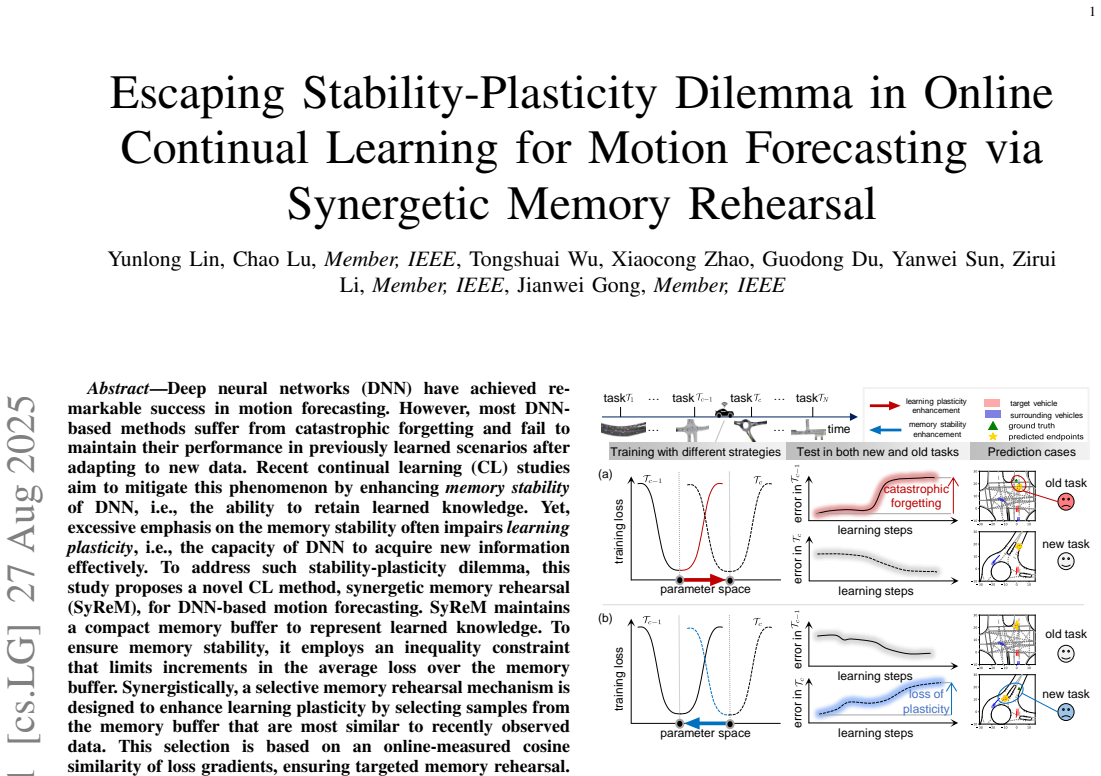
In the one-pass online continual learning setting, SyReM formalizes the goal as minimizing loss on the current task subject to the constraint that the average loss on a memory buffer of past scenarios does not increase. Memory stability comes from a gradient projection rule: when the gradient of the total loss points against the gradient of the buffer loss, the update is projected to the closest gradient satisfying the constraint. Learning plasticity comes from a selective rehearsal mechanism: each step, the method scores candidate memory samples by cosine similarity between their loss gradients and the gradient of the just-observed current batch, then rehearses the top-B samples. Because re
What carries the argument
The central object is a two-part memory buffer: a long-term buffer maintained by reservoir sampling to represent all learned scenarios, and a temporal buffer holding one batch of the most recent samples from the current task. The mechanism that resolves the dilemma is the synergy between two uses of this buffer. The temporal buffer lets the method convert 'similarity to the current task' into a measurable gradient cosine similarity q_k, which selects which long-term samples to rehearse. The long-term buffer also supplies the average-loss gradient g_M used in the inequality constraint. The load-bearing identity is the projected-gradient update: when the inner product of the total-loss gradien
Load-bearing premise
The key assumption is that old examples whose error direction resembles the error direction of the newest examples are the old examples worth replaying; the paper provides one ablation and no proof that this resemblance causes better learning.
What would settle it
Compare, on the same 11-task stream, updates that rehearse the top-B samples selected by gradient cosine similarity against updates that rehearse the bottom-B (least similar) samples. If the top-B advantage over bottom-B in current-task miss rate is not statistically significant, or if the correlation between similarity score and per-sample current-task loss reduction is zero or negative, the selectivity mechanism is not doing the plasticity work claimed.
If this is right
- If the claim holds, motion forecasting models can be updated from a one-pass data stream in the vehicle, without offline multi-epoch retraining on large historical datasets.
- Past-scenario performance is not only preserved but slightly improves (negative backward transfer), meaning knowledge from different driving scenarios accumulates instead of being overwritten.
- Selective rehearsal acts as task-relevant data augmentation, so a small buffer (1,000 cases, 0.47% of the data) suffices to gain plasticity, reducing storage demands.
- Retaining a broad distribution in the buffer improves zero-shot generalization to unseen scenarios, as measured by forward-transfer metrics on the 11 tasks.
- The training-time mechanisms are model-agnostic in design, so the same rehearsal and projection strategy could be applied to other motion forecasting backbones beyond UQnet.
Where Pith is reading between the lines
- An extension the authors do not report: the gradient-cosine selector could be tested against feature-space similarity or uncertainty-based selection to see whether the plasticity gain comes specifically from gradient alignment or from any relevance filter.
- Because the temporal buffer holds only the last observed batch, the selection may be myopic within a long task with drifting conditions; a testable modification is to keep a small queue of recent gradients and average the similarity over it.
- The paper's buffer is 0.47% of the 11-task stream; in much longer streams the reservoir may no longer represent the full distribution, so an open question is how the method scales as the stream grows far beyond the buffer size.
- The negative backward transfer result suggests that some old scenarios actually improve when new scenarios arrive; a natural follow-up is to identify which scenario types benefit from which new tasks, using the similarity scores as labels.
Editorial analysis
A structured set of objections, weighed in public.
Referee Report
Summary. The paper proposes SyReM, an online continual learning method for motion forecasting built on the UQnet trajectory predictor. SyReM maintains a long-term memory buffer updated by reservoir sampling and a temporal buffer of recently observed current-task samples. Memory stability is enforced by a gradient-projection constraint (Section IV-C) that limits increases in the average loss over the long-term buffer. Learning plasticity is addressed by a selective rehearsal mechanism (Section IV-B) that replays the B buffer samples whose loss-gradient cosine similarity to the last observed current-task sample is highest. Experiments on 11 INTERACTION sub-datasets compare SyReM with Vanilla, Vanilla-GP, random-rehearsal SyReM-R, and joint training, using BWT, CT, JT, and FWT metrics. The central claim is that SyReM escapes the stability-plasticity dilemma by simultaneously improving memory stability and learning plasticity.
Significance. If fully supported, the paper would provide a useful demonstration that memory replay can be steered to help, rather than hinder, adaptation to new tasks in online continual learning for motion forecasting. The paper has clear strengths: the gradient-projection derivation in Eqs. (13)-(19) is standard and correct; the problem formulation and metrics (BWT, CT, JT, FWT) are standard and defined independently of the method; the ablation separates selective from random rehearsal; and the implementation is publicly released. However, the empirical support for the central 'escape the dilemma' claim is not yet sufficient. The key plasticity mechanism rests on one unseeded ablation, the paper reports no error bars, multiple seeds, or significance tests, and a single fixed task order is used. The stated contribution is therefore conditional on substantially stronger evidence.
major comments (4)
- [Section V-C, Tables II-III, Fig. 12] The headline comparisons are reported without any measure of variability. No number of seeds, error bars, or significance tests are given, and only one task order is used. This matters because many of the per-task differences that carry the plasticity claim are very small or in the wrong direction. In Table III, SyReM has larger FDE-CT than Vanilla at T1-T2, T1-T3, T1-T7, and T1-T9, and equal or larger MR-CT at T1-T2, T1-T4, T1-T8, and T1-T10. The averaged plots in Fig. 8 and Fig. 12 cannot establish a systematic improvement without variance information. Please report multiple seeds, ideally with permuted task orders, and provide mean +/- std with pairwise significance tests for BWT and CT.
- [Section IV-B, Eq. (9), Section V-C4] The selective rehearsal mechanism is the only component that distinguishes SyReM from a gradient-projection-plus-random-replay method, yet its plasticity benefit is supported by a single unseeded comparison (SyReM vs. SyReM-R in Fig. 12). The paper assumes that a larger cosine similarity between a memory sample's loss gradient and the current sample's loss gradient identifies memory samples whose rehearsal improves adaptation to the current task. No theoretical justification or alternative ablation (e.g., selecting least-similar samples, similarity computed on batch gradients, or random selection controlled for buffer overlap) is provided. Given that SyReM's per-task CT results are not consistently better than Vanilla, the reported 26% averaged MR-CT improvement is not sufficient to establish that similarity-based selection is the actual driver of the plasticity gain.
- [Algorithm 1, Section IV-B] There is a mismatch between the described temporal buffer and the algorithm. Algorithm 1 updates Mtmp with a single sample (X,Y)_k at lines 4 and 8, while the text and Fig. 2 describe using one batch of samples observed at the last learning step. Equation (9) then computes gc from the gradient of the 'lastly observed sample.' If Mtmp is truly a single sample, the selection signal is a single-sample, high-dimensional gradient cosine, which is likely to be dominated by noise and shared low-level features rather than task-relevant transfer. This is a load-bearing detail: the selectivity claim depends on the quality of gc. The pseudocode, text, and experiments should be made consistent, and the choice should be justified either by analysis or by ablations comparing single-sample and batch-gradient similarity.
- [Section V-C, Fig. 8, Fig. 12] The claim that SyReM 'escapes' the dilemma is stated in absolute terms, but the evidence shows a quantitative improvement on two scalar metrics, not the absence of a trade-off. For example, SyReM improves average MR-BWT over Vanilla-GP while also improving average MR-CT, but Table III shows several task groups where CT is not improved and Table II shows several groups where BWT is positive. The conclusion should be calibrated to the measured effect sizes and the uncertainty in them. If the authors wish to retain the word 'escapes,' they need a crisper operational definition of the dilemma and statistical evidence that both objectives are improved across the distribution of task orders and seeds.
minor comments (6)
- [Table I] Typo: 'Roudabout' should be 'Roundabout' in the T5 row.
- [Section V-C2] Typo: 'Vaniall' should be 'Vanilla' in the paragraph describing Fig. 10.
- [Eq. (6)] The notation r ~ Uniform(1, k) should specify a discrete uniform distribution over {1,...,k}; as written it is ambiguous.
- [Eq. (8)] The inner-product constraint should state explicitly that both gradients are evaluated at the current parameter vector theta before the update; otherwise the inequality is underspecified.
- [Eq. (9)] Typo: 'between between' should be 'between'.
- [Figures 8 and 10] The figure text contains embedded glyph artifacts (e.g., strings beginning with '/uni00000039 /uni00000044...') in axis labels and legends. These should be repaired before publication.
Circularity Check
No significant circularity: evaluations use external benchmarks and independent metrics; selective rehearsal is an empirical mechanism, not a tautology.
full rationale
The paper's central derivation chain is self-contained. The memory buffer uses reservoir sampling (Algorithm 1), an external standard method, and the gradient projection constraint in Eq. (19) is the exact KKT solution to Eq. (13); neither step encodes the evaluation metrics. Memory stability is measured by backward transfer (BWT, Eq. 23) and plasticity by current-task error (CT, Eq. 24), both defined on held-out test sets that are independent of the method's internal buffer and rehearsal selection. The selective rehearsal heuristic in Eq. (9)-(10) is an empirical design choice: the claim that gradient-similar memory samples improve plasticity is tested by the SyReM vs. SyReM-R ablation (Fig. 12), not assumed by construction. The cosine-similarity score does not contain or predict BWT/CT by definition. Self-citations in the manuscript ([15], [19], [22]) appear only as background and motivation for online continual learning in motion forecasting; no load-bearing uniqueness theorem or ansatz is imported from them. The absence of error bars and the single task order in the ablation are statistical-evidence concerns, not circularity. Therefore no circular step can be identified from the paper's equations or citations.
Axiom & Free-Parameter Ledger
free parameters (5)
- Memory buffer size |M| =
1000
- Training batch size B =
8
- Rehearsal candidate count M =
16 (2B)
- Learning rate =
1e-3
- Loss combination weight for rehearsal loss =
1.0 (equal weight)
axioms (5)
- standard math Reservoir sampling yields a uniform random subsample of a stream of unknown length.
- domain assumption The inner-product constraint (8) is a valid first-order condition for non-increase of the buffer loss.
- domain assumption Gradient cosine similarity between a memory sample and the current batch indicates usefulness for learning the current task.
- domain assumption Data within each task is i.i.d. from a task-specific distribution.
- standard math The KKT conditions and L2 projection solution (equations 13 to 18) are valid.
Cite this review
Pith. "Pith review of Escaping Stability-Plasticity Dilemma in Online Continual Learning for Motion Forecasting via Synergetic Memory Rehearsal." pith.science (2026). https://pith.science/paper/RSPYP75Y
@misc{pith2026250819571,
  author       = {Pith},
  title        = {Pith review of: Escaping Stability-Plasticity Dilemma in Online Continual Learning for Motion Forecasting via Synergetic Memory Rehearsal},
  year         = {2026},
  howpublished = {\url{https://pith.science/paper/RSPYP75Y}},
  note         = {Machine review of arXiv:2508.19571}
}
read the original abstract
Deep neural networks (DNN) have achieved remarkable success in motion forecasting. However, most DNN-based methods suffer from catastrophic forgetting and fail to maintain their performance in previously learned scenarios after adapting to new data. Recent continual learning (CL) studies aim to mitigate this phenomenon by enhancing memory stability of DNN, i.e., the ability to retain learned knowledge. Yet, excessive emphasis on the memory stability often impairs learning plasticity, i.e., the capacity of DNN to acquire new information effectively. To address such stability-plasticity dilemma, this study proposes a novel CL method, synergetic memory rehearsal (SyReM), for DNN-based motion forecasting. SyReM maintains a compact memory buffer to represent learned knowledge. To ensure memory stability, it employs an inequality constraint that limits increments in the average loss over the memory buffer. Synergistically, a selective memory rehearsal mechanism is designed to enhance learning plasticity by selecting samples from the memory buffer that are most similar to recently observed data. This selection is based on an online-measured cosine similarity of loss gradients, ensuring targeted memory rehearsal. Since replayed samples originate from learned scenarios, this memory rehearsal mechanism avoids compromising memory stability. We validate SyReM under an online CL paradigm where training samples from diverse scenarios arrive as a one-pass stream. Experiments on 11 naturalistic driving datasets from INTERACTION demonstrate that, compared to non-CL and CL baselines, SyReM significantly mitigates catastrophic forgetting in past scenarios while improving forecasting accuracy in new ones. The implementation is publicly available at https://github.com/BIT-Jack/SyReM.
Figures


Reference graph
Works this paper leans on
-
[1]
R. Li, S. Katsigiannis, T.-K. Kim, and H. P. H. Shum, “Bp-sgcn: Behavioral pseudo-label informed sparse graph convolution network for pedestrian and heterogeneous trajectory prediction,” IEEE Transactions on Neural Networks and Learning Systems , pp. 1–15, 2025
work page 2025
-
[2]
Hybrid- prediction integrated planning for autonomous driving,
H. Liu, Z. Huang, W. Huang, H. Yang, X. Mo, and C. Lv, “Hybrid- prediction integrated planning for autonomous driving,” IEEE Transac- tions on Pattern Analysis and Machine Intelligence , vol. 47, no. 4, pp. 2597–2614, 2025
work page 2025
-
[3]
Biological underpinnings for lifelong learning machines,
D. Kudithipudi, M. Aguilar-Simon, J. Babb, M. Bazhenov, D. Black- iston, J. Bongard, A. P. Brna, S. Chakravarthi Raja, N. Cheney, J. Clune et al., “Biological underpinnings for lifelong learning machines,” Nature Machine Intelligence, vol. 4, no. 3, pp. 196–210, 2022
work page 2022
-
[4]
R. Korbmacher and A. Tordeux, “Review of pedestrian trajectory prediction methods: Comparing deep learning and knowledge-based approaches,” IEEE Transactions on Intelligent Transportation Systems , vol. 23, no. 12, pp. 24 126–24 144, 2022
work page 2022
-
[5]
Deep learning-based vehicle behavior prediction for autonomous driving applications: A review,
S. Mozaffari, O. Y . Al-Jarrah, M. Dianati, P. Jennings, and A. Mouza- kitis, “Deep learning-based vehicle behavior prediction for autonomous driving applications: A review,” IEEE Transactions on Intelligent Trans- portation Systems , vol. 23, no. 1, pp. 33–47, 2022
work page 2022
-
[6]
Z. Li, C. Gong, Y . Lin, G. Li, X. Wang, C. Lu, M. Wang, S. Chen, and J. Gong, “Continual driver behaviour learning for connected vehicles and intelligent transportation systems: Framework, survey and challenges,” Green Energy and Intelligent Transportation , p. 100103, 2023
work page 2023
-
[7]
Catastrophic interference in connec- tionist networks: The sequential learning problem,
M. McCloskey and N. J. Cohen, “Catastrophic interference in connec- tionist networks: The sequential learning problem,” in Psychology of learning and motivation . Elsevier, 1989, vol. 24, pp. 109–165
1989
-
[8]
A comprehensive survey of forgetting in deep learning beyond continual learning,
Z. Wang, E. Yang, L. Shen, and H. Huang, “A comprehensive survey of forgetting in deep learning beyond continual learning,” IEEE Transac- tions on Pattern Analysis and Machine Intelligence , vol. 47, no. 3, pp. 1464–1483, 2025
work page 2025
-
[9]
Incorporating neuro-inspired adaptability for continual learning in artificial intelligence,
L. Wang, X. Zhang, Q. Li, M. Zhang, H. Su, J. Zhu, and Y . Zhong, “Incorporating neuro-inspired adaptability for continual learning in artificial intelligence,” Nature Machine Intelligence , vol. 5, no. 12, pp. 1356–1368, 2023
work page 2023
-
[10]
T. Lesort, V . Lomonaco, A. Stoian, D. Maltoni, D. Filliat, and N. D ´ıaz- Rodr´ıguez, “Continual learning for robotics: Definition, framework, learning strategies, opportunities and challenges,” Information fusion , vol. 58, pp. 52–68, 2020
work page 2020
-
[11]
A. Lu, H. Yuan, T. Feng, and Y . Sun, “Rethinking the stability-plasticity trade-off in continual learning from an architectural perspective,” in F orty-second International Conference on Machine Learning , 2025
work page 2025
-
[12]
Understanding plasticity in neural networks,
C. Lyle, Z. Zheng, E. Nikishin, B. A. Pires, R. Pascanu, and W. Dabney, “Understanding plasticity in neural networks,” in International Confer- ence on Machine Learning . PMLR, 2023, pp. 23 190–23 211
work page 2023
-
[13]
A comprehensive survey of continual learning: Theory, method and application,
L. Wang, X. Zhang, H. Su, and J. Zhu, “A comprehensive survey of continual learning: Theory, method and application,” IEEE Transactions on Pattern Analysis and Machine Intelligence , vol. 46, no. 8, pp. 5362– 5383, 2024
work page 2024
-
[14]
Continual multi-agent interaction behavior prediction with conditional generative memory,
H. Ma, Y . Sun, J. Li, M. Tomizuka, and C. Choi, “Continual multi-agent interaction behavior prediction with conditional generative memory,” IEEE Robotics and Automation Letters , vol. 6, no. 4, pp. 8410–8417, 2021
work page 2021
-
[15]
Y . Lin, Z. Li, C. Gong, C. Lu, X. Wang, and J. Gong, “Continual interactive behavior learning with traffic divergence measurement: A dynamic gradient scenario memory approach,” IEEE Transactions on Intelligent Transportation Systems, vol. 25, no. 3, pp. 2355–2372, 2024
work page 2024
-
[16]
Continual pedestrian trajectory learning with social generative replay,
Y . Wu, A. Bighashdel, G. Chen, G. Dubbelman, and P. Jancura, “Continual pedestrian trajectory learning with social generative replay,” IEEE Robotics and Automation Letters , vol. 8, no. 2, pp. 848–855, 2022
work page 2022
-
[17]
Im- proving pedestrian prediction models with self-supervised continual learning,
L. Knoedler, C. Salmi, H. Zhu, B. Brito, and J. Alonso-Mora, “Im- proving pedestrian prediction models with self-supervised continual learning,” IEEE Robotics and Automation Letters , vol. 7, no. 2, pp. 4781–4788, 2022
work page 2022
-
[18]
Lifelong vehicle trajectory prediction framework based on generative replay,
P. Bao, Z. Chen, J. Wang, D. Dai, and H. Zhao, “Lifelong vehicle trajectory prediction framework based on generative replay,” IEEE Transactions on Intelligent Transportation Systems , vol. 24, no. 12, pp. 13 729–13 741, 2023
work page 2023
-
[19]
Y . Lin, Z. Li, G. Du, X. Zhao, C. Gong, X. Wang, C. Lu, and J. Gong, “H2c: Hippocampal circuit-inspired continual learning for lifelong trajectory prediction in autonomous driving,” arXiv preprint arXiv:2508.01158, 2025
work page internal anchor Pith review Pith/arXiv arXiv 2025
-
[20]
Online active continual learning for robotic lifelong object recognition,
X. Nie, Z. Deng, M. He, M. Fan, and Z. Tang, “Online active continual learning for robotic lifelong object recognition,” IEEE Transactions on Neural Networks and Learning Systems , vol. 35, no. 12, pp. 17 790– 17 804, 2024
work page 2024
-
[21]
Online multi-agent forecasting with interpretable collaborative graph neural net- works,
M. Li, S. Chen, Y . Shen, G. Liu, I. W. Tsang, and Y . Zhang, “Online multi-agent forecasting with interpretable collaborative graph neural net- works,” IEEE Transactions on Neural Networks and Learning Systems , vol. 35, no. 4, pp. 4768–4782, 2024
work page 2024
-
[22]
Y . Lin, Z. Li, C. Gong, Q. Liu, C. Lu, and J. Gong, “Rethinking trajec- tory prediction in real-world applications: An online task-free continual learning perspective,” in 2023 IEEE 26th International Conference on Intelligent Transportation Systems (ITSC). IEEE, 2023, pp. 5020–5026
work page 2023
-
[23]
Loss of plasticity in deep continual learning,
S. Dohare, J. F. Hernandez-Garcia, Q. Lan, P. Rahman, A. R. Mahmood, and R. S. Sutton, “Loss of plasticity in deep continual learning,” Nature, vol. 632, no. 8026, pp. 768–774, 2024
work page 2024
-
[24]
Poppl: Pedestrian trajectory prediction by lstm with automatic route class clustering,
H. Xue, D. Q. Huynh, and M. Reynolds, “Poppl: Pedestrian trajectory prediction by lstm with automatic route class clustering,” IEEE Trans- 15 actions on Neural Networks and Learning Systems , vol. 32, no. 1, pp. 77–90, 2021
work page 2021
-
[25]
Social gan: Socially acceptable trajectories with generative adversarial networks,
A. Gupta, J. Johnson, L. Fei-Fei, S. Savarese, and A. Alahi, “Social gan: Socially acceptable trajectories with generative adversarial networks,” in Proceedings of the IEEE Conference on Computer Vision and Pattern Recognition, 2018, pp. 2255–2264
work page 2018
-
[26]
R. Li, S. Katsigiannis, T.-K. Kim, and H. P. H. Shum, “Bp-sgcn: Behavioral pseudo-label informed sparse graph convolution network for pedestrian and heterogeneous trajectory prediction,” IEEE Transactions on Neural Networks and Learning Systems , vol. 36, no. 8, pp. 14 566– 14 580, 2025
work page 2025
-
[27]
Conditional goal-oriented trajectory prediction for interacting vehicles,
D. Li, Q. Zhang, S. Lu, Y . Pan, and D. Zhao, “Conditional goal-oriented trajectory prediction for interacting vehicles,” IEEE Transactions on Neural Networks and Learning Systems , vol. 35, no. 12, pp. 18 758– 18 770, 2024
work page 2024
-
[28]
Stglow: A flow-based generative framework with dual-graphormer for pedestrian trajectory prediction,
R. Liang, Y . Li, J. Zhou, and X. Li, “Stglow: A flow-based generative framework with dual-graphormer for pedestrian trajectory prediction,” IEEE Transactions on Neural Networks and Learning Systems , vol. 35, no. 11, pp. 16 504–16 517, 2024
work page 2024
-
[29]
Unravelling uncertainty in trajectory prediction using a non-parametric approach,
G. Li, Z. Li, V . L. Knoop, and H. van Lint, “Unravelling uncertainty in trajectory prediction using a non-parametric approach,” Transportation Research Part C: Emerging Technologies , vol. 163, p. 104659, 2024
work page 2024
-
[30]
C. L. P. Chen and Z. Liu, “Broad learning system: An effective and efficient incremental learning system without the need for deep architecture,” IEEE Transactions on Neural Networks and Learning Systems, vol. 29, no. 1, pp. 10–24, 2018
work page 2018
-
[31]
Rotate your networks: Better weight consolidation and less catastrophic forgetting,
X. Liu, M. Masana, L. Herranz, J. Van de Weijer, A. M. L ´opez, and A. D. Bagdanov, “Rotate your networks: Better weight consolidation and less catastrophic forgetting,” in 2018 24th International Conference on Pattern Recognition (ICPR) , 2018, pp. 2262–2268
work page 2018
-
[32]
F. Feng, L. Hou, Q. She, R. H. M. Chan, and J. T. Kwok, “Power law in deep neural networks: Sparse network generation and continual learning with preferential attachment,” IEEE Transactions on Neural Networks and Learning Systems , vol. 35, no. 7, pp. 8999–9013, 2024
work page 2024
-
[33]
Triple- memory networks: A brain-inspired method for continual learning,
L. Wang, B. Lei, Q. Li, H. Su, J. Zhu, and Y . Zhong, “Triple- memory networks: A brain-inspired method for continual learning,” IEEE Transactions on Neural Networks and Learning Systems , vol. 33, no. 5, pp. 1925–1934, 2022
work page 1925
-
[34]
Hpcr: Holistic proxy-based contrastive replay for online continual learning,
H. Lin, S. Feng, B. Zhang, X. Li, and Y . Ye, “Hpcr: Holistic proxy-based contrastive replay for online continual learning,” IEEE Transactions on Neural Networks and Learning Systems , vol. 36, no. 8, pp. 14 706– 14 720, 2025
work page 2025
-
[35]
Incremental concept learning via online generative memory recall,
H. Li, W. Dong, and B.-G. Hu, “Incremental concept learning via online generative memory recall,” IEEE Transactions on Neural Networks and Learning Systems , vol. 32, no. 7, pp. 3206–3216, 2021
work page 2021
-
[36]
Trcla: A transfer learning approach to reduce negative transfer for cellular learn- ing automata,
S. A. H. Minoofam, A. Bastanfard, and M. R. Keyvanpour, “Trcla: A transfer learning approach to reduce negative transfer for cellular learn- ing automata,” IEEE Transactions on Neural Networks and Learning Systems, vol. 34, no. 5, pp. 2480–2489, 2023
work page 2023
-
[37]
Meta-learning-based deep reinforcement learning for multiobjective optimization problems,
Z. Zhang, Z. Wu, H. Zhang, and J. Wang, “Meta-learning-based deep reinforcement learning for multiobjective optimization problems,” IEEE Transactions on Neural Networks and Learning Systems , vol. 34, no. 10, pp. 7978–7991, 2023
work page 2023
-
[38]
Transfer learning for driver model adaptation in lane-changing scenarios using manifold alignment,
C. Lu, F. Hu, D. Cao, J. Gong, Y . Xing, and Z. Li, “Transfer learning for driver model adaptation in lane-changing scenarios using manifold alignment,” IEEE transactions on intelligent transportation systems , vol. 21, no. 8, pp. 3281–3293, 2019
work page 2019
-
[39]
Rc-tl: Reinforcement convolutional transfer learning for large-scale trajectory prediction,
N. Emami, L. Pacheco, A. Di Maio, and T. Braun, “Rc-tl: Reinforcement convolutional transfer learning for large-scale trajectory prediction,” in NOMS 2022-2022 IEEE/IFIP Network Operations and Management Symposium. IEEE, 2022, pp. 1–9
work page 2022
-
[40]
Meta-learning in neural networks: A survey,
T. Hospedales, A. Antoniou, P. Micaelli, and A. Storkey, “Meta-learning in neural networks: A survey,” IEEE Transactions on Pattern Analysis and Machine Intelligence , vol. 44, no. 9, pp. 5149–5169, 2022
work page 2022
-
[41]
Random sampling with a reservoir,
J. S. Vitter, “Random sampling with a reservoir,” ACM Transactions on Mathematical Software (TOMS) , vol. 11, no. 1, pp. 37–57, 1985
work page 1985
-
[42]
Gradient episodic memory for continual learning,
D. Lopez-Paz and M. Ranzato, “Gradient episodic memory for continual learning,” Advances in neural information processing systems , vol. 30, 2017
2017
-
[43]
W. Zhan, L. Sun, D. Wang, H. Shi, A. Clausse, M. Naumann, J. Kum- merle, H. Konigshof, C. Stiller, A. de La Fortelle et al. , “Interaction dataset: An international, adversarial and cooperative motion dataset in interactive driving scenarios with semantic maps,” arXiv preprint arXiv:1910.03088, 2019
Pith/arXiv arXiv 1910
-
[44]
Densetnt: End-to-end trajectory prediction from dense goal sets,
J. Gu, C. Sun, and H. Zhao, “Densetnt: End-to-end trajectory prediction from dense goal sets,” in Proceedings of the IEEE/CVF International Conference on Computer Vision , 2021, pp. 15 303–15 312
work page 2021
-
[45]
Focal loss for dense object detection,
T.-Y . Lin, P. Goyal, R. Girshick, K. He, and P. Doll ´ar, “Focal loss for dense object detection,” IEEE Transactions on Pattern Analysis and Machine Intelligence, vol. 42, no. 2, pp. 318–327, 2020
work page 2020
-
[46]
Adam: A method for stochastic optimization,
D. P. Kingma and J. Ba, “Adam: A method for stochastic optimization,” arXiv preprint arXiv:1412.6980 , 2014
Pith/arXiv arXiv 2014
-
[47]
On the stability-plasticity dilemma of class- incremental learning,
D. Kim and B. Han, “On the stability-plasticity dilemma of class- incremental learning,” in Proceedings of the IEEE/CVF Conference on Computer Vision and Pattern Recognition , 2023, pp. 20 196–20 204
work page 2023
This paper was first reviewed by deepseek-v4-flash on August 5, 2026.
discussion (0)
Sign in with ORCID, Apple, or X to comment. Anyone can read and Pith papers without signing in.