REVIEW 4 major objections 5 minor 145 references
Infrared foundations for quantum geometry II: Catalogue of all torsion-like theories including new ghost-tachyon-free cases
T0 review · 4 major / 5 minor · reviewed 2026-08-06 · deepseek-v4-flash
Pith's one-line read Systematically classifying all parity-conserving quadratic theories of a pair-antisymmetric rank-three field, the paper finds that every ghost- and tachyon-free gauge-symmetric model propagates vector torsion, and none propagates scalar…
desk verdict A genuinely systematic catalogue of pair-antisymmetric rank-three theories; the 22 assessed unitary models all propagate vectors, but the abstract overstates the no-scalar conclusion and the artifacts are missing. read the letter →
The pith
A machine-rendered reading of the paper's core claim, the machinery that carries it, and where it could break.
The reading
What carries the argument
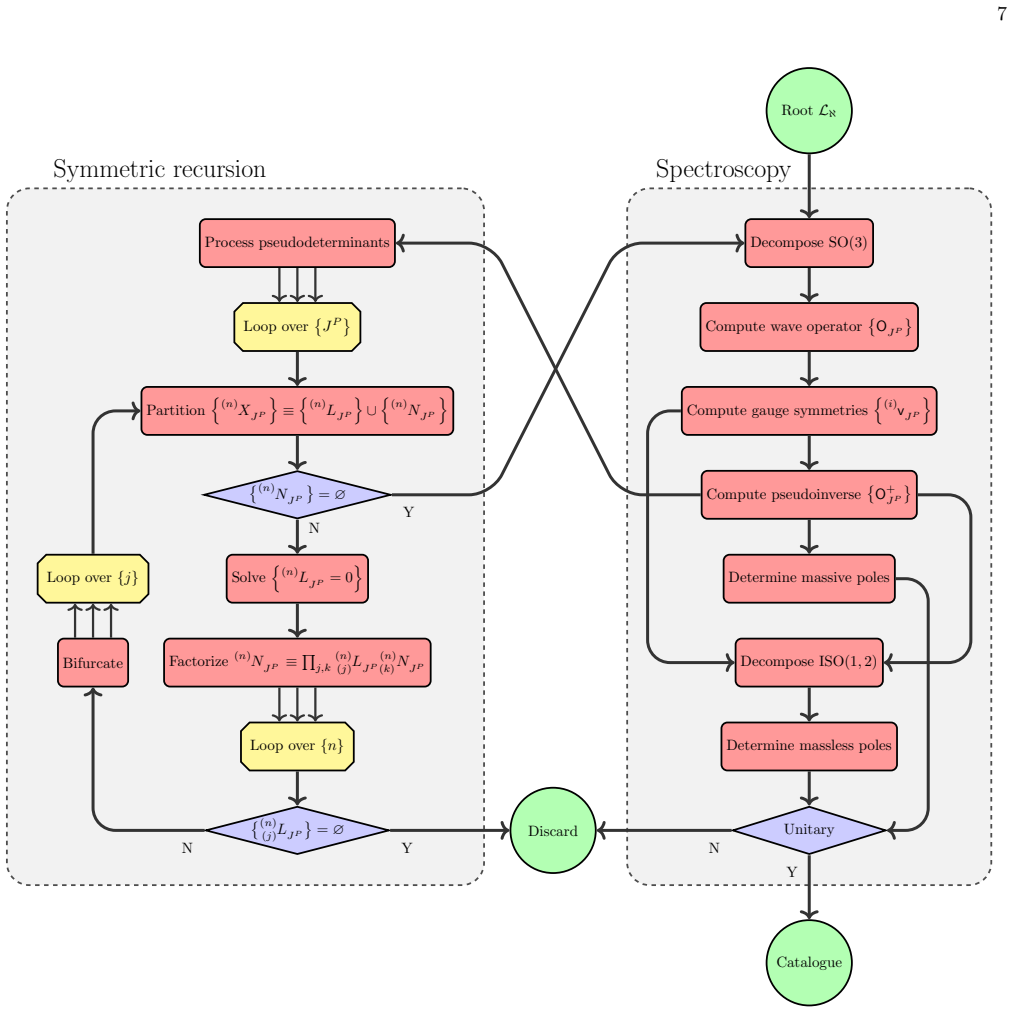
The central object is the pair-antisymmetric rank-three tensor $K_{\alpha\beta\gamma}$, the infrared avatar of spacetime torsion when the metric perturbation is switched off. The argument runs through the saturated propagator built from the wave operator of the general Lagrangian: poles give masses, residues give unitarity, and gauge symmetries are identified as null vectors of the wave operator. The algorithmic search works with the pseudodeterminant of a regularised wave operator, whose vanishing encodes a new gauge symmetry, and recursively solves the resulting algebraic constraints on the couplings to produce the full hierarchy of models. The spin-parity decomposition of the field into $0^{\pm}$, $1^{\pm}$ and $2^{\pm}$ sectors is what makes the final statement precise: the conflicting no-ghost and no-tachyon conditions in the $0^{\pm}$ and $2^{\pm}$ sectors doom the unconstrained theory, and no symmetric, unitary sub-model retains those sectors.
What would settle it
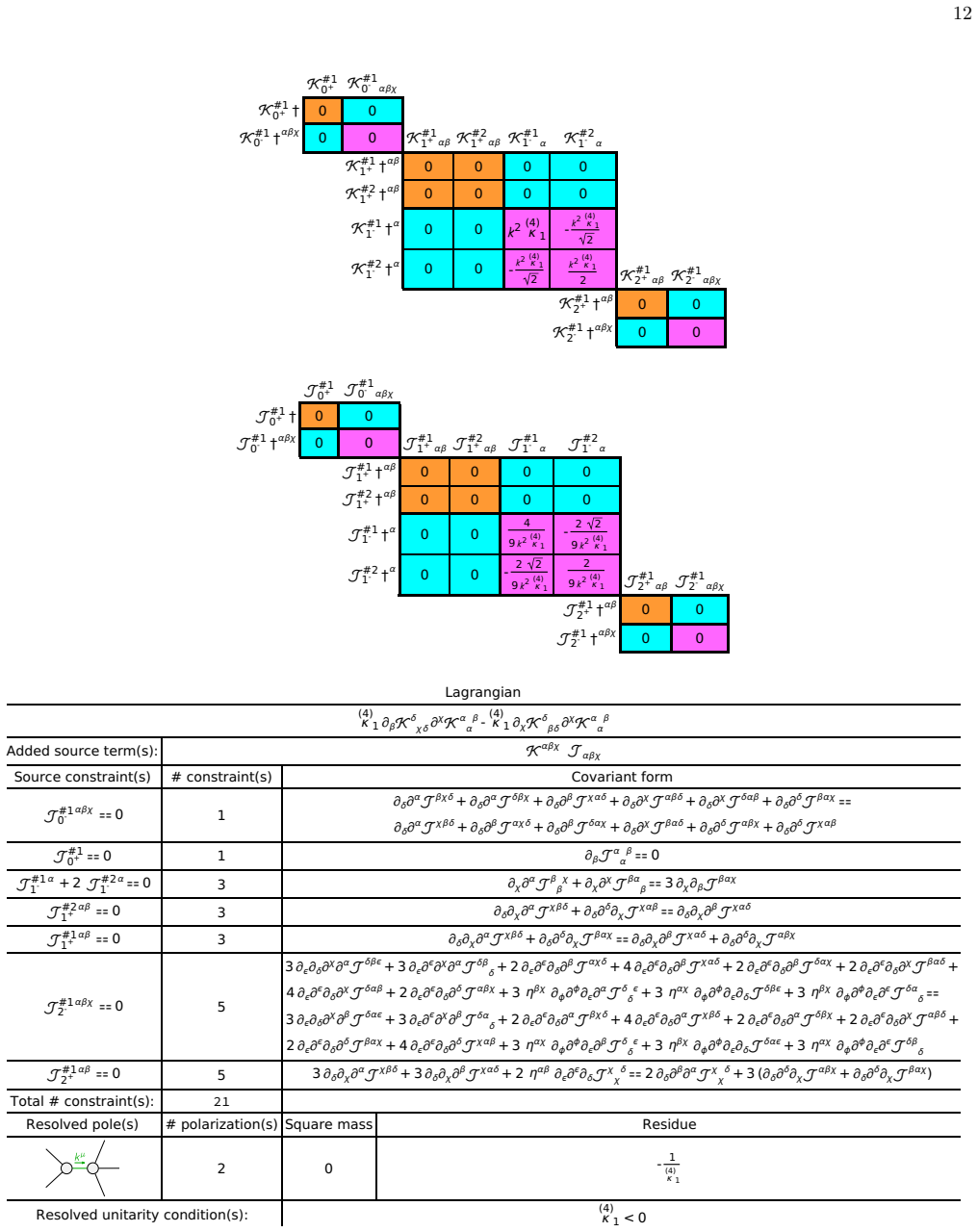
Run a computer-algebra search over the full 12-coupling space of Eq. (6) for any point that satisfies the linear gauge-symmetry constraints of the catalogue and has a real positive-residue pole in the $0^{+}$ or $0^{-}$ block (or a $2^{\pm}$ block) while all other sectors are healthy; the existence of even one such point would overturn the paper's central outcome. A simpler decisive check is to resolve the unitarity inequalities for the 22 identified unitary models and confirm that each has at least one propagating spin-one sector and no healthy scalar or spin-two sector.
Extended reading notes
Core claim
Starting from the most general parity-conserving quadratic Lagrangian for a pair-antisymmetric rank-three field in flat space, the authors impose, one by one, the linear constraints that correspond to exact gauge symmetries and generate a hierarchy of 206 distinct models. They fully assess unitarity for 22 of these models, and the result is uniform: all 22 are ghost- and tachyon-free, and all propagate only spin-one modes. In the authors' words, within this subset they find no symmetry that can support the tuning necessary for propagating spin-zero or spin-two torsion. The simplest unitary cases are a polar-vector model, an axial-vector model, and a two-vector model with decoupled polar and axial sectors. The paper argues that previous scalar- and pseudoscalar-torsion constructions relied on special non-linear completions and coupling tuning that is not stable under radiative corrections.
Load-bearing premise
The torsion interpretation rests on the claim from the preceding paper [1] that every perturbative propagating torsion has, in the infrared, exactly the flat-space quadratic Lagrangian of Eq. (6), with the metric perturbation and all metric-torsion couplings dropped; if that universal limit misses infrared-relevant couplings, the catalogue is not actually the infrared foundation of torsion.
Editorial extensions
If this is right
- If the catalogue is right, any parity-conserving, gauge-symmetric, ghost- and tachyon-free quadratic IR theory of torsion propagates at least one vector mode and never a scalar or spin-two torsion mode.
- The models named K2, K3 and J12 are the simplest concrete starting points: one polar vector, one axial vector, and a decoupled pair of vectors, respectively.
- The full 206-model hierarchy applies beyond torsion, so dual-graviton, Lanczos-potential, string-theory and higher-spin constructions using this field now have a complete reference map of their IR foundations.
- The 22 unitary models are the candidates to embed into non-linear completions; the needed next step is a consistent deformation analysis of each model.
- Because a small number of catalogue entries resisted automated unitarity analysis, the tally of 22 is a lower bound, but the paper argues the missing cases are unlikely to change the vector-only conclusion.
Reading between the lines
- A natural extension is to repeat the classification with parity-violating operators added; if scalar or pseudoscalar modes reappear there, the vector-only claim is specific to parity conservation rather than to torsion itself.
- The absence of spin-two torsion fits the four-dimensional Curtright/dual-graviton expectation that the Weyl-like curvature of this field vanishes, suggesting that spin-two torsion would have to come from curvature-type couplings or non-linear effects outside the flat-space quadratic starting point.
- The paper's own EFT logic predicts that selected unitary models should remain ghost- and tachyon-free under radiative corrections; computing one-loop corrections for K2 or J12 would test that prediction directly.
- If a non-linear completion of torsion reintroduces IR-relevant metric-torsion couplings, the catalogue still stands as a classification of rank-three pair-antisymmetric field theories, so the dual-graviton and higher-spin applications would survive even if the torsion interpretation did not.
Editorial analysis
A structured set of objections, weighed in public.
Referee Report
Summary. This paper presents a systematic scan of all parity-conserving quadratic Lagrangians for a pair-antisymmetric rank-three field on Minkowski space, starting from the 12-operator basis in Eq. (6) and using the PSALTer algorithm to find enhanced gauge symmetries. The authors catalogue 206 models, identify 22 for which unitarity is assessed, and report that all 22 propagate only spin-one modes, with no scalar, pseudoscalar, or spin-two propagating modes. They interpret this as strong evidence against scalar/pseudoscalar torsion and in favour of vector torsion, challenging the consensus that only spin-zero torsion can be consistent.
Significance. If the central no-go statement can be upheld for the full catalogue, this is a valuable and non-circular structural result: it would show that within a defined space of quadratic, symmetric, parity-conserving IR theories of a pair-antisymmetric rank-three field, unitary propagation selects vector torsion, and it would provide a useful catalogue for dual-graviton and higher-spin model building. The strengths are the explicit operator basis, the use of machine-checked spectrographs for representative models, the algorithmic symmetry-search method, and the candid admission of computational limitations. The result is not circular, as the no-go is a computed consequence of the constraint equations rather than an input assumption. However, the headline claims currently outrun the evidence: the no-scalar/no-pseudoscalar and vector-only statements are established only for 22 of 206 models, with 22 further models unresolved and parametric branches not counted.
major comments (4)
- [Abstract; Section III, 'Science products'; 'Further work'; Footnote 11] The abstract states without qualification that 'None of the models we obtain propagate scalar or pseudoscalar torsion' and that 'all models propagate one or more vector torsion modes', but the body restricts the no-scalar/no-pseudoscalar statement to the 'sub-set of 22 models for which the unitarity is assessed' (Section III). The Further Work section concedes that 22 additional models resisted automatic unitarity analysis (footnote 11), while Section II postpones consideration of inherently non-linear 'parametric' models. As written, the abstract is not supported: a unitary scalar, pseudoscalar, or spin-two model among the timeout or parametric branches would falsify it. Please either qualify the abstract and all summary statements to the 22 assessed models, or extend the unitarity and helicity analysis to cover the remaining catalogue entries.
- [Section II, 'Symmetries and constraints'; Section III, 'Scale of catalogue'] The claim that the paper 'systematically derive[s] all' parity-conserving models and that Fig. 5 and Table II 'exhaustively catalogue' the IR foundations is contradicted by the same sections' statement that irreducible non-linear constraint branches are 'quarantined' and that 'we postpone even the counting of inherently non-linear or "parametric" models'. Thus the catalogue is exhaustive only within the linear-constraint branch. The scope restriction should be stated in the abstract and in the statements of exhaustiveness; otherwise the 'no symmetry can support scalar or spin-two torsion' conclusion is not a universal no-go for the theory space defined by Eq. (6).
- [Section II, 'Massless helicity'; Section III list of 22 models] The vector-only claim for 19 of the 22 unitary models depends on a manual helicity-identification step whose outputs are not shown. The paper states that PSALTer does not resolve helicity and that 'we have performed the analysis manually to verify our claims'. For a result whose headline is that all unitary models propagate vectors, the underlying helicity assignments for the non-displayed models need to be reported, for example as supplementary tables or by making the analysis code public, or the vector-only claim should be explicitly marked as provisional for those models. The three displayed spectrographs (K2, K3, J12) are consistent with the claim, but they are only three of twenty-two.
- [Section I, 'General Lagrangian'] The paper's title and interpretation depend on the assertion from reference [1] that Eq. (6) is the universal IR limit of propagating perturbative torsion with the metric perturbation set to flat space and metric-torsion couplings discarded. This assertion is not derived in the present work. If a consistent nonlinear completion contains IR-relevant operators outside Eq. (6), the catalogue would not be the infrared foundation of torsion. Please clarify the logical status of this step and whether the conclusion is conditional on the prequel's derivation.
minor comments (5)
- [Figure 7 caption] The caption says 'As with K2 in Fig. 7', but the K2 spectrograph is Fig. 6; this should be corrected.
- [Footnote 11] The numerical coincidence between the 22 confirmed unitary models and the 22 treatment-resistant models is described as 'Somewhat confusingly'; please make explicit that there is no known physical connection, and consider listing the model names for the timeout set for transparency.
- [Abstract] The phrase 'all linear, parity-conserving models' is ambiguous: it could mean models linear in the fields, models defined by linear constraints, or models linear in the couplings. Please define this term in the introduction or abstract.
- [Section III, 'Minimal spin one'] The statement that J14 'adds a decoupled and non-propagating scalar sector' can be misread as contradicting the 'no scalar torsion' claim, since the no-scalar claim concerns propagating scalars; consider clarifying 'non-propagating scalar sector'.
- [Figure 5] The vertex labels in the graph are very small in the printed version; an electronic version with mouse-over definitions or a separate table of model names would improve usability.
Circularity Check
No circular derivation: the vector-only torsion conclusion is a computed consequence of Eq. (6) and the symmetry-search algorithm, not an input; the IR-limit premise cited from [1] is a self-citation with independent content.
full rationale
The derivation chain is self-contained: starting from the declared general quadratic Lagrangian Lℵ in Eq. (6), the PSALTer algorithm computes wave-operator blocks, solves the constraint system {X(n)=0} for additional gauge symmetries, and then extracts pole content and unitarity conditions; the vector-only and no-scalar/pseudoscalar conclusions for the 22 fully assessed unitary models are computed outputs of that pipeline, not assumptions fed into it (the root theory ℵ explicitly has resolved 0+, 0−, 2+ and 2− poles, so the absence of these sectors in the unitary sub-catalogue is a non-trivial result). The one potentially load-bearing external input is the identification of Eq. (6) as the universal IR limit of propagating torsion, which is imported from the authors' own prequel [1]; but that cited claim is parameter-free, its stated assumptions (propagating, perturbative, parity-conserving, flat-space IR) do not contain the target no-scalar/no-spin-two conclusion, and the catalogue stands as a classification of the pair-antisymmetric rank-three field independent of the torsion interpretation. The paper itself flags the real limitations—unitarity assessed for 22 of 206 models, 22 treatment-resistant timeouts, and postponed parametric branches—but these are completeness and correctness concerns, not circular reasoning.
Assumptions & free parameters
assumptions (6)
- domain assumption Eq. (6) is the complete universal infrared limit of perturbative propagating torsion in flat space, inherited from [1].
- domain assumption The 12-operator basis in Eq. (6) exhausts all parity-conserving quadratic terms up to boundary terms and total derivatives.
- domain assumption Gauge symmetry, rather than fine-tuned couplings, is the correct principle for defining radiatively stable effective field theories.
- standard math Standard polology is valid: real poles give particle masses, positive residues exclude ghosts, and light-like frame analysis gives massless helicity content.
- ad hoc to paper Models defined by linear constraints are robust, while irreducible non-linear 'parametric' models can be quarantined.
- domain assumption The PSALTer software correctly computes wave operator blocks, pseudodeterminants, and pole spectra.
Cite this review
Pith. "Pith review of Infrared foundations for quantum geometry II: Catalogue of all torsion-like theories including new ghost-tachyon-free cases." pith.science (2026). https://pith.science/paper/RTO5QX7M
@misc{pith2026250705349,
  author       = {Pith},
  title        = {Pith review of: Infrared foundations for quantum geometry II: Catalogue of all torsion-like theories including new ghost-tachyon-free cases},
  year         = {2026},
  howpublished = {\url{https://pith.science/paper/RTO5QX7M}},
  note         = {Machine review of arXiv:2507.05349}
}
read the original abstract
The construction of consistent effective field theories in the infrared demands that models be defined by their underlying gauge symmetries, rather than by an arbitrary tuning of couplings or a cherry-picking of operators which may not be stable against radiative corrections. Adhering to this principle, we systematically derive all linear, parity-conserving models that propagate a pair-antisymmetric rank-three field on a Minkowski background. Such models are relevant not only to torsion, but to many areas in high-energy physics ranging from dual graviton formulations to string theory and higher-spin theories. Following this exhaustive classification, we extract several unitary models. In the context of torsion, the results are remarkable. None of the models we obtain propagate scalar or pseudoscalar torsion, in stark contrast to the literature focus. Instead, all models propagate one or more vector torsion modes.
Figures


Figures from the paper (5 more)



Reference graph
Works this paper leans on
-
[50]
G. K. Karananas, M. Shaposhnikov, A. Shkerin, and S. Zell, Matter matters in Einstein-Cartan gravity, Phys. Rev. D 104, 064036 (2021), arXiv:2106.13811 [hep-th]
arXiv 2021
-
[51]
C. Rigouzzo and S. Zell, Coupling metric-affine gravity to the standard model and dark matter fermions, Phys. Rev. D 108, 124067 (2023), arXiv:2306.13134 [gr-qc]
arXiv 2023
-
[52]
F. Bauer and D. A. Demir, Inflation with Non-Minimal Coupling: Metric versus Palatini Formulations, Phys. Lett. B 665, 222 (2008), arXiv:0803.2664 [hep-ph]
arXiv 2008
-
[53]
N. J. Poplawski, Matter-antimatter asymmetry and dark matter from torsion, Phys. Rev. D 83, 084033 (2011), arXiv:1101.4012 [gr-qc]
arXiv 2011
-
[54]
D. Diakonov, A. G. Tumanov, and A. A. Vladimirov, Low-energy General Relativity with torsion: A Sys- tematic derivative expansion, Phys. Rev. D 84, 124042 (2011), arXiv:1104.2432 [hep-th]
arXiv 2011
-
[55]
I. B. Khriplovich, Gravitational four-fermion interaction on the Planck scale, Phys. Lett. B 709, 111 (2012), arXiv:1201.4226 [gr-qc]
arXiv 2012
-
[56]
J. a. Magueijo, T. G. Zlosnik, and T. W. B. Kibble, Cosmology with a spin, Phys. Rev. D87, 063504 (2013), arXiv:1212.0585 [astro-ph.CO]
arXiv 2013
-
[57]
I. B. Khriplovich and A. S. Rudenko, Gravitational four- fermion interaction and dynamics of the early Universe, JHEP 11, 174, arXiv:1303.1348 [astro-ph.CO]
Show all 145 references
-
[58]
Markkanen, T
T. Markkanen, T. Tenkanen, V. Vaskonen, and H. Veerm¨ ae, Quantum corrections to quartic inflation with a non-minimal coupling: metric vs. Palatini, JCAP 03, 029, arXiv:1712.04874 [gr-qc]
-
[59]
Carrilho, D
P. Carrilho, D. Mulryne, J. Ronayne, and T. Tenkanen, Attractor Behaviour in Multifield Inflation, JCAP 06, 032, arXiv:1804.10489 [astro-ph.CO]
-
[60]
Enckell, K
V.-M. Enckell, K. Enqvist, S. Rasanen, and L.-P. Wahlman, Inflation with R2 term in the Palatini for- malism, JCAP 02, 022, arXiv:1810.05536 [gr-qc]
-
[61]
Rasanen and E
S. Rasanen and E. Tomberg, Planck scale black hole dark matter from Higgs inflation, JCAP 01, 038, arXiv:1810.12608 [astro-ph.CO]
-
[63]
Rubio and E
J. Rubio and E. S. Tomberg, Preheating in Palatini Higgs inflation, JCAP 04, 021, arXiv:1902.10148 [hep- ph]
1902 arXiv
-
[64]
Shaposhnikov, A
M. Shaposhnikov, A. Shkerin, and S. Zell, Standard Model Meets Gravity: Electroweak Symmetry Break- ing and Inflation, Phys. Rev. D 103, 033006 (2021), arXiv:2001.09088 [hep-th]
2021 arXiv
-
[65]
G. K. Karananas, M. Michel, and J. Rubio, One residue to rule them all: Electroweak symmetry breaking, infla- tion and field-space geometry, Phys. Lett. B811, 135876 (2020), arXiv:2006.11290 [hep-th]
2020 arXiv
-
[66]
L ˚ angvik, J.-M
M. L ˚ angvik, J.-M. Ojanper¨ a, S. Raatikainen, and S. Rasanen, Higgs inflation with the Holst and the Nieh–Yan term, Phys. Rev. D 103, 083514 (2021), arXiv:2007.12595 [astro-ph.CO]
2021 arXiv
-
[67]
Shaposhnikov, A
M. Shaposhnikov, A. Shkerin, I. Timiryasov, and S. Zell, Higgs inflation in Einstein-Cartan gravity, JCAP 02, 008, [Erratum: JCAP 10, E01 (2021)], arXiv:2007.14978 [hep-ph]
2021 arXiv
-
[68]
Mikura, Y
Y. Mikura, Y. Tada, and S. Yokoyama, Conformal in- flation in the metric-affine geometry, EPL 132, 39001 (2020), arXiv:2008.00628 [hep-th]
2020 arXiv
-
[69]
Shaposhnikov, A
M. Shaposhnikov, A. Shkerin, I. Timiryasov, and S. Zell, Einstein-Cartan Portal to Dark Matter, Phys. Rev. Lett. 126, 161301 (2021), [Erratum: Phys.Rev.Lett. 127, 169901 (2021)], arXiv:2008.11686 [hep-ph]
2021 arXiv
-
[70]
Kubota, K.-Y
M. Kubota, K.-Y. Oda, K. Shimada, and M. Yam- aguchi, Cosmological Perturbations in Palatini Formal- ism, JCAP 03, 006, arXiv:2010.07867 [hep-th]. 16 0+ #10-#1 αβχ 0+ #1† 0 0 0-#1 †αβχ 0 0 1+ #1 αβ1+ #2 αβ1-#1 α 1-#2 α 1+ #1 †αβ -2 κ (4) 3-2 κ (4) 3 2 0 0 1+ #2†αβ ...
2010 arXiv
-
[71]
Enckell, S
V.-M. Enckell, S. Nurmi, S. R¨ as¨ anen, and E. Tomberg, Critical point Higgs inflation in the Palatini formula- tion, JHEP 04, 059, arXiv:2012.03660 [astro-ph.CO]
2012 arXiv
-
[72]
Iosifidis and L
D. Iosifidis and L. Ravera, The cosmology of quadratic torsionful gravity, Eur. Phys. J. C 81, 736 (2021), arXiv:2101.10339 [gr-qc]
2021 arXiv
-
[73]
Bombacigno, S
F. Bombacigno, S. Boudet, G. J. Olmo, and G. Mon- tani, Big bounce and future time singularity resolu- tion in Bianchi I cosmologies: The projective invari- ant Nieh-Yan case, Phys. Rev. D 103, 124031 (2021), arXiv:2105.06870 [gr-qc]
2021 arXiv
-
[74]
Racioppi, J
A. Racioppi, J. Rajasalu, and K. Selke, Multiple point criticality principle and Coleman-Weinberg inflation, JHEP 06, 107, arXiv:2109.03238 [astro-ph.CO]
-
[75]
D. Y. Cheong, S. M. Lee, and S. C. Park, Reheating in models with non-minimal coupling in metric and Pala- tini formalisms, JCAP 02 (02), 029, arXiv:2111.00825 [hep-ph]
-
[76]
Dioguardi, A
C. Dioguardi, A. Racioppi, and E. Tomberg, Slow- roll inflation in Palatini F(R) gravity, JHEP 06, 106, arXiv:2112.12149 [gr-qc]
-
[77]
Piani and J
M. Piani and J. Rubio, Higgs-Dilaton inflation in Einstein-Cartan gravity, JCAP 05 (05), 009, arXiv:2202.04665 [gr-qc]
-
[78]
F. Dux, A. Florio, J. Klari´ c, A. Shkerin, and I. Timiryasov, Preheating in Palatini Higgs inflation on the lattice, JCAP 09, 015, arXiv:2203.13286 [hep-ph]
-
[79]
Rigouzzo and S
C. Rigouzzo and S. Zell, Coupling metric-affine gravity to a Higgs-like scalar field, Phys. Rev. D 106, 024015 (2022), arXiv:2204.03003 [hep-th]
2022 arXiv
-
[80]
Pradisi and A
G. Pradisi and A. Salvio, (In)equivalence of metric- affine and metric effective field theories, Eur. Phys. J. C 82, 840 (2022), arXiv:2206.15041 [hep-th]
2022 arXiv
-
[81]
Salvio, Inflating and reheating the Universe with an independent affine connection, Phys
A. Salvio, Inflating and reheating the Universe with an independent affine connection, Phys. Rev. D 106, 103510 (2022), arXiv:2207.08830 [hep-ph]
2022 arXiv
-
[82]
Rasanen and Y
S. Rasanen and Y. Verbin, Palatini formulation for gauge theory: implications for slow-roll inflation, (2022), arXiv:2211.15584 [astro-ph.CO]
2022 arXiv
-
[83]
I. D. Gialamas and K. Tamvakis, Inflation in metric-affine quadratic gravity, JCAP 03, 042, arXiv:2212.09896 [gr-qc]
-
[84]
I. D. Gialamas and H. Veerm¨ ae, Electroweak vacuum decay in metric-affine gravity, Phys. Lett. B844, 138109 (2023), arXiv:2305.07693 [hep-th]
2023 arXiv
-
[85]
I. D. Gialamas, A. Karam, T. D. Pappas, and E. Tomberg, Implications of Palatini gravity for infla- tion and beyond, Int. J. Geom. Meth. Mod. Phys. 20, 2330007 (2023), arXiv:2303.14148 [gr-qc]
2023 arXiv
-
[86]
Piani and J
M. Piani and J. Rubio, Preheating in Einstein-Cartan Higgs Inflation: oscillon formation, JCAP 12, 002, arXiv:2304.13056 [hep-ph]
-
[87]
Poisson, I
A. Poisson, I. Timiryasov, and S. Zell, Critical Points in Palatini Higgs Inflation with Small Non-Minimal Cou- pling, (2023), arXiv:2306.03893 [hep-ph]
2023 arXiv
-
[88]
Barker and S
W. Barker and S. Zell, Einstein-Proca theory from the Einstein-Cartan formulation, Phys. Rev. D 109, 024007 (2024), arXiv:2306.14953 [hep-th]
2024 arXiv
-
[89]
G. K. Karananas, M. Shaposhnikov, and S. Zell, Scale invariant Einstein-Cartan gravity and flat space confor- mal symmetry, JHEP 11, 171, arXiv:2307.11151 [hep- th]
-
[90]
Martini, G
R. Martini, G. Paci, and D. Sauro, Radiative correc- tions to the R and R 2 invariants from torsion fluctua- tions on maximally symmetric spaces, JHEP 12, 138, arXiv:2312.16681 [gr-qc]
-
[91]
M. He, M. Hong, and K. Mukaida, Starobinsky Infla- tion and beyond in Einstein-Cartan Gravity, (2024), arXiv:2402.05358 [gr-qc]
2024 arXiv
-
[92]
Bauer and D
F. Bauer and D. A. Demir, Higgs-Palatini Infla- tion and Unitarity, Phys. Lett. B 698, 425 (2011), arXiv:1012.2900 [hep-ph]
2011 arXiv
-
[93]
Shaposhnikov, A
M. Shaposhnikov, A. Shkerin, and S. Zell, Quantum Effects in Palatini Higgs Inflation, JCAP 07, 064, arXiv:2002.07105 [hep-ph]
2002 arXiv
-
[94]
Hayashi and T
K. Hayashi and T. Nakano, Extended translation invari- ance and associated gauge fields, Prog. Theor. Phys. 38, 491 (1967)
1967
-
[95]
Hayashi and T
K. Hayashi and T. Shirafuji, Gravity From Poincare Gauge Theory of the Fundamental Particles. 4. Mass and Energy of Particle Spectrum, Prog. Theor. Phys. 64, 2222 (1980)
1980
-
[96]
Yo and J
H.-j. Yo and J. M. Nester, Hamiltonian analysis of Poincare gauge theory scalar modes, Int. J. Mod. Phys. D 8, 459 (1999), arXiv:gr-qc/9902032
1999 arXiv
-
[97]
Yo and J
H.-J. Yo and J. M. Nester, Hamiltonian analysis of Poincare gauge theory: Higher spin modes, Int. J. Mod. Phys. D 11, 747 (2002), arXiv:gr-qc/0112030
2002 arXiv
-
[98]
Puetzfeld, Status of non-Riemannian cosmology, New Astron
D. Puetzfeld, Status of non-Riemannian cosmology, New Astron. Rev. 49, 59 (2005), arXiv:gr-qc/0404119
2005 arXiv
-
[99]
Sezgin, Class of Ghost Free Gravity Lagrangians With Massive or Massless Propagating Torsion, Phys
E. Sezgin, Class of Ghost Free Gravity Lagrangians With Massive or Massless Propagating Torsion, Phys. Rev. D 24, 1677 (1981)
1981
-
[100]
Blagojevic and I
M. Blagojevic and I. A. Nikolic, Hamiltonian dynamics of Poincare gauge theory: General structure in the time gauge, Phys. Rev. D 28, 2455 (1983)
1983
-
[101]
Blagojevic and M
M. Blagojevic and M. Vasilic, EXTRA GAUGE SYM- METRIES IN A WEAK FIELD APPROXIMATION OF AN R + T**2 + R**2 THEORY OF GRA VITY, Phys. Rev. D 35, 3748 (1987)
1987
-
[102]
Kuhfuss and J
R. Kuhfuss and J. Nitsch, Propagating Modes in Gauge Field Theories of Gravity, Gen. Rel. Grav. 18, 1207 (1986)
1986
-
[103]
Blagojevic, Gravitation and gauge symmetries (CRC Press, Bristol and Philadelphia, 2002)
M. Blagojevic, Gravitation and gauge symmetries (CRC Press, Bristol and Philadelphia, 2002)
2002
-
[104]
Yo and J
H.-J. Yo and J. M. Nester, Dynamic Scalar Torsion and an Oscillating Universe, Mod. Phys. Lett. A 22, 2057 (2007), arXiv:astro-ph/0612738
2007 arXiv
-
[105]
K.-F. Shie, J. M. Nester, and H.-J. Yo, Torsion Cosmol- ogy and the Accelerating Universe, Phys. Rev. D 78, 023522 (2008), arXiv:0805.3834 [gr-qc]
2008 arXiv
-
[106]
V. P. Nair, S. Randjbar-Daemi, and V. Rubakov, Mas- sive Spin-2 fields of Geometric Origin in Curved Space- times, Phys. Rev. D 80, 104031 (2009), arXiv:0811.3781 [hep-th]
2009 arXiv
-
[107]
Nikiforova, S
V. Nikiforova, S. Randjbar-Daemi, and V. Rubakov, In- frared Modified Gravity with Dynamical Torsion, Phys. Rev. D 80, 124050 (2009), arXiv:0905.3732 [hep-th]
2009 arXiv
-
[108]
Chen, F.-H
H. Chen, F.-H. Ho, J. M. Nester, C.-H. Wang, and H.-J. Yo, Cosmological dynamics with propagating Lorentz connection modes of spin zero, JCAP 10, 027, arXiv:0908.3323 [gr-qc]
-
[109]
Ni, Searches for the role of spin and polariza- tion in gravity, Rept
W.-T. Ni, Searches for the role of spin and polariza- tion in gravity, Rept. Prog. Phys. 73, 056901 (2010), arXiv:0912.5057 [gr-qc]
2010 arXiv
-
[110]
Baekler, F
P. Baekler, F. W. Hehl, and J. M. Nester, Poincare gauge theory of gravity: Friedman cosmology with even and odd parity modes. Analytic part, Phys. Rev. D 83, 18 024001 (2011), arXiv:1009.5112 [gr-qc]
2011 arXiv
-
[111]
Ho and J
F.-H. Ho and J. M. Nester, Poincar´ e gauge theory with even and odd parity dynamic connection modes: isotropic Bianchi cosmological models, J. Phys. Conf. Ser. 330, 012005 (2011), arXiv:1105.5001 [gr-qc]
2011 arXiv
-
[112]
Ho and J
F.-H. Ho and J. M. Nester, Poincar´ e Gauge The- ory With Coupled Even And Odd Parity Dynamic Spin-0 Modes: Dynamic Equations For Isotropic Bianchi Cosmologies, Annalen Phys. 524, 97 (2012), arXiv:1106.0711 [gr-qc]
2012 arXiv
-
[113]
Y. C. Ong, K. Izumi, J. M. Nester, and P. Chen, Problems with Propagation and Time Evolution in f(T) Gravity, Phys. Rev. D 88, 024019 (2013), arXiv:1303.0993 [gr-qc]
2013 arXiv
-
[114]
Puetzfeld and Y
D. Puetzfeld and Y. N. Obukhov, Prospects of detecting spacetime torsion, Int. J. Mod. Phys. D 23, 1442004 (2014), arXiv:1405.4137 [gr-qc]
2014 arXiv
-
[115]
G. K. Karananas, The particle spectrum of parity- violating Poincar´ e gravitational theory, Class. Quant. Grav. 32, 055012 (2015), arXiv:1411.5613 [gr-qc]
2015 arXiv
-
[116]
Ni, Searches for the role of spin and polarization in gravity: a five-year update, Int
W.-T. Ni, Searches for the role of spin and polarization in gravity: a five-year update, Int. J. Mod. Phys. Conf. Ser. 40, 1660010 (2016), arXiv:1501.07696 [hep-ph]
2016 arXiv
-
[117]
F.-H. Ho, H. Chen, J. M. Nester, and H.-J. Yo, General Poincar´ e Gauge Theory Cosmology, Chin. J. Phys.53, 110109 (2015), arXiv:1512.01202 [gr-qc]
2015 arXiv
-
[118]
G. K. Karananas, Poincar´ e, Scale and Conformal Sym- metries Gauge Perspective and Cosmological Ramifi- cations, Ph.D. thesis, Ecole Polytechnique, Lausanne (2016), arXiv:1608.08451 [hep-th]
2016 arXiv
-
[119]
Y. N. Obukhov, Gravitational waves in Poincar´ e gauge gravity theory, Phys. Rev. D 95, 084028 (2017), arXiv:1702.05185 [gr-qc]
2017 arXiv
-
[120]
Blagojevi´ c, B
M. Blagojevi´ c, B. Cvetkovi´ c, and Y. N. Obukhov, Gen- eralized plane waves in Poincar´ e gauge theory of gravity, Phys. Rev. D 96, 064031 (2017), arXiv:1708.08766 [gr- qc]
2017 arXiv
-
[121]
Blagojevi´ c and B
M. Blagojevi´ c and B. Cvetkovi´ c, General Poincar´ e gauge theory: Hamiltonian structure and parti- cle spectrum, Phys. Rev. D 98, 024014 (2018), arXiv:1804.05556 [gr-qc]
2018 arXiv
-
[122]
Tseng, Gravitational Theories with Torsion , Ph.D
H.-H. Tseng, Gravitational Theories with Torsion , Ph.D. thesis, Taiwan, Natl. Tsing Hua U. (2018), arXiv:1812.00314 [gr-qc]
2018 arXiv
-
[123]
Beltr´ an Jim´ enez and A
J. Beltr´ an Jim´ enez and A. Delhom, Ghosts in metric- affine higher order curvature gravity, Eur. Phys. J. C 79, 656 (2019), arXiv:1901.08988 [gr-qc]
2019 arXiv
-
[124]
Zhang and L
H. Zhang and L. Xu, Late-time acceleration and infla- tion in a Poincar´ e gauge cosmological model, JCAP09, 050, arXiv:1904.03545 [gr-qc]
1904 arXiv
-
[125]
Aoki and K
K. Aoki and K. Shimada, Scalar-metric-affine theories: Can we get ghost-free theories from symmetry?, Phys. Rev. D 100, 044037 (2019), arXiv:1904.10175 [hep-th]
2019 arXiv
-
[126]
Zhang and L
H. Zhang and L. Xu, Inflation in the parity- conserving Poincar´ e gauge cosmology, JCAP 10, 003, arXiv:1906.04340 [gr-qc]
1906 arXiv
-
[127]
Beltr´ an Jim´ enez and F
J. Beltr´ an Jim´ enez and F. J. Maldonado Torralba, Re- visiting the stability of quadratic Poincar´ e gauge grav- ity, Eur. Phys. J. C 80, 611 (2020), arXiv:1910.07506 [gr-qc]
2020 arXiv
-
[128]
Percacci and E
R. Percacci and E. Sezgin, New class of ghost- and tachyon-free metric affine gravities, Phys. Rev. D 101, 084040 (2020), arXiv:1912.01023 [hep-th]
2020 arXiv
-
[129]
W. E. V. Barker, A. N. Lasenby, M. P. Hobson, and W. J. Handley, Systematic study of background cosmol- ogy in unitary Poincar´ e gauge theories with application to emergent dark radiation and H0 tension, Phys. Rev. D 102, 024048 (2020), arXiv:2003.02690 [gr-qc]
2020 arXiv
-
[130]
Beltr´ an Jim´ enez and A
J. Beltr´ an Jim´ enez and A. Delhom, Instabilities in metric-affine theories of gravity with higher order curvature terms, Eur. Phys. J. C 80, 585 (2020), arXiv:2004.11357 [gr-qc]
2020 arXiv
-
[131]
F. J. Maldonado Torralba, New effective theories of gravitation and their phenomenological consequences , Ph.D. thesis, Cape Town U., Dept. Math. (2020), arXiv:2101.11523 [gr-qc]
2020 arXiv
-
[132]
W. E. V. Barker, A. N. Lasenby, M. P. Hobson, and W. J. Handley, Nonlinear Hamiltonian analysis of new quadratic torsion theories: Cases with curvature- free constraints, Phys. Rev. D 104, 084036 (2021), arXiv:2101.02645 [gr-qc]
2021 arXiv
-
[133]
Marzo, Ghost and tachyon free propagation up to spin 3 in Lorentz invariant field theories, Phys
C. Marzo, Ghost and tachyon free propagation up to spin 3 in Lorentz invariant field theories, Phys. Rev. D 105, 065017 (2022), arXiv:2108.11982 [hep-ph]
2022 arXiv
-
[134]
Marzo, Radiatively stable ghost and tachyon free- dom in metric affine gravity, Phys
C. Marzo, Radiatively stable ghost and tachyon free- dom in metric affine gravity, Phys. Rev. D 106, 024045 (2022), arXiv:2110.14788 [hep-th]
2022 arXiv
-
[135]
de la Cruz Dombriz, F
A. de la Cruz Dombriz, F. J. Maldonado Torralba, and D. F. Mota, Dark matter candidate from torsion, Phys. Lett. B 834, 137488 (2022), arXiv:2112.03957 [gr-qc]
2022 arXiv
-
[136]
Baldazzi, O
A. Baldazzi, O. Melichev, and R. Percacci, Metric-Affine Gravity as an effective field theory, Annals Phys. 438, 168757 (2022), arXiv:2112.10193 [gr-qc]
2022 arXiv
-
[137]
Annala and S
J. Annala and S. Rasanen, Stability of non-degenerate Ricci-type Palatini theories, JCAP 04, 014, [Erratum: JCAP 08, E02 (2023)], arXiv:2212.09820 [gr-qc]
2023 arXiv
-
[138]
Mikura, V
Y. Mikura, V. Naso, and R. Percacci, Some simple theo- ries of gravity with propagating torsion, arXiv preprint (2023), arXiv:2312.10249 [gr-qc]
2023 arXiv
-
[139]
Mikura and R
Y. Mikura and R. Percacci, Some simple theories of gravity with propagating nonmetricity, arXiv preprint (2024), arXiv:2401.10097 [gr-qc]
2024 arXiv
-
[140]
Barker and C
W. Barker and C. Marzo, Particle spectra of gen- eral Ricci-type Palatini or metric-affine theories, arXiv preprint (2024), arXiv:2402.07641 [hep-th]
2024 arXiv
-
[141]
G. K. Karananas, M. Shaposhnikov, and S. Zell, Weyl-invariant Einstein-Cartan gravity: unifying the strong CP and hierarchy puzzles, JHEP 11, 146, arXiv:2406.11956 [hep-th]
-
[142]
Møller, Conservation Law and Absolute Parallelism in General Relativity, K
C. Møller, Conservation Law and Absolute Parallelism in General Relativity, K. Dan. Vidensk. Selsk. Mat. Fys. Skr. 1, 1 (1961)
1961
-
[143]
Pellegrini and J
C. Pellegrini and J. Plebanski, Tetrad Fields and Grav- itational Fields, K. Dan. Vidensk. Selsk. Mat. Fys. Skr. 2, 1 (1963)
1963
-
[144]
Y. M. Cho, Einstein Lagrangian as the Translational Yang-Mills Lagrangian, Phys. Rev. D 14, 2521 (1976)
1976
-
[145]
Hayashi and T
K. Hayashi and T. Shirafuji, New general relativity., Phys. Rev. D 19, 3524 (1979), [Addendum: Phys.Rev.D 24, 3312–3314 (1982)]
1979
-
[146]
Dimakis, The Initial Value Problem of the Poincare Gauge Theory in Vacuum
A. Dimakis, The Initial Value Problem of the Poincare Gauge Theory in Vacuum. 1: Second Order Formalism, Ann. Inst. H. Poincare Phys. Theor. 51, 371 (1989)
1989
-
[147]
Dimakis, THE INITIAL V ALUE PROBLEM OF THE POINCARE GAUGE THEORY IN V ACUUM
A. Dimakis, THE INITIAL V ALUE PROBLEM OF THE POINCARE GAUGE THEORY IN V ACUUM. 1: FIRST ORDER FORMALISM, Ann. Inst. H. Poincare Phys. Theor. 51, 389 (1989)
1989
-
[148]
Lemke, Shock waves in the Poincare gauge theory of 19 gravitation, Phys
J. Lemke, Shock waves in the Poincare gauge theory of 19 gravitation, Phys. Lett. A 143, 13 (1990)
1990
-
[149]
R. D. Hecht, J. Lemke, and R. P. Wallner, Tachyonic torsion shock waves in Poincare gauge theory, Phys. Lett. A 151, 12 (1990)
1990
-
[150]
R. D. Hecht, J. Lemke, and R. P. Wallner, Can Poincare gauge theory be saved?, Phys. Rev. D 44, 2442 (1991)
1991
-
[151]
Afshordi, D
N. Afshordi, D. J. H. Chung, and G. Geshnizjani, Cus- cuton: A Causal Field Theory with an Infinite Speed of Sound, Phys. Rev. D 75, 083513 (2007), arXiv:hep- th/0609150
2007
-
[152]
Magueijo, Bimetric varying speed of light theories and primordial fluctuations, Phys
J. Magueijo, Bimetric varying speed of light theories and primordial fluctuations, Phys. Rev. D 79, 043525 (2009), arXiv:0807.1689 [gr-qc]
2009 arXiv
-
[153]
Charmousis and A
C. Charmousis and A. Padilla, The Instability of Vacua in Gauss-Bonnet Gravity, JHEP 12, 038, arXiv:0807.2864 [hep-th]
-
[154]
Charmousis, G
C. Charmousis, G. Niz, A. Padilla, and P. M. Saf- fin, Strong coupling in Horava gravity, JHEP 08, 070, arXiv:0905.2579 [hep-th]
-
[155]
Papazoglou and T
A. Papazoglou and T. P. Sotiriou, Strong coupling in extended Horava-Lifshitz gravity, Phys. Lett. B 685, 197 (2010), arXiv:0911.1299 [hep-th]
2010 arXiv
-
[156]
Baumann, L
D. Baumann, L. Senatore, and M. Zaldarriaga, Scale- Invariance and the Strong Coupling Problem, JCAP05, 004, arXiv:1101.3320 [hep-th]
-
[157]
D’Amico, C
G. D’Amico, C. de Rham, S. Dubovsky, G. Gabadadze, D. Pirtskhalava, and A. J. Tolley, Massive Cosmologies, Phys. Rev. D 84, 124046 (2011), arXiv:1108.5231 [hep- th]
2011 arXiv
-
[158]
A. E. Gumrukcuoglu, C. Lin, and S. Muko- hyama, Anisotropic Friedmann-Robertson-Walker uni- verse from nonlinear massive gravity, Phys. Lett. B717, 295 (2012), arXiv:1206.2723 [hep-th]
2012 arXiv
-
[159]
Wang, Hoˇ rava gravity at a Lifshitz point: A progress report, Int
A. Wang, Hoˇ rava gravity at a Lifshitz point: A progress report, Int. J. Mod. Phys. D 26, 1730014 (2017), arXiv:1701.06087 [gr-qc]
2017 arXiv
-
[160]
Mazuet, S
C. Mazuet, S. Mukohyama, and M. S. Volkov, Anisotropic deformations of spatially open cosmol- ogy in massive gravity theory, JCAP 04, 039, arXiv:1702.04205 [hep-th]
-
[161]
Beltr´ an Jim´ enez and A
J. Beltr´ an Jim´ enez and A. Jim´ enez-Cano, On the strong coupling of Einsteinian Cubic Gravity and its generali- sations, JCAP 01, 069, arXiv:2009.08197 [gr-qc]
2009 arXiv
-
[162]
Jim´ enez Cano, Metric-affine Gauge theories of gravity
A. Jim´ enez Cano, Metric-affine Gauge theories of gravity. Foundations and new insights , Ph.D. the- sis, Granada U., Theor. Phys. Astrophys. (2021), arXiv:2201.12847 [gr-qc]
2021 arXiv
-
[163]
W. E. V. Barker, Supercomputers against strong cou- pling in gravity with curvature and torsion, Eur. Phys. J. C 83, 228 (2023), arXiv:2206.00658 [gr-qc]
2023 arXiv
-
[164]
Delhom, A
A. Delhom, A. Jim´ enez-Cano, and F. J. Maldon- ado Torralba, Instabilities in Field Theory: A Primer with Applications in Modified Gravity (Springer, 2022) arXiv:2207.13431 [gr-qc]
2022 arXiv
-
[165]
G. K. Karananas, Particle content of (scalar curvature)2 gravities revisited, Phys. Rev. D 111, 044068 (2025), arXiv:2407.09598 [hep-th]
2025 arXiv
-
[166]
A. I. Vainshtein, To the problem of nonvanishing grav- itation mass, Phys. Lett. B 39, 393 (1972)
1972
-
[167]
Deffayet, G
C. Deffayet, G. R. Dvali, G. Gabadadze, and A. I. Vain- shtein, Nonperturbative continuity in graviton mass ver- sus perturbative discontinuity, Phys. Rev. D65, 044026 (2002), arXiv:hep-th/0106001
2002 arXiv
-
[168]
Deffayet and J.-W
C. Deffayet and J.-W. Rombouts, Ghosts, strong cou- pling and accidental symmetries in massive gravity, Phys. Rev. D 72, 044003 (2005), arXiv:gr-qc/0505134
2005 arXiv
-
[169]
de Rham, Massive Gravity, Living Rev
C. de Rham, Massive Gravity, Living Rev. Rel. 17, 7 (2014), arXiv:1401.4173 [hep-th]
2014 arXiv
-
[170]
Deser, M
S. Deser, M. Sandora, A. Waldron, and G. Zahariade, Covariant constraints for generic massive gravity and analysis of its characteristics, Phys. Rev. D 90, 104043 (2014), arXiv:1408.0561 [hep-th]
2014 arXiv
-
[171]
Velo and D
G. Velo and D. Zwanziger, Noncausality and other de- fects of interaction lagrangians for particles with spin one and higher, Phys. Rev. 188, 2218 (1969)
1969
-
[172]
Aragone and S
C. Aragone and S. Deser, Constraints on gravitationally coupled tensor fields, Nuovo Cim. A 3, 709 (1971)
1971
-
[173]
Cheng, D.-C
W.-H. Cheng, D.-C. Chern, and J. M. Nester, Canoni- cal Analysis of the One Parameter Teleparallel Theory, Phys. Rev. D 38, 2656 (1988)
1988
-
[174]
R. D. Hecht, J. M. Nester, and V. V. Zhytnikov, Some Poincare gauge theory Lagrangians with well posed ini- tial value problems, Phys. Lett. A 222, 37 (1996)
1996
-
[175]
H. Chen, J. M. Nester, and H.-J. Yo, Acausal PGT modes and the nonlinear constraint effect, Acta Phys. Polon. B 29, 961 (1998)
1998
-
[176]
Blixt, M
D. Blixt, M. Hohmann, and C. Pfeifer, Hamiltonian and primary constraints of new general relativity, Phys. Rev. D 99, 084025 (2019), arXiv:1811.11137 [gr-qc]
2019 arXiv
-
[177]
Blixt, M
D. Blixt, M. Hohmann, M. Krˇ sˇ s´ ak, and C. Pfeifer, Hamiltonian analysis in new general relativity, in 15th Marcel Grossmann Meeting on Recent Developments in Theoretical and Experimental General Relativity, Astrophysics, and Relativistic Field Theories (2019) arXiv:1905.11...
2019 arXiv
-
[178]
Blixt, M.-J
D. Blixt, M.-J. Guzm´ an, M. Hohmann, and C. Pfeifer, Review of the Hamiltonian analysis in teleparallel grav- ity, Int. J. Geom. Meth. Mod. Phys.18, 2130005 (2021), arXiv:2012.09180 [gr-qc]
2021 arXiv
-
[179]
Krasnov and E
K. Krasnov and E. Mitsou, Pure Lorentz spin connec- tion theories and uniqueness of general relativity, Class. Quant. Grav. 38, 205009 (2021), arXiv:2106.05803 [gr- qc]
2021 arXiv
-
[180]
Bahamonde, K
S. Bahamonde, K. F. Dialektopoulos, C. Escamilla- Rivera, G. Farrugia, V. Gakis, M. Hendry, M. Hohmann, J. Levi Said, J. Mifsud, and E. Di Valentino, Teleparallel gravity: from theory to cosmology, Rept. Prog. Phys. 86, 026901 (2023), arXiv:2106.13793 [gr-qc]
2023 arXiv
-
[181]
Blagojevi´ c and B
M. Blagojevi´ c and B. Cvetkovi´ c, Three-dimensional gravity with propagating torsion: Hamiltonian struc- ture of the scalar sector, Phys. Rev. D 88, 104032 (2013), arXiv:1309.0411 [gr-qc]
2013 arXiv
-
[182]
Blagojevi´ c and B
M. Blagojevi´ c and B. Cvetkovi´ c, Poincar´ e gauge the- ory in 3D: canonical stability of the scalar sector, arXiv preprint (2013), arXiv:1310.8309 [gr-qc]
2013 arXiv
-
[183]
Aoki, Nonlinearly ghost-free higher curvature grav- ity, Phys
K. Aoki, Nonlinearly ghost-free higher curvature grav- ity, Phys. Rev. D 102, 124049 (2020), arXiv:2009.11739 [hep-th]
2020 arXiv
-
[184]
G. K. Karananas, Geometrical origin of inflation in Weyl-invariant Einstein-Cartan gravity, Phys. Lett. B 862, 139343 (2025), arXiv:2501.16416 [gr-qc]
2025 arXiv
-
[185]
Shaposhnikov, Progress in Einstein-Cartan gravity (2025) arXiv:2506.11847 [hep-th]
M. Shaposhnikov, Progress in Einstein-Cartan gravity (2025) arXiv:2506.11847 [hep-th]
2025 arXiv
-
[186]
Beltr´ an Jim´ enez, L
J. Beltr´ an Jim´ enez, L. Heisenberg, and T. S. Koivisto, The Geometrical Trinity of Gravity, Universe 5, 173 (2019), arXiv:1903.06830 [hep-th]
2019 arXiv
-
[187]
Piva, Massive higher-spin multiplets and asymptotic 20 freedom in quantum gravity, Phys
M. Piva, Massive higher-spin multiplets and asymptotic 20 freedom in quantum gravity, Phys. Rev. D 105, 045006 (2022), arXiv:2110.09649 [hep-th]
2022 arXiv
-
[188]
Iosifidis, R
D. Iosifidis, R. Myrzakulov, L. Ravera, G. Yergaliyeva, and K. Yerzhanov, Metric-Affine Vector–Tensor corre- spondence and implications in F(R,T,Q,T,D) gravity, Phys. Dark Univ. 37, 101094 (2022), arXiv:2111.14214 [gr-qc]
2022 arXiv
-
[189]
Jim´ enez-Cano and F
A. Jim´ enez-Cano and F. J. Maldonado Torralba, Vector stability in quadratic metric-affine theories, JCAP 09, 044, arXiv:2205.05674 [gr-qc]
-
[190]
Iosifidis and K
D. Iosifidis and K. Pallikaris, Describing metric-affine theories anew: alternative frameworks, examples and solutions, JCAP 05, 037, arXiv:2301.11364 [gr-qc]
-
[191]
Barker, M
W. Barker, M. Hobson, A. Lasenby, Y.-C. Lin, and Z. Wei, Every Poincar´ e gauge theory is conformal: A compelling case for dynamical vector torsion, Phys. Lett. B 863, 139316 (2025), arXiv:2406.12826 [hep-th]
2025 arXiv
-
[192]
Melichev and R
O. Melichev and R. Percacci, On the renormalization of Poincar´ e gauge theories, arXiv preprint (2023), arXiv:2307.02336 [hep-th]
2023 arXiv
-
[193]
Melichev, Quadratic gravity with propagating tor- sion and asymptotic freedom, arXiv preprint (2025), arXiv:2504.13090 [hep-th]
O. Melichev, Quadratic gravity with propagating tor- sion and asymptotic freedom, arXiv preprint (2025), arXiv:2504.13090 [hep-th]
2025 arXiv
-
[194]
Francia, S
D. Francia, S. L. Lyakhovich, and A. A. Shara- pov, On the gauge symmetries of Maxwell-like higher- spin Lagrangians, Nucl. Phys. B 881, 248 (2014), arXiv:1310.8589 [hep-th]
2014 arXiv
-
[195]
G. K. Karananas, M. Shaposhnikov, and S. Zell, On the Gravitational Origin of the QCD Axion, (2025), arXiv:2506.11836 [hep-th]. A CA T ALOGUE This appendix presents, in Table II, the complete defi- nitions for all models illustrated in the hierarchy of Fig. 5. Table II: This t...
2025 arXiv
Reviewed August 6, 2026 · model on record in the stance chip above.
Discussion (0). Sign in to comment.