REVIEW 3 major objections 4 minor 3 cited by
Lattice simulation of nucleon distribution and shell closure in the proton-rich nucleus $^{22}$Si
T0 review · 3 major / 4 minor · reviewed 2026-08-12 · deepseek-v4-flash
Pith's one-line read Lattice simulation finds that the exotic proton-rich nucleus 22Si is bound against two-proton emission and doubly magic with Z=14 and N=8 shell closures.
desk verdict Credible NLEFT prediction for 22Si binding, but the abstract overstates the exclusion of 2p emission and the doubly-magic claim rests on an unvalidated pinhole method. read the letter →
The pith
A machine-rendered reading of the paper's core claim, the machinery that carries it, and where it could break.
The reading
What carries the argument
The central object is the pinhole method in a harmonic-oscillator basis: a new variant of the standard pinhole algorithm in which a complete set of $A$-body harmonic-oscillator basis states is inserted at the middle of the Euclidean-time projection, the occupation configuration is sampled by the Metropolis algorithm along with the auxiliary fields, and the occupation number of any orbital is the phase-weighted average over the sampled configurations. This is what converts the Monte Carlo wavefunction into a shell-model occupation pattern. The supporting machinery is the wavefunction matching of nuclear lattice effective field theory, which maps the chiral Hamiltonian $H_\chi$ to a simple sign-problem-free Hamiltonian $H_S$ and treats the difference in perturbation theory up to $N^3$LO, plus the coordinate-space pinhole method that yields nucleon distance distributions relative to the center of mass.
What would settle it
A direct mass measurement of $^{22}$Si that gives a two-proton separation energy $S_{2p} < 0$ would refute the central claim; short of that, applying the new harmonic-oscillator pinhole method to a known closed-shell nucleus such as $^{16}$O and obtaining occupation numbers that disagree with the expected closed-shell occupancies would refute the doubly-magic interpretation.
Extended reading notes
Core claim
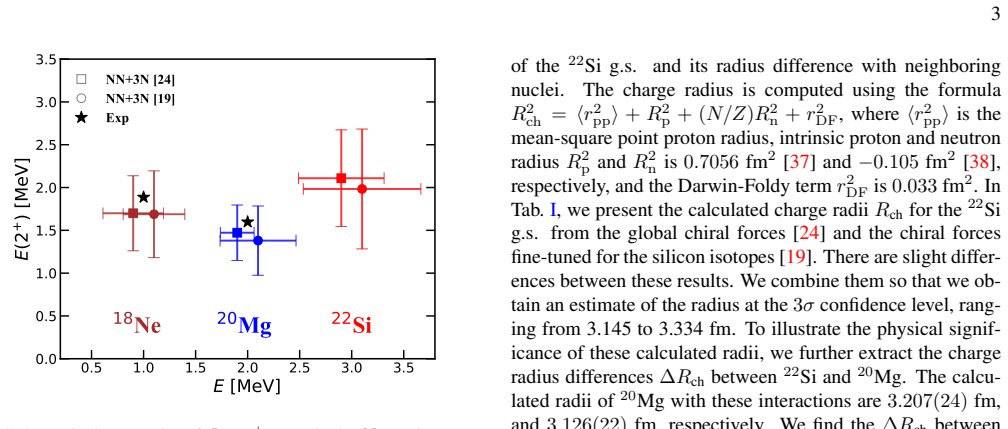
The central claim is that $^{22}$Si, probably the lightest bound nucleus with isospin projection $T_z = -3$, is bound against two-proton decay and is doubly magic. Using the global chiral interaction, the extrapolated ground-state energy of $^{22}$Si is $-134.38(39)$ MeV versus $-133.66(28)$ MeV for $^{20}$Mg, giving $S_{2p} = 0.72(48)$ MeV; the silicon-tuned interaction gives $S_{2p} = 1.34(45)$ MeV, and in both cases $^{22}$Si stays more bound than $^{20}$Mg by enough to exclude two-proton emission. The shell-closure claim rests on three pieces: the computed $2^+$ excitation energy of $^{22}$Si ($2.11(57)$ MeV with the global interaction) lies above those of $^{18}$Ne and $^{20}$Mg, the simulated proton distance distributions show an outer proton in $^{22}$Si that is less extended than in $^{20}$Mg, and the harmonic-oscillator occupation numbers from the new pinhole variant show the neutron $N=8$ shell essentially full, the six valence protons preferentially in $0d_{5/2}$, and only a minor contribution from $1s_{1/2}$, which together support $Z=14$ and $N=8$ closures.
Load-bearing premise
The doubly-magic conclusion depends on the unverified premise that the truncated harmonic-oscillator pinhole sampling at a single Euclidean time, with no center-of-mass projection, yields occupation numbers that faithfully represent the shell structure rather than artifacts of the basis and of center-of-mass motion.
Editorial extensions
If this is right
- If $^{22}$Si is truly bound by roughly $S_{2p} \approx 0.7$–$1.3$ MeV, searches for two-proton radioactivity in $^{22}$Si should find none, and the proton dripline for the $N=8$ isotones is fixed at $^{22}$Si; a direct mass measurement can then discriminate between the two interaction sets.
- The predicted charge radius of $^{22}$Si ($3.145$–$3.334$ fm) and the mirror radius difference $\Delta R_{\rm ch}(^{22}\mathrm{Si}{-}^{22}\mathrm{O}) \approx 0.36$–$0.37$ fm, if measured, would place a constraint on the symmetry-energy slope $L$ of the nuclear equation of state.
- The new HO-basis pinhole method, if reliable, gives lattice simulations direct access to shell-model occupation numbers, so other shell-model observables such as single-particle strengths or transition matrix elements could be extracted from the same wavefunctions.
- The similarity between the computed $\Delta R_{\rm ch}(^{22}\mathrm{Si}{-}^{20}\mathrm{Mg})$ and the measured silicon–magnesium radius differences suggests that the $Z=14$ closure keeps the $^{22}$Si radius normal despite the small separation energy.
- Consistency of the two interaction sets on $S_{2p}$ and on the $2^+$ energies indicates the qualitative conclusions are not sensitive to the 3N-force fine-tuning, so the remaining uncertainty is dominated by the simulation parameters and extrapolations rather than the interaction choice.
Reading between the lines
- The HO-pinhole method is not yet benchmarked on a known closed-shell nucleus; a natural extension is to compute occupation numbers for $^{16}$O or $^{40}$Ca in the same framework and compare with the expected closed-shell occupancies before trusting the $^{22}$Si numbers.
- The occupation numbers are evaluated at a single Euclidean time $\tau = 0.2$ MeV$^{-1}$, while energies and radii are extrapolated in $\tau$; testing the convergence of the occupancies with $\tau$ would tell whether the extracted shell structure is asymptotic or still contaminated by excited-state admixtures.
- Since $^{22}$O is the well-established doubly magic mirror partner, a direct comparison of the full proton and neutron orbital occupancies of $^{22}$Si and $^{22}$O could isolate the Coulomb and isospin-breaking effects on the shell structure, rather than the radius difference alone.
- If the $Z=14$ closure is as strong as implied, the dripline may extend one nucleon further; running the same simulation for $^{23}$Si would give a sharper, testable boundary for the proton dripline and could be a more sensitive falsifier of the predicted shell stabilisation.
Signed reviews
Editorial analysis
A structured set of objections, weighed in public.
Referee Report
Summary. The paper reports Nuclear Lattice Effective Field Theory (NLEFT) calculations for the proton-rich nucleus 22Si and its neighbors, using a global chiral NN+3N interaction and a second interaction fine-tuned to silicon isotopes. The authors compute ground-state energies, 2+ excitation energies, charge radii, and nucleon spatial distributions. They introduce a harmonic-oscillator-basis variant of the pinhole algorithm to extract shell-model occupation numbers. On this basis they claim that 22Si is more bound than 20Mg, excluding two-proton emission (S2p = 0.72(48) MeV with the global interaction and 1.34(45) MeV with the silicon-tuned interaction), and that 22Si is a doubly magic nucleus with Z=14 and N=8 shell closures.
Significance. If the claims are quantitatively sound, this would be an interesting first extension of NLEFT to a T_z=-3 proton-rich dripline nucleus, with a potentially useful new tool (HO-basis pinhole occupations) for connecting lattice simulations to the shell model. The paper also provides charge radii and a mirror-radius difference that could be tested by future experiments. However, both central claims require stronger support than the manuscript currently provides: the two-proton separation energy is only about 1.5 standard deviations above zero and appears to contradict an indirect experimental mass quoted in the paper, and the HO-basis occupation numbers are presented without a convergence check, center-of-mass correction, or benchmark on a known closed-shell nucleus.
major comments (3)
- [Results, binding energies and S2p (Fig. 1)] The first central claim, that two-proton emission from 22Si is excluded, is not supported by the quoted numbers. The global interaction gives S2p = 0.72(48) MeV, which is only about 1.5 standard deviations above zero, so the abstract's wording 'excluding the possibility of two-proton emission' is too strong. Moreover, the same section quotes an indirect experimental g.s. energy of -134.51 MeV for 22Si and -134.61 MeV for 20Mg; if these are binding energies, they imply B(22Si) - B(20Mg) = -0.10 MeV, i.e., a negative S2p with the opposite sign from the calculation. The authors should discuss this discrepancy explicitly and replace the exclusion claim with a quantified confidence statement.
- [Supplemental Material, 'The pinhole method in harmonic oscillator basis'; Table S1] The HO-basis pinhole occupation numbers are not demonstrated to be ground-state observables. They are evaluated at a single Euclidean time tau = 0.2 MeV^-1, whereas the energies in Fig. 1 are extrapolated in tau and are still about 4 MeV above the extrapolated ground state at that tau. The supplemental text states that translations were not applied to the wavefunctions and gives only a 1.3% center-of-mass estimate for the ground-state energy, with no analogous check for occupation numbers. Table S1 contains negative occupation numbers, e.g., 0d3/2[3/2] = -0.127(169), and no benchmark on a known closed-shell nucleus such as 16O or 40Ca is provided. Because the trial wavefunction is a product of HO single-particle states with 0d5/2 filled, a short-time projection can partially reproduce the trial occupations. The shell-closure conclusion therefore needs a tau-convergence study and an independent validation before it can be regarded as established.
- [Results, shell closure evidence from 2+ states and nucleon distributions] The claim that 22Si is doubly magic is also supported by qualitative indicators: the 2+ energies in N=8 isotones and the spatial compactness of the outermost proton distribution. These indicators are statistically weak; for example, the 2+ energies of 22Si and 20Mg are 2.11(57) MeV and 1.47(32) MeV, whose error bars overlap, and the spatial-distribution argument is not quantified. Even if the binding-energy calculation is correct, the doubly-magic conclusion should be based on a validated occupation-number analysis or another quantitative measure, rather than on these qualitative trends alone.
minor comments (4)
- [Methods, paragraph 1] The word 'pertubatively' should be 'perturbatively'.
- [Fig. 2 caption] The caption's explanation that the squares, circles, and stars are plotted as references on the E-axis, with only horizontal errors calibrated by the E-axis, is confusing and should be rewritten to clarify the axis meaning and the uncertainty representation.
- [Results, charge radii] The procedure for combining the two interaction results into a 3-sigma radius range is not specified; please state how the central value and the confidence interval are obtained from the two calculations.
- [References and supplemental material] The main text refers to Ref. [31] for several pieces of information; since [31] is the Supplemental Material, it would be clearer to name the supplement explicitly in the text.
Circularity Check
Doubly-magic claim rests on HO-pinhole occupations that mirror the trial state, and the silicon-tuned S2p repeats a fitted input.
-
fitted input called prediction
[Methods and Results: binding energies of 22Si/20Mg and S2p extraction]
"we also use the modified version of the 3NFs that was fine-tuned to the binding energies of the silicon isotopic chain [19]. ... Furthermore, we also employed an alternative set of chiral forces proposed for silicon isotopes for a sensitivity analysis [19]. The calculated g.s. energies of 22Si and 20Mg are −136.28(41) MeV and −134.94(18) MeV, respectively. The extracted S2p is 1.34(45) MeV, which is consistent with the prediction from the global interaction."
The 'alternative' force is explicitly fine-tuned to binding energies of the silicon isotopic chain, and 22Si is a silicon isotope. Consequently the two-proton separation energy S2p = 1.34(45) MeV obtained with this force is a re-statement of the fitted input, not an independent validation of the dripline conclusion. The paper presents it as corroborating the global-interaction prediction, but only the global-interaction result (S2p = 0.72(48) MeV) is a genuinely predictive extrapolation for 22Si.
-
self definitional
[Supplemental Material, 'The pinhole method in harmonic oscillator basis', Eq. (S6); Methods; Table S1]
"The initial states are chosen as products of single-particle HO wavefunctions. ... All the calculated energies and radii are then extrapolated in Euclidean time using the formalism from Refs. [27–29], while the nucleon distribution and occupation numbers are simulation results at τ = 0.2 MeV−1. ... In practical calculations, due to the localized nature of the HO basis and its lack of translational invariance, we did not apply translations to the wavefunctions of the initial, final, or intermediate states."
The occupation numbers used to support the Z=14 and N=8 shell closures are taken at a single Euclidean time τ = 0.2 MeV−1, without extrapolation, no CoM translation, and with no benchmark on a known closed-shell nucleus. The trial state already is an HO product with the Z=14 and N=8 shells filled, and Eq. (S6) projects that trial configuration onto HO occupations at early time, when Fig. 1 shows the energy is still several MeV above the extrapolated ground state. Table S1 returns ~1 for 0s, 0p and 0d5/2 and ~0 (with unphysical negative values) for 1s1/2 and 0d3/2, i.e. the input trial configuration. The claimed shell-closure evidence from these occupations is therefore equivalent to the ansatz, not an emergent prediction.
full rationale
The primary dripline finding from the global chiral interaction is a genuine first-principles extrapolation: Ref. [24] fitted the 3NF to a broad set of A=3–40 masses, and the computed S2p = 0.72(48) MeV is not a fit to the 22Si binding energy. That part of the paper is not circular. However, two load-bearing elements are. First, the 'silicon-tuned' interaction is said to be fine-tuned to binding energies of the silicon isotopic chain, so the S2p = 1.34(45) MeV quoted with it is a fitted number presented as confirmation. Second, the doubly-magic interpretation rests substantially on HO-basis pinhole occupation numbers evaluated at τ = 0.2 MeV−1 with no CoM translation, starting from an HO product trial state that already encodes the N=8 and Z=14 closures; Table S1 reproduces that trial configuration within errors. The paper itself discloses the lack of translation and the lack of τ-extrapolation, which confirms rather than removes the circularity. Because the 2+ energy systematics provide an independent (if weaker) shell-closure argument and the global-interaction S2p remains predictive, the overall circularity is partial, not total: score 6.
Assumptions & free parameters
free parameters (3)
- Low-energy constants of the global chiral 3N interaction (Ref. [24]) =
fitted to selected nuclear masses for A = 3 to 40
- Low-energy constants of the silicon-tuned chiral interaction (Ref. [19]) =
fine-tuned to binding energies/radii of the silicon isotopic chain
- Empirical harmonic oscillator parameter hbar-omega =
41 A^{-1/3} MeV
assumptions (6)
- domain assumption The wavefunction-matched Hamiltonian HS plus first-order perturbation theory for H'_chi - HS accurately approximates the N3LO chiral Hamiltonian (Ref. [24]).
- domain assumption The periodic lattice with L=10 and a=1.32 fm is large enough to avoid significant finite-volume effects for A=18-22 nuclei.
- domain assumption The Euclidean time extrapolation (Refs. [27-29]) gives converged ground-state energies and radii, and occupation numbers at tau=0.2 MeV^-1 are close to ground-state values.
- ad hoc to paper The truncated HO basis (n <= 5 for s,p,d; n <= 1 for f,g) and the neglect of center-of-mass projection do not distort the occupation numbers materially.
- ad hoc to paper The empirical oscillator parameter hbar-omega = 41 A^{-1/3} MeV is the correct basis parameter for extracting shell-model occupancies.
- domain assumption Gaussian smearing of pinhole configurations preserves the relative spatial compactness of the outermost nucleon distributions.
Cite this review
Pith. "Pith review of Lattice simulation of nucleon distribution and shell closure in the proton-rich nucleus $^{22}$Si." pith.science (2026). https://pith.science/paper/RTZPKQ7U
@misc{pith2026241117462,
  author       = {Pith},
  title        = {Pith review of: Lattice simulation of nucleon distribution and shell closure in the proton-rich nucleus $^22$Si},
  year         = {2026},
  howpublished = {\url{https://pith.science/paper/RTZPKQ7U}},
  note         = {Machine review of arXiv:2411.17462}
}
abstract
The proton-rich nucleus $^{22}$Si is studied using Nuclear Lattice Effective Field Theory with high-fidelity chiral forces. Our results indicate that $^{22}$Si is more tightly bound than $^{20}$Mg, thereby excluding the possibility of two-proton emission. The $Z = 14$ shell closure in $^{22}$Si is supported by the evolution of the $2^+$ state in the neighboring nuclei. We then focus on the charge radius and spatial distribution information of $^{22}$Si, considering the novel phenomena that may emerge due to the small two-proton separation energy and the shell closure. We present the distribution of the $14$ protons and $8$ neutrons obtained from our lattice simulation, revealing insights into the spatial arrangement of the nucleons. Moreover, the spatial localization of the outermost proton and neutron suggests that $^{22}$Si is a doubly magic nucleus. Furthermore, we develop the pinhole method based on the harmonic oscillator basis, which gives insight into the nuclear structure in terms of the shell model picture from lattice simulations. Our calculated occupation numbers support that $Z = 14$ and $N = 8$ are the shell closures and show that the $\pi 1s_{1/2}$ orbital component is minor in $^{22}$Si.
Figures


Forward citations
Cited by 3 Pith papers
-
Lattice calculation of the Sn isotopes near the proton dripline
First high-fidelity lattice calculations of 99-102Sn reach percent-level agreement with measured binding energies, confirm the N=50 shell closure, and find 99Sn less bound than extrapolations from heavier tin isotopes.
-
Observation of renormalization group invariance in symmetry-restored nuclear lattice effective field theory
After restoring Galilean invariance with counterterms, the N2LO lattice prediction for 4He binding stays constant for cutoffs 250-400 MeV and matches experiment.
-
Ab initio lattice study of neutron-alpha scattering with chiral forces at N3LO
A lattice calculation of neutron-helium-4 scattering with chiral forces at N3LO matches empirical phase shifts in the 2S1/2 and 2P3/2 channels but not the 2P1/2 channel, pointing to limitations in the three-nucleon force.
Reference graph
Works this paper leans on
-
[1]
T. B. Webb et al. , Phys. Rev. Lett. 122, 122501 (2019), arXiv:1812.08880 [nucl-ex]
work page Pith review arXiv 2019
-
[2]
The structure of $^{36}$Ca under the Coulomb magnifying glass
L. Lalanne et al. , Phys. Rev. Lett. 129, 122501 (2022), arXiv:2201.01513 [nucl-ex]
work page Pith review arXiv 2022
-
[3]
J. J. Liu et al. (RIBLL), Phys. Rev. Lett. 129, 242502 (2022)
work page 2022
-
[4]
N=16 magicity revealed at the proton drip-line through the study of 35Ca
L. Lalanne et al. , Phys. Rev. Lett. 131, 092501 (2023), arXiv:2302.14382 [nucl-ex]
work page Pith review arXiv 2023
- [5]
-
[6]
A. M. Rogers et al., Phys. Rev. Lett. 106, 252503 (2011)
work page 2011
-
[7]
R. J. Charity et al., Phys. Rev. Lett. 131, 172501 (2023)
work page 2023
-
[8]
Two-proton emission and related phenomena
M. Pf ¨utzner, I. Mukha, and S. Wang, Prog. Part. Nucl. Phys.132, 104050 (2023), arXiv:2304.13391 [nucl-ex]
work page Pith review arXiv 2023
Show all 46 references
-
[9]
Yuet al., Phys
Y . Yuet al., Phys. Rev. Lett. (2024), accepted for publication, October 22, 2024
2024
-
[10]
T. A. L ¨ahde and U.-G. Meißner, Nuclear Lattice Effective Field Theory: An introduction, V ol. 957 (Springer, 2019)
2019
-
[11]
M. G. Saint Laurent et al., Phys. Rev. Lett. 59, 33 (1987)
1987
-
[12]
Blank et al., Phys
B. Blank et al., Phys. Rev. C 54, 572 (1996)
1996
-
[13]
X. X. Xu et al., Phys. Lett. B 766, 312 (2017)
2017
-
[14]
Babo, β-delayed charged particle decays of neutron- deficient nuclei 20Mg and 22.23Si, Theses, Universit ´e de Caen Normandie (2016)
M. Babo, β-delayed charged particle decays of neutron- deficient nuclei 20Mg and 22.23Si, Theses, Universit ´e de Caen Normandie (2016)
2016
-
[15]
J. D. Holt, J. Menendez, and A. Schwenk, Phys. Rev. Lett. 110, 022502 (2013), arXiv:1207.1509 [nucl-th]
2013 arXiv
-
[16]
S. R. Stroberg, J. D. Holt, A. Schwenk, and J. Simonis, Phys. Rev. Lett. 126, 022501 (2021), arXiv:1905.10475 [nucl-th]
2021 arXiv
-
[17]
Zhang, Y
S. Zhang, Y . Z. Ma, J. G. Li, B. S. Hu, Q. Yuan, Z. H. Cheng, and F. R. Xu, Phys. Lett. B 827, 136958 (2022), arXiv:2112.02844 [nucl-th]
2022 arXiv
-
[18]
S. V . Pineda et al. , Phys. Rev. Lett. 127, 182503 (2021), arXiv:2106.10378 [nucl-ex]
2021 arXiv
-
[19]
K ¨onig et al., Phys
K. K ¨onig et al., Phys. Rev. Lett. 132, 162502 (2024), [Erratum: Phys.Rev.Lett. 133, 059901 (2024)], arXiv:2309.02037 [nucl- ex]
2024
-
[20]
and the first mass measurement of 22Al [21, 22], re- spectively, revealed and suggested the halo structure in 22Al. Given that 22Si lies nearer the edge of the nuclear landscape, it is fascinating to explore how its shell closure and proton- neutron imbalance compete, and to i...
2024 arXiv
-
[21]
Lee et al., Phys
J. Lee et al., Phys. Rev. Lett. 125, 192503 (2020)
2020
-
[22]
M. Z. Sun et al. , Chin. Phys. C 48, 034002 (2024), arXiv:2401.14704 [nucl-ex]
2024 arXiv
-
[23]
S. E. Campbell et al. , Phys. Rev. Lett. 132, 152501 (2024), arXiv:2312.11366 [nucl-ex]
2024 arXiv
-
[24]
Mutschler et al
A. Mutschler et al. , Nature Phys. 13, 152 (2017), arXiv:1707.03583 [nucl-ex]
2017 arXiv
-
[25]
Elhatisari et al., Nature 630, 59 (2024), arXiv:2210.17488 [nucl-th]
S. Elhatisari et al., Nature 630, 59 (2024), arXiv:2210.17488 [nucl-th]
2024 arXiv
-
[28]
T. A. L ¨ahde, E. Epelbaum, H. Krebs, D. Lee, U.-G. Meißner, and G. Rupak, J. Phys. G 42, 034012 (2015), arXiv:1409.7538 [nucl-th]
2015 arXiv
-
[29]
R. He, N. Li, B.-N. Lu, and D. Lee, Phys. Rev. A 101, 063615 (2020), arXiv:1910.01257 [cond-mat.quant-gas]
2020 arXiv
-
[30]
S. Shen, S. Elhatisari, T. A. L¨ahde, D. Lee, B.-N. Lu, and U.-G. Meißner, Nature Commun. 14, 2777 (2023), arXiv:2202.13596 [nucl-th]
2023 arXiv
-
[31]
https://www.nndc.bnl.gov/ensdf/
-
[32]
See Supplemental Material for the discussion of the pinhole algorithm in coordinate and HO space, the occupation number calculations, the distribution of neutrons and the average proton distances in various nuclei
-
[33]
A. T. Gallant et al. , Phys. Rev. Lett. 113, 082501 (2014), arXiv:1409.1477 [nucl-ex]
2014 arXiv
-
[34]
Otsuka, T
T. Otsuka, T. Suzuki, J. D. Holt, A. Schwenk, and Y . Akaishi, Phys. Rev. Lett. 105, 032501 (2010), arXiv:0908.2607 [nucl-th]
2010 arXiv
-
[35]
Hagen, M
G. Hagen, M. Hjorth-Jensen, G. R. Jansen, R. Machleidt, and T. Papenbrock, Phys. Rev. Lett. 108, 242501 (2012), arXiv:1202.2839 [nucl-th]
2012 arXiv
-
[36]
Hergert, S
H. Hergert, S. Binder, A. Calci, J. Langhammer, and R. Roth, Phys. Rev. Lett. 110, 242501 (2013), arXiv:1302.7294 [nucl-th]
2013 arXiv
-
[37]
J. G. Li, H. H. Li, S. Zhang, Y . M. Xing, and W. Zuo, Phys. Lett. B 846, 138197 (2023)
2023
-
[38]
Lin, H.-W
Y .-H. Lin, H.-W. Hammer, and U.-G. Meißner, Phys. Rev. Lett. 128, 052002 (2022), arXiv:2109.12961 [hep-ph]
2022 arXiv
-
[39]
A. A. Filin, D. M ¨oller, V . Baru, E. Epelbaum, H. Krebs, and P. Reinert, Phys. Rev. C 103, 024313 (2021), arXiv:2009.08911 [nucl-th]
2021 arXiv
-
[40]
D. T. Yordanov et al., Phys. Rev. Lett. 108, 042504 (2012)
2012
-
[41]
B. A. Brown, Phys. Rev. Lett. 119, 122502 (2017)
2017
-
[42]
B. A. Brown et al., Phys. Rev. Res. 2, 022035 (2020)
2020
-
[43]
S. J. Novario, D. Lonardoni, S. Gandolfi, and G. Hagen, Phys. Rev. Lett. 130, 032501 (2023), arXiv:2111.12775 [nucl-th]. 6 SUPPLEMENTAL MA TERIAL Nuclear Lattice Effective Theory (NLEFT) simulation costs scale modestly with the nucleon number A, tCPU ∼ A1...2, due to the advan...
2023 arXiv
-
[44]
Elhatisari et al., Phys
S. Elhatisari et al., Phys. Rev. Lett. 119, 222505 (2017), arXiv:1702.05177 [nucl-th]
2017 arXiv
-
[45]
B.-N. Lu, N. Li, S. Elhatisari, D. Lee, E. Epelbaum, and U.-G. Meißner, Phys. Lett. B 797, 134863 (2019), arXiv:1812.10928 [nucl-th]
2019 arXiv
-
[46]
D. H. Gloeckner and R. D. Lawson, Phys. Lett. B 53, 313 (1974)
1974
-
[47]
Hagen, T
G. Hagen, T. Papenbrock, and D. J. Dean, Phys. Rev. Lett. 103, 062503 (2009), arXiv:0905.3167 [nucl-th]
2009 arXiv
-
[48]
Hergert, S
H. Hergert, S. K. Bogner, T. D. Morris, A. Schwenk, and K. Tsukiyama, Phys. Rept. 621, 165 (2016), arXiv:1512.06956 [nucl-th]
2016 arXiv
Reviewed August 12, 2026 · model on record in the stance chip above.
Discussion (0). Continue with ORCID to comment.