REVIEW 3 major objections 5 minor 4 cited by
First ab initio lattice calculation of proton-rich tin isotopes reproduces binding energies to ~1 percent for even–even nuclei after a small three-nucleon-force adjustment, and confirms the N=50 shell closure in 100Sn.
Reviewed by Pith at T0; open to challenge. T0 means a machine referee read the full paper against a public rubric. the ladder, T0–T4 →
T0 review · deepseek-v4-flash
2026-08-04 20:23 UTC pith:GWHY73A6
load-bearing objection First NLEFT run near 100Sn is genuinely new and honestly presented, but the central 3N retuning is underdocumented and the odd-A error bars are large. the 3 major comments →
Lattice calculation of the Sn isotopes near the proton dripline
The pith
A machine-rendered reading of the paper's core claim, the machinery that carries it, and where it could break.
Core claim
The authors report the first ab initio lattice calculation of 99Sn–102Sn, using nuclear lattice effective field theory with nonlocally regulated chiral N3LO two-nucleon forces and locally smeared three-nucleon forces, together with wavefunction matching and Galilean-invariance restoration. With the original three-nucleon couplings, the four isotopes are underbound by about 5% relative to experiment. Adjusting two SU(4)-symmetric three-nucleon couplings at the percent level reproduces the experimental binding energy of 100Sn, and without further tuning brings 99Sn, 101Sn, and 102Sn into agreement with experiment: even–even binding energies to about 1%, and energy splittings and two-neutron se
What carries the argument
The central computational object is Euclidean-time projection on a four-dimensional lattice with spatial volume L=12 lattice units (lattice spacing 1.32 fm, box length 15.84 fm) and up to L_t=1600 time steps. The sign problem is suppressed by evolving with a simplified SU(4)-symmetric Hamiltonian H_s and treating the difference from the full chiral Hamiltonian perturbatively via wavefunction matching. Ground-state energies are extracted by extrapolating operator expectation values to infinite Euclidean time with a double-exponential ansatz, <O(τ)> = <O(∞)> + a exp(-ΔE τ) + b exp(-ΔE τ/2), where a single decay parameter ΔE is shared among all operators. For odd-A nuclei the average complex ph
Load-bearing premise
The ground-state energies rest on the assumption that every operator expectation value decays to its infinite-time limit as a sum of just two exponentials sharing a single decay rate; if the true finite-time correction is different for the odd-A systems, where the signal is only controllable to about 1000 time steps, the quoted central values shift.
What would settle it
Extend the odd-A lattice runs (99Sn and 101Sn) beyond L_t≈1000 on the same lattice and check whether the energies extracted with the double-exponential ansatz remain stable against a three-exponential fit or a direct ratio-method extraction; a shift larger than the quoted ~8–10 MeV uncertainty would indicate the N3LO* agreement is an artifact of the extrapolation. A direct high-precision mass measurement of 99Sn would also discriminate, since the N3LO* prediction (804±8 MeV) sits below the AME2020 extrapolation (807.9±0.6 MeV).
If this is right
- Binding energies of even–even tin isotopes near the proton dripline can be computed from first principles to about 1% with high-fidelity chiral forces.
- A percent-level retuning of two three-nucleon couplings, originally motivated by alpha-cluster EFT, is sufficient to bring 99–102Sn into agreement with experiment while preserving the description of lighter nuclei used in the original fit.
- The N=50 shell closure at 100Sn is reproduced in an ab initio lattice framework, consistent with earlier coupled-cluster predictions.
- Mass differences and two-neutron separation energies in this region are captured within uncertainties, indicating that differential observables are less sensitive to three-nucleon calibration than absolute binding energies.
- The same machinery can be extended to the whole tin isotopic chain and to excited states, charge radii, beta decays, and collective excitations, as the authors state as future work.
Where Pith is reading between the lines
- Editorial inference: A direct high-precision mass measurement of 99Sn would provide a sharp test: the N3LO* prediction (804±8 MeV) lies about 4 MeV below the AME2020 extrapolated value (807.9±0.6 MeV), within the combined uncertainty but in a direction that would confirm the paper's claim of a local mass-surface anomaly.
- Editorial inference: If the systematic underbinding pattern holds for other heavy proton-rich nuclei, refitting three-nucleon LECs with A≈100 data could shift predicted charge radii and neutron skins elsewhere, which are currently open experimental questions.
- Editorial inference: The shared-ΔE double-exponential extrapolation could be stress-tested by comparing with an alternative extraction (for example, a three-exponential form or a direct transfer-matrix eigenvalue analysis) around L_t≈1000, where the odd-A phase signal is weakest.
- Editorial inference: The apparent need for a small enhancement of alpha-cluster-motivated 3N operators in this mass region raises the question of whether those operator forms remain the right degrees of freedom for heavier nuclei or whether additional three-nucleon structures are needed.
Editorial analysis
A structured set of objections, weighed in public.
Referee Report
Summary. This paper presents the first nuclear lattice effective field theory (NLEFT) calculations of the proton-rich tin isotopes 99–102Sn using high-fidelity chiral N3LO two- and three-nucleon forces. Ground-state binding energies are computed via Euclidean time projection with wavefunction matching. The original N3LO Hamiltonian underbinds by about 5% relative to experiment; the authors then adjust two SU(4)-symmetric 3N couplings (V_cE^(l), V_cE^(t)) by a reported 'percent-level' amount to reproduce the 100Sn binding energy, calling the result N3LO*. With this recalibration, they report that 99Sn, 101Sn, and 102Sn binding energies, the 100Sn–99Sn splitting, and S_2n(102Sn) agree with experiment, confirming the N=50 shell closure and a 99Sn binding energy below values extrapolated from heavier isotopes.
Significance. If the claims hold, this is a notable step: it would extend NLEFT with high-fidelity chiral forces into the A≈100 proton-rich region and provide an ab initio confirmation of the doubly magic character of 100Sn. The strengths are the first-lattice-calculation status, the explicit reporting of the original underbinding, and the demonstration that the recalibration preserves the 4He and 40Ca binding energies. However, the central predictive claim is currently underdetermined because the numerical values of the adjusted 3N LECs are not given, and the odd-A extrapolation procedure is not validated beyond an assumed ansatz. The paper is therefore promising but not yet conclusive.
major comments (3)
- [Table I / Results] The N3LO* Hamiltonian is defined by adjusting two SU(4)-symmetric 3N couplings, V_cE^(l) and V_cE^(t), to reproduce the 100Sn binding energy, yet the numerical values of these adjusted LECs are never reported. The text only says a 'percent-level adjustment' was made. With two parameters fit to one observable, the retuning is generically underdetermined: a one-parameter family of (V_cE^(l), V_cE^(t)) pairs can reproduce B(100Sn) while still preserving the 4He and 40Ca shifts quoted. The claim that 99Sn, 101Sn, and 102Sn 'come into agreement without further tuning' is meaningful only if the results are insensitive to the choice inside this family or if the second parameter is fixed by an independent constraint. Neither is demonstrated. Please report the fitted LEC values and provide a sensitivity scan along the degeneracy for the observables in Tables I and II. Without this, the central pr
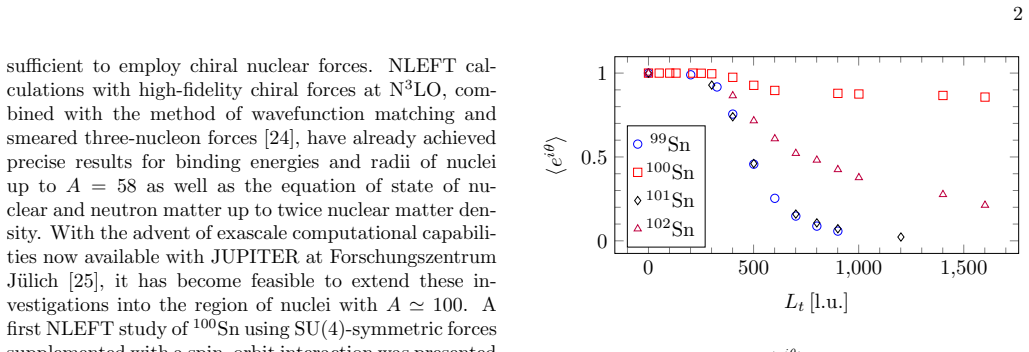
- [Eq. (2), Fig. 1] For the odd-A nuclei 99Sn and 101Sn, Fig. 1 shows that the average phase <e^{iθ}> decays rapidly beyond L_t ~ 1000. Consequently, the quoted ground-state energies for these nuclei rest almost entirely on the assumed double-exponential form of Eq. (2), <O(τ)> = <O(∞)> + a exp(-ΔE τ) + b exp(-ΔE τ/2), with a single shared ΔE. The text states that this form 'provides a good description for all operators,' but no fit-quality measure, no fit-range sensitivity, and no comparison with alternative extrapolations are given. Because the odd-A central values and the 101-100, 102-101, and 100-99 splittings in Table II depend on this ansatz, the systematic uncertainty from the extrapolation must be quantified. I request fits with different functional forms or truncated fit ranges, and ideally a plateau analysis for at least one odd-A nucleus.
- [Table II / Results] The statement that the N3LO* Hamiltonian 'reproduces two-neutron separation energies and nearest-neighbor splittings to within experimental uncertainties' is not supported as written. The theoretical uncertainties in Table II are 8.6-12.8 MeV, i.e., 10-30 times larger than the experimental uncertainties (0.3-0.7 MeV). The correct statement is that the central values are consistent with experiment within the much larger theoretical errors. This distinction matters for the abstract's 'in agreement with experiment' claim. Please revise the wording and discuss whether the present precision is sufficient to claim quantitative reproduction of mass differences rather than just consistency at the ~10 MeV level.
minor comments (5)
- [Abstract] Minor typo: 'ab initiolattice' should read 'ab initio lattice'.
- [Section heading] 'RESUL TS AND DISCUSSION' has an extraneous space; also the text inconsistently uses 'N3LO' and 'N 3LO'.
- [Table I] The experimental value for 99Sn is extrapolated (AME 2020). This is stated in the caption but should be emphasized in the main text, since the abstract's claim that the 99Sn binding energy lies 'below values extrapolated from heavier isotopes' is a comparison to an extrapolated benchmark rather than a direct measurement.
- [Eq. (2)] The parameter ΔE in the double-exponential ansatz is described only as a 'decay parameter.' Please define it more precisely (e.g., as an effective excitation energy of the dominant correction) and state whether the same value is used for all isotopes or fitted per isotope.
- [Figure 1] It would help to indicate whether the curves have error bars smaller than the symbol size, or to add shaded statistical bands, so the reader can judge the quality of the phase average.
Circularity Check
100Sn binding-energy reproduction is a fitted input; 99,101,102Sn and mass differences retain independent predictive content.
specific steps
-
fitted input called prediction
[Results and Discussion, paragraph after Table I (and Table I, N3LO* row)]
"To assess the role of three-nucleon forces, we performed controlled variations of two SU(4)-symmetric 3N couplings, V_cE^(l) and V_cE^(t), originally motivated by alpha-cluster EFT. With only a percent-level adjustment, we reproduce the experimental binding energy of 100Sn (denoted N 3LO* in Table I)."
The N3LO* Hamiltonian used for all reported results is defined by adjusting two 3N LECs so that B(100Sn) matches the experimental value. Table I then presents N3LO* B(100Sn)=825.2(3.0) MeV versus 825.16(24) MeV as part of the claim 'we reproduce binding energies with ~1% accuracy for the even-even systems' in the abstract. That single datum is an input to the fit, so its reproduction is enforced by construction, not derived. The remaining isotopes and all Table II differences are genuine predictions and are largely stable between N3LO and N3LO* (differences shift by <0.5 MeV), so the circularity is partial. The paper does not quote the adjusted LEC values; with two parameters fit to one energy there is a degenerate family, but that is an underdetermination/reproducibility concern rather th
full rationale
The only load-bearing reduction by construction is the 100Sn binding energy. The authors explicitly retune two SU(4)-symmetric 3N couplings to reproduce B(100Sn), so the N3LO* entry for 100Sn in Table I is a fitted result, not an ab initio prediction. This affects the abstract's blanket statement about reproducing even-even binding energies. However, the main physics claims are not destroyed by this circularity: 99Sn, 101Sn, and 102Sn are computed after the retuning and agree with experiment, and the mass splittings and S2n values in Table II are nearly identical in the original N3LO and retuned N3LO* calculations, showing that the shell-closure and separation-energy statements derive from the many-body calculation rather than from the fit. The unmodified N3LO Hamiltonian is fit to np scattering and light/medium nuclei up to 40Ca, which are independent inputs; citations to the authors' own Ref. [24] for the method are standard methodology citations, not load-bearing self-citations. The double-exponential extrapolation (Eq. 2) is a modeling assumption but not circular. Score reflects the one constructed 'reproduction' (a 6, partial circularity), not a fully circular derivation.
Axiom & Free-Parameter Ledger
free parameters (3)
- C_s (SU(4) 2N coupling in H_s) =
0.42 x 10^-6 MeV^-2
- N3LO* 3N LEC adjustments (VcE^l, VcE^t) =
percent-level, numerical values not quoted
- Double-exponential fit parameters (a, b, DeltaE) =
per-operator fit parameters
axioms (5)
- domain assumption Chiral EFT at N3LO with the LECs of Ref. [24] provides a valid Hamiltonian at A≈100 after small 3N modifications
- domain assumption The wavefunction-matching perturbation of H - H_s converges
- ad hoc to paper Double-exponential ansatz Eq. (2) correctly describes the tau-dependence of all operators
- domain assumption Experimental 99Sn mass from AME2020 is a valid benchmark despite being extrapolated
- domain assumption Lattice volume L=12 l.u. (15.84 fm) and spacing a=1.32 fm are sufficient for the chiral forces and suppress finite-volume effects
Cite this review
Pith. "Pith review of Lattice calculation of the Sn isotopes near the proton dripline." pith.science (2026). https://pith.science/paper/GWHY73A6
@misc{pith2026250908579,
  author       = {Pith},
  title        = {Pith review of: Lattice calculation of the Sn isotopes near the proton dripline},
  year         = {2026},
  howpublished = {\url{https://pith.science/paper/GWHY73A6}},
  note         = {Machine review of arXiv:2509.08579}
}
read the original abstract
We present the first $\textit{ab initio}$ lattice calculations of the proton-rich tin isotopes $^{99}$Sn to $^{102}$Sn using nuclear lattice effective field theory with high-fidelity two- and three-nucleon forces. For a given set of three-nucleon couplings, we reproduce binding energies with $\sim 1\%$ accuracy for the even-even systems, and obtain energy splitting and two-nucleon separation energies in agreement with experiment. Our results confirm the $N=50$ shell closure and reveal that the binding energy of $^{99}$Sn lies below values extrapolated from heavier isotopes.
Figures

Forward citations
Cited by 4 Pith papers
-
Ab initio lattice calculation of nuclear magnetic dipole moments with systematic error quantifications
Nuclear lattice EFT reproduces measured magnetic moments of selected light and aluminum nuclei once two-body electromagnetic currents are included, with error bars assigned to statistical, extrapolation, and rotationa...
-
From binding and saturation to criticality in nuclear matter with lattice effective field theory
Improved leading-order lattice Hamiltonians lower the liquid-gas critical temperature of symmetric nuclear matter to 13.50(17)-13.71(19) MeV while improving zero-temperature binding energies and saturation point.
-
Ab initio calculations of nuclear charge radii across and beyond ${}^{132}$Sn: Putting chiral EFT nuclear interactions to the test
No chiral-EFT Hamiltonian tested here reproduces all tin charge-radius trends; 1.8/2.0 (EM7.5) matches the 132Sn kink for the wrong physical reason.
-
Searching for the Tetraneutron Resonance on the Lattice
Lattice EFT calculations find no resonance signature in the tetraneutron ground-state energy, only a weak attraction in the dineutron-dineutron phase shift whose confined energy is close to the experimental low-energy peak.
Reference graph
Works this paper leans on
-
[1]
J. Karthein et al. Electromagnetic properties of in- dium isotopes illuminate the doubly magic character of 100Sn.Nature Phys., 20(11):1719–1725, 2024.arXiv: 2310.15093,doi:10.1038/s41567-024-02612-y
Pith/arXiv arXiv 2024
-
[2]
R. M. Clark, A. O. Macchiavelli, H. L. Crawford, P. Fal- lon, D. Rudolph, A. S ˚ amark-Roth, C. M. Campbell, M. Cromaz, C. Morse, and C. Santamaria. Enhance- ment ofα-particle formation near 100Sn.Phys. Rev. C, 101(3):034313, 2020.doi:10.1103/PhysRevC.101. 034313
-
[3]
T. Faestermann, M. Gorska, and H. Grawe. The struc- ture of Sn-100 and neighbouring nuclei.Prog. Part. Nucl. Phys., 69:85–130, 2013.doi:10.1016/j.ppnp.2012.10. 002
-
[4]
M. Mougeot et al. Mass measurements of 99−101In chal- lenge ab initio nuclear theory of the nuclide100Sn.Nature Phys., 17:1099, 2021.arXiv:2109.10673,doi:10.1038/ s41567-021-01326-9
Pith/arXiv arXiv 2021
-
[5]
L. Nies et al. Refining the nuclear mass surface with the mass of 103Sn.Phys. Rev. C, 111(1):014315, 2025.arXiv: 2410.17995,doi:10.1103/PhysRevC.111.014315
Pith/arXiv arXiv 2025
-
[6]
C. M. Ireland et al. High-precision mass measurement of 103Sn restores smoothness of the mass surface.Phys. Rev. C, 111(1):014314, 2025.arXiv:2410.04650,doi: 10.1103/PhysRevC.111.014314
arXiv 2025
-
[7]
T. D. Morris, J. Simonis, S. R. Stroberg, C. Stumpf, G. Hagen, J. D. Holt, G. R. Jansen, T. Papenbrock, R. Roth, and A. Schwenk. Structure of the lightest tin isotopes.Phys. Rev. Lett., 120(15):152503, 2018.arXiv: 1709.02786,doi:10.1103/PhysRevLett.120.152503
Pith/arXiv arXiv 2018
-
[8]
A. Tichai, P. Demol, and T. Duguet. Towards heavy- mass ab initio nuclear structure: Open-shell Ca, Ni and Sn isotopes from Bogoliubov coupled-cluster the- ory.Phys. Lett. B, 851:138571, 2024.arXiv:2307.15619, doi:10.1016/j.physletb.2024.138571
Pith/arXiv arXiv 2024
-
[9]
Alberto Scalesi, Thomas Duguet, Pepijn Demol, Mikael Frosini, Vittorio Som` a, and Alexander Tichai. Impact of correlations on nuclear binding energies: Ab initio cal- culations of singly and doubly open-shell nuclei.Eur. Phys. J. A, 60(10):209, 2024.arXiv:2406.03545,doi: 10.1140/epja/s10050-024-01424-1
arXiv 2024
-
[10]
K. Hebeler, S. K. Bogner, R. J. Furnstahl, A. Nogga, and A. Schwenk. Improved nuclear matter calculations from chiral low-momentum interactions.Phys. Rev. C, 83:031301, 2011.arXiv:1012.3381,doi:10.1103/ PhysRevC.83.031301
Pith/arXiv arXiv 2011
-
[11]
S. R. Stroberg, J. D. Holt, A. Schwenk, and J. Simo- nis. Ab Initio Limits of Atomic Nuclei.Phys. Rev. Lett., 126(2):022501, 2021.arXiv:1905.10475,doi: 10.1103/PhysRevLett.126.022501
Pith/arXiv arXiv 2021
-
[12]
T. Miyagi, S. R. Stroberg, P. Navr´ atil, K. Hebeler, and J. D. Holt. Converged ab initio calculations of heavy nuclei.Phys. Rev. C, 105(1):014302, 2022.arXiv:2104. 04688,doi:10.1103/PhysRevC.105.014302
-
[13]
G. Hagen, G. R. Jansen, and T. Papenbrock. Struc- ture of 78Ni from first-principles computations.Phys. Rev. Lett., 117:172501, Oct 2016. URL:https://link. aps.org/doi/10.1103/PhysRevLett.117.172501,doi: 10.1103/PhysRevLett.117.172501
-
[14]
R. Wirth, J. M. Yao, and H. Hergert. Ab initio calcula- tion of the contact operator contribution in the standard mechanism for neutrinoless double beta decay.Phys. Rev. Lett., 127:242502, Dec 2021. URL:https://link. aps.org/doi/10.1103/PhysRevLett.127.242502,doi: 10.1103/PhysRevLett.127.242502
-
[15]
P. Arthuis, K. Hebeler, and A. Schwenk. Neutron-rich nuclei and neutron skins from chiral low-resolution inter- actions. 1 2024.arXiv:2401.06675
Pith/arXiv arXiv 2024
-
[16]
A. Cipollone, C. Barbieri, and P. Navr´ atil. Chiral three- nucleon forces and the evolution of correlations along the oxygen isotopic chain.Phys. Rev. C, 92(1):014306, 2015. arXiv:1412.0491,doi:10.1103/PhysRevC.92.014306
Pith/arXiv arXiv 2015
-
[17]
V. Lapoux, V. Som` a, C. Barbieri, H. Hergert, J. D. Holt, and S. R. Stroberg. Radii and Binding Energies in Oxy- gen Isotopes: A Challenge for Nuclear Forces.Phys. Rev. Lett., 117(5):052501, 2016.arXiv:1605.07885,doi: 10.1103/PhysRevLett.117.052501
Pith/arXiv arXiv 2016
-
[18]
P. Maris et al. Nuclear properties with semilocal momentum-space regularized chiral interactions beyond N2LO.Phys. Rev. C, 106(6):064002, 2022.arXiv: 2206.13303,doi:10.1103/PhysRevC.106.064002
Pith/arXiv arXiv 2022
-
[19]
Nuclear radii from first principles
Takayuki Miyagi. Nuclear radii from first principles. Front. in Phys., 13:1581854, 2025.doi:10.3389/fphy. 2025.1581854
arXiv 2025
-
[20]
H. Hergert. A Guided Tour of ab initio Nuclear Many- Body Theory.Front. in Phys., 8:379, 2020.arXiv:2008. 05061,doi:10.3389/fphy.2020.00379
arXiv 2020
-
[21]
Structure of the doubly magic nuclei 208Pb and 266Pb from ab initio computations
Francesca Bonaiti, Gaute Hagen, and Thomas Papen- brock. Structure of the doubly magic nuclei 208Pb and 266Pb from ab initio computations. 8 2025.arXiv: 2508.14217
Pith/arXiv arXiv 2025
-
[22]
Timo A. L¨ ahde and Ulf-G. Meißner.Nuclear Lattice Effective Field Theory: An introduction, volume 957. Springer, 2019.doi:10.1007/978-3-030-14189-9. 6
-
[23]
Lattice Effective Field Theory Simulations of Nuclei
Dean Lee. Lattice Effective Field Theory Simulations of Nuclei. 1 2025.arXiv:2501.03303
arXiv 2025
-
[24]
Serdar Elhatisari et al. Wavefunction matching for solving quantum many-body problems.Nature, 630(8015):59–63, 2024.arXiv:2210.17488,doi:10. 1038/s41586-024-07422-z
Pith/arXiv arXiv 2024
-
[25]
Jureap - seeding exas- cale in europe.https://www.fz-juelich.de/en/ias/ jsc/jupiter/jureap, 2025
J¨ ulich Supercomputing Centre. Jureap - seeding exas- cale in europe.https://www.fz-juelich.de/en/ias/ jsc/jupiter/jureap, 2025
2025
-
[26]
Sign-Problem-Free Nuclear Quantum Monte Carlo
Zhong-Wang Niu and Bing-Nan Lu. Sign-Problem-Free Nuclear Quantum Monte Carlo. 6 2025.arXiv:2506. 12874
2025
-
[27]
Shuang Zhang, Serdar Elhatisari, Ulf-G. Meißner, and Shihang Shen. Lattice simulation of nucleon distribution and shell closure in the proton-rich nucleus 22Si.Phys. Lett. B, 869:139839, 2025.arXiv:2411.17462,doi:10. 1016/j.physletb.2025.139839
Pith/arXiv arXiv 2025
-
[28]
Martin Hoferichter, Jacobo Ruiz de Elvira, Bastian Ku- bis, and Ulf-G. Meißner. Matching pion-nucleon Roy- Steiner equations to chiral perturbation theory.Phys. Rev. Lett., 115(19):192301, 2015.arXiv:1507.07552, doi:10.1103/PhysRevLett.115.192301
Pith/arXiv arXiv 2015
-
[29]
Galilean invariance restoration on the lattice.Phys
Ning Li, Serdar Elhatisari, Evgeny Epelbaum, Dean Lee, Bingnan Lu, and Ulf-G Meißner. Galilean invariance restoration on the lattice.Phys. Rev. C, 99(6):064001, 2019.arXiv:1902.01295,doi:10.1103/PhysRevC.99. 064001
Pith/arXiv arXiv 2019
-
[30]
P. Reinert, H. Krebs, and E. Epelbaum. Semilocal momentum-space regularized chiral two-nucleon poten- tials up to fifth order.Eur. Phys. J. A, 54(5):86, 2018. arXiv:1711.08821,doi:10.1140/epja/i2018-12516-4
Pith/arXiv arXiv 2018
-
[31]
Hidden Spin-Isospin Exchange Sym- metry.Phys
Dean Lee et al. Hidden Spin-Isospin Exchange Sym- metry.Phys. Rev. Lett., 127(6):062501, 2021.arXiv: 2010.09420,doi:10.1103/PhysRevLett.127.062501
Pith/arXiv arXiv 2021
-
[32]
Meng Wang, W. J. Huang, F. G. Kondev, G. Audi, and S. Naimi. The AME 2020 atomic mass evalua- tion (II). Tables, graphs and references.Chin. Phys. C, 45(3):030003, 2021.doi:10.1088/1674-1137/abddaf
-
[33]
D. S. Delion and A. Dumitrescu. Alpha-clustering and related phenomena in medium and heavy nuclei. Eur. Phys. J. A, 59(9):210, 2023.doi:10.1140/epja/ s10050-023-01105-5
doi:10.1140/epja/ 2023
-
[34]
Maria G. Mayer. On Closed Shells in Nuclei.Phys. Rev., 74:235–239, 1948.doi:10.1103/PhysRev.74.235
-
[35]
Yuping Cao, Danhui Lu, Yibin Qian, and Zhongzhou Ren. Uncertainty analysis for the nuclear liquid drop model and implications for the symmetry energy co- efficients.Phys. Rev. C, 105(3):034304, 2022.doi: 10.1103/PhysRevC.105.034304
-
[36]
Yuan-Zhuo Ma, Zidu Lin, Bing-Nan Lu, Serdar Elhati- sari, Dean Lee, Ning Li, Ulf-G. Meißner, Andrew W. Steiner, and Qian Wang. Structure Factors for Hot Neu- tron Matter from Ab Initio Lattice Simulations with High-Fidelity Chiral Interactions.Phys. Rev. Lett., 132(23):232502, 2024.arXiv:2306.04500,doi:10.1103/ PhysRevLett.132.232502
Pith/arXiv arXiv 2024
-
[37]
Nuclear Charge Radii of Silicon Iso- topes.Phys
Kristian K¨ onig et al. Nuclear Charge Radii of Silicon Iso- topes.Phys. Rev. Lett., 132(16):162502, 2024. [Erratum: Phys.Rev.Lett. 133, 059901 (2024)].arXiv:2309.02037, doi:10.1103/PhysRevLett.132.162502
arXiv 2024
-
[38]
Fabian Hildenbrand, Serdar Elhatisari, Zhengxue Ren, and Ulf-G. Meißner. Towards hypernuclei from nu- clear lattice effective field theory.Eur. Phys. J. A, 60(10):215, 2024.arXiv:2406.17638,doi:10.1140/ epja/s10050-024-01427-y
Pith/arXiv arXiv 2024
-
[39]
Serdar Elhatisari, Fabian Hildenbrand, and Ulf-G. Meißner. The triton lifetime from nuclear lattice effec- tive field theory.Phys. Lett. B, 859:139086, 2024.arXiv: 2408.06670,doi:10.1016/j.physletb.2024.139086
Pith/arXiv arXiv 2024
-
[40]
Shihang Shen, Serdar Elhatisari, Dean Lee, Ulf-G. Meißner, and Zhengxue Ren. Ab Initio Study of the Beryllium Isotopes Be7 to Be12.Phys. Rev. Lett., 134(16):162503, 2025.arXiv:2411.14935,doi:10.1103/ PhysRevLett.134.162503
Pith/arXiv arXiv 2025
-
[41]
Serdar Elhatisari, Fabian Hildenbrand, and Ulf-G. Meißner. Ab initio lattice study of neutron-alpha scat- tering with chiral forces at N3LO. 7 2025.arXiv: 2507.08495
Pith/arXiv arXiv 2025
discussion (0)
Sign in with ORCID, Apple, or X to comment. Anyone can read and Pith papers without signing in.