REVIEW 4 major objections 5 minor 77 references
Invariance-embedded Machine Learning Sub-grid-scale Stress Models for Meso-scale Hurricane Boundary Layer Flow Simulation I: Model Development and $\textit{a priori}$ Studies
T0 review · 4 major / 5 minor · reviewed 2026-08-16 · deepseek-v4-flash
Pith's one-line read Machine learning can predict the signed Smagorinsky coefficient in hurricane boundary layers, representing both energy cascade and backscatter.
desk verdict Worth reading for the framework, not for the numbers as they stand: the a priori claims are likely leakage-inflated, but the classifier/regressor pipeline is a sensible contribution. read the letter →
The pith
A machine-rendered reading of the paper's core claim, the machinery that carries it, and where it could break.
The reading
What carries the argument
The load-bearing object is the Smagorinsky closure with a signed coefficient $\nu_t = C_s \Delta^2 |S^*_{ij}|$, where $C_s$ may be negative to model energy backscatter. The true coefficient is defined from the production of TKE, $C_s = (\tau_{ij}S_{ij} - \tau_{kk}S_{ii}/3)/(2\Delta^2 |S^*_{ij}| S^*_{ij}S_{ij})$, which projects the actual SGS stress onto the strain-rate direction. The learning pipeline embeds physical invariance via tensor invariants such as $\mathrm{tr}(S^2)$ and $\mathrm{tr}(R^2)$, and geometric invariance via singular values of local $3\times3$ or $5\times5$ neighborhoods, which are invariant under rotation and reflection. This mechanism is what lets a pointwise scalar coefficient carry the model: the classifier decides where the coefficient is large, and the ensemble regressor supplies its signed value.
What would settle it
Compute the residual between the actual sub-grid stress tensor and its closest Smagorinsky-form reconstruction in regions flagged as backscatter: if the residual energy is not small compared with the total, the signed scalar coefficient cannot carry the claimed physics. In a live simulation, the claim also fails if the model becomes unstable or fails to reproduce the backscatter statistics of the high-fidelity data in a posteriori tests.
Extended reading notes
Core claim
The discovery the paper argues for is that the signed Smagorinsky coefficient $C_s$, positive for forward TKE cascade and negative for backscatter, can be learned pointwise from local flow data, provided the input encodes physical invariance through tensor invariants of strain and rotation and geometric invariance through singular values of local neighborhoods. Using high-fidelity hurricane boundary layer LES data filtered to a one-kilometer scale, the authors define a true $C_s$ by projecting SGS production onto the Smagorinsky form, then train classifiers and regressors on that target. The resulting ensemble neural networks track the true signed coefficient better than the dynamic Smagorinsky model while avoiding its extreme fluctuations, and the classifier's F1 rises from about 0.60 without geometric invariance to about 0.72 on a 5 by 5 neighborhood, the roughly 17 percent improvement claimed. The paper presents this as a functional SGS model that admits backscatter while remaining a drop-in Smagorinsky closure.
Load-bearing premise
The load-bearing premise is that a single signed number multiplying the strain-rate tensor can represent the sub-grid stress in hurricane boundary layers, so any stress part not aligned with that tensor is ignored by both the machine learning model and the dynamic Smagorinsky comparison.
Editorial extensions
If this is right
- Classification with 5 by 5 singular-value neighborhoods reaches an F1 score around 0.72, about 17 percent higher than setups without geometric invariance, meaning the model can locate regions where backscatter matters.
- Ensemble regressors achieve test mean squared error as low as $2.49 \times 10^{-8}$ for the signed coefficient, far below the scatter of the dynamic Smagorinsky model in a priori comparisons.
- Because the output is a scalar coefficient in Smagorinsky form, the model can be plugged into existing LES and CFD solvers without changing the stress tensor structure.
- A signed coefficient permits both forward cascade and backscatter, while the classification stage restricts regression to strong-transfer regions, which the authors argue helps avoid the numerical instability usually associated with anti-diffusion.
Reading between the lines
- The invariance embedding compresses local geometry without assuming a fixed stencil orientation, so the same trained model may transfer across hurricane cases with different storm-relative orientations; the paper does not test this transfer.
- If a posteriori tests confirm stability, the classifier-regressor split suggests a cheap gating strategy for hybrid solvers: use standard eddy viscosity in mild regions and machine-learning backscatter only where the classifier says it is needed.
- The residual-stress projection issue implies that a tensor-valued machine-learning correction trained on the full stress, rather than only the projected coefficient, could be compared against this model to quantify how much backscatter physics is lost by the Smagorinsky alignment assumption.
Signed reviews
Editorial analysis
A structured set of objections, weighed in public.
Referee Report
Summary. The paper proposes a two-stage machine-learning sub-grid-scale (SGS) stress closure for meso-scale hurricane boundary layer LES. A binary classifier separates regions of strong signed Smagorinsky coefficient magnitude from weak ones using tensor invariants and local singular-value-decomposition features, and a regression network predicts the signed Smagorinsky coefficient Cs in strong-transfer regions. The study uses high-resolution WRF LES hurricane data, compares pointwise versus group learning, and reports that geometric invariance embedded via 3x3 and 5x5 SVD neighborhoods improves classification F1 by roughly 17%, with ensemble neural networks yielding lower mean squared error than single networks and matching the dynamic Smagorinsky model more closely in a priori tests. The paper positions the work as an interpretable, invariance-respecting alternative to black-box SGS closures while retaining the Smagorinsky functional form for ease of CFD implementation.
Significance. If the reported gains are robust, the framework is a useful contribution: it gives a physically motivated, feature-based route to signed-Cs prediction that explicitly admits energy backscatter, and the SVD-based geometric invariance is a sensible way to make local SGS models coordinate-aware without losing tensorial consistency. The use of production-based Cs as a well-defined scalar target, the systematic comparison across pointwise and group learning, and the ensemble bagging strategy are all strengths. The central empirical claims, however, rest on an evaluation protocol that is not yet demonstrated to be leakage-free: overlapping patches, point-level randomization, and test-set-based ensemble selection could inflate both the F1 improvement and the MSE advantage over DSM. The Smagorinsky alignment assumption is also a genuine modeling limit that should be stated and tested. These issues are fixable within the manuscript's scope, so the result is promising but not yet established.
major comments (4)
- [§III C 2 and §IV A 2] The train/test protocol is not described in a way that rules out spatial leakage. Group learning constructs each sample from overlapping 3x3 or 5x5 neighborhoods, and the text states only that the dataset was 'randomized and converted to PyTorch tensors'; if points are split at random, adjacent test points share nearly all of their input patches with training points, so the reported F1 values (Tables IV-VI) measure interpolation within a dense patch cloud rather than generalization to unseen flow regions. Please specify whether the split is spatial, temporal, or by sea-surface-temperature case, and report metrics for a spatially separated split, for example by holding out entire eyewall sectors or SST cases.
- [§IV B 2] The ensemble evaluation in Table VIII is vulnerable to selection bias. The text says predictions are aggregated from 'networks meeting a specified MSE threshold (1e-8)' and then reports a final ensemble test MSE as low as 2.49e-8; if that threshold is applied to the same test set used to compute the final number, the reported MSE is a selection statistic rather than an unbiased estimate of predictive error. Please clarify on which data the threshold is evaluated, and use a nested or validation-based selection protocol so that the reported test MSE is not optimized over.
- [§III B, Eq. (4)] The scalar Cs is defined by projecting the true SGS production onto the Smagorinsky strain-rate alignment, and this same projected Cs is simultaneously the training label, the regression output, and the benchmark against which DSM is compared. As a result, the paper demonstrates prediction of a projected scalar, not of the full anisotropic SGS stress tensor; if the real stress has components orthogonal to the deviatoric strain rate, both the ML predictions and the DSM comparison are blind to them. The authors should state this limitation explicitly and, ideally, add a direct evaluation of predicted SGS stress components or production against the filtered LES truth to show that the scalar projection captures the physically relevant part of the stress.
- [Tables III-VI and VIII] No error bars, repeated-seed statistics, or cross-validation results are reported for any of the classification or regression metrics. The central claim of a roughly 17% F1 improvement from geometric invariance is a comparison of single numbers; without variance over network initializations and data splits, it is not possible to tell whether that improvement is statistically significant. Please report means and standard deviations over at least several random seeds and over the chosen split, and state the sample sizes used for training and testing in each configuration.
minor comments (5)
- [§III B, Eq. (4)] Equation (4) appears to rely on an incompressibility or commutation assumption for the filtered field, but the manuscript does not state this explicitly; please clarify the validity of S*_ii = 0 for the filtered hurricane boundary layer data.
- [References, Ref. 51] The in-text citation 'Lily et al.' should be 'Lilly', and the reference should specify D. K. Lilly's 1967 work.
- [Figure 12 caption] The caption refers to 'Definition of Production (blue solid line)', which is unclear; it should say the true Cs from the production-based definition.
- [§IV A 3 and Table VI] The abstract states an improvement of 'about 17%', but comparing the best pointwise F1 of 0.60 with the best 5x5 F1 of 0.73 gives a relative increase of about 22%; please specify the exact baseline and configuration used for the 17% figure.
- [§III C 2 and Appendix] The text refers to 'Appendix V' when discussing classifier comparisons, but the appendix is unnumbered and does not carry a 'V' label; please correct the cross-reference.
Circularity Check
No definitional circularity: the learned map from resolved invariants to the production-based Cs is a genuine supervised closure, and the self-citations are not load-bearing.
full rationale
The paper's derivation chain is self-contained. Equation (4) defines the production-based signed Smagorinsky coefficient from filtered LES data and the resolved/SGS stresses; this is a diagnostic definition used to create regression labels, not a predicted quantity. The ML inputs are the five tensor invariants of the resolved strain-rate and rotation-rate tensors (Table I) and SVD singular values of local 3x3 or 5x5 patches (Section III C), none of which contains the SGS stress tensor tau_ij. The regression therefore learns a genuine map from resolved features to unresolved-scale information; the target is not recoverable from the inputs by an algebraic identity. The regression target and the 'ground truth' used for the DSM comparison in Section IV C are the same production-based Cs, but that is the standard supervised a priori setup: the NN is fitted to that target and evaluated on reported test data, while DSM is an independent baseline. The paper's self-citations (Refs. 25, 54, 65) provide background, classifier-selection details, and prior related work; none of them is invoked as a uniqueness theorem or as the sole justification for the central Cs regression claim. Two evaluation-protocol risks are noted but are not demonstrated circularity: group learning builds overlapping SVD patches around each point with a dataset that is described only as 'randomized' (Sections III C 2 and IV A 2), and the ensemble aggregates networks 'meeting a specified MSE threshold' before reporting a test MSE (Section IV B 2). If the split or threshold were evaluated on the same test points used for the headline numbers, the F1/MSE gains would be optimistic; however, the paper does not specify the split rule or the data on which the threshold is computed, so a circular reduction cannot be exhibited from the text.
Assumptions & free parameters
free parameters (4)
- Classification threshold for |Cs| =
0.001
- Gaussian filter width and standard deviation =
Delta = 1 km; sigma = 2 and 20 shown in illustrations, training sigma not fully specified
- Ensemble network selection MSE threshold =
1e-8
- SVD neighborhood size =
3x3 and 5x5
assumptions (4)
- domain assumption The SGS stress is representable by a Smagorinsky closure with a signed scalar coefficient, i.e., the anisotropic SGS stress is aligned with the deviatoric strain rate tensor.
- domain assumption The high-resolution WRF LES data of Ren et al. at 62 m are an accurate representation of hurricane boundary layer turbulence at sub-kilometer scales.
- domain assumption Filtering commutes with differentiation and the flow is treated as incompressible, giving S*_ii = 0 and simplifying Eq. (4).
- domain assumption The five tensor invariants plus local singular values contain sufficient information to determine the signed Smagorinsky coefficient at a point.
Cite this review
Pith. "Pith review of Invariance-embedded Machine Learning Sub-grid-scale Stress Models for Meso-scale Hurricane Boundary Layer Flow Simulation I: Model Development and $\textit{a priori}$ Studies." pith.science (2026). https://pith.science/paper/RWZCUDOV
@misc{pith2026250414473,
  author       = {Pith},
  title        = {Pith review of: Invariance-embedded Machine Learning Sub-grid-scale Stress Models for Meso-scale Hurricane Boundary Layer Flow Simulation I: Model Development and $\textita priori$ Studies},
  year         = {2026},
  howpublished = {\url{https://pith.science/paper/RWZCUDOV}},
  note         = {Machine review of arXiv:2504.14473}
}
abstract
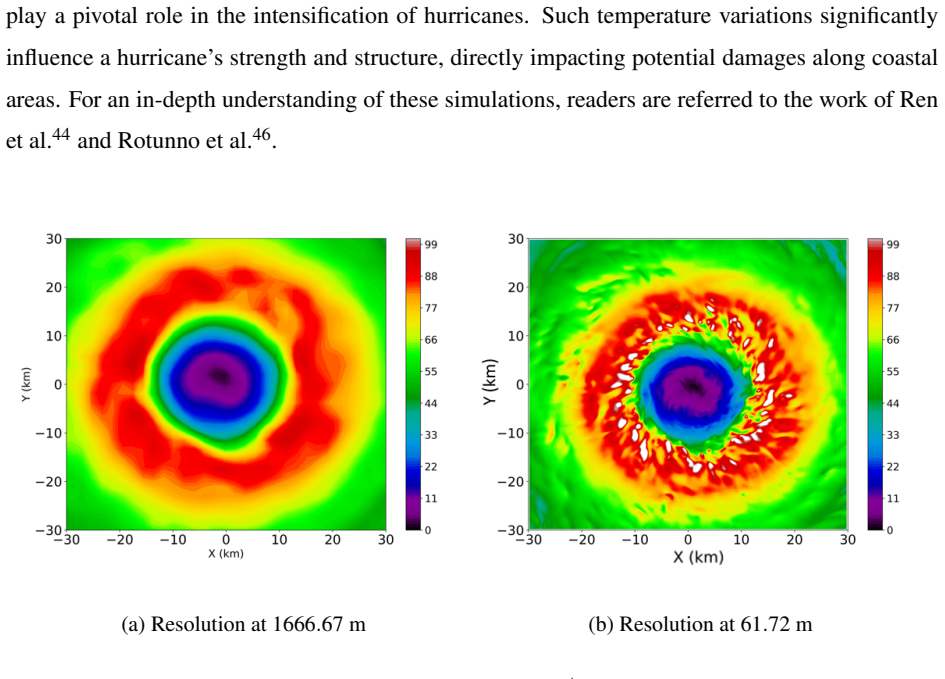
This study develops invariance-embedded machine learning sub-grid-scale (SGS) stress models admitting turbulence kinetic energy (TKE) backscatter towards more accurate large eddy simulation (LES) of meso-scale turbulent hurricane boundary layer flows. The new machine learning SGS model consists of two parts: a classification model used to distinguish regions with either strong energy cascade or energy backscatter from those with mild TKE transfer and a regression model used to calculate SGS stresses in regions with strong TKE transfer. To ease model implementation in computational fluid dynamics (CFD) solvers, the Smagorinsky model with a signed coefficient $C_s$, where a positive value indicates energy cascade while a negative one indicates energy backscatter, is employed as the carrier of the machine learning model. To improve its robustness and generality, both physical invariance and geometric invariance features of turbulent flows are embedded into the model input for classification and regression, and the signed Smagorinsky model coefficient is used as the output of the regression model. Different machine-learning methods and input setups have been used to test the classification model's performance. The F1-scores, which measure balanced precision and recall of a model, of the classification models with physical and geometric invariance embedded can be improved by about $17\%$ over those without considering geometric invariance. Regression models based on ensemble neural networks have demonstrated superior performance in predicting the signed Smagorinsky model coefficient, exceeding that of the dynamic Smagorinsky model in $\textit{a priori}$ tests.
Figures


Figures from the paper (19 more)


Reference graph
Works this paper leans on
-
[1]
merlin.mbs aapmrev4-1.bst 2010-07-25 4.21a (PWD, AO, DPC) hacked
FUNCTION id.bst "merlin.mbs aapmrev4-1.bst 2010-07-25 4.21a (PWD, AO, DPC) hacked" ENTRY address archive archivePrefix author bookaddress booktitle chapter collaboration doi edition editor eid eprint howpublished institution isbn issn journal key language month note number organization pages primaryClass publisher school SLACcitation series title translat...
2010
-
[2]
merlin.mbs aipauth4-1.bst 2010-07-25 4.21a (PWD, AO, DPC) hacked
FUNCTION id.bst "merlin.mbs aipauth4-1.bst 2010-07-25 4.21a (PWD, AO, DPC) hacked" ENTRY address archive archivePrefix author bookaddress booktitle chapter collaboration doi edition editor eid eprint howpublished institution isbn issn journal key language month note number organization pages primaryClass publisher school SLACcitation series title translat...
2010
-
[3]
merlin.mbs aipnum4-1.bst 2010-07-25 4.21a (PWD, AO, DPC) hacked
FUNCTION id.bst "merlin.mbs aipnum4-1.bst 2010-07-25 4.21a (PWD, AO, DPC) hacked" ENTRY address archive archivePrefix author bookaddress booktitle chapter collaboration doi edition editor eid eprint howpublished institution isbn issn journal key language month note number organization pages primaryClass publisher school SLACcitation series title translati...
2010
-
[4]
merlin.mbs apsrev4-1.bst 2010-07-25 4.21a (PWD, AO, DPC) hacked
FUNCTION id.bst "merlin.mbs apsrev4-1.bst 2010-07-25 4.21a (PWD, AO, DPC) hacked" ENTRY address archive archivePrefix author bookaddress booktitle chapter collaboration doi edition editor eid eprint howpublished institution isbn issn journal key language month note number organization pages primaryClass publisher school SLACcitation series title translati...
2010
-
[5]
merlin.mbs apsrmp4-1.bst 2010-07-25 4.21a (PWD, AO, DPC) hacked
FUNCTION id.bst "merlin.mbs apsrmp4-1.bst 2010-07-25 4.21a (PWD, AO, DPC) hacked" ENTRY address archive archivePrefix author bookaddress booktitle chapter collaboration doi edition editor eid eprint howpublished institution isbn issn journal key language month note number organization pages primaryClass publisher school SLACcitation series title translati...
2010
-
[6]
author author I. B. \ Celik , author Z. N. \ Cehreli , \ and\ author I. Yavuz ,\ title title Index of Resolution Quality for Large Eddy Simulations , \ 10.1115/1.1990201 journal journal Journal of Fluids Engineering \ volume 127 ,\ pages 949--958 ( year 2005 ) NoStop
-
[7]
author author G. Matheou ,\ title title Numerical discretization and subgrid-scale model effects on large-eddy simulations of a stable boundary layer , \ @noop journal journal Quarterly Journal of the Royal Meteorological Society \ volume 142 ,\ pages 3050--3062 ( year 2016 ) NoStop
work page 2016
-
[8]
author author E. Bou-Zeid , author C. Meneveau , \ and\ author M. Parlange ,\ title title A scale-dependent Lagrangian dynamic model for large eddy simulation of complex turbulent flows , \ 10.1063/1.1839152 journal journal Physics of Fluids \ volume 17 ,\ pages 025105 ( year 2005 ) NoStop
Show all 77 references
-
[9]
Giraldo \ and\ author M
author author F. Giraldo \ and\ author M. Restelli ,\ title title A study of spectral element and discontinuous galerkin methods for the navier–stokes equations in nonhydrostatic mesoscale atmospheric modeling: Equation sets and test cases , \ https://doi.org/10.1016/j.jcp.200...
-
[10]
author author M. B. \ Hasan , author S. R. \ Guimond , author M. L. \ Yu , author S. Reddy , \ and\ author F. X. \ Giraldo ,\ title title The effects of numerical dissipation on hurricane rapid intensification with observational heating , \ @noop journal journal Journal of Adv...
2022
-
[11]
author author M. L. \ Yu , author F. X. \ Giraldo , author M. Peng , \ and\ author Z. Wang ,\ title title Localized artificial viscosity stabilization of discontinuous galerkin methods for nonhydrostatic mesoscale atmospheric modeling , \ @noop journal journal Monthly Weather ...
2015
-
[12]
author author B. T. \ Nadiga \ and\ author D. Livescu ,\ title title Instability of the perfect subgrid model in implicit-filtering large eddy simulation of geostrophic turbulence , \ 10.1103/PhysRevE.75.046303 journal journal Phys. Rev. E \ volume 75 ,\ pages 046303 ( year 20...
-
[13]
author author J. G. \ Ballouz \ and\ author N. T. \ Ouellette ,\ title title Tensor geometry in the turbulent cascade , \ 10.1017/jfm.2017.802 journal journal Journal of Fluid Mechanics \ volume 835 ,\ pages 1048–1064 ( year 2018 ) NoStop
2017 doi
-
[14]
Linkmann , author M
author author M. Linkmann , author M. Buzzicotti , \ and\ author L. Biferale ,\ title title Multiscale properties of large eddy simulations: correlations between resolved-scale velocity-field increments and subgrid-scale quantities , \ 10.1080/14685248.2018.1462497 journal jou...
-
[15]
author author A. Vela-Martín ,\ title title Subgrid-scale models of isotropic turbulence need not produce energy backscatter , \ 10.1017/jfm.2022.123 journal journal Journal of Fluid Mechanics \ volume 937 ,\ pages A14 ( year 2022 ) NoStop
2022 doi
-
[16]
author author M. F. \ Jansen \ and\ author I. M. \ Held ,\ title title Parameterizing subgrid-scale eddy effects using energetically consistent backscatter , \ https://doi.org/10.1016/j.ocemod.2014.06.002 journal journal Ocean Modelling \ volume 80 ,\ pages 36--48 ( year 2014 ) NoStop
2014 doi
-
[17]
author author I. Grooms ,\ title title Backscatter in energetically-constrained Leith parameterizations , \ 10.1016/j.ocemod.2023.102265 journal journal Ocean Modelling \ volume 186 ,\ eid 102265 ( year 2023 ) NoStop
2023
-
[18]
\ Chang , author A
author author C.-Y. \ Chang , author A. Adcroft , author L. Zanna , author R. Hallberg , \ and\ author S. M. \ Griffies ,\ title title Remote versus local impacts of energy backscatter on the north atlantic sst biases in a global ocean model , \ https://doi.org/10.1029/2023GL1...
-
[19]
author author S. L. \ Brunton , author B. R. \ Noack , \ and\ author P. Koumoutsakos ,\ title title Machine learning for fluid mechanics , \ 10.1146/annurev-fluid-010719-060214 journal journal Annual Review of Fluid Mechanics \ volume 52 ,\ pages 477–508 ( year 2020 ) NoStop
-
[20]
author author K. Duraisamy ,\ title title Perspectives on machine learning-augmented reynolds-averaged and large eddy simulation models of turbulence , \ 10.1103/PhysRevFluids.6.050504 journal journal Phys. Rev. Fluids \ volume 6 ,\ pages 050504 ( year 2021 ) NoStop
-
[21]
Gentine , author V
author author P. Gentine , author V. Eyring , \ and\ author T. Beucler ,\ title Deep learning for the parametrization of subgrid processes in climate models , \ in\ https://doi.org/10.1002/9781119646181.ch21 booktitle Deep Learning for the Earth Sciences \ ( publisher John Wil...
-
[22]
Zanna \ and\ author T
author author L. Zanna \ and\ author T. Bolton ,\ title Deep learning of unresolved turbulent ocean processes in climate models , \ in\ https://doi.org/10.1002/9781119646181.ch20 booktitle Deep Learning for the Earth Sciences \ ( publisher John Wiley & Sons, Ltd ,\ year 2021 )...
-
[23]
Guan , author A
author author Y. Guan , author A. Chattopadhyay , author A. Subel , \ and\ author P. Hassanzadeh ,\ title title Stable a posteriori LES of 2D turbulence using convolutional neural networks: Backscattering analysis and generalization to higher Re via transfer learning , \ 10.10...
-
[24]
Bolton \ and\ author L
author author T. Bolton \ and\ author L. Zanna ,\ title title Applications of deep learning to ocean data inference and subgrid parameterization , \ https://doi.org/10.1029/2018MS001472 journal journal Journal of Advances in Modeling Earth Systems \ volume 11 ,\ pages 376--399...
-
[25]
Frezat , author J
author author H. Frezat , author J. Le Sommer , author R. Fablet , author G. Balarac , \ and\ author R. Lguensat ,\ title title A posteriori learning for quasi-geostrophic turbulence parametrization , \ https://doi.org/10.1029/2022MS003124 journal journal Journal of Advances i...
-
[26]
Cheng , author M
author author Y. Cheng , author M. G. \ Giometto , author P. Kauffmann , author L. Lin , author C. Cao , author C. Zupnick , author H. Li , author Q. Li , author Y. Huang , author R. Abernathey , \ and\ author P. Gentine ,\ title title Deep learning for subgrid-scale turbulenc...
-
[27]
author author A. P. \ Guillaumin \ and\ author L. Zanna ,\ title title Stochastic-deep learning parameterization of ocean momentum forcing , \ https://doi.org/10.1029/2021MS002534 journal journal Journal of Advances in Modeling Earth Systems \ volume 13 ,\ pages e2021MS002534 ...
-
[28]
Yuval \ and\ author P
author author J. Yuval \ and\ author P. A. \ O’Gorman ,\ title title Stable machine-learning parameterization of subgrid processes for climate modeling at a range of resolutions , \ 10.1038/s41467-020-17142-3 journal journal Nature Communications \ volume 11 ( year 2020 ),\ 10...
-
[29]
Guan , author A
author author Y. Guan , author A. Subel , author A. Chattopadhyay , \ and\ author P. Hassanzadeh ,\ title title Learning physics-constrained subgrid-scale closures in the small-data regime for stable and accurate les , \ 10.1016/j.physd.2022.133568 journal journal Physica D: N...
-
[30]
author author M. B. \ Hasan , author M. Yu , \ and\ author H. Xiao ,\ title title Sub-grid scale modeling of meso-scale hurricane boundary layer flows using machine learning , \ in\ @noop booktitle AIAA SCITECH 2023 Forum \ ( year 2023 )\ p.\ pages 2487 NoStop
2023
-
[31]
\ Zhou , author J
author author X.-H. \ Zhou , author J. Han , \ and\ author H. Xiao ,\ title title Frame-independent vector-cloud neural network for nonlocal constitutive modelling on arbitrary grids , \ @noop journal journal Computer Methods in Applied Mechanics and Engineering \ ( year 2022 ) NoStop
2022
-
[32]
Ling , author R
author author J. Ling , author R. Jones , \ and\ author J. Templeton ,\ title title Machine learning strategies for systems with invariance properties , \ https://doi.org/10.1016/j.jcp.2016.05.003 journal journal Journal of Computational Physics \ volume 318 ,\ pages 22--35 ( ...
2016 doi
-
[33]
Meneveau \ and\ author J
author author C. Meneveau \ and\ author J. Katz ,\ title title Scale-invariance and turbulence models for large-eddy simulation , \ 10.1146/annurev.fluid.32.1.1 journal journal Annual Review of Fluid Mechanics \ volume 32 ,\ pages 1--32 ( year 2000 ) ,\ http://arxiv.org/abs/ht...
-
[34]
Sagaut ,\ @noop title Large Eddy Simulation for Incompressible Flows: An Introduction ,\ edition 3rd \ ed.\ ( publisher Springer ,\ year 2006 ) NoStop
author author P. Sagaut ,\ @noop title Large Eddy Simulation for Incompressible Flows: An Introduction ,\ edition 3rd \ ed.\ ( publisher Springer ,\ year 2006 ) NoStop
2006
-
[35]
author author G. B. \ A. Vollant \ and\ author C. Corre ,\ title title Subgrid-scale scalar flux modelling based on optimal estimation theory and machine-learning procedures , \ 10.1080/14685248.2017.1334907 journal journal Journal of Turbulence \ volume 18 ,\ pages 854--878 (...
2017
-
[36]
Vreman , author B
author author A. Vreman , author B. Geurts , \ and\ author H. Kuerten ,\ title title Subgrid-modeling in les of compressible flow , \ 10.1007/BF00849116 journal journal Applied Scientific Research \ volume 54 ,\ pages 191--203 ( year 1995 ) NoStop
-
[37]
Carati , author S
author author D. Carati , author S. Ghosal , \ and\ author P. Moin ,\ title title On the representation of backscatter in dynamic localization models , \ 10.1063/1.868585 journal journal Physics of Fluids \ volume 7 ,\ pages 606--616 ( year 1995 ) NoStop
-
[38]
author author R. M. \ Kerr , author J. A. \ Domaradzki , \ and\ author G. Barbier ,\ title title Small‐scale properties of nonlinear interactions and subgrid‐scale energy transfer in isotropic turbulence , \ 10.1063/1.868827 journal journal Physics of Fluids \ volume 8 ,\ page...
-
[39]
author author P. J. \ Mason \ and\ author D. J. \ Thomson ,\ title title Stochastic backscatter in large-eddy simulations of boundary layers , \ 10.1017/S0022112092002271 journal journal Journal of Fluid Mechanics \ volume 242 ,\ pages 51–78 ( year 1992 ) NoStop
-
[40]
author author J. A. \ Domaradzki ,\ title title Large eddy simulations of high reynolds number turbulence based on interscale energy transfer among resolved scales , \ 10.1103/PhysRevFluids.6.044609 journal journal Phys. Rev. Fluids \ volume 6 ,\ pages 044609 ( year 2021 ) NoStop
-
[41]
Nabavi \ and\ author J
author author M. Nabavi \ and\ author J. Kim ,\ title title Optimising subgrid-scale closures for spectral energy transfer in turbulent flows , \ 10.1017/jfm.2024.101 journal journal Journal of Fluid Mechanics \ volume 982 ,\ pages A18 ( year 2024 ) NoStop
2024 doi
-
[42]
Beck , author D
author author A. Beck , author D. Flad , \ and\ author C.-D. \ Munz ,\ title title Deep neural networks for data-driven LES closure models , \ https://doi.org/10.1016/j.jcp.2019.108910 journal journal Journal of Computational Physics \ volume 398 ,\ pages 108910 ( year 2019 ) NoStop
2019
-
[43]
Zhou , author S
author author Z. Zhou , author S. Wang , author X. Yang , \ and\ author G. Jin ,\ title title A structural subgrid-scale model for the collision-related statistics of inertial particles in large-eddy simulations of isotropic turbulent flows , \ 10.1063/5.0018756 journal journa...
-
[44]
Xie , author Z
author author C. Xie , author Z. Yuan , \ and\ author J. Wang ,\ title title Artificial neural network-based nonlinear algebraic models for large eddy simulation of turbulence , \ 10.1063/5.0025138 journal journal Physics of Fluids \ volume 32 ,\ pages 115101 ( year 2020 ) NoStop
-
[45]
Xie , author J
author author C. Xie , author J. Wang , \ and\ author W. E ,\ title title Modeling subgrid-scale forces by spatial artificial neural networks in large eddy simulation of turbulence , \ 10.1103/PhysRevFluids.5.054606 journal journal Phys. Rev. Fluids \ volume 5 ,\ pages 054606 ...
-
[46]
Sroka \ and\ author S
author author S. Sroka \ and\ author S. Guimond ,\ title title Organized kinetic energy backscatter in the hurricane boundary layer from radar measurements , \ @noop journal journal Journal of Fluid Mechanics \ volume 924 ( year 2021 ) NoStop
2021
-
[47]
Piomelli \ and\ author E
author author U. Piomelli \ and\ author E. Balaras ,\ title title Wall-layer models for large-eddy simulations , \ 10.1146/annurev.fluid.34.082901.144919 journal journal Annual Review of Fluid Mechanics \ volume 34 ,\ pages 349--374 ( year 2002 ) NoStop
-
[48]
Germano , author U
author author M. Germano , author U. Piomelli , author P. Moin , \ and\ author W. H. \ Cabot ,\ title title A dynamic subgrid-scale eddy viscosity model , \ https://doi.org/10.1063/1.859315 journal journal Physics of Fluids A: Fluid Dynamics \ volume 3 ,\ pages 1760--1764 ( ye...
-
[49]
Ren , author J
author author H. Ren , author J. Dudhia , \ and\ author H. Li ,\ title title Large-eddy simulation of idealized hurricanes at different sea surface temperatures , \ https://doi.org/10.1029/2020MS002057 journal journal Journal of Advances in Modeling Earth Systems \ volume 12 ,...
-
[50]
author author W. C. \ Skamarock , author J. B. \ Klemp , author J. Dudhia , author O. Gill , author Z. Liu , author J. Berner , author W. Wang , author G. Powers , author G. Duda , author D. M. \ Barker , \ and\ author X. yu Huang ,\ title title A description of the advanced r...
-
[51]
Rotunno , author Y
author author R. Rotunno , author Y. Chen , author W. Wang , author C. Davis , author J. Dudhia , \ and\ author G. J. \ Holland ,\ title title Large-eddy simulation of an idealized tropical cyclone , \ 10.1175/2009BAMS2884.1 journal journal Bulletin of the American Meteorologi...
-
[52]
author author A. N. \ Kolmogorov ,\ title title The local structure of turbulence in incompressible viscous fluid for very large reynolds numbers , \ http://www.jstor.org/stable/51980 journal journal Proceedings: Mathematical and Physical Sciences \ volume 434 ,\ pages 9--13 (...
1991
-
[53]
Pope ,\ title title Turbulent flows , \ https://doi.org/10.1017/CBO9780511840531 \ ( year 2000 ),\ https://doi.org/10.1017/CBO9780511840531 NoStop
author author S. Pope ,\ title title Turbulent flows , \ https://doi.org/10.1017/CBO9780511840531 \ ( year 2000 ),\ https://doi.org/10.1017/CBO9780511840531 NoStop
2000 doi
-
[54]
Durbin \ and\ author B
author author P. Durbin \ and\ author B. A. P. \ Reif ,\ @noop title Statistical theory and modelling for turbulent flows ,\ edition 2nd \ ed.\ ( publisher John Wiley and Sons ,\ year 2011 ) NoStop
2011
-
[55]
author author D. C. \ Wilcox ,\ @noop title Turbulence Modeling for CFD (2nd ed.) \ ( publisher DCW Industries, La Cañada ,\ year 2008 ) NoStop
2008
-
[56]
author author D. K. \ Lilly ,\ title title The representation of small-scale turbulence in numerical simulation experiments , \ in\ @noop booktitle Proceedings of the IBM Scientific Computing Symposium on Environmental Sciences \ ( organization IBM ,\ address Yorktown Heights,...
1967
-
[57]
Wang , author J.-L
author author J. Wang , author J.-L. \ Wu , \ and\ author H. Xiao ,\ title title Physics-informed machine learning approach for reconstructing reynolds stress modeling discrepancies based on dns data , \ @noop journal journal Physical Review Fluids \ volume 2 ,\ pages 034603 (...
2017
-
[58]
\ Wu , author H
author author J.-L. \ Wu , author H. Xiao , \ and\ author E. Paterson ,\ title title Physics-informed machine learning approach for augmenting turbulence models: A comprehensive framework , \ 10.1103/PhysRevFluids.3.074602 journal journal Phys. Rev. Fluids \ volume 3 ,\ pages ...
-
[59]
author author M. B. \ Hasan , author M. Yu , \ and\ author T. Oates ,\ title title Comparison of several neural network-enhanced sub-grid scale stress models for meso-scale hurricane boundary layer flow simulation , \ in\ 10.2514/6.2025-2212 booktitle AIAA SCITECH 2025 Forum \...
-
[60]
author author B. D. \ Tracey , author K. Duraisamy , \ and\ author J. J. \ Alonso ,\ title title Application of supervised learning to quantify uncertainties in turbulence and combustion modeling , \ @noop journal journal 51st AIAA Aerospace Sciences Meeting including the New ...
2013
-
[61]
author author H. E. \ Willoughby ,\ title title Temporal changes of the primary circulation in tropical cyclones , \ @noop journal journal Journal of the Atmospheric Sciences \ volume 47 ,\ pages 242--264 ( year 1990 ) NoStop
1990
-
[62]
author author F. D. \ Marks , author P. G. \ Black , author M. T. \ Montgomery , \ and\ author R. W. \ Burpee ,\ title title Structure of the eye and eyewall of hurricane hugo (1989) , \ @noop journal journal Monthly Weather Review \ volume 136 ,\ pages 1237--1259 ( year 2008 ) NoStop
1989
-
[63]
Paszke , author S
author author A. Paszke , author S. Gross , author F. Massa , author A. Lerer , author J. Bradbury , author G. Chanan , author T. Killeen , author Z. Lin , author N. Gimelshein , author L. Antiga , author A. Desmaison , author A. Kopf , author E. Yang , author Z. DeVito , auth...
2019
-
[64]
author author I. J. \ Good ,\ title title Rational decisions , \ @noop journal journal Journal of the Royal Statistical Society. Series B (Methodological) \ volume 14 ,\ pages 107--114 ( year 1952 ) NoStop
1952
-
[65]
author author D. E. \ Rumelhart , author G. E. \ Hinton , \ and\ author R. J. \ Williams ,\ title title Learning representations by back-propagating errors , \ @noop journal journal Nature \ volume 323 ,\ pages 533--536 ( year 1986 ) NoStop
1986
-
[66]
author author D. M. \ Hawkins ,\ title title The problem of overfitting , \ 10.1021/ci0342472 journal journal Journal of Chemical Information and Computer Sciences \ volume 44 ,\ pages 1--12 ( year 2004 ) NoStop
2004 doi
-
[67]
Srivastava , author G
author author N. Srivastava , author G. Hinton , author A. Krizhevsky , author I. Sutskever , \ and\ author R. Salakhutdinov ,\ title title Dropout: A simple way to prevent neural networks from overfitting , \ http://jmlr.org/papers/v15/srivastava14a.html journal journal Journ...
1929
-
[68]
author author F. D. \ Foresee \ and\ author M. T. \ Hagan ,\ title title Gauss-newton approximation to bayesian learning , \ https://api.semanticscholar.org/CorpusID:18793440 journal journal Proceedings of International Conference on Neural Networks (ICNN'97) \ volume 3 ,\ pag...
1930
-
[69]
author author D. J. C. \ MacKay ,\ title title A Practical Bayesian Framework for Backpropagation Networks , \ 10.1162/neco.1992.4.3.448 journal journal Neural Computation \ volume 4 ,\ pages 448--472 ( year 1992 ) ,\ http://arxiv.org/abs/https://direct.mit.edu/neco/article-pd...
1992 doi
-
[70]
author author M. B. \ Hasan , author M. Yu , \ and\ author T. Oates ,\ title title Evaluating machine learning-enhanced sub-grid scale stress models with invariance embedding for meso-scale hurricane boundary layer flows , \ in\ @noop booktitle ASME Fluids Engineering Division...
2025
-
[71]
author author D. W. \ Hosmer , author S. Lemeshow , \ and\ author R. X. \ Sturdivant ,\ @noop title Applied Logistic Regression \ ( publisher Wiley ,\ year 2013 ) NoStop
2013
-
[72]
Cortes \ and\ author V
author author C. Cortes \ and\ author V. Vapnik ,\ title title Support-vector networks , \ @noop journal journal Machine learning \ volume 20 ,\ pages 273--297 ( year 1995 ) NoStop
1995
-
[73]
Breiman ,\ title title Random forests , \ @noop journal journal Machine Learning \ volume 45 ,\ pages 5--32 ( year 2001 ) NoStop
author author L. Breiman ,\ title title Random forests , \ @noop journal journal Machine Learning \ volume 45 ,\ pages 5--32 ( year 2001 ) NoStop
2001
-
[74]
author author J. H. \ Friedman ,\ title title Greedy function approximation: A gradient boosting machine. \ @noop journal journal The Annals of Statistics \ volume 29 ,\ pages 1189 -- 1232 ( year 2001 ) NoStop
2001
-
[75]
LeCun , author Y
author author Y. LeCun , author Y. Bengio , \ and\ author G. Hinton ,\ title title Deep learning , \ @noop journal journal nature \ volume 521 ,\ pages 436--444 ( year 2015 ) NoStop
2015
-
[76]
Goodfellow , author Y
author author I. Goodfellow , author Y. Bengio , \ and\ author A. Courville ,\ @noop title Deep Learning \ ( publisher The MIT Press ,\ year 2016 ) NoStop
2016
-
[77]
author author J. Schmidhuber ,\ title title Deep learning in neural networks: An overview , \ 10.1016/j.neunet.2014.09.003 journal journal Neural Networks \ volume 61 ,\ pages 85--117 ( year 2015 ) NoStop
2014 doi
Reviewed August 16, 2026 · model on record in the stance chip above.
Discussion (0). Continue with ORCID to comment.