REVIEW 3 major objections 5 minor 1 cited by
ExoMiner++: Enhanced Transit Classification and a New Vetting Catalog for 2-Minute TESS Data
T0 review · 3 major / 5 minor · reviewed 2026-08-07 · deepseek-v4-flash
Pith's one-line read ExoMiner++ claims that a deep network fed with five new diagnostic inputs—difference images, periodograms, flux trends, unfolded flux, and momentum-dump flags—can classify TESS 2-minute transit signals and rank candidates so precisely…
desk verdict Useful model and public catalog, but the headline precision belongs to the easy labeled subset; the only holdout from the ambiguous catalog population shows 0.76 precision, so the 7,330-PC claim needs a caveat. read the letter →
The pith
A machine-rendered reading of the paper's core claim, the machinery that carries it, and where it could break.
The reading
What carries the argument
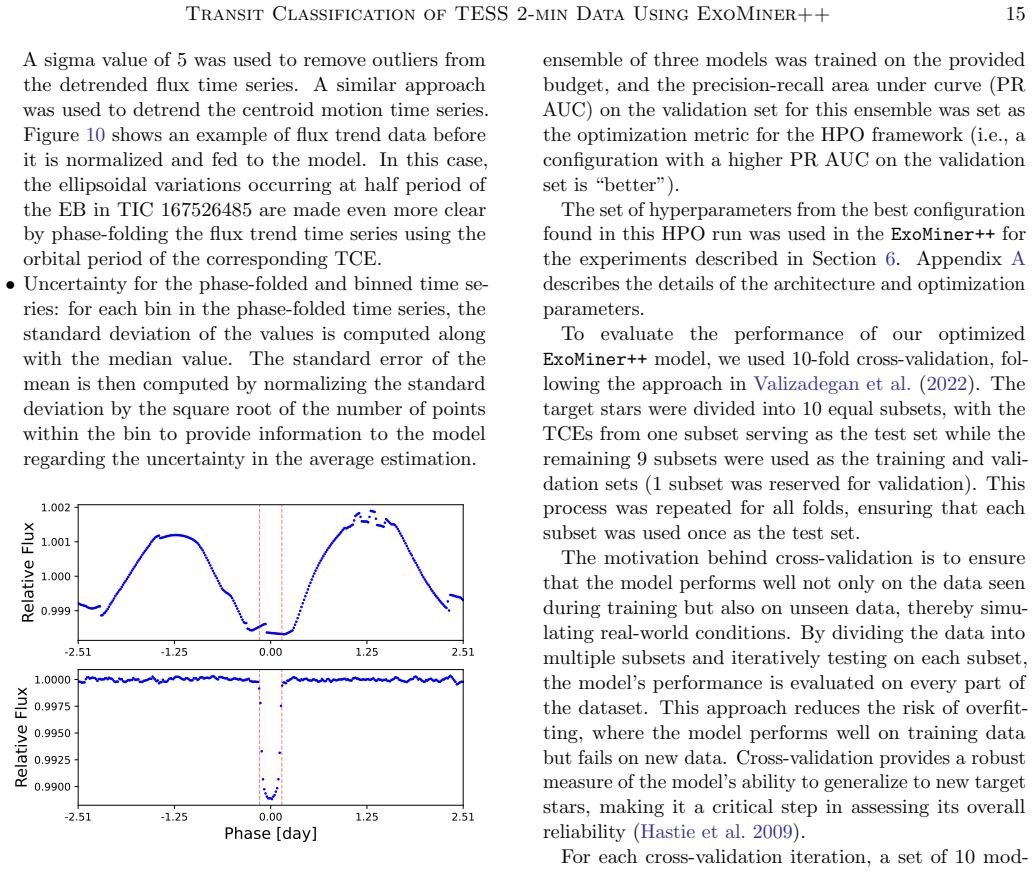
The engine is a multi-branch convolutional network whose branches mirror the diagnostic tests in the telescope's Data Validation report: phase-folded flux, odd/even flux, weak secondary, centroid motion, unfolded flux, difference image, periodogram, flux trend, and momentum-dump time series, plus stellar parameters and detection statistics as scalars. Each branch has its own feature extractor, and the three transit-view flux branches share low-level convolutional features; the model also receives the standard error of each phase bin as an extra channel. Two additional mechanisms drive much of the gain: multi-source learning, which mixes clean Kepler labels into the noisier TESS training set, and multi-sector aggregation, which assigns one score per physical event based on the longest sector run. Detrending was switched from a spline fit to a Savitzky-Golay filter, and the removed trend is fed back in as its own branch, letting the model see signals like ellipsoidal variations that occur at the orbital period timescale.
What would settle it
Follow up the 50 newly introduced CTOIs with radial-velocity and high-resolution imaging; if most turn out to be eclipsing binaries, background transits, or other false positives rather than planets, the claim that ExoMiner++ ranks the most likely candidates would be refuted.
Extended reading notes
Core claim
The paper's central claim is that one convolutional architecture, ExoMiner++, can perform automated transit vetting for TESS at a level that narrows the follow-up search space while keeping few false positives at the top. For each TCE the model outputs a score between 0 and 1; a score above 0.5 counts as a planet candidate. On the labeled TESS dataset, the best configuration, trained on TESS plus Kepler and aggregated across sectors, reports precision 0.933, recall 0.951, PR AUC 0.976, and ROC AUC 0.998. Ranking quality is the headline: every one of the top 200 TCEs is an exoplanet, Precision@1000 is at least 0.99 across models, and Precision@3000 is 0.977 for the TESS+Kepler aggregate model. The paper argues this ranking transfers to unlabeled data: 7,330 of 147,568 unlabeled TCEs are classified as planet candidates, corresponding to 1,868 matched TOIs and 50 new CTOIs introduced by the authors. A temporal check adds support: of 151 TCEs promoted from uncertain TOI dispositions to confirmed planets between January and December 2024, ExoMiner++ scored 147 as planet candidates.
Load-bearing premise
The training and evaluation labels for non-planets, mostly non-transiting phenomena from flux triage and eclipsing binaries from the EB catalog, are accurate enough to serve as ground truth, despite acknowledged noise and failed ephemeris matches.
Editorial extensions
If this is right
- Follow-up programs can target roughly 7,330 planet candidates instead of 147,568 unlabeled threshold-crossing events, with the top of the ranking consisting almost entirely of exoplanets.
- TOIs with uncertain community dispositions can be re-ranked by model score; among 151 TOIs later confirmed as planets, 147 received candidate scores, suggesting the ranking can anticipate future confirmations.
- The public catalog provides a confidence score per TCE and per TOI, allowing observers to schedule follow-up by score threshold and to revisit borderline cases.
- The same architecture and preprocessing are directly portable to TESS full-frame-image data and to future transit surveys, since all branches consume standard diagnostics rather than mission-specific features.
- If ranking quality persists, the overall yield of confirmed planets per observation hour should rise because telescope time will be spent on high-score candidates.
Reading between the lines
- Because ExoMiner++ scores are not calibrated probabilities, the 0.5 cutoff is a working threshold, not a posterior; comparing scores across surveys or converting them into false-positive rates would require a separate calibration step.
- The paper's label-noise examples cut both ways: if true planets are sometimes labeled as eclipsing binaries or non-transiting phenomena, the reported recall on TESS may be an underestimate, and the true precision of the 7,330-candidate catalog could be better than the labeled-set metrics suggest.
- A clean prospective test would be to score each newly dispositioned TOI as the follow-up community updates its catalog over the next year, avoiding the circularity of evaluating on the same surrogate labels used for training.
- The contaminated-aperture and nearby-background-transit subclasses remain the weakest spots, so adding known nearby-star positions and brightnesses as extra difference-image channels is a natural, testable extension in crowded fields.
Signed reviews
Editorial analysis
A structured set of objections, weighed in public.
Referee Report
Summary. ExoMiner++ is a deep-learning classifier for TESS 2-minute transit signals that extends the earlier ExoMiner architecture with five new input branches: transit-view unfolded flux, difference image, phase-folded momentum dump flags, a Lomb-Scargle periodogram, and a full-orbit folded flux trend. The model is trained with multi-source learning on Kepler plus TESS labels derived from ExoFOP, the Villanova EB catalog, and TESS-ExoClass NTPs, and is evaluated with 10-fold cross-validation using target-star splits. The authors report precision/recall of 0.933/0.951 and PR AUC 0.976 on the labeled TESS subset with TESS+Kepler aggregate scoring, show via ablations that most new branches improve performance, and release a vetting catalog in which 7,330 of 147,568 previously unlabeled TCEs are classified as planet candidates, including 50 newly introduced CTOIs.
Significance. If the catalog is as reliable as the headline metrics suggest, this is a substantial community resource: it narrows the TESS follow-up target list, provides confidence scores for ranking, and introduces new candidates. The paper has genuine strengths: the code is public, the cross-validation scheme splits on target stars rather than TCEs, the ablation study in Section 6.9 tests each new branch against a baseline, and the authors are unusually candid about label noise and ephemeris-matching failures in Section 4.1 and Section 6.7. The main deliverable is the 7,330-planet-candidate catalog, and the decision-relevant performance question is how well the model discriminates on the ambiguous, previously unlabeled population. The paper's own Section 7 evidence indicates that precision is substantially lower there than on the certain-label test set, so the catalog claim needs additional validation or careful qualification before it can be fully credited.
major comments (3)
- [Section 7 and Table 6] The decision-relevant precision for the catalog is not the Table 6 value of 0.933 on the certain-label TESS set, but the precision on TCEs that were unlabeled or uncertain in January 2024 and later resolved. The paper's own Section 7 calculation gives 147/(147+47)=0.76 precision and 0.97 recall on the 293 TCEs whose labels changed from PC/APC/FA to CP/FP between January and December 2024. That is a large drop from 0.933, and the 293-TCE subset is enriched in planets (prior about 0.5), whereas the full 147,568 UNK pool almost certainly has a much lower planet fraction. At a lower prior, precision at score>0.5 would fall further. Since the abstract's "7,330 planet candidates" and the implied follow-up prioritization rest on the UNK population, please report precision/recall and score-threshold curves directly for the label-transition subset, and either validate the catalog on a held-out ambiguous sample or substantially qualify the headline precision claim.
- [Section 4.1 and Section 6.7, item 4] The training and evaluation labels are surrogate labels from ExoFOP, the Villanova EB catalog, and TESS-ExoClass NTP triage. Section 6.7 gives explicit examples of known planets mislabeled as EBs (e.g., TIC 309792357 TCEs) and of planets mislabeled as NTPs due to failed ephemeris matching, and the authors acknowledge that the Villanova catalog has label noise. Because the same label-generation procedure produces both the training targets and the Table 6 evaluation labels, the reported 0.933/0.951 may be optimistically biased, and the 7,330 catalog classifications inherit that bias. Please add a quantitative label-noise robustness analysis, for example by re-evaluating on TCEs whose ExoFOP disposition changed between January and December 2024, or by reporting performance after removing Villanova/TEC labels that cannot be independently confirmed.
- [Section 7 (catalog construction)] The 50 newly introduced CTOIs are carefully vetted, but they are only a small subset of the 7,330 planet candidates. After the aggressive period matching, 427 unmatched TCEs remain and are reduced to 288 events and then to 91 high-confidence potential CTOIs by requiring consensus across all ten models and at least three observed transits; only these 91 are manually reviewed. The remaining thousands of PC classifications, including the 6,322 TCEs matched to existing TOIs and the 1,008 unmatched TCEs, do not receive the same SME scrutiny. Please state explicitly how many of the 7,330 are in each category and give separate expected-precision estimates for matched versus unmatched TCEs, so that the catalog's overall precision claim is not conflated with the well-vetted 50-CTOI list.
minor comments (5)
- [Abstract vs. Section 7] The abstract states 147,568 unlabeled TCEs, while Section 7 states 147,567 unlabeled TCEs. The numbers should be reconciled.
- [Tables and figures throughout] There are many typographical errors in the text and tables, including "T able", "T ransit", "V alizadegan", "TYIC" in Table 15, and "MESS" in figure axis labels. A careful proofread is needed.
- [Figure 6 and Figure 7 captions] The Figure 6 caption identifies TIC 82707763-1-S37 as TOI 1991.01, while the Figure 7 caption identifies the same TCE as TOI 1046.01 and refers to the target as TIC 309787037. The target identifier in the Figure 7 caption appears to be a copy-paste error and should be corrected.
- [Section 6.4] The sentence "There is no clearn pattern" should read "no clear pattern," and the surrounding discussion of MES and performance would benefit from a more direct presentation of the heatmap values.
- [Section 6.2] The description of multi-source learning says the simpler combining approach proved more effective, but the paper does not report the transfer-learning or fine-tuning comparison quantitatively. A sentence stating that those results are omitted for brevity would help the reader interpret the claim.
Circularity Check
No significant circularity: ExoMiner++ is a supervised classifier with held-out evaluation; the catalog counts are direct threshold outputs.
full rationale
The paper's derivation chain is self-contained: DV diagnostics are preprocessed into fixed-size inputs (Section 4.2), a deep network is trained with binary cross-entropy on labels assembled from ExoFOP, the Villanova EB catalog, and TESS-ExoClass NTPs plus Kepler data (Sections 4.1, 5), and performance is measured by 10-fold cross-validation on held-out target-star folds (Section 5, Table 6). The catalog claim of 7,330 planet candidates among 147,567 unlabeled TCEs is a direct application of the trained ensemble's thresholded scores (Section 7, Table 14), not a quantity that was fit to those TCEs. The additional holdout in Section 7, using 293 TCEs whose labels changed from PC/APC/FA to CP/FP between January and December 2024, is genuine out-of-sample evidence on the previously ambiguous population; the reported precision=0.76 versus the headline 0.933 is a generalization gap, not a circular reduction. The acknowledged label noise and ephemeris-matching failures (Sections 4.1 and 6.7) are validity limitations that could bias metrics, but they do not make any prediction equivalent to its training input by construction. Self-citations to ExoMiner (Valizadegan et al. 2022) describe architectural lineage and prior comparisons, but no load-bearing claim in this paper rests on an unverified self-citation or an imported uniqueness theorem. The central classification and ranking results are independently evaluated on held-out data, so no circular step is exhibited.
Assumptions & free parameters
free parameters (5)
- classification score threshold =
0.5
- ephemeris matching threshold =
0.75 cosine similarity
- CTOI period matching tolerance =
1%
- minimum observed transits for CTOI candidate =
3
- Savitzky-Golay detrending window =
1.2 days
assumptions (5)
- domain assumption The ExoFOP, Villanova EB, and TESS-ExoClass catalogs provide sufficiently accurate ground-truth labels for training and evaluation.
- domain assumption Photometric diagnostics from SPOC data-validation reports contain enough information to distinguish planets from false positives in TESS data.
- domain assumption Kepler labels transfer to TESS through multi-source learning.
- standard math Backpropagation and the universal approximation theorem justify training a deep CNN for this classification task.
- domain assumption Splitting by target star prevents data leakage between training and test folds.
Cite this review
Pith. "Pith review of ExoMiner++: Enhanced Transit Classification and a New Vetting Catalog for 2-Minute TESS Data." pith.science (2026). https://pith.science/paper/RWZEEJAI
@misc{pith2026250209790,
  author       = {Pith},
  title        = {Pith review of: ExoMiner++: Enhanced Transit Classification and a New Vetting Catalog for 2-Minute TESS Data},
  year         = {2026},
  howpublished = {\url{https://pith.science/paper/RWZEEJAI}},
  note         = {Machine review of arXiv:2502.09790}
}
read the original abstract
We present ExoMiner++, an enhanced deep learning model that builds on the success of ExoMiner to improve transit signal classification in 2-minute TESS data. ExoMiner++ incorporates additional diagnostic inputs, including periodogram, flux trend, difference image, unfolded flux, and spacecraft attitude control data, all of which are crucial for effectively distinguishing transit signals from more challenging sources of false positives. To further enhance performance, we leverage multi-source training by combining high-quality labeled data from the Kepler space telescope with TESS data. This approach mitigates the impact of TESS's noisier and more ambiguous labels. ExoMiner++ achieves high accuracy across various classification and ranking metrics, significantly narrowing the search space for follow-up investigations to confirm new planets. To serve the exoplanet community, we introduce new TESS catalog containing ExoMiner++ classifications and confidence scores for each transit signal. Among the 147,568 unlabeled TCEs, ExoMiner++ identifies 7,330 as planet candidates, with the remainder classified as false positives. These 7,330 planet candidates correspond to 1,868 existing TESS Objects of Interest (TOIs), 69 Community TESS Objects of Interest (CTOIs), and 50 newly introduced CTOIs. 1,797 out of the 2,506 TOIs previously labeled as planet candidates in ExoFOP are classified as planet candidates by ExoMiner++. This reduction in plausible candidates combined with the excellent ranking quality of ExoMiner++ allows the follow-up efforts to be focused on the most likely candidates, increasing the overall planet yield.
Figures


Figures from the paper (18 more)






Forward citations
Cited by 1 Pith paper
-
The TESS Ten Thousand Catalog: 10,001 uniformly-vetted and -validated Eclipsing Binary Stars detected in Full-Frame Image data by machine learning and analyzed by citizen scientists
A uniformly vetted catalog of 10,001 eclipsing binary stars from TESS full-frame images, including 7,936 new systems and 2,065 corrected ephemerides.
Reference graph
Works this paper leans on
-
[1]
, " * write output.state after.block = add.period write newline
ENTRY address archivePrefix author booktitle chapter doi edition editor eprint howpublished institution journal key month number organization pages publisher school series title misctitle type volume year version url label extra.label sort.label short.list INTEGERS output.state before.all mid.sentence after.sentence after.block FUNCTION init.state.consts ...
-
[2]
write newline
" write newline "" before.all 'output.state := FUNCTION format.url url empty "" new.block "" url * "" * if FUNCTION format.eprint eprint empty "" archivePrefix empty "" archivePrefix "arXiv" = new.block " " eprint * " " * new.block " " eprint * " " * if if if FUNCTION format.doi doi empty "" " " doi * " " * if FUNCTION format.pid doi empty eprint empty ur...
-
[3]
- [1] #1 = = ^ ^ ^ .\!\!^ d .\!\!^ h .\!\!^ m .\!\!^ s .\!\!^ @mss
thebibliography [1] 20pt to REFERENCES 6pt =0pt -12pt 10pt plus 3pt =0pt =0pt =1pt plus 1pt =0pt =0pt -12pt =13pt plus 1pt =20pt =13pt plus 1pt \@M =10000 =-1.0em =0pt =0pt 0pt =0pt =1.0em @enumiv\@empty 10000 10000 `\.\@m \@noitemerr \@latex@warning Empty `thebibliography' environment \@ifnextchar \@reference \@latexerr Missing key on reference command E...
2021
-
[5]
Ansdell, M., Ioannou, Y., Osborn, H. P., et al. 2018, The Astrophysical Journal, 869, L7, 10.3847/2041-8213/aaf23b
-
[6]
Armstrong, D. J., Gamper, J., & Damoulas, T. 2020, Monthly Notices of the Royal Astronomical Society, 504, 5327–5344, 10.1093/mnras/staa2498
-
[7]
Bishop, C. M. 2006, Pattern Recognition and Machine Learning (Information Science and Statistics) (Berlin, Heidelberg: Springer-Verlag)
2006
-
[8]
J., Koch, D., Basri, G., et al
Borucki, W. J., Koch, D., Basri, G., et al. 2010, Science, 327, 977
2010
-
[9]
2001, Machine Learning, 45, 5, 10.1023/A:1010933404324
Breiman, L. 2001, Machine Learning, 45, 5, 10.1023/A:1010933404324
Show all 62 references
-
[10]
Coughlin, J. L. 2017, KSCI-19114-001
2017
-
[11]
2021, The Astronomical Journal, 163, 23, 10.3847/1538-3881/ac3482
Cui, K., Liu, J., Feng, F., & Liu, J. 2021, The Astronomical Journal, 163, 23, 10.3847/1538-3881/ac3482
2021 doi
-
[12]
2018 a , in International conference on machine learning, PMLR, 1437--1446
Falkner, S., Klein, A., & Hutter, F. 2018 a , in International conference on machine learning, PMLR, 1437--1446
2018
-
[13]
2018 b , CoRR, abs/1807.01774
Falkner, S., Klein, A., & Hutter, F. 2018 b , CoRR, abs/1807.01774. 1807.01774
2018 arXiv
-
[14]
2023 a , The Astrophysical Journal Supplement Series, 268, 4, 10.3847/1538-4365/acdee5
Fetherolf, T., Pepper, J., Simpson, E., et al. 2023 a , The Astrophysical Journal Supplement Series, 268, 4, 10.3847/1538-4365/acdee5
2023 doi
-
[15]
2023 b , The Astrophysical Journal Supplement Series, 268, 4
---. 2023 b , The Astrophysical Journal Supplement Series, 268, 4
2023
-
[16]
1969, IEEE Transactions on Systems Science and Cybernetics, 5, 322
Fukushima, K. 1969, IEEE Transactions on Systems Science and Cybernetics, 5, 322
1969
-
[17]
D., Jensen, E
Giacalone, S., Dressing, C. D., Jensen, E. L. N., et al. 2020, The Astronomical Journal, 161, 24, 10.3847/1538-3881/abc6af
2020 doi
-
[18]
M., Seager , S., Huang , C
Guerrero , N. M., Seager , S., Huang , C. X., et al. 2021, , 254, 39, 10.3847/1538-4365/abefe1
2021 doi
-
[19]
T., & Dittmann, J
Hansen, M. T., & Dittmann, J. A. 2024, Single Transit Detection In Kepler With Machine Learning And Onboard Spacecraft Diagnostics. 2403.03427
2024 arXiv
-
[20]
2009, The Elements of Statistical Learning: Data Mining, Inference, and Prediction, Second Edition (Springer Series in Statistics)
Hastie, T., Tibshirani, R., & Friedman, J. 2009, The Elements of Statistical Learning: Data Mining, Inference, and Prediction, Second Edition (Springer Series in Statistics)
2009
-
[21]
2015, in Proceedings of the IEEE international conference on computer vision, 1026--1034
He, K., Zhang, X., Ren, S., & Sun, J. 2015, in Proceedings of the IEEE international conference on computer vision, 1026--1034
2015
-
[22]
1989, Neural Networks, 2, 359, https://doi.org/10.1016/0893-6080(89)90020-8
Hornik, K., Stinchcombe, M., & White, H. 1989, Neural Networks, 2, 359, https://doi.org/10.1016/0893-6080(89)90020-8
1989 doi
-
[23]
Jenkins, J. M. 2020, KSCI-19081-003
2020
-
[24]
M., McCauliff , S., Burke , C., et al
Jenkins , J. M., McCauliff , S., Burke , C., et al. 2014, in Formation, Detection, and Characterization of Extrasolar Habitable Planets, ed. N. Haghighipour , Vol. 293, 94--99, 10.1017/S1743921313012611
2014 doi
-
[25]
M., Twicken, J
Jenkins, J. M., Twicken, J. D., McCauliff, S., et al. 2016, in Society of Photo-Optical Instrumentation Engineers (SPIE) Conference Series, Vol. 9913, Software and Cyberinfrastructure for Astronomy IV, ed. G. Chiozzi & J. C. Guzman, 99133E, 10.1117/12.2233418
2016 doi
-
[26]
T., & Cadima, J
Jolliffe, I. T., & Cadima, J. 2016, Philosophical Transactions of the Royal Society A: Mathematical, Physical and Engineering Sciences, 374. https://api.semanticscholar.org/CorpusID:20101754
2016
-
[27]
Kingma, D. P. 2014, arXiv preprint arXiv:1412.6980
2014 arXiv
-
[28]
Krizhevsky, A., Sutskever, I., & Hinton, G. E. 2012, in Advances in Neural Information Processing Systems, ed. F. Pereira, C. Burges, L. Bottou, & K. Weinberger, Vol. 25 (Curran Associates, Inc.). https://proceedings.neurips.cc/paper_files/paper/2012/file/c399862d3b9d6b76c8436...
2012
-
[29]
D., et al
Li, J., Tenenbaum, P., Twicken, J. D., et al. 2019, Publications of the Astronomical Society of the Pacific, 131, 024506, 10.1088/1538-3873/aaf44d
2019 doi
-
[30]
A., Hern \'a ndez , J., et al
Lindegren , L., Klioner , S. A., Hern \'a ndez , J., et al. 2021, Astronomy & Astrophysics, 649, A2, 10.1051/0004-6361/202039709
2021 doi
-
[31]
Lomb, N. R. 1976, Astrophysics and space science, 39, 447
1976
-
[32]
2002, The Astrophysical Journal, 580, L171–L175, 10.1086/345520
Mandel, K., & Agol, E. 2002, The Astrophysical Journal, 580, L171–L175, 10.1086/345520
2002 doi
-
[33]
D., Jenkins, J
McCauliff, S. D., Jenkins, J. M., Catanzarite, J., et al. 2015, The Astrophysical Journal, 806, 6, 10.1088/0004-637x/806/1/6
2015 doi
-
[34]
L., Twicken , J
Morris , R. L., Twicken , J. D., Smith , J. C., et al. 2020, Kepler Data Processing Handbook: Photometric Analysis , Kepler Science Document KSCI-19081-003, id. 6. Edited by Jon M. Jenkins
2020
-
[35]
D., Bryson, S
Morton, T. D., Bryson, S. T., Coughlin, J. L., et al. 2016, The Astrophysical Journal, 822, 86, 10.3847/0004-637x/822/2/86
2016 doi
-
[36]
Ng, A. Y. 2016, in Advances in Neural Information Processing Systems (MIT Press). https://media.nips.cc/Conferences/2016/Slides/6203-Slides.pdf
2016
-
[37]
2025, ChatGPT
OpenAI. 2025, ChatGPT
2025
-
[38]
P., Ansdell, M., Ioannou, Y., et al
Osborn, H. P., Ansdell, M., Ioannou, Y., et al. 2020, Astronomy & Astrophysics, 633, A53, 10.1051/0004-6361/201935345
2020 doi
-
[39]
E., et al
Prša, A., Kochoska, A., Conroy, K. E., et al. 2022, The Astrophysical Journal Supplement Series, 258, 16, 10.3847/1538-4365/ac324a
2022 doi
-
[40]
R., Winn , J
Ricker , G. R., Winn , J. N., Vanderspek , R., et al. 2015, Journal of Astronomical Telescopes, Instruments, and Systems, 1, 014003, 10.1117/1.JATIS.1.1.014003
2015 doi
-
[41]
2023, Monthly Notices of the Royal Astronomical Society, 522, 3201–3216, 10.1093/mnras/stad1173
Salinas, H., Pichara, K., Brahm, R., Pérez-Galarce, F., & Mery, D. 2023, Monthly Notices of the Royal Astronomical Society, 522, 3201–3216, 10.1093/mnras/stad1173
2023 doi
-
[42]
Savitzky, A., & Golay, M. J. E. 1964, Analytical Chemistry, 36, 1627, 10.1021/ac60214a047
1964 doi
-
[43]
Scargle, J. D. 1982, Astrophysical Journal, Part 1, vol. 263, Dec. 15, 1982, p. 835-853., 263, 835
1982
-
[44]
Schapire, R. E. 1990, Machine Learning, 5, 197, 10.1007/BF00116037
1990 doi
-
[45]
2022, Annotated History of Modern AI and Deep Learning
Schmidhuber, J. 2022, Annotated History of Modern AI and Deep Learning. 2212.11279
2022
-
[46]
1978, The annals of statistics, 461
Schwarz, G. 1978, The annals of statistics, 461
1978
-
[47]
M., & Burke , C
Seader , S., Tenenbaum , P., Jenkins , J. M., & Burke , C. J. 2013, , 206, 25, 10.1088/0067-0049/206/2/25
2013 doi
-
[48]
M., Tenenbaum, P., et al
Seader, S., Jenkins, J. M., Tenenbaum, P., et al. 2015, The Astrophysical Journal Supplement Series, 217, 18, 10.1088/0067-0049/217/1/18
2015 doi
-
[49]
J., & Vanderburg, A
Shallue, C. J., & Vanderburg, A. 2018, The Astronomical Journal, 155, 94
2018
-
[50]
C., Stumpe, M
Smith, J. C., Stumpe, M. C., Van Cleve, J. E., et al. 2012, Publications of the Astronomical Society of the Pacific, 124, 1000, 10.1086/667697
2012 doi
-
[51]
2004, IEEE Signal Processing Magazine, 21, 36, 10.1109/MSP.2004.1311138
Stoica, P., & Selen, Y. 2004, IEEE Signal Processing Magazine, 21, 36, 10.1109/MSP.2004.1311138
2004 arXiv
-
[52]
C., Smith, J
Stumpe, M. C., Smith, J. C., Van Cleve, J. E., et al. 2012, Publications of the Astronomical Society of the Pacific, 124, 985–999, 10.1086/667698
2012 doi
-
[53]
W., Winn, J
Sullivan, P. W., Winn, J. N., Berta-Thompson, Z. K., et al. 2015, The Astrophysical Journal, 809, 77, 10.1088/0004-637X/809/1/77
2015 doi
-
[54]
2023, The Astronomical Journal, 165, 95, 10.3847/1538-3881/acad85
Tey, E., Moldovan, D., Kunimoto, M., et al. 2023, The Astronomical Journal, 165, 95, 10.3847/1538-3881/acad85
2023 doi
-
[55]
D., Caldwell, D
Twicken, J. D., Caldwell, D. A., & et al. 2020, EXP-TESS-ARC-ICD-0014 Rev F. https://archive.stsci.edu/files/live/sites/mast/files/home/missions-and-data/active-missions/tess/_documents/EXP-TESS-ARC-ICD-TM-0014-Rev-F.pdf
2020
-
[56]
D., Chandrasekaran, H., Jenkins, J
Twicken, J. D., Chandrasekaran, H., Jenkins, J. M., et al. 2010, in Software and Cyberinfrastructure for Astronomy, ed. N. M. Radziwill & A. Bridger, Vol. 7740, International Society for Optics and Photonics (SPIE), 77401U, 10.1117/12.856798
2010 doi
-
[58]
2018 b , Publications of the Astronomical Society of the Pacific, 130, 064502, 10.1088/1538-3873/aab694
---. 2018 b , Publications of the Astronomical Society of the Pacific, 130, 064502, 10.1088/1538-3873/aab694
2018 doi
-
[59]
Valizadegan, H., Martinho, M. J. S., Jenkins, J. M., et al. 2023, The Astronomical Journal, 166, 28, 10.3847/1538-3881/acd344
2023 doi
-
[60]
Valizadegan, H., Martinho, M. J. S., Wilkens, L. S., et al. 2022, The Astrophysical Journal, 926, 120, 10.3847/1538-4357/ac4399
2022 doi
-
[61]
E., & Caldwell , D
Van Cleve , J. E., & Caldwell , D. A. 2016, Kepler Instrument Handbook , Kepler Science Document KSCI-19033-002, id.1. Edited by Michael R. Haas and Steve B. Howell
2016
-
[62]
Vapnik, V. N. 1998, Statistical Learning Theory (Wiley-Interscience). https://www.wiley.com/en-us/Statistical+Learning+Theory-p-9780471030034
1998
-
[63]
2023, Attention Is All You Need
Vaswani, A., Shazeer, N., Parmar, N., et al. 2023, Attention Is All You Need. 1706.03762
2023 arXiv
-
[64]
2019, The Astronomical Journal, 158, 25, 10.3847/1538-3881/ab21d6
Yu, L., Vanderburg, A., Huang, C., et al. 2019, The Astronomical Journal, 158, 25, 10.3847/1538-3881/ab21d6
2019 doi
Reviewed August 7, 2026 · model on record in the stance chip above.
Discussion (0). Continue with ORCID to comment.