Clustering SPH Debris into N-body Fragments: A Collisional Code for Planet Formation
Pith reviewed 2026-06-27 01:51 UTC · model grok-4.3
The pith
SHARD clusters SPH debris into N-body fragments to show that fragment resolution controls reaccretion, damping, and volatile retention during late-stage planet formation.
A machine-rendered reading of the paper's core claim, the machinery that carries it, and where it could break.
Core claim
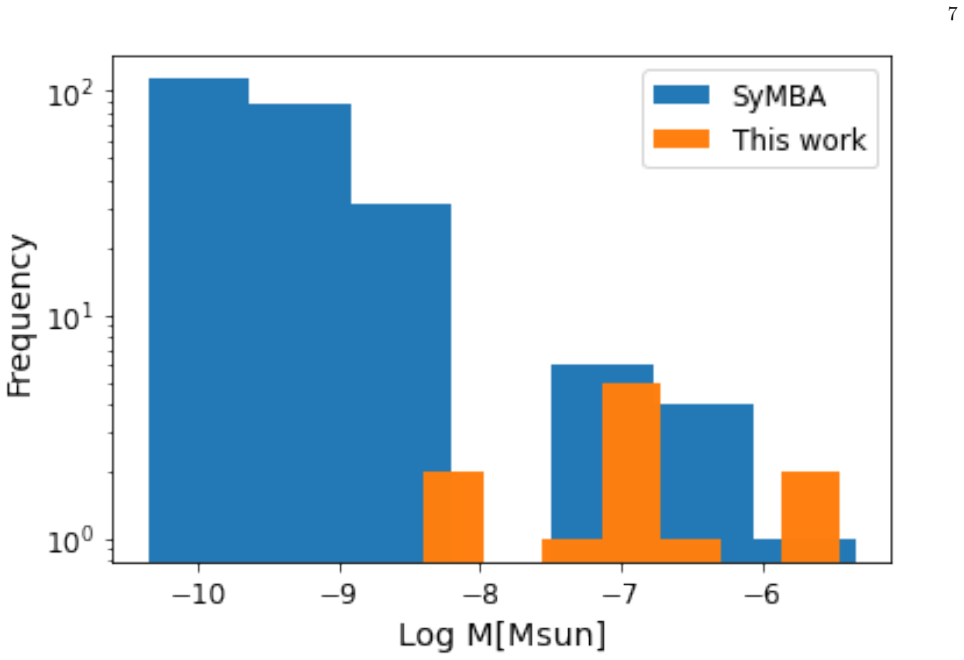
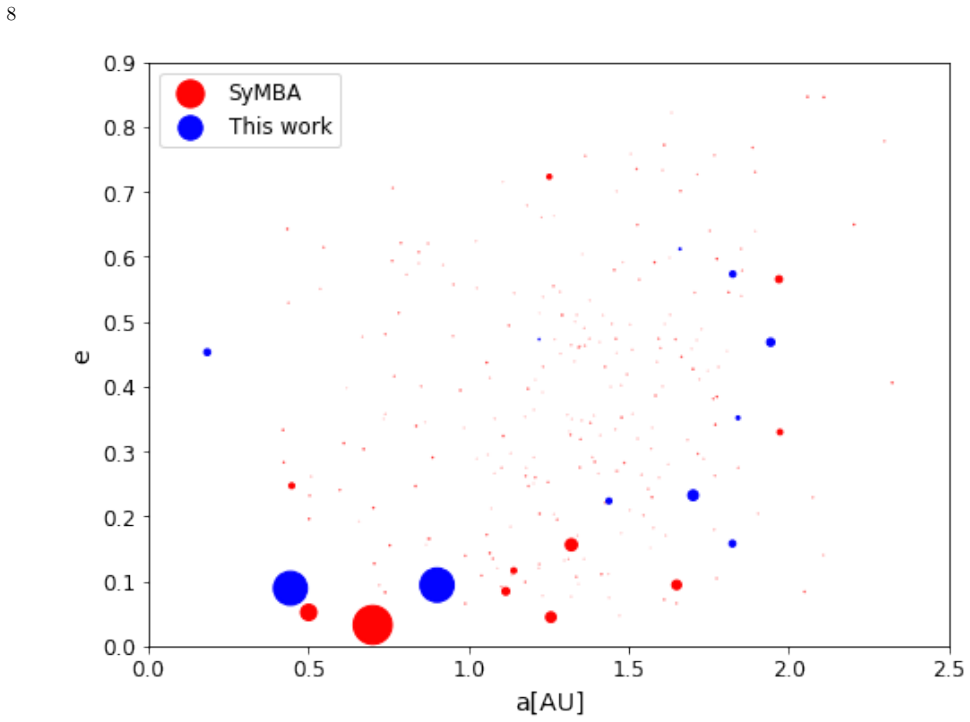
SHARD returns interpolated SPH remnants for each collision and reconstructs the unresolved fragment population by compressing nearby SPH debris snapshots with mass-weighted k-means in velocity space into a tractable number of fragments, with immediate energy-based reaccretion checks; the benchmark shows that this debris treatment produces a final embryo distribution that is dynamically hotter and more top-heavy in mass than perfect-merging models.
What carries the argument
Six-dimensional SPH outcome catalog with multi-linear interpolation for remnants plus mass-weighted k-means clustering of debris in velocity space to generate N-body fragments.
If this is right
- Debris clustering produces a dynamically hotter and more top-heavy final embryo population than perfect merging.
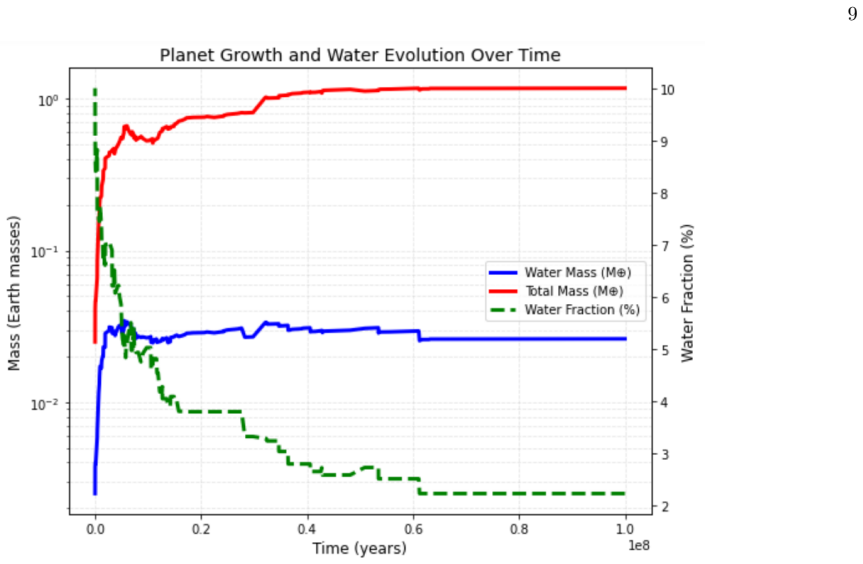
- Volatile budgets of the embryos depend on the number of tracked fragments.
- Reaccretion and dynamical damping rates vary with the resolution of the unresolved debris population.
- Compositionally aware collision handling can be inserted into existing N-body codes without saturating the integrator.
Where Pith is reading between the lines
- The same clustering approach could be applied to study water delivery across a wider range of disk masses and initial conditions.
- Varying the minimum fragment mass in convergence tests would quantify how many fragments are needed for stable statistics.
- Extending the SPH catalog to include more extreme mass ratios or higher velocities would widen the range of applicable systems.
Load-bearing premise
The tabulated SPH collision outcomes are representative of the collisions that occur in the N-body runs and permit accurate multi-linear interpolation without extrapolation inside the covered parameter ranges.
What would settle it
Re-running the Mercury-formation benchmark with the minimum fragment mass threshold raised or lowered by a factor of ten and finding that the final embryo mass and eccentricity distributions remain essentially unchanged would falsify the claim that fragment resolution is dynamically consequential.
Figures
read the original abstract
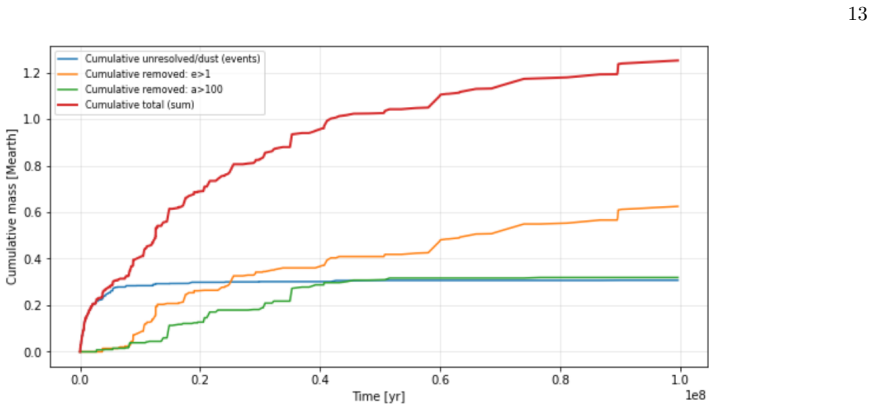
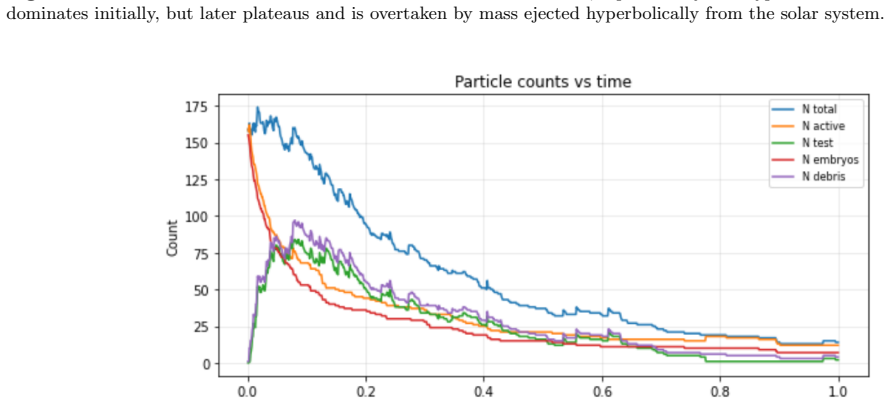
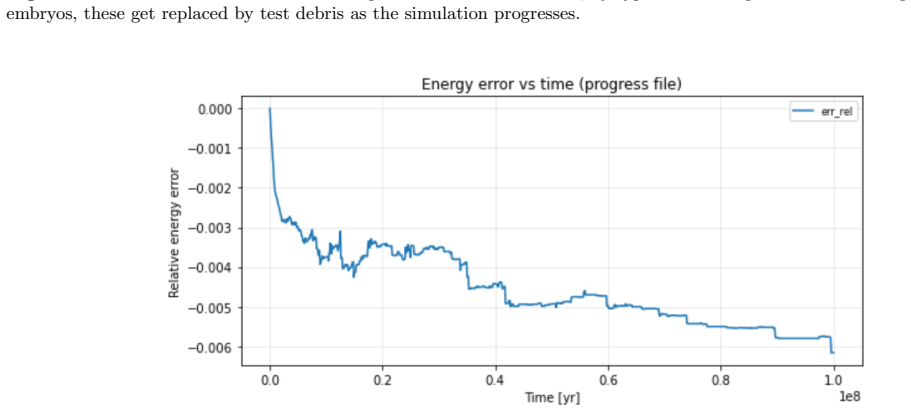
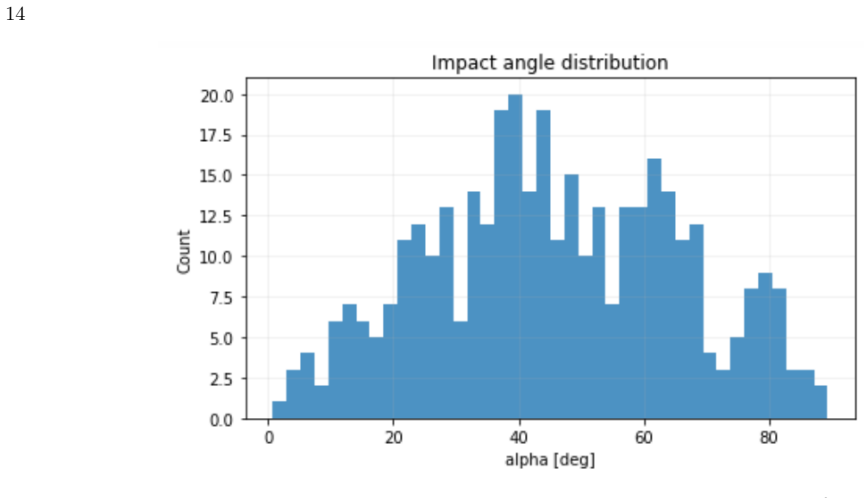
Giant impacts among planetary embryos generate long-lived debris that feeds back on late-stage terrestrial planet growth, yet most N-body models either assume perfect merging or treat fragments in ad hoc ways. We present SHARD, a collision-resolution framework that couples a hybrid integrator (REBOUND/mercurius) to a six-dimensional catalog of smoothed-particle hydrodynamics (SPH) outcomes spanning impact speed, geometry, total mass (up to 2 M_earth), mass ratio, and target/projectile water fractions. For each detected impact we multi-linearly interpolate to return the two largest remnants with self-consistent kinematics and volatile budgets, and we reconstruct the unresolved fragment population by aggregating nearby SPH debris snapshots and compressing them with mass-weighted k-means in velocity space into a tractable number of fragments above a tunable minimum mass. Exact conservation of total mass and water mass is enforced across survivors and debris, with immediate, energy-based reaccretion checks performed within the timestep. Debris interpolation is constrained to the tabulated SPH grid (no extrapolation), and special handling of hit-and-run and catastrophic regimes is included. We benchmark our code against SyMBA in a Mercury-formation experiment and find broad qualitative agreement, though our final embryos distribution is dynamically hotter and more top-heavy in mass. The benchmark outcome suggests that debris clustering is dynamically consequential: fragment resolution controls reaccretion, damping, and volatile retention. This SPH-anchored debris treatment provides a drop-in, compositionally aware alternative to perfect merging, enabling late-stage accretion studies that retains fragment feedback without saturating the integrator.
Editorial analysis
A structured set of objections, weighed in public.
Referee Report
Summary. The paper presents SHARD, a hybrid N-body/SPH framework for resolving giant impacts in terrestrial planet formation. It interpolates remnant properties (mass, velocity, water content) from a precomputed 6D SPH catalog via multi-linear interpolation, clusters unresolved debris into N-body fragments using mass-weighted k-means in velocity space above a tunable minimum mass, and enforces exact mass and water conservation with immediate reaccretion checks. A benchmark against SyMBA in a Mercury-formation run yields broad qualitative agreement, but produces a dynamically hotter and more top-heavy embryo distribution, which the authors interpret as evidence that debris clustering is dynamically consequential.
Significance. If the central claim holds, the method supplies a drop-in, compositionally resolved alternative to perfect merging that retains fragment feedback on damping, reaccretion, and volatile budgets without integrator saturation. The SPH-anchored catalog and conservation enforcement are strengths, but the absence of quantitative validation metrics leaves the dynamical-consequence interpretation only partially supported.
major comments (2)
- [Abstract] Abstract: the benchmark is described only as 'broad qualitative agreement' with a 'dynamically hotter and more top-heavy' embryo distribution; no quantitative metrics (e.g., final mass histogram, mean eccentricity, reaccretion fraction, or water-retention statistics with uncertainties) are reported, so the claim that 'fragment resolution controls reaccretion, damping, and volatile retention' rests on an unquantified visual comparison.
- [Abstract] Abstract (and method description): the interpolation is stated to be 'constrained to the tabulated SPH grid (no extrapolation)' with special handling only for hit-and-run and catastrophic regimes, yet no check is supplied that the collisions arising in the Mercury-formation N-body benchmark (or any other runs) lie inside the sampled ranges of impact speed, geometry, total mass ≤2 M_earth, mass ratio, and water fractions; without this coverage test the reported differences could be artifacts of unvalidated extrapolation handling.
minor comments (1)
- The tunable minimum mass and k-means cluster count are listed as free parameters; their effect on the benchmark outcome should be shown explicitly (e.g., a short sensitivity table) to demonstrate robustness.
Simulated Author's Rebuttal
We thank the referee for the careful review and constructive suggestions. The comments correctly identify areas where additional quantification and validation would strengthen the manuscript. We respond to each major comment below and will make the indicated revisions.
read point-by-point responses
-
Referee: [Abstract] Abstract: the benchmark is described only as 'broad qualitative agreement' with a 'dynamically hotter and more top-heavy' embryo distribution; no quantitative metrics (e.g., final mass histogram, mean eccentricity, reaccretion fraction, or water-retention statistics with uncertainties) are reported, so the claim that 'fragment resolution controls reaccretion, damping, and volatile retention' rests on an unquantified visual comparison.
Authors: We agree that the benchmark description would benefit from quantitative metrics to support the interpretation. In the revised manuscript we will expand both the abstract and the results section to report specific metrics from the Mercury-formation run, including the final embryo mass histogram, mean eccentricity and inclination, reaccretion fraction, and water-retention statistics with uncertainties. These additions will allow a more rigorous evaluation of the dynamical consequences of debris clustering. revision: yes
-
Referee: [Abstract] Abstract (and method description): the interpolation is stated to be 'constrained to the tabulated SPH grid (no extrapolation)' with special handling only for hit-and-run and catastrophic regimes, yet no check is supplied that the collisions arising in the Mercury-formation N-body benchmark (or any other runs) lie inside the sampled ranges of impact speed, geometry, total mass ≤2 M_earth, mass ratio, and water fractions; without this coverage test the reported differences could be artifacts of unvalidated extrapolation handling.
Authors: The referee is correct that an explicit coverage check for the benchmark collisions is not currently provided. Although the interpolation routine is written to reject extrapolation, confirming that the encountered impact parameters lie inside the SPH grid is necessary to substantiate the results. We will add this verification to the revised manuscript, either as a table or supplementary figure that compares the distribution of impact parameters from the N-body simulation against the tabulated SPH ranges. revision: yes
Circularity Check
No circularity: derivation anchored in external SPH catalog and conservation laws
full rationale
The paper constructs SHARD by interpolating from an external six-dimensional SPH outcome catalog (impact speed, geometry, mass, mass ratio, water fractions), applying mass-weighted k-means clustering to debris, and enforcing exact mass/water conservation plus energy-based reaccretion. These steps rely on standard numerical methods and tabulated external data rather than any self-referential definition, fitted parameter renamed as prediction, or load-bearing self-citation. The benchmark comparison to SyMBA is an external validation, not an internal reduction. No quoted equation or claim reduces the central result to its own inputs by construction.
Axiom & Free-Parameter Ledger
free parameters (2)
- tunable minimum mass
- k-means cluster count
axioms (2)
- domain assumption Multi-linear interpolation within the tabulated SPH grid accurately captures collision outcomes for parameters inside the catalog range.
- domain assumption Mass-weighted k-means clustering in velocity space preserves the essential dynamical and compositional properties of the unresolved debris.
Reference graph
Works this paper leans on
-
[1]
Agnor, C. B., & Asphaug, E. 2004, The Astrophysical Journal Letters, 613, L157, doi: 10.1086/425158
-
[2]
Information and Computation , author =
Benz, W., & Asphaug, E. 1994, Icarus, 107, 98, doi: 10.1006/icar.1994.1009
-
[3]
Burger, C., Bazs´ o,´A., & Sch¨ afer, C. M. 2020, Astronomy & Astrophysics, 634, A76, doi: 10.1051/0004-6361/201936366
-
[4]
Chambers, J. E. 2001, Icarus, 152, 205, doi: 10.1006/icar.2001.6639 —. 2013, Icarus, 224, 43, doi: 10.1016/j.icarus.2013.02.015
-
[5]
Duncan, M. J., Levison, H. F., & Lee, M. H. 1998, AJ, 116, 2067, doi: 10.1086/300541
-
[6]
2013, Icarus, 225, 122, doi: 10.1016/j.icarus.2013.03.006
Kobayashi, H., & Dauphas, N. 2013, Icarus, 225, 122, doi: 10.1016/j.icarus.2013.03.006
-
[7]
2010, The Astrophysical Journal Letters, 714, L21, doi: 10.1088/2041-8205/714/1/L21
Kokubo, E., & Genda, H. 2010, The Astrophysical Journal Letters, 714, L21, doi: 10.1088/2041-8205/714/1/L21
-
[8]
Leinhardt, Z. M., & Stewart, S. T. 2012a, The Astrophysical Journal, 745, 79, doi: 10.1088/0004-637X/745/1/79 —. 2012b, The Astrophysical Journal, 745, 79, doi: 10.1088/0004-637X/745/1/79
-
[9]
Levison, H. F., Duncan, M. J., & Thommes, E. 2012, The Astronomical Journal, 144, 119, doi: 10.1088/0004-6256/144/4/119
-
[10]
Marcus, R. A., Stewart, S. T., Sasselov, D., & Hernquist, L. 2009, The Astrophysical Journal Letters, 700, L118, doi: 10.1088/0004-637X/700/2/L118
-
[11]
Monaghan, J., & Pongracic, H. 1985, Applied Numerical Mathematics, 1, 187, doi: https://doi.org/10.1016/0168-9274(85)90015-7 O’Brien, D. P., Morbidelli, A., & Levison, H. F. 2006, Icarus, 184, 39, doi: 10.1016/j.icarus.2006.04.005
-
[12]
A&A 537, A128,10.1051/0004-6361/201118085
Rein, H., & Liu, S.-F. 2012, A&A, 537, A128, doi: 10.1051/0004-6361/201118085
work page internal anchor Pith review doi:10.1051/0004-6361/201118085 2012
-
[13]
Rein, H., Hernandez, D. M., Tamayo, D., et al. 2019, MNRAS, 485, 5490, doi: 10.1093/mnras/stz769 Sch¨ afer, C. M., Riecker, S., Maindl, T. I., et al. 2016, Astronomy & Astrophysics, 590, A19, doi: 10.1051/0004-6361/201528060 Sch¨ afer, C. M., Wandel, O. J., Burger, C., et al. 2020, Astronomy and Computing, 33, 100410, doi: 10.1016/j.ascom.2020.100410
-
[14]
2024, ApJ, 967, 1, doi: 10.3847/1538-4357/ad39e6
Scora, J., Valencia, D., Morbidelli, A., & Jacobson, S. 2024, ApJ, 967, 1, doi: 10.3847/1538-4357/ad39e6
-
[15]
Stewart, S. T., & Leinhardt, Z. M. 2012, The Astrophysical Journal, 751, 32, doi: 10.1088/0004-637X/751/1/32
-
[16]
Tamayo, D., Rein, H., Shi, P., & Hernandez, D. M. 2020, MNRAS, 491, 2885, doi: 10.1093/mnras/stz2870
-
[17]
Walsh, K. J., & Levison, H. F. 2019, Icarus, 329, 88, doi: 10.1016/j.icarus.2019.03.031
discussion (0)
Sign in with ORCID, Apple, or X to comment. Anyone can read and Pith papers without signing in.