REVIEW 64 references
A covariant NJL calculation gives the charge radii and magnetic moments of the charged and neutral K* vector mesons, matching other theory and lattice results.
Reviewed by Pith at T0; open to challenge. T0 means a machine referee read the full paper against a public rubric. the ladder, T0–T4 →
T0 review · grok-4.5
2026-07-31 08:44 UTC pith:S3M4MI45
load-bearing objection Clean NJL extension that delivers usable charged-K* numbers; the neutral magnetic moment is a residual cancellation artifact and the lattice-consistency claim does not hold for its sign.
Electromagnetic structure of charged and neutral strange vector mesons
The pith
A machine-rendered reading of the paper's core claim, the machinery that carries it, and where it could break.
Core claim
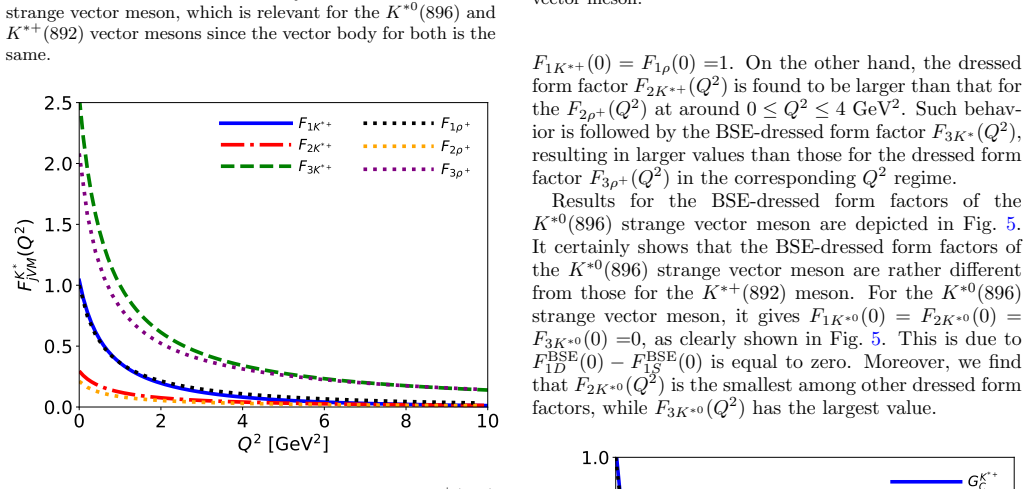
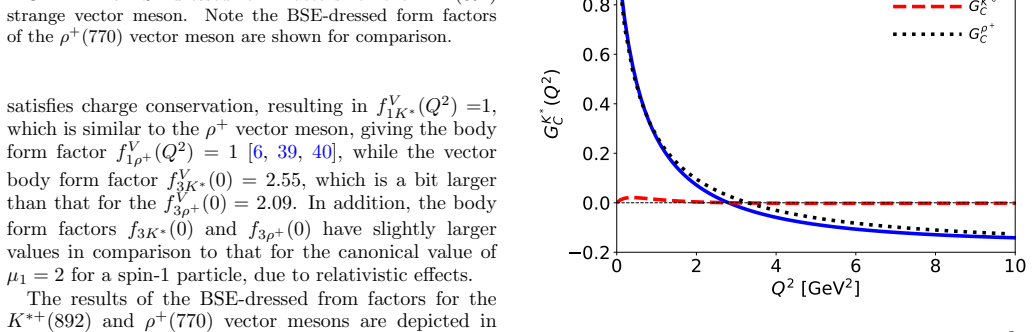
Within the covariant NJL model regularized by Schwinger proper time, the electromagnetic form factors of K*+(892) and K*0(896) yield charge radii ⟨r²⟩_K*+ = 0.45 fm² (r = 0.67 fm) and ⟨r²⟩_K*0 = −0.04 fm², magnetic moments μ_K*+ = 2.67 μ_N and μ_K*0 = 0.032 μ_N, and corresponding quadrupole moments, all stated to be consistent with other theoretical calculations and lattice QCD.
What carries the argument
The covariant SU(3) Nambu–Jona-Lasinio model with Schwinger proper-time cutoffs: dressed quark masses from the gap equation, K* bound states from the Bethe–Salpeter equation, and the three Sachs form factors extracted from the electromagnetic current built from two dominant quark-loop diagrams with BSE-dressed photon–quark vertices.
Load-bearing premise
That fixing an infrared cutoff by hand near the QCD scale, and omitting pion-cloud and tensor dressing of the strange quark, is enough to stand in for confinement and still give physically meaningful static moments.
What would settle it
A lattice QCD determination (or a future experimental extraction) of μ_K*0 or of the K*+ charge radius that lies well outside the reported 0.032 μ_N and 0.67 fm, or that reverses the sign of the neutral magnetic moment while keeping the same quark-mass setup.
If this is right
- Charge, magnetic, and quadrupole form factors of both charged and neutral K* are now available as continuous functions of Q² for comparison with upcoming EIC, JLab, and COMPASS/AMBER data.
- The small negative mean-square charge radius of K*0 is a concrete, model-level prediction of flavor-asymmetric charge cancellation inside a neutral strange vector meson.
- The same framework supplies a baseline against which lattice simulations of vector-meson form factors can be checked for quark-mass and continuum systematics.
- Zero-crossing of G_C for K*+ near 3 GeV² is a sharp, testable feature of the calculated charge distribution.
Where Pith is reading between the lines
- Because the model sets the strange-quark Pauli form factor to zero, any future measurement that finds a sizable anomalous magnetic moment for the strange quark inside K* would require extending the interaction kernel beyond the present contact terms.
- The opposite signs reported here and on the lattice for μ_K*0 mark a clean target for next-generation lattice work with physical strange-quark mass.
- Once the same proper-time NJL setup is applied to medium-modified K* form factors, the free-space radii and moments computed here become the natural vacuum baseline for in-medium studies.
Editorial analysis
A structured set of objections, weighed in public.
Circularity Check
Standard NJL phenomenology: spectrum-fitted parameters, then independent EMFF outputs; no load-bearing circular reduction.
specific steps
-
self citation load bearing
[Sec. IV, parameter paragraph; Refs. [2, 57, 60, 61]]
"The NJL model parameters used in this work are G_π, G_ω, and G_ρ, as in Refs. [2, 57, 60, 61]. ... The resulting fit yields an ultraviolet cutoff Λ_UV = 645 MeV, pion coupling constant G_π = 19.04×10^{-6} MeV^{-2}, G_ρ = 11.04×10^{-6} MeV^{-2}, and strange constituent quark mass M_s = 611 MeV."
Model couplings and cutoffs are taken from the author’s prior NJL papers rather than re-derived here. This is normal parameter inheritance, not a proof that the K* EMFFs must equal the quoted values; the triangle-diagram evaluation remains an independent computation. Minor and not load-bearing for the form-factor claims.
full rationale
The derivation is the usual effective-model pipeline. Gap equation, BSE pole condition, and meson–quark coupling fix the dressed masses and g_K*qq from the Lagrangian plus Schwinger proper-time cutoffs; EMFFs are then computed from the triangle diagrams (Eqs. 15–34) and Sachs combinations (12–14). Fitted inputs are m_π, f_π, m_K, m_ρ, m_K*, M_N (Sec. IV); outputs are G_C, G_M, G_Q and static moments. These are different observables, so the moments are not forced by the fit. Charge normalizations G_C(0)=1 (charged) and 0 (neutral) follow from current conservation and quark charges, not from refitting the radii or μ. Self-citations ([2,57,60,61]) only supply the author’s prior NJL parameter set and framework; they do not prove uniqueness of the K* form factors. The small nonzero μ_K*0=0.032 μ_N despite the text’s statement that F_jK*0(0)=0 is an internal numerical/regulator inconsistency (correctness issue), not a circular identification of output with input. No self-definitional loop, no fitted-EMFF-called-prediction, and no uniqueness theorem imported from the author. Score 1 only for ordinary parameter self-citation that is not load-bearing for the central claims.
Axiom & Free-Parameter Ledger
free parameters (7)
- Λ_IR =
0.24 GeV
- Λ_UV =
645 MeV
- G_π =
19.04×10^{-6} MeV^{-2}
- G_ρ =
11.04×10^{-6} MeV^{-2}
- M_l (constituent light-quark mass) =
400 MeV
- M_s (constituent strange-quark mass) =
611 MeV
- m_u, m_s (current quark masses) =
m_u=16 MeV, m_s=356 MeV
axioms (5)
- domain assumption Local SU(3) NJL four-fermion Lagrangian with only scalar-pseudoscalar and vector-axial couplings adequately encodes low-energy QCD for vector-meson EMFFs.
- domain assumption Schwinger proper-time regularization with a finite IR cutoff simulates quark confinement by eliminating free-quark production thresholds.
- domain assumption Hartree mean-field gap equation plus random-phase-approximation BSE suffice for dressed masses and meson bound states.
- ad hoc to paper Tensor–tensor four-fermion channels and pion-cloud corrections to the strange quark can be omitted (F_2S=0, F_2ρ=F_2ω=0).
- domain assumption Two triangle diagrams of Fig. 1 dominate the electromagnetic current; higher Fock components are negligible.
read the original abstract
We investigate the electromagnetic form factors (EMFFs) of the charged $K^{*+}(892)$ ($u\bar{s}$) and neutral $K^{0}(896)$ ($d\bar{s}$) strange vector mesons within the covariant Nambu--Jona-Lasinio (NJL) model, employing the Schwinger proper-time regularization scheme to regularize ultraviolet divergences while incorporating the QCD aspect of quark confinement. To this end, we evaluate the charge (electric) $G_C(Q^2)$, magnetic $G_M(Q^2)$, and quadrupole $G_Q(Q^2)$ form factors, as well as the charge radii, of the charged $K^{+}(892)$ and neutral $K^{0}(896)$ strange vector mesons. We find the charge radii to be $\langle r^2 \rangle_{K^{+}} = 0.45~\mathrm{fm}^2$ and $\langle r^2 \rangle_{K^{0}} = -0.04~\mathrm{fm}^2$, respectively, while the corresponding magnetic moments are $\mu_{K^{+}} = 2.67,\mu_N$ and $\mu_{K^{*0}} = 0.032,\mu_N$. These results are consistent with other theoretical calculations and lattice QCD simulations.
Figures



Reference graph
Works this paper leans on
-
[1]
C. Lorc´ e, A. Metz, B. Pasquini, P. Schweitzer, Parton Distribution Functions and their Generalizations, 2025. arXiv:2507.12664
Pith/arXiv arXiv 2025
-
[2]
P. T. P. Hutauruk, I. C. Cloet, A. W. Thomas, Flavor dependence of the pion and kaon form factors and par- ton distribution functions, Phys. Rev. C 94 (3) (2016) 035201.arXiv:1604.02853,doi:10.1103/PhysRevC.94. 035201
Pith/arXiv arXiv 2016
-
[3]
J. C. Collins, D. E. Soper, Parton Distribution and Decay Functions, Nucl. Phys. B 194 (1982) 445–492.doi:10. 1016/0550-3213(82)90021-9
1982
-
[4]
P. T. P. Hutauruk, Pseudoscalar Meson Parton Distri- butions Within Gauge-Invariant Nonlocal Chiral Quark Model, Symmetry 17 (6) (2025) 971.arXiv:2505.06726, 9 doi:10.3390/sym17060971
Pith/arXiv arXiv 2025
-
[5]
R. J. Hern´ andez-Pinto, L. X. Guti´ errez-Guerrero, M. A. Bedolla, A. Bashir, Electric, magnetic, and quadrupole form factors and charge radii of vector mesons: From light to heavy sectors in a contact interaction, Phys. Rev. D 110 (11) (2024) 114015.arXiv:2410.23813,doi:10. 1103/PhysRevD.110.114015
Pith/arXiv arXiv 2024
-
[6]
P. T. P. Hutauruk, T. Mart, K. Tsushima, Medium ef- fects on the electromagnetic form factors of theρmeson, Phys. Rev. D 112 (11) (2025) 114030.arXiv:2508.20501, doi:10.1103/95yl-nwds
arXiv 2025
-
[7]
E. C. Aschenauer, I. Borsa, R. Sassot, C. Van Hulse, Semi-inclusive Deep-Inelastic Scattering, Parton Dis- tributions and Fragmentation Functions at a Future Electron-Ion Collider, Phys. Rev. D 99 (9) (2019) 094004. arXiv:1902.10663,doi:10.1103/PhysRevD.99.094004
Pith/arXiv arXiv 2019
-
[8]
A. Metz, A. Vossen, Parton Fragmentation Functions, Prog. Part. Nucl. Phys. 91 (2016) 136–202.arXiv:1607. 02521,doi:10.1016/j.ppnp.2016.08.003
-
[9]
M. G. Echevarria, I. Scimemi, A. Vladimirov, Unpolar- ized Transverse Momentum Dependent Parton Distri- bution and Fragmentation Functions at next-to-next-to- leading order, JHEP 09 (2016) 004.arXiv:1604.07869, doi:10.1007/JHEP09(2016)004
Pith/arXiv arXiv 2016
-
[10]
B. Sun, Y. Dong, Generalized parton distribution func- tions ofρmeson, SciPost Phys. Proc. 3 (2020) 014. doi:10.21468/SciPostPhysProc.3.014
-
[11]
C. Shi, J. Li, P.-L. Yin, W. Jia, Unpolarized generalized parton distributions of light and heavy vector mesons, Phys. Rev. D 107 (7) (2023) 074009.arXiv:2302.02388, doi:10.1103/PhysRevD.107.074009
Pith/arXiv arXiv 2023
-
[12]
Diehl, Introduction to GPDs and TMDs, Eur
M. Diehl, Introduction to GPDs and TMDs, Eur. Phys. J. A 52 (6) (2016) 149.arXiv:1512.01328,doi:10.1140/ epja/i2016-16149-3
Pith/arXiv arXiv 2016
-
[13]
H.-D. Son, P. T. P. Hutauruk, Generalized parton distri- butions of the kaon and pion within the nonlocal chiral quark model, Phys. Rev. D 111 (5) (2025) 054007.arXiv: 2411.18130,doi:10.1103/PhysRevD.111.054007
Pith/arXiv arXiv 2025
-
[14]
Y. Ninomiya, W. Bentz, I. C. Clo¨ et, Transverse- momentum-dependent quark distribution functions of spin-one targets: Formalism and covariant calculations, Phys. Rev. C 96 (4) (2017) 045206.arXiv:1707.03787, doi:10.1103/PhysRevC.96.045206
Pith/arXiv arXiv 2017
-
[15]
W.-Y. Liu, I. Zahed, Tomography of the rho meson in the QCD instanton vacuum: Transverse momentum dependent parton distribution functions, Phys. Rev. D 112 (3) (2025) 034028.arXiv:2503.11959,doi:10.1103/ 6ffp-qs8p
arXiv 2025
-
[16]
Boussarie, et al., TMD Handbook (4 2023).arXiv: 2304.03302
R. Boussarie, et al., TMD Handbook (4 2023).arXiv: 2304.03302
Pith/arXiv arXiv 2023
-
[17]
A. Bacchetta, V. Bertone, C. Bissolotti, G. Bozzi, F. Del- carro, F. Piacenza, M. Radici, Transverse-momentum- dependent parton distributions up to N 3LL from Drell- Yan data, JHEP 07 (2020) 117.arXiv:1912.07550, doi:10.1007/JHEP07(2020)117
Pith/arXiv arXiv 2020
-
[18]
V. Bertone, M. G. Echevarria, ´O. del Rio, S. Rodini, One- loop matching for leading-twist generalised transverse- momentum-dependent distributions, JHEP 05 (2025) 183.arXiv:2502.07576,doi:10.1007/JHEP05(2025) 183
Pith/arXiv arXiv 2025
-
[19]
B. Linek, M. Luszczak, W. Sch¨ afer, A. Szczurek, Probing gluon GTMDs of the proton in deep inelastic diffractive dijet production at HERA, Phys. Rev. D 110 (5) (2024) 054027.arXiv:2403.15110,doi:10.1103/PhysRevD. 110.054027
Pith/arXiv arXiv 2024
- [20]
-
[21]
B. L. Ioffe, QCD at low energies, Prog. Part. Nucl. Phys. 56 (2006) 232–277.arXiv:hep-ph/0502148,doi: 10.1016/j.ppnp.2005.05.001
Pith/arXiv arXiv 2006
-
[22]
Gross, et al., 50 Years of Quantum Chromodynamics, Eur
F. Gross, et al., 50 Years of Quantum Chromodynamics, Eur. Phys. J. C 83 (2023) 1125.arXiv:2212.11107,doi: 10.1140/epjc/s10052-023-11949-2
Pith/arXiv arXiv 2023
-
[23]
Leutwyler, On the history of the strong interaction, Mod
H. Leutwyler, On the history of the strong interaction, Mod. Phys. Lett. A 29 (2014) 1430023.arXiv:1211. 6777,doi:10.1142/S0217732314300237
-
[24]
E. Epelbaum, J. Gegelia, U. G. Meißner, M. V. Polyakov, Chiral theory ofρ-meson gravitational form factors, Phys. Rev. D 105 (1) (2022) 016018.arXiv:2109.10826, doi:10.1103/PhysRevD.105.016018
Pith/arXiv arXiv 2022
-
[25]
Pagels, Energy-Momentum Structure Form Factors of Particles, Phys
H. Pagels, Energy-Momentum Structure Form Factors of Particles, Phys. Rev. 144 (1966) 1250–1260.doi:10. 1103/PhysRev.144.1250
1966
-
[26]
W. Cosyn, S. Cotogno, A. Freese, C. Lorc´ e, The energy- momentum tensor of spin-1 hadrons: formalism, Eur. Phys. J. C 79 (6) (2019) 476.arXiv:1903.00408,doi: 10.1140/epjc/s10052-019-6981-3
Pith/arXiv arXiv 2019
-
[27]
Y. Z. Xu, K. Raya, J. Rodr ´ ıguez-Quintero, J. Segovia, Charge distributions of pseudoscalar and vector mesons from Dyson-Schwinger equations, Phys. Rev. D 110 (5) (2024) 054031.arXiv:2406.13306,doi:10.1103/ PhysRevD.110.054031
Pith/arXiv arXiv 2024
-
[28]
M. S. Bhagwat, P. Maris, Vector meson form factors and their quark-mass dependence, Phys. Rev. C 77 (2008) 025203.arXiv:nucl-th/0612069,doi:10.1103/ PhysRevC.77.025203
Pith/arXiv arXiv 2008
-
[29]
F. Cardarelli, I. L. Grach, I. M. Narodetsky, G. Salme, S. Simula, Electromagnetic form-factors of the rho meson in a light front constituent quark model, Phys. Lett. B 349 (1995) 393–399.arXiv:hep-ph/9502360,doi:10. 1016/0370-2693(95)00230-I
Pith/arXiv arXiv 1995
-
[30]
S. J. Brodsky, J. R. Hiller, Universal properties of the electromagnetic interactions of spin one systems, Phys. Rev. D 46 (1992) 2141–2149.doi:10.1103/PhysRevD. 46.2141
doi:10.1103/physrevd 1992
- [31]
-
[32]
J. P. B. C. De Melo, Unambiguous Extraction of the Electromagnetic Form Factors for Spin-1 Particles on the Light-Front, Phys. Lett. B 788 (2019) 152–160.arXiv: 1810.11478,doi:10.1016/j.physletb.2018.11.003
Pith/arXiv arXiv 2019
-
[33]
A. F. Krutov, R. G. Polezhaev, V. E. Troitsky, Mag- netic moment of theρmeson in instant-form relativistic quantum mechanics, Phys. Rev. D 97 (3) (2018) 033007. arXiv:1801.01458,doi:10.1103/PhysRevD.97.033007
Pith/arXiv arXiv 2018
-
[34]
H.-M. Choi, C.-R. Ji, Electromagnetic structure of the rho meson in the light front quark model, Phys. Rev. D 70 (2004) 053015.arXiv:hep-ph/0402114,doi:10. 1103/PhysRevD.70.053015
Pith/arXiv arXiv 2004
-
[35]
M. B. Hecht, B. H. J. McKellar, Dipole moments of the rho meson, Phys. Rev. C 57 (1998) 2638–2647.arXiv: hep-ph/9704326,doi:10.1103/PhysRevC.57.2638
Pith/arXiv arXiv 1998
-
[36]
V. V. Braguta, A. I. Onishchenko, rho meson form- factors and QCD sum rules, Phys. Rev. D 70 (2004) 033001.arXiv:hep-ph/0403258,doi:10.1103/ 10 PhysRevD.70.033001
Pith/arXiv arXiv 2004
-
[37]
T. M. Aliev, M. Savci, Electromagnetic form factors of the rho meson in light cone QCD sum rules, Phys. Rev. D 70 (2004) 094007.arXiv:hep-ph/0405235,doi:10. 1103/PhysRevD.70.094007
Pith/arXiv arXiv 2004
-
[38]
Jaus, Consistent treatment of spin 1 mesons in the light front quark model, Phys
W. Jaus, Consistent treatment of spin 1 mesons in the light front quark model, Phys. Rev. D 67 (2003) 094010.arXiv:hep-ph/0212098,doi:10.1103/ PhysRevD.67.094010
Pith/arXiv arXiv 2003
-
[39]
M. E. Carrillo-Serrano, W. Bentz, I. C. Clo¨ et, A. W. Thomas,ρmeson form factors in a confining Nambu–Jona-Lasinio model, Phys. Rev. C 92 (1) (2015) 015212.arXiv:1504.08119,doi:10.1103/PhysRevC.92. 015212
Pith/arXiv arXiv 2015
-
[40]
I. C. Clo¨ et, W. Bentz, A. W. Thomas, Role of diquark correlations and the pion cloud in nucleon elastic form factors, Phys. Rev. C 90 (2014) 045202.arXiv:1405. 5542,doi:10.1103/PhysRevC.90.045202
-
[41]
H. L. L. Roberts, A. Bashir, L. X. Gutierrez-Guerrero, C. D. Roberts, D. J. Wilson, pi- and rho-mesons, and their diquark partners, from a contact interaction, Phys. Rev. C 83 (2011) 065206.arXiv:1102.4376,doi:10. 1103/PhysRevC.83.065206
Pith/arXiv arXiv 2011
-
[42]
F. T. Hawes, M. A. Pichowsky, Electromagnetic form- factors of light vector mesons, Phys. Rev. C 59 (1999) 1743–1750.arXiv:nucl-th/9806025,doi:10.1103/ PhysRevC.59.1743
Pith/arXiv arXiv 1999
-
[43]
S. R. Amendolia, et al., A Measurement of the Pion Charge Radius, Phys. Lett. B 146 (1984) 116–120.doi: 10.1016/0370-2693(84)90655-5
-
[44]
S. R. Amendolia, et al., A Measurement of the Space - Like Pion Electromagnetic Form-Factor, Nucl. Phys. B 277 (1986) 168.doi:10.1016/0550-3213(86)90437-2
-
[45]
Horn, et al., Determination of the Charged Pion Form Factor at Q**2 = 1.60 and 2.45-(GeV/c)**2, Phys
T. Horn, et al., Determination of the Charged Pion Form Factor at Q**2 = 1.60 and 2.45-(GeV/c)**2, Phys. Rev. Lett. 97 (2006) 192001.arXiv:nucl-ex/0607005,doi: 10.1103/PhysRevLett.97.192001
Pith/arXiv arXiv 2006
-
[46]
B. Adams, et al., Letter of Intent: A New QCD fa- cility at the M2 beam line of the CERN SPS (COM- PASS++/AMBER) (8 2018).arXiv:1808.00848
Pith/arXiv arXiv 2018
-
[47]
A. Accardi, et al., Strong interaction physics at the lu- minosity frontier with 22 GeV electrons at Jefferson Lab, Eur. Phys. J. A 60 (9) (2024) 173.arXiv:2306.09360, doi:10.1140/epja/s10050-024-01282-x
Pith/arXiv arXiv 2024
-
[48]
T. Sawada, W.-C. Chang, S. Kumano, J.-C. Peng, S. Sawada, K. Tanaka, Accessing proton generalized par- ton distributions and pion distribution amplitudes with the exclusive pion-induced Drell-Yan process at J-PARC, Phys. Rev. D 93 (11) (2016) 114034.arXiv:1605.00364, doi:10.1103/PhysRevD.93.114034
Pith/arXiv arXiv 2016
-
[49]
D. P. Anderle, et al., Electron-ion collider in China, Front. Phys. (Beijing) 16 (6) (2021) 64701.arXiv: 2102.09222,doi:10.1007/s11467-021-1062-0
Pith/arXiv arXiv 2021
-
[50]
J. Arrington, et al., Revealing the structure of light pseu- doscalar mesons at the electron–ion collider, J. Phys. G 48 (7) (2021) 075106.arXiv:2102.11788,doi:10.1088/ 1361-6471/abf5c3
Pith/arXiv arXiv 2021
-
[51]
J. N. Hedditch, W. Kamleh, B. G. Lasscock, D. B. Leinweber, A. G. Williams, J. M. Zanotti, Pseudoscalar and vector meson form-factors from lattice QCD, Phys. Rev. D 75 (2007) 094504.arXiv:hep-lat/0703014,doi: 10.1103/PhysRevD.75.094504
Pith/arXiv arXiv 2007
-
[52]
W. Detmold, D. Pefkou, P. E. Shanahan, Off-forward gluonic structure of vector mesons, Phys. Rev. D 95 (11) (2017) 114515.arXiv:1703.08220,doi:10.1103/ PhysRevD.95.114515
Pith/arXiv arXiv 2017
-
[53]
Z. Wang, D. B. Leinweber, C. Liu, L. Liu, P. Sun, A. W. Thomas, J.-j. Wu, H. Xing, K. Yu, Spectral parameters of theρresonance from lattice QCD, JHEP 08 (2025) 064. arXiv:2502.03700,doi:10.1007/JHEP08(2025)064
Pith/arXiv arXiv 2025
-
[54]
U.-G. Meißner, A. Rusetsky, A. S. Sakthivasan, G. Schierholz, J.-J. Wu, Form factors of theρmeson from effective field theory and the lattice, JHEP 06 (2026) 164. arXiv:2602.23044,doi:10.1007/JHEP06(2026)164
Pith/arXiv arXiv 2026
-
[55]
E. V. Luschevskaya, O. V. Teryaev, E. A. Dorenskaya, S. Y. Alimagomedova, Z. V. Khaidukov, Magnetic Mo- ment of K* 0 Mesons in SU(3) Lattice Gauge Theory, JETP Lett. 123 (10) (2026) 653–660.doi:10.1134/ S0021364025608437
2026
-
[56]
F. X. Lee, S. Moerschbacher, W. Wilcox, Magnetic mo- ments of vector, axial, and tensor mesons in lattice QCD, Phys. Rev. D 78 (2008) 094502.arXiv:0807.4150, doi:10.1103/PhysRevD.78.094502
Pith/arXiv arXiv 2008
-
[57]
P. T. P. Hutauruk, W. Bentz, I. C. Clo¨ et, A. W. Thomas, Charge Symmetry Breaking Effects in Pion and Kaon Structure, Phys. Rev. C 97 (5) (2018) 055210.arXiv: 1802.05511,doi:10.1103/PhysRevC.97.055210
Pith/arXiv arXiv 2018
-
[58]
W. Bentz, A. W. Thomas, The Stability of nuclear matter in the Nambu-Jona-Lasinio model, Nucl. Phys. A 696 (2001) 138–172.arXiv:nucl-th/0105022,doi:10.1016/ S0375-9474(01)01119-8
Pith/arXiv arXiv 2001
-
[59]
D. L. Whittenbury, H. H. Matevosyan, A. W. Thomas, Hybrid stars using the quark-meson coupling and proper-time Nambu–Jona-Lasinio models, Phys. Rev. C 93 (3) (2016) 035807.arXiv:1511.08561,doi:10.1103/ PhysRevC.93.035807
Pith/arXiv arXiv 2016
-
[60]
G. Gifari, P. T. P. Hutauruk, T. Mart, Nuclear medium meson structures from the Schwinger proper- time Nambu–Jona-Lasinio model, Phys. Rev. D 110 (1) (2024) 014043.arXiv:2402.19048,doi:10.1103/ PhysRevD.110.014043
Pith/arXiv arXiv 2024
-
[61]
P. T. P. Hutauruk, S.-i. Nam, Gluon and valence quark distributions for the pion and kaon in nuclear matter, Phys. Rev. D 105 (3) (2022) 034021.arXiv:2112.05435, doi:10.1103/PhysRevD.105.034021
Pith/arXiv arXiv 2022
-
[62]
Y.-L. Luan, X.-L. Chen, W.-Z. Deng, Meson electro- magnetic form factors in an extended Nambu–Jona- Lasinio model including heavy quark flavors, Chin. Phys. C 39 (11) (2015) 113103.arXiv:1504.03799,doi:10. 1088/1674-1137/39/11/113103
Pith/arXiv arXiv 2015
-
[63]
L. X. Guti´ errez-Guerrero, R. J. Hern´ andez-Pinto, Symmetry- Preserving Contact Interaction Approaches: An Overview of Meson and Diquark Form Factors, Par- ticles 9 (2) (2026) 45.arXiv:2604.15122,doi:10.3390/ particles9020045
Pith/arXiv arXiv 2026
-
[64]
A. M. Badalian, Y. A. Simonov, Magnetic moments of mesons, Phys. Rev. D 87 (7) (2013) 074012.arXiv:1211. 4349,doi:10.1103/PhysRevD.87.074012
discussion (0)
Sign in with ORCID, Apple, or X to comment. Anyone can read and Pith papers without signing in.