REVIEW 2 major objections 4 minor 1 cited by
Collective dynamics in heavy and light-ion collisions -- I) Kinetic Theory vs. Hydrodynamics
T0 review · 2 major / 4 minor · reviewed 2026-08-12 · deepseek-v4-flash
Pith's one-line read Event-by-event simulations of flow in OO, AuAu, and PbPb collisions show that viscous hydrodynamics matches kinetic theory only above opacity ~3 and that oxygen collisions carry a ~10 percent non-hydrodynamic signature.
desk verdict The conformal kinetic-theory vs. hydrodynamics comparison is careful, reproducible, and likely correct; the nonconformal extension is honestly labeled but not yet strong enough to carry the quantitative OO claim. read the letter →
The pith
A machine-rendered reading of the paper's core claim, the machinery that carries it, and where it could break.
The reading
What carries the argument
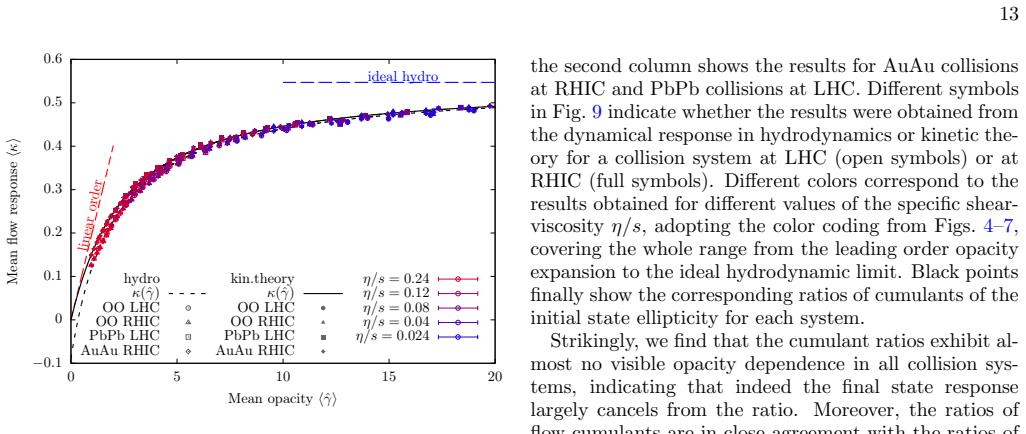
The central object is the opacity parameter $\hat{\gamma} = \frac{1}{5\,\eta/s}\left(\frac{R}{\pi a}\frac{dE_\perp^0}{d\eta}\right)^{1/4}$, a single dimensionless number that collects the specific shear viscosity $\eta/s$, the transverse system size $R$, and the initial transverse energy per rapidity. It controls how much the system equilibrates before transverse expansion begins. The response coefficient $\kappa = \varepsilon_p/\epsilon_2$ maps the initial eccentricity to the final energy-flow ellipticity, and the paper's key result is that $\kappa$ is a universal function of $\hat{\gamma}$ across systems, centralities, and viscosities, with the kinetic-theory curve interpolating between the linear low-opacity limit $\kappa = \kappa'_0 \hat{\gamma}$ and the ideal-hydrodynamic saturation $\kappa_{\mathrm{id}}$. A second piece of machinery is the factorization $c_{\varepsilon_p}\{2k\} = c_{\epsilon_2}\{2k\}\,\kappa(\langle\hat{\gamma}\rangle)^{2k}$, which lets cumulant ratios cancel the response and expose the initial geometry. The comparison uses energy-momentum-based elliptic flow rather than particle-number flow, avoiding hadronization modeling.
What would settle it
A numerical experiment would settle this: run the same event-by-event oxygen-oxygen initial conditions through a nonconformal kinetic theory that includes bulk viscosity and a realistic QCD equation of state, and compare the resulting response curve $\kappa(\hat{\gamma})$ to the conformal-RTA curve. If the curves separate by more than the reported 10 percent in the opacity range $\hat{\gamma} \sim 3$–$10$, or if the ratio of hydrodynamic to kinetic response at $\hat{\gamma}=3$ deviates from the few-percent agreement claimed here, the central claim would be falsified.
Extended reading notes
Core claim
Hydrodynamics provides an accurate description of collective flow for large collision systems (AuAu, PbPb) up to peripheral centrality classes, but deviates in small systems (OO), restricting its range of applicability to opacities $\hat{\gamma} \gtrsim 3$. The event-by-event elliptic flow response coefficient $\kappa = \varepsilon_p/\epsilon_2$, where $\varepsilon_p$ is the energy-flow ellipticity and $\epsilon_2$ the initial eccentricity, is found to be a universal function of the opacity $\hat{\gamma}$ for both kinetic theory and hydrodynamics, with Padé fits given by Eqs. (23) and (24). Hydrodynamics undershoots the kinetic-theory response at low opacity and approaches it from below at high opacity. For OO collisions at RHIC and LHC, the sensitivity to the underlying microscopic dynamics is typically at the 10 percent level. Flow cumulant ratios $c_{\varepsilon_p}\{2k\}/c_{\varepsilon_p}\{2\}^k$ are nearly independent of opacity and agree with the corresponding initial-eccentricity ratios, so these ratios directly probe the initial-state geometry. A first nonconformal test with a QCD equation of state shows that at LHC energies the main effect is a global rescaling of the response by about 0.8, while at RHIC energies it adds a centrality-dependent spread.
Load-bearing premise
The quantitative 10 percent sensitivity claim for real collisions assumes that a simplified model of the quark-gluon plasma, consisting of one type of massless particle with no confinement scale and no hadronization, reproduces the flow-relevant dynamics of full QCD; the paper argues this by universality rather than proving it.
Editorial extensions
If this is right
- For central and mid-central AuAu and PbPb collisions, where the mean opacity is above about 3, viscous hydrodynamics reproduces the kinetic-theory flow response within a few percent, so multi-stage hydrodynamic models can be trusted in that regime.
- For oxygen-oxygen collisions at RHIC and LHC, the final elliptic flow differs between kinetic theory and hydrodynamics by about 10 percent at realistic shear viscosity, so flow measurements there are genuinely sensitive to non-equilibrium dynamics beyond hydrodynamics.
- The universal response curve $\kappa(\hat{\gamma})$ collapses results across systems, energies, and viscosities, so the collective flow response is controlled by opacity alone, not by the details of the collision system.
- Ratios of flow cumulants such as $c_{\varepsilon_p}\{4\}/c_{\varepsilon_p}\{2\}^2$ are nearly opacity-independent and match the corresponding initial-eccentricity ratios, making them direct probes of the initial-state geometry.
- Using a nonconformal equation of state in hydrodynamics rescales the conformal flow response by roughly 0.8 at LHC energies, while at RHIC energies it introduces an additional centrality-dependent effect.
Reading between the lines
- If the opacity-only factorization survives in more realistic theories, then measuring $\kappa$ in oxygen collisions at a known opacity could be inverted to constrain the initial-state eccentricity and transverse size, effectively calibrating initial-state models without hadronization modeling.
- The 10 percent sensitivity means that distinguishing hydrodynamic from non-hydrodynamic behavior in OO requires initial-geometry uncertainties below 10 percent; otherwise a hydrodynamic model with a slightly larger eccentricity can always reproduce a weaker response, so OO data alone may not settle the debate.
- The paper notes unusual event-by-event spread in hydrodynamic results at low opacity that is not present in kinetic theory; a testable extension would be to add higher-order or resummed viscous corrections and check whether the spread collapses toward the kinetic-theory cloud.
- A decisive extension would be a nonconformal kinetic theory with bulk viscosity; if its $\kappa(\hat{\gamma})$ curve shifts by more than about 10 percent from the conformal-RTA curve, the transfer of these conclusions to QCD would need revision.
Editorial analysis
A structured set of objections, weighed in public.
Referee Report
Summary. This paper presents an event-by-event comparison of collective elliptic flow in conformal RTA kinetic theory and in second-order viscous hydrodynamics matched to the same transport coefficients, for OO, AuAu, and PbPb collisions at RHIC and LHC energies. Initial conditions are generated with trento, the dynamics is boost-invariant, and the elliptic response is characterized by the coefficient κ = ε_p/ε_2 as a function of the opacity γ̂, together with flow cumulants c_{ε_p}{2k} and their ratios. The central findings are a universal response curve κ(γ̂) for both descriptions, agreement between hydrodynamics and kinetic theory for γ̂ ≳ 3, deviations at the 10% level in OO collisions for realistic η/s, and a first exploration of nonconformal effects through an instantaneous switch to a QCD equation of state in hydrodynamics.
Significance. If the conclusions hold, the paper provides a quantitative criterion for the applicability of viscous hydrodynamics in small collision systems and identifies OO collisions as borderline probes of non-equilibrium dynamics. The study has notable methodological strengths: event-by-event simulations with 1600 events per centrality class, jackknife error estimates, publicly available plot data, a documented optimized linear-order kinetic-theory code in Appendix A, and a transparent discussion of the nonconformal setup's limitations in Appendix C. The model-level comparison within conformal RTA is carefully constructed, and the universal response curve is a useful compact summary of the simulation results.
major comments (2)
- [Sec. V and App. C, Fig. 16] The quantitative transfer of the headline sensitivity estimate to real OO collisions is not yet supported. Section IV B concludes that OO collisions at RHIC and LHC are sensitive to non-equilibrium dynamics 'typically only at the 10% level,' but the nonconformal setup in Sec. V A changes the equation of state discontinuously at tau_switch/R = 0.1, keeping e, u^mu and pi^mu nu fixed while setting bulk pressure to zero [Eqs. (29)-(30)]. Appendix C shows that varying tau_switch/R between 0.03 and 0.3 changes the final elliptic flow by about 10% and produces a jump in the energy-momentum tensor at the switch. This is the same order of magnitude as the reported OO sensitivity, and Fig. 11 shows an additional centrality-dependent suppression at RHIC. The paper should either restrict the 10% claim to the conformal model or provide a quantitative uncertainty band for the nonconformal matching, for example by testing a continuous switching prescription or by including the switched pressure difference as a bulk stress.
- [Sec. V B, Fig. 10] The nonconformal analysis compares nonconformal hydrodynamics with conformal hydrodynamics, not with a nonconformal kinetic theory. It therefore cannot establish how much of the kinetic-theory versus hydrodynamics difference found in Sec. IV survives when a QCD equation of state is used. The constant 0.8 scaling at LHC and the centrality dependence at RHIC are statements about two hydrodynamic descriptions; since the original 10% estimate is a difference between two dynamical frameworks, the nonconformal correction should be propagated to that difference rather than only to the hydrodynamic response. As written, the conclusion that nonconformal effects would not affect the discussion at LHC overstates what the setup can show.
minor comments (4)
- [Sec. VI and Sec. II A] There are several typos: 'dynamcis' in the conclusion, 'qualtitively' in Sec. II A, and 'Timis,oara' in the affiliation line; these should be corrected.
- [Fig. 4] In the lower-right panel of Fig. 4, the inset label 'kin.th./hydro' appears inverted relative to the other panels and to the caption's description 'hydro/kin.th.'; please verify the orientation of the ratio.
- [Eq. (24)] The Padé fit for hydrodynamics takes a negative value at γ̂ = 0. If the fit is only meant to describe the computed range, please state the fit range explicitly so that the curve is not extrapolated into the unphysical region where the hydrodynamic description is not defined.
- [Fig. 9] The comparison with ATLAS data is based on sixth-order polynomial fits to the published cumulants rather than on the original data (footnote 7). Since this introduces an unknown systematic uncertainty, the approximation should be described in the main text rather than only in a footnote.
Circularity Check
Main kinetic-theory vs hydro comparison is not circular, but Appendix B is a self-admitted construction from the same universal response curve, and the QCD-transfer premise rests on a same-author citation.
-
fitted input called prediction
[Appendix B, 'Flow cumulants at fixed final state transverse energy' (paragraphs 2–3)]
"These results were obtained not from additional simulations but from a well-motivated extrapolation procedure from the results for fixed initial transverse energy... we simply extrapolate the scaled results from the data we have already obtained... Then we compute for each η/s the change in the event-by-event flow response due to the scaling of the initial condition according to the flow response curve κ(γ̂)... Of course this was entirely expected, since we performed the scaling according to the universal curves, so we get out what we put in."
The 'scaled' flow cumulants in Figs. 12–15 are generated by taking the already-fitted universal response curve κ(γ̂) and the f_work curve, shifting each event's opacity by a normalization factor, and recomputing cεp{2k}. The difference between scaled and unscaled results is therefore an algebraic consequence of the same curves used to construct it; no independent simulation is performed. The paper's own sentence 'we get out what we put in' confirms the reduction. This step is not central to the kinetic-vs-hydro comparison, but it is a prediction that reduces by construction.
-
self citation load bearing
[Section II A, paragraph following Eq. (4)]
"However, we note that in the context of thermalization studies, it has been found that the dynamics of the energy momentum tensor which is severely restricted by conservation laws, exhibits a rather similar behavior for different underlying microscopic theories, as discussed e.g. in [40]. Since for the purposes of this work only the evolution of the energy-momentum tensor is relevant, we expect that comparing full QCD dynamics to hydrodynamics matched to QCD will yield qualtitively similar results as comparing conformal RTA to conformal hydrodynamics matched to RTA."
The premise that conformal RTA results transfer to QCD — explicitly an 'expect[ation]' — is the bridge that turns the model-level ~10% difference into a statement about real OO collisions. The only support offered is Ref. [40], a conference proceedings authored by co-author S. Schlichting. The paper supplies no independent derivation or external benchmark for this universality, so the phenomenological conclusion rests on a same-author citation rather than on a result derived in the present work. This does not make the model-level comparison circular, but it is load-bearing for the real-QCD claim.
full rationale
The central Sec. IV comparison is genuinely self-contained: hydrodynamic transport coefficients are matched to the same RTA relaxation time (Eq. 10), hydrodynamic initial conditions are placed on the Bjorken attractor with the kinetic-theory rescaling, and the elliptic-flow response κ(γ̂) emerges from event-by-event simulations rather than being an input. No main-text equation defines the predicted flow in terms of the fit; the Padé fits (23)–(24) are descriptive, and the hydro-applicability threshold γ̂ ≳ 3 is an emergent finding. Two caveats prevent a score of 0–2. First, Appendix B's fixed-final-energy cumulants are not simulated but extrapolated by applying the already-fitted universal κ(γ̂) and f_work curves to rescaled opacities; the paper concedes 'we get out what we put in,' so that robustness check is circular by construction, though non-central. Second, the transfer of the conformal-model sensitivity to real QCD rests on an expectation of universality of energy-momentum dynamics, supported only by a same-author citation [40]; this is load-bearing for the phenomenological OO statement. Additionally, the paper itself flags in Appendix C that 'Varying the switching times on this scale can cause the final state results to differ on the order of 10%' and that the EOS switch produces a jump in T^{μν}; this is a correctness risk comparable to the headline 10% sensitivity, not a circularity, but it reinforces the need for caution in the real-QCD claim.
Assumptions & free parameters
free parameters (8)
- trento shape parameters (w, p) =
w=0.985, p=0.038
- trento normalization N =
N=20.013 (PbPb 2.76 TeV), 9.69 (200 GeV), 30 (7 TeV)
- ideal-hydro response coefficient kappa_id =
0.547
- Pade coefficients for kinetic theory response curve =
0.201, 0.129, 0.892, 0.235 (Eq. 23)
- Pade coefficients for hydro response curve =
-0.0896, 0.271, 0.496 (Eq. 24)
- nonconformal initial-energy normalization =
centrality-dependent unspecified factor
- EOS switch time tau_switch/R =
0.1
- specific shear viscosity eta/s (scan) =
0.024, 0.04, 0.08, 0.12, 0.24
assumptions (7)
- domain assumption Conformal RTA with a single massless boson species is an adequate proxy for QCD dynamics of the energy-momentum tensor.
- domain assumption Boost invariance and absence of initial transverse momentum anisotropies (effectively 2+1D evolution).
- domain assumption trento parametric initial state with pre-generated nucleon configurations reproduces the true initial geometry.
- ad hoc to paper The local rescaling of hydrodynamic initial energy to the Bjorken attractor of the same kinetic theory correctly accounts for pre-equilibrium dynamics.
- domain assumption Hydrodynamic transport coefficients are fixed by the same conformal RTA (Eq. 10), so differences from kinetic theory are due to truncation of the gradient expansion.
- domain assumption Factorization c_eps_p{2k} approx c_eps_2{2k} times kappa(<gamma>)^{2k}, i.e. event-by-event response fluctuations are subleading.
- ad hoc to paper Instantaneous EOS switch at tau_switch/R=0.1 with discontinuous pressure but continuous e, u and pi, and with bulk pressure set to zero, is a valid approximation.
Cite this review
Pith. "Pith review of Collective dynamics in heavy and light-ion collisions -- I) Kinetic Theory vs. Hydrodynamics." pith.science (2026). https://pith.science/paper/S3PUKFHI
@misc{pith2026241119708,
  author       = {Pith},
  title        = {Pith review of: Collective dynamics in heavy and light-ion collisions -- I) Kinetic Theory vs. Hydrodynamics},
  year         = {2026},
  howpublished = {\url{https://pith.science/paper/S3PUKFHI}},
  note         = {Machine review of arXiv:2411.19708}
}
read the original abstract
High-energy nuclear collisions exhibit collective flow, which emerges as a dynamical response of the Quark-Gluon Plasma (QGP) to the initial state geometry of the collision. Collective flow in heavy-ion collisions is usually described within multi-stage evolution models, which employ a viscous relativistic hydrodynamic description of the space-time evolution of the QGP. By comparing event-by-event simulations in kinetic theory and viscous hydrodynamics in OO, AuAu and PbPb collisions at RHIC and LHC energies, we quantify to what extent a macroscopic hydrodynamic description can accurately describe the development of collective flow and to what extent collective flow in small systems, such as OO, is sensitive to the non-equilibrium evolution of the QGP beyond hydrodynamics.
Figures


Figures from the paper (13 more)




Forward citations
Cited by 1 Pith paper
-
Collective dynamics in heavy and light-ion collisions -- II) Determining the origin of collective behavior in high-energy collisions
A new observable, W, built from ratios of flow cumulants and transverse energies in same-nucleus collisions at RHIC and LHC, is proposed and validated as a measure of how close a collision system is to hydrodynamic behavior.
Reference graph
Works this paper leans on
-
[40]
V. E. Ambrus, S. Schlichting, and C. Werthmann, (2024), arXiv:2411.19709 [hep-ph]
arXiv 2024
-
[1]
Initial state Given an initial transverse energy density profile e(x⊥), we characterize the geometry of the correspond- ing event in terms of the characteristic observables that are introduced in the following. The total energy at early times is equal to the initial transverse energy d E0 ⊥ dη, since longitudinal momenta (and masses) vanish: dE0 ⊥ dη = τ0...
-
[2]
Final state When considering the collective flow buildup in re- sponse to the initial state geometry, we will focus on the elliptic flow, which is usually quantified in terms 4 Technically this phase can become important to discern the ori- entation of the elliptic flow. The sign in Eq. (13) is chosen such that elliptic flow will typically be positive whe...
-
[3]
Identify cells in the initial state grid that intersect with the circle The algorithm starts in positive x-direction from the center of the circle, i.e. from the cell whose lower left corner is the grid point at x⊥ + (a⌊∆τ ′/a⌋, 0), where a is the grid spacing, and follows the circle counterclockwise. The simplification coming from the grid in x⊥ being ch...
-
[4]
Find the angles at which the circle enters and exits each cell When the circle enters or exits a cell, one of the carte- sian coordinates is exactly equal to a grid coordinate. Now we can draw a right-angled triangle with the differ- ence of this coordinate to that of the circle center being a cathetus and the radius of the circle ∆ τ being the hy- potenu...
-
[5]
Compute the integral contribution from each cell and sum We now consider the contribution of a single cell. We denote the coordinates of its corners by x0 < x1 and y0 < y1 and the values of the input energy density profile as e00 = e(τ0, x0, y0) , e 10 = e(τ0, x1, y0) , e01 = e(τ0, x0, y1) , e 11 = e(τ0, x1, y1) . (A3) The bilinear interpolation of e(τ ′,...
-
[6]
U. W. Heinz, J. Phys. Conf. Ser. 455, 012044 (2013), arXiv:1304.3634 [nucl-th]
arXiv 2013
-
[7]
C. Shen, Z. Qiu, H. Song, J. Bernhard, S. Bass, and U. Heinz, Comput. Phys. Commun. 199, 61 (2016), arXiv:1409.8164 [nucl-th]
arXiv 2016
Show all 71 references
-
[8]
McDonald, C
S. McDonald, C. Shen, F. Fillion-Gourdeau, S. Jeon, and C. Gale, Phys. Rev. C 95, 064913 (2017), arXiv:1609.02958 [hep-ph]
2017 arXiv
-
[9]
J. H. Putschke et al., (2019), arXiv:1903.07706, arXiv:1903.07706 [nucl-th]
2019 arXiv
-
[10]
G. Nijs, W. van der Schee, U. G¨ ursoy, and R. Snellings, Phys. Rev. C 103, 054909 (2021), arXiv:2010.15134 [nucl-th]
2021 arXiv
-
[11]
Everett et al
D. Everett et al. (JETSCAPE), Phys. Rev. C 103, 054904 (2021), arXiv:2011.01430 [hep-ph]
2021 arXiv
- [12]
-
[13]
Z. Xu, C. Greiner, and H. Stocker, Phys. Rev. Lett. 101, 082302 (2008), arXiv:0711.0961 [nucl-th]
2008 arXiv
-
[14]
Z.-W. Lin, C. M. Ko, B.-A. Li, B. Zhang, and S. Pal, Phys. Rev. C 72, 064901 (2005), arXiv:nucl-th/0411110
2005 arXiv
-
[15]
E. L. Bratkovskaya, W. Cassing, V. P. Konchakovski, and O. Linnyk, Nucl. Phys. A 856, 162 (2011), arXiv:1101.5793 [nucl-th]
2011 arXiv
-
[16]
Linnyk, E
O. Linnyk, E. L. Bratkovskaya, and W. Cassing, Prog. Part. Nucl. Phys. 87, 50 (2016), arXiv:1512.08126 [nucl- th]
2016 arXiv
-
[17]
V. E. Ambrus,, S. Schlichting, and C. Werthmann, Phys. Rev. D 105, 014031 (2022), arXiv:2109.03290 [hep-ph]
2022 arXiv
-
[18]
M. P. Heller, A. Kurkela, M. Spali´ nski, and V. Svensson, Phys. Rev. D 97, 091503 (2018), arXiv:1609.04803 [nucl- 22 −10 −5 0 5 10 15 0 10 20 30 40 50 60 70 80 90 100 Cumulant cεp {6} ·106 Centrality Percentile cϵ2 {6} ·κ6 id LO η/s = 0.24 η/s = 0.12 η/s = 0.08 η/s = 0.04 η/s...
2018 arXiv
-
[19]
Spali´ nski, Phys
M. Spali´ nski, Phys. Lett. B 776, 468 (2018), arXiv:1708.01921 [hep-th]
2018 arXiv
-
[20]
Romatschke, JHEP 12, 079 (2017), arXiv:1710.03234 [hep-th]
P. Romatschke, JHEP 12, 079 (2017), arXiv:1710.03234 [hep-th]
2017 arXiv
-
[21]
Du and S
X. Du and S. Schlichting, Phys. Rev. D 104, 054011 (2021), arXiv:2012.09079 [hep-ph]
2021 arXiv
-
[22]
Du and S
X. Du and S. Schlichting, Phys. Rev. Lett. 127, 122301 (2021), arXiv:2012.09068 [hep-ph]
2021 arXiv
-
[23]
Kurkela, A
A. Kurkela, A. Mazeliauskas, J.-F. Paquet, S. Schlicht- ing, and D. Teaney, Phys. Rev. Lett.122, 122302 (2019), arXiv:1805.01604 [hep-ph]
2019 arXiv
-
[24]
KøMPøST,
A. Kurkela, A. Mazeliauskas, J.-F. Paquet, S. Schlicht- ing, and D. Teaney, “KøMPøST,” https://github. com/KMPST/KoMPoST (2018)
2018
-
[25]
Liyanage, D
D. Liyanage, D. Everett, C. Chattopadhyay, and U. Heinz, Phys. Rev. C 105, 064908 (2022), arXiv:2205.00964 [nucl-th]
2022 arXiv
-
[26]
M¨ antysaari, B
H. M¨ antysaari, B. Schenke, C. Shen, and P. Tribedy, Phys. Lett. B 772, 681 (2017), arXiv:1705.03177 [nucl- th]
2017 arXiv
-
[27]
W. Zhao, S. Ryu, C. Shen, and B. Schenke, Phys. Rev. C 107, 014904 (2023), arXiv:2211.16376 [nucl-th]
2023 arXiv
-
[28]
Werner, I
K. Werner, I. Karpenko, and T. Pierog, Phys. Rev. Lett. 106, 122004 (2011), arXiv:1011.0375 [hep-ph]
2011 arXiv
-
[29]
Werner, M
K. Werner, M. Bleicher, B. Guiot, I. Karpenko, and T. Pierog, Phys. Rev. Lett. 112, 232301 (2014), arXiv:1307.4379 [nucl-th]
2014 arXiv
-
[30]
Schenke and R
B. Schenke and R. Venugopalan, Phys. Rev. Lett. 113, 102301 (2014), arXiv:1405.3605 [nucl-th]
2014 arXiv
-
[31]
Schenke, Rept
B. Schenke, Rept. Prog. Phys. 84, 082301 (2021), arXiv:2102.11189 [nucl-th]
2021 arXiv
-
[32]
Demirci, T
S. Demirci, T. Lappi, and S. Schlichting, Phys. Rev. D 103, 094025 (2021), arXiv:2101.03791 [hep-ph]
2021 arXiv
-
[33]
Schenke, S
B. Schenke, S. Schlichting, and R. Venugopalan, Phys. Lett. B 747, 76 (2015), arXiv:1502.01331 [hep-ph]
2015 arXiv
-
[34]
McLerran and V
L. McLerran and V. Skokov, Nucl. Phys. A 947, 142 (2016), arXiv:1510.08072 [hep-ph]
2016 arXiv
-
[35]
Schenke, S
B. Schenke, S. Schlichting, and P. Singh, Phys. Rev. D 105, 094023 (2022), arXiv:2201.08864 [nucl-th]
2022 arXiv
-
[36]
Kurkela, U
A. Kurkela, U. A. Wiedemann, and B. Wu, Eur. Phys. J. C 79, 965 (2019), arXiv:1905.05139 [hep-ph]
2019 arXiv
-
[37]
Kurkela, S
A. Kurkela, S. F. Taghavi, U. A. Wiedemann, and B. Wu, Phys. Lett. B 811, 135901 (2020), arXiv:2007.06851 [hep-ph]
2020 arXiv
-
[38]
V. E. Ambrus, S. Schlichting, and C. Werthmann, Phys. Rev. D 107, 094013 (2023), arXiv:2211.14379 [hep-ph]
2023 arXiv
-
[39]
V. E. Ambrus, S. Schlichting, and C. Werthmann, Phys. Rev. Lett. 130, 152301 (2023), arXiv:2211.14356 [hep- ph]
2023 arXiv
-
[41]
Plot data for
C. Werthmann, V. E. Ambrus, and S. Schlichting, “Plot data for ”collective dynamics in heavy and light-ion col- lisions – i) kinetic theory vs. hydrodynamics”,” (2025)
2025
-
[42]
Bazavov et al
A. Bazavov et al. (HotQCD), Phys. Rev. D 90, 094503 (2014), arXiv:1407.6387 [hep-lat]. 23 −16 −14 −12 −10 −8 −6 −4 −2 0 2 4 6 0 10 20 30 40 50 60 70 80 90 100 Cumulant cεp {8} ·107 Centrality Percentile cϵ2 {8} ·κ8 id LO η/s = 0.24 η/s = 0.12 η/s = 0.08 η/s = 0.024 ideal hydro...
2014 arXiv
-
[43]
Borsanyi et al., Nature 539, 69 (2016), arXiv:1606.07494 [hep-lat]
S. Borsanyi et al., Nature 539, 69 (2016), arXiv:1606.07494 [hep-lat]
2016 arXiv
-
[44]
A. H. Mueller, Phys. Lett. B 475, 220 (2000), arXiv:hep- ph/9909388
2000
-
[45]
Schlichting, EPJ Web Conf
S. Schlichting, EPJ Web Conf. 296, 01020 (2024), arXiv:2401.03841 [hep-ph]
2024 arXiv
-
[46]
Heiselberg and A.-M
H. Heiselberg and A.-M. Levy, Phys. Rev. C 59, 2716 (1999), arXiv:nucl-th/9812034
1999 arXiv
-
[47]
Borghini and C
N. Borghini and C. Gombeaud, Eur. Phys. J. C 71, 1612 (2011), arXiv:1012.0899 [nucl-th]
2011 arXiv
-
[48]
G. S. Denicol, H. Niemi, E. Molnar, and D. H. Rischke, Phys. Rev. D 85, 114047 (2012), [Erratum: Phys.Rev.D 24 91, 039902 (2015)], arXiv:1202.4551 [nucl-th]
2012 arXiv
- [49]
-
[50]
Moln´ ar, H
E. Moln´ ar, H. Niemi, G. S. Denicol, and D. H. Rischke, Phys. Rev. D 89, 074010 (2014), arXiv:1308.0785 [nucl- th]
2014 arXiv
-
[51]
V. E. Ambrus, E. Moln´ ar, and D. H. Rischke, Phys. Rev. D 106, 076005 (2022), arXiv:2207.05670 [nucl-th]
2022 arXiv
-
[52]
Karpenko, P
I. Karpenko, P. Huovinen, and M. Bleicher, Comput. Phys. Commun. 185, 3016 (2014), arXiv:1312.4160 [nucl- th]
2014 arXiv
-
[53]
J. S. Moreland, J. E. Bernhard, and S. A. Bass, Phys. Rev. C 92, 011901 (2015), arXiv:1412.4708 [nucl-th]
2015 arXiv
-
[54]
Nijs and W
G. Nijs and W. van der Schee, Phys. Rev. C 106, 044903 (2022), arXiv:2110.13153 [nucl-th]
2022 arXiv
-
[55]
Liyanage, O
D. Liyanage, O. S¨ urer, M. Plumlee, S. M. Wild, and U. Heinz, Phys. Rev. C 108, 054905 (2023), arXiv:2302.14184 [nucl-th]
2023 arXiv
-
[56]
Alvioli, H
M. Alvioli, H. J. Drescher, and M. Strikman, Phys. Lett. B 680, 225 (2009), arXiv:0905.2670 [nucl-th]
2009 arXiv
-
[57]
Alvioli, H
M. Alvioli, H. Holopainen, K. J. Eskola, and M. Strik- man, Phys. Rev. C 85, 034902 (2012), arXiv:1112.5306 [hep-ph]
2012 arXiv
-
[58]
S. H. Lim, J. Carlson, C. Loizides, D. Lonardoni, J. E. Lynn, J. L. Nagle, J. D. Orjuela Koop, and J. Ouellette, Phys. Rev. C 99, 044904 (2019), arXiv:1812.08096 [nucl- th]
2019 arXiv
-
[59]
TGlauberMC on HepForge
“TGlauberMC on HepForge.” https://tglaubermc. hepforge.org, v3.2
-
[60]
Rybczy´ nski and W
M. Rybczy´ nski and W. Broniowski, Phys. Rev. C 100, 064912 (2019), arXiv:1910.09489 [hep-ph]
2019 arXiv
-
[61]
Giacalone, A
G. Giacalone, A. Mazeliauskas, and S. Schlichting, Phys. Rev. Lett. 123, 262301 (2019), arXiv:1908.02866 [hep- ph]
2019 arXiv
- [62]
-
[63]
Borghini, P
N. Borghini, P. M. Dinh, and J.-Y. Ollitrault, Phys. Rev. C 63, 054906 (2001), arXiv:nucl-th/0007063
2001 arXiv
-
[64]
Borghini, P
N. Borghini, P. M. Dinh, and J.-Y. Ollitrault, Phys. Rev. C 64, 054901 (2001), arXiv:nucl-th/0105040
2001 arXiv
-
[65]
R. S. Bhalerao, M. Luzum, and J.-Y. Ollitrault, Phys. Rev. C 84, 034910 (2011), arXiv:1104.4740 [nucl-th]
2011 arXiv
-
[66]
Giacalone, L
G. Giacalone, L. Yan, J. Noronha-Hostler, and J.-Y. Ollitrault, Phys. Rev. C 95, 014913 (2017), arXiv:1608.01823 [nucl-th]
2017 arXiv
-
[67]
Aad et al
G. Aad et al. (ATLAS), Eur. Phys. J. C 74, 3157 (2014), arXiv:1408.4342 [hep-ex]
2014 arXiv
-
[68]
Noronha-Hostler, L
J. Noronha-Hostler, L. Yan, F. G. Gardim, and J.-Y. Ollitrault, Phys. Rev. C 93, 014909 (2016), arXiv:1511.03896 [nucl-th]
2016 arXiv
-
[69]
M. L. Sambataro, Y. Sun, V. Minissale, S. Plumari, and V. Greco, Eur. Phys. J. C 82, 833 (2022), arXiv:2206.03160 [hep-ph]
2022
-
[70]
Steinheimer, S
J. Steinheimer, S. Schramm, and H. Stocker, J. Phys. G 38, 035001 (2011), arXiv:1009.5239 [hep-ph]
2011 arXiv
-
[71]
Krupczak et al
R. Krupczak et al. (ExTrEMe), Phys. Rev. C 109, 034908 (2024), arXiv:2311.02210 [nucl-th]
2024 arXiv
Reviewed August 12, 2026 · model on record in the stance chip above.
Discussion (0). Continue with ORCID to comment.