REVIEW 2 major objections 4 minor
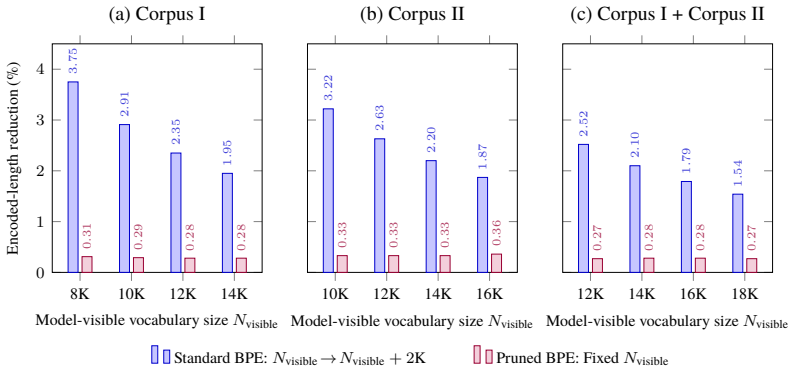
Pruned BPE cuts encoded token length by up to 0.36 percent without adding vocabulary
Reviewed by Pith at T0; open to challenge. T0 means a machine referee read the full paper against a public rubric. the ladder, T0–T4 →
T0 review · deepseek-v4-flash
2026-08-05 00:10 UTC pith:S5BD5RJB
load-bearing objection Plausible pruning idea, but the missing same-total-merge control means the reported gains could be entirely explained by a larger candidate pool, not by exposure-based selection. the 2 major comments →
Pruned BPE: Post-training Visibility Pruning and Token Reallocation for Byte Pair Encoding
The pith
A machine-rendered reading of the paper's core claim, the machinery that carries it, and where it could break.
Core claim
The paper's central claim is that a fixed BPE vocabulary budget can be made more efficient by post-training visibility pruning and token reallocation. After standard BPE training reaches the target vocabulary size, each learned token is scored by final exposure, defined as how often it remains visible after the full merge sequence is applied to the training corpus. Tokens below an exposure threshold are retained in the merge table but are recursively expanded into visible descendants during encoding, so the language model never sees them as token IDs. Their vocabulary slots are given to additional trained candidates until the target visible vocabulary size is restored. Across two corpora and
What carries the argument
The key mechanism is final exposure E(t), the number of times a learned token appears after all BPE merges have been applied. Tokens with E(t) below a threshold τ are designated internal-only and assigned IDs outside the visible vocabulary; during encoding they are expanded recursively through their merge children until only visible tokens remain. Merge ranks are preserved separately from exported IDs so that reallocation does not change the original BPE merge order. A dynamic stopping condition continues resumed training until enough eligible candidates are available to fill all visible learned-token positions, keeping the model-visible vocabulary size fixed.
Load-bearing premise
The measured improvement is assumed to come from the pruning and reallocation mechanism, but Pruned BPE trains on more merges than Standard BPE before evaluation, so the extra candidate pool, not the visibility criterion, could be the actual cause of the shorter encoded sequences.
What would settle it
Train Standard BPE to the same total number of merges that Pruned BPE uses (including the extra candidate tokens), then truncate the merge list to only the first Nvisible tokens and use that truncated vocabulary for encoding. If this baseline matches Pruned BPE's encoded length, the claimed benefit of visibility pruning is not real. A second test would be to evaluate whether Pruned BPE's advantage disappears when final exposure is computed on a held-out corpus rather than the training corpus.
If this is right
- A fixed vocabulary budget yields shorter token sequences, so more text fits into the same context window without increasing model vocabulary size.
- Internal-only tokens can be reused as construction nodes while remaining invisible to the language model, preserving the learned merge structure.
- Because merge ranks are stored separately from exported IDs, the same trained merge tree could support multiple domain-specific visible vocabularies.
- The reported gains are a meaningful fraction of the 1.5 to 3.8 percent marginal reduction that would otherwise require adding another 2K Standard BPE tokens.
- Pruned BPE does not require changing the core BPE pair-selection and merge operations, only the post-training export and encoding steps.
Where Pith is reading between the lines
- The results imply that Standard BPE's vocabulary allocation is suboptimal with respect to final-token usefulness: some visible slots are effectively wasted on intermediate units, and the paper's method recovers that capacity for free.
- A testable extension would be to train language models of identical architecture and data with Standard BPE and Pruned BPE and compare validation loss and downstream performance, since the paper only measures encoded length.
- The same final-exposure criterion could be applied to other subword tokenization schemes, such as unigram or SentencePiece-style models, to see whether visibility pruning helps beyond byte-level BPE.
- The extra training compute required by resumed training could be traded against tokenizer efficiency; an interesting follow-up would be to measure whether the encoded-length gain justifies the added cost in practical deployment.
Editorial analysis
A structured set of objections, weighed in public.
Referee Report
Summary. The paper proposes Pruned BPE, a post-training modification of byte-level BPE that separates merge construction from the model-visible vocabulary. After standard BPE training to a target visible size N, each learned token is scored by final exposure on the fully encoded training corpus; low-exposure tokens are retained as internal-only merge nodes, and their visible vocabulary slots are refilled by additional candidates learned through resumed BPE training. Encoding applies all retained merge rules and recursively expands internal-only tokens so that only visible token IDs are emitted. Experiments on two corpora and their combination report consistent encoded-length reductions of about 0.27%–0.36% at a 40% exposure threshold, and a vocabulary-only minimum-token DP evaluation reports similar reductions. The paper includes a reference implementation and public code/data.
Significance. If the effect is attributable to the exposure-based selection criterion, the method is a simple and useful improvement: it achieves shorter encodings without increasing the model-visible vocabulary budget, and the reported gains are a nontrivial fraction of the benefit from adding 2K standard tokens. The cross-corpus evaluation and the shared DP encoder are thoughtful diagnostics, and the public release of code, corpora, and trained tokenizers is a strength. However, the central attribution is currently under-supported: the comparison does not control for the fact that Pruned BPE trains additional merges, so the observed gains may stem from a larger candidate pool rather than from visibility pruning and reallocation.
major comments (2)
- [§3.3, Algorithm 1 lines 12–19; §4.5; Table 3; Eq. (3)] The comparison does not control for the extra training budget. Standard BPE performs exactly Nrequired merges, while Pruned BPE performs additional merges until Neligible ≥ Nrequired. The reductions in Eq. (3) therefore compare vocabularies produced from different-sized merge trees. Table 4 reports only internal-only counts, not the number of additional merges or discarded candidates, so the size of the candidate-pool advantage is unknown (it is at least the internal-only count). A control is missing: train a Standard BPE tokenizer to the same total number of merges as Pruned BPE and then select Nrequired visible tokens under alternative rules (e.g., first Nrequired in merge order, random selection, highest final exposure), with internal-only expansion allowed. Without this, the measured 0.27–0.36% could be a candidate-pool effect rather than an effect of the exposure criterion.
- [§4.6] The vocabulary-only DP evaluation does not remove the confound identified above. It holds the inference objective constant, but the two visible vocabularies are still selected from different-sized trained pools; Pruned BPE's visible vocabulary contains later merge candidates that Standard BPE at Nrequired never sees. The statement that 'the improvement arises from a more efficient composition of the model-visible vocabulary' (also in the Abstract) is therefore stronger than the experiment supports. A control that fixes the candidate pool (same total merges) and varies only the visibility-selection rule is needed; the DP objective can then be applied to both vocabularies.
minor comments (4)
- [§4.1, §4.3] No held-out split is created, and final exposure is computed on the training corpus, so the same-corpus results are partly a fit to that corpus. The cross-corpus rows in Table 3 mitigate this concern, but the paper should either present cross-corpus results as the primary evidence or add a held-out split.
- [Algorithm 1, line 16] The 'small batch' size for additional merges is unspecified. Reporting the batch size and, for each configuration, the total number of additional merges performed (including discarded candidates) would make the extra-training cost transparent. Table 4's internal-only counts do not equal the extra merge count.
- [§4.5, Figure 1] The comparison with adding 2K Standard BPE tokens is informative, but the 'meaningful fraction' statement is incomplete without reporting the actual extra training used by Pruned BPE. Please include the total trained vocabulary size for each Pruned BPE configuration.
- [Notation] Some notation is introduced without equation numbers (e.g., Neligible, Sharep, child(t), emit(t)); adding equation numbers would improve readability and cross-referencing.
Circularity Check
No circularity: visible-vocabulary selection uses final exposure, but the reported reductions are empirical comparisons, not the selection criterion by construction; cross-corpus and shared-DP evaluations provide independent grounding.
full rationale
The paper's method is a training-time/post-training procedure: Standard BPE merges are learned, tokens are scored by final exposure E(t), low-exposure tokens are kept as internal-only nodes, and visible slots are refilled by resumed training. The central measured quantities are encoded lengths L_std and L_pruned under the same training/evaluation corpus and model-visible vocabulary size (Eq. 3). This comparison is not self-definitional: E(t) counts token occurrences in the fully merged corpus, not encoded length, and the export procedure admits eligible tokens in merge order until the visible target is filled rather than performing any explicit encoded-length minimization. Pruned BPE could in principle lose on the training corpus if expansion of internal tokens outweighed the benefit of replacement tokens, so the observed reduction is an empirical result. The same-corpus evaluation is a deliberate matched comparison, not a prediction from a fitted parameter. The cross-corpus evaluations (e.g., Corpus I-trained tokenizers evaluated on Corpus II) and the vocabulary-only minimum-token DP evaluation (Section 4.6) further decouple the result from training-corpus-specific fitting; the DP encoder uses only the exported visible vocab.txt, not merge ranks or internal-only nodes, and the advantage persists. The only self-reference is [19], the public code/data repository, which is not load-bearing for any claim. The absence of a same-total-merge control for Standard BPE is a potential confound (extra candidate budget), but that is an experimental-control issue, not a circularity of the derivation chain. No step reduces, by the paper's own equations or by self-citation, to its inputs.
Axiom & Free-Parameter Ledger
free parameters (4)
- Exposure threshold multiplier r =
0.20, 0.30, 0.40
- Target vocabulary sizes N =
8K, 10K, 12K, 14K, 16K, 18K depending on corpus
- Small batch size in resumed training =
not specified
- Maximum training size Nmax =
not specified in experiments
axioms (5)
- standard math Standard BPE merge process is correct and reproducible.
- domain assumption Final exposure in the training corpus is a good proxy for token usefulness in downstream tasks.
- domain assumption The training corpus is representative of the evaluation corpora.
- domain assumption Recursive expansion of internal-only tokens preserves the intended segmentation and meaning.
- domain assumption The shared pretokenizer is applied identically to both methods.
Cite this review
Pith. "Pith review of Pruned BPE: Post-training Visibility Pruning and Token Reallocation for Byte Pair Encoding." pith.science (2026). https://pith.science/paper/S5BD5RJB
@misc{pith2026260800837,
  author       = {Pith},
  title        = {Pith review of: Pruned BPE: Post-training Visibility Pruning and Token Reallocation for Byte Pair Encoding},
  year         = {2026},
  howpublished = {\url{https://pith.science/paper/S5BD5RJB}},
  note         = {Machine review of arXiv:2608.00837}
}
read the original abstract
Byte Pair Encoding (BPE) is widely used for subword tokenization, but standard BPE exposes every learned merge token to the downstream model, including tokens that mainly serve as intermediate construction units and rarely appear in the final encoded corpus. This paper proposes Pruned BPE, a post-training visibility-pruning and token-reallocation method that separates merge construction from model-visible vocabulary selection. After standard BPE training, tokens are evaluated by final exposure. Low-exposure tokens are retained as internal-only merge nodes, while their visible vocabulary slots are reassigned to better-exposed candidates learned through resumed training. During encoding, internal-only tokens are recursively expanded into visible descendants while the original BPE merge order is preserved. Experiments on two non-overlapping English- and Chinese-dominated corpora and their combination show that Pruned BPE consistently reduces encoded length relative to Standard BPE at the same training corpus, evaluation corpus, and model-visible vocabulary size. At a 40% exposure threshold, the reduction is approximately 0.27%--0.36% on same-corpus evaluations. In a vocabulary-only evaluation using a shared exact minimum-token dynamic-programming encoder, Pruned BPE retains an advantage of approximately 0.23%--0.31%, indicating that the improvement arises from a more efficient visible vocabulary. These gains represent a meaningful fraction of the approximately 1.5%--3.8% marginal reduction that would otherwise require adding another 2K Standard BPE tokens. Qualitative analysis shows that internal-only tokens include reusable English fragments, Chinese components, partial UTF-8 byte sequences, and structured-text fragments. The results indicate that post-training visibility pruning can improve BPE vocabulary efficiency without increasing the vocabulary exposed to the language model.
Figures

discussion (0)
Sign in with ORCID, Apple, or X to comment. Anyone can read and Pith papers without signing in.