REVIEW 3 major objections 7 minor 40 references
Driving the Wrong Way: Leveraging Interpretability in End2End Autonomous Driving Models
T0 review · 3 major / 7 minor · reviewed 2026-07-08 · glm-5.2
Pith's one-line read Zeroing three neurons makes a self-driving model safer
desk verdict First application of SAE-based concept decomposition to end-to-end autonomous driving models; the intervention result is promising but unvalidated due to selection-evaluation circularity. read the letter →
The pith
A machine-rendered reading of the paper's core claim, the machinery that carries it, and where it could break.
The reading
What carries the argument
SAE
What would settle it
If the same three-neuron ablation fails to produce comparable improvements on a different driving benchmark or in closed-loop simulation, the gain would be a dataset-specific artifact rather than a genuine correction of model behavior.
Extended reading notes
Core claim
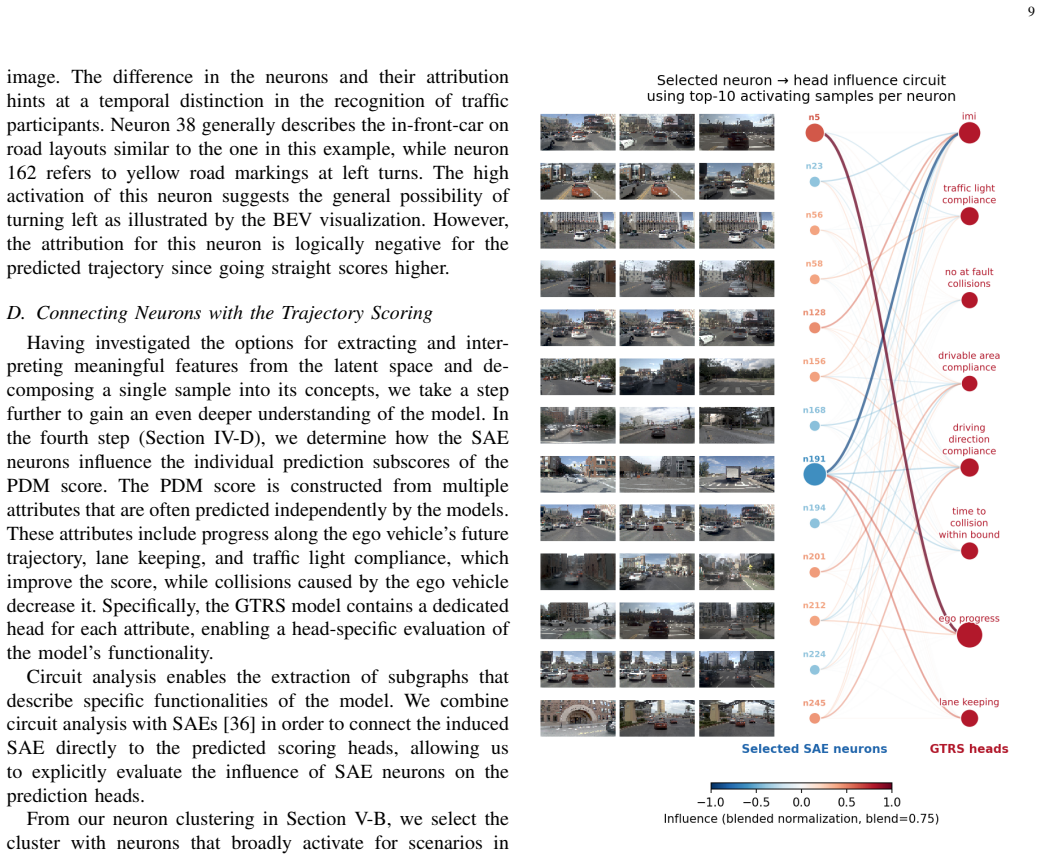
The paper's central object is the SAE-injected latent space sitting directly before a driving model's trajectory-scoring module. By training a Sparse Autoencoder on this representation, the authors decompose the model's entangled internal features into sparse, monosemantic concept directions. Circuit analysis then maps these concepts to individual scoring heads, revealing which latent features drive which aspects of the driving decision. The core discovery is that zeroing just three of these concept-level neurons — identified as having broad negative influence across multiple heads — produces a measurable improvement in driving performance, shifting the model from risky, progress-maximizing,
Load-bearing premise
The three neurons are selected based on circuit analysis performed on the same NAVSIM evaluation set used to measure the improvement, with no held-out test set or closed-loop simulation to confirm that zeroing them generalizes beyond that benchmark.
Editorial extensions
Reading between the lines
- The three-neuron ablation is selected and evaluated on the same benchmark (NAVSIM), so the reported gain could partly reflect overfitting to that dataset's specific scenario distribution rather than a generalizable correction of model behavior.
- The finding that the backward-facing camera has no measurable influence on predictions suggests the model may be ignoring potentially useful input modalities, raising questions about whether other cameras or sensors are similarly underutilized.
- The observation that penalty heads (e.g., traffic-light compliance) score high by default when no violation exists implies that attribution-based interpretability methods may systematically miss the most safety-critical failure modes, since those occur when the model fails to detect a hazard rather than when it actively processes one.
- If the concept-level intervention approach generalizes, it could enable rapid post-deployment safety patches for autonomous driving models — correcting discovered failure modes through neuron-level edits rather than full retraining cycles.
Signed reviews
Editorial analysis
A structured set of objections, weighed in public.
Referee Report
Summary. This paper introduces a concept-based interpretability framework for end-to-end autonomous driving models. The authors integrate Sparse Autoencoders (SAEs) into the latent space of state-of-the-art models (GTRS, iPAD) to decompose driving behavior into interpretable concepts. They propose a stepwise methodology: selecting a latent space, training SAEs, assigning semantic meaning via activation maximization and attribution, linking concepts to trajectory scoring heads via circuit analysis, and performing targeted interventions by zeroing specific SAE neurons. The central intervention result claims that ablating three SAE neurons ({177, 59, 71}) improves the EPDMS score from 0.496 (SAE-injected baseline) to 0.593, surpassing the original model's 0.524.
Significance. The paper addresses an important gap in end-to-end autonomous driving: the lack of concept-level latent space interpretability. The systematic comparison of SAE variants (TopK, Matryoshka, Archetypal) in Table I is a useful contribution, and the application of circuit discovery to connect SAE features to PDM subscores is methodologically sound and well-motivated. The observation that the backward-facing camera in iPAD appears unused is a concrete, falsifiable finding. The framework is clearly structured and the SAE training and circuit analysis methodology is reasonably specified.
major comments (3)
- §V-F, Table II: The central intervention result has a selection-evaluation circularity. Neurons {177, 59, 71} are selected post hoc based on circuit analysis (attribution patching, activation patching, ACDC pruning) computed over the NAVSIM evaluation data, and the EPDMS improvement from ablation is then measured on that same data. With 256 active SAE neurons and multiple scoring heads, the search space for beneficial ablation combinations is large, and selecting 3 neurons that improve the score on the same benchmark used to identify them provides no evidence of generalization. The paper needs either a held-out validation split for neuron selection or cross-validation to demonstrate that the 0.097 EPDMS gain is not a dataset-specific artifact.
- §V-F: The paper claims 'improved closed-loop behavior' but evaluates only on NAVSIM, an open-loop benchmark where trajectory proposals are scored against ground truth without environmental reactivity. The ego progress drop of -0.100 (Table II) is consistent with a model that selects more conservative trajectories to game compliance scores, which is a known failure mode of open-loop metrics. The claim of improved closed-loop behavior is not supported by the evaluation; either closed-loop simulation results should be provided, or the claim should be retracted and the result framed strictly as an open-loop improvement.
- §V-F, Table II: The magnitude of the intervention effect is suspiciously large. The SAE injection degrades EPDMS from 0.524 to 0.496 despite near-perfect reconstruction (cosine similarity 0.9975, explained variance 0.9951, Table I), yet ablating just 3 of 256 neurons not only recovers this loss but surpasses the original model by 0.069. The paper should explain why such a minimal intervention produces such a large effect, and whether the 0.496 baseline reflects a systematic degradation from SAE injection that the ablation happens to correct, rather than a genuine correction of erroneous model behavior.
minor comments (7)
- §III-B, Eq. (1): The ego correlation score is defined as the max over neurons of |r_{i,j}|, but the notation uses index 'n' in r_{n,j} while the max is over 'i'. This should be made consistent.
- §V-A: The text states 'SAEs in language models typically require a high expansion factor, we experience substantially less required neurons for vision-based models.' This claim would benefit from a citation or quantitative comparison to support it.
- Table I: The 'TopK*256' row uses an asterisk that is not explained in the table caption. Presumably this marks the selected SAE configuration, but this should be stated explicitly.
- §V-F: The paper states neurons 59 and 71 'show a close correlation to neuron 177.' It would strengthen the intervention claim to report the actual correlation values and clarify whether 'correlation' refers to activation correlation or influence correlation.
- §V-E: The remark on model construction and interpretability is insightful but reads as a tangent. Consider integrating this observation (that penalty heads predict absence of violation, complicating activation-based attribution) into the methodology section where it can inform the interpretation framework.
- Fig. 2: The caption references 'top' and 'bottom' panels but the figure description could be more precise about what the clustering visualization (top) actually shows (e.g., t-SNE/UMAP projection, dendrogram, etc.).
- §IV-B, Eq. (8): The reanimation loss term is described as encouraging inactive neurons, but the mechanism by which pushing pre-activations of dead neurons leads to reactivation could be stated more precisely.
Simulated Author's Rebuttal
We thank the referee for a careful and constructive review. The referee raises three major concerns about the intervention results in Section V-F: (1) selection-evaluation circularity due to neuron selection and evaluation on the same NAVSIM data, (2) an unsupported claim of improved closed-loop behavior when only open-loop evaluation is conducted, and (3) the suspiciously large magnitude of the intervention effect relative to the minimal nature of the ablation. We agree with the substance of all three comments and will revise the manuscript accordingly. Specifically, we will (a) add a held-out validation split for neuron selection and report cross-validated results, (b) retract the 'improved closed-loop behavior' claim and reframe the result strictly as an open-loop improvement, and (c) add analysis explaining the mechanism by which SAE injection introduces systematic degradation that the ablation corrects. No standing objections remain.
read point-by-point responses
-
Referee: §V-F, Table II: The central intervention result has a selection-evaluation circularity. Neurons {177, 59, 71} are selected post hoc based on circuit analysis (attribution patching, activation patching, ACDC pruning) computed over the NAVSIM evaluation data, and the EPDMS improvement from ablation is then measured on that same data. With 256 active SAE neurons and multiple scoring heads, the search space for beneficial ablation combinations is large, and selecting 3 neurons that improve the score on the same benchmark used to identify them provides no evidence of generalization. The paper needs either a held-out validation split for neuron selection or cross-validation to demonstrate that the 0.097 EPDMS gain is not a dataset-specific artifact.
Authors: The referee is correct that the current evaluation has a selection-evaluation circularity: the circuit analysis used to identify neurons {177, 59, 71} was computed over the NAVSIM evaluation data, and the ablation effect was measured on the same data. We acknowledge that this does not constitute evidence of generalization. We will address this by splitting the NAVSIM evaluation set into a validation split (used for neuron selection via circuit analysis) and a held-out test split (used solely for reporting the final ablation result). We will additionally report the EPDMS change on the held-out split. If the effect does not generalize, we will report this honestly and reframe the contribution accordingly. The circuit analysis methodology itself (attribution patching, activation patching, ACDC pruning) is not changed; only the data split on which selection versus evaluation occurs is corrected. revision: yes
-
Referee: §V-F: The paper claims 'improved closed-loop behavior' but evaluates only on NAVSIM, an open-loop benchmark where trajectory proposals are scored against ground truth without environmental reactivity. The ego progress drop of -0.100 (Table II) is consistent with a model that selects more conservative trajectories to game compliance scores, which is a known failure mode of open-loop metrics. The claim of improved closed-loop behavior is not supported by the evaluation; either closed-loop simulation results should be provided, or the claim should be retracted and the result framed strictly as an open-loop improvement.
Authors: The referee is correct. NAVSIM is an open-loop, non-reactive benchmark, and our use of the phrase 'improved closed-loop behavior' in Section V-F is not supported by the evaluation we present. We will retract this claim throughout the manuscript and reframe the result strictly as an open-loop EPDMS improvement. We also agree that the ego progress drop of -0.100 is consistent with the known failure mode of open-loop metrics rewarding overly conservative trajectory selection. We will add an explicit discussion of this limitation, noting that the observed trade-off between compliance scores and ego progress may reflect metric gaming rather than genuine behavioral improvement, and that closed-loop evaluation would be needed to distinguish these explanations. Providing closed-loop simulation results is beyond the scope of what we can add in revision, so we will scope our claims accordingly. revision: yes
-
Referee: §V-F, Table II: The magnitude of the intervention effect is suspiciously large. The SAE injection degrades EPDMS from 0.524 to 0.496 despite near-perfect reconstruction (cosine similarity 0.9975, explained variance 0.9951, Table I), yet ablating just 3 of 256 neurons not only recovers this loss but surpasses the original model by 0.069. The paper should explain why such a minimal intervention produces such a large effect, and whether the 0.496 baseline reflects a systematic degradation from SAE injection that the ablation happens to correct, rather than a genuine correction of erroneous model behavior.
Authors: The referee raises a valid concern about the plausibility of the effect magnitude. We will add analysis addressing this. Our working hypothesis is that the near-perfect reconstruction metrics (cosine similarity 0.9975, explained variance 0.9951) are aggregate measures that can mask localized, high-impact distortions in specific regions of the latent space that are disproportionately important for particular scoring heads. The SAE injection may introduce small but systematic perturbations in the representations feeding the compliance-related heads (drivable area, driving direction), which are particularly sensitive to certain feature directions. The three ablated neurons may sit at a critical junction where the SAE's reconstruction error concentrates, so their ablation removes a systematic bias introduced by the SAE rather than correcting an original model error. This would mean the 0.496 baseline partly reflects SAE-injection degradation, and the ablation recovers and surpasses the original by removing both the SAE-induced distortion and a pre-existing spurious correlation. We will add this analysis to the manuscript and be explicit that the result may reflect correction of SAE-injection artifacts rather than purely genuine correction of erroneous model behavior. We will also report per-head reconstruction quality to test whether the degradation is concentrated in specific heads. revision: partial
Circularity Check
Neuron selection and performance evaluation occur on the same NAVSIM split with no held-out validation, making the 0.097 EPDMS gain indistinguishable from test-set overfitting
full rationale
The paper's SAE training and circuit analysis methodology is not circular: the SAE is trained on frozen model activations, and circuit analysis uses attribution/activation patching against the model's actual outputs. However, the central intervention result has a selection-evaluation circularity concern. In §V-F, neurons {177, 59, 71} are selected because they show 'negative influence across multiple scoring heads' as determined by circuit analysis computed over the NAVSIM evaluation data. The EPDMS improvement from ablation is then measured on that same NAVSIM evaluation dataset. With 256 active SAE neurons and multiple scoring heads, the search space for beneficial ablation combinations is enormous, and selecting 3 neurons that improve the score on the same benchmark they were identified on provides no evidence of generalization. This is a textbook fitted-input-called-prediction pattern: the neurons are fit to the evaluation data (via circuit analysis identifying 'negative influence'), and then the 'improvement' is measured on that same data. The concern is amplified by the SAE injection itself degrading EPDMS from 0.524 to 0.496 despite near-perfect reconstruction (cosine similarity 0.9975, explained variance 0.9951), yet ablating just 3 of 256 neurons not only recovers this loss but surpasses the original model by 0.069 — a suspiciously large effect for such a minimal intervention. The paper also claims 'improved closed-loop behavior' (§V-F) but evaluates only on NAVSIM, an open-loop benchmark. The ego progress drop of -0.100 (Table II) is consistent with the model selecting more conservative trajectories that game compliance scores without genuinely better driving. No held-out test set or closed-loop simulation is used to verify that the intervention generalizes. This is not a self-definitional circularity (the SAE and circuit analysis are independently grounded), but the headline 'improvement' result is statistically forced by the selection-evaluation overlap. The paper's other contributions — concept extraction, semantic assignment, circuit visualization — are independently grounded and not circular. The circularity is confined to the intervention claim in §V-F and does not invalidate the interpretability framework itself. Score 4 reflects that the central 'performance improvement' claim has partial circularity while the broader methodology retains independent content. No self-citation load-bearing issues were found: the paper cites prior SAE work [
Assumptions & free parameters
free parameters (5)
- SAE latent dimension m =
256 (selected variant)
- top-k sparsity parameter =
64 (selected variant)
- reanimation loss weight λ_r =
not specified
- circuit threshold τ =
not specified
- ablated neurons {177, 59, 71} =
N/A
assumptions (4)
- domain assumption The latent representation directly preceding the scoring module encodes a dense summary of scene understanding and is the basis for trajectory scoring.
- domain assumption SAE neurons correspond to monosemantic, human-interpretable concepts.
- standard math Attribution patching and activation patching approximate causal influence of neurons on model outputs.
- domain assumption Open-loop NAVSIM evaluation is a sufficient proxy for driving performance improvement.
Cite this review
Pith. "Pith review of Driving the Wrong Way: Leveraging Interpretability in End2End Autonomous Driving Models." pith.science (2026). https://pith.science/paper/S7SZHF6P
@misc{pith2026260706328,
  author       = {Pith},
  title        = {Pith review of: Driving the Wrong Way: Leveraging Interpretability in End2End Autonomous Driving Models},
  year         = {2026},
  howpublished = {\url{https://pith.science/paper/S7SZHF6P}},
  note         = {Machine review of arXiv:2607.06328}
}
read the original abstract
The increasing adoption of end-to-end learning for autonomous driving introduces increased model complexity and opacity, raising the risk of learning undesired or erroneous behavior. In this work, we integrate unsupervised dictionary learning as a post hoc interpretability module within state-of-the-art driving models to decompose driving behavior into semantically meaningful concepts while demonstrating their causal influence on the model's driving decisions. We propose a stepwise framework for extracting and interpreting meaningful concepts from the end-to-end model and connecting them to the multifaceted model outputs, thereby revealing the underlying decision-making logic for the prediction of future trajectories. Furthermore, targeted interventions at the concept level allow us to manipulate and correct driving decisions, resulting in measurable improvements in overall driving performance. We thus demonstrate how interpretability can effectively be used to reduce model opacity, uncover erroneous behavior, and enable targeted mitigation, ultimately boosting model performance.
Figures


Figures from the paper (2 more)

Reference graph
Works this paper leans on
-
[1]
End-to-end autonomous driving: Challenges and frontiers,
L. Chen, P. Wu, K. Chitta, B. Jaeger, A. Geiger, and H. Li, “End-to-end autonomous driving: Challenges and frontiers,”IEEE Transactions on Pattern Analysis and Machine Intelligence, vol. 46, no. 12, pp. 10 164– 10 183, 2024
work page 2024
-
[2]
Navsim: Data-driven non-reactive autonomous vehicle simulation and benchmarking,
D. Dauner, M. Hallgarten, T. Li, X. Weng, Z. Huang, Z. Yang, H. Li, I. Gilitschenski, B. Ivanovic, M. Pavone, A. Geiger, and K. Chitta, “Navsim: Data-driven non-reactive autonomous vehicle simulation and benchmarking,” inAdvances in Neural Information Processing Systems, vol. 37, 2024, pp. 28 706–28 719
work page 2024
-
[3]
Pseudo-simulation for autonomous driving,
W. Cao, M. Hallgarten, T. Li, D. Dauner, X. Gu, C. Wang, Y . Miron, M. Aiello, H. Li, I. Gilitschenski, B. Ivanovic, M. Pavone, A. Geiger, and K. Chitta, “Pseudo-simulation for autonomous driving,” 2025
work page 2025
-
[4]
Explainable ai for safe and trustworthy autonomous driving: A system- atic review,
A. Kuznietsov, B. Gyevnar, C. Wang, S. Peters, and S. V . Albrecht, “Explainable ai for safe and trustworthy autonomous driving: A system- atic review,”IEEE Transactions on Intelligent Transportation Systems, vol. 25, no. 12, pp. 19 342–19 364, 2024
work page 2024
-
[5]
Safety implications of explainable artificial intelligence in end-to-end autonomous driving,
S. Atakishiyev, M. Salameh, and R. Goebel, “Safety implications of explainable artificial intelligence in end-to-end autonomous driving,” IEEE Transactions on Intelligent Transportation Systems, vol. 26, no. 10, pp. 14 516–14 535, 2025
work page 2025
-
[6]
Hydra-mdp: End-to-end multimodal planning with multi-target hydra-distillation,
Z. Li, K. Li, S. Wang, S. Lan, Z. Yu, Y . Ji, Z. Li, Z. Zhu, J. Kautz, Z. Wu et al., “Hydra-mdp: End-to-end multimodal planning with multi-target hydra-distillation,” 2024
work page 2024
-
[7]
EMMA: End-to-end multimodal model for autonomous driving,
J.-J. Hwang, R. Xu, H. Lin, W.-C. Hung, J. Ji, K. Choi, D. Huang, T. He, P. Covington, B. Sapp, Y . Zhou, J. Guo, D. Anguelov, and M. Tan, “EMMA: End-to-end multimodal model for autonomous driving,”Trans- actions on Machine Learning Research, 2025
work page 2025
-
[8]
Vadv2: End-to-end vectorized autonomous driving via probabilistic planning,
B. Jiang, S. Chen, H. Gao, B. Liao, Q. Zhang, W. Liu, and X. Wang, “Vadv2: End-to-end vectorized autonomous driving via probabilistic planning,” 2026
work page 2026
Show all 40 references
-
[9]
Generalized trajectory scoring for end-to-end multimodal planning,
Z. Li, W. Yao, Z. Wang, X. Sun, J. Chen, N. Chang, M. Shen, Z. Wu, S. Lan, and J. M. Alvarez, “Generalized trajectory scoring for end-to-end multimodal planning,” 2025
2025
-
[10]
ipad: Iterative proposal- centric end-to-end autonomous driving,
K. Guo, H. Liu, X. Wu, J. Pan, and C. Lv, “ipad: Iterative proposal- centric end-to-end autonomous driving,” 2025
2025
-
[11]
Explaining how a deep neural network trained with end-to-end learning steers a car,
M. Bojarski, P. Yeres, A. Choromanska, K. Choromanski, B. Firner, L. D. Jackel, and U. Muller, “Explaining how a deep neural network trained with end-to-end learning steers a car,” 2017
2017
-
[12]
Visualbackprop: Efficient visual- ization of cnns for autonomous driving,
M. Bojarski, A. Choromanska, K. Choromanski, B. Firner, L. J. Ackel, U. Muller, P. Yeres, and K. Zieba, “Visualbackprop: Efficient visual- ization of cnns for autonomous driving,” in2018 IEEE International Conference on Robotics and Automation (ICRA), 2018, pp. 4701–4708
2018
-
[13]
Interpretable learning for self-driving cars by visualizing causal attention,
J. Kim and J. Canny, “Interpretable learning for self-driving cars by visualizing causal attention,” in2017 IEEE International Conference on Computer Vision (ICCV), 2017, pp. 2961–2969
2017
-
[14]
Conditional affordance learn- ing for driving in urban environments,
A. Sauer, N. Savinov, and A. Geiger, “Conditional affordance learn- ing for driving in urban environments,” inProceedings of The 2nd Conference on Robot Learning, ser. Proceedings of Machine Learning Research, vol. 87, 29–31 Oct 2018, pp. 237–252. 12
2018
-
[15]
Interpretable self-attention temporal reasoning for driving behavior understanding,
Y .-C. Liu, Y .-A. Hsieh, M.-H. Chen, C.-H. H. Yang, J. Tegner, and Y .- C. J. Tsai, “Interpretable self-attention temporal reasoning for driving behavior understanding,” inICASSP 2020 - 2020 IEEE International Conference on Acoustics, Speech and Signal Processing (ICASSP), 20...
2020
-
[16]
Leveraging driver attention for an end-to-end explainable decision-making from frontal images,
J. Araluce, L. M. Bergasa, M. Oca ˜na, ´A. Llamazares, and E. L ´opez- Guill´en, “Leveraging driver attention for an end-to-end explainable decision-making from frontal images,”IEEE Transactions on Intelligent Transportation Systems, vol. 25, no. 8, pp. 10 091–10 102, 2024
2024
-
[17]
Attentional bottleneck: Towards an interpretable deep driving network,
J. Kim and M. Bansal, “Attentional bottleneck: Towards an interpretable deep driving network,” inProceedings of the IEEE/CVF Conference on Computer Vision and Pattern Recognition (CVPR) Workshops, June 2020
2020
-
[18]
What matters for scalable and robust learning in end-to-end driving planners?
D. Holtz, N. Hanselmann, S. Doll, M. Cordts, and B. Schiele, “What matters for scalable and robust learning in end-to-end driving planners?” 2026
2026
-
[19]
Interpretable decision-making for end- to-end autonomous driving,
M. Mirzaie and B. Rosenhahn, “Interpretable decision-making for end- to-end autonomous driving,” inProceedings of the IEEE/CVF Inter- national Conference on Computer Vision (ICCV) Workshops, October 2025, pp. 805–815
2025
-
[20]
Simultaneous policy learning and latent state inference for imitating driver behavior,
J. Morton and M. J. Kochenderfer, “Simultaneous policy learning and latent state inference for imitating driver behavior,” in2017 IEEE 20th International Conference on Intelligent Transportation Systems (ITSC), 2017, pp. 1–6
2017
-
[21]
Deeptest: automated testing of deep-neural-network-driven autonomous cars,
Y . Tian, K. Pei, S. Jana, and B. Ray, “Deeptest: automated testing of deep-neural-network-driven autonomous cars,” inProceedings of the 40th International Conference on Software Engineering, ser. ICSE ’18, New York, NY , USA, 2018, p. 303–314
2018
-
[22]
St-p3: End-to-end vision-based autonomous driving via spatial-temporal feature learning,
S. Hu, L. Chen, P. Wu, H. Li, J. Yan, and D. Tao, “St-p3: End-to-end vision-based autonomous driving via spatial-temporal feature learning,” inComputer Vision – ECCV 2022, 2022, pp. 533–549
2022
-
[23]
Autovla: A vision-language-action model for end-to-end autonomous driving with adaptive reasoning and reinforcement fine-tuning,
Z. Zhou, T. Cai, S. Zhao, Y . Zhang, Z. Huang, B. Zhou, and J. Ma, “Autovla: A vision-language-action model for end-to-end autonomous driving with adaptive reasoning and reinforcement fine-tuning,” in Advances in Neural Information Processing Systems, vol. 38, 2025, pp. 27 920–27 956
2025
-
[24]
Opendrivevla: Towards end-to-end autonomous driving with large vision language action model,
X. Zhou, X. Han, F. Yang, Y . Ma, V . Tresp, and A. Knoll, “Opendrivevla: Towards end-to-end autonomous driving with large vision language action model,” inProceedings of the AAAI Conference on Artificial Intelligence, vol. 40, no. 16, 2026, pp. 13 782–13 790
2026
-
[25]
Scaling monosemanticity: Extracting interpretable features from claude 3 sonnet,
A. Templeton, T. Conerly, J. Marcus, J. Lindsey, T. Bricken, B. Chen, A. Pearce, C. Citro, E. Ameisen, A. Jones, H. Cunningham, N. L. Turner, C. McDougall, M. MacDiarmid, C. D. Freeman, T. R. Sumers, E. Rees, J. Batson, A. Jermyn, S. Carter, C. Olah, and T. Henighan, “Scaling ...
2024
-
[26]
Daujotas
G. Daujotas. (2024, June) Interpreting and steering features in images. LessWrong. [Online]. Available: https://www.lesswrong.com/posts/ Quqekpvx8BGMMcaem/interpreting-and-steering-features-in-images
2024
-
[27]
Sparse autoencoders reveal selective remapping of visual concepts during adaptation,
H. Lim, J. Choi, J. Choo, and S. Schneider, “Sparse autoencoders reveal selective remapping of visual concepts during adaptation,” inThe Thirteenth International Conference on Learning Representations, 2025
2025
-
[28]
Can i trust my trajectory prediction model?
F. Motzkus, C. Schlauch, S. Bernhard, and U. Schmid, “Can i trust my trajectory prediction model?” inProceedings of the TRUST-AI Workshop: European Workshop on Trustworthy AI, co-located with the European Conference on Artificial Intelligence (ECAI 2025), ser. CEUR Workshop Pr...
2025
-
[29]
Toy models of superposition,
N. Elhage, T. Hume, C. Olsson, N. Schiefer, T. Henighan, S. Kravec, Z. Hatfield-Dodds, R. Lasenby, D. Drain, C. Chen, R. Grosse, S. Mc- Candlish, J. Kaplan, D. Amodei, M. Wattenberg, and C. Olah, “Toy models of superposition,”Transformer Circuits Thread, 2022
2022
-
[30]
Towards monosemanticity: Decomposing language mod- els with dictionary learning,
T. Bricken, A. Templeton, J. Batson, B. Chen, A. Jermyn, T. Conerly, N. Turner, C. Anil, C. Denison, A. Askell, R. Lasenby, Y . Wu, S. Kravec, N. Schiefer, T. Maxwell, N. Joseph, Z. Hatfield-Dodds, A. Tamkin, K. Nguyen, B. McLean, J. E. Burke, T. Hume, S. Carter, T. Henighan, ...
2023
-
[31]
Sparse autoencoders find highly interpretable features in language models,
R. Huben, H. Cunningham, L. R. Smith, A. Ewart, and L. Sharkey, “Sparse autoencoders find highly interpretable features in language models,” inThe Twelfth International Conference on Learning Repre- sentations, 2024
2024
-
[32]
Scaling and evaluating sparse autoencoders,
L. Gao, T. D. la Tour, H. Tillman, G. Goh, R. Troll, A. Radford, I. Sutskever, J. Leike, and J. Wu, “Scaling and evaluating sparse autoencoders,” inThe Thirteenth International Conference on Learning Representations, 2025
2025
-
[33]
Learning multi-level features with matryoshka sparse autoencoders,
B. Bussmann, N. Nabeshima, A. Karvonen, and N. Nanda, “Learning multi-level features with matryoshka sparse autoencoders,” inForty- second International Conference on Machine Learning, 2025
2025
-
[34]
Archetypal SAE: Adaptive and stable dictionary learning for concept extraction in large vision models,
T. Fel, E. S. Lubana, J. S. Prince, M. Kowal, V . Boutin, I. Papadimitriou, B. Wang, M. Wattenberg, D. E. Ba, and T. Konkle, “Archetypal SAE: Adaptive and stable dictionary learning for concept extraction in large vision models,” inProceedings of the 42nd International Confere...
2025
-
[35]
Mechanistic?
N. Saphra and S. Wiegreffe, “Mechanistic?” 2024
2024
-
[36]
Sparse feature circuits: Discovering and editing interpretable causal graphs in language models,
S. Marks, C. Rager, E. J. Michaud, Y . Belinkov, D. Bau, and A. Mueller, “Sparse feature circuits: Discovering and editing interpretable causal graphs in language models,” inThe Thirteenth International Conference on Learning Representations, 2025
2025
-
[37]
Feature visualization,
C. Olah, A. Mordvintsev, and L. Schubert, “Feature visualization,” Distill, 2017
2017
-
[38]
From attribution maps to human-understandable explanations through concept relevance propagation,
R. Achtibat, M. Dreyer, I. Eisenbraun, S. Bosse, T. Wiegand, W. Samek, and S. Lapuschkin, “From attribution maps to human-understandable explanations through concept relevance propagation,”Nature Machine Intelligence, vol. 5, no. 9, pp. 1006–1019, Sep 2023
2023
-
[39]
On pixel-wise explanations for non-linear classifier deci- sions by layer-wise relevance propagation,
S. Bach, A. Binder, G. Montavon, F. Klauschen, K.-R. M ¨uller, and W. Samek, “On pixel-wise explanations for non-linear classifier deci- sions by layer-wise relevance propagation,”PLOS ONE, vol. 10, no. 7, pp. 1–46, 07 2015
2015
-
[40]
Into the rabbit hull: From task-relevant concepts in DINO to minkowski geometry,
T. Fel, B. Wang, M. A. Lepori, M. Kowal, A. Lee, R. Balestriero, S. Joseph, E. S. Lubana, T. Konkle, D. E. Ba, and M. Wattenberg, “Into the rabbit hull: From task-relevant concepts in DINO to minkowski geometry,” 2025
2025
Reviewed July 8, 2026 · model on record in the stance chip above.
Discussion (0). Continue with ORCID to comment.