REVIEW 4 major objections 5 minor 59 references
Sparse 3D Perception for Rose Harvesting Robots: A Two-Stage Approach Bridging Simulation and Real-World Applications
T0 review · 4 major / 5 minor · reviewed 2026-08-06 · deepseek-v4-flash
Pith's one-line read The paper argues that rose-harvesting robots can be guided by a synthetic-trained stereo pipeline that detects rose centers and estimates depth, removing the need for real 3D labels.
desk verdict Solid engineering and a useful synthetic dataset, but the sim-to-real bridge is asserted for depth, not measured, and the only real 2D comparison favors YOLOv5s. read the letter →
The pith
A machine-rendered reading of the paper's core claim, the machinery that carries it, and where it could break.
The reading
What carries the argument
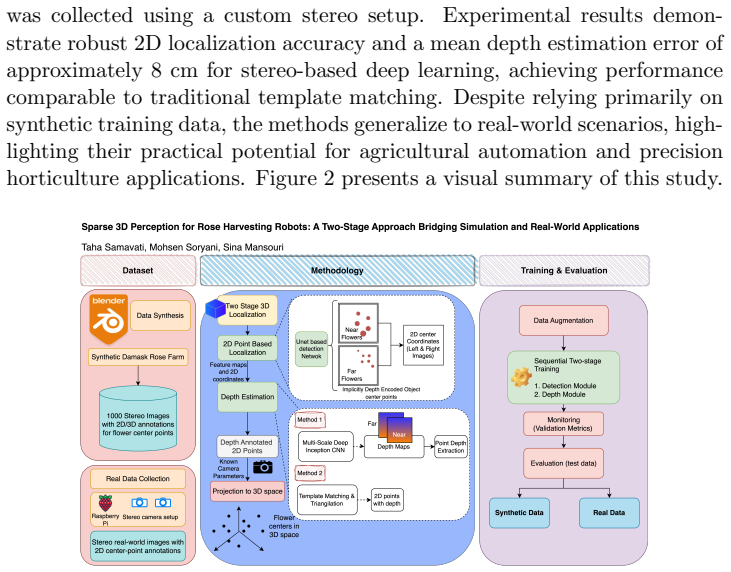
The load-bearing object is the three-channel adaptive-Gaussian heatmap, which turns 2D detection into a dense point-prediction problem and encodes depth through kernel sharpness. The stereo depth decoder then reads the detected centers off a dense depth map produced from shared encoder features of the left and right images. Two-stage training (localizing first, freezing the detector, then training depth) and the custom sigmoid parameterization of the depth output are supporting mechanisms that stabilize learning.
What would settle it
Collect real rose-field stereo pairs with ground-truth depths (for example, from LiDAR or a rangefinder) across 0.5 to 6 meters, run the trained stereo deep and template-matching pipelines, and compare predicted versus measured depths; the central claim fails if the error at 2 meters is substantially above the reported roughly 6 to 8 centimeters or if real-data detection F1 does not approach the fine-tuned YOLOv5s baseline of 80.4.
Extended reading notes
Core claim
The paper's central claim is that point-based, sparse localization can be coupled with direct stereo depth regression so that both tasks share an encoder and are trained on synthetic data alone. The localization head is a U-Net-style decoder on an EfficientNetV2-S backbone that outputs three heatmap channels; ground-truth heatmaps are Gaussian peaks whose spatial extent shrinks with flower depth, so the network is encouraged to localize close flowers sharply. The stereo depth decoder receives features from both images, which lets correspondence happen implicitly, and is supervised only at flower centers by a smoothed L1 loss. On the synthetic test set, near-flower localization reaches about 95.5% F1 for the stereo model, and stereo deep depth error is 9.6 cm for near flowers versus 6 cm for template matching with triangulation; the authors express these as 5% and 3% relative errors at 2 meters. The paper's own comparison shows the point detector outperforms a fine-tuned YOLOv5s on synthetic data but trails it on real data (74-point versus 80-point F1), which the authors attribute to the domain gap in the synthetic training set.
Load-bearing premise
The load-bearing premise is that Blender-generated rose-farm images transfer to real fields for both detection and depth; the depth half of that transfer is never measured because the real dataset lacks depth labels.
Editorial extensions
If this is right
- If the transfer claim holds, a rose-harvesting robot could be built with a cheap stereo camera and a model trained on Blender images, eliminating LiDAR and real 3D labeling cost.
- The near/distant heatmap split means the system is explicitly optimized to grasp nearby blooms, which is the operationally relevant target for a robotic arm.
- Because stereo deep regression beats template matching for distant flowers (13 cm versus 20 cm test L1 error) while template matching wins nearby (6 cm versus 9.6 cm), a hybrid matcher could widen the accurate picking range.
- The compact models, under five million parameters, are offered as evidence that the pipeline can run on resource-constrained field hardware.
Reading between the lines
- A decisive test the paper leaves undone is measuring real depth: recording LiDAR or manual distances for a subset of the real stereo pairs and comparing the stereo network's predictions would directly test the sim-to-real depth transfer that the title promises.
- The reported real-data result suggests the point-based detector's advantage is environment-specific; combining its heatmap head with a stronger feature extractor or adding a small amount of real labeled imagery to training could close the six-point real F1 gap.
- The adaptive-Gaussian heatmap that encodes depth-dependent sharpness could be reused for other sparse grasping targets, such as stems, fruit peduncles, or flower buds, not just rose centers.
- Because template matching and deep stereo fail in complementary ranges, a confidence-based selector between the two depth estimates is a natural next system-level improvement.
Editorial analysis
A structured set of objections, weighed in public.
Referee Report
Summary. The paper proposes a two-stage pipeline for sparse 3D localization of rose centers in agricultural robotics: a point-based 2D detector (U-Net-like architecture with an EfficientNetV2-S encoder) followed by depth estimation, implemented in monocular and stereo variants and compared with a template-matching triangulation baseline. Training relies on a synthetic Blender-generated rose-farm dataset with dense 2D/3D annotations, while a small real-world stereo dataset with 2D-only labels is used for evaluation. The authors report high synthetic F1 scores and depth errors of 3–8% at 2 m range, and they claim that the approach bridges the simulation-to-real domain gap for 3D perception.
Significance. If fully supported, the paper would offer a practical recipe for training agricultural 3D perception systems entirely on synthetic data with minimal real annotation. The Blender-based synthetic dataset with precise 2D/3D labels and the point-based detection formulation are potentially reusable contributions. However, the two load-bearing claims are not established: real-world 3D localization accuracy is never measured, and the paper's own real-world 2D comparison shows a fine-tuned YOLOv5s baseline outperforming the proposed detector. The headline numbers in the abstract are also not consistently recoverable from the reported tables. With these gaps, the contribution reduces to a synthetic-only depth-estimation study whose real-world transfer remains unvalidated.
major comments (4)
- [Abstract; Tables 2–3; Table 10] The abstract's headline F1 of 95.6% (synthetic) cannot be recovered from the per-category results in Tables 2 and 3: monocular near/distant F1 are 96.6/96.3 and stereo near/distant are 95.5/99.8, and no listed averaging procedure produces 95.6. Likewise, the abstract's 74.4% (real) is the stereo near-flower F1 from Table 3, while the monocular near-flower F1 is 78.0 and the fine-tuned YOLOv5s baseline in Table 10 achieves 80.4; the claimed 'superiority of our method' is therefore not supported by the paper's own real-data comparison.
- [Sections 3.2 and 5.7; abstract] The paper never evaluates depth estimation on real-world data: Section 3.2 states that 'the depth of flower centers was not recorded' in the real dataset, and Section 5.7 excludes real-world depth metrics 'due to the absence of acquired depth ground-truth for real-world data.' The abstract's '3% at a 2-meter range' is a synthetic-only result (Table 5, NCCoef near flowers). Since the title and abstract claim a bridge from simulation to real-world applications and the paper's central contribution is 3D localization, this missing measurement leaves the key claim unsupported.
- [Section 5.2; Tables 3 and 9] The 'hit rate' of 100% reported for the proposed stereo methods in Table 9 is inconsistent with the recall values in Table 3 (97.6% for near flowers in both stereo rows), and Section 5.2 does not define 'hit rate' as a metric. The comparison table also mixes F1, mAP, and hit rate across studies without a clear common basis; the paper should either reconcile these numbers or remove the comparison.
- [Sections 5.5–5.6 and Table 5] The abstract credits the 'lightweight deep neural network' with the 3% depth error at 2 m, but Table 5 shows that 0.06 m (3%) is the template-matching baseline (NCCoef), not the deep stereo network, whose near-flower error is 0.096 m (4.8%). The deep method is superior to template matching only for distant flowers (0.13 m vs 0.20 m); the framing of the results should be corrected to attribute the headline figure to the appropriate method.
minor comments (5)
- [Section 5.8, Table 7] The inference times for 3D monocular are reported as 211 ms (CPU) and 893 ms (GPU); since GPU inference should be faster, these values are likely swapped or mislabeled.
- [Section 2.3] Several typos appear in the related-work section, including 'localizae' and 'by appying'; the text needs copyediting.
- [Equation (12)] The caption reads 'Bounding box size (pixles)' — typo — and the heuristic '60/depth' is introduced without motivation or sensitivity analysis.
- [Section 5.2] The confidence threshold of 0.51 and the ±5-pixel spatial tolerance for true positives are presented without justification or an ablation study.
- [Reference [43]] The Blender citation lacks publication year or last-updated date; please complete the reference.
Circularity Check
No circularity: the reported detection and depth numbers are measured outputs on held-out data, not fitted inputs renamed as predictions; the absent real-world depth validation is a generalization gap, not circular reasoning.
full rationale
The paper's derivation chain is not self-referential. The synthetic dataset (Section 3.1) provides independent ground-truth 2D/3D coordinates; the proposed models are trained on the 70% training split and evaluated on a held-out 15% test split (Section 3.3.1). The depth errors in Tables 4-6 are computed by comparing network outputs with ground-truth labels; they are not constants encoded in the loss functions (Eqs. 4-6) or in the network architecture. The stereo triangulation formula depth = b × f / disparity (Eq. 10) is a standard physical relation, not a fitted identity. The abstract's '3% at 2-meter range' corresponds to the NCCoef near-flower L1 error of 0.06 m in Table 5, which is a measured result on the synthetic test set and not derivable from the inputs by construction. The real-world limitation is explicit and non-circular: Section 3.2 states 'the depth of flower centers was not recorded,' and Section 5.7 reports that 'real-world performance metrics are excluded due to the absence of acquired depth ground-truth for real-world data.' This means the sim-to-real 3D claim is under-validated, but under-validation is an external-validity problem, not circularity. The paper contains no load-bearing self-citations or imported uniqueness theorems; it cites standard tools and benchmark studies. Even the real-data 2D comparison (Table 10) favors fine-tuned YOLOv5s over the proposed detectors, which is unfavorable external evidence rather than a self-confirming reduction. No step in the paper equates a prediction to its input by definition, so the circularity score is zero.
Assumptions & free parameters
free parameters (8)
- Near/distant distance threshold tau =
2 m
- Depth scaling factor alpha =
1/8
- Custom sigmoid shift and scale =
(x-5)/2
- Confidence threshold =
0.51
- Spatial tolerance for true positives =
+/-5 pixels
- Template size for NCC matching =
32x32 pixels
- Class weights in weighted cross-entropy loss =
Not specified
- Bounding box heuristic for YOLOv5 comparison =
size = 60 / depth
assumptions (6)
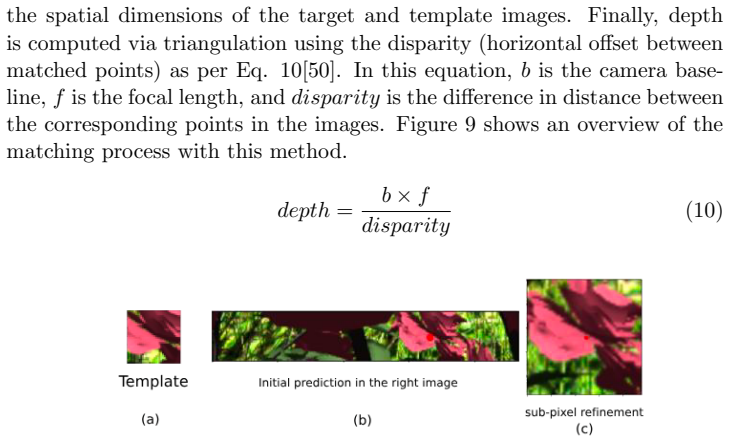
- standard math Pinhole stereo triangulation: depth = b*f/disparity
- domain assumption Cameras form a rectified parallel stereo pair with the parameters in Table 1
- domain assumption Blender synthetic renderings are photorealistic and representative of real rose farms
- ad hoc to paper Heatmap peaks within +/-5 pixels with confidence over 0.51 count as correct detections
- domain assumption Pretrained ImageNet weights transfer to rose heatmap detection and depth estimation
- domain assumption Depth supervision at flower center pixels is sufficient to learn usable depth for those centers
Cite this review
Pith. "Pith review of Sparse 3D Perception for Rose Harvesting Robots: A Two-Stage Approach Bridging Simulation and Real-World Applications." pith.science (2026). https://pith.science/paper/SABZTYPH
@misc{pith2026250800900,
  author       = {Pith},
  title        = {Pith review of: Sparse 3D Perception for Rose Harvesting Robots: A Two-Stage Approach Bridging Simulation and Real-World Applications},
  year         = {2026},
  howpublished = {\url{https://pith.science/paper/SABZTYPH}},
  note         = {Machine review of arXiv:2508.00900}
}
read the original abstract
The global demand for medicinal plants, such as Damask roses, has surged with population growth, yet labor-intensive harvesting remains a bottleneck for scalability. To address this, we propose a novel 3D perception pipeline tailored for flower-harvesting robots, focusing on sparse 3D localization of rose centers. Our two-stage algorithm first performs 2D point-based detection on stereo images, followed by depth estimation using a lightweight deep neural network. To overcome the challenge of scarce real-world labeled data, we introduce a photorealistic synthetic dataset generated via Blender, simulating a dynamic rose farm environment with precise 3D annotations. This approach minimizes manual labeling costs while enabling robust model training. We evaluate two depth estimation paradigms: a traditional triangulation-based method and our proposed deep learning framework. Results demonstrate the superiority of our method, achieving an F1 score of 95.6% (synthetic) and 74.4% (real) in 2D detection, with a depth estimation error of 3% at a 2-meter range on synthetic data. The pipeline is optimized for computational efficiency, ensuring compatibility with resource-constrained robotic systems. By bridging the domain gap between synthetic and real-world data, this work advances agricultural automation for specialty crops, offering a scalable solution for precision harvesting.
Figures


Figures from the paper (21 more)




Reference graph
Works this paper leans on
-
[1]
Field with the fragrant damask rose,
ralij, “Field with the fragrant damask rose,” 2022, image taken from google search results. Thr original photo information is: Stock photo ID: 1401314461, Upload date: June 09, 2022, Location: Bulgaria, Categories: Stock Photos—Rose - Flower. [Online]. Available: https://www.istockphoto.com/photo/field-with- the-fragrant-damask-rose-gm1401314461-454601829
work page 2022
-
[2]
Yolov4: Op- timal speed and accuracy of object detection,
A. Bochkovskiy, C.-Y. Wang, and H.-Y. M. Liao, “Yolov4: Op- timal speed and accuracy of object detection,” arXiv preprint arXiv:2004.10934, 2020
arXiv 2004
-
[3]
Voxelnet: End-to-end learning for point cloud based 3d object detection,
Y. Zhou and O. Tuzel, “Voxelnet: End-to-end learning for point cloud based 3d object detection,” in Proceedings of the IEEE conference on computer vision and pattern recognition , 2018, pp. 4490–4499
work page 2018
-
[4]
Center- net: Keypoint triplets for object detection,
K. Duan, S. Bai, L. Xie, H. Qi, Q. Huang, and Q. Tian, “Center- net: Keypoint triplets for object detection,” in Proceedings of the IEEE/CVF international conference on computer vision , 2019, pp. 6569–6578
work page 2019
-
[5]
X. Zhou, D. Wang, and P. Kr¨ ahenb¨ uhl, “Objects as points,” arXiv preprint arXiv:1904.07850, 2019
arXiv 1904
-
[6]
Frustum pointnets for 3d object detection from rgb-d data,
C. R. Qi, W. Liu, C. Wu, H. Su, and L. J. Guibas, “Frustum pointnets for 3d object detection from rgb-d data,” in Proceedings of the IEEE conference on computer vision and pattern recognition , 2018, pp. 918– 927
work page 2018
-
[7]
Voting for voting in online point cloud ob- ject detection
D. Z. Wang and I. Posner, “Voting for voting in online point cloud ob- ject detection.” in Robotics: science and systems , vol. 1, no. 3. Rome, Italy, 2015, pp. 10–15
work page 2015
-
[8]
3d object proposals using stereo imagery for accurate object class detec- tion,
X. Chen, K. Kundu, Y. Zhu, H. Ma, S. Fidler, and R. Urtasun, “3d object proposals using stereo imagery for accurate object class detec- tion,” IEEE transactions on pattern analysis and machine intelligence , vol. 40, no. 5, pp. 1259–1272, 2017
work page 2017
Show all 59 references
-
[9]
Efficient joint segmen- tation, occlusion labeling, stereo and flow estimation,
K. Yamaguchi, D. McAllester, and R. Urtasun, “Efficient joint segmen- tation, occlusion labeling, stereo and flow estimation,” in Computer Vision–ECCV 2014: 13th European Conference, Zurich, Switzerland, September 6-12, 2014, Proceedings, Part V 13 . Springer, 2014, pp. 756–771. 35
2014
-
[10]
Stereo r-cnn based 3d object detection for autonomous driving,
P. Li, X. Chen, and S. Shen, “Stereo r-cnn based 3d object detection for autonomous driving,” in Proceedings of the IEEE/CVF Conference on Computer Vision and Pattern Recognition , 2019, pp. 7644–7652
2019
-
[11]
Faster r-cnn: Towards real- time object detection with region proposal networks,
S. Ren, K. He, R. Girshick, and J. Sun, “Faster r-cnn: Towards real- time object detection with region proposal networks,” Advances in neu- ral information processing systems , vol. 28, 2015
2015
-
[12]
Monocular 3d object detection for autonomous driving,
X. Chen, K. Kundu, Z. Zhang, H. Ma, S. Fidler, and R. Urtasun, “Monocular 3d object detection for autonomous driving,” in Proceed- ings of the IEEE conference on computer vision and pattern recognition, 2016, pp. 2147–2156
2016
-
[13]
Monogrnet: A geometric reasoning net- work for monocular 3d object localization,
Z. Qin, J. Wang, and Y. Lu, “Monogrnet: A geometric reasoning net- work for monocular 3d object localization,” in Proceedings of the AAAI conference on artificial intelligence, vol. 33, no. 01, 2019, pp. 8851–8858
2019
-
[14]
Unsupervised cnn for single view depth estimation: Geometry to the rescue,
R. Garg, V. K. Bg, G. Carneiro, and I. Reid, “Unsupervised cnn for single view depth estimation: Geometry to the rescue,” in Com- puter Vision–ECCV 2016: 14th European Conference, Amsterdam, The Netherlands, October 11-14, 2016, Proceedings, Part VIII 14. Springer, 2016, pp. 740–756
2016
-
[15]
Unsupervised monoc- ular depth estimation with left-right consistency,
C. Godard, O. Mac Aodha, and G. J. Brostow, “Unsupervised monoc- ular depth estimation with left-right consistency,” in Proceedings of the IEEE conference on computer vision and pattern recognition , 2017, pp. 270–279
2017
-
[16]
Using channel pruning-based yolo v4 deep learning algorithm for the real-time and accurate detection of apple flowers in natural environments,
D. Wu, S. Lv, M. Jiang, and H. Song, “Using channel pruning-based yolo v4 deep learning algorithm for the real-time and accurate detection of apple flowers in natural environments,” Computers and Electronics in Agriculture, vol. 178, p. 105742, 2020
2020
-
[17]
Real-time apple detection system using embedded systems with hardware accelerators: An edge ai application,
V. Mazzia, A. Khaliq, F. Salvetti, and M. Chiaberge, “Real-time apple detection system using embedded systems with hardware accelerators: An edge ai application,” IEEE Access, vol. 8, pp. 9102–9114, 2020
2020
-
[18]
Deep learning-based apple detection using a suppression mask r-cnn,
P. Chu, Z. Li, K. Lammers, R. Lu, and X. Liu, “Deep learning-based apple detection using a suppression mask r-cnn,” Pattern Recognition Letters, vol. 147, pp. 206–211, 2021
2021
-
[19]
Mask r-cnn,
K. He, G. Gkioxari, P. Doll´ ar, and R. Girshick, “Mask r-cnn,” in Pro- ceedings of the IEEE international conference on computer vision, 2017, pp. 2961–2969. 36
2017
-
[20]
Flower classifica- tion using deep convolutional neural networks,
H. Hiary, H. Saadeh, M. Saadeh, and M. Yaqub, “Flower classifica- tion using deep convolutional neural networks,” IET Computer Vision , vol. 12, no. 6, pp. 855–862, 2018
2018
-
[21]
Very deep convolutional networks for large-scale image recognition,
K. Simonyan and A. Zisserman, “Very deep convolutional networks for large-scale image recognition,” arXiv preprint arXiv:1409.1556 , 2014
2014 arXiv
-
[22]
Imagenet: A large-scale hierarchical image database,
J. Deng, W. Dong, R. Socher, L.-J. Li, K. Li, and L. Fei-Fei, “Imagenet: A large-scale hierarchical image database,” in 2009 IEEE conference on computer vision and pattern recognition . Ieee, 2009, pp. 248–255
2009
-
[23]
A visual vocabulary for flower classi- fication,
M.-E. Nilsback and A. Zisserman, “A visual vocabulary for flower classi- fication,” in 2006 IEEE computer society conference on computer vision and pattern recognition (CVPR’06), vol. 2. IEEE, 2006, pp. 1447–1454
2006
-
[24]
Evaluation of model-based interactive flower recognition,
J. Zou and G. Nagy, “Evaluation of model-based interactive flower recognition,” in Proceedings of the 17th International Conference on Pattern Recognition, 2004. ICPR 2004. , vol. 2. IEEE, 2004, pp. 311– 314
2004
-
[25]
Fruit detection, segmentation and 3d visuali- sation of environments in apple orchards,
H. Kang and C. Chen, “Fruit detection, segmentation and 3d visuali- sation of environments in apple orchards,” Computers and Electronics in Agriculture, vol. 171, p. 105302, 2020
2020
-
[26]
Flower detection using advanced deep learning techniques,
K. B. Prakash, C. Sreedevi, P. Lanke, P. K. Vadla, S. Ranganayakulu, and S. L. Tripathi, “Flower detection using advanced deep learning techniques,” in Innovations in Electronics and Communication Engi- neering: Proceedings of the 9th ICIECE 2021 . Springer, 2022, pp. 205–212
2021
-
[27]
Apple, peach, and pear flower de- tection using semantic segmentation network and shape constraint level set,
K. Sun, X. Wang, S. Liu, and C. Liu, “Apple, peach, and pear flower de- tection using semantic segmentation network and shape constraint level set,” Computers and Electronics in Agriculture , vol. 185, p. 106150, 2021
2021
-
[28]
Deeplab: Semantic image segmentation with deep convolutional nets, atrous convolution, and fully connected crfs,
L.-C. Chen, G. Papandreou, I. Kokkinos, K. Murphy, and A. L. Yuille, “Deeplab: Semantic image segmentation with deep convolutional nets, atrous convolution, and fully connected crfs,” IEEE transactions on pattern analysis and machine intelligence , vol. 40, no. 4, pp. 834–848, 2017
2017
-
[29]
Coco-stuff: Thing and stuff classes in context,
H. Caesar, J. Uijlings, and V. Ferrari, “Coco-stuff: Thing and stuff classes in context,” in Proceedings of the IEEE conference on computer vision and pattern recognition, 2018, pp. 1209–1218. 37
2018
-
[30]
Real-time detection of kiwifruit flower and bud simultane- ously in orchard using yolov4 for robotic pollination,
G. Li, R. Suo, G. Zhao, C. Gao, L. Fu, F. Shi, J. Dhupia, R. Li, and Y. Cui, “Real-time detection of kiwifruit flower and bud simultane- ously in orchard using yolov4 for robotic pollination,” Computers and Electronics in Agriculture, vol. 193, p. 106641, 2022
2022
-
[31]
Image based mango fruit detection, localisation and yield estimation using multiple view geome- try,
M. Stein, S. Bargoti, and J. Underwood, “Image based mango fruit detection, localisation and yield estimation using multiple view geome- try,” Sensors, vol. 16, no. 11, p. 1915, 2016
1915
-
[32]
An automated fruit harvesting robot by using deep learn- ing,
Y. Onishi, T. Yoshida, H. Kurita, T. Fukao, H. Arihara, and A. Iwai, “An automated fruit harvesting robot by using deep learn- ing,” Robomech Journal, vol. 6, no. 1, pp. 1–8, 2019
2019
-
[33]
Ssd: Single shot multibox detector,
W. Liu, D. Anguelov, D. Erhan, C. Szegedy, S. Reed, C.-Y. Fu, and A. C. Berg, “Ssd: Single shot multibox detector,” in Computer Vision– ECCV 2016: 14th European Conference, Amsterdam, The Netherlands, October 11–14, 2016, Proceedings, Part I 14 . Springer, 2016, pp. 21– 37
2016
-
[34]
Robotic harvesting of rosa damascena using stereoscopic ma- chine vision,
A. Kohan, A. M. Borghaee, M. Yazdi, S. Minaei, M. J. Sheykhdavudi et al. , “Robotic harvesting of rosa damascena using stereoscopic ma- chine vision,” World Applied Sciences Journal , vol. 12, no. 2, pp. 231– 237, 2011
2011
-
[35]
Geometry-aware fruit grasping estimation for robotic har- vesting in apple orchards,
X. Wang, H. Kang, H. Zhou, W. Au, and C. Chen, “Geometry-aware fruit grasping estimation for robotic har- vesting in apple orchards,” Computers and Electronics in Agriculture , vol. 193, p. 106716, 2022. [Online]. Available: https://www.sciencedirect.com/science/article/pii/S0...
2022
-
[36]
Pointnet: Deep learning on point sets for 3d classification and segmentation,
C. R. Qi, H. Su, K. Mo, and L. J. Guibas, “Pointnet: Deep learning on point sets for 3d classification and segmentation,” in Proceedings of the IEEE conference on computer vision and pattern recognition , 2017, pp. 652–660
2017
-
[37]
Octomap: An efficient probabilistic 3d mapping framework based on octrees,
A. Hornung, K. M. Wurm, M. Bennewitz, C. Stachniss, and W. Bur- gard, “Octomap: An efficient probabilistic 3d mapping framework based on octrees,” Autonomous robots, vol. 34, pp. 189–206, 2013
2013
-
[38]
Rapid strawberry ripeness detection and 3d localization of picking point based on improved yolo v8-pose with rgb-camera,
C. Xia, “Rapid strawberry ripeness detection and 3d localization of picking point based on improved yolo v8-pose with rgb-camera,” Jour- nal of Electrical Systems , vol. 20, pp. 2171–2181, 04 2024. 38
2024
-
[39]
Ultralytics YOLO,
G. Jocher, A. Chaurasia, and J. Qiu, “Ultralytics YOLO,” Jan. 2023. [Online]. Available: https://github.com/ultralytics/ultralytics
2023
-
[40]
Efficientdet: Scalable and efficient object detection,
M. Tan, R. Pang, and Q. V. Le, “Efficientdet: Scalable and efficient object detection,” in Proceedings of the IEEE/CVF conference on com- puter vision and pattern recognition , 2020, pp. 10 781–10 790
2020
-
[41]
Mobilevitv3: Mobile-friendly vision transformer with simple and effective fusion of local, global and input features,
S. N. Wadekar and A. Chaurasia, “Mobilevitv3: Mobile-friendly vision transformer with simple and effective fusion of local, global and input features,” arXiv preprint arXiv:2209.15159 , 2022
2022 arXiv
-
[42]
Tomato pose estimation us- ing the association of tomato body and sepal,
M. Jang and Y. Hwang, “Tomato pose estimation us- ing the association of tomato body and sepal,” Computers and Electronics in Agriculture, vol. 221, p. 108961, 2024. [Online]. Available: https://www.sciencedirect.com/science/article/pii/S0168169924003521
2024
-
[43]
Organization
A. Organization. (Year Published/ Last Updated) ”about blender,” the blender foundation, [online]. [Online]. Available: https://www.blender.org/about/
-
[44]
U-net: Convolutional net- works for biomedical image segmentation,
O. Ronneberger, P. Fischer, and T. Brox, “U-net: Convolutional net- works for biomedical image segmentation,” in Medical image computing and computer-assisted intervention–MICCAI 2015: 18th international conference, Munich, Germany, October 5-9, 2015, proceedings, part III
2015
-
[45]
Springer, 2015, pp. 234–241
2015
-
[46]
Efficientnetv2: Smaller models and faster training,
M. Tan and Q. Le, “Efficientnetv2: Smaller models and faster training,” in International conference on machine learning . PMLR, 2021, pp. 10 096–10 106
2021
-
[47]
Going deeper with convolu- tions,
C. Szegedy, W. Liu, Y. Jia, P. Sermanet, S. Reed, D. Anguelov, D. Er- han, V. Vanhoucke, and A. Rabinovich, “Going deeper with convolu- tions,” in Proceedings of the IEEE conference on computer vision and pattern recognition, 2015, pp. 1–9
2015
-
[48]
Cross-entropy loss functions: The- oretical analysis and applications,
A. Mao, M. Mohri, and Y. Zhong, “Cross-entropy loss functions: The- oretical analysis and applications,” in International conference on Ma- chine learning. PMLR, 2023, pp. 23 803–23 828
2023
-
[49]
Fast r-cnn,
R. Girshick, “Fast r-cnn,” in Proceedings of the IEEE international conference on computer vision , 2015, pp. 1440–1448. 39
2015
-
[50]
Template matching,
O. Documentation, “Template matching,” 2018, accessed: 2024-09-07. [Online]. Available: https://docs.opencv.org/3.4/de/da9/tutorial template matching.html
2018
-
[51]
Image rectification,
P. Forsyth, “Image rectification,” in Computer Vision - A Modern Ap- proach. Pearson, 2002, p. 326
2002
-
[52]
Are we ready for autonomous driving? the kitti vision benchmark suite,
A. Geiger, P. Lenz, and R. Urtasun, “Are we ready for autonomous driving? the kitti vision benchmark suite,” in 2012 IEEE Conference on Computer Vision and Pattern Recognition , 2012, pp. 3354–3361
2012
-
[53]
Location of apples in trees using stereo- scopic vision,
Y. Si, G. Liu, and J. Feng, “Location of apples in trees using stereo- scopic vision,” Computers and Electronics in Agriculture , vol. 112, pp. 68–74, 2015
2015
-
[54]
De- formable convolutional networks,
J. Dai, H. Qi, Y. Xiong, Y. Li, G. Zhang, H. Hu, and Y. Wei, “De- formable convolutional networks,” in Proceedings of the IEEE interna- tional conference on computer vision , 2017, pp. 764–773
2017
-
[55]
Siamese neural net- works for one-shot image recognition,
G. Koch, R. Zemel, R. Salakhutdinov et al. , “Siamese neural net- works for one-shot image recognition,” in ICML deep learning work- shop, vol. 2, no. 1. Lille, 2015, pp. 1–30
2015
-
[56]
Widening siamese ar- chitectures for stereo matching,
P. Brandao, E. Mazomenos, and D. Stoyanov, “Widening siamese ar- chitectures for stereo matching,” Pattern recognition letters , vol. 120, pp. 75–81, 2019
2019
-
[57]
Dynamic feature fusion for visual object detection and segmen- tation,
Y.-M. Hu, J.-J. Xie, H.-H. Shuai, C.-C. Huang, I.-F. Chou, and W.-H. Cheng, “Dynamic feature fusion for visual object detection and segmen- tation,” in 2023 IEEE International Conference on Consumer Electron- ics (ICCE) , 2023, pp. 01–06
2023
-
[58]
Self-supervised joint learning framework of depth estimation via implicit cues,
J. Wang, G. Zhang, Z. Wu, X. Li, and L. Liu, “Self-supervised joint learning framework of depth estimation via implicit cues,” arXiv preprint arXiv:2006.09876, 2020
2006 arXiv
-
[59]
Transdssl: Trans- former based depth estimation via self-supervised learning,
D. Han, J. Shin, N. Kim, S. Hwang, and Y. Choi, “Transdssl: Trans- former based depth estimation via self-supervised learning,” IEEE Robotics and Automation Letters, vol. 7, no. 4, pp. 10 969–10 976, 2022. 40
2022
Reviewed August 6, 2026 · model on record in the stance chip above.
Discussion (0). Sign in to comment.