REVIEW 2 major objections 4 minor 1 cited by
Bockstein braiding statistics
T0 review · 2 major / 4 minor · reviewed 2026-08-02 · deepseek-v4-flash
Pith's one-line read In one spatial dimension below ordinary braiding, a 4N-step operator word defines a quantized mutual-statistics phase for Z_N-fusing excitations.
desk verdict Genuinely new W_N word with Bockstein response and solid lattice checks; the universality claim needs a caveat about one-dimensional sectors, but this is refereeable. read the letter →
The pith
A machine-rendered reading of the paper's core claim, the machinery that carries it, and where it could break.
The reading
What carries the argument
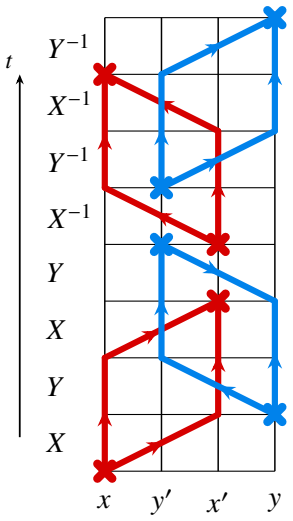
The central object is the $4N$-step operator word $W_N(X, Y) = (Y^{-1} X^{-1})^N (Y X)^N$, with X and Y local creation or hopping operators whose supports in $d = p + q + 1$ intersect along a line in a staggered geometry. The N-fold repetition compares two alternating histories that are closed by $Z_N$ fusion; the surviving phase measures the linking of one excitation with the N-fold fusion junction of the other, encoded by the Bockstein homomorphism $\beta_N$ associated to the short exact sequence $0 \to Z_N \to Z_{N^2} \to Z_N \to 0$. The argument relies on cancellation of local phases in one-dimensional fixed-configuration sectors and on locality identities that make the phase independent of local re
What would settle it
Construct a lattice model with a $Z_N$-fusing excitation whose fixed-configuration sector is two-dimensional and compute $W_N$ in two different bases within that sector: if the phase is not a c-number or depends on the basis, the invariant is not well-defined. Equivalently, numerically evaluate $W_2$ on a (1+1)D spin chain with the staggered interval ordering reversed; the claimed $-1$ phase should be independent of interval lengths and boundary decorations.
Extended reading notes
Core claim
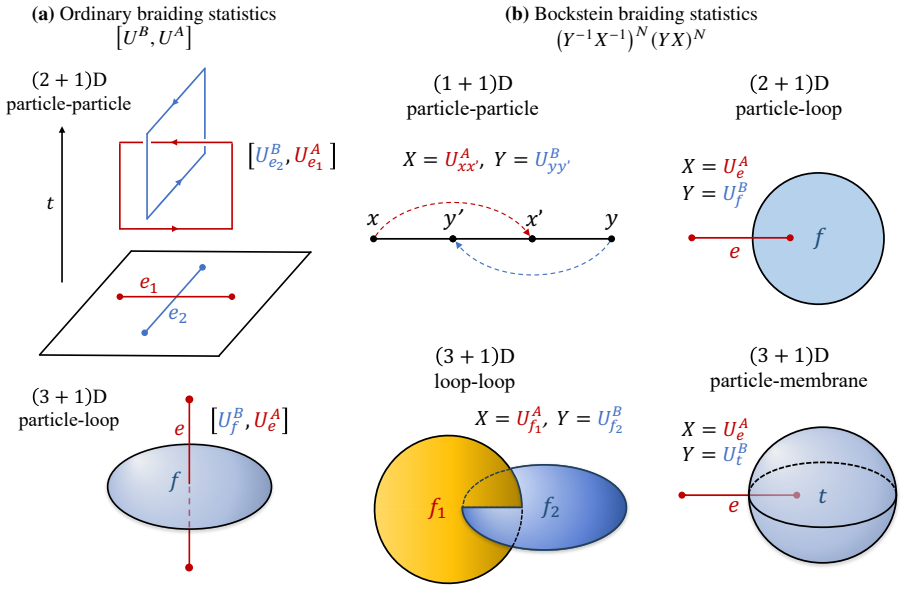
In $d = p + q + 1$, $Z_N$-fusing p- and q-dimensional excitations have a well-defined mutual statistic $W_N(X, Y) = (Y^{-1} X^{-1})^N (Y X)^N$. Starting from vacuum, both alternating histories close because of $Z_N$ fusion; the relative Berry phase survives local redefinitions, is quantized as $\exp(2\pi i k / N)$, is bilinear in fusion labels, and equals the field-theory anomaly inflow $(2\pi i k/N) \int A \cup \beta_N B$. Interpreted via open symmetry operators, the same word diagnoses mixed anomalies, with explicit (1+1)D spin-chain, (2+1)D and (3+1)D lattice models, and continuum (3+1)D gauge-theory realizations.
Load-bearing premise
The proof that $W_N$ is a well-defined scalar phase assumes every fixed-configuration sector of the local excitations is one-dimensional (Abelian fusion), so that local phase factors cancel; degenerate or non-Abelian fusion spaces would break the argument.
Editorial extensions
If this is right
- For any N and any excitation dimensions p, q with Z_N fusion, Bockstein braiding is a well-defined, quantized mutual-statistics invariant in d = p + q + 1.
- A nontrivial Bockstein phase forbids a fully symmetric gapped phase, so the system must be gapless or break one of the two symmetries.
- The invariant obstructs simultaneous condensation of the two excitations and implies fractionalization of higher-form symmetries in the broken phase.
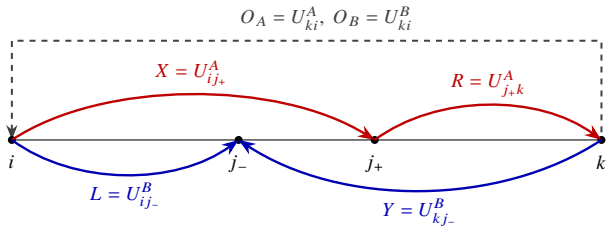
- Applied to open symmetry operators, W_N becomes a microscopic diagnostic of mixed anomalies, as demonstrated in a (1+1)D spin chain for the spin-flip and controlled-Z symmetries.
- Explicit (2+1)D and (3+1)D lattice models and (3+1)D gauge theories realize the invariant with k = 1.
Reading between the lines
- If the one-dimensional-sector assumption fails, for example for non-Abelian or degenerate fusion spaces, W_N may fail to be a c-number; probing that regime would clarify the boundary of the construction's universality.
- Because W_N is a finite, roughly 4N-term local unitary word, it could serve as a numerically accessible probe of symmetry-enforced gaplessness in finite-size or tensor-network simulations.
- The staggered-alternating structure suggests generalizations beyond the N-fold junction case, such as Z_N and Z_M excitations with mixed Bockstein responses, which the paper does not treat.
Signed reviews
Editorial analysis
A structured set of objections, weighed in public.
Referee Report
Summary. The paper introduces a statistical process W_N(X,Y) = (Y^{-1}X^{-1})^N(YX)^N for Z_N-fusing excitations in spatial dimension d=p+q+1, one less than the dimension required for ordinary mutual braiding. The central claims are that W_N is a closed, locally robust statistical process whose Berry phase is quantized as exp(2πik/N), is bilinear in the fusion labels, and has field-theory response given by the Bockstein inflow action (2πik/N)∫ A∪β_N B. The authors present a (1+1)D spin-chain realization diagnosing the mixed anomaly between ∏X and ∏CZ, explicit (2+1)D and (3+1)D lattice patch constructions, a condensed Z_{N^2} toric-code realization for arbitrary N, and applications to Abelian and non-Abelian continuum gauge theories. They further prove that a nontrivial Bockstein phase obstructs a fully symmetric gapped phase and implies symmetry fractionalization.
Significance. If the construction is correct, it provides a uniform and remarkably simple microscopic invariant for mutual statistics in the previously awkward dimension d=p+q+1, and it connects that invariant directly to the Bockstein homomorphism and to mixed generalized-symmetry anomalies. The paper's strengths include explicit, self-contained lattice evaluations (spin-chain W_2=-1, toric-code W_N=exp(2πi/N), and the (2+1)D and (3+1)D patch words), parameter-free derivations, and a detailed proof of bilinearity in Appendix C. The proposal is significant for the field and likely to be useful as a diagnostic tool for lattice models and gauge theories, provided the Abelian scope is stated precisely.
major comments (2)
- [Appendix A, near Eq. (15); Abstract and §2] The scalar-phase property of W_N is proven only under the explicit assumption that each fixed-configuration sector is one-dimensional ('we restrict to Abelian defects for which each fixed-configuration sector is one-dimensional'). The abstract and main text nevertheless state the construction applies to 'excitations obeying Z_N fusion for arbitrary N and all excitation dimensions p and q' without this Abelian qualifier. If a Z_N-fusing defect has degenerate or non-Abelian fusion spaces, φ_v in Eq. (15) is an operator, the two staircases in Eqs. (16)–(22) need not cancel, and W_N need not be a scalar phase; consequently the quantization W_N^N=1 in Eq. (8) is not established. Please either restrict the theorem/abstract to Abelian defects with one-dimensional fixed-configuration sectors, or provide a proof covering degenerate sectors. The explicit lattice examples in Appendices D–G are all
- [§3.1, Theorem 1 and footnote 3] The no-gapped-phase theorem relies on the remote-detectability/condensation-completion property for arbitrary r, with a separate citation for r≤1. Since this property is load-bearing for the advertised consequence that a nontrivial Bockstein phase rules out a fully symmetric gapped phase, the manuscript should state precisely the theorem being invoked and verify its hypotheses: why the absence of genuine charged operators implies D_A is a condensation defect, and why the twisted-sector junction J_B can be used in the linked correlator in the same way as a genuine operator. As written, the proof is a sketch that depends on a standard but nontrivial result without a precise statement or derivation.
minor comments (4)
- [§2.2, Eq. (8)] The quantization argument is very terse ('Translate W_N horizontally...'). Consider adding an explicit algebraic demonstration that the product of the N translated words is the identity, in the spirit of Appendix C, to make the proof self-contained.
- [Eqs. (3) and (5)] The two forms W_N=(Y^{-1}X^{-1})^N(YX)^N and W_N=((XY)^N)^{-1}(YX)^N are used interchangeably. It would help to state explicitly that they are equal by inversion of (XY)^N.
- [Appendices F.5 and G.2] The symbol 𝔴^GT_1 is used both for a specific chain and for its homology class PD(w_1). Please distinguish the chain coefficient from the homology class to avoid confusion on nonorientable surfaces, where the chain need not be a boundary.
- [§2, first paragraph] The phrase 'selected N-fold fusion junction' is central but is defined only pictorially. A short formal definition (e.g., as the junction at the end of the vertical segment in Fig. 2, or via β_N B) would improve precision.
Circularity Check
No significant circularity: W_N is evaluated microscopically with no fitted inputs; self-citations to prior statistical-process and anomaly frameworks are not load-bearing. Main caveat is a scope limitation (Abelian one-dimensional sectors), not circularity.
full rationale
The central derivation is not circular. W_N is defined as an explicit 4N-step word (Eq. (3)/(5)) and its phase is computed directly in the lattice realizations: W_2(U^A_e,U^B_f)=-1 in Eq. (108) for the condensed Z_4 toric code, and W_2(X_I,Y_J)=-1 in Eqs. (147), (195), (274) for the (1+1)D, (2+1)D and (3+1)D patch constructions. No parameter is fitted to the Bockstein phase; the field-theory response (4) is matched to the microscopic result, not used to define it. Quantization (8) is argued from the configuration-torus translation picture, and bilinearity (9) is proven in Appendix C using locality identities; neither step reduces to an input. The cited statistical-process framework [12,13,30] and gauge-theory anomaly facts [39-41] are prior results with independent co-authors [12,30,31] and are used as tools, while the new W_N cancellation is also proved directly in Appendix A under its stated assumption. Thus self-citation is present but not load-bearing. Non-circular caveat that should be weighed: Appendix A states "we restrict to Abelian defects for which each fixed-configuration sector is one-dimensional" (near Eq. (15)). The abstract's universality claim ("arbitrary N and all excitation dimensions p and q") goes beyond this Abelian one-dimensional-sector assumption; a Z_N-fusing defect with degenerate fusion space is not covered by the cancellation proof. This is a scope/correctness gap, not a circularity, and it does not raise the circularity score.
Assumptions & free parameters
assumptions (5)
- domain assumption Closed statistical phases are invariant under local symmetric redefinitions of open excitation operators (initial-state independence).
- domain assumption Each fixed-configuration sector of the defects is one-dimensional (Abelian defects).
- standard math Locality identities: nested commutators vanish when the common intersection of supports is empty.
- domain assumption Remote detectability / condensation completion: every topological defect with trivial linking with all genuine operators is in the condensation completion and admits a topological gapped boundary.
- domain assumption The Bockstein anomaly of U(1) and SU(N^2)/Z_N gauge theories with k=1.
Cite this review
Pith. "Pith review of Bockstein braiding statistics." pith.science (2026). https://pith.science/paper/SE6WGEH4
@misc{pith2026260702280,
  author       = {Pith},
  title        = {Pith review of: Bockstein braiding statistics},
  year         = {2026},
  howpublished = {\url{https://pith.science/paper/SE6WGEH4}},
  note         = {Machine review of arXiv:2607.02280}
}
abstract
Braiding phenomena, from the charge-flux Aharonov-Bohm effect to anyonic statistics in fractional quantum Hall systems, are paradigmatic manifestations of topology in quantum physics. Ordinary mutual braiding between $p$- and $q$-dimensional excitations occurs in $d=p+q+2$ spatial dimensions. In this work, we introduce a universal construction of mutual statistics in the adjacent dimension $d=p+q+1$, applicable to excitations obeying $\mathbb Z_N$ fusion for arbitrary $N$ and all excitation dimensions $p$ and $q$. The corresponding invariant is the Berry phase accumulated in a simple $4N$-step microscopic unitary process built from local excitation operators on lattices. This process measures the linking of one excitation with the $N$-fold fusion junction of the other, encompassing particle-particle statistics in one dimension, particle-loop statistics in two dimensions, and loop-loop or particle-membrane statistics in three dimensions. We establish the quantization and bilinearity of the invariant and show that its field-theory response is governed by the Bockstein homomorphism, motivating the name Bockstein braiding statistics. Interpreting the excitation operators as open symmetry operators turns the same invariant into a direct microscopic diagnostic of mixed anomalies between symmetries. We demonstrate this diagnostic in a (1+1)D spin chain, where the nontrivial Bockstein braiding phase proves the mixed anomaly between the spin-flip symmetry $\prod X$ and the nearest-neighbor controlled-$Z$ symmetry $\prod CZ$. We construct explicit (2+1)D and (3+1)D lattice analogs, yielding new anomalous symmetry pairs, and apply the framework to strongly coupled (3+1)D continuum gauge theories. Nontrivial Bockstein braiding rules out a fully symmetric gapped phase, obstructs simultaneous condensation of the two excitations, and implies fractionalization of higher-form symmetries.
Figures


Figures from the paper (13 more)






Forward citations
Cited by 1 Pith paper
-
Non-Clifford quantum cellular automata from invertible topological quantum field theories
Invertible TQFT data is converted into explicit bounded-range quantum cellular automata, yielding new non-Clifford families and proving that the 5D w3^2 and w2^3 automorphisms are finite-depth circuits.
Reference graph
Works this paper leans on
-
[1]
Significance of electromagnetic potentials in the quantum theory,
Y. Aharonov and D. Bohm, “Significance of electromagnetic potentials in the quantum theory,”Phys. Rev.115(1959) 485–491
1959
-
[2]
Fractional statistics and the quantum Hall effect,
D. Arovas, J. R. Schrieffer, and F. Wilczek, “Fractional statistics and the quantum Hall effect,”Phys. Rev. Lett.53(1984) 722–723
1984
-
[3]
Quantum mechanics of fractional-spin particles,
F. Wilczek, “Quantum mechanics of fractional-spin particles,”Phys. Rev. Lett.49(1982) 957–959
1982
-
[4]
Superconductors are topologically ordered,
T. Hansson, V. Oganesyan, and S. Sondhi, “Superconductors are topologically ordered,”Annals of Physics313no. 2, (2004) 497–538
2004
-
[5]
Topological quantum computation,
R. Walter Ogburn and J. Preskill, “Topological quantum computation,” inQuantum Computing and Quantum Communications, C. P. Williams, ed., pp. 341–356. Springer Berlin Heidelberg, Berlin, Heidelberg, 1999
1999
-
[6]
Fault-tolerantquantumcomputationbyanyons,
A.Kitaev,“Fault-tolerantquantumcomputationbyanyons,”Annals of Physics303no.1,(2003)2–30
2003
-
[7]
Topological quantum computation,
M. H. Freedman, A. Kitaev, M. J. Larsen, and Z. Wang, “Topological quantum computation,”Bulletin of the American Mathematical Society40no. 1, (2003) 31–38
2003
-
[8]
Non-Abelian anyons and topological quantum computation,
C. Nayak, S. H. Simon, A. Stern, M. Freedman, and S. Das Sarma, “Non-Abelian anyons and topological quantum computation,”Rev. Mod. Phys.80(2008) 1083–1159
2008
Show all 46 references
-
[9]
Generalized Global Symmetries,
D. Gaiotto, A. Kapustin, N. Seiberg, and B. Willett, “Generalized Global Symmetries,”JHEP02 (2015) 172,arXiv:1412.5148 [hep-th]
2015 arXiv
-
[10]
Anomalous discrete symmetries in three dimensions and group cohomology,
A. Kapustin and R. Thorngren, “Anomalous discrete symmetries in three dimensions and group cohomology,”Phys. Rev. Lett.112(2014) 231602. 42
2014
-
[11]
Anomalies of discrete symmetries in various dimensions and group cohomology,
A. Kapustin and R. Thorngren, “Anomalies of discrete symmetries in various dimensions and group cohomology,”arXiv:1404.3230 [hep-th]
-
[12]
Statistics of Abelian topological excitations,
H. Xue, “Statistics of Abelian topological excitations,”Phys. Rev. B113(2026) 045143
2026
-
[13]
Generalized statistics on lattices,
R. Kobayashi, Y. Li, H. Xue, P.-S. Hsin, and Y.-A. Chen, “Generalized statistics on lattices,”Phys. Rev. X16(2026) 011010
2026
-
[14]
Anyonic membranes and Pontryagin statistics,
Y. Feng, H. Xue, Y. Li, M. Cheng, R. Kobayashi, P.-S. Hsin, and Y.-A. Chen, “Anyonic membranes and Pontryagin statistics,”Phys. Rev. Lett.136(2026) 086601
2026
-
[15]
Pauli stabilizer formalism for topological quantum field theories and generalized statistics,
Y. Feng, H. Xue, R. Kobayashi, P.-S. Hsin, and Y.-A. Chen, “Pauli stabilizer formalism for topological quantum field theories and generalized statistics,”arXiv:2601.00064 [quant-ph]
-
[16]
Universal systems of∇-homology rings,
M. Bockstein, “Universal systems of∇-homology rings,”C. R. (Doklady) Acad. Sci. URSS (N.S.)37 (1942) 243–245
1942
-
[17]
Hatcher,Algebraic Topology
A. Hatcher,Algebraic Topology. Cambridge University Press, Cambridge, 2002
2002
-
[18]
Braiding statistics of loop excitations in three dimensions,
C. Wang and M. Levin, “Braiding statistics of loop excitations in three dimensions,”Phys. Rev. Lett. 113(2014) 080403
2014
-
[19]
Cheshire charge in (3+1)-dimensional topological phases,
D. V. Else and C. Nayak, “Cheshire charge in (3+1)-dimensional topological phases,”Phys. Rev. B96 (2017) 045136
2017
-
[20]
Loop braiding statistics in exactly soluble three-dimensional lattice models,
C.-H. Lin and M. Levin, “Loop braiding statistics in exactly soluble three-dimensional lattice models,”Phys. Rev. B92(2015) 035115
2015
-
[21]
Generalized modular transformations in(3+1)Dtopologically ordered phases and triple linking invariant of loop braiding,
S. Jiang, A. Mesaros, and Y. Ran, “Generalized modular transformations in(3+1)Dtopologically ordered phases and triple linking invariant of loop braiding,”Phys. Rev. X4(2014) 031048
2014
-
[22]
Anyon and loop braiding statistics in field theories with a topologicalΘ term,
Z. Bi, Y.-Z. You, and C. Xu, “Anyon and loop braiding statistics in field theories with a topologicalΘ term,”Phys. Rev. B90(2014) 081110
2014
-
[23]
Classifying symmetry-protected topological phases through the anomalous action of the symmetry on the edge,
D. V. Else and C. Nayak, “Classifying symmetry-protected topological phases through the anomalous action of the symmetry on the edge,”Phys. Rev. B90(2014) 235137
2014
-
[24]
Topological theory of Lieb-Schultz-Mattis theorems in quantum spin systems,
D. V. Else and R. Thorngren, “Topological theory of Lieb-Schultz-Mattis theorems in quantum spin systems,”Phys. Rev. B101(2020) 224437
2020
-
[25]
Anomalous symmetries of quantum spin chains and a generalization of the Lieb–Schultz–Mattis theorem,
A. Kapustin and N. Sopenko, “Anomalous symmetries of quantum spin chains and a generalization of the Lieb–Schultz–Mattis theorem,”Communications in Mathematical Physics406no. 10, (2025) 238
2025
-
[26]
Higher symmetries and anomalies in quantum lattice systems,
A. Kapustin and S. Xu, “Higher symmetries and anomalies in quantum lattice systems,” arXiv:2505.04719 [math-ph]
-
[27]
Higher symmetries, anomalies, and crossed squares in lattice gauge theory,
A. Kapustin and L. Spodyneiko, “Higher symmetries, anomalies, and crossed squares in lattice gauge theory,”arXiv:2507.16966 [hep-th]
-
[28]
Higher-form anomalies on lattices,
Y. Feng, R. Kobayashi, Y.-A. Chen, and S. Ryu, “Higher-form anomalies on lattices,”Phys. Rev. Lett. 136(2026) 046504
2026
-
[29]
Disentangling anomaly-free symmetries of quantum spin chains,
S. Seifnashri and W. Shirley, “Disentangling anomaly-free symmetries of quantum spin chains,”Phys. Rev. Lett.136(2026) 216603. 43
2026
-
[30]
Gravitational anomaly of(3+1)-dimensionalZ2 toric code with fermionic charges and fermionic loop self-statistics,
L. Fidkowski, J. Haah, and M. B. Hastings, “Gravitational anomaly of(3+1)-dimensionalZ2 toric code with fermionic charges and fermionic loop self-statistics,”Phys. Rev. B106(2022) 165135
2022
-
[31]
Topological invariants for symmetry-protected topological phase entanglers,
C. Zhang, “Topological invariants for symmetry-protected topological phase entanglers,”Phys. Rev. B 107(2023) 235104
2023
-
[32]
Higher Symmetry and Gapped Phases of Gauge Theories,
A. Kapustin and R. Thorngren, “Higher Symmetry and Gapped Phases of Gauge Theories,”Prog. Math.324(2017) 177–202,arXiv:1309.4721 [hep-th]
2017 arXiv
-
[33]
On the classification of topological orders,
T. Johnson-Freyd, “On the classification of topological orders,”Communications in Mathematical Physics393no. 2, (2022) 989–1033
2022
-
[34]
Higher gauging and non-invertible condensation defects,
K. Roumpedakis, S. Seifnashri, and S.-H. Shao, “Higher gauging and non-invertible condensation defects,”Communications in Mathematical Physics401no. 3, (2023) 3043–3107
2023
-
[35]
Anomaly Obstructions to Symmetry Preserving Gapped Phases,
C. Córdova and K. Ohmori, “Anomaly Obstructions to Symmetry Preserving Gapped Phases,” arXiv:1910.04962 [hep-th]
1910 arXiv
-
[36]
Anomalies of coset non-invertible symmetries,
P.-S. Hsin, R. Kobayashi, and C. Zhang, “Anomalies of coset non-invertible symmetries,”SciPost Phys.20no. 1, (2026) 006,arXiv:2503.00105 [cond-mat.str-el]
2026
-
[37]
Symmetry-enriched quantum spin liquids in (3 + 1)𝑑,
P.-S. Hsin and A. Turzillo, “Symmetry-enriched quantum spin liquids in (3 + 1)𝑑,”JHEP09(2020) 022,arXiv:1904.11550 [cond-mat.str-el]
2020 arXiv
-
[38]
Generalized Hall conductivities in local commuting projector models: Generalized symmetries and protected surface modes,
P.-S. Hsin and R. Kobayashi, “Generalized Hall conductivities in local commuting projector models: Generalized symmetries and protected surface modes,”Phys. Rev. B113no. 7, (2026) 075106, arXiv:2505.20384 [cond-mat.str-el]
2026
-
[39]
Generalized Symmetries Phase Transitions with Local Quantum Fields,
P.-S. Hsin, “Generalized Symmetries Phase Transitions with Local Quantum Fields,” arXiv:2506.07688 [cond-mat.str-el]
-
[40]
On 2-Group Global Symmetries and their Anomalies,
F. Benini, C. Córdova, and P.-S. Hsin, “On 2-Group Global Symmetries and their Anomalies,”JHEP 03(2019) 118,arXiv:1803.09336 [hep-th]
2019 arXiv
-
[41]
Discrete theta angles, symmetries and anomalies,
P.-S. Hsin and H. T. Lam, “Discrete theta angles, symmetries and anomalies,”SciPost Phys.10no. 2, (2021) 032,arXiv:2007.05915 [hep-th]
2021 arXiv
-
[42]
Topological quantum memory,
E. Dennis, A. Kitaev, A. Landahl, and J. Preskill, “Topological quantum memory,”Journal of Mathematical Physics43no. 9, (2002) 4452–4505
2002
-
[43]
Exactly solvable lattice Hamiltonians and gravitational anomalies,
Y.-A. Chen and P.-S. Hsin, “Exactly solvable lattice Hamiltonians and gravitational anomalies,” SciPost Phys.14(2023) 089
2023
-
[44]
Higher cup products on hypercubic lattices: Application to lattice models of topological phases,
Y.-A. Chen and S. Tata, “Higher cup products on hypercubic lattices: Application to lattice models of topological phases,”Journal of Mathematical Physics64no. 9, (2023) 091902
2023
-
[45]
A formula for Stiefel-Whitney homology classes,
R. Z. Goldstein and E. C. Turner, “A formula for Stiefel-Whitney homology classes,”Proceedings of the American Mathematical Society58no. 1, (1976) 339–342
1976
-
[46]
Constraints on Supersymmetry Breaking,
E. Witten, “Constraints on Supersymmetry Breaking,”Nucl. Phys. B202(1982) 253. 44
1982
Reviewed August 2, 2026 · model on record in the stance chip above.
Discussion (0). Continue with ORCID to comment.