REVIEW 4 major objections 4 minor 49 references
DecoupleGS: a decoupled 3DGS simulator for interactive E2E driving testing.
Reviewed by Pith at T0; open to challenge. T0 means a machine referee read the full paper against a public rubric. the ladder, T0–T4 →
DecoupleGS splits 3D Gaussian Splatting scenes into a persistent background and compressible, relightable vehicle assets to run interactive closed-loop tests of end-to-end driving policies.
T0 review reviewed 2026-08-04 challenge →
load-bearing objection Useful decoupled 3DGS system for E2E simulation, but the headline closed-loop comparison is not controlled and the ADE metric is entangled with the registration objective. the 4 major comments →
DecoupleGS: Interactive 3D Gaussian Splatting for End-to-End Autonomous Driving Testing
The pith
A machine-rendered reading of the paper's core claim, the machinery that carries it, and where it could break.
The reading
Core claim
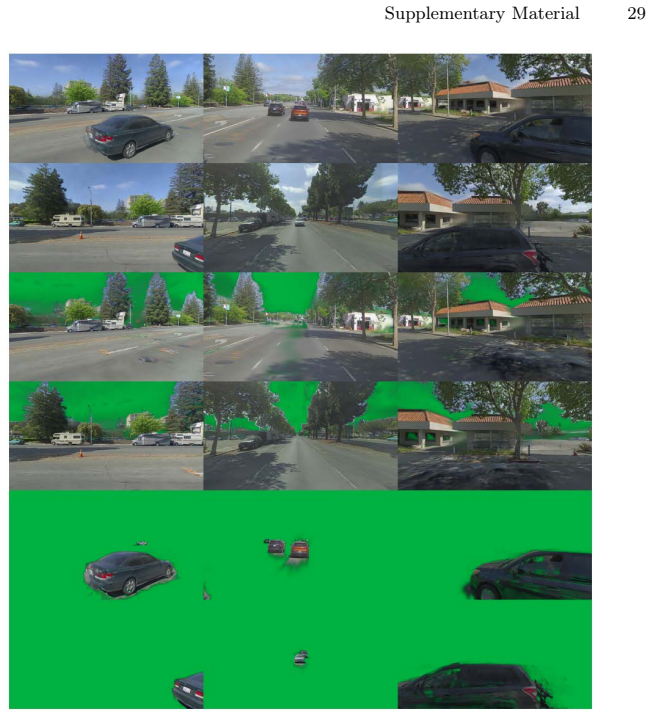
The paper's central claim is that a scene can be decomposed into a persistent static background and object-centric canonical vehicle volumes without losing photorealism or interactivity. Three targeted modules carry the argument: semantic-aware compression prunes perceptually unimportant Gaussians and vector-quantizes the rest so many vehicles fit in memory; map-guided registration aligns vehicle trajectories to lane topology via DTW, SE(2) Procrustes correction, and opacity-accumulated vertical grounding; proxy-based relighting transfers local ambient SH illumination to inserted assets and adds dynamic contact shadows. With these modules, the framework reports the best balance of fidelity a
What carries the argument
The load-bearing mechanism is the decoupled scene representation: a time-invariant background field plus K canonical vehicle volumes, fused by SE(3) transforms before rasterization. View-dependent color is kept correct under rotation by applying the Wigner D-matrix to spherical-harmonic coefficients. Around that core sit the three conflict-solving modules—importance scoring (visibility, contrast, entropy) plus vector quantization for compression; constrained DTW lane matching, Orthogonal Procrustes, and opacity-weighted vertical grounding for geometry; and a linear SH transfer operator plus super-ellipse contact shadow mask for relighting.
Load-bearing premise
The load-bearing premise is that every scene where agents are inserted has reliable lane centerlines (from an HD map or a vectorized map extractor) and a clean segmenter-inpainted background with no residual floaters or shadows.
What would settle it
Run DecoupleGS on an overpass or under-bridge scene whose lane polylines are missing or poorly detected, insert a vehicle, and measure Trajectory ADE and Ground Penetration Rate; if ADE departs substantially from the reported 0.05 m or GPR rises, the geometric-registration claim fails wherever map topology is unreliable. A second decisive check: relight a glossy vehicle under a high-frequency specular environment and measure PAE; the linear SH transfer predicts low PAE, and a large jump would falsify the photometric claim.
If this is right
- Multi-agent interactive closed-loop testing becomes feasible on one GPU: 45 FPS with up to 50 vehicles and roughly linear VRAM growth.
- E2E planners can be stress-tested across controlled difficulty levels; reported Driving Score and Success Rate degrade monotonically from Easy to Extreme, exposing planner-specific weaknesses.
- Inserted vehicles inherit scene illumination and ground contact, so open-loop planner behavior on rendered frames approaches behavior on real frames (mADE 0.82 vs 0.76 real).
- The compression, registration, and relighting modules are solver-agnostic and can be grafted onto other neural simulators to improve their speed and photometric accuracy.
- Scene editing—moving, swapping, or re-lighting vehicles—needs no per-scene retraining.
Where Pith is reading between the lines
- If reliable lane topology can be obtained for multi-level roads and overpasses, the same registration pipeline could extend to arbitrary infrastructure like parking garages and intersections without stop lines.
- The linear SH relighting operator is a proxy; scenes with strong multi-bounce or high-frequency specular lighting would likely need additional terms, so a testable extension is measuring PAE on such scenes.
- Because the framework is rigid-agent and camera-only, extending to pedestrians or LiDAR would require canonical deformation models and a range-sensing rasterizer—an avenue the paper lists as future work.
- The difficulty-graded scenario protocol could serve as a reusable benchmark for comparing E2E planners' safety margins across simulation platforms.
Editorial analysis
A structured set of objections, weighed in public.
Referee Report
Summary. The paper proposes DecoupleGS, a 3D Gaussian Splatting-based closed-loop sensor simulator for end-to-end autonomous driving testing. The scene is decomposed into a persistent static background and object-centric canonical vehicle assets, with three targeted modules: semantic-aware asset compression (importance pruning + VQ), map-guided geometric registration (DTW + Procrustes + opacity-weighted vertical grounding), and proxy-based relighting (affine SH transfer + parametric contact shadows). The authors evaluate on nuScenes and PandaSet backgrounds with 3DRealCar assets, conduct open-loop and closed-loop experiments with UniAD/VAD, and claim a balanced fidelity-efficiency trade-off, improved metric and photometric consistency, and a practical interactive closed-loop E2E testing platform.
Significance. If the empirical claims hold under controlled evaluation, DecoupleGS would be a useful contribution to neural closed-loop simulation for end-to-end driving. The decoupled background/asset representation is natural and the three modules address genuinely important bottlenecks. The paper is also reproducible in spirit: the algorithms and hyperparameters are described in detail, and the supplement includes pseudocode and metric definitions. The ablation in Table 4 gives each module a clear role. However, the current evidence has two load-bearing gaps: the closed-loop comparison in Table 2 lacks a controlled protocol, and the ADE metric used for geometric consistency is essentially the same objective the registration module minimizes. These issues must be resolved before the central claims can be accepted.
major comments (4)
- [§4.5, Table 2] The central claim of a practical closed-loop E2E testing engine rests on Table 2, where DecoupleGS reports the highest Driving Score and Route Completion. The paper does not state whether HUGSIM, RealEngine, and OASim were evaluated under the same protocol: same E2E policy, same route/scenario set, same traffic-behavior engine, same vehicle dynamics, same infraction penalties, same camera configuration, and same rendering resolution. Driving Score and Route Completion are highly sensitive to these choices, and 'normalized to [0,1]' does not make different protocols comparable. The FPS comparison (45 vs 12/32/18) is likewise only meaningful if resolution, scene complexity, and hardware were fixed. Please provide a common protocol, or substantially narrow the claim to what can be supported.
- [Supp. Eq. (21), §3.3, Table 4] ADE is defined as the trajectory's distance to lane centerlines, and the map-guided registration module explicitly minimizes trajectory-to-lane distance via constrained DTW and SE(2) Procrustes. The reported improvement from 0.48 m to 0.05 m in Table 4 is therefore in large part a measure of how well the optimization objective was solved, not an independent evaluation of geometric consistency. This makes the geometric-fidelity claim circular. Please include an external metric (e.g., ground-truth pose error or multi-view reprojection error) or explicitly state that ADE is an objective-tracking measure rather than an external evaluation.
- [Tables 1, 2, 4] Fidelity, efficiency, geometric, and closed-loop results are reported as single values without variance, number of repetitions, or statistical significance. Given the small curated set (25 clips, 20 assets), statements such as 'consistently top-2' and the closed-loop ordering may not be robust. Table 3 already reports mean±std over 50 episodes; the same practice should be extended to Tables 1, 2, and 4, or the claims should be attenuated.
- [§3.3, §4.7] The map-guided registration and all geometry metrics inherit the accuracy of the input lane topology, whether from HD maps or MapTRv2. The authors acknowledge this limitation for overpasses, under-bridges, and poorly detected lanes, but the abstract and Section 4 use stronger language such as 'strictly align trajectories.' Since topology is an input assumption, the method does not guarantee strict alignment in general. Please either soften the wording or quantify the failure rate on the curated clips, especially where MapTRv2 is the topology source.
minor comments (4)
- [§3.2] The importance-score weights w_vis, w_col, w_ent are obtained by grid search and claimed to 'demonstrate robust generalization,' but no sensitivity analysis is shown. A small grid or a plot showing the effect of varying these weights on Table 1 would make the claim more credible.
- [§4.6, Fig. 9] The plug-and-play experiment in Fig. 9 is described only qualitatively. Please report the underlying numerical values for rendering speed and photometric accuracy when the modules are inserted into HUGSIM/OASim, so the reader can assess the magnitude of the claimed improvement.
- [§4.5, Table 3] Table 3 reports mean±std over 50 independent episodes, but it is not defined how the episodes are drawn for each difficulty level (e.g., initial states, route variations, random seeds). This is needed to interpret the variance.
- [References] Reference formatting is inconsistent in places (e.g., the DOI/URL style for [11] and [47]); please unify according to the venue style.
Circularity Check
ADE improvement is the registration module's own objective, making the geometric-fidelity claim partly circular; the central simulator claim is not reduced by construction.
specific steps
-
fitted input called prediction
[Supp. C.2, Eq. (21); Sec. 3.3 (Map-Guided Geometric Registration); Sec. 4.6, Table 4]
"ADE= 1/T Σ_{t=1}^{T} min_{l∈L} ||p_t − l||_2 (Supp. Eq. 21); we build a cost matrix that penalizes both Euclidean distance and heading mismatch. We utilize constrained Dynamic Time Warping (DTW) to find the optimal warping path establishing trajectory-to-lane correspondences. Subsequently, an Orthogonal Procrustes analysis computes the globally optimal 2D rigid transform T_align ∈ SE(2) to eliminate systemic lateral drift. (Sec. 3.3); Without map-guided registration, ADE increases from 0.05 m to 0.48 m (Sec. 4.6)."
The ADE metric is defined as the average distance from the agent trajectory to the lane centerlines L. The map-guided registration module is explicitly built to make trajectories coincide with those same centerlines: DTW establishes trajectory-to-lane correspondences and the SE(2) Procrustes transform eliminates lateral drift, i.e., minimizes the very quantity ADE measures. Thus Table 4's ablation ('w/o map-guided reg.' ADE 0.48 m vs. full framework ADE 0.05 m) is not independent evidence that geometric fidelity improved; it reports fit quality to the lane geometry that was the module's optimization target. The claim in Sec. 4.3 that registration 'significantly reduces trajectory drift' is therefore partly circular for the ADE component, although GPR, photometric, and closed-loop results a
full rationale
The only concrete circularity I can exhibit is the ADE-based geometric-fidelity claim. The map-guided registration module's DTW+Procrustes procedure minimizes trajectory-to-lane-centerline distance, and ADE (Supp. Eq. 21) is literally that distance; Table 4's 'w/o map-guided reg. ADE 0.48 m → 0.05 m' therefore reports the module's own objective as an independent metric. This is a genuine but localized circularity: it affects the 'improves metric consistency' contribution, while the photometric, efficiency, and closed-loop claims are not reduced by the same construction. I do not find load-bearing self-citation: the paper's reference list contains no self-citations by the authors, and the component citations (MapTRv2, 3DRealCar, IDM/MOBIL) are external and are used in a parameter-free or standard way. The closed-loop comparison in Table 2 is a serious protocol-comparability concern (different simulators, normalized scores, no stated common policy/scenario/dynamics control), but that is an experimental-validity issue, not circularity, and I do not score it as such. The paper's own Sec. 4.7 limitation—'map-guided registration relies on reliable semantic topology'—is acknowledged and scopes the claim, but it does not cure the ADE tautology. Overall score 5: one metric-level circularity; the central simulator claim still has independent, if protocol-confounded, evidence.
Axiom & Free-Parameter Ledger
free parameters (8)
- Importance weight w_vis =
0.5
- Importance weight w_col =
0.3
- Importance weight w_ent =
0.2
- Pruning threshold tau_s =
0.005
- DTW heading penalty lambda_heading =
2.5
- Relighting operator Theta = {W_T, w_0, W_B, b_0} =
Fit by OLS over synthetic HDRI dataset
- Codebook sizes K_color, K_shape =
1024 / 512
- Shadow and probe parameters (lambda, tau_decay, sigma_p, p) =
not reported
axioms (6)
- domain assumption Static background can be cleanly reconstructed from SAM-masked images with 5-pixel morphological dilation, leaving no floaters or shadow entanglements.
- domain assumption Opacity-weighted depth accumulation (Eq. 6) yields an accurate local ground plane for vertical grounding.
- ad hoc to paper Ambient illumination transfer between background and assets is affine-linear in the local SH descriptor L(x) (Eq. 8).
- domain assumption Accurate lane topology is available (HD map or MapTRv2) for every scene where agents are inserted.
- standard math Wigner D-matrix rotation of SH coefficients (Eq. 3) preserves correct view-dependent appearance under rigid motion.
- domain assumption IDM and MOBIL models produce realistic reactive background traffic for closed-loop evaluation.
Cite this review
Pith. "Pith review of DecoupleGS: Interactive 3D Gaussian Splatting for End-to-End Autonomous Driving Testing." pith.science (2026). https://pith.science/paper/SGXSS3H5
@misc{pith2026260801761,
  author       = {Pith},
  title        = {Pith review of: DecoupleGS: Interactive 3D Gaussian Splatting for End-to-End Autonomous Driving Testing},
  year         = {2026},
  howpublished = {\url{https://pith.science/paper/SGXSS3H5}},
  note         = {Machine review of arXiv:2608.01761}
}
read the original abstract
End-to-end (E2E) autonomous driving algorithms require rigorous closed-loop validation in simulation environments offering high visual fidelity, strong interactivity, and real-time performance. Existing approaches, from game engines to static neural rendering, inherently trade off these requirements and struggle with the dynamic scene composition essential for E2E testing. To bridge this gap, we propose a novel decoupled 3D Gaussian Splatting (3DGS) framework tailored for large-scale E2E evaluation. We fundamentally decompose scenes into a high-fidelity static background and manipulable dynamic agents using an object-centric canonical representation. To resolve resulting representational conflicts, we introduce three targeted modules: (1) asset compression via perceptual pruning and vector quantization for real-time traffic rendering; (2) map-guided geometric registration leveraging semantic topology to strictly align trajectories; and (3) proxy-based relighting transferring ambient illumination for seamless photometric integration. Extensive experiments demonstrate that DecoupleGS achieves a balanced fidelity-efficiency trade-off, improves metric and photometric consistency, and provides a practical closed-loop sensor simulation platform for E2E autonomous driving evaluation.
Figures



Reference graph
Works this paper leans on
-
[1]
Barron, J.T., Mildenhall, B., Verbin, D., Srinivasan, P.P., Hedman, P.: Mip-NeRF 360: Unbounded anti-aliased neural radiance fields. In: IEEE Conf. Comput. Vis. Pattern Recog. (2022)
work page 2022
-
[2]
Behrisch, M., Bieker, L., Erdmann, J., Krajzewicz, D.: SUMO: Simulation of urban mobility. In: Int. Conf. Advances Syst. Simul. (2011)
work page 2011
-
[3]
Caesar, H., Bankiti, V., Lang, A.H., Vora, S., Liong, V.E., Xu, Q., Krishnan, A., Pan, Y., Baldan, G., Beijbom, O.: nuScenes: A multimodal dataset for autonomous driving. In: IEEE Conf. Comput. Vis. Pattern Recog. (2020)
work page 2020
-
[4]
Cao, W., Hallgarten, M., Li, T., Dauner, D., Gu, X., Wang, C., Miron, Y., Aiello, M., Li, H., Gilitschenski, I., Ivanovic, B., Pavone, M., Geiger, A., Chitta, K.: Pseudo-simulation for autonomous driving. In: Conf. Robot Learn. Proceedings of Machine Learning Research, vol. 305, pp. 4709–4722. PMLR (2025)
work page 2025
-
[5]
Chen, A., Xu, Z., Geiger, A., Yu, J., Su, H.: TensoRF: Tensorial radiance fields. In: Eur. Conf. Comput. Vis. (2022)
work page 2022
-
[6]
Chen, L., Wu, P., Chitta, K., Jaeger, B., Geiger, A., Li, H.: End-to-end autonomous driving: Challenges and frontiers. IEEE Trans. Pattern Anal. Mach. Intell.46(12), 10164–10183 (2024)
work page 2024
-
[7]
Chitta, K., Prakash, A., Jaeger, B., Yu, Z., Renz, K., Geiger, A.: Transfuser: Imi- tation with transformer-based sensor fusion for autonomous driving. IEEE Trans. Pattern Anal. Mach. Intell.45, 12878–12895 (2023)
work page 2023
-
[8]
Codevilla, F., Müller, M., López, A., Koltun, V., Dosovitskiy, A.: End-to-end driv- ing via conditional imitation learning. In: IEEE Int. Conf. Robot. Autom. (2018)
work page 2018
- [9]
-
[10]
Du, X., Wang, Y., Sun, H., Wu, Z., Sheng, H., Wang, S., Ying, J., Lu, M., Zhu, T., Zhan, K., Yu, X.: 3DRealCar: An in-the-wild RGB-D car dataset with 360-degree views. In: Int. Conf. Comput. Vis. pp. 26488–26498 (2025)
work page 2025
-
[11]
Fan, Z., Wang, K., Wen, K., Zhu, Z., Xu, D., Wang, Z.: LightGaussian: Unbounded 3D gaussian compression with 15x reduction and 200+ FPS. In: Adv. Neural In- form. Process. Syst. (2024).https://doi.org/10.52202/079017-4447
-
[12]
Fridovich-Keil, S., Yu, A., Tancik, M., Chen, Q., Recht, B., Kanazawa, A.: Plenox- els: Radiance fields without neural networks. In: IEEE Conf. Comput. Vis. Pattern Recog. (2022)
work page 2022
-
[13]
Fridovich-Keil, S., et al.: K-planes: Explicit radiance fields in space, time, and appearance. In: IEEE Conf. Comput. Vis. Pattern Recog. (2023)
work page 2023
-
[14]
Ge, J., Liu, Z., Fan, L., Jiang, Y., Su, J., Li, Y., Zhang, Z., Chen, S.: Unraveling the effects of synthetic data on end-to-end autonomous driving. In: Int. Conf. Comput. Vis. pp. 28859–28869 (2025)
work page 2025
-
[15]
arXiv preprint arXiv:2309.17080 (2023) DecoupleGS 17
Hu, A., Russell, L., Yeo, H., et al.: GAIA-1: A generative world model for au- tonomous driving. arXiv preprint arXiv:2309.17080 (2023) DecoupleGS 17
Pith/arXiv arXiv 2023
-
[16]
Hu, Y., Yang, J., Chen, L., Li, K., Sima, C., Zhu, X., Chai, S., Du, S., Lin, T., Wang, W., et al.: Planning-oriented autonomous driving. In: IEEE Conf. Comput. Vis. Pattern Recog. (2023)
work page 2023
-
[17]
Jiang,B.,Chen,S.,Xu,Q.,Liao,B.,Chen,J.,Zhou,H.,Zhang,Q.,Liu,W.,Huang, C., Wang, X.: VAD: Vectorized scene representation for efficient autonomous driv- ing. In: Int. Conf. Comput. Vis. (2023)
work page 2023
-
[18]
arXiv preprint arXiv:2505.16902 (2025)
Jiang, J., Song, N., Li, J., Zhu, X., Zhang, L.: RealEngine: Simulating autonomous driving in realistic context. arXiv preprint arXiv:2505.16902 (2025)
arXiv 2025
- [19]
-
[20]
Transportation Research Record1999(1), 86–94 (2007)
Kesting, A., Treiber, M., Helbing, D.: General lane-changing model MOBIL for car-following models. Transportation Research Record1999(1), 86–94 (2007)
work page 2007
-
[21]
Kirillov, A., Mintun, E., Ravi, N., Mao, H., Rolland, C., Gustafson, L., Xiao, T., Whitehead, S., Berg, A.C., Lo, W.Y., Dollar, P., Girshick, R.: Segment anything. In: Int. Conf. Comput. Vis. pp. 4015–4026 (2023)
work page 2023
-
[22]
Kundu, A., et al.: Panoptic neural fields: A semantic object-aware neural scene representation. In: IEEE Conf. Comput. Vis. Pattern Recog. (2022)
work page 2022
-
[23]
Li, Q., Peng, Z., Feng, L., Zhang, Q., Xue, Z., Zhou, B.: Metadrive: Compos- ing diverse driving scenarios for generalizable reinforcement learning. IEEE Trans. Pattern Anal. Mach. Intell.45(3), 3461–3475 (2023)
work page 2023
-
[24]
Liao, B., Chen, S., Zhang, Y., et al.: MapTRv2: An end-to-end framework for online vectorized HD map construction. Int. J. Comput. Vis.133(3), 1352–1374 (2025)
work page 2025
-
[25]
arXiv preprint arXiv:2512.21618 (2025)
Liu, Z., Fu, D., Cai, P., Wang, L., Liu, Y., Ren, Y., Shi, B., Wang, J.: SymDrive: Realistic and controllable driving simulator via symmetric auto-regressive online restoration. arXiv preprint arXiv:2512.21618 (2025)
-
[26]
Ljungbergh, W., Tonderski, A., Johnander, J., Caesar, H., Åström, K., Felsberg, M., Petersson, C.: NeuroNCAP: Photorealistic closed-loop safety testing for au- tonomous driving. In: Eur. Conf. Comput. Vis. pp. 161–177 (2024)
work page 2024
-
[27]
Mildenhall, B., Srinivasan, P.P., Tancik, M., Barron, J.T., Ramamoorthi, R., Ng, R.: NeRF: Representing scenes as neural radiance fields for view synthesis. In: Eur. Conf. Comput. Vis. (2020)
work page 2020
- [28]
-
[29]
Ost, J., et al.: Neural scene graphs for dynamic scenes. In: IEEE Conf. Comput. Vis. Pattern Recog. (2021)
work page 2021
-
[30]
Rombach, R., Blattmann, A., Lorenz, D., Esser, P., Ommer, B.: High-resolution image synthesis with latent diffusion models. In: IEEE Conf. Comput. Vis. Pattern Recog. (2022)
work page 2022
-
[31]
Rong, G., Shin, B.H., Tabatabaee, H., Lu, Q., Lemke, S., Možeiko, M., Boise, E., Uhm, G., Gerow, M., Mehta, S., Agafonov, E., Kim, T.H., Sterner, E., Ushiroda, K., Reyes, M., Zelenkovsky, D., Kim, S.: LGSVL simulator: A high fidelity simu- lator for autonomous driving. In: IEEE Intell. Transp. Syst. Conf. pp. 1–6 (2020). https://doi.org/10.1109/ITSC45102....
arXiv 2020
-
[32]
In: Field and Service Robotics (2018)
Shah, S., Dey, D., Lovett, C., Kapoor, A.: AirSim: High-fidelity visual and physical simulation for autonomous vehicles. In: Field and Service Robotics (2018)
work page 2018
-
[33]
Tampuu, A., Matiisen, T., Semikin, M., Fishman, D., Muhammad, N.: A survey of end-to-end driving: Architectures and training methods. IEEE Trans. Neural Netw. Learn. Syst.33(4), 1364–1384 (2022)
work page 2022
-
[34]
Tancik, M., et al.: Block-nerf: Scalable large scene neural view synthesis. In: IEEE Conf. Comput. Vis. Pattern Recog. (2022) 18 S. Li et al
work page 2022
-
[35]
Physical Review E62(2), 1805–1824 (2000)
Treiber, M., Hennecke, A., Helbing, D.: Congested traffic states in empirical obser- vations and microscopic simulations. Physical Review E62(2), 1805–1824 (2000)
work page 2000
-
[36]
Turki, H., et al.: Mega-nerf: Scalable construction of large-scale nerfs for virtual fly-throughs. In: IEEE Conf. Comput. Vis. Pattern Recog. (2022)
work page 2022
-
[37]
Wang, X., Zhu, Z., Huang, G., Chen, X., Zhu, J., Lu, J.: DriveDreamer: Towards real-world-drive world models for autonomous driving. In: Eur. Conf. Comput. Vis. pp. 55–72 (2024).https://doi.org/10.1007/978-3-031-73195-2_4
-
[38]
Wu, Z., Liu, T., Luo, L., Zhong, Z., Chen, J., Xiao, H., Hou, C., Lou, H., Chen, Y., Yang, R., et al.: MARS: An instance-aware, modular and realistic simulator for autonomous driving. In: Artificial Intelligence. Lecture Notes in Computer Science, vol. 14473, pp. 3–15 (2023).https://doi.org/10.1007/978-981-99-8850-1_1
-
[39]
Xiao, P., Shao, Z., Hao, S., Zhang, Z., Chai, X., Jiao, J., Li, Z., Wu, J., Sun, K., Jiang, K., Wang, Y., Yang, D.: PandaSet: Advanced sensor suite dataset for autonomous driving. In: IEEE Intell. Transp. Syst. Conf. (2021)
work page 2021
-
[40]
arXiv preprint arXiv:2402.03830 (2024)
Yan, G., Pi, J., Guo, J., Luo, Z., Dou, M., Deng, N., Huang, Q., Fu, D., Wen, L., Cai, P., Gao, X., Cai, X., Zhang, B., Yang, X., Bai, Y., Zhou, H., Shi, B.: OASim: An open and adaptive simulator based on neural rendering for autonomous driving. arXiv preprint arXiv:2402.03830 (2024)
Pith/arXiv arXiv 2024
-
[41]
Yan, T., Wu, D., Han, W., Jiang, J., Zhou, X., Zhan, K., Xu, C.Z., Shen, J.: DrivingSphere: Building a high-fidelity 4D world for closed-loop simulation. In: IEEE Conf. Comput. Vis. Pattern Recog. pp. 27531–27541 (2025)
work page 2025
-
[42]
Yan, Y., Lin, H., Zhou, C., Wang, W., Sun, H., Zhan, K., Lang, X., Zhou, X., Peng, S.: Street Gaussians: Modeling dynamic urban scenes with gaussian splatting. In: Eur. Conf. Comput. Vis. (2024)
work page 2024
-
[43]
Yan, Z., Low, W.F., Chen, Y., Lee, G.H.: Multi-scale 3D gaussian splatting for anti- aliased rendering. In: IEEE Conf. Comput. Vis. Pattern Recog. pp. 20923–20931 (2024)
work page 2024
-
[44]
Yang,X.,Wen,L.,Wei,T.,Ma,Y.,Mei,J.,Li,X.,Lei,W.,Fu,D.,Cai,P.,Dou,M., He, L., Liu, Y., Shi, B., Qiao, Y.: DriveArena: A closed-loop generative simulation platform for autonomous driving. In: Int. Conf. Comput. Vis. pp. 26933–26943 (2025)
work page 2025
-
[45]
Yang, Z., Chen, Y., Wang, J., Manivasagam, S., Ma, W.C., Yang, A.J., Urtasun, R.: UniSim: A neural closed-loop sensor simulator. In: IEEE Conf. Comput. Vis. Pattern Recog. pp. 1389–1399 (2023)
work page 2023
-
[46]
Yu, H.X., et al.: Unsupervised discovery of object radiance fields. In: Int. Conf. Learn. Represent. (2022)
work page 2022
-
[47]
Zhou, H., Lin, L., Wang, J., Lu, Y., Bai, D., Liu, B., Wang, Y., Geiger, A., Liao, Y.: HUGSIM: A real-time, photo-realistic and closed-loop simulator for autonomous driving. IEEE Trans. Pattern Anal. Mach. Intell.48(4), 4673–4691 (2026).https: //doi.org/10.1109/TPAMI.2025.3647952
-
[48]
Zhou, X., Lin, Z., Shan, X., Wang, Y., Sun, D., Yang, M.H.: DrivingGaussian: Composite gaussian splatting for surrounding dynamic autonomous driving scenes. In: IEEE Conf. Comput. Vis. Pattern Recog. pp. 21634–21643 (2024)
work page 2024
-
[49]
Zhu, X., Yi, R., Wen, X., Zhu, C., Xu, K.: Relighting scenes with object insertions in neural radiance fields. IEEE Trans. Circuit Syst. Video Technol.35(7), 6787– 6802 (2025) Supplementary Material 19 DecoupleGS: Interactive 3D Gaussian Splatting for End-to-End Autonomous Driving Testing Supplementary Material Overview This supplementary document provide...
work page 2025
This paper was first reviewed by deepseek-v4-flash on August 4, 2026.
discussion (0)
Sign in with ORCID, Apple, or X to comment. Anyone can read and Pith papers without signing in.