REVIEW 4 major objections 5 minor 299 references
Private, Verifiable, and Auditable AI Systems
T0 review · 4 major / 5 minor · reviewed 2026-08-05 · deepseek-v4-flash
Pith's one-line read A foundation-model AI can be private, verifiable, and auditable at once, the thesis argues, with working prototypes for each pillar.
desk verdict A transparent compilation of solid prior work; PRAG is the real contribution but its core privacy claim is unproven, so treat the synthesis as conditional. read the letter →
The pith
A machine-rendered reading of the paper's core claim, the machinery that carries it, and where it could break.
The reading
What carries the argument
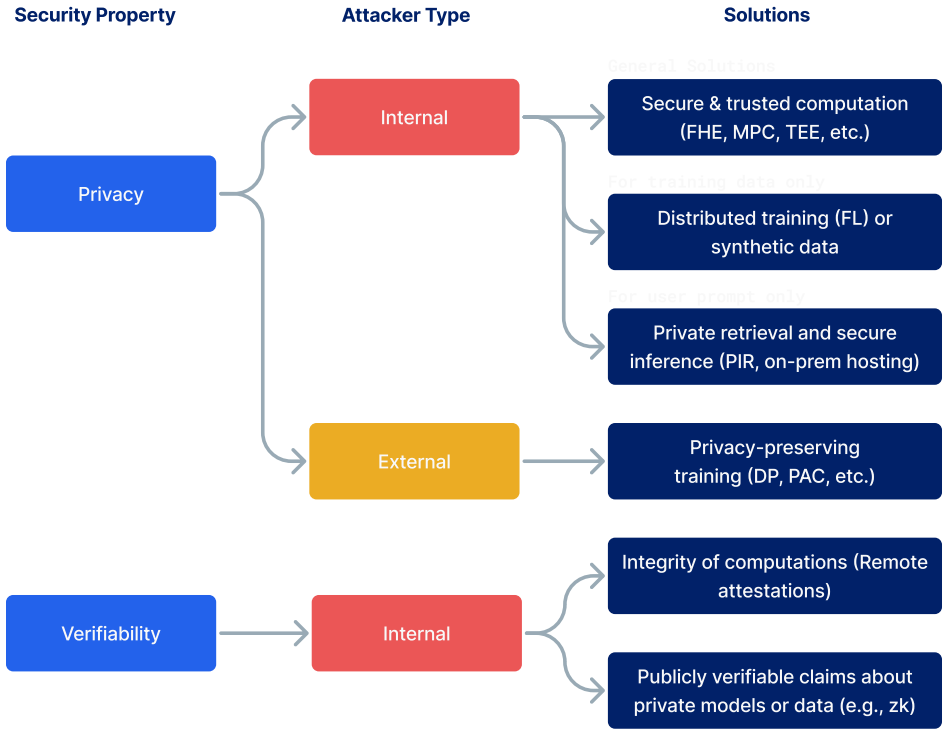
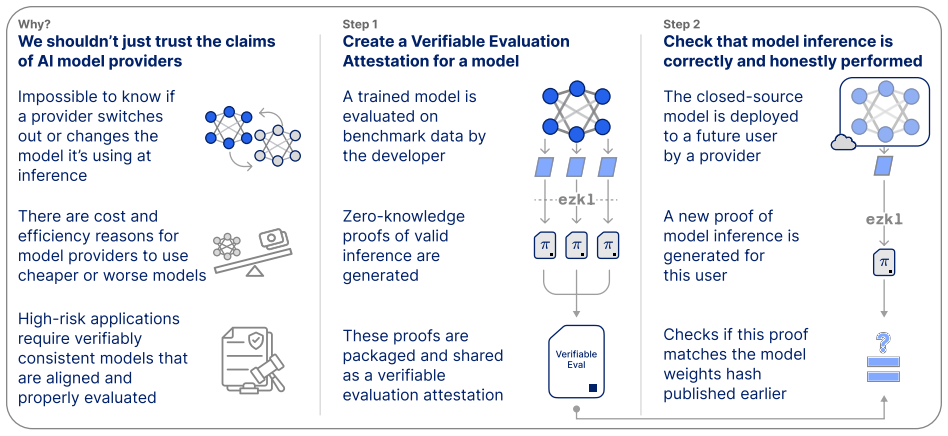
The argument rides on three mechanisms. A zkSNARK 'predict, then prove' pipeline—built on the thesis's ezkl toolkit, which compiles any ONNX-format model into a proof circuit under fixed-point quantization and folds a zero-knowledge hash of the model weights into every proof—is what turns 'this model scored X' into a claim anyone can check without the weights. A secret-shared inverted-file index queried inside multi-party computation, combining an MPC top-k over cluster centroids with oblivious retrieval of candidate vectors, is what lets PRAG do approximate nearest-neighbor search while hiding both query and database. Delegation credentials extending OpenID Connect and User-Managed Access b
What would settle it
Run PRAG with a majority of servers that actively deviate and check whether query embeddings or document contents are exposed, and test whether adversarially chosen inputs can make a zk evaluation attestation diverge from the full-precision model's true output. A third check: see whether a predict-then-prove endpoint can slip in a different model between the served prediction and the later proof, since the thesis concedes challenge-based audits only prove the provider possesses the attested model.
Extended reading notes
Core claim
The thesis claims that the friction between privacy, verifiability, and auditability in foundation-model AI is a design problem, not a law of nature, and that existing cryptographic primitives can already resolve it. For closed-weight models, it packages repeated zkSNARK proofs of inference over a benchmark into a verifiable evaluation attestation tied to a hash of the model weights: anyone can confirm an accuracy or fairness claim without seeing the weights, and a later inference can be challenged to confirm the served model matches the attested one. For retrieval-augmented generation, it introduces PRAG, a protocol in which a query embedding is secret-shared across servers holding a secret
Load-bearing premise
PRAG's privacy guarantee assumes a majority of honest-but-curious servers and a corpus that was correctly secret-shared before any query, while the zk evaluation proofs vouch for quantized inference rather than the exact model; if any of those premises fails, the corresponding claim collapses.
Editorial extensions
If this is right
- A model vendor could publish benchmark, bias, or safety attestations that any user or regulator can verify without access to model weights, then have live outputs challenged to confirm the model being served is the one attested.
- Organizations could pool sensitive documents into a secret-shared retrieval index so LLM question-answering draws on distributed private data while no single server sees the documents or the queries.
- RAG gives LLM systems a built-in audit trail and updatability: outputs trace to the retrieved records that grounded them, and erroneous or stale records can be corrected or deleted without retraining the model.
- AI agents could carry authenticated, scope-limited delegation credentials verified through existing OAuth/OpenID infrastructure, letting third parties confirm who authorized an action and under what constraints.
- Verifiable evaluation attestations are small, portable, and cheap to verify, so they can be mirrored and hosted anywhere; the heavy proof cost sits with the model provider, not the auditor.
Reading between the lines
- The predict-then-prove design implies verification can be decoupled from response latency, so as proof costs fall, challenge-based spot audits could become the default in regulated settings—full attestation becomes the baseline, and random or suspicion-triggered challenges enforce it.
- The same secret-shared retrieval machinery that hides queries and corpora could generalize to other database-side analytics, suggesting a pattern for federated knowledge systems beyond LLM question answering.
- Two extensions would determine how far the approach travels: a malicious-party-secure version of PRAG, or an accounting of the one-time cost of building the secret-shared index, and a rigorous bound on how much fixed-point quantization lets a zk proof diverge from full-precision model behavior.
Editorial analysis
A structured set of objections, weighed in public.
Referee Report
Summary. The manuscript is a PhD thesis that assembles several published and unpublished papers into a unified argument that privacy, verifiability, and auditability can be jointly engineered into foundation-model-based AI systems. Chapter 1 frames the risk landscape and a roadmap coupling cryptographic and confidential-computing tools. Chapter 2 develops zero-knowledge proofs (zkSNARKs) for verifiable model evaluation, sketches partial verification of AI systems, and applies the same primitives to portable data attestations. Chapter 3 is the technical core: it introduces PRAG, a multi-party-computation (MPC) protocol for private retrieval-augmented generation that claims to hide both client queries and the retrieved database, alongside a TEE-based RAG architecture. Chapter 4 treats authenticated delegation and personhood credentials for AI agents, and Chapter 5 synthesizes these components. The strongest concrete results are the verifiable-evaluation experiments on small models (MLP, CNN, LSTM, nanoGPT) and the PRAG experiments on synthetic and real embedding data, reporting accuracy and runtime against non-secure baselines.
Significance. If the claims are correct, the manuscript offers two substantive contributions: (a) a working, open-source route to verifiable evaluations of closed-weight models using zkSNARKs, demonstrated across several model classes; and (b) a first-of-its-kind MPC-based private RAG protocol that hides both query and database from any single server, with an IVF approximation intended to achieve sublinear communication. The thesis is honest about many practical limitations, including slow proving, quantization drift, the semi-honest assumption, and the absence of end-to-end system integration. It also ships reproducible artifacts (ezkl, a Crypten-based PRAG implementation, GitHub code), which is a concrete strength. However, the central security claim of PRAG is not accompanied by a formal proof, and the advertised sublinear communication is not actually established for the described protocol. These are load-bearing gaps that prevent the manuscript from being accepted in its current form.
major comments (4)
- [§3.2.1.4, Algorithm 1] The paper claims sublinear communication for ΠIVFQuery, but the described candidate-reduction step computes [candidates] := MatMult([closest buckets], [IVF]), where [closest buckets] is an nprobe×nc one-hot matrix and [IVF] has size nc×m×d. With nc=α√N and m=O(√N), a standard Shamir MPC matrix product requires communication O(nprobe·nc·m·d)=O(nprobe·N·d), linear in N. To realize the claimed sublinear behavior, the protocol needs a genuinely sublinear oblivious-selection primitive and a precise cost model; neither is specified or analyzed. This affects the headline contribution of the IVF protocol and must be corrected, or the claims scaled back.
- [§3.2.1.1, Algorithm 1] The central privacy guarantee — that no server observes a client's query or can see the database content — is stated but not proven. There is no ideal/real simulation, no leakage analysis for the repeated argmax/scale-down used in ExactTopk, no treatment of fixed-point truncation after multiplications, and no analysis of the padding pattern in fixed-size clusters or tie-breaking in distance comparisons. The experiments (Figs. 3.3, 3.4) measure only runtime and retrieval accuracy, not leakage. The semi-honest, honest-majority assumption alone does not rule out order/timing/tie leaks. A formal security statement with a simulation-based proof, or at least a precise leakage profile, is required for the main protocol.
- [§2.1.3, §2.1.8.3, Table 2.1] The verifiable-evaluation attestation is produced for a fixed-point quantized circuit, and the model-weight hash H(W) and witness outputs are quantized. The thesis does not formally state the relationship between the attested quantized model and the original float model, nor does it bound the accuracy difference caused by quantization. Because the calibration procedure is run on the benchmark test set (Sec. 2.1.8.3), the attestation can be tuned to that test set. The paper should state precisely what property is proven (e.g., existence of a quantized model with weights W_quant that achieves metric A on the quantized benchmark) and how that relates to the claim 'models with fixed private weights achieve stated performance'.
- [§2.2] This section is presented as a contribution ('Verifiable computation of partial AI systems') but is only a project abstract. No protocol definition, threat model, security argument, or experiments are provided. As written, this purported contribution cannot be evaluated. It should either be removed from the list of claimed contributions or developed at the same level of detail as Section 2.1.
minor comments (5)
- [§3.2.1.2] The text says 'we run argmax([x]) to get the current minimum's index'; if the goal is the minimum, the function should be argmin. Please correct the terminology or clarify the convention.
- [Figure 2.3 caption] 'multi-layered perceptions' should read 'multi-layer perceptrons'.
- [Table 2.1] Specify whether Prove Time is per inference, per token, or per entire benchmark; the nanoGPT entry (2781 s) is ambiguous without this context.
- [Figure 3.4] The axes should be labeled more explicitly, especially the x-axis of the accuracy/nprobe plot (fraction nprobe/nc) and the y-axis of the scaling plot (time per query).
- [§2.1.8.2] The sentence 'Argument 3 is constructed without leveraging the intermediate calculations of 2.1.8.2' refers to a section number in a confusing way; rephrase to reference the appropriate equations.
Circularity Check
No circular derivation: the technical chapters build on standard, externally checkable primitives and disclose their assumptions rather than defining predictions from fitted inputs.
full rationale
The thesis is a compilation of the author's own prior papers, and several chapters are explicitly self-citational (e.g., Sec. 1.1: "This section is based on the 'Risks to Privacy' section of the First International AI Safety Report [28] that I had the honor of authoring"; Sec. 2.1.8.1: "The ezkl toolkit, which underpins the system and is a contribution from the authors"). However, this self-citation is not load-bearing in the derivation chain. Each technical contribution is implemented and evaluated against external, non-secure baselines: Chapter 2 reports measured proof times, proof sizes, and accuracy tradeoffs for real models (Table 2.1, Fig. 2.3), and Chapter 3 compares PRAG retrieval accuracy and latency with standard IVF and exact search (Figs. 3.3, 3.4). These builds on standard cryptographic primitives—Halo2/ezkl zkSNARKs, Shamir secret sharing, Crypten MPC—whose security properties are inherited from established theory, not imported from the author's own prior claims. The PRAG privacy guarantee is explicitly scoped to a semi-honest, honest-majority model (Sec. 3.2.1.1: "we assume that all parties in the system are semi-honest ... at most t < n_servers/2 of the servers are corrupt"), and the thesis also states that data owners are assumed to have already secret-shared their data. That is a stated trust model, not a fitted input renamed as a prediction. The absence of a formal ideal/real simulation proof for Algorithm 1 is a real verification gap, but a missing security proof is a correctness risk, not circularity: no equation in the paper is defined in terms of the result it is supposed to establish. Similarly, the zk evaluation system proves quantized inference, and the thesis discloses this calibration tradeoff (Sec. 2.1.8.3: "When accuracy is sacrificed, the quantized input-output pair may be different from the original values by a few percent"), rather than silently equating quantized and exact inference. Overall, the derivation chains are self-contained in the sense that they reduce to stated assumptions and standard primitives, and no load-bearing conclusion is produced by construction from its own input. Score 0.
Assumptions & free parameters
free parameters (4)
- IVF cluster count coefficient alpha =
not stated; n_c = alpha * sqrt(N)
- nprobe (clusters inspected per query) =
not stated
- fixed-point precision (scale) in MPC =
not stated
- zk quantization calibration =
not stated
assumptions (6)
- standard math Zero-knowledge SNARK soundness and knowledge soundness, plus trusted setup via Perpetual Powers of Tau.
- domain assumption Honest-majority semi-honest MPC with at most t < n/2 corrupted servers.
- domain assumption A trusted dealer generates shared random values for preprocessing.
- domain assumption AI question answering can be modeled as embedding-based top-k retrieval followed by LLM inference.
- domain assumption Trusted Execution Environments provide confidentiality and remote attestation without mathematical guarantees.
- domain assumption A Trusted Data Source exists, signs data faithfully, and keeps its private key uncompromised.
invented entities (2)
-
Verifiable delegation credential for AI agents
-
Community Transformers data trust with TEE enclaves
Cite this review
Pith. "Pith review of Private, Verifiable, and Auditable AI Systems." pith.science (2026). https://pith.science/paper/SMMKKY6J
@misc{pith2026250900085,
  author       = {Pith},
  title        = {Pith review of: Private, Verifiable, and Auditable AI Systems},
  year         = {2026},
  howpublished = {\url{https://pith.science/paper/SMMKKY6J}},
  note         = {Machine review of arXiv:2509.00085}
}
read the original abstract
The growing societal reliance on artificial intelligence necessitates robust frameworks for ensuring its security, accountability, and trustworthiness. This thesis addresses the complex interplay between privacy, verifiability, and auditability in modern AI, particularly in foundation models. It argues that technical solutions that integrate these elements are critical for responsible AI innovation. Drawing from international policy contributions and technical research to identify key risks in the AI pipeline, this work introduces novel technical solutions for critical privacy and verifiability challenges. Specifically, the research introduces techniques for enabling verifiable and auditable claims about AI systems using zero-knowledge cryptography; utilizing secure multi-party computation and trusted execution environments for auditable, confidential deployment of large language models and information retrieval; and implementing enhanced delegation mechanisms, credentialing systems, and access controls to secure interactions with autonomous and multi-agent AI systems. Synthesizing these technical advancements, this dissertation presents a cohesive perspective on balancing privacy, verifiability, and auditability in foundation model-based AI systems, offering practical blueprints for system designers and informing policy discussions on AI safety and governance.
Figures


Figures from the paper (25 more)





Reference graph
Works this paper leans on
-
[1]
The Washington Post, Apr 2023
Inside the secret list of websites that make AI like ChatGPT sound smart — washing- tonpost.com. The Washington Post, Apr 2023
2023
-
[2]
Cooperation, competition, and maliciousness: LLM-stakeholders interactive negotiation
Sahar Abdelnabi, Amr Gomaa, Sarath Sivaprasad, Lea Schönherr, and Mario Fritz. Cooperation, competition, and maliciousness: LLM-stakeholders interactive negotiation. September 2023
2023
-
[3]
Multi-orbac: A new access control model for distributed, heterogeneous and collaborative systems
Anas Abou El Kalam and Yves Deswarte. Multi-orbac: A new access control model for distributed, heterogeneous and collaborative systems. InProceedings of the IEEE Symposium on Systems and Information Security, 2006
2006
-
[4]
Blinder–scalable, robust anony- mous committed broadcast
Ittai Abraham, Benny Pinkas, and Avishay Yanai. Blinder–scalable, robust anony- mous committed broadcast. InProceedings of the 2020 ACM SIGSAC Conference on Computer and Communications Security, pages 1233–1252, 2020
2020
-
[5]
Personhood credentials: Artificial intelligence and the value of privacy-preserving tools to distinguish who is real online
Steven Adler, Zoë Hitzig, Shrey Jain, Catherine Brewer, Wayne Chang, Renée DiResta, Eddy Lazzarin, Sean McGregor, Wendy Seltzer, Divya Siddarth, Nouran Soliman, Tobin South, Connor Spelliscy, Manu Sporny, Varya Srivastava, John Bailey, Brian Christian, Andrew Critch, Ronnie Falcon, Heather Flanagan, Kim Hamilton Duffy, Eric Ho, Claire R Leibowicz, Srikant...
2024
-
[6]
Steven Adler, Zoë Hitzig, Shrey Jain, Catherine Brewer, Wayne Chang, Renée DiResta, Eddy Lazzarin, Sean McGregor, Wendy Seltzer, Divya Siddarth, et al. Personhood credentials: Artificial intelligence and the value of privacy-preserving tools to distinguish who is real online.arXiv preprint arXiv:2408.07892, 2024
arXiv 2024
-
[7]
Privformer: Privacy-preserving transformer with mpc
Yoshimasa Akimoto, Kazuto Fukuchi, Youhei Akimoto, and Jun Sakuma. Privformer: Privacy-preserving transformer with mpc. In2023 IEEE 8th European Symposium on Security and Privacy (EuroS&P), pages 392–410. IEEE, 2023
2023
-
[8]
Reproducibility of Machine Learning: Terminology, Recommendations and Open Issues
Riccardo Albertoni, Sara Colantonio, Piotr Skrzypczy’nski, and Jerzy Stefanowski. Reproducibility of machine learning: Terminology, recommendations and open issues. ArXiv, abs/2302.12691, 2023. 135
work page Pith review arXiv 2023
Show all 299 references
-
[9]
Restatement (Third) of Agency
American Law Institute. Restatement (Third) of Agency. American Law Institute, Philadelphia, PA, 2006
2006
-
[10]
Introducing the model context protocol, November 2024
Anthropic. Introducing the model context protocol, November 2024. URL https: //www.anthropic.com/news/model-context-protocol
2024
-
[11]
The Human Condition
Hannah Arendt. The Human Condition. University of Chicago Press, Chicago, 1958
1958
-
[12]
Can foundation models help us achieve perfect secrecy?, 2022
Simran Arora and Christopher Ré. Can foundation models help us achieve perfect secrecy?, 2022
2022
-
[13]
Reasoning over public and private data in retrieval-based systems.ArXiv, abs/2203.11027, 2022
Simran Arora, Patrick Lewis, Angela Fan, Jacob Kahn, and Christopher R’e. Reasoning over public and private data in retrieval-based systems.ArXiv, abs/2203.11027, 2022
2022 arXiv
-
[14]
Reasoning over public and private data in retrieval-based systems.Trans
Simran Arora, Patrick Lewis, Angela Fan, Jacob Kahn, and Christopher Ré. Reasoning over public and private data in retrieval-based systems.Trans. Assoc. Comput. Linguist., 11:902–921, August 2023
2023
-
[15]
Privacy-preserving search of similar patients in genomic data.Cryptology ePrint Archive, 2017
Gilad Asharov, Shai Halevi, Yehuda Lindell, and Tal Rabin. Privacy-preserving search of similar patients in genomic data.Cryptology ePrint Archive, 2017
2017
-
[16]
wav2vec 2.0: A framework for self-supervised learning of speech representations.Advances in neural information processing systems, 33:12449–12460, 2020
Alexei Baevski, Yuhao Zhou, Abdelrahman Mohamed, and Michael Auli. wav2vec 2.0: A framework for self-supervised learning of speech representations.Advances in neural information processing systems, 33:12449–12460, 2020
2020
-
[17]
Kairouz, Marco Gruteser, Se- woong Oh, Borja Balle, and Daniel Ramage
Eugene Bagdasarian, Ren Yi, Sahra Ghalebikesabi, P. Kairouz, Marco Gruteser, Se- woong Oh, Borja Balle, and Daniel Ramage. Airgapagent: Protecting privacy-conscious conversational agents, 2024
2024
-
[18]
Artificial intelligence can persuade humans on political issues
Hui Bai, Jan Voelkel, Johannes Eichstaedt, and Robb Willer. Artificial intelligence can persuade humans on political issues. September 2023
2023
-
[19]
Bakker, Martin Chadwick, Hannah Sheahan, Michael Henry Tessler, Lucy Campbell-Gillingham, Jan Balaguer, Nathan McAleese, Amelia Glaese, John Aslanides, Matthew M
Michiel A. Bakker, Martin Chadwick, Hannah Sheahan, Michael Henry Tessler, Lucy Campbell-Gillingham, Jan Balaguer, Nathan McAleese, Amelia Glaese, John Aslanides, Matthew M. Botvinick, and Christopher Summerfield. Fine-tuning language models to find agreement among humans with...
2022 arXiv
-
[20]
The path of robotics law.California Law Review Circuit, 6:45, 2015
Jack M Balkin. The path of robotics law.California Law Review Circuit, 6:45, 2015
2015
-
[21]
Towards human-ai teaming to mitigate alert fatigue in security operations centres
Mohan Baruwal Chhetri, Shahroz Tariq, Ronal Singh, Fatemeh Jalalvand, Cecile Paris, and Surya Nepal. Towards human-ai teaming to mitigate alert fatigue in security operations centres. ACM Trans. Internet Technol., 24(3), July 2024. ISSN 1533-5399. doi:10.1145/3670009. URL http...
2024 doi
-
[22]
Manrai, and Marzyeh Ghassemi
Andrew Beam, Arjun K. Manrai, and Marzyeh Ghassemi. Challenges to the repro- ducibility of machine learning models in health care.JAMA, 2020
2020
-
[23]
Beam, Arjun K
Andrew L. Beam, Arjun K. Manrai, and Marzyeh Ghassemi. Challenges to the Reproducibility of Machine Learning Models in Health Care.JAMA, 323(4):305–306, 01 2020. ISSN 0098-7484. 136
2020
-
[24]
Anya Belz, Craig Thomson, Ehud Reiter, Gavin Abercrombie, Jose Maria Alonso-Moral, Mohammad Arvan, Jackie Chi Kit Cheung, Mark Cieliebak, Elizabeth Clark, Kees van Deemter, Tanvi Dinkar, Ondrej Dusek, Steffen Eger, Qixiang Fang, Albert Gatt, Dimitra Gkatzia, Javier Gonz’alez-C...
2023 arXiv
-
[25]
Zerocash: Decentralized anonymous payments from bitcoin
Eli Ben-Sasson, Alessandro Chiesa, Christina Garman, Matthew Green, Ian Miers, Eran Tromer, and Madars Virza. Zerocash: Decentralized anonymous payments from bitcoin. 2014 IEEE Symposium on Security and Privacy, 2014
2014
-
[26]
Bender and Batya Friedman
Emily M. Bender and Batya Friedman. Data Statements for Natural Language Process- ing: Toward Mitigating System Bias and Enabling Better Science.Transactions of the Association for Computational Linguistics, 6:587–604, 2018. doi:10.1162/tacl_a_00041. URL https://aclanthology.o...
2018 doi
-
[27]
On the dangers of stochastic parrots: Can language models be too big? InProceedings of the 2021 ACM conference on fairness, accountability, and transparency, pages 610–623, 2021
Emily M Bender, Timnit Gebru, Angelina McMillan-Major, and Shmargaret Shmitchell. On the dangers of stochastic parrots: Can language models be too big? InProceedings of the 2021 ACM conference on fairness, accountability, and transparency, pages 610–623, 2021
2021
-
[28]
Yoshua Bengio, Sören Mindermann, Daniel Privitera, Tamay Besiroglu, Rishi Bom- masani, Stephen Casper, Yejin Choi, Philip Fox, Ben Garfinkel, Danielle Goldfarb, Hoda Heidari, Anson Ho, Sayash Kapoor, Leila Khalatbari, Shayne Longpre, Sam Manning, Vasilios Mavroudis, Mantas Maz...
2025
-
[29]
K. P. Bennett and O. L. Mangasarian. Robust linear programming discrimination of two linearly inseparable sets.Optimization Methods and Software, 1:23–34, 1992
1992
-
[30]
zktax: A pragmatic way to support zero-knowledge tax disclosures
Alex Berke, Tobin South, Robert Mahari, Kent Larson, and Alex Pentland. zktax: A pragmatic way to support zero-knowledge tax disclosures. InProceedings of the 2024 on ACM SIGSAC Conference on Computer and Communications Security, pages 4952–4954, 2024
2024
-
[31]
Language (technology)ispower: Acriticalsurveyof"bias"innlp
Su Lin Blodgett, Solon Barocas, Hal Daumé III, and Hanna Wallach. Language (technology)ispower: Acriticalsurveyof"bias"innlp. arXiv preprint arXiv:2005.14050, 2020
2005 arXiv
-
[32]
Privacy expectations for human-autonomous vehicle interactions, 2022
Cara Bloom and Josiah Emery. Privacy expectations for human-autonomous vehicle interactions, 2022
2022
-
[33]
Help wanted: An examination of hiring algorithms, equity, and bias
Miranda Bogen and Aaron Rieke. Help wanted: An examination of hiring algorithms, equity, and bias. 2018
2018
-
[34]
Hudson, Ehsan Adeli, Russ Altman, Simran Arora, Sydney von Arx, Michael S
Rishi Bommasani, Drew A. Hudson, Ehsan Adeli, Russ Altman, Simran Arora, Sydney von Arx, Michael S. Bernstein, Jeannette Bohg, Antoine Bosselut, Emma Brunskill, Erik Brynjolfsson, Shyamal Buch, Dallas Card, Rodrigo Castellon, Niladri Chatterji, Annie Chen, Kathleen Creel, Jare...
2022 arXiv
-
[35]
Halo infinite: Recursive zk-snarks from any additive polynomial commitment scheme.Cryptology ePrint Archive, 2020
Dan Boneh, Justin Drake, Ben Fisch, and Ariel Gabizon. Halo infinite: Recursive zk-snarks from any additive polynomial commitment scheme.Cryptology ePrint Archive, 2020. 138
2020
-
[36]
Proof-of-Personhood: Redemocratizing permissionless cryptocurrencies
MariaBorge, EleftheriosKokoris-Kogias, PhilippJovanovic, LinusGasser, NicolasGailly, and Bryan Ford. Proof-of-Personhood: Redemocratizing permissionless cryptocurrencies. In 2017 IEEE European Symposium on Security and Privacy Workshops (EuroS&PW). IEEE, April 2017
2017
-
[37]
Proof-of-Personhood: Redemocratizing permissionless cryptocurren- cies
MariaBorge, EleftheriosKokoris-Kogias, PhilippJovanovic, LinusGasser, NicolasGailly, and Bryan Ford. Proof-of-Personhood: Redemocratizing permissionless cryptocurren- cies. In 2017 IEEE European Symposium on Security and Privacy Workshops, EU- ROS&PW, pages 23–26. IEEE Compute...
2017 doi
-
[38]
What will it take to fix benchmarking in natural language understanding?arXiv preprint arXiv:2104.02145, 2021
Samuel R Bowman and George E Dahl. What will it take to fix benchmarking in natural language understanding?arXiv preprint arXiv:2104.02145, 2021
2021 arXiv
-
[39]
Ontology-based access control for fair data.Data Intelligence, 2(1-2):66–77, 01 2020
Christopher Brewster, Barry Nouwt, Stephan Raaijmakers, and Jack Verhoosel. Ontology-based access control for fair data.Data Intelligence, 2(1-2):66–77, 01 2020. ISSN 2641-435X. doi:10.1162/dint_a_00029. URL https://doi.org/10.1162/dint_a_ 00029
2020 doi
-
[40]
Language models are few-shot learners.Advances in neural information processing systems, 33:1877–1901, 2020
Tom Brown, Benjamin Mann, Nick Ryder, Melanie Subbiah, Jared D Kaplan, Prafulla Dhariwal, Arvind Neelakantan, Pranav Shyam, Girish Sastry, Amanda Askell, et al. Language models are few-shot learners.Advances in neural information processing systems, 33:1877–1901, 2020
1901
-
[41]
Gender shades: Intersectional accuracy disparities in commercial gender classification
Joy Buolamwini and Timnit Gebru. Gender shades: Intersectional accuracy disparities in commercial gender classification. In Conference on fairness, accountability and transparency, pages 77–91. PMLR, 2018
2018
-
[42]
Gender shades: Intersectional accuracy disparities in commercial gender classification
Joy Buolamwini and Timnit Gebru. Gender shades: Intersectional accuracy disparities in commercial gender classification. InProceedings of the 1st Conference on Fairness, Accountability and Transparency, Machine Learning Research, pages 77–91. PMLR,
-
[43]
What do I think about biometric proof of personhood? Blog, 2023
Vitalik Buterin. What do I think about biometric proof of personhood? Blog, 2023. URL https://vitalik.eth.limo/general/2023/07/24/biometric.html
2023
-
[44]
C2PA Technical Specification, 2023
C2PA. C2PA Technical Specification, 2023. URL https://c2pa.org/specifications/ specifications/1.3/specs/C2PA_Specification.html#_introduction
2023
-
[45]
Honey I snarked the GPT
Alexander Camuto, Bianca Gănescu, Jonathan Passerat-Palmbach, and Jason Morton. Honey I snarked the GPT. EZKL Blog, Oct 2023
2023
-
[46]
Steps in hardware, leaps in performance
Alexander Camuto, Sofia Wawrzyniak, and Jason Morton. Steps in hardware, leaps in performance. EZKL Blog, Nov 2023
2023
-
[47]
Splitting and parallelizing proofs
Alexander Camuto, Sofia Wawrzyniak, and Jason Morton. Splitting and parallelizing proofs. EZKL Blog, Oct 2023. 139
2023
-
[48]
Removing additional commitment cost
Alexander Camuto, Sofia Wawrzyniak, and Jason Morton. Removing additional commitment cost. EZKL Blog, Oct 2023
2023
-
[49]
Extracting training data from large language models
Nicholas Carlini, Florian Tramèr, Eric Wallace, Matthew Jagielski, Ariel Herbert-Voss, Katherine Lee, Adam Roberts, Tom Brown, Dawn Song, Úlfar Erlingsson, Alina Oprea, and Colin Raffel. Extracting training data from large language models. In30th USENIX security symposium (USE...
2021
-
[50]
Quantifying memorization across neural language models
Nicholas Carlini, Daphne Ippolito, Matthew Jagielski, Katherine Lee, Florian Tramer, and Chiyuan Zhang. Quantifying memorization across neural language models. In11th International Conference on Learning Representations (ICLR 2023), Kigali, Rwanda, 2022
2023
-
[51]
Extracting training data from diffusion models
Nicolas Carlini, Jamie Hayes, Milad Nasr, Matthew Jagielski, Vikash Sehwag, Florian Tramèr, Borja Balle, Daphne Ippolito, and Eric Wallace. Extracting training data from diffusion models. In32nd USENIX security symposium (USENIX security 23), pages 5253–5270, Anaheim, CA, Augu...
2023
-
[52]
Trust and incentives in agency
Ramon Casadesus-Masanell and Daniel F Spulber. Trust and incentives in agency. Southern California Interdisciplinary Law Journal, 15:45, 2005
2005
-
[53]
Secure computation with fixed-point numbers
Octavian Catrina and Amitabh Saxena. Secure computation with fixed-point numbers. In Financial Cryptography and Data Security: 14th International Conference, FC 2010, Tenerife, Canary Islands, January 25-28, 2010, Revised Selected Papers 14, pages 35–50. Springer, 2010
2010
-
[54]
Harms from increasingly agentic algorithmic systems
Alan Chan, Rebecca Salganik, Alva Markelius, Chris Pang, Nitarshan Rajkumar, Dmitrii Krasheninnikov, Lauro Langosco, Zhonghao He, Yawen Duan, Micah Carroll, et al. Harms from increasingly agentic algorithmic systems. InProceedings of the 2023 ACM Conference on Fairness, Accoun...
2023
-
[55]
Visibility into ai agents
Alan Chan, Carson Ezell, Max Kaufmann, Kevin Wei, Lewis Hammond, Herbie Bradley, Emma Bluemke, Nitarshan Rajkumar, David Krueger, Noam Kolt, et al. Visibility into ai agents. InThe 2024 ACM Conference on Fairness, Accountability, and Transparency, pages 958–973, 2024
2024
-
[56]
Ids for ai systems.arXiv preprint arXiv:2406.12137, 2024
Alan Chan, Noam Kolt, Peter Wills, Usman Anwar, Christian Schroeder de Witt, Nitarshan Rajkumar, Lewis Hammond, David Krueger, Lennart Heim, and Markus Anderljung. Ids for ai systems.arXiv preprint arXiv:2406.12137, 2024
2024 arXiv
-
[57]
A survey on evaluation of large language models
Yupeng Chang, Xu Wang, Jindong Wang, Yuan Wu, Linyi Yang, Kaijie Zhu, Hao Chen, Xiaoyuan Yi, Cunxiang Wang, Yidong Wang, et al. A survey on evaluation of large language models. ACM Transactions on Intelligent Systems and Technology, 15(3): 1–45, 2024
2024
-
[58]
Sense of community in the urban environment: A catalyst for participation and community development.American journal of community psychology, 18(1):55–81, 1990
David M Chavis and Abraham Wandersman. Sense of community in the urban environment: A catalyst for participation and community development.American journal of community psychology, 18(1):55–81, 1990. 140
1990
-
[59]
Zkml: An optimizing system for ml inference in zero-knowledge proofs
Bing-Jyue Chen, Suppakit Waiwitlikhit, Ion Stoica, and Daniel Kang. Zkml: An optimizing system for ml inference in zero-knowledge proofs. InProceedings of the Nineteenth European Conference on Computer Systems, pages 560–574, 2024
2024
-
[60]
{SANNS}: Scaling up secure approximate{k-Nearest} neighbors search
Hao Chen, Ilaria Chillotti, Yihe Dong, Oxana Poburinnaya, Ilya Razenshteyn, and M Sadegh Riazi. {SANNS}: Scaling up secure approximate{k-Nearest} neighbors search. In 29th USENIX Security Symposium (USENIX Security 20), pages 2111–2128, 2020
2020
-
[61]
How is chatgpt’s behavior changing over time? arXiv preprint arXiv:2307.09009, 2023
Lingjiao Chen, Matei Zaharia, and James Zou. How is chatgpt’s behavior changing over time? arXiv preprint arXiv:2307.09009, 2023
2023 arXiv
-
[62]
MarkChen, JerryTworek, Heewoo Jun, Qiming Yuan, HenriquePondedeOliveira Pinto, Jared Kaplan, Harri Edwards, Yuri Burda, Nicholas Joseph, Greg Brockman, Alex Ray, Raul Puri, Gretchen Krueger, Michael Petrov, Heidy Khlaaf, Girish Sastry, Pamela Mishkin, Brooke Chan, Scott Gray, ...
2021
-
[63]
The-x: Privacy-preserving transformer inference with homomorphic encryption
Tianyu Chen, Hangbo Bao, Shaohan Huang, Li Dong, Binxing Jiao, Daxin Jiang, Haoyi Zhou, Jianxin Li, and Furu Wei. The-x: Privacy-preserving transformer inference with homomorphic encryption. arXiv preprint arXiv:2206.00216, 2022
2022 arXiv
-
[64]
Can language models be instructed to protect personal information? October 2023
Yang Chen, Ethan Mendes, Sauvik Das, Wei Xu, and Alan Ritter. Can language models be instructed to protect personal information? October 2023
2023
-
[65]
Can you fake it until you make it? impacts of differentially private synthetic data on downstream classification fairness
Victoria Cheng et al. Can you fake it until you make it? impacts of differentially private synthetic data on downstream classification fairness. InProceedings of the 2021 ACM Conference on Fairness, Accountability, and Transparency, FAccT ’21, pages 149–160, 3 2021. doi:10.114...
2021
-
[66]
Fast large-scale honest-majority mpc for malicious adversaries
Koji Chida, Daniel Genkin, Koki Hamada, Dai Ikarashi, Ryo Kikuchi, Yehuda Lindell, and Ariel Nof. Fast large-scale honest-majority mpc for malicious adversaries. In Advances in Cryptology–CRYPTO 2018: 38th Annual International Cryptology Confer- ence, Santa Barbara, CA, USA, A...
2018
-
[67]
Civil Resolution Tribunal (British Columbia). Patel v. wong, 2024 bccrt 149, 2024. URL https://www.canlii.org/en/bc/bccrt/doc/2024/2024bccrt149/2024bccrt149.html. Accessed: 2025-01-06. 141
2024
-
[68]
The measure and mismeasure of fairness: A critical review of fair machine learning.ArXiv, abs/1808.00023, 2018
Sam Corbett-Davies and Sharad Goel. The measure and mismeasure of fairness: A critical review of fair machine learning.ArXiv, abs/1808.00023, 2018
2018 arXiv
-
[69]
Advancing differential privacy: Where we are now and future directions for real-world deployment
Rachel Cummings et al. Advancing differential privacy: Where we are now and future directions for real-world deployment. Harvard Data Science Review, 6(1), 1 2024. doi:10.1162/99608f92.d3197524. URL https://doi.org/10.1162/99608f92.d3197524
2024 doi
-
[70]
Dagher, Benedikt Bünz, Joseph Bonneau, Jeremy Clark, and Dan Boneh
Gaby G. Dagher, Benedikt Bünz, Joseph Bonneau, Jeremy Clark, and Dan Boneh. Provisions: Privacy-preserving proofs of solvency for bitcoin exchanges.Proceedings of the 22nd ACM SIGSAC Conference on Computer and Communications Security, 2015
2015
-
[71]
Scalable and unconditionally secure multiparty computation
Ivan Damgård and Jesper Buus Nielsen. Scalable and unconditionally secure multiparty computation. In Annual International Cryptology Conference, pages 572–590. Springer, 2007
2007
-
[72]
Practical covertly secure mpc for dishonest majority–or: breaking the spdz limits
Ivan Damgård, Marcel Keller, Enrique Larraia, Valerio Pastro, Peter Scholl, and Nigel P Smart. Practical covertly secure mpc for dishonest majority–or: breaking the spdz limits. In Computer Security–ESORICS 2013: 18th European Symposium on Research in Computer Security, Egham,...
2013
-
[73]
The mnist database of handwritten digit images for machine learning research
Li Deng. The mnist database of handwritten digit images for machine learning research. IEEE Signal Processing Magazine, 29(6):141–142, 2012
2012
-
[74]
PhD thesis, Lehigh University, 2023
Tal Derei.Accelerating the PlonK zkSNARK Proving System using GPU Architectures. PhD thesis, Lehigh University, 2023
2023
-
[75]
Trust but verify: A guide to algorithms and the law
Deven R Desai and Joshua A Kroll. Trust but verify: A guide to algorithms and the law. Harv. JL & Tech., 31:1, 2017
2017
-
[76]
Puma: Secure inference of llama-7b in five minutes.ArXiv, abs/2307.12533, 2023
Ye Dong, Wen jie Lu, Yancheng Zheng, Haoqi Wu, Derun Zhao, Jin Tan, Zhicong Huang, Cheng Hong, Tao Wei, and Wen-Chang Cheng. Puma: Secure inference of llama-7b in five minutes.ArXiv, abs/2307.12533, 2023
2023
-
[77]
Citadel: Enclaves with strong microarchitectural isolation and secure shared memory on a speculative out-of-order processor
Jules Drean, Miguel Gomez-Garcia, Thomas Bourgeat, and Srinivas Devadas. Citadel: Enclaves with strong microarchitectural isolation and secure shared memory on a speculative out-of-order processor. 2023
2023
-
[78]
Do membership inference attacks work on large language models? February 2024
Michael Duan, Anshuman Suri, Niloofar Mireshghallah, Sewon Min, Weijia Shi, Luke Zettlemoyer, Yulia Tsvetkov, Yejin Choi, David Evans, and Hannaneh Hajishirzi. Do membership inference attacks work on large language models? February 2024
2024
-
[79]
cqlin: Efficient linear operations on kzg commitments with cached quotients
Liam Eagen and Ariel Gabizon. cqlin: Efficient linear operations on kzg commitments with cached quotients. Cryptology ePrint Archive, Paper 2023/393, 2023
2023
-
[80]
Oversight for Frontier AI through a Know-Your- Customer Scheme for Compute Providers, October 2023
Janet Egan and Lennart Heim. Oversight for Frontier AI through a Know-Your- Customer Scheme for Compute Providers, October 2023. URL http://arxiv.org/abs/ 2310.13625. arXiv:2310.13625 [cs]. 142
2023 arXiv
-
[81]
Gpts are gpts: An early look at the labor market impact potential of large language models.ArXiv, 2023
Tyna Eloundou, Sam Manning, Pamela Mishkin, and Daniel Rock. Gpts are gpts: An early look at the labor market impact potential of large language models.ArXiv, 2023
2023
-
[82]
Improved primitives for mpc over mixed arithmetic-binary circuits
Daniel Escudero, Satrajit Ghosh, Marcel Keller, Rahul Rachuri, and Peter Scholl. Improved primitives for mpc over mixed arithmetic-binary circuits. In Advances in Cryptology–CRYPTO 2020: 40th Annual International Cryptology Conference, CRYPTO 2020, Santa Barbara, CA, USA, Augu...
2020
-
[83]
European Commission. Proposal for a regulation of the european parliament and of the council laying down harmonised rules on artificial intelligence (artificial intelligence act) and amending certain union legislative acts. Legislative proposal, European Commission, 4 2021. UR...
2021
-
[84]
Artificial intelligence act, 4 2021
European Commission. Artificial intelligence act, 4 2021
2021
-
[85]
European Commission. Proposal for a Regulation of the European Parliament and of the Council Laying Down Harmonised Rules on Artificial Intelligence (Artificial Intelligence Act) and amending certain Union legislative acts. COM(2021) 206 final, 2021/0106 (COD), 2021. https://e...
2021
-
[86]
Report of the work undertaken by the ChatGPT taskforce
European Data Protection Board. Report of the work undertaken by the ChatGPT taskforce. Technical report, EDPB, May 2024
2024
-
[87]
Goldcoin: Grounding large language models in privacy laws via contextual integrity theory, 2024
Wei Fan, Haoran Li, Zheye Deng, Weiqi Wang, and Yangqiu Song. Goldcoin: Grounding large language models in privacy laws via contextual integrity theory, 2024
2024
-
[88]
Ppmck: Privacy-preserving multi-party computing for k-means clustering
Yongkai Fan, Jianrong Bai, Xia Lei, Weiguo Lin, Qian Hu, Guodong Wu, Jiaming Guo, and Gang Tan. Ppmck: Privacy-preserving multi-party computing for k-means clustering. Journal of Parallel and Distributed Computing, 154:54–63, 2021
2021
-
[89]
LLM agents can au- tonomously hack websites, 2024
Richard Fang, Rohan Bindu, Akul Gupta, and Daniel Kang. LLM agents can au- tonomously hack websites, 2024. URL https://arxiv.org/abs/2402.06664
2024 arXiv
-
[90]
FTC says ring employees illegally surveilled customers, failed to stop hackers from taking control of users’ cam- eras
Federal Trade Commission. FTC says ring employees illegally surveilled customers, failed to stop hackers from taking control of users’ cam- eras. https://www.ftc.gov/news-events/news/press-releases/2023/05/ ftc-says-ring-employees-illegally-surveilled-customers-failed-stop-hac...
2023
-
[91]
Federal Trade Commission. FTC staff report finds large social me- dia and video streaming companies have engaged in vast surveillance of users with lax privacy controls and inadequate safeguards for kids and teens. https://www.ftc.gov/news-events/news/press-releases/2024/09/ f...
2024
-
[92]
Switch transformers: Scaling to trillion parameter models with simple and efficient sparsity.The Journal of Machine Learning Research, 23(1):5232–5270, 2022
William Fedus, Barret Zoph, and Noam Shazeer. Switch transformers: Scaling to trillion parameter models with simple and efficient sparsity.The Journal of Machine Learning Research, 23(1):5232–5270, 2022
2022
-
[93]
Zen: An optimizing compiler for verifiable, zero-knowledge neural network inferences
Boyuan Feng, Lianke Qin, Zhenfei Zhang, Yufei Ding, and Shumo Chu. Zen: An optimizing compiler for verifiable, zero-knowledge neural network inferences. 2021
2021
-
[94]
Fielding
Roy T. Fielding. Architectural Styles and the Design of Network-based Software Architectures. Doctoral thesis, University of California at Irvine, June 2000. URL https://www.ics.uci.edu/~fielding/pubs/dissertation/fielding_dissertation.pdf
2000
-
[95]
Rowlbac: representing role based access control in owl
T.Finin, A.Joshi, L.Kagal, J.Niu, R.Sandhu, W.Winsborough, andB.Thuraisingham. Rowlbac: representing role based access control in owl. InProceedings of the 13th ACM Symposium on Access Control Models and Technologies, SACMAT ’08, page 73–82, New York, NY, USA, 2008. Associatio...
2008
-
[96]
Katherine B. Forrest. The ethics and challenges of legal personhood for AI.Yale Law Journal, 133, 2024. URL https://www.yalelawjournal.org/pdf/ForrestYLJForumEssay_ at8hdu63.pdf
2024
-
[97]
An inter- sectional definition of fairness
James R Foulds, Rashidul Islam, Kamrun Naher Keya, and Shimei Pan. An inter- sectional definition of fairness. In2020 IEEE 36th International Conference on Data Engineering (ICDE), pages 1918–1921. IEEE, 2020
1918
-
[98]
Magentic-one: A generalist multi-agent system for solving complex tasks.arXiv preprint arXiv:2411.04468, 2024
Adam Fourney, Gagan Bansal, Hussein Mozannar, Cheng Tan, Eduardo Salinas, Friederike Niedtner, Grace Proebsting, Griffin Bassman, Jack Gerrits, Jacob Alber, et al. Magentic-one: A generalist multi-agent system for solving complex tasks.arXiv preprint arXiv:2411.04468, 2024
2024 arXiv
-
[99]
Model inversion attacks that exploit confidence information and basic countermeasures
Matt Fredrikson, Somesh Jha, and Thomas Ristenpart. Model inversion attacks that exploit confidence information and basic countermeasures. InProceedings of the 22nd ACM SIGSAC Conference on Computer and Communications Security (CCS ’15), pages 1322–1333, New York, NY, USA, Oct...
2015
-
[100]
The ethics of advanced AI assistants
Iason Gabriel, Arianna Manzini, Geoff Keeling, Lisa Anne Hendricks, Verena Rieser, Hasan Iqbal, Nenad Tomašev, Ira Ktena, Zachary Kenton, Mikel Rodriguez, Seliem El-Sayed, Sasha Brown, Canfer Akbulut, Andrew Trask, Edward Hughes, A Ste- vie Bergman, Renee Shelby, Nahema Marcha...
2024
-
[101]
Trust the process: Zero- knowledge machine learning to enhance trust in generative ai interactions.arXiv preprint arXiv:2402.06414, 2024
Bianca-Mihaela Ganescu and Jonathan Passerat-Palmbach. Trust the process: Zero- knowledge machine learning to enhance trust in generative ai interactions.arXiv preprint arXiv:2402.06414, 2024
2024 arXiv
-
[102]
Experimenting with zero-knowledge proofs of training
Sanjam Garg, Aarushi Goel, Somesh Jha, Saeed Mahloujifar, Mohammad Mahmoody, Guru-Vamsi Policharla, and Mingyuan Wang. Experimenting with zero-knowledge proofs of training. InProceedings of the 2023 ACM SIGSAC Conference on Computer and Communications Security, pages 1880–1894, 2023
2023
-
[103]
Garner, editor.Black’s Law Dictionary
Bryan A. Garner, editor.Black’s Law Dictionary. Thomson Reuters, St. Paul, MN, 11th edition, 2019
2019
-
[104]
Datasheets for datasets.Com- munications of the ACM, 64(12):86–92, December 2021
Timnit Gebru, Jamie Morgenstern, Briana Vecchione, Jennifer Wortman Vaughan, Hanna Wallach, Hal Daumé Iii, and Kate Crawford. Datasheets for datasets.Com- munications of the ACM, 64(12):86–92, December 2021. ISSN 0001-0782, 1557-7317. doi:10.1145/3458723. URL https://dl.acm.or...
2021 doi
-
[105]
Gemini: A family of highly capable multimodal models
Gemini Team, Rohan Anil, Sebastian Borgeaud, Jean-Baptiste Alayrac, Jiahui Yu, Radu Soricut, Johan Schalkwyk, Andrew M Dai, Anja Hauth, Katie Millican, David Silver, Melvin Johnson, Ioannis Antonoglou, Julian Schrittwieser, Amelia Glaese, Jilin Chen, Emily Pitler, Timothy Lill...
2023
-
[106]
Operationalizing contextual integrity in privacy- conscious assistants, 2024
Sahra Ghalebikesabi, Eugene Bagdasaryan, Ren Yi, Itay Yona, Ilia Shumailov, Aneesh Pappu, Chongyang Shi, Laura Weidinger, Robert Stanforth, Leonard Berrada, Pushmeet Kohli, Po-Sen Huang, and Borja Balle. Operationalizing contextual integrity in privacy- conscious assistants, 2024
2024
-
[107]
Safetynets: Verifiable execution of deep neural networks on an untrusted cloud
Zahra Ghodsi, Tianyu Gu, and Siddharth Garg. Safetynets: Verifiable execution of deep neural networks on an untrusted cloud. InNeural Information Processing Systems, 2017
2017
-
[108]
Cryptonets: Applying neural networks to encrypted data with high throughput and accuracy
Ran Gilad-Bachrach et al. Cryptonets: Applying neural networks to encrypted data with high throughput and accuracy. In Maria Florina Balcan and Kilian Q. Weinberger, editors, International Conference on Machine Learning, pages 201–210, New York, 2016. PMLR
2016
-
[109]
Generative language models and automated influence operations: Emerging threats and potential mitigations
Josh A Goldstein, Girish Sastry, Micah Musser, Renee DiResta, Matthew Gentzel, and Katerina Sedova. Generative language models and automated influence operations: Emerging threats and potential mitigations. January 2023
2023
-
[110]
Planting undetectable backdoors in machine learning models
Shafi Goldwasser et al. Planting undetectable backdoors in machine learning models. In 2022 IEEE 63rd Annual Symposium on Foundations of Computer Science (FOCS), pages 931–942, 2022. doi:10.1109/FOCS54457.2022.00092. URL https://doi.org/10. 1109/FOCS54457.2022.00092
2022
-
[111]
Joint statement on data scraping and the protection of privacy
GPA’s International Enforcement Cooperation Working Group. Joint statement on data scraping and the protection of privacy. Technical report, Information Commissioner’s Office, August 2023
2023
-
[112]
Transactions on open agents, November 2024
Dazza Greenwood. Transactions on open agents, November 2024. URL https://onagents. org/transactions/. Accessed: 2025-01-06
2024
-
[113]
On the size of pairing-based non-interactive arguments.IACR Cryptol
Jens Groth. On the size of pairing-based non-interactive arguments.IACR Cryptol. ePrint Arch., 2016:260, 2016
2016
-
[114]
Updat- able and universal common reference strings with applications to zk-snarks
Jens Groth, Markulf Kohlweiss, Mary Maller, Sarah Meiklejohn, and Ian Miers. Updat- able and universal common reference strings with applications to zk-snarks. InAnnual International Cryptology Conference, pages 698–728. Springer, 2018
2018
-
[115]
Do machine learning platforms provide out-of-the-box reproducibility?Future Generation Computer Systems, 126:34–47, 2022
Odd Erik Gundersen, Saeid Shamsaliei, and Richard Juul Isdahl. Do machine learning platforms provide out-of-the-box reproducibility?Future Generation Computer Systems, 126:34–47, 2022
2022
-
[116]
Apple intelligence foundation language models
Tom Gunter, Zirui Wang, Chong Wang, Ruoming Pang, Andy Narayanan, Aonan Zhang, Bowen Zhang, Chen Chen, Chung-Cheng Chiu, David Qiu, Deepak Gopinath, Dian Ang Yap, Dong Yin, Feng Nan, Floris Weers, Guoli Yin, Haoshuo Huang, Jianyu Wang, Jiarui Lu, John Peebles, Ke Ye, Mark Lee,...
2024
-
[117]
Sigma: Secure gpt inference with function secret sharing
Kanav Gupta, Neha Jawalkar, Ananta Mukherjee, Nishanth Chandran, Divya Gupta, Ashish Panwar, and Rahul Sharma. Sigma: Secure gpt inference with function secret sharing. Cryptology ePrint Archive, 2023
2023
-
[118]
Multivariate lookups based on logarithmic derivatives.Cryptology ePrint Archive, 2022
Ulrich Haböck. Multivariate lookups based on logarithmic derivatives.Cryptology ePrint Archive, 2022
2022
-
[119]
Hardjono, E
T. Hardjono, E. Maler, M. Machulak, and D. Catalano. User-Managed Access (UMA) ProfileofOAuth2.0–SpecificationVersion1.0. Kantarapublishedspecification, Kantara Initiative, April 2015. https://docs.kantarainitiative.org/uma/rec-uma-core.html
2015
-
[120]
Thomas Hardjono. Federated Authorization over Access to Personal Data for Decentral- ized Identity Management.IEEE Communications Standards Magazine – The Dawn of the Internet Identity Layer and the Role of Decentralized Identity, 3(4):32–38, December
-
[121]
Data cooperatives: Towards a foundation for decentralized personal data management
Thomas Hardjono and Alex ’Sandy’ Pentland. Data cooperatives: Towards a foundation for decentralized personal data management. ArXiv, abs/1905.08819, 2019. URL https://api.semanticscholar.org/CorpusID:162168525
1905 arXiv
-
[122]
D. Hardt. The OAuth 2.0 Authorization Framework, October 2012. URL https: //tools.ietf.org/html/rfc6749. IETF Standard RFC6749
2012
-
[123]
Measuring massive multitask language understanding
Dan Hendrycks, Collin Burns, Steven Basart, Andy Zou, Mantas Mazeika, Dawn Song, and Jacob Steinhardt. Measuring massive multitask language understanding. Proceedings of the International Conference on Learning Representations (ICLR), 2021. 152
2021
-
[124]
Private web search with tiptoe
Alexandra Henzinger et al. Private web search with tiptoe. In Proceedings of the 29th Symposium on Operating Systems Principles , pages 396–416, 10 2023. doi:10.1145/3600006.3613134. URL https://doi.org/10.1145/3600006.3613134
2023
- [125]
-
[126]
Distilling the knowledge in a neural network
Geoffrey Hinton, Oriol Vinyals, and Jeff Dean. Distilling the knowledge in a neural network. arXiv preprint arXiv:1503.02531, 2015
2015 arXiv
-
[127]
Imagen video: High definition video generation with diffusion models
Jonathan Ho, William Chan, Chitwan Saharia, Jay Whang, Ruiqi Gao, Alexey Grit- senko, Diederik P Kingma, Ben Poole, Mohammad Norouzi, David J Fleet, and Tim Salimans. Imagen video: High definition video generation with diffusion models. October 2022
2022
-
[128]
Lora: Low-rank adaptation of large language models, 2021
Edward Hu, Yelong Shen, Phil Wallis, Zeyuan Allen-Zhu, Yuanzhi Li, Lu Wang, and Weizhu Chen. Lora: Low-rank adaptation of large language models, 2021
2021
-
[129]
Secret sharing scheme realizing general access structure
Mitsuru Ito, Akira Saito, and Takao Nishizeki. Secret sharing scheme realizing general access structure. Electronics and Communications in Japan (Part III: Fundamental Electronic Science), 72(9):56–64, 1989
1989
-
[130]
Geetha Jagannathan and Rebecca N. Wright. Privacy-preserving distributed k-means clustering over arbitrarily partitioned data. InKnowledge Discovery and Data Mining, 2005
2005
-
[131]
Contextual confidence and generative AI
Shrey Jain, Zoë Hitzig, and Pamela Mishkin. Contextual confidence and generative AI. November 2023
2023
-
[132]
Ragent: Retrieval-based access control policy generation
Sakuna Harinda Jayasundara, Nalin Asanka Gamagedara Arachchilage, and Giovanni Russello. Ragent: Retrieval-based access control policy generation. arXiv preprint arXiv:2409.07489, 2024
2024 arXiv
-
[133]
Sgxonerated: Finding (and partially fixing) privacy flaws in tee-based smart contract platforms without breaking the tee.Cryptology ePrint Archive, 2023
Nerla Jean-Louis, Yunqi Li, Yan Ji, Harjasleen Malvai, Thomas Yurek, Sylvain Belle- mare, and Andrew Miller. Sgxonerated: Finding (and partially fixing) privacy flaws in tee-based smart contract platforms without breaking the tee.Cryptology ePrint Archive, 2023
2023
-
[134]
Product quantization for nearest neighbor search
Hervé Jégou, Matthijs Douze, and Cordelia Schmid. Product quantization for nearest neighbor search. IEEE Transactions on Pattern Analysis and Machine Intelligence, pages 117–128, 2011
2011
-
[135]
Deepreshape: Redesigning neural networks for efficient private inference.ArXiv, abs/2304.10593, 2023
Nandan Kumar Jha and Brandon Reagen. Deepreshape: Redesigning neural networks for efficient private inference.ArXiv, abs/2304.10593, 2023
2023 arXiv
-
[136]
Choquette-Choo, Natalie Dullerud, Anvith Thudi, Varun Chandrasekaran, and Nicolas Papernot
Hengrui Jia, Mohammad Yaghini, Christopher A. Choquette-Choo, Natalie Dullerud, Anvith Thudi, Varun Chandrasekaran, and Nicolas Papernot. Proof-of-learning: Def- initions and practice. 2021 IEEE Symposium on Security and Privacy (SP), pages 1039–1056, 2021. 153
2021
-
[137]
Billion-scale similarity search with gpus
Jeff Johnson, Matthijs Douze, and Hervé Jégou. Billion-scale similarity search with gpus. IEEE Transactions on Big Data, 7:535–547, 2017
2017
-
[138]
Evaluating natural language processing systems: An analysis and review
Karen Sparck Jones and Julia R Galliers. Evaluating natural language processing systems: An analysis and review. 1995
1995
-
[139]
Gazelle: A low latency framework for secure neural network inference
Chiraag Juvekar, Vinod Vaikuntanathan, and Anantha Chandrakasan. Gazelle: A low latency framework for secure neural network inference. In27th USENIX Security Symposium (USENIX Security 18), pages 1651–1669, 2018
2018
-
[140]
Peter Kairouz, H. B. McMahan, Brendan Avent, Aurélien Bellet, Mehdi Bennis, Ar- jun Nitin Bhagoji, Keith Bonawitz, Zachary B. Charles, Graham Cormode, Rachel Cummings, Rafael G. L. D’Oliveira, Salim Y. El Rouayheb, David Evans, Josh Gardner, Zachary Garrett, Adrià Gascón, Badi...
2019
-
[141]
Scaling up trustless dnn inference with zero-knowledge proofs.arXiv preprint arXiv:2210.08674, 2022
Daniel Kang, Tatsunori Hashimoto, Ion Stoica, and Yi Sun. Scaling up trustless dnn inference with zero-knowledge proofs.arXiv preprint arXiv:2210.08674, 2022
2022 arXiv
- [142]
-
[143]
Daniel D. Kang. Tensorplonk: A “gpu”’ for zkml, delivering 1,000x speedups. Medium, 2023
2023
-
[144]
Groundwork of the Metaphysics of Morals
Immanuel Kant. Groundwork of the Metaphysics of Morals. Cambridge University Press, Cambridge, 1785. Translated by Mary Gregor, 1997
1997
-
[145]
Jared Kaplan, Sam McCandlish, T. J. Henighan, Tom B. Brown, Benjamin Chess, Rewon Child, Scott Gray, Alec Radford, Jeff Wu, and Dario Amodei. Scaling laws for neural language models.ArXiv, abs/2001.08361, 2020
2001 arXiv
-
[146]
Fairface: Face attribute dataset for balanced race, gender, and age for bias measurement and mitigation
Kimmo Kärkkäinen and Jungseock Joo. Fairface: Face attribute dataset for balanced race, gender, and age for bias measurement and mitigation. 2021 IEEE Winter Conference on Applications of Computer Vision (WACV), pages 1547–1557, 2021
2021
-
[147]
Dense passage retrieval for open-domain question answering
Vladimir Karpukhin, Barlas Oguz, Sewon Min, Patrick Lewis, Ledell Wu, Sergey Edunov, Danqi Chen, and Wen-Tau Yih. Dense passage retrieval for open-domain question answering. In Proceedings of the 2020 Conference on Empirical Methods 154 in Natural Language Processing (EMNLP), ...
2020
-
[148]
Dense passage retrieval for open-domain ques- tion answering
Vladimir Karpukhin, Barlas Oğuz, Sewon Min, Patrick Lewis, Ledell Yu Wu, Sergey Edunov, Danqi Chen, and Wen tau Yih. Dense passage retrieval for open-domain ques- tion answering. InConference on Empirical Methods in Natural Language Processing, 2020
2020
-
[149]
Securing artificial intelligence model weights: Interim report
Ajay Karpur, Dan Lahav, Jason Matheny, Jeff Alstott, and Sella Nevo. Securing artificial intelligence model weights: Interim report. 2023
2023
-
[150]
Constant-size commitments to polynomials and their applications
Aniket Kate, Gregory M Zaverucha, and Ian Goldberg. Constant-size commitments to polynomials and their applications. InAdvances in Cryptology-ASIACRYPT 2010: 16th International Conference on the Theory and Application of Cryptology and Information Security, Singapore, December...
2010
-
[151]
Alignment of language agents.ArXiv, abs/2103.14659, 2021
Zachary Kenton, Tom Everitt, Laura Weidinger, Iason Gabriel, Vladimir Mikulik, and Geoffrey Irving. Alignment of language agents.ArXiv, abs/2103.14659, 2021
2021 arXiv
-
[152]
Discovering agents
Zachary Kenton, Ramana Kumar, Sebastian Farquhar, Jonathan Richens, Matt Mac- Dermott, and Tom Everitt. Discovering agents. Artif. Intell., 322(103963):103963, September 2023
2023
-
[153]
Dynabench: Rethinking benchmarking in nlp.arXiv preprint arXiv:2104.14337, 2021
Douwe Kiela, Max Bartolo, Yixin Nie, Divyansh Kaushik, Atticus Geiger, Zhengx- uan Wu, Bertie Vidgen, Grusha Prasad, Amanpreet Singh, Pratik Ringshia, et al. Dynabench: Rethinking benchmarking in nlp.arXiv preprint arXiv:2104.14337, 2021
2021 arXiv
-
[154]
Pufferfish: A framework for mathematical privacy definitions
Daniel Kifer and Ashwin Machanavajjhala. Pufferfish: A framework for mathematical privacy definitions. ACM Transactions on Database Systems (TODS), 39(1):1–36, 1
-
[155]
Auditing algorithms for discrimination.U
Pauline T Kim. Auditing algorithms for discrimination.U. Pa. L. Rev. Online, 166: 189, 2017
2017
-
[156]
Auto-encoding variational bayes
Diederik P Kingma and Max Welling. Auto-encoding variational bayes. InProceedings of the International Conference on Learning Representations (ICLR), 2014
2014
-
[157]
Lin, Hjalmar Wijk, Joel Burget, Aaron Ho, Elizabeth Barnes, and Paul Christiano
Megan Kinniment, Lucas Jun Koba Sato, Haoxing Du, Brian Goodrich, Max Hasin, Lawrence Chan, Luke Harold Miles, Tao R. Lin, Hjalmar Wijk, Joel Burget, Aaron Ho, Elizabeth Barnes, and Paul Christiano. Evaluating language-model agents on realistic autonomous tasks, 2024. URL http...
2024 arXiv
-
[158]
Bias out-of-the-box: An empirical analysis of intersectional occupational biases in popular generative language models
Hannah Rose Kirk, Yennie Jun, Filippo Volpin, Haider Iqbal, Elias Benussi, Frederic Dreyer, Aleksandar Shtedritski, and Yuki Asano. Bias out-of-the-box: An empirical analysis of intersectional occupational biases in popular generative language models. In M. Ranzato, A. Beygelz...
-
[159]
Crypten: Secure multi-party computation meets machine learning
Brian Knott, Shobha Venkataraman, Awni Hannun, Shubho Sengupta, Mark Ibrahim, and Laurens van der Maaten. Crypten: Secure multi-party computation meets machine learning. Advances in Neural Information Processing Systems, 34:4961–4973, 2021
2021
-
[160]
Hannun, Shubho Sengupta, Mark Ibrahim, and Laurens van der Maaten
Brian Knott, Shobha Venkataraman, Awni Y. Hannun, Shubho Sengupta, Mark Ibrahim, and Laurens van der Maaten. Crypten: Secure multi-party computation meets machine learning. ArXiv, abs/2109.00984, 2021
2021 arXiv
-
[161]
Crypten: Secure multi-party computation meets machine learning
Brian Knott et al. Crypten: Secure multi-party computation meets machine learning. In Advances in Neural Information Processing Systems, volume 34, pages 4961–4973, 2021
2021
-
[162]
Large language models are zero-shot reasoners.ArXiv, 2022
Takeshi Kojima, Shixiang Shane Gu, Machel Reid, Yutaka Matsuo, and Yusuke Iwasawa. Large language models are zero-shot reasoners.ArXiv, 2022
2022
-
[163]
Governing AI agents, 2024
Noam Kolt. Governing AI agents, 2024. URL https://papers.ssrn.com/abstract= 4772956
2024
-
[164]
Frost: flexible round-optimized schnorr threshold signatures
Chelsea Komlo and Ian Goldberg. Frost: flexible round-optimized schnorr threshold signatures. In Selected Areas in Cryptography: 27th International Conference, Halifax, NS, Canada (Virtual Event), October 21-23, 2020, Revised Selected Papers 27, pages 34–65. Springer, 2021
2020
-
[165]
Private traits and attributes are predictable from digital records of human behavior.Proc
Michal Kosinski, David Stillwell, and Thore Graepel. Private traits and attributes are predictable from digital records of human behavior.Proc. Natl. Acad. Sci. U. S. A., 110(15):5802–5805, April 2013
2013
-
[166]
Nova: Recursive zero-knowledge arguments from folding schemes
Abhiram Kothapalli, Srinath Setty, and Ioanna Tzialla. Nova: Recursive zero-knowledge arguments from folding schemes. InAnnual International Cryptology Conference, pages 359–388. Springer, 2022
2022
-
[167]
Accountable algorithms
Joshua Alexander Kroll. Accountable algorithms. PhD thesis, Princeton University, 2015
2015
-
[168]
Lalor, Yi Yang, Kendall Smith, Nicole Forsgren, and Ahmed Abbasi
John P. Lalor, Yi Yang, Kendall Smith, Nicole Forsgren, and Ahmed Abbasi. Bench- marking intersectional biases in nlp. InProceedings of the 2022 Annual Conference of the North American Chapter of the Association for Computational Linguistics. Association for Computational Ling...
2022
-
[169]
Generative AI in healthcare: Adoption trends and what’s next
Jessica Lamb, Greg Israelstam, Rahul Agarwal, and Shashank Bhasker. Generative AI in healthcare: Adoption trends and what’s next. Technical report, McKinsey & Company, July 2024
2024
-
[170]
vcnn: Verifiable convolutional neural network based on zk-snarks
Seunghwan Lee. vcnn: Verifiable convolutional neural network based on zk-snarks. 2020
2020
-
[171]
Retrieval-Augmented Generation for Knowledge-Intensive 156 NLP Tasks
Patrick Lewis, Ethan Perez, Aleksandra Piktus, Fabio Petroni, Vladimir Karpukhin, Naman Goyal, Heinrich Küttler, Mike Lewis, Wen-Tau Yih, Tim Rocktäschel, Sebastian Riedel, and Douwe Kiela. Retrieval-Augmented Generation for Knowledge-Intensive 156 NLP Tasks. In34th Conference...
2020
-
[172]
Retrieval-augmented generation for knowledge-intensive nlp tasks
Patrick Lewis et al. Retrieval-augmented generation for knowledge-intensive nlp tasks. In Proceedings of the 34th International Conference on Neural Information Processing Systems, pages 9459–9474, 12 2020
2020
- [173]
-
[174]
Holistic evaluation of language models.arXiv preprint arXiv:2211.09110, 2022
Percy Liang, Rishi Bommasani, Tony Lee, Dimitris Tsipras, Dilara Soylu, Michihiro Yasunaga, Yian Zhang, Deepak Narayanan, Yuhuai Wu, Ananya Kumar, et al. Holistic evaluation of language models.arXiv preprint arXiv:2211.09110, 2022
2022 arXiv
-
[175]
Are we learning yet? a meta review of evaluation failures across machine learning
Thomas Liao. Are we learning yet? a meta review of evaluation failures across machine learning. In NeurIPS Datasets and Benchmarks, 2021
2021
-
[176]
Autonomous interface agents
Henry Lieberman. Autonomous interface agents. InProceedings of the ACM SIGCHI Conference on Human factors in computing systems, New York, NY, USA, March 1997. ACM
1997
-
[177]
Aiwei Liu, Leyi Pan, Yijian Lu, Jingjing Li, Xuming Hu, Lijie Wen, Irwin King, and Philip S. Yu. A Survey of Text Watermarking in the Era of Large Language Models, January 2024. URL http://arxiv.org/abs/2312.07913. arXiv:2312.07913 [cs]
2024 arXiv
-
[178]
Faircompass: Operationalising fairness in machine learning.ArXiv, abs/2312.16726, 2023
Jessica Liu, Huaming Chen, Jun Shen, and Kim-Kwang Raymond Choo. Faircompass: Operationalising fairness in machine learning.ArXiv, abs/2312.16726, 2023
2023 arXiv
-
[179]
zkcnn: Zero knowledge proofs for convolu- tional neural network predictions and accuracy.Proceedings of the 2021 ACM SIGSAC Conference on Computer and Communications Security, 2021
Tianyi Liu, Xiang Xie, and Yupeng Zhang. zkcnn: Zero knowledge proofs for convolu- tional neural network predictions and accuracy.Proceedings of the 2021 ACM SIGSAC Conference on Computer and Communications Security, 2021
2021
-
[180]
AgentBench: Evaluating LLMs as agents
Xiao Liu, Hao Yu, Hanchen Zhang, Yifan Xu, Xuanyu Lei, Hanyu Lai, Yu Gu, Hangliang Ding, Kaiwen Men, Kejuan Yang, Shudan Zhang, Xiang Deng, Aohan Zeng, Zhengxiao Du, Chenhui Zhang, Sheng Shen, Tianjun Zhang, Yu Su, Huan Sun, Minlie Huang, Yuxiao Dong, and Jie Tang. AgentBench:...
2023
-
[181]
Prompt injection attack against LLM-integrated applications
Yi Liu, Gelei Deng, Yuekang Li, Kailong Wang, Zihao Wang, Xiaofeng Wang, Tianwei Zhang, Yepang Liu, Haoyu Wang, Yan Zheng, and Yang Liu. Prompt injection attack against LLM-integrated applications. June 2023
2023
-
[182]
Deep learning face attributes in the wild
Ziwei Liu, Ping Luo, Xiaogang Wang, and Xiaoou Tang. Deep learning face attributes in the wild. InProceedings of the IEEE international conference on computer vision, pages 3730–3738, 2015
2015
-
[183]
Consent in crisis: The rapid decline of the ai data commons.arXiv preprint arXiv:2407.14933, 2024
Shayne Longpre, Robert Mahari, Ariel Lee, Campbell Lund, Hamidah Oderinwale, William Brannon, Nayan Saxena, Naana Obeng-Marnu, Tobin South, Cole Hunter, et al. Consent in crisis: The rapid decline of the ai data commons.arXiv preprint arXiv:2407.14933, 2024. 157
2024 arXiv
-
[184]
Consent in crisis: The rapid decline of the AI data commons
Shayne Longpre, Robert Mahari, Ariel N Lee, Campbell S Lund, Hamidah Oderinwale, William Brannon, Nayan Saxena, Naana Obeng-Marnu, Tobin South, Cole J Hunter, Kevin Klyman, Christopher Klamm, Hailey Schoelkopf, Nikhil Singh, Manuel Cherep, Ahmad Mustafa Anis, An Dinh, Caroline...
2024
-
[185]
Hemet: A homomorphic-encryption-friendly privacy-preserving mobile neural network architecture
Qian Lou and Lei Jiang. Hemet: A homomorphic-encryption-friendly privacy-preserving mobile neural network architecture. InInternational Conference on Machine Learning, 2021
2021
-
[186]
Analyzing leakage of personally identifiable information in language models
Nils Lukas, Ahmed Salem, Robert Sim, Shruti Tople, Lukas Wutschitz, and Santiago Zanella-Béguelin. Analyzing leakage of personally identifiable information in language models. In 2023 IEEE Symposium on Security and Privacy (SP), pages 346–363. IEEE, May 2023
2023
-
[187]
Time for a new antitrust era: Refocusing antitrust law to invigorate competition in the 21st century
Robert Mahari, Sandro Claudio Lera, and Alex ’Sandy’ Pentland. Time for a new antitrust era: Refocusing antitrust law to invigorate competition in the 21st century. Stanford Computational Antitrust, 1, 2021
2021
-
[188]
Generation-augmented retrieval for open-domain question answering
Yuning Mao, Pengcheng He, Xiaodong Liu, Yelong Shen, Jianfeng Gao, Jiawei Han, and Weizhu Chen. Generation-augmented retrieval for open-domain question answering. In Annual Meeting of the Association for Computational Linguistics, 2020
2020
-
[189]
A Protocol Sketch For LLM Communication, April 2024
Samuele Marro. A Protocol Sketch For LLM Communication, April 2024. URL https://samuelemarro.it/blog/2024/a-protocol-for-llm/
2024
-
[190]
Bowman, and Rachel Rudinger
Chandler May, Alex Wang, Shikha Bordia, Samuel R. Bowman, and Rachel Rudinger. On measuring social biases in sentence encoders.ArXiv, abs/1903.10561, 2019
1903 arXiv
-
[191]
Innovative Instructions and Soft- ware Model for Isolated Execution
Frank Mckeen, Ilya Alexandrovich, Alex Berenzon, Carlos Rozas, Hisham Shafi, Vedvyas Shanbhogue, and Uday Savagaonkar. Innovative Instructions and Soft- ware Model for Isolated Execution. In Proc. Second Workshop on Hardware and Architectural Support for Security and Privacy H...
2013
-
[192]
Ninareh Mehrabi, Fred Morstatter, Nripsuta Ani Saxena, Kristina Lerman, and A. G. Galstyan. A survey on bias and fairness in machine learning.ACM Computing Surveys (CSUR), 54:1 – 35, 2019. 158
2019
-
[193]
Trust no bot: Discovering personal disclosures in Human-LLM conversations in the wild
Niloofar Mireshghallah, Maria Antoniak, Yash More, Yejin Choi, and Golnoosh Farnadi. Trust no bot: Discovering personal disclosures in Human-LLM conversations in the wild. In First Conference on Language Modeling, August 2024
2024
-
[194]
Lehmkuhl, Akshayaram Srinivasan, Wenting Zheng, and Raluca A
Pratyush Mishra, Ryan T. Lehmkuhl, Akshayaram Srinivasan, Wenting Zheng, and Raluca A. Popa. D elphi : A cryptographic inference service for neural networks. 2019
2019
-
[195]
Model cards for model reporting
Margaret Mitchell, Simone Wu, Andrew Zaldivar, Parker Barnes, Lucy Vasserman, Ben Hutchinson, Elena Spitzer, Inioluwa Deborah Raji, and Timnit Gebru. Model cards for model reporting. InProceedings of the conference on fairness, accountability, and transparency, pages 220–229, 2019
2019
-
[196]
Model Cards for Model Reporting
Margaret Mitchell, Simone Wu, Andrew Zaldivar, Parker Barnes, Lucy Vasserman, Ben Hutchinson, Elena Spitzer, Inioluwa Deborah Raji, and Timnit Gebru. Model Cards for Model Reporting. InProceedings of the Conference on Fairness, Accountability, and Transparency, pages 220–229, ...
2019
-
[197]
Fan Mo, Ali Shahin Shamsabadi, Kleomenis Katevas, Soteris Demetriou, Ilias Leontiadis, Andrea Cavallaro, and Hamed Haddadi. Darknetz: towards model privacy at the edge using trusted execution environments.Proceedings of the 18th International Conference on Mobile Systems, Appl...
2020
-
[198]
Secureml: A system for scalable privacy- preserving machine learning
Payman Mohassel and Yupeng Zhang. Secureml: A system for scalable privacy- preserving machine learning. In2017 IEEE Symposium on Security and Privacy (SP), pages 19–38. IEEE, 2017. doi:10.1109/SP.2017.12
2017 doi
-
[199]
Human-in-the-loop machine learning: a state of the art
Eduardo Mosqueira-Rey, Elena Hernández-Pereira, David Alonso-Ríos, José Bobes- Bascarán, and Ángel Fernández-Leal. Human-in-the-loop machine learning: a state of the art. Artificial Intelligence Review, 56(4):3005–3054, 2023
2023
-
[200]
Ratha, Prasanna Sattigeri, Chai- Wah Wu, Brian Kingsbury, Abhishek Kumar, Samuel Thomas, Aleksandra Mojsilovic, and Kush R
Vidya Muthukumar, Tejaswini Pedapati, Nalini K. Ratha, Prasanna Sattigeri, Chai- Wah Wu, Brian Kingsbury, Abhishek Kumar, Samuel Thomas, Aleksandra Mojsilovic, and Kush R. Varshney. Understanding unequal gender classification accuracy from face images. ArXiv, abs/1812.00099, 2018
2018 arXiv
-
[201]
Compiling classical ml pipelines into tensor computations for one-size-fits-all prediction serving
Supun Nakandala, Gyeong-In Yu, Markus Weimer, and Matteo Interlandi. Compiling classical ml pipelines into tensor computations for one-size-fits-all prediction serving. In System for ML Workshop. NeurIPS, 2019
2019
-
[202]
WebGPT: Browser-assisted question-answering with human feedback
Reiichiro Nakano, Jacob Hilton, Suchir Balaji, Jeff Wu, Long Ouyang, Christina Kim, Christopher Hesse, Shantanu Jain, Vineet Kosaraju, William Saunders, Xu Jiang, Karl Cobbe, Tyna Eloundou, Gretchen Krueger, Kevin Button, Matthew Knight, Benjamin Chess, and John Schulman. WebG...
2021
-
[203]
Shokri, and Amir Houmansadr
Milad Nasr, R. Shokri, and Amir Houmansadr. Comprehensive privacy analysis of deep learning: Passive and active white-box inference attacks against centralized and 159 federated learning.2019 IEEE Symposium on Security and Privacy (SP), pages 739–753, 2018
2019
-
[204]
Uniform Electronic Transactions Act (UETA)
National Conference of Commissioners on Uniform State Laws. Uniform Electronic Transactions Act (UETA). Proposed official text, 1999
1999
-
[205]
Neuman, T
C. Neuman, T. Yu, S. Hartman, and K. Raeburn. The Kerberos Network Authenti- cation Service (V5), July 2005. URL https://datatracker.ietf.org/doc/html/rfc4120. IETF Standard RFC4120
2005
-
[206]
Powers-of-tau to the people: Decentralizing setup ceremonies.Cryptology ePrint Archive, 2022
Valeria Nikolaenko, Sam Ragsdale, Joseph Bonneau, and Dan Boneh. Powers-of-tau to the people: Decentralizing setup ceremonies.Cryptology ePrint Archive, 2022
2022
-
[207]
Powers-of-tau to the people: Decentralizing setup ceremonies
Valeria Nikolaenko, Sam Ragsdale, Joseph Bonneau, and Dan Boneh. Powers-of-tau to the people: Decentralizing setup ceremonies. InInternational Conference on Applied Cryptography and Network Security, pages 105–134. Springer, 2024
2024
-
[208]
Privacy as contextual integrity.Washington Law Review, 79(1):119, 2004
Helen Nissenbaum. Privacy as contextual integrity.Washington Law Review, 79(1):119, 2004
2004
-
[209]
Privacy in Context: Technology, Policy, and the Integrity of Social Life
Helen Nissenbaum. Privacy in Context: Technology, Policy, and the Integrity of Social Life. Stanford University Press, Palo Alto, CA, 2009
2009
-
[210]
Privacy in Context: Technology, Policy, and the Integrity of Social Life
Helen Nissenbaum. Privacy in Context: Technology, Policy, and the Integrity of Social Life. Stanford University Press, Stanford, California, 2009
2009
-
[211]
extensible access control markup language (xacml) version 3.0
OASIS. extensible access control markup language (xacml) version 3.0. 2013. URL https://docs.oasis-open.org/xacml/3.0/xacml-3.0-core-spec-os-en.html
2013
-
[212]
Deployment Corrections: An incident response framework for frontier AI models, September 2023
Joe O’Brien, Shaun Ee, and Zoe Williams. Deployment Corrections: An incident response framework for frontier AI models, September 2023. URL http://arxiv.org/ abs/2310.00328. arXiv:2310.00328 [cs]
2023 arXiv
-
[213]
get in researchers; we’re measuring reproducibility
Daniel Olszewski, Allison Lu, Carson Stillman, Kevin Warren, Cole Kitroser, Alejandro Pascual, Divyajyoti Ukirde, Kevin Butler, and Patrick Traynor. "get in researchers; we’re measuring reproducibility": A reproducibility study of machine learning papers in tier 1 security con...
2023
-
[214]
Gpt-4 technical report
OpenAI. Gpt-4 technical report. ArXiv, abs/2303.08774, 2023. URL https://api. semanticscholar.org/CorpusID:257532815
2023 arXiv
-
[215]
ChatGPT plugins, 2023
OpenAI. ChatGPT plugins, 2023. URL https://openai.com/blog/chatgpt-plugins
2023
-
[216]
GPT-4o system card
OpenAI. GPT-4o system card. Technical report, OpenAI, August 2024. 160
2024
-
[217]
Overdrive2k: efficient secure mpc over from somewhat homomorphic encryption
Emmanuela Orsini, Nigel P Smart, and Frederik Vercauteren. Overdrive2k: efficient secure mpc over from somewhat homomorphic encryption. InCryptographers’ Track at the RSA Conference, pages 254–283. Springer, 2020
2020
-
[218]
Training language models to follow instructions with human feedback.Advances in Neural Information Processing Systems, 35:27730–27744, 2022
Long Ouyang, Jeffrey Wu, Xu Jiang, Diogo Almeida, Carroll Wainwright, Pamela Mishkin, Chong Zhang, Sandhini Agarwal, Katarina Slama, Alex Ray, et al. Training language models to follow instructions with human feedback.Advances in Neural Information Processing Systems, 35:27730...
2022
-
[219]
Nearest neighbor search with strong location privacy.Proceedings of the VLDB Endowment, 3:619 – 629, 2010
Stavros Papadopoulos, Spiridon Bakiras, and Dimitris Papadias. Nearest neighbor search with strong location privacy.Proceedings of the VLDB Endowment, 3:619 – 629, 2010
2010
-
[220]
Móre, Christian Mattjie de Oliveira, Nathan S
Otávio Parraga, Martin D. Móre, Christian Mattjie de Oliveira, Nathan S. Gavenski, Lucas S. Kupssinskü, Adilson Medronha, Luis V. Moura, Gabriel S. Simões, and Rodrigo C. Barros. Fairness in deep learning: A survey on vision and language research. ACM Computing Surveys, 2023
2023
-
[221]
An efficient approach for privacy preserving distributed k-means clustering based on shamir’s secret sharing scheme
Sankita Patel, Sweta Garasia, and Devesh Jinwala. An efficient approach for privacy preserving distributed k-means clustering based on shamir’s secret sharing scheme. In Trust Management VI: 6th IFIP WG 11.11 International Conference, IFIPTM 2012, Surat, India, May 21-25, 2012...
2012
-
[222]
Patil, Tianjun Zhang, Vivian Fang, Noppapon C., Roy Huang, Aaron Hao, Martin Casado, Joseph E
Shishir G. Patil, Tianjun Zhang, Vivian Fang, Noppapon C., Roy Huang, Aaron Hao, Martin Casado, Joseph E. Gonzalez, Raluca Ada Popa, and Ion Stoica. GoEX: Perspectives and Designs Towards a Runtime for Autonomous LLM Applications, April
-
[223]
Bender, Emily Denton, and Alex Hanna
Amandalynne Paullada, Inioluwa Deborah Raji, Emily M. Bender, Emily Denton, and Alex Hanna. Data and its (dis)contents: A survey of dataset development and use in machine learning research.Patterns, 2(11):100336, November 2021. ISSN 2666-3899. doi:10.1016/j.patter.2021.100336....
2021
-
[224]
The MIT Press, 2021
Alex Pentland, Alexander Lipton, and Thomas Hardjono.Building the New Economy: Data as Capital. The MIT Press, 2021. ISBN 9780262543156
2021
-
[225]
Evaluating frontier models for dangerous capabilities, 2024
Mary Phuong, Matthew Aitchison, Elliot Catt, Sarah Cogan, Alexandre Kaskasoli, Victoria Krakovna, David Lindner, Matthew Rahtz, Yannis Assael, Sarah Hodkinson, Heidi Howard, Tom Lieberum, Ramana Kumar, Maria Abi Raad, Albert Webson, Lewis Ho, Sharon Lin, Sebastian Farquhar, Ma...
2024 arXiv
-
[226]
Improving repro- ducibility in machine learning research (a report from the neurips 2019 reproducibility program)
Joelle Pineau, Philippe Vincent-Lamarre, Koustuv Sinha, Vincent Larivière, Alina Beygelzimer, Florence d’Alché Buc, Emily Fox, and Hugo Larochelle. Improving repro- ducibility in machine learning research (a report from the neurips 2019 reproducibility program). J. Mach. Learn...
2019
-
[227]
Posner.Economic Analysis of Law
Richard A. Posner.Economic Analysis of Law. Wolters Kluwer, New York, 10th edition, 2019
2019
-
[228]
Open banking & apis for transformation in banking
Anshu Premchand and Anurag Choudhry. Open banking & apis for transformation in banking. 2018 International Conference on Communication, Computing and Internet of Things (IC3IoT), pages 25–29, 2018
2018
-
[229]
Simon and schuster, 2000
Robert D Putnam.Bowling alone: The collapse and revival of American community. Simon and schuster, 2000
2000
-
[230]
Improvinglanguageunderstandingbygenerative pre-training
AlecRadfordandKarthikNarasimhan. Improvinglanguageunderstandingbygenerative pre-training. 2018
2018
-
[231]
Language models are unsupervised multitask learners.OpenAI blog, 2019
Alec Radford, Jeffrey Wu, Rewon Child, David Luan, Dario Amodei, and Ilya Sutskever. Language models are unsupervised multitask learners.OpenAI blog, 2019
2019
-
[232]
Actionable auditing: Investigating the impact of publicly naming biased performance results of commercial ai products
Inioluwa Deborah Raji and Joy Buolamwini. Actionable auditing: Investigating the impact of publicly naming biased performance results of commercial ai products. Proceedings of the 2019 AAAI/ACM Conference on AI, Ethics, and Society, 2019
2019
-
[233]
Actionable auditing: Investigating the impact of publicly naming biased performance results of commercial ai products
Inioluwa Deborah Raji and Joy Buolamwini. Actionable auditing: Investigating the impact of publicly naming biased performance results of commercial ai products. In Proceedings of the 2019 AAAI/ACM Conference on AI, Ethics, and Society, pages 429–435, 2019
2019
-
[234]
Ai and the everything in the whole wide world benchmark.arXiv preprint arXiv:2111.15366, 2021
Inioluwa Deborah Raji, Emily M Bender, Amandalynne Paullada, Emily Denton, and Alex Hanna. Ai and the everything in the whole wide world benchmark.arXiv preprint arXiv:2111.15366, 2021
2021 arXiv
-
[235]
The fallacy of AI functionality
Inioluwa Deborah Raji, I Elizabeth Kumar, Aaron Horowitz, and Andrew Selbst. The fallacy of AI functionality. In2022 ACM Conference on Fairness, Accountability, and Transparency, volume 12, pages 959–972, New York, NY, USA, June 2022. ACM
2022
-
[236]
In-Context retrieval-augmented language models.Trans
Ori Ram, Yoav Levine, Itay Dalmedigos, Dor Muhlgay, Amnon Shashua, Kevin Leyton- Brown, and Yoav Shoham. In-Context retrieval-augmented language models.Trans. Assoc. Comput. Linguist., 11:1316–1331, November 2023
2023
-
[237]
Political Liberalism
John Rawls. Political Liberalism. Columbia University Press, New York, 1993
1993
-
[238]
Sentence-bert: Sentence embeddings using siamese bert-networks
Nils Reimers and Iryna Gurevych. Sentence-bert: Sentence embeddings using siamese bert-networks. In Proceedings of the 2019 Conference on Empirical Methods in Natural Language Processing. Association for Computational Linguistics, 11 2019. URL https: //arxiv.org/abs/1908.10084
2019 arXiv
-
[239]
Making monolingual sentence embeddings multilin- gual using knowledge distillation
Nils Reimers and Iryna Gurevych. Making monolingual sentence embeddings multilin- gual using knowledge distillation. InProceedings of the 2020 Conference on Empirical Methods in Natural Language Processing. Association for Computational Linguistics, 11
2020
-
[240]
Reka core, flash, and edge: A series of powerful multimodal language models
Reka Team, Aitor Ormazabal, Che Zheng, Cyprien de Masson d’Autume, Dani Yo- gatama, Deyu Fu, Donovan Ong, Eric Chen, Eugenie Lamprecht, Hai Pham, Isaac Ong, Kaloyan Aleksiev, Lei Li, Matthew Henderson, Max Bain, Mikel Artetxe, Nishant Relan, Piotr Padlewski, Qi Liu, Ren Chen, ...
2024
-
[241]
Open problems in technical ai governance.arXiv preprint arXiv:2407.14981, 2024
Anka Reuel, Ben Bucknall, Stephen Casper, Tim Fist, Lisa Soder, Onni Aarne, Lewis Hammond, Lujain Ibrahim, Alan Chan, Peter Wills, et al. Open problems in technical ai governance.arXiv preprint arXiv:2407.14981, 2024
2024 arXiv
-
[242]
Chameleon: A hybrid secure computation framework for machine learning applications
M Sadegh Riazi, Christian Weinert, Oleksandr Tkachenko, Ebrahim M Songhori, Thomas Schneider, and Farinaz Koushanfar. Chameleon: A hybrid secure computation framework for machine learning applications. In Proceedings of the 2018 on Asia conference on computer and communication...
2018
-
[243]
Grant Negotiation and Authorization Protocol (GNAP)
Justin Richer and Fabien Imbault. Grant Negotiation and Authorization Protocol (GNAP). RFC 9635, Internet Engineering Task Force (IETF), October 2024. URL https://www.rfc-editor.org/info/rfc9635
2024
-
[244]
Rodriguez, Miguel Angel Léon Chávez, Nareli Cruz Cortés, and Francisco Rodríguez-Henríquez
Luis Rivera-Zamarripa, Lil M. Rodriguez, Miguel Angel Léon Chávez, Nareli Cruz Cortés, and Francisco Rodríguez-Henríquez. Security analysis of the mexican fiscal digital certificate system.Computación y Sistemas, 2019
2019
-
[245]
Capabilities of gemini models in medicine
Khaled Saab, Tao Tu, Wei-Hung Weng, Ryutaro Tanno, David Stutz, Ellery Wulczyn, Fan Zhang, Tim Strother, Chunjong Park, Elahe Vedadi, Juanma Zambrano Chaves, Szu-Yeu Hu, Mike Schaekermann, Aishwarya Kamath, Yong Cheng, David G T Barrett, Cathy Cheung, Basil Mustafa, Anil Palep...
2024
-
[246]
Robustness of AI-image detectors: Funda- mental limits and practical attacks, 2024
Mehrdad Saberi, Vinu Sankar Sadasivan, Keivan Rezaei, Aounon Kumar, Atoosa Chegini, Wenxiao Wang, and Soheil Feizi. Robustness of AI-image detectors: Funda- mental limits and practical attacks, 2024. URL https://arxiv.org/abs/2310.00076
2024 arXiv
-
[247]
Long short-term memory recurrent neural network architectures for large scale acoustic modeling
Hasim Sak, Andrew W Senior, and Françoise Beaufays. Long short-term memory recurrent neural network architectures for large scale acoustic modeling. 2014. 163
2014
-
[248]
Sakimura, J
N. Sakimura, J. Bradley, M. Jones, B. de Medeiros, and C. Mortimore. OpenID Connect Core 1.0. Technical specification v1.0 – errata set 1, OpenID Foundation, November
-
[249]
Efficient redactable signature and application to anonymous credentials
Olivier Sanders. Efficient redactable signature and application to anonymous credentials. In Public-Key Cryptography–PKC 2020: 23rd IACR International Conference on Practice and Theory of Public-Key Cryptography, Edinburgh, UK, May 4–7, 2020, Proceedings, Part II, pages 628–65...
2020
-
[250]
Private nearest neighbors classification in federated databases.IACR Cryptol
Phillipp Schoppmann, Adrià Gascón, and Borja Balle. Private nearest neighbors classification in federated databases.IACR Cryptol. ePrint Arch., page 289, 2018
2018
-
[251]
Vassilev, Kristen Greene, Lori A
Reva Schwartz, Apostol T. Vassilev, Kristen Greene, Lori A. Perine, Andrew Burt, and Patrick Hall. Towards a standard for identifying and managing bias in artificial intelligence. 2022
2022
-
[252]
Meaningful information and the right to expla- nation
Andrew D Selbst and Julia Powles. Meaningful information and the right to expla- nation. International Data Privacy Law, 7(4):233–242, 12 2017. ISSN 2044-3994. doi:10.1093/idpl/ipx022. URL https://doi.org/10.1093/idpl/ipx022
2017 doi
-
[253]
Reproducibility in machine learning-driven research.arXiv preprint arXiv:2307.10320, 2023
Harald Semmelrock, Simone Kopeinik, Dieter Theiler, Tony Ross-Hellauer, and Do- minik Kowald. Reproducibility in machine learning-driven research.arXiv preprint arXiv:2307.10320, 2023
2023 arXiv
-
[254]
Russian man uses AI for online dating, claims it helped him find his wife
Trisha Sengupta. Russian man uses AI for online dating, claims it helped him find his wife. Hindustan Times, 2024. URL https://www.hindustantimes.com/trending/ russian-man-uses-ai-for-online-dating-claims-it-helped-him-find-his-wife-101706798506466. html
2024
-
[255]
http://openid.net/specs/openid-connect-core-1_0.html
-
[256]
Spartan: Efficient and general-purpose zksnarks without trusted setup
Srinath Setty. Spartan: Efficient and general-purpose zksnarks without trusted setup. In Annual International Cryptology Conference, pages 704–737. Springer, 2020
2020
-
[257]
Predictive biases in natural lan- guage processing models: A conceptual framework and overview
Deven Shah, H Andrew Schwartz, and Dirk Hovy. Predictive biases in natural lan- guage processing models: A conceptual framework and overview. arXiv preprint arXiv:1912.11078, 2019
1912 arXiv
-
[258]
How to share a secret.Communications of the ACM, 22(11):612–613, 1979
Adi Shamir. How to share a secret.Communications of the ACM, 22(11):612–613, 1979
1979
-
[260]
Securek-ish nearest neighbors classifier
Hayim Shaul, Dan Feldman, and Daniela Rus. Securek-ish nearest neighbors classifier. arXiv preprint arXiv:1801.07301, 2018. 164
2018 arXiv
-
[261]
Practices for governing agentic ai systems.Research Paper, OpenAI, December, 2023
Yonadav Shavit, Sandhini Agarwal, Miles Brundage, Steven Adler, Cullen O’Keefe, Rosie Campbell, Teddy Lee, Pamela Mishkin, Tyna Eloundou, Alan Hickey, et al. Practices for governing agentic ai systems.Research Paper, OpenAI, December, 2023
2023
-
[262]
Private approximate nearest neighbor search with sublinear communication
Sacha Servan-Schreiber, Simon Langowski, and Srinivas Devadas. Private approximate nearest neighbor search with sublinear communication. In2022 IEEE Symposium on Security and Privacy (SP), pages 911–929. IEEE, 2022
2022
-
[263]
Membership inference attacks against machine learning models
Reza Shokri, Marco Stronati, Congzheng Song, and Vitaly Shmatikov. Membership inference attacks against machine learning models. In 2017 IEEE Symposium on Security and Privacy (SP), pages 3–18, San Jose, CA, USA, 2017. IEEE
2017
-
[264]
W. Simpson. PPP Challenge Handshake Authentication Protocol (CHAP), August
-
[265]
Measuring and improving persuasiveness of large language models
Somesh Singh, Yaman K Singla, Harini Si, and Balaji Krishnamurthy. Measuring and improving persuasiveness of large language models. October 2024
2024
-
[266]
Evaluating the social impact of generative ai systems in systems and society.arXiv preprint arXiv:2306.05949, 2023
Irene Solaiman, Zeerak Talat, William Agnew, Lama Ahmad, Dylan Baker, Su Lin Blodgett, Hal Daumé III, Jesse Dodge, Ellie Evans, Sara Hooker, et al. Evaluating the social impact of generative ai systems in systems and society.arXiv preprint arXiv:2306.05949, 2023
2023 arXiv
-
[267]
Artificial intelligence and privacy.Florida Law Review, 2025
Daniel J Solove. Artificial intelligence and privacy.Florida Law Review, 2025
2025
-
[268]
Lawrence B. Solum. Legal personhood for artificial intelligences.North Carolina Law Review, 70(4):415–471, 1992. URL https://scholarship.law.unc.edu/cgi/viewcontent. cgi?article=3447&context=nclr
1992
-
[269]
Detecting pretraining data from large language models
Weijia Shi, Anirudh Ajith, Mengzhou Xia, Yangsibo Huang, Daogao Liu, Terra Blevins, Danqi Chen, and Luke Zettlemoyer. Detecting pretraining data from large language models. In The 12th International Conference on Learning Representations (ICLR 2024), Vienna, Austria, October 2023
2024
-
[270]
Transparency by design for large language models
Tobin South, Robert Mahari, and Alex Pentland. Transparency by design for large language models. Network Law Review, Computational Legal Futures, May 2023
2023
-
[271]
Secure community transformers: Private pooled data for llms
Tobin South, Guy Zuskind, Robert Mahari, and Thomas Hardjono. Secure community transformers: Private pooled data for llms. 2023
2023
-
[272]
A Roadmap for End-to-End Privacy and Security in Generative AI.An MIT Exploration of Generative AI, sep 10 2024
Tobin South, Jules Drean, Abhishek Singh, Guy Zyskind, Robert Mahari, Vivek Sharma, Praneeth Vepakomma, Lalana Kagal, Srinivas Devadas, and Alex Pentland. A Roadmap for End-to-End Privacy and Security in Generative AI.An MIT Exploration of Generative AI, sep 10 2024. https://m...
2024
-
[273]
Authenticated delegation and authorized ai agents.Forty-Second International Conference on Machine Learning, 2025
Tobin South, Samuele Marro, Thomas Hardjono, Robert Mahari, Cedric Deslandes Whitney, Dazza Greenwood, Alan Chan, and Alex Pentland. Authenticated delegation and authorized ai agents.Forty-Second International Conference on Machine Learning, 2025. 165
2025
- [274]
-
[275]
Verifiable Credentials Data Model 1.1
Manu Sporny, Dave Longley, and David Chadwick. Verifiable Credentials Data Model 1.1. W3C Recommendation, W3C, March 2022. URL https://www.w3.org/TR/ vc-data-model/
2022
-
[276]
Decentralized identifiers (DIDs) v1.1
Manu Sporny, Dave Longley, Markus Sabadello, Drummond Reed, Orie Steele, Christo- pher Allen, and W3C. Decentralized identifiers (DIDs) v1.1. World Wide Web Consor- tium Editor’s Draft, 2024. URL https://w3c.github.io/did-core/
2024
-
[277]
Compacting privacy-preserving k-nearest neighbor search using logic synthesis
Ebrahim M Songhori, Siam U Hussain, Ahmad-Reza Sadeghi, and Farinaz Koushanfar. Compacting privacy-preserving k-nearest neighbor search using logic synthesis. In Proceedings of the 52nd Annual Design Automation Conference, pages 1–6, 2015
2015
-
[278]
Beyond memorization: Violating privacy via inference with large language models
Robin Staab, Mark Vero, Mislav Balunovic, and Martin Vechev. Beyond memorization: Violating privacy via inference with large language models. InThe 12th International Conference on Learning Representations (ICLR 2024), Vienna, Austria, October 2023
2024
-
[279]
Content extraction signatures
Ron Steinfeld, Laurence Bull, and Yuliang Zheng. Content extraction signatures. In Information Security and Cryptology—ICISC 2001: 4th International Conference Seoul, Korea, December 6–7, 2001 Proceedings 4, pages 285–304. Springer, 2002
2001
-
[280]
Intent-based access control: Using llms to intelligently manage access control.arXiv preprint arXiv:2402.07332, 2024
Pranav Subramaniam and Sanjay Krishnan. Intent-based access control: Using llms to intelligently manage access control.arXiv preprint arXiv:2402.07332, 2024
2024 arXiv
-
[281]
zkdl: Efficient zero-knowledge proofs of deep learning training
Hao-Lun Sun and Hongyang Zhang. zkdl: Efficient zero-knowledge proofs of deep learning training. ArXiv, abs/2307.16273, 2023
2023 arXiv
- [282]
-
[283]
zkllm: Zero knowledge proofs for large language models
Haochen Sun, Jason Li, and Hongyang Zhang. zkllm: Zero knowledge proofs for large language models. arXiv preprint arXiv:2404.16109, 2024
2024 arXiv
-
[284]
Harini Suresh and John V. Guttag. A framework for understanding sources of harm throughout the machine learning life cycle.Equity and Access in Algorithms, Mecha- nisms, and Optimization, 2019
2019
-
[285]
Jones, Gabe Cohen, and W3C
Manu Sporny, Ted Thibodeau Jr., Ivan Herman, Michael B. Jones, Gabe Cohen, and W3C. Verifiable credentials data model v2.0. W3C Candidate Recommendation Draft, August 2024. URL https://www.w3.org/TR/vc-data-model-2.0/. Accessed: 2024-08-10
2024
-
[286]
Privacy-preserving and trustless verifiable fairness audit of machine learning models.International Journal of Advanced Computer Science and Applications, 2023
Gui Tang, Wuzheng Tan, and Mei Cai. Privacy-preserving and trustless verifiable fairness audit of machine learning models.International Journal of Advanced Computer Science and Applications, 2023. 166
2023
-
[287]
BEIR: A heterogeneous benchmark for zero-shot evaluation of infor- mation retrieval models
Nandan Thakur, Nils Reimers, Andreas Rücklé, Abhishek Srivastava, and Iryna Gurevych. BEIR: A heterogeneous benchmark for zero-shot evaluation of infor- mation retrieval models. In Thirty-fifth Conference on Neural Information Pro- cessing Systems Datasets and Benchmarks Track...
2021
-
[288]
Executive order on the safe, secure, and trustworthy development and use of artificial intelligence, 10 2023
The White House. Executive order on the safe, secure, and trustworthy development and use of artificial intelligence, 10 2023
2023
-
[289]
Guidelines for secure AI system development
UK National Cyber Security Centre, US Cybersecurity and Infrastructure Security Agency, National Security Agency, Federal Bureau of Investigation, Australian Signals Directorate’s Australian Cyber Security Centre, Canadian Centre for Cyber Security, New Zealand National Cyber ...
2023
-
[290]
Privacy-preserving k-means clustering over vertically partitioned data
Jaideep Vaidya and Chris Clifton. Privacy-preserving k-means clustering over vertically partitioned data. InKnowledge Discovery and Data Mining, 2003
2003
-
[291]
Goal-oriented requirements engineering: A guided tour
Axel Van Lamsweerde. Goal-oriented requirements engineering: A guided tour. In Proceedings fifth ieee international symposium on requirements engineering, pages 249–262. IEEE, 2001
2001
-
[292]
Captcha: Using hard ai problems for security
Luis Von Ahn, Manuel Blum, Nicholas J Hopper, and John Langford. Captcha: Using hard ai problems for security. InAdvances in Cryptology—EUROCRYPT 2003: International Conference on the Theory and Applications of Cryptographic Techniques, Warsaw, Poland, May 4–8, 2003 Proceeding...
2003
-
[293]
Assessing social and intersectional biases in contextu- alized word representations.Advances in neural information processing systems, 32, 2019
Yi Chern Tan and L Elisa Celis. Assessing social and intersectional biases in contextu- alized word representations.Advances in neural information processing systems, 32, 2019
2019
-
[1996]
IETF Standard RFC1996
URL https://datatracker.ietf.org/doc/rfc1994/. IETF Standard RFC1996
- [2014]
-
[2018]
URL https://proceedings.mlr.press/v81/buolamwini18a.html
-
[2019]
URL https://doi.org/10.1109/MCOMSTD.001.1900019
-
[2020]
URL https://arxiv.org/abs/2004.09813. 162
2004 arXiv
- [2024]
-
[2624]
URL https://proceedings.neurips.cc/paper_files/ paper/2021/file/1531beb762df4029513ebf9295e0d34f-Paper.pdf
Curran Associates, Inc., 2021. URL https://proceedings.neurips.cc/paper_files/ paper/2021/file/1531beb762df4029513ebf9295e0d34f-Paper.pdf. 155
2021
Reviewed August 5, 2026 · model on record in the stance chip above.
Discussion (0). Sign in to comment.