REVIEW 4 major objections 6 minor 47 references
Identifying Bias in Deep Neural Networks Using Image Transforms
T0 review · 4 major / 6 minor · reviewed 2026-08-11 · deepseek-v4-flash
Pith's one-line read The paper claims that applying wavelet transforms and median filtering to full images can reveal when a CNN's classification accuracy is driven by hidden background bias, eliminating the need to crop blank background regions for such a…
desk verdict A plausible but empirically thin extension of the authors' own blank-background bias work, worth a conditional read but not yet a reliable diagnostic. read the letter →
The pith
A machine-rendered reading of the paper's core claim, the machinery that carries it, and where it could break.
The reading
What carries the argument
The test is a comparison of classification accuracy across four versions of each dataset: the original images, images passed through a two-dimensional discrete wavelet transform (Haar or Daubechies), images smoothed by a 5×5 median filter, and images given the median filter followed by the wavelet transform. The wavelet–median combination is the carrier of the argument: median filtering removes salt-and-pepper noise while preserving edges, and the subsequent wavelet decomposition localizes the residual high-frequency structure, which the authors hold reveals the systematic signal left by the image-acquisition process while destroying the contextual content that supports genuine recognition. The decision rule is that if the transformed-image accuracy matches or exceeds the original accuracy, the CNN's predictions are likely being driven by background bias rather than by the objects of interest.
What would settle it
Take a natural multi-source dataset and add a per-class background artifact of controlled strength, such as a faint fixed watermark or a constant gradient in every image of each class; then apply the wavelet-plus-median test. If the claim is correct, the transformed-versus-original accuracy pattern should shift from 'drops' to 'stable or rises' as the artifact is strengthened; if the pattern tracks dataset type instead, the diagnostic is not actually measuring imaging-process bias.
Extended reading notes
Core claim
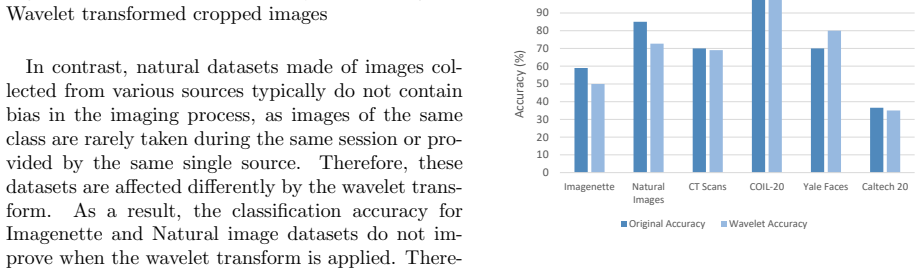
On the paper's own terms, the discovery is that image transforms act asymmetrically on contextual object information and on the artifacts of the imaging process. Using the VGG16 architecture on six datasets, the authors show that Fourier transform reduces accuracy everywhere and is therefore unusable as a diagnostic. In contrast, Haar and Daubechies wavelet transforms, a 5×5 median filter, and the median-plus-wavelet combination lower accuracy on the natural datasets (Imagenette, Natural Images) while leaving accuracy unchanged or improved on the synthetic and hybrid datasets (CT Scans, COIL-20, Yale Faces, Caltech 20). The authors interpret the same experiments on 20×20 blank-background crops, where wavelet transforms raise the accuracy of crops from biased datasets, as direct evidence that the transform is exposing hidden background signal. The concluding claim is that accuracy on the transformed full images can distinguish contextual information from imaging-process bias and alert to bias without separating background from the original images.
Load-bearing premise
The method assumes that the different reaction of natural versus synthetic datasets to the transforms is caused by the presence or absence of imaging-process bias, and not by other systematic differences between the groups, such as color versus grayscale images, single-source versus multi-source collection, or the regularity of object poses.
Editorial extensions
If this is right
- A researcher can screen a dataset for this class of bias without needing blank background crops: if accuracy after wavelet or median+wavelet transforms is comparable to or higher than original accuracy, the classifier is likely exploiting background signal.
- The method is aimed at controlled-environment datasets such as medical images, where every pixel may carry diagnostic information and no clearly irrelevant background region exists to crop.
- The test is a one-sided check: the paper states that a negative result does not guarantee the absence of bias, since other kinds of bias can still be present.
- The Fourier transform is explicitly ruled out as a diagnostic, because it degrades accuracy across natural, synthetic, and hybrid datasets alike and cannot separate contextual from bias signal.
Reading between the lines
- A decisive control the paper does not run would be to inject a tunable per-class artifact, such as a faint watermark or a fixed illumination gradient, into natural images and verify that the accuracy pattern moves with artifact strength; such an experiment would isolate imaging-process bias from dataset provenance.
- The six datasets differ in more than bias: the natural sets are color, multi-source photographs, while the biased positives are grayscale or single-setup captures, so the claimed diagnostic could in principle be tracking low-level statistical differences instead of bias. Converting the synthetic datasets to color or graying the natural datasets would test this.
- The proposed rule is a warning flag, not a debiasing procedure; if adopted, it would motivate a follow-up stage that removes or neutralizes the flagged background signal rather than merely reporting it.
Editorial analysis
A structured set of objections, weighed in public.
Referee Report
Summary. The paper proposes a method to detect dataset bias in CNNs without cropping blank background regions, by applying image transforms (Fourier transform, Haar/Daubechies wavelet transforms, median filtering, and their combinations) to full images. Experiments are performed with VGG16 on six datasets, categorized as natural (Imagenette, Natural Images), synthetic (CT Scans, COIL-20, Yale Faces), and hybrid (Caltech 20). The main observation is that wavelet and median-based transforms decrease classification accuracy on natural datasets but keep it stable or increase it on synthetic and hybrid datasets; Fourier transform decreases accuracy everywhere. From this, the paper concludes in Section 5 that stable or higher post-transform accuracy indicates that classification is driven by imaging-process background bias, and positions the method as a practical bias-alert tool when blank backgrounds are unavailable. The code is publicly available.
Significance. If the proposed rule were validated, it would offer a simple and inexpensive proxy for detecting hidden imaging-process bias in datasets where blank-background controls are impossible, which is a real need for medical imaging and other controlled-capture domains. The paper has concrete strengths: it uses established benchmark datasets, the transforms are clearly described, the decision rule is explicitly stated, and the code is released. However, the current evidence is preliminary: there are no error bars or repeated-seed experiments, the six datasets differ systematically in color, grayscale, object variability, and background structure, and the biased/unbiased labels are taken from prior blank-background studies that also motivated the rule. Because the central claim is an empirical decision rule, the missing statistical support and the absence of controls against confounds are load-bearing, not presentation issues.
major comments (4)
- [§5, Table 1] The decision rule in Section 5 rests on accuracy differences, but Table 1 reports only point estimates from a single run with no confidence intervals, error bars, or statistical tests. Several decisive comparisons are very close: CT Scans median+wavelet is 70.5% versus 70.0% original, and Caltech 20 median+wavelet is 36.0% versus 36.6% original, which is a decrease, contrary to the stated pattern. With a single 70/15/15 split and one training run, these differences are within plausible noise. The paper should report results over multiple random seeds and data splits, with mean, standard deviation, and paired significance tests (e.g., McNemar's test or a paired bootstrap) for each transform versus the original images.
- [§3.2, §5] The method is validated in a circular manner: the synthetic datasets are selected because they were already known from prior blank-background studies to contain bias, and the rule 'similar or higher accuracy after transforms implies bias' is then derived from the observed responses on these same datasets. No independent, out-of-sample validation is performed. The paper should either prospectively predict bias status for datasets not used to develop the rule, or at least apply the method to additional datasets whose bias status is not already documented, and report sensitivity and specificity under a pre-registered threshold.
- [§3.1–§3.3, §4] The observed differential response is confounded with dataset type: natural datasets are color images with heterogeneous backgrounds and high object variability, while the synthetic datasets are grayscale, single-source, and have controlled or uniform backgrounds. The conclusion that the response is caused by the presence or absence of imaging-process bias requires control experiments that separate this factor from low-level image statistics. Suggested controls include: applying the same transforms to grayscale versions of Imagenette and Natural Images, adding natural-like background variability to synthetic datasets, or artificially implanting a known acquisition artifact into a natural dataset and checking that the method flags it.
- [§3.4, §4] All experiments use a single architecture (VGG16) with one training protocol (40 epochs, Adam). The paper repeatedly speaks of 'CNNs' in general, but no evidence is given that the pattern holds across architectures, depths, or training settings. At minimum, the key comparisons in Table 1 should be repeated with one or two additional standard architectures (e.g., ResNet or a smaller CNN) and with changes in training budget, since the proposed method is meant to be a general diagnostic for CNN bias.
minor comments (6)
- [Figure 7] The caption says 'VGG15 architecture' but the text describes VGG16; the caption should be corrected.
- [§4.4] The sentence 'The table provides a higher resolution view of the results' appears twice in succession; remove the duplicate.
- [§4.3 and Figures 14, 16] The y-axis labels in Figures 14 and 16 say 'Wavelet Accuracy' where the bar labels are median-filtered and median+wavelet, respectively; the labels should match the transform being reported.
- [§3.1] The 'Natural Images' dataset from Roy et al. (2018) is used with the 'fruit' class discarded; a brief description of the class counts and image sizes would help reproducibility.
- [§4] There are several typos and grammatical errors throughout, including 'This transformations affect', 'the images are cannot be registered', and 'Wavelet transformation were generated'; a careful language edit is needed.
- [Table 1] Table 1 does not report the random-chance accuracy for each dataset, which is important for interpreting values like Caltech 20's 36.6% accuracy; adding a chance-level row would improve readability.
Circularity Check
Bias-detection rule is fitted to the same six datasets used for validation, so the claimed alert is post hoc rather than a prediction.
-
fitted input called prediction
[Section 3.2 (dataset selection) and Section 5 (decision rule); conclusion summarized in the Abstract]
""Therefore, these datasets can be used as datasets that are known as datasets that contain information leading to bias, and any method for bias identification needs to be sensitive to the bias in these datasets." [...] "If the classification accuracy with the transformed images is similar or higher than the classification accuracy when using the original images, it is an indication that the classification might be driven by bias.""
The six datasets were selected because prior work (largely by the same authors) had already labeled them as biased (COIL-20, Yale Faces, CT Scans) or unbiased (Imagenette, Natural Images). The transforms were then screened: Fourier was rejected because it did not separate these labels, while wavelet/median were retained because their accuracy behavior did separate them. The Section 5 rule ('similar or higher accuracy implies bias') is the same separation stated as a test. Applying it to the datasets used to choose the transforms and threshold reproduces the input labels by construction; it is a post hoc description, not an independent prediction. No held-out dataset with unknown bias is tested, so the claimed alert is not supported as a generalizable prediction.
full rationale
The paper is an empirical proposal rather than a derivation; there are no equations that would make a result equal to its input by algebra. The main circularity concern is evaluative: the decision rule and the choice of transforms are selected post hoc from six datasets whose bias labels come from the same authors' earlier blank-background experiments. This makes the 'alert' on those datasets trivially consistent with the labels, and no independent dataset is used to show that the rule generalizes. However, the prior blank-background results are separate external experiments, not a construct of this paper, and the observed accuracy differences are genuine measurements; therefore the circularity is partial (the claimed validation reduces to the training set) rather than a definitional equivalence. The paper also includes a caveat that a negative test does not prove absence of bias, which qualifies but does not repair the missing out-of-sample test.
Assumptions & free parameters
free parameters (1)
- median filter window size =
5x5
assumptions (4)
- ad hoc to paper The difference in accuracy between original and transformed images is attributable to dataset bias, not other image properties.
- ad hoc to paper The transforms affect contextual visual information differently than imaging-process artifacts.
- domain assumption Synthetic and controlled datasets used here are biased while natural datasets are not.
- domain assumption VGG16 is representative of CNNs in general.
Cite this review
Pith. "Pith review of Identifying Bias in Deep Neural Networks Using Image Transforms." pith.science (2026). https://pith.science/paper/SNY6ROZS
@misc{pith2026241213079,
  author       = {Pith},
  title        = {Pith review of: Identifying Bias in Deep Neural Networks Using Image Transforms},
  year         = {2026},
  howpublished = {\url{https://pith.science/paper/SNY6ROZS}},
  note         = {Machine review of arXiv:2412.13079}
}
read the original abstract
CNNs have become one of the most commonly used computational tool in the past two decades. One of the primary downsides of CNNs is that they work as a ``black box", where the user cannot necessarily know how the image data are analyzed, and therefore needs to rely on empirical evaluation to test the efficacy of a trained CNN. This can lead to hidden biases that affect the performance evaluation of neural networks, but are difficult to identify. Here we discuss examples of such hidden biases in common and widely used benchmark datasets, and propose techniques for identifying dataset biases that can affect the standard performance evaluation metrics. One effective approach to identify dataset bias is to perform image classification by using merely blank background parts of the original images. However, in some situations a blank background in the images is not available, making it more difficult to separate foreground or contextual information from the bias. To overcome this, we propose a method to identify dataset bias without the need to crop background information from the images. That method is based on applying several image transforms to the original images, including Fourier transform, wavelet transforms, median filter, and their combinations. These transforms were applied to recover background bias information that CNNs use to classify images. This transformations affect the contextual visual information in a different manner than it affects the systemic background bias. Therefore, the method can distinguish between contextual information and the bias, and alert on the presence of background bias even without the need to separate sub-images parts from the blank background of the original images. Code used in the experiments is publicly available.
Figures


Figures from the paper (13 more)




Reference graph
Works this paper leans on
-
[1]
Agarwal, S., Singh, O., and Nagaria, D. (2017). Analysis and comparison of wavelet transforms for denoising mri image. Biomed Pharmacol J , 10(2). Article
work page 2017
-
[2]
Alqaraawi, A., Schuessler, M., Wei , P., Costanza, E., and Berthouze, N. (2020). Evaluating saliency map explanations for convolutional neural networks: a user study. In Proceedings of the 25th International Conference on Intelligent User Interfaces , pages 275--285
work page 2020
-
[3]
Arun, N., Gaw, N., Singh, P., Chang, K., Aggarwal, M., Chen, B., Hoebel, K., Gupta, S., Patel, J., Gidwani, M., et al. (2021). Assessing the trustworthiness of saliency maps for localizing abnormalities in medical imaging. Radiology: Artificial Intelligence , 3(6):e200267
work page 2021
-
[4]
Babul, K. A. R., Sathish, R., and Pattanaik, M. (2024). Synthetic simplicity: Unveiling bias in medical data augmentation. In Proceedings of Data Engineering in Medical Imaging: Second MICCAI Workshop, DEMI 2024 , page 64. Springer Nature
work page 2024
-
[5]
Ball, P. (2023). Is ai leading to a reproducibility crisis in science? Nature , 624:22--25
work page 2023
-
[6]
Belitskaya, O. (2018). Yale face database - kaggle
work page 2018
-
[7]
Buhrmester, V., Münch, D., and Arens, M. (2021). Analysis of explainers of black box deep neural networks for computer vision: A survey. Machine Learning and Knowledge Extraction , 3(4):966--989
work page 2021
-
[8]
Cochran, W. T., Cooley, J. W., Favin, D. L., Helms, H. D., Kaenel, R. A., Lang, W. W., Maling, G. C., Nelson, D. E., Rader, C. M., and Welch, P. D. (1967). What is the fast fourier transform? Proceedings of the IEEE , 55(10):1664--1674
work page 1967
Show all 47 references
-
[9]
Deng, J., Dong, W., Socher, R., Li, L.-J., Li, K., and Fei-Fei, L. (2009). Imagenet: A large-scale hierarchical image database. In 2009 IEEE Conference on Computer Vision and Pattern Recognition , pages 248--255
2009
-
[10]
and Parker, M
Dhanani, S. and Parker, M. (2013). Introduction to digital filtering. In Dhanani, S. and Parker, M., editors, Digital Video Processing for Engineers , pages 19--28. Newnes, Oxford
2013
-
[11]
and Shamir, L
Dhar, S. and Shamir, L. (2021). Evaluation of the benchmark datasets for testing the efficacy of deep convolutional neural networks. Visual Informatics , 5
2021
-
[12]
and Shamir, L
Dhar, S. and Shamir, L. (2022). Systematic biases when using deep neural networks for annotating large catalogs of astronomical images. Astronomy and Computing , 38:100545
2022
-
[13]
Fisher, R., Perkins, S., Walker, A., and Wolfart, E. (1996). Hypermedia image processing reference. England: John Wiley & Sons Ltd , pages 209--213
1996
-
[14]
D., Jordache, A., Vasdani, M., and Deng, J
Gavrilov, A. D., Jordache, A., Vasdani, M., and Deng, J. (2018). Preventing model overfitting and underfitting in convolutional neural networks. International Journal of Software Science and Computational Intelligence , 10(4):19--28
2018
-
[15]
S., Belhumeur, P
Georghiades, A. S., Belhumeur, P. N., and Kriegman, D. J. (2001). From few to many: Illumination cone models for face recognition under variable lighting and pose. IEEE transactions on pattern analysis and machine intelligence , 23(6):643--660
2001
-
[16]
Griffin, G., Holub, A., Perona, P., et al. (2007). Caltech-256 object category dataset. Technical report, Technical Report 7694, California Institute of Technology Pasadena
2007
-
[17]
Hashimoto, N., Fukushima, D., Koga, R., Takagi, Y., Ko, K., Kohno, K., Nakaguro, M., Nakamura, S., Hontani, H., and Takeuchi, I. (2020). Multi-scale domain-adversarial multiple-instance cnn for cancer subtype classification with unannotated histopathological images. In Proceed...
2020
-
[18]
and Ntoutsi, E
Iosifidis, V. and Ntoutsi, E. (2018). Dealing with bias via data augmentation in supervised learning scenarios. Jo Bates Paul D. Clough Robert J \"a schke , 24(11)
2018
-
[19]
Jaipuria, N., Zhang, X., Bhasin, R., Arafa, M., Chakravarty, P., Shrivastava, S., Manglani, S., and Murali, V. N. (2020). Deflating dataset bias using synthetic data augmentation. In Proceedings of the IEEE Conference on Computer Vision and Pattern Recognition Workshops , page...
2020
-
[20]
Kim, B., Seo, J., Jeon, S., Koo, J., Choe, J., and Jeon, T. (2019). Why are saliency maps noisy? cause of and solution to noisy saliency maps. In 2019 IEEE/CVF International Conference on Computer Vision Workshop , pages 4149--4157. IEEE
2019
-
[21]
Lin, Y., Zhao, H., Ma, X., Tu, Y., and Wang, M. (2020). Adversarial attacks in modulation recognition with convolutional neural networks. IEEE Transactions on Reliability , 70(1):389--401
2020
-
[22]
Majeed, T., Rashid, R., Ali, D., and Asaad, A. (2020). Issues associated with deploying cnn transfer learning to detect covid-19 from chest x-rays. Physical and Engineering Sciences in Medicine , 43:1289–--1303
2020
-
[23]
M., and Miller, P
McLaughlin, N., Del Rincon, J. M., and Miller, P. (2015). Data-augmentation for reducing dataset bias in person re-identification. In 12th IEEE International conference on advanced video and signal based surveillance , pages 1--6. IEEE
2015
-
[24]
and Shamir, L
Model, I. and Shamir, L. (2015). Comparison of data set bias in object recognition benchmarks. IEEE Access , 3:1953--1962
2015
-
[25]
A., Nayar, S
Nene, S. A., Nayar, S. K., Murase, H., et al. (1996). Columbia object image library (coil-20). Citeseer
1996
-
[26]
Opencv image filtering documentation
OpenCV (2024). Opencv image filtering documentation
2024
-
[27]
and Zeebaree, D
Othman, G. and Zeebaree, D. Q. (2020). The applications of discrete wavelet transform in image processing: A review. Journal of Soft Computing and Data Mining , 1(2):31--43
2020
-
[28]
Pastaltzidis, I., Dimitriou, N., Quezada-Tavarez, K., Aidinlis, S., Marquenie, T., Gurzawska, A., and Tzovaras, D. (2022). Data augmentation for fairness-aware machine learning: Preventing algorithmic bias in law enforcement systems. In Proceedings of the 2022 ACM Conference o...
2022
-
[29]
and Maragos, P
Pertigkiozoglou, S. and Maragos, P. (2018). Detecting adversarial examples in convolutional neural networks. arXiv:1812.03303
2018 arXiv
-
[30]
T., Wei, M
Pfau, J., Young, A. T., Wei, M. L., and Keiser, M. J. (2019). Global saliency: aggregating saliency maps to assess dataset artefact bias. arXiv:1910.07604
2019 arXiv
-
[31]
Pywavelets documentation
PyWavelet Developers (2024). Pywavelets documentation
2024
-
[32]
A., Sathish, R., Pattanaik, M., and Venkataramani, R
Raja Babu, K. A., Sathish, R., Pattanaik, M., and Venkataramani, R. (2024). Synthetic simplicity: Unveiling bias in medical data augmentation. In MICCAI Workshop on Data Engineering in Medical Imaging , pages 64--72. Springer
2024
-
[33]
L., Byttner, W., Krumnack, U., Wiedenroth, A., Schallner, L., and Shenk, J
Richter, M. L., Byttner, W., Krumnack, U., Wiedenroth, A., Schallner, L., and Shenk, J. (2021). (input) size matters for cnn classifiers. In Proceedings of 30th International Conference on Artificial Neural Networks ICANN 2021: , Bratislava, Slovakia, September 14--17, 2021, ,...
2021
-
[34]
Roy, P., Ghosh, S., Bhattacharya, S., and Pal, U. (2018). Effects of degradations on deep neural network architectures. arXiv preprint arXiv:1807.10108
2018 arXiv
-
[35]
Santos, C. F. G. D. and Papa, J. P. (2022). Avoiding overfitting: A survey on regularization methods for convolutional neural networks. ACM Computing Surveys , 54(10s):1--25
2022
-
[36]
Shamir, L. (2008). Evaluation of face datasets as tools for assessing the performance of face recognition methods. International Journal of Computer Vision , 79:225--230
2008
-
[37]
M., Bouneffouf, D., Muthusamy, V., and Varshney, K
Sharma, S., Zhang, Y., R \' os Aliaga, J. M., Bouneffouf, D., Muthusamy, V., and Varshney, K. R. (2020). Data augmentation for discrimination prevention and bias disambiguation. In Proceedings of the AAAI/ACM Conference on AI, Ethics, and Society , pages 358--364
2020
-
[38]
and Benitez, R
Sikha, O. and Benitez, R. (2024). Deep feature discriminability as a diagnostic measure of overfitting in cnn models. In Science and Information Conference , pages 218--233. Springer
2024
-
[39]
Simonyan, K. (2013). Deep inside convolutional networks: Visualising image classification models and saliency maps. arXiv:1312.6034
2013 arXiv
-
[40]
and Zisserman, A
Simonyan, K. and Zisserman, A. (2014). Very deep convolutional networks for large-scale image recognition. ArXiv: 1409.1556
2014 arXiv
-
[41]
Thanapol, P., Lavangnananda, K., Bouvry, P., Pinel, F., and Lepr \'e vost, F. (2020). Reducing overfitting and improving generalization in training convolutional neural network (cnn) under limited sample sizes in image recognition. In International Conference on Information Te...
2020
-
[42]
Tommasi, T., Patricia, N., Caputo, B., and Tuytelaars, T. (2015). A deeper look at dataset bias. CoRR , abs/1505.01257
2015 arXiv
-
[43]
and Efros, A
Torralba, A. and Efros, A. A. (2011). Unbiased look at dataset bias. In Proceedings of IEEE Conference on Computer Vision and Pattern Recognition , pages 1521--1528. IEEE
2011
-
[44]
K., and Zhu, A
Uchida, S., Ide, S., Iwana, B. K., and Zhu, A. (2016). A further step to perfect accuracy by training cnn with larger data. In 2016 15th International Conference on Frontiers in Handwriting Recognition (ICFHR) , pages 405--410. IEEE
2016
-
[45]
black box
Wang, B., Ma, R., Kuang, J., and Zhang, Y. (2020). How decisions are made in brains: Unpack “black box” of cnn with ms. pac-man video game. IEEE Access , 8:142446--142458
2020
-
[46]
Wang, J., Zhao, J., Yin, Q., Luo, X., Zheng, Y., Shi, Y.-Q., and Jha, S. K. (2021). Smsnet: A new deep convolutional neural network model for adversarial example detection. IEEE Transactions on Multimedia , 24:230--244
2021
-
[47]
Winastwan, R. (2024). Class activation mapping (cam): Better interpretability in deep learning models
2024
Reviewed August 11, 2026 · model on record in the stance chip above.
Discussion (0). Continue with ORCID to comment.