A Guide to the Bott Index and Localizer Index
Pith reviewed 2026-05-24 14:53 UTC · model grok-4.3
The pith
The localizer index can be tuned to behave like the global Bott index on a Chern insulator model.
A machine-rendered reading of the paper's core claim, the machinery that carries it, and where it could break.
Core claim
The Bott index is inherently global while the localizer index, formerly the pseudospectral index, is local. On a standard Chern insulator model the localizer index can be tuned so that it behaves like a global index, and the paper emphasizes practical programming steps for both quantities.
What carries the argument
The localizer index tuned via adjustable parameters to match global topological invariants on the Chern insulator lattice.
If this is right
- Programming routines for the indices become practical on finite lattices with standard Chern models.
- Local data suffice for global index values once the tuning parameters are chosen.
- The localizer index serves as a drop-in replacement for the Bott index after tuning.
Where Pith is reading between the lines
- The tuning approach may allow index calculations on systems with disorder where global phases are hard to define.
- Similar local-to-global matching could apply to other topological invariants beyond the Chern case.
Load-bearing premise
The standard Chern insulator model and the described tuning procedure generalize beyond the specific examples shown.
What would settle it
Compute the tuned localizer index and the Bott index on a lattice model without Chern number or on a different insulator Hamiltonian and check whether the values continue to agree after tuning.
Figures


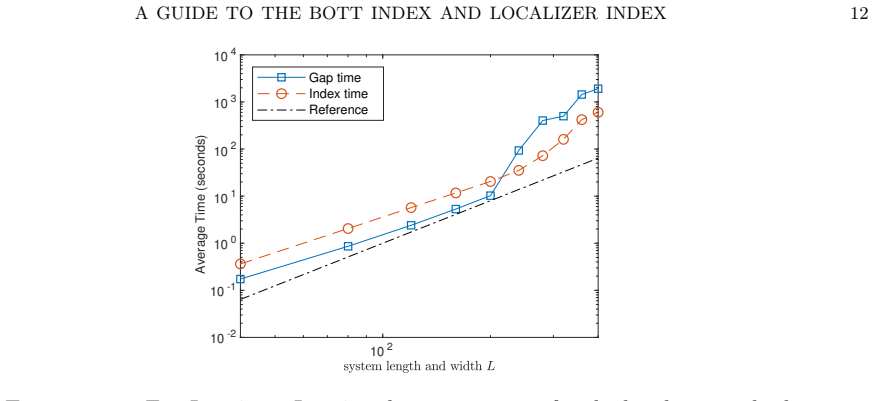


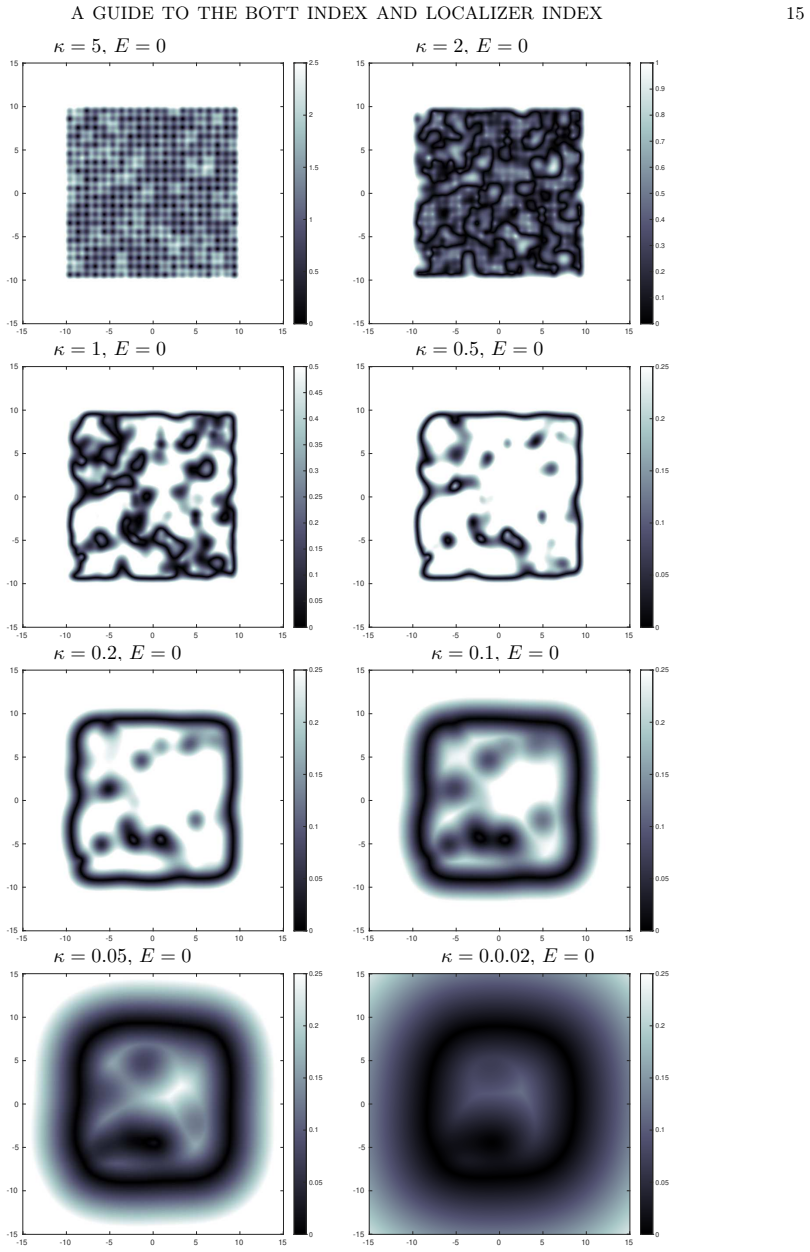
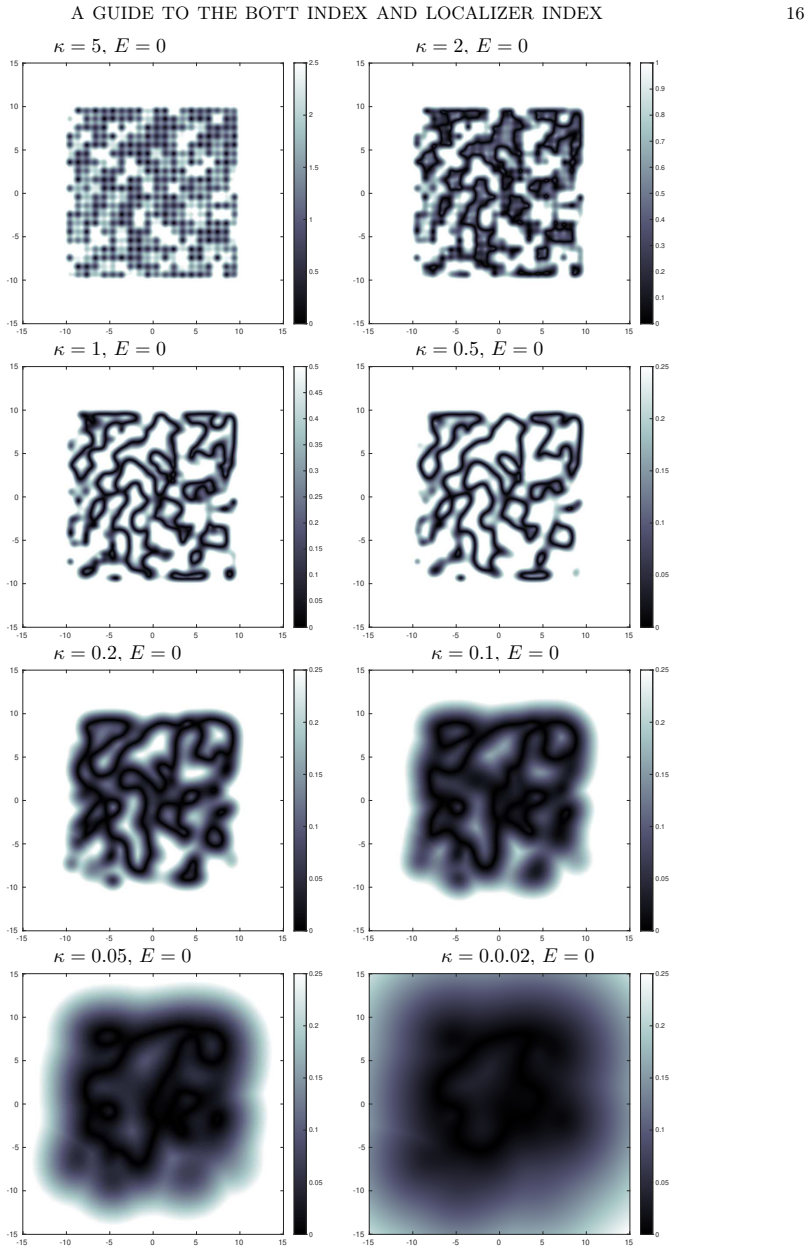


read the original abstract
The Bott index is inherently global. The pseudospectal index is inherently local, and so now the preferred name is the localizer index. We look at these on a rather standard model for a Chern insulator, with an emphasis how to program these effectively. We also discuss how to tune the localizer index so it behaves like a global index.
Editorial analysis
A structured set of objections, weighed in public.
Referee Report
Summary. The manuscript is an expository guide to the Bott index (global topological invariant) and the localizer index (local version, formerly called the pseudospectral index). It demonstrates both on a standard Chern insulator model, with emphasis on practical programming implementation details, and discusses tuning the localizer index so that it behaves like a global index.
Significance. The paper supplies concrete implementation guidance and an explicit construction on the Chern insulator model showing that the localizer index can be tuned to align with the Bott index. This practical focus, together with the absence of any asserted general theorem beyond the demonstrated examples, provides useful reference material for numerical work in topological insulators.
minor comments (2)
- [Abstract] Abstract: the phrase 'with an emphasis how to program' is missing the preposition 'on' and should read 'with an emphasis on how to program'.
- The manuscript would benefit from a short table or pseudocode listing the key tuning parameters and their effect on the localizer index for the Chern model, to make the tuning discussion more immediately usable.
Simulated Author's Rebuttal
We thank the referee for the positive assessment of our manuscript as a practical guide to the Bott and localizer indices on Chern insulator models. The recommendation for minor revision is noted. No specific major comments were raised in the report.
Circularity Check
Expository guide; no derivation chain or fitted predictions present
full rationale
The paper presents an expository guide to the Bott index and localizer index on a standard Chern insulator model, focusing on programming and tuning guidance. No new first-principles derivations, predictions, or uniqueness theorems are asserted that could reduce to self-definition, fitted inputs, or self-citation chains. The central discussion of tuning is explicit construction on the given model rather than a general claim requiring external justification. No load-bearing steps match any enumerated circularity pattern.
Axiom & Free-Parameter Ledger
Lean theorems connected to this paper
-
IndisputableMonolith/Cost/FunctionalEquation.leanwashburn_uniqueness_aczel unclear?
unclearRelation between the paper passage and the cited Recognition theorem.
The Bott index is inherently global. The pseudospectral index is inherently local... We also discuss how to tune the localizer index so it behaves like a global index.
-
IndisputableMonolith/Foundation/AlexanderDuality.leanalexander_duality_circle_linking unclear?
unclearRelation between the paper passage and the cited Recognition theorem.
The Clifford spectrum... localizer Lλ(M1,...,Md) ...
What do these tags mean?
- matches
- The paper's claim is directly supported by a theorem in the formal canon.
- supports
- The theorem supports part of the paper's argument, but the paper may add assumptions or extra steps.
- extends
- The paper goes beyond the formal theorem; the theorem is a base layer rather than the whole result.
- uses
- The paper appears to rely on the theorem as machinery.
- contradicts
- The paper's claim conflicts with a theorem or certificate in the canon.
- unclear
- Pith found a possible connection, but the passage is too broad, indirect, or ambiguous to say the theorem truly supports the claim.
Forward citations
Cited by 2 Pith papers
-
The Bott Metric: A Real-Space Bridge Between Topology and Quantum Metric
The Bott metric, derived from the plaquette operator, unifies topology and quantum geometry by converging to the trace of the integrated quantum metric in the thermodynamic limit for disordered and amorphous systems.
-
Adiabatic charge transport through non-Bloch bands
Non-Bloch bands in a non-Hermitian extended SSH model support adiabatic charge transport that preserves quantized flow when the bands remain gapped during time evolution.
Reference graph
Works this paper leans on
-
[1]
mathworks.com/help/matlab/ref/ldl.html
Matlab function ldl documentation. mathworks.com/help/matlab/ref/ldl.html. Accessed: 2019-07-24
work page 2019
-
[2]
mumps.enseeiht.fr/doc/userguide_5.2.1.pdf
MUltifrontal Massively Parallel Solver Users guide. mumps.enseeiht.fr/doc/userguide_5.2.1.pdf. Ac- cessed: 2019-07-24
work page 2019
-
[3]
math.unm.edu/%7Eloring/BottLocalizerGuide/
Supplementary files. math.unm.edu/%7Eloring/BottLocalizerGuide/
-
[4]
Miguel A Bandres, Mikael C Rechtsman, and Mordechai Segev. Topological photonic quasicrystals: Fractal topological spectrum and protected transport.Physical Review X, 6(1):011016, 2016
work page 2016
-
[5]
J. Bellissard, A. van Elst, and H. Schulz-Baldes. The noncommutative geometry of the quantum Hall effect. J. Math. Phys. , 35(10):5373–5451, 1994. Topology and physics
work page 1994
-
[6]
Michele Benzi, Paola Boito, and Nader Razouk. Decay properties of spectral projectors with applications to electronic structure.SIAM review, 55(1):3–64, 2013
work page 2013
-
[7]
Matrix embeddings on flatR3 and the geometry of membranes
David Berenstein and Eric Dzienkowski. Matrix embeddings on flatR3 and the geometry of membranes. Physical Review D, 86(8):086001, 2012
work page 2012
-
[8]
Mapping topological order in coordinate space.Physical Review B, 84(24):241106, 2011
Raffaello Bianco and Raffaele Resta. Mapping topological order in coordinate space.Physical Review B, 84(24):241106, 2011
work page 2011
-
[9]
Bruce Blackadar. Shape theory forC ∗-algebras. Math. Scand., 56(2):249–275, 1985
work page 1985
-
[10]
Déformations, morphismes asymptotiques etK-théorie bivariante
Alain Connes and Nigel Higson. Déformations, morphismes asymptotiques etK-théorie bivariante. C. R. Acad. Sci. Paris Sér. I Math. , 311(2):101–106, 1990
work page 1990
-
[11]
Dynamical preparation of Floquet Chern insulators.Nature commu- nications, 6:8336, 2015
Luca D’Alessio and Marcos Rigol. Dynamical preparation of Floquet Chern insulators.Nature commu- nications, 6:8336, 2015
work page 2015
-
[12]
Søren Eilers and Terry A. Loring. Computing contingencies for stable relations.Internat. J. Math. , 10(3):301–326, 1999
work page 1999
-
[13]
Søren Eilers, Terry A. Loring, and Gert K. Pedersen. Morphisms of extensions ofC ∗-algebras: pushing forward the Busby invariant.Adv. Math., 147(1):74–109, 1999
work page 1999
-
[14]
Ruy Exel and Terry A. Loring. Invariants of almost commuting unitaries.J. Funct. Anal., 95(2):364–376, 1991
work page 1991
-
[15]
Aperiodic weak topological superconductors.Phys- ical review letters, 116(25):257002, 2016
Ion C Fulga, Dmitry I Pikulin, and Terry A Loring. Aperiodic weak topological superconductors.Phys- ical review letters, 116(25):257002, 2016
work page 2016
-
[16]
Matthew B. Hastings and Terry A. Loring. Topological insulators andC ∗-algebras: Theory and numer- ical practice. Ann. Physics, 326(7):1699–1759, 2011. A GUIDE TO THE BOTT INDEX AND LOCALIZER INDEX 25
work page 2011
-
[17]
Hua Jiang, Lei Wang, Qing-feng Sun, and XC Xie. Numerical study of the topological anderson insulator in HgTe/CdTe quantum wells.Physical Review B, 80(16):165316, 2009
work page 2009
-
[18]
Möbius transformations and monogenic functional calculus.Electron
Vladimir Kisil. Möbius transformations and monogenic functional calculus.Electron. Res. Announc. Math. Sci, 2(1):26–33, 1996
work page 1996
-
[19]
Anyons in an exactly solved model and beyond.Annals of Physics , 321(1):2–111, 2006
Alexei Kitaev. Anyons in an exactly solved model and beyond.Annals of Physics , 321(1):2–111, 2006
work page 2006
-
[20]
Approximating spectral densities of large matrices.SIAM review, 58(1):34–65, 2016
Lin Lin, Yousef Saad, and Chao Yang. Approximating spectral densities of large matrices.SIAM review, 58(1):34–65, 2016
work page 2016
-
[21]
The spectral localizer for even index pairings
Terry Loring and Hermann Schulz-Baldes. The spectral localizer for even index pairings.J. Noncommut. Geom., to appear. arXiv preprint arXiv:1802.04517
work page internal anchor Pith review Pith/arXiv arXiv
-
[22]
Loring.K-theory and asymptotically commuting matrices.Canad
Terry A. Loring.K-theory and asymptotically commuting matrices.Canad. J. Math. , 40(1):197–216, 1988
work page 1988
-
[23]
Terry A. Loring.C ∗-algebra relations. Math. Scand., 107(1):43–72, 2010
work page 2010
-
[24]
Loring.K-theory and pseudospectra for topological insulators
Terry A. Loring.K-theory and pseudospectra for topological insulators. Ann. Physics, 356:383–416, 2015
work page 2015
-
[25]
Terry A Loring. Bulk spectrum and k-theory for infinite-area topological quascrystal.arXiv preprint arXiv:1811.07494, 2018
-
[26]
Terry A. Loring and Matthew B. Hastings. Disordered topological insulators viaC ∗-algebras. Europhys. Lett. EPL, 92:67004, 2010
work page 2010
-
[27]
Loring and Hermann Schulz-Baldes
Terry A. Loring and Hermann Schulz-Baldes. Finite volume calculation ofK-theory invariants. New York J. Math., 23:1111–1140, 2017
work page 2017
-
[28]
Spectral flow argument localizing an odd index pairing
Terry A Loring and Hermann Schulz-Baldes. Spectral flow argument localizing an odd index pairing. Canadian Mathematical Bulletin , 62(2):373–381, 2019
work page 2019
-
[29]
Amorphous topological insulators constructed from random point sets.Nature Physics, 14(4):380, 2018
Noah P Mitchell, Lisa M Nash, Daniel Hexner, Ari M Turner, and William TM Irvine. Amorphous topological insulators constructed from random point sets.Nature Physics, 14(4):380, 2018
work page 2018
-
[30]
Disordered topological insulators: a non-commutative geometry perspective.J
Emil Prodan. Disordered topological insulators: a non-commutative geometry perspective.J. Phys. A , 44(11):113001, 50, 2011
work page 2011
-
[31]
The fuzzy space construction kit
Andreas Sykora. The fuzzy space construction kit.arXiv preprint arXiv:1610.01504 , 2016
work page internal anchor Pith review Pith/arXiv arXiv 2016
-
[32]
Daniele Toniolo. Time-dependent topological systems: A study of the bott index.Physical Review B , 98(23):235425, 2018
work page 2018
-
[33]
Chern numbers as half-signature of the spectral localizer.J
Jonas; Viesca, Edgar Lozano; Schober and Hermann Schulz-Baldes. Chern numbers as half-signature of the spectral localizer.J. Math. Phys. , to appear. Department of Mathematics and Statistics, University of New Mexico, Albuquerque, New Mexico 87131, USA E-mail address: loring@math.unm.edu
discussion (0)
Sign in with ORCID, Apple, or X to comment. Anyone can read and Pith papers without signing in.