REVIEW 4 major objections 5 minor 32 references
Imaging extended sources with the solar gravitational lens
T0 review · 4 major / 5 minor · reviewed 2026-08-14 · deepseek-v4-flash
Pith's one-line read The paper establishes the point-spread function of the solar gravitational lens for a source at finite distance, and shows that convolving it with source brightness yields the image-plane power needed for multipixel exoplanet imaging.
desk verdict Useful extension of SGL wave optics to finite distances and extended sources, but the central PSF rests on an approximation that needs sharper justification and numerical verification. read the letter →
The pith
A machine-rendered reading of the paper's core claim, the machinery that carries it, and where it could break.
The reading
What carries the argument
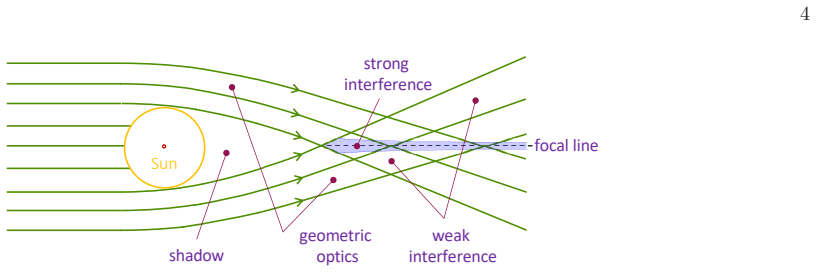
The load-bearing object is the finite-distance SGL point-spread function of Eq. (80). It is built from three ingredients: the known plane-wave solution of Maxwell's equations on the solar monopole background, encoded in the Debye potential (8), rotated by the angle $\beta = b/r_0$ around the optical axis; the WKB radial function (13), which supplies the phase $k(r+r_0+r_g\ln 4k^2rr_0)$ plus the centrifugal term $\ell(\ell+1)/(2k)(1/r+1/r_0)$; and the stationary-phase evaluation that turns the Debye partial-wave sum into $J_0/J_1$ Bessel patterns with argument $k\sqrt{2r_g\tilde{r}}\,(\theta+\beta)$. The effective distance $\tilde{r} = rr_0/(r+r_0)$ encapsulates the finite-distance focusing shift and appears throughout the image-formation integrals.
What would settle it
Solve the radial equation (A1) with an incoming spherical-wave boundary condition at $r_0$ instead of the WKB plane-wave ansatz, and compare the phase to Eq. (13) at next order: if a term of order $r_g b/r_0^2$ appears, the argument of the Bessel function in Eq. (80) must be corrected and the PSF null radii would shift measurably. A direct numerical evaluation of the Debye partial-wave sum (8) at finite $r_0$ for off-axis source points would already reveal whether the rotation-plus-amplitude-rescaling prescription misses phase terms.
Extended reading notes
Core claim
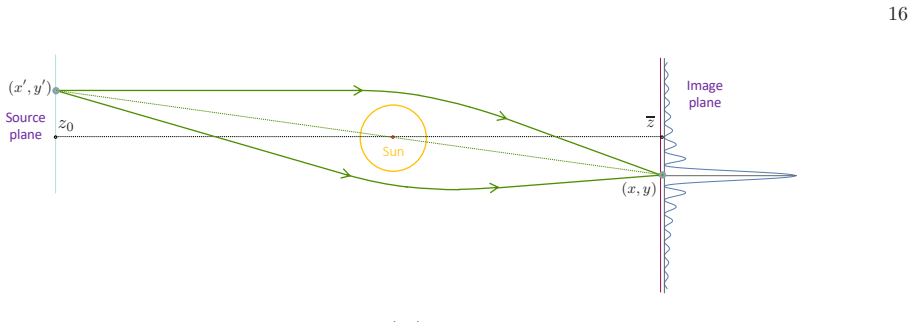
For a point source at heliocentric distance $z_0$ and an observer at distance $z$, the SGL's point-spread function is $\bar{\mu}_z(\mathbf{x},\mathbf{x}') = \mu_0 J_0^2\big((2\pi/\lambda)\sqrt{2r_g/z}\,|\mathbf{x} + (z/z_0)\mathbf{x}'|\big)$, where $r_g$ is the Sun's Schwarzschild radius and $\mu_0 = 4\pi^2(1-e^{-4\pi^2 r_g/\lambda})^{-1} r_g/\lambda$. This generalizes the earlier infinite-distance result, Eq. (9), by replacing the angle $\theta$ with $\theta+\beta$, where $\beta = b/r_0$, and by using the effective distance $\tilde{r} = rr_0/(r+r_0)$ in the focal geometry. Extended sources are treated as noncoherent collections of point sources, so the image-plane power density is obtained by convolving the surface brightness $B(\mathbf{x}',y')$ with this PSF, yielding Eqs. (81) and (83). The SGL therefore behaves like a convex lens that demagnifies the source by $z/z_0$, mapping $\mathbf{x}'$ to $\mathbf{x} = -(z/z_0)\mathbf{x}'$ while each source point retains the broad $J_0^2$ PSF.
Load-bearing premise
The derivation stands or falls on treating the unknown exact wave from a finite-distance source as a rotated plane wave with amplitude rescaled by $1/r_0$; any extra phase or higher-order term in $b/r_0$ in the true solution would alter the point-spread function.
Editorial extensions
If this is right
- A source at finite distance focuses slightly farther from the Sun: for impact parameter $b$, the focal distance becomes $(b^2/2r_g)(1 + b^2/(2r_g z_0))$, a shift that matters for SGL mission design.
- The SGL's image of an extended source is inverted and demagnified by $z/z_0$; an Earth-radius exoplanet at 30 pc projects to about 1.34 km at 650 AU.
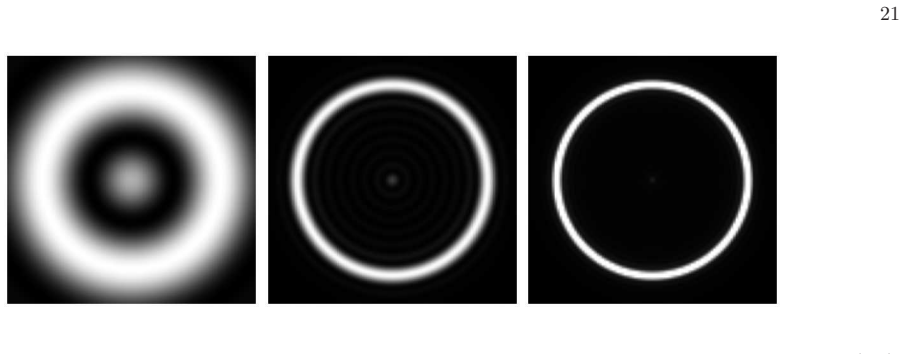
- Because each source point contributes a broad $J_0^2$ PSF, the image of a resolved body is a superposition of overlapping Einstein rings and arcs, with Eq. (83) giving the power detected by a finite telescope aperture.
- In the limit $z_0\to\infty$, Eq. (80) reduces to the earlier plane-wave PSF of Eq. (9), and in the limit $r_g\to 0$, the coherent imaging result reduces to the classical Airy pattern.
- A telescope in the focal region can resolve the Einstein ring: for a 25 cm to 2 m aperture at 650 AU, the ring occupies several 10 $\mu$m pixels and a focal length near 12.8 m for a 10-pixel ring.
Reading between the lines
- Editorial inference: The $J_0^2$ PSF of Eq. (80) suggests a practical check of the finite-distance approximation without a mission to the focal region: a distant bright pointlike source passing behind the Sun should show the predicted Bessel null rings to radio telescopes, and any shift in their radii would reveal the missing exact finite-distance phase terms.
- Editorial inference: The convolution structure of Eq. (81) should apply to gravitational microlensing of resolved stellar and quasar sources, where current treatments often use geometric-optics magnifications; testing the $J_0^2$ kernel against microlensing light curves may be easier than testing it at the SGL itself.
- Editorial inference: The paper stops at photometric and coherent image formation; a natural extension is to invert Eq. (83) as a deconvolution problem, recovering the surface brightness map $B(\mathbf{x}',y')$ from telescope measurements made at several image-plane positions.
Signed reviews
Editorial analysis
A structured set of objections, weighed in public.
Referee Report
Summary. The paper develops a wave-optical theory of the solar gravitational lens (SGL) for a point source located at a large but finite distance from the Sun, using the first post-Newtonian metric of the solar monopole. Building on the authors' earlier Mie-theory solution for a plane wave (Debye potential, Eq. (8)), the authors account for the finite source distance by rotating the coordinate system by the angle beta = b/r0 and rescaling the field amplitude by 1/r0, then evaluate the resulting partial-wave sums using WKB and stationary-phase methods. The central result is the point-spread function in Eq. (80), mu_bar_z(x,x') = mu_0 J_0^2[(2*pi/lambda)*sqrt(2*r_g/z)*|x + (z/z0)*x'|], together with the image-formation integrals (81) and (83). The paper also derives the EM field in the shadow, geometric-optics, weak-interference, and strong-interference regions, and analyzes telescope image formation, including the Einstein-ring signal.
Significance. If correct, the result is significant: it upgrades the SGL point-spread function from the infinite-source formula (9) to a form that explicitly depends on the source-plane coordinates, enabling realistic simulations of multipixel exoplanet imaging with a telescope in the SGL focal region. The paper is careful to state the orders of neglected terms and correctly reduces to the previously known result (9) in the limit z0 to infinity. The derivation, however, rests on an assumption that is explicitly acknowledged in the text as unproven, and the closed-form PSF is not numerically validated against the exact partial-wave series. The significance is therefore conditional on the validity of that assumption and of the subsequent asymptotic evaluations.
major comments (4)
- [Sec. III.A, Eqs. (10)-(13)] The pivotal step of the paper is the replacement of the unknown finite-distance solution by the plane-wave solution rotated by beta = b/r0 with amplitude rescaled by E_s0/r0. The manuscript states in Sec. III.A that 'No such solution is currently known' and gives no independent derivation or numerical check for this step. Since Eqs. (16)-(83), including the main PSF (80), are all derived from this rotated Debye potential, the central claim is unsupported unless the rotation-plus-paraxial prescription is justified from the boundary-value problem or validated numerically.
- [Appendix A, Eqs. (A12)-(A18), and Eq. (13)] The transition from the WKB radial solution to the claimed asymptotic form of the Coulomb-Hankel functions is internally inconsistent. In Eq. (A12), the WKB action contains the term -2b = -2*ell/k, which contributes a linear-in-ell phase -2*ell to the exponent; this term is absent from Eqs. (A16), (A18), (13), and (16) with no explanation, and the sentence about omitting terms proportional to r_g/r does not cover it. If retained, the stationary-phase condition (27) gains a constant -2, shifting the thin-lens relation (29) and the argument of the Bessel function in the PSF (80). Furthermore, Eq. (13) labels the expression as the asymptotic behavior of H^{+/-}_ell(kr_g, kr), but the standard Coulomb-Hankel asymptotic contains no r0-dependent phase; the r0 terms originate from the WKB solution for the radial function R_ell, so the identification in Eq. (13) needs to be repaired.
- [Sec. III.B, Eqs. (11)-(12)] Replacing the polar angle theta by theta+beta in the associated Legendre polynomials P_ell^{(1)}(cos theta) is not a rotation of the partial-wave expansion. A genuine rotation of the coordinate system mixes m=1 partial waves with m=0 and m=-1 components through Wigner D-matrices. The paper's assertion that the azimuthal rotation (12) does not need to be computed because of axial symmetry in the strong-interference region is not demonstrated. Since the Bessel argument in the PSF (80) arises from the stationary-phase evaluation of these partial waves, the validity of the rotation step is load-bearing.
- [Sec. V, Eqs. (61)-(80)] The closed-form PSF (80) is obtained by replacing the partial-wave sums in Eqs. (61)-(72) with stationary-phase integrals, but no numerical comparison with the exact Debye potential (8), or with the original sums, is presented. Given that the derivation relies on three successive approximations (WKB, stationary phase, and the beta-rotation), a numerical validation of the final PSF for representative parameters, including the plane-wave limit beta=0, is needed to support the central claim.
minor comments (5)
- [Eq. (13)] The notation 'lim_{kr to infinity} H^{+/-}_ell(kr_g, kr) ~' is misleading because the right-hand side is the WKB radial function rather than the standard Coulomb-Hankel asymptotics; the relationship between these objects should be clarified in the text.
- [Title and affiliations] The first page contains obvious OCR or spelling errors (e.g., 'Techno logy' and 'gravitat ional') that should be corrected in the final version.
- [Sec. VI, Eqs. (79)-(80)] The notation switches between r and z without a clear statement; for instance, r is replaced by z = z(1+z/z0) in the course of deriving Eq. (80), which is a slight abuse of notation. All symbols should be defined explicitly at first use.
- [Fig. 4 caption] The caption of Fig. 4 appears to contain duplicated text ('is unique and preserve axial symmetry' is repeated); the figure caption should be cleaned up.
- [Sec. VI] The paper should state the parameter range for which the main result (80) is claimed to be valid, e.g., beta << 1, theta+beta near 0, z >> r_g, and z0 large compared to the source size.
Circularity Check
No significant circularity: the finite-distance PSF is a genuine generalization of the previously known SGL PSF, checked by reduction to the infinite-distance limit, with no fitted parameters.
full rationale
The derivation chain starts from the Debye potential (8) adopted from the authors' earlier wave-optical analyses [2,3,7], including fully absorbing boundary conditions. The new finite-distance content is introduced explicitly in Sec. III.A: the known plane-wave solution is rotated by beta=b/r0 (Eqs. 10-12), the amplitude is rescaled E0 -> Es0/r0 in the paraxial approximation, and the WKB radial function (A18) adds r0-dependent phase terms. The stationary-phase evaluation of the Legendre sums in Secs. IV-V yields the interference-region fields (73)-(74), the Poynting flux (77), the point-source PSF (78), and finally the extended-source integrals (80)-(83). I found no fitted parameter that is later announced as a prediction, and no quantity that is defined in terms of the claimed output. Equation (80) reduces correctly to the known plane-wave PSF (9) in the limit z0 -> infinity / beta = 0, which is a genuine limiting check rather than an imposed equivalence. The x' dependence of the main result is a coordinate substitution: the optical axis for a source point at x' maps to the image-plane location x = -(z/z0)x' (82), so |x + (z/z0)x'| measures distance from that geometric image point. The self-citations supply the initial Debye potential and boundary conditions, but the finite-distance generalization is derived in the present paper and is not obtained by renaming or refitting prior results. The paper explicitly acknowledges that no exact finite-distance solution is known ('No such solution is currently known') and adopts an approximation; that is an admitted validity limitation, not circularity. Any concern that Eq. (13) is not the standard Coulomb-Hankel asymptotic is a correctness question, not a circularity question.
Assumptions & free parameters
assumptions (6)
- domain assumption The Sun's gravitational field is a static, spherically symmetric monopole in first post-Newtonian approximation.
- domain assumption Fully absorbing boundary conditions at the solar surface: rays with impact parameter b <= R*_sun are absorbed and no outgoing waves are produced.
- ad hoc to paper The incident wave from a finite-distance source can be represented by the plane-wave solution rotated by angle beta = b/r0 with amplitude rescaled by 1/r0.
- standard math The WKB approximation for the radial function R_l, given by Eq. (A18), is valid for the relevant parameter regime (large kr, large k).
- standard math The method of stationary phase accurately evaluates the partial-wave sums in the geometric and interference regions.
- domain assumption Paraxial approximation: angles theta and beta are small, so terms of O(theta^2, beta^2) are neglected.
Cite this review
Pith. "Pith review of Imaging extended sources with the solar gravitational lens." pith.science (2026). https://pith.science/paper/SOHV4WEC
@misc{pith2026190801948,
  author       = {Pith},
  title        = {Pith review of: Imaging extended sources with the solar gravitational lens},
  year         = {2026},
  howpublished = {\url{https://pith.science/paper/SOHV4WEC}},
  note         = {Machine review of arXiv:1908.01948}
}
read the original abstract
We investigate the optical properties of the solar gravitational lens (SGL) with respect to an extended source located at a large but finite distance from the Sun. The static, spherically symmetric gravitational field of the Sun is modeled within the first post-Newtonian approximation of the general theory of relativity. We consider the propagation of monochromatic electromagnetic (EM) waves near the Sun. We develop, based on a Mie theory, a vector theory of diffraction that accounts for the refractive properties of the solar gravitational field. The finite distance to a point source can be accounted for using a rotation of the coordinate system to align its polar axis with the axis directed from the point source to the center of the Sun, which we call the optical axis. We determine the EM field and study the key optical properties of the SGL in all four regions formed behind the Sun by an EM wave diffracted by the solar gravity field: the shadow, geometric optics, and weak and strong interference regions. Extended sources can then be represented as collections of point sources. We present the power density of the signal received by a telescope in the image plane. Our discussion concludes with considering the implications for imaging with the SGL.
Figures


Figures from the paper (5 more)



Reference graph
Works this paper leans on
-
[1]
The intensity of ligh t, therefore, does not depend on φ
In regions other than the region of strong interference, at an y point in space, light arrives in the form of at most two rays, both of which travel in the same plane. The intensity of ligh t, therefore, does not depend on φ
-
[2]
In the strong interference region, we are near the optical axis , axial symmetry is restored, and dependence on the transformed azimuthal angle φ vanishes, which is also apparent from the obvious degeneracy of Eq . (12) when θ → 0. Therefore, although in this region, multiple rays of light traveling in different azimuthal planes are combined, the result re...
-
[3]
= r ( θ + b r0 ) + O(r3/r2
-
[4]
= r ( θ + β ) + O(r3/r2 0). (36) As a result, the expression for αin(r, θ) from (22) for the incident wave takes the form αin(r, θ) = E0u−1 r0 (r + r0) sin(θ + β) ( 1 + rg r ( 1 − cos(θ + β) ) + O(θ2, rg r θ2) ) eiϕin(r,θ), (37) where to derive the phase, ϕin(r, θ), according to (24), we combined the WKB phase from the exponen t in front of the integral i...
-
[5]
S. G. Turyshev, Phys. Rev. D 95, 084041 (2017), arXiv:1703.05783 [gr-qc]
arXiv 2017
-
[6]
S. G. Turyshev and V. T. Toth, Phys. Rev. D 96, 024008 (2017), arXiv:1704.06824 [gr-qc]
arXiv 2017
-
[7]
S. G. Turyshev and V. T. Toth, Phys. Rev. D 99, 024044 (2019), arXiv:1810.06627 [gr-qc]
arXiv 2019
- [8]
Show all 32 references
-
[9]
Alkalai, N
L. Alkalai, N. Arora, S. G. Turyshev, S. Michael, S. Weins tein-Weiss, M. Opher, and S. Redfield, A vision for planetary and exoplanets science: Exploration of the interstellar me dium – the space between stars (2017), IAC-17-D4.4.1x41640
2017
-
[10]
S. G. Turyshev et al., Direct Multipixel Imaging and Spectroscopy of an Exoplanet with a Solar Gravity Lens Mission, The Final Report for the NASA’s Innovative Advanced Concepts (N IAC) Phase I proposal (2018), arXiv:1802.08421
2018 arXiv
-
[11]
S. G. Turyshev and V. T. Toth, Phys. Rev. D 98, 104015 (2018), arXiv:1805.10581 [gr-qc]
2018 arXiv
-
[12]
L. D. Landau and E. M. Lifshitz, The Classical Theory of Fields. (7th edition. Nauka: Moscow (in Russian), 1988)
1988
-
[13]
Born and E
M. Born and E. Wolf, Principles of Optics: Electromagnetic Theory of Propagati on, Interference and Diffraction of Light (Cambridge University Press; 7th edition, October 13, 1999 )
1999
-
[14]
Herlt and H
E. Herlt and H. Stephani, Int. J. Theor. Phys. 15, 45 (1976)
1976
-
[15]
Abramowitz and I
M. Abramowitz and I. A. Stegun, Handbook of Mathematical Functions: with Formulas, Graphs , and Mathematical Tables. (Dover Publications, New York; revised edition, 1965)
1965
-
[16]
Kerker, The scattering of light, and other electromagnetic radiati on (Academic Press, New York, 1969)
M. Kerker, The scattering of light, and other electromagnetic radiati on (Academic Press, New York, 1969)
1969
-
[17]
H. C. van de Hulst, Light Scattering by Small Particles (Dover Publications, New York, 1981)
1981
-
[18]
W. T. Grandy Jr., Scattering of Waves from Large Spheres (Cambridge University Press, Cambridge, UK, 2005)
2005
-
[19]
P. M. Morse and H. Feshbach, Methods of Theoretical Physics, Part I (McGraw-Hill Science, New York, 1953)
1953
-
[20]
S. G. Turyshev and V. T. Toth, Phys. Rev. A 97, 033810 (2018), arXiv:1801.06253 [physics.optics]
2018 arXiv
-
[21]
S. G. Turyshev and V. T. Toth, Journal of Optics 21, 045601 (2019), arXiv:1805.00398 [physics.optics]
2019 arXiv
-
[22]
Messiah, Quantum Mechanics, Vol 1 (John Wiley & Sons, 1968)
A. Messiah, Quantum Mechanics, Vol 1 (John Wiley & Sons, 1968)
1968
-
[23]
L. I. Schiff, Quantum mechanics. (McGraw-Hill, 1968)
1968
-
[24]
S. K. Sharma, Optics: Principles and Applications (Elsevier, London, New York, 2006)
2006
-
[25]
Friedrich, Scattering Theory (Springer-Verlag, Berlin, Heidelberg, 2013)
H. Friedrich, Scattering Theory (Springer-Verlag, Berlin, Heidelberg, 2013)
2013
-
[26]
Bateman, A
H. Bateman, A. Erd´ elyi, and Bateman Manuscript Project, Higher transcendental functions, vol. 1 of Higher Transcendental Functions (McGraw-Hill, New York, 1953)
1953
-
[27]
G. A. Korn and T. M. Korn, Mathematical Handbook for Scientists and Engineers: Defini tions, Theorems, and Formulas for Reference and Review (McGraw-Hill Book Co., New York, 1968)
1968
-
[28]
Nambu, International Journal of Astronomy and Astro physics 3, 1 (2013)
Y. Nambu, International Journal of Astronomy and Astro physics 3, 1 (2013)
2013
-
[29]
Deguchi and W
S. Deguchi and W. D. Watson, Astrophys. J. 315, 440 (1987)
1987
-
[30]
Nambu, Journal of Physics: Conference Series 410, 012036 (2013)
Y. Nambu, Journal of Physics: Conference Series 410, 012036 (2013)
2013
-
[31]
Kanai and Y
K. Kanai and Y. Nambu, Classical and Quantum Gravity 30, 175002 (2013)
2013
-
[32]
Friedrich and J
H. Friedrich and J. Trost, Physics Reports 397, 359 (2004). Appendix A: Solution for the radial equation in the WKB appro ximation Here we focus on the equation for the radial function, Rℓ, used to identify the solution for the Debye potential (8). This equation has the follow...
2004
Reviewed August 14, 2026 · model on record in the stance chip above.
Discussion (0). Continue with ORCID to comment.