REVIEW 1 major objections 1 minor 2 cited by
Reviewed by Pith at T0; open to challenge.
T0 means a machine referee read the full paper against a public rubric. The mark states how deep the mechanical check went, never who wrote it. the ladder, T0–T4 →
T0 review · grok-4.3
The 5D index matches the entropy of rotating black holes below a critical angular momentum and is dominated by black rings above it.
2026-06-30 18:31 UTC pith:SQGMTFAJ
load-bearing objection The paper extracts phase structure and black-hole matches from new high-genus GV data, but the numerical fitting steps lack the diagnostics needed to trust the claimed precision. the 1 major comments →
Large Order Enumerative Geometry, Black Holes and Black Rings
The pith
A machine-rendered reading of the paper's core claim, the machinery that carries it, and where it could break.
Core claim
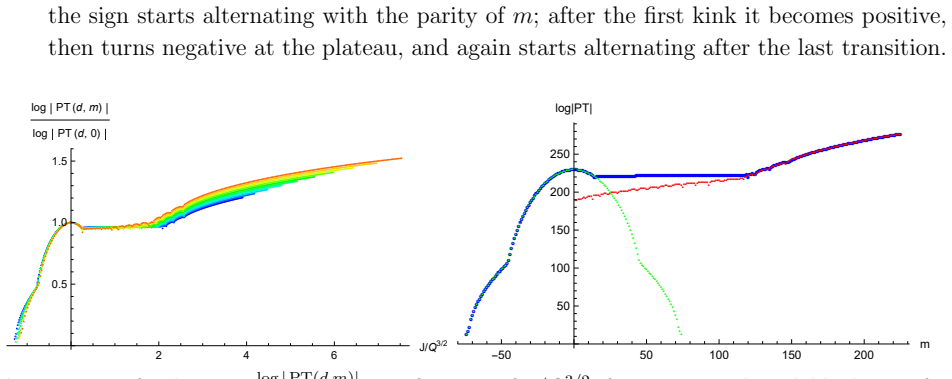
Exploiting high-genus Gopakumar-Vafa invariants, the growth of the 5D index Ω_5D(d,m) at large d agrees perfectly with the entropy of rotating 5D BMPV black holes for m below a critical value, including subleading four-derivative terms, but switches to being dominated by black rings with the smallest dipole charge when m exceeds that value. The stable pair invariant PT(d,m) shows a similar black ring-hole transition at negative m together with two additional transitions at positive m leading first to a plateau and then to polynomial growth proportional to m to the power 2d-1. The rank one DT invariant DT(d,m) follows the same pattern at negative m before entering a D0-brane dominated phase w
What carries the argument
The 5D index Ω_5D(d,m) extracted from Gopakumar-Vafa invariants, which serves as the generating function whose large-charge asymptotics are compared to black hole and black ring entropies.
Load-bearing premise
The high-genus Gopakumar-Vafa invariant data accurately captures the true mathematical values and that the extraction of large-charge asymptotics is free from truncation or convergence artifacts.
What would settle it
A mismatch between the numerically computed 5D index at a charge above the critical m and the entropy formula for the black ring with minimal dipole charge would falsify the dominance claim.
If this is right
- The subleading entropy correction from four-derivative interactions is reproduced by the index below the critical m.
- For m above critical, the smallest dipole charge black rings determine the index.
- PT invariants exhibit a plateau phase and then polynomial growth ~ m^{2d-1} after the initial transition.
- DT invariants transition to a phase with entropy of order m^{2/3} dominated by D0-branes.
- The fixed-genus large-degree behavior of GV invariants is determined, including the g-dependent constant, and extended approximately to large g.
Where Pith is reading between the lines
- The observed phase transitions likely mark points where different BPS configurations exchange dominance in the index.
- If the numerical agreement persists at even larger charges, it would support the idea that enumerative invariants fully encode the quantum corrections to black hole entropy.
- The noted effectiveness of the PT/MSW relation may point to a deeper algebraic identity between these invariants.
Editorial analysis
A structured set of objections, weighed in public.
Referee Report
Summary. The paper uses newly available high-genus Gopakumar-Vafa invariant data for one-parameter hypergeometric Calabi-Yau threefolds to numerically study the large-charge growth of the 5D index Ω_5D(d,m), stable pair invariants PT(d,m), and rank one DT invariants DT(d,m). It reports perfect agreement below a critical m with the Bekenstein-Hawking-Wald entropy of rotating 5D BMPV black holes including four-derivative corrections, transitioning to black ring domination above it. Similar phase transitions are identified for PT and DT, with approximate expressions derived in each phase, and a conjecture of Mariño on topological free energies is confirmed. The fixed genus large degree behavior of GV invariants is determined, including g-dependent constant, and extended to large g.
Significance. If the numerical results hold, this work provides compelling evidence for the microscopic origin of 5D black hole and black ring entropies from enumerative invariants, including subleading corrections. It demonstrates phase transitions in the invariants corresponding to different gravitational configurations and offers new insights into the asymptotics of GV invariants. The confirmation of Mariño's conjecture and the approximate PT/MSW relation are notable strengths. The availability of high-genus data enables these large-order studies, which are rare in the field.
major comments (1)
- [Numerical analysis of Ω_5D(d,m) growth (abstract and results)] The claim of 'perfect agreement' with the BMPV entropy including the precise subleading four-derivative correction is load-bearing on the numerical extraction of large-(d,m) asymptotics from the finite GV table. No information is supplied on data precision, error estimation, convergence criteria, or how the critical m is determined, nor on systematic checks by varying genus cutoff or cross-validation against known GV values. This undermines confidence in whether the agreement survives more complete data.
minor comments (1)
- The abstract mentions determining the overall g-dependent constant in the fixed genus large degree behavior of GV invariants; it would be helpful to state this constant explicitly in the main text.
Simulated Author's Rebuttal
We thank the referee for their careful reading of the manuscript and for highlighting the need for greater transparency in our numerical methodology. We address the major comment below and will revise the manuscript to incorporate additional details on data handling and validation.
read point-by-point responses
-
Referee: [Numerical analysis of Ω_5D(d,m) growth (abstract and results)] The claim of 'perfect agreement' with the BMPV entropy including the precise subleading four-derivative correction is load-bearing on the numerical extraction of large-(d,m) asymptotics from the finite GV table. No information is supplied on data precision, error estimation, convergence criteria, or how the critical m is determined, nor on systematic checks by varying genus cutoff or cross-validation against known GV values. This undermines confidence in whether the agreement survives more complete data.
Authors: We agree that the manuscript would benefit from explicit documentation of the numerical procedures. In the revised version we will add a new subsection (likely in Section 3 or an appendix) that: (i) states the precision and known error bounds of the input GV invariants from the available tables; (ii) describes the fitting procedure used to extract the leading and subleading coefficients of the entropy, together with the associated uncertainties; (iii) specifies the convergence criteria with respect to the genus cutoff (including plots or tables showing stability when the cutoff is varied); (iv) explains how the critical value of m is identified (by direct comparison of the extracted growth rates to the BMPV and black-ring formulae); and (v) reports cross-checks against lower-genus or lower-degree GV data where independent results are known. These additions will make the robustness of the reported agreement quantifiable. While the present data set is finite, the observed agreement within the accessible range remains robust under the checks we have performed internally; the revision will render this transparent to the reader. revision: yes
Circularity Check
No significant circularity; comparisons are to independent supergravity formulas
full rationale
The paper extracts large-charge asymptotics of 5D indices, PT invariants and DT invariants numerically from external high-genus GV data for a specific Calabi-Yau, then compares those asymptotics to the Bekenstein-Hawking-Wald entropy of BMPV black holes (including four-derivative corrections) taken from the supergravity literature. This comparison is to an externally defined physical quantity rather than to any quantity constructed from the same invariants or fitted parameters. No self-definitional steps, no fitted inputs relabeled as predictions, and no load-bearing self-citations appear in the derivation chain. The numerical procedure itself may raise separate questions of convergence, but those do not reduce the claimed agreement to a tautology by construction.
Axiom & Free-Parameter Ledger
axioms (1)
- domain assumption Newly available high-genus Gopakumar-Vafa data are sufficiently accurate and complete for extracting large-charge asymptotics
read the original abstract
Exploiting newly available data on Gopakumar-Vafa invariants at high genus for one-parameter hypergeometric Calabi-Yau threefolds, we study numerically the growth of the 5D indices, stable pair (PT) invariants and rank one Donaldson-Thomas (DT) invariants at large charges. For the 5D index $\Omega_{5D}(d,m)$, below a critical value of the angular momentum $m$, we find perfect agreement with the Bekenstein-Hawking-Wald entropy of rotating 5D BMPV black holes, including the subleading correction from four-derivative interactions. When $m$ exceeds the critical value, the 5D index is instead dominated by black rings with the smallest possible dipole charge. The stable pair invariant $PT(d,m)$, which is determined by 5D indices, has a similar black ring/hole transition at negative $m$ (now interpreted as the D0-brane charge) but surprisingly exhibits two other phase transitions at positive $m$: first, to a plateau and then to a polynomial growth $\sim m^{2d-1}$. In each phase, we derive an approximate expression for the invariant. Finally, the rank one DT invariant $DT(d,m)$ is similar to $PT(d,m)$ at negative $m$, and then transitions to a phase dominated by D0-branes, with entropy of order $m^{2/3}$. Along the way, we determine the fixed genus, large degree behavior of GV invariants (including the overall $g$-dependent constant), extend it to an approximate formula valid also for large $g$, point out the unreasonable effectiveness of a simple PT/MSW relation, and study the growth of topological free energies at fixed degree, confirming a conjecture of Mari\~no.
Figures




Forward citations
Cited by 2 Pith papers
-
BMPV black hole at first order in $\alpha'$
Derives analytic α' corrections to the three-charge BMPV black hole geometry and computes its corrected entropy via generalized Wald formula, matching supersymmetric index results.
-
Extended Supergravity Needs String Scale Cut-off
String-scale UV cut-off in the gravitational path integral removes string-coupling dependence from the BPS black hole index in extended supergravity, matching supersymmetry expectations for zero-Euler-number cases.
Reference graph
Works this paper leans on
-
[1]
R. Pandharipande and R. P. Thomas, “13/2 ways of counting curves,”Lond. Math. Soc. Lect. Note Ser.411(2014) 282–333, 1111.1552
work page internal anchor Pith review Pith/arXiv arXiv 2014
-
[2]
A pair of Calabi-Yau manifolds as an exactly soluble superconformal theory,
P. Candelas, X. C. de la Ossa, P. S. Green, and L. Parkes, “A pair of Calabi-Yau manifolds as an exactly soluble superconformal theory,”Nucl. Phys.B359(1991) 21–74
work page 1991
-
[3]
Kodaira-Spencer Theory of Gravity and Exact Results for Quantum String Amplitudes
M. Bershadsky, S. Cecotti, H. Ooguri, and C. Vafa, “Kodaira-Spencer theory of gravity and exact results for quantum string amplitudes,”Commun. Math. Phys.165(1994) 311–428, hep-th/9309140
work page internal anchor Pith review Pith/arXiv arXiv 1994
-
[4]
Topological Amplitudes in String Theory
I. Antoniadis, E. Gava, K. S. Narain, and T. R. Taylor, “Topological amplitudes in string theory,”Nucl. Phys. B413(1994) 162–184, hep-th/9307158
work page internal anchor Pith review Pith/arXiv arXiv 1994
-
[5]
M-Theory and Topological Strings--I
R. Gopakumar and C. Vafa, “M-theory and topological strings. I,” hep-th/9809187
work page internal anchor Pith review Pith/arXiv arXiv
-
[6]
M-Theory and Topological Strings--II
R. Gopakumar and C. Vafa, “M-theory and topological strings. II,” hep-th/9812127
work page internal anchor Pith review Pith/arXiv arXiv
-
[7]
M-Theory, Topological Strings and Spinning Black Holes
S. H. Katz, A. Klemm, and C. Vafa, “M theory, topological strings and spinning black holes,” Adv. Theor. Math. Phys.3(1999) 1445–1537, hep-th/9910181
work page internal anchor Pith review Pith/arXiv arXiv 1999
-
[8]
Gromov-Witten theory and Donaldson-Thomas theory. I,
D. Maulik, N. Nekrasov, A. Okounkov, and R. Pandharipande, “Gromov-Witten theory and Donaldson-Thomas theory. I,”Compos. Math.142(2006), no. 5, 1263–1285
work page 2006
-
[9]
A holomorphic Casson invariant for Calabi-Yau 3-folds, and bundles on K3 fibrations
R. P. Thomas, “A holomorphic Casson invariant for Calabi-Yau 3-folds, and bundles on K3 fibrations,” math/9806111
work page internal anchor Pith review Pith/arXiv arXiv
-
[10]
Curve counting via stable pairs in the derived category,
R. Pandharipande and R. P. Thomas, “Curve counting via stable pairs in the derived category,”Invent. Math.178(2009) 407–447, 0707.2348
-
[11]
Stability structures, motivic Donaldson-Thomas invariants and cluster transformations
M. Kontsevich and Y. Soibelman, “Stability structures, motivic Donaldson-Thomas invariants and cluster transformations,” 0811.2435
work page internal anchor Pith review Pith/arXiv arXiv
-
[12]
Generalized Donaldson-Thomas invariants
D. Joyce, “Generalized Donaldson-Thomas invariants,”Surveys in differential geometry16 (2011), no. 1, 125–160, 0910.0105
work page internal anchor Pith review Pith/arXiv arXiv 2011
-
[13]
S. Feyzbakhsh and R. P. Thomas, “Curve counting and S-duality,” ´Epijournal de G´ eom´ etrie Alg´ ebrique7(2023) 2007.03037
work page internal anchor Pith review Pith/arXiv arXiv 2023
-
[14]
S. Feyzbakhsh and R. P. Thomas, “Rank r DT theory from rank 0,”Duke Math. J.173 (2024), no. 11, 2063–2116, 2103.02915
-
[15]
Holomorphic Anomalies in Topological Field Theories
M. Bershadsky, S. Cecotti, H. Ooguri, and C. Vafa, “Holomorphic anomalies in topological field theories,”Nucl. Phys.B405(1993) 279–304, hep-th/9302103
work page internal anchor Pith review Pith/arXiv arXiv 1993
-
[16]
Topological String Theory on Compact Calabi-Yau: Modularity and Boundary Conditions
M.-x. Huang, A. Klemm, and S. Quackenbush, “Topological string theory on compact Calabi-Yau: Modularity and boundary conditions,”Lect. Notes Phys.757(2009) 45–102, hep-th/0612125
work page internal anchor Pith review Pith/arXiv arXiv 2009
-
[17]
Direct Integration of the Topological String
T. W. Grimm, A. Klemm, M. Marino, and M. Weiss, “Direct Integration of the Topological String,”JHEP08(2007) 058, hep-th/0702187. – 56 –
work page internal anchor Pith review Pith/arXiv arXiv 2007
-
[18]
Topological String Partition Functions as Polynomials
S. Yamaguchi and S.-T. Yau, “Topological string partition functions as polynomials,”JHEP 07(2004) 047, hep-th/0406078
work page internal anchor Pith review Pith/arXiv arXiv 2004
-
[19]
Polynomial Structure of the (Open) Topological String Partition Function
M. Alim and J. D. Lange, “Polynomial Structure of the (Open) Topological String Partition Function,”JHEP10(2007) 045, 0708.2886
work page internal anchor Pith review Pith/arXiv arXiv 2007
-
[20]
Black Hole Entropy in M-Theory
J. M. Maldacena, A. Strominger, and E. Witten, “Black hole entropy in M-theory,”JHEP12 (1997) 002, hep-th/9711053
work page internal anchor Pith review Pith/arXiv arXiv 1997
-
[21]
Quantum geometry, stability and modularity,
S. Alexandrov, S. Feyzbakhsh, A. Klemm, B. Pioline, and T. Schimannek, “Quantum geometry, stability and modularity,”Commun. Num. Theor. Phys.18(2024), no. 1, 49–151, 2301.08066
-
[22]
The M5-Brane Elliptic Genus: Modularity and BPS States
D. Gaiotto, A. Strominger, and X. Yin, “The M5-brane elliptic genus: Modularity and BPS states,”JHEP08(2007) 070, hep-th/0607010
work page internal anchor Pith review Pith/arXiv arXiv 2007
-
[23]
D3-instantons, Mock Theta Series and Twistors
S. Alexandrov, J. Manschot, and B. Pioline, “D3-instantons, Mock Theta Series and Twistors,”JHEP1304(2013) 002, 1207.1109
work page internal anchor Pith review Pith/arXiv arXiv 2013
-
[24]
Multiple D3-instantons and mock modular forms I,
S. Alexandrov, S. Banerjee, J. Manschot, and B. Pioline, “Multiple D3-instantons and mock modular forms I,”Commun. Math. Phys.353(2017), no. 1, 379–411, 1605.05945
-
[25]
Black holes and higher depth mock modular forms,
S. Alexandrov and B. Pioline, “Black holes and higher depth mock modular forms,”Commun. Math. Phys.374(2019), no. 2, 549–625, 1808.08479
-
[26]
Quantum geometry and mock modularity,
S. Alexandrov, S. Feyzbakhsh, A. Klemm, and B. Pioline, “Quantum geometry and mock modularity,”Commun. Num. Theor. Phys.20(2026), no. 1, 97–148, 2312.12629
-
[27]
New examples of Abelian D4D2D0 indices,
J. McGovern, “New examples of Abelian D4D2D0 indices,”SciPost Phys.20(2026), no. 1, 015, 2412.01149
-
[28]
Mock Modularity at Work, or Black Holes in a Forest,
S. Alexandrov, “Mock Modularity at Work, or Black Holes in a Forest,”Entropy27(2025), no. 7, 719, 2505.02572
-
[29]
Black Holes and Large Order Quantum Geometry
M.-x. Huang, A. Klemm, M. Marino, and A. Tavanfar, “Black holes and large order quantum geometry,”Phys. Rev. D79(2009) 066001, 0704.2440
work page internal anchor Pith review Pith/arXiv arXiv 2009
-
[30]
Split States, Entropy Enigmas, Holes and Halos
F. Denef and G. W. Moore, “Split states, entropy enigmas, holes and halos,”JHEP1111 (2011) 129, hep-th/0702146
work page internal anchor Pith review Pith/arXiv arXiv 2011
-
[31]
Local Mirror Symmetry at Higher Genus
A. Klemm and E. Zaslow, “Local mirror symmetry at higher genus,”AMS/IP Stud. Adv. Math.23(2001) 183–207, hep-th/9906046
work page internal anchor Pith review Pith/arXiv arXiv 2001
-
[32]
Logarithmic Corrections to Rotating Extremal Black Hole Entropy in Four and Five Dimensions
A. Sen, “Logarithmic Corrections to Rotating Extremal Black Hole Entropy in Four and Five Dimensions,”Gen. Rel. Grav.44(2012) 1947–1991, 1109.3706
work page internal anchor Pith review Pith/arXiv arXiv 2012
-
[33]
A. Sen, “Logarithmic Corrections to Schwarzschild and Other Non-extremal Black Hole Entropy in Different Dimensions,”JHEP04(2013) 156, 1205.0971
work page internal anchor Pith review Pith/arXiv arXiv 2013
-
[34]
Revisiting logarithmic correction to five dimensional BPS black hole entropy,
A. H. Anupam, C. Chowdhury, and A. Sen, “Revisiting logarithmic correction to five dimensional BPS black hole entropy,”JHEP05(2024) 070, 2308.00038. – 57 –
-
[35]
D. Cassani, A. Ruip´ erez, and E. Turetta, “Higher-derivative corrections to flavoured BPS black hole thermodynamics and holography,”JHEP05(2024) 276, 2403.02410
-
[36]
R^2 Corrections for 5D Black Holes and Rings
M. Guica, L. Huang, W. Li, and A. Strominger, “R 2 corrections for 5-D black holes and rings,”JHEP10(2006) 036, hep-th/0505188
work page internal anchor Pith review Pith/arXiv arXiv 2006
-
[37]
Precision Entropy of Spinning Black Holes
A. Castro, J. L. Davis, P. Kraus, and F. Larsen, “Precision Entropy of Spinning Black Holes,” JHEP09(2007) 003, 0705.1847
work page internal anchor Pith review Pith/arXiv arXiv 2007
-
[38]
Near-horizon analysis of D=5 BPS black holes and rings
B. de Wit and S. Katmadas, “Near-Horizon Analysis of D=5 BPS Black Holes and Rings,” JHEP02(2010) 056, 0910.4907
work page internal anchor Pith review Pith/arXiv arXiv 2010
-
[39]
Black hole/black ring transition,
I. Halder and Y.-H. Lin, “Black hole/black ring transition,”JHEP01(2024) 193, 2307.13735
-
[40]
C. F. Doran and J. W. Morgan, “Mirror symmetry and integral variations of Hodge structure underlying one parameter families of Calabi-Yau threefolds,” inWorkshop on Calabi-Yau Varieties and Mirror Symmetry. 5, 2005. math/0505272
work page internal anchor Pith review Pith/arXiv arXiv 2005
-
[41]
“CYCluster: AESZ.”https://cycluster.mpim-bonn.mpg.de, 2025. [Online; accessed 31 July 2025]
work page 2025
-
[42]
K. B¨ onisch, A. Klemm, E. Scheidegger, and D. Zagier, “D-brane Masses at Special Fibres of Hypergeometric Families of Calabi–Yau Threefolds, Modular Forms, and Periods,”Commun. Math. Phys.405(2024), no. 6, 134, 2203.09426
-
[43]
Research Data Homepage Group A. Klemm
“Research Data Homepage Group A. Klemm.” http://www.th.physik.uni-bonn.de/groups/klemm/material/LFTM, 2026
work page 2026
-
[44]
Periods of fibre products of elliptic surfaces and the gamma conjecture,
E. Pichon-Pharabod, “Periods of fibre products of elliptic surfaces and the gamma conjecture,” 2505.07685
-
[45]
Gamma classes and quantum cohomology of fano manifolds: gamma conjectures,
S. Galkin, V. Golyshev, and H. Iritani, “Gamma classes and quantum cohomology of fano manifolds: gamma conjectures,”Duke Mathematical Journal165(2016), no. 11, 2005–2077
work page 2016
-
[46]
Quantum Background Independence In String Theory
E. Witten, “Quantum background independence in string theory,” hep-th/9306122
work page internal anchor Pith review Pith/arXiv arXiv
-
[47]
Topological Strings and (Almost) Modular Forms
M. Aganagic, V. Bouchard, and A. Klemm, “Topological Strings and (Almost) Modular Forms,”Commun. Math. Phys.277(2008) 771–819, hep-th/0607100
work page internal anchor Pith review Pith/arXiv arXiv 2008
-
[48]
Quantization and holomorphic anomaly
A. Schwarz and X. Tang, “Quantization and holomorphic anomaly,”JHEP03(2007) 062, hep-th/0611281
work page internal anchor Pith review Pith/arXiv arXiv 2007
-
[49]
Revisiting the Quantum Geometry of Torus-fibered Calabi-Yau Threefolds
B. Pioline and T. Schimannek, “Revisiting the Quantum Geometry of Torus-fibered Calabi-Yau Threefolds,” 2510.23722
work page internal anchor Pith review Pith/arXiv arXiv
-
[50]
Holomorphic Anomaly in Gauge Theories and Matrix Models
M.-x. Huang and A. Klemm, “Holomorphic Anomaly in Gauge Theories and Matrix Models,” JHEP09(2007) 054, hep-th/0605195
work page internal anchor Pith review Pith/arXiv arXiv 2007
-
[51]
R. Gopakumar and C. Vafa, “Branes and fundamental groups,”Adv. Theor. Math. Phys.2 (1998) 399–411, hep-th/9712048
work page internal anchor Pith review Pith/arXiv arXiv 1998
-
[52]
c=1 String as the Topological Theory of the Conifold
D. Ghoshal and C. Vafa, “C = 1 string as the topological theory of the conifold,”Nucl. Phys. B453(1995) 121–128, hep-th/9506122. – 58 –
work page internal anchor Pith review Pith/arXiv arXiv 1995
-
[53]
Equivariant Gromov-Witten invariants,
A. B. Givental, “Equivariant Gromov-Witten invariants,”Internat. Math. Res. Notices(1996), no. 13, 613–663
work page 1996
-
[54]
B. H. Lian, K. Liu, and S.-T. Yau, “Mirror principle. I,”Asian J. Math.1(1997), no. 4, 729–763
work page 1997
-
[55]
The reduced genus 1 Gromov-Witten invariants of Calabi-Yau hypersurfaces,
A. Zinger, “The reduced genus 1 Gromov-Witten invariants of Calabi-Yau hypersurfaces,”J. Amer. Math. Soc.22(2009), no. 3, 691–737
work page 2009
-
[56]
MSP theory for smooth Calabi-Yau threefolds in weightedP 4,
P. Lei, “MSP theory for smooth Calabi-Yau threefolds in weightedP 4,” 2024
work page 2024
-
[57]
The Gopakumar-Vafa formula for symplectic manifolds
E.-N. Ionel and T. Parker, “The Gopakumar-Vafa formula for symplectic manifolds,”Ann. Math. (2)187(2018), no. 1, 1–64, 1306.1516
work page internal anchor Pith review Pith/arXiv arXiv 2018
-
[58]
The Gopakumar-Vafa finiteness conjecture,
A. Doan, E.-N. Ionel, and T. Walpuski, “The Gopakumar-Vafa finiteness conjecture,” 2103.08221
-
[59]
Genus zero Gopakumar-Vafa invariants of contractible curves
S. H. Katz, “Genus zero Gopakumar-Vafa invariants of contractible curves,”J. Diff. Geom. 79(2008), no. 2, 185–195, math/0601193
work page internal anchor Pith review Pith/arXiv arXiv 2008
-
[60]
Gopakumar-Vafa invariants via vanishing cycles
D. Maulik and Y. Toda, “Gopakumar–Vafa invariants via vanishing cycles,”Inventiones mathematicae213(2018), no. 3, 1017–1097, 1610.07303
work page internal anchor Pith review Pith/arXiv arXiv 2018
-
[61]
On stability conditions for the quintic threefold,
C. Li, “On stability conditions for the quintic threefold,”Inventiones mathematicae218 (2019), no. 1, 301–340, 1810.03434
-
[62]
Stability conditions on Calabi-Yau double/triple solids,
N. Koseki, “Stability conditions on Calabi-Yau double/triple solids,” 2007.00044
-
[63]
S. Liu, “Stability condition on Calabi-Yau threefold of complete intersection of quadratic and quartic hypersurfaces,” 2108.08934
-
[64]
Castelnuovo bound and higher genus Gromov-Witten invariants of quintic 3-folds,
Z. Liu and Y. Ruan, “Castelnuovo bound and higher genus Gromov-Witten invariants of quintic 3-folds,” 2210.13411
-
[65]
Castelnuovo bound for curves in projective 3-folds,
Z. Liu, “Castelnuovo bound for curves in projective 3-folds,” 2407.20161
-
[66]
Darboux, G, “M´ emoire sur l’approximation des fonctions de tr` es-grands nombres, et sur une classe ´ etendue de d´ eveloppements en s´ erie,”Journal de math´ ematiques pures et appliqu´ ees3e (1878)
-
[67]
Fibering out Calabi-Yau motives,
K. B¨ onisch, V. Golyshev, and A. Klemm, “Fibering out Calabi-Yau motives,” 2510.03939
-
[68]
C. Schoen, “On the geometry of a special determinantal hypersurface associated to the Mumford-Horrocks vector bundle,”J. Reine Angew. Math.364(1986) 85–111
work page 1986
-
[69]
C. M. Bender and S. A. Orszag,Advanced mathematical methods for scientists and engineers. International Series in Pure and Applied Mathematics. McGraw-Hill Book Co., New York, 1978
work page 1978
-
[70]
Large Order Enumerative Geometry in toric Calabi-Yau threefolds
S. Alexandrov, A. Klemm, and B. Pioline, “Large Order Enumerative Geometry in toric Calabi-Yau threefolds.” To appear
-
[71]
Novel black saddles for 5d gravitational indices and the index enigma,
J. Boruch, R. Emparan, L. V. Iliesiu, and S. Murthy, “Novel black saddles for 5d gravitational indices and the index enigma,” 2510.23699. – 59 –
-
[72]
D--branes and Spinning Black Holes
J. C. Breckenridge, R. C. Myers, A. W. Peet, and C. Vafa, “D-branes and spinning black holes,”Phys. Lett. B391(1997) 93–98, hep-th/9602065
work page internal anchor Pith review Pith/arXiv arXiv 1997
-
[73]
General Static Spherically Symmetric Black Holes of Heterotic String on a Six Torus
M. Cvetic and D. Youm, “All the static spherically symmetric black holes of heterotic string on a six torus,”Nucl. Phys.B472(1996) 249–267, hep-th/9512127
work page internal anchor Pith review Pith/arXiv arXiv 1996
-
[74]
5D Black Holes and Strings with Higher Derivatives
A. Castro, J. L. Davis, P. Kraus, and F. Larsen, “5D Black Holes and Strings with Higher Derivatives,”JHEP06(2007) 007, hep-th/0703087
work page internal anchor Pith review Pith/arXiv arXiv 2007
-
[75]
On R**2 Corrections for 5D Black Holes
M. Alishahiha, “OnR 2 corrections for 5D black holes,”JHEP08(2007) 094, hep-th/0703099
work page internal anchor Pith review Pith/arXiv arXiv 2007
-
[76]
H. Elvang, R. Emparan, D. Mateos, and H. S. Reall, “A Supersymmetric black ring,”Phys. Rev. Lett.93(2004) 211302, hep-th/0407065
work page internal anchor Pith review Pith/arXiv arXiv 2004
-
[77]
Supersymmetric black rings and three-charge supertubes
H. Elvang, R. Emparan, D. Mateos, and H. S. Reall, “Supersymmetric black rings and three-charge supertubes,”Phys. Rev. D71(2005) 024033, hep-th/0408120
work page internal anchor Pith review Pith/arXiv arXiv 2005
-
[78]
One Ring to Rule Them All ... and in the Darkness Bind Them?
I. Bena and N. P. Warner, “One ring to rule them all ... and in the darkness bind them?,” Adv. Theor. Math. Phys.9(2005), no. 5, 667–701, hep-th/0408106
work page internal anchor Pith review Pith/arXiv arXiv 2005
-
[79]
General Concentric Black Rings
J. P. Gauntlett and J. B. Gutowski, “General concentric black rings,”Phys. Rev. D71(2005) 045002, hep-th/0408122
work page internal anchor Pith review Pith/arXiv arXiv 2005
-
[80]
5D Black Rings and 4D Black Holes
D. Gaiotto, A. Strominger, and X. Yin, “5d black rings and 4d black holes,”JHEP02(2006) 023, hep-th/0504126
work page internal anchor Pith review Pith/arXiv arXiv 2006
discussion (0)
Sign in with ORCID, Apple, or X to comment. Anyone can read and Pith papers without signing in.