REVIEW 4 major objections 5 minor 15 references
Uncertainty-aware Test-Time Training (UT$^3$) for Efficient On-the-fly Domain Adaptive Dense Regression
T0 review · 4 major / 5 minor · reviewed 2026-08-05 · deepseek-v4-flash
Pith's one-line read The paper claims that applying test-time training only to uncertainty-flagged keyframes, and freezing the adapted model in between, recovers standard test-time-training accuracy roughly 70% faster on continuously shifted depth-estimation st
desk verdict Good idea, under-supported efficiency claim, and a target-leakage ambiguity that has to be resolved. read the letter →
The pith
A machine-rendered reading of the paper's core claim, the machinery that carries it, and where it could break.
The reading
What carries the argument
The central object is the entropy of the Gaussian distribution predicted by the uncertainty-aware masked-autoencoding self-supervision head. The head is split to output both a reconstruction and a variance for each pixel, trained with the heteroscedastic Gaussian loss from equation 5. At test time, each frame's entropy is compared against a source-domain entropy quantile (equation 6); frames above the threshold are keyframes that receive test-time training, and the adapted encoder and self-supervision head states are preserved until the next keyframe. This single entropy signal both detects novel frames and decides when the adaptation budget should be spent.
What would settle it
Run the same UT3 protocol on a SHIFT sequence with an abrupt transition, such as one clear frame followed immediately by a heavy-rain frame, and measure Abs Rel and keyframe frequency. If the source-calibrated entropy threshold either fires on almost every frame, producing no savings, or fails to fire at the transition, causing accuracy to collapse to the no-adaptation level, the continuous-shift premise breaks.
Extended reading notes
Core claim
The paper's central claim is that for dense regression under continuous domain shift, the adapted weights learned at one well-chosen frame remain valid for nearby frames, so spending gradient steps on every frame is wasteful. By rebuilding the masked-autoencoder self-supervision task so that its reconstruction head outputs a per-pixel heteroscedastic Gaussian (mean and variance), the paper obtains a per-frame entropy signal; frames whose entropy exceeds a source-domain quantile are selected as keyframes and receive Q test-time training steps, while all other frames use the preserved adapted encoder. On KITTI-trained monocular depth networks evaluated on SHIFT night, fog, and rain sequences,
Load-bearing premise
The method assumes that domain drift between consecutive frames is small enough that a model adapted at one keyframe remains good until the next, and that the entropy distribution from the source domain reliably flags when that is no longer true.
Editorial extensions
If this is right
- Test-time adaptation on a stream can be scheduled by uncertainty rather than by fixed intervals or every-frame updates, so low-latency systems can budget adaptation compute.
- The self-supervision head doubles as a domain-novelty detector: high entropy flags the moments a model should update.
- The threshold q allows the same deployed model to be tuned to different compute budgets without retraining.
- Standard test-time training can be extended to dense regression tasks such as monocular depth estimation, not just classification or segmentation.
- If the keyframe signal transfers, other dense prediction streams could use the same uncertainty-based scheduling principle.
Reading between the lines
- The authors do not test sudden, one-shot domain jumps; a natural extension is to make the keyframe decision also depend on temporal deltas in entropy, so an abrupt shift triggers immediate adaptation.
- Because the entropy signal comes from the self-supervision head, the same keyframe-selection scheme should transfer to other dense prediction tasks with a masked reconstruction head, such as optical flow or surface normal estimation; this is my inference, not a paper claim.
- The ~70% speedup is measured on the specific KITTI-to-SHIFT setup; the more transferable claim is that uncertainty-selected keyframes dominate uniform and random selection for continuous shifts.
- An obvious deployment refinement would be to auto-calibrate the q threshold online from the observed entropy stream rather than fixing it from the source validation set.
Editorial analysis
A structured set of objections, weighed in public.
Referee Report
Summary. The paper proposes UT3, an uncertainty-aware test-time training (TTT) protocol for monocular depth estimation under continuous domain shift. It extends MonoDepth2 with a masked-autoencoding self-supervision head that outputs a heteroscedastic Gaussian reconstruction, uses the entropy of that Gaussian as an uncertainty signal, and performs TTT only on selected keyframes whose entropy exceeds a threshold derived from a validation set (Eq. 6). Model state is preserved between keyframes. Experiments on KITTI-to-SHIFT shifts (Night, Foggy, Rainy) compare UT3 with random, uniform, and shallow TTT baselines, and the paper claims that uncertainty-based keyframe selection achieves the best performance approximately 70% faster.
Significance. If the efficiency claim is supported, UT3 provides a practical latency-performance trade-off for TTT in dense regression, a task that has received less attention than classification/segmentation in the TTT literature. The idea of using aleatoric uncertainty from a self-supervision head to trigger adaptation is sensible, and the paper includes useful baselines (Uniform scratch/warm, Random, Shallow) that isolate the contribution of uncertainty-based selection. The qualitative trend in Figures 6-7 is plausible and the application to monocular depth is timely. However, the central quantitative claim is not yet auditable from the reported evidence.
major comments (4)
- [Section 4.4 vs Section 3.3] The provenance of the entropy threshold is contradictory and load-bearing. Section 3.3 defines τ_{q,S} on a validation set from the source domain Dval_s (Eq. 6), which is methodologically correct for TTT. Section 4.4, however, states: 'A threshold for the entropy value is defined using the source SHIFT Distribution.' Since SHIFT is the target dataset in this paper, this sentence implies the threshold is calibrated on target-domain validation statistics. If so, the comparison to Random-TTT/Uniform-TTT is unfair and the 'on-the-fly' claim is undermined. The authors must state unambiguously which dataset was used to compute the entropy distribution and threshold, whether the same threshold was used for all three SHIFT shifts, and what value of q was used for the reported ~70% result.
- [Section 4.4 / Figure 7] The headline '≈70% faster' is not supported by the data as presented. There are no absolute wall-clock times, no specification of hardware or runtime measurement methodology, and no error bars or multiple seeds. Figure 7 appears to plot performance against average wall-clock time per frame, but the axes are not clearly labeled and the reference point for '70% faster' is not defined. The authors should provide a table of mean and standard deviation of per-frame wall-clock time for each strategy (including the entropy forward pass and TTT updates), the number of frames, and the hardware. This is essential for independent audit of the central efficiency claim.
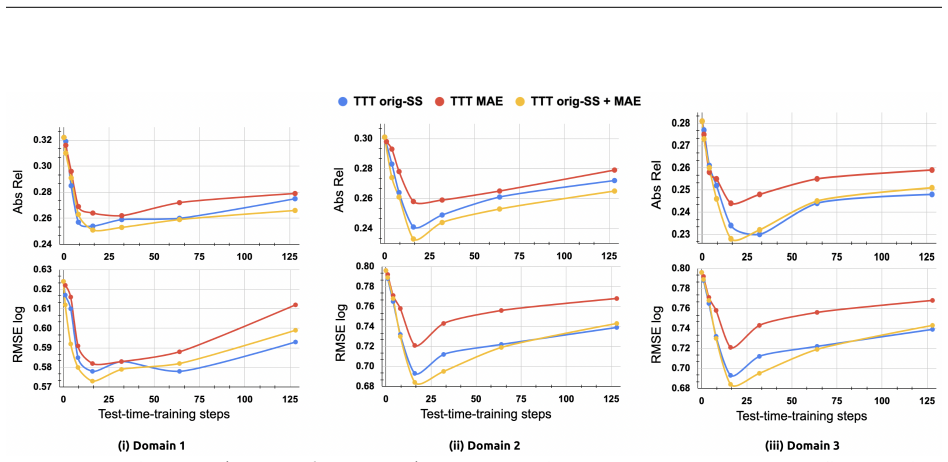
- [Section 3.3 / Section 4.1] The TTT update protocol is inconsistent across the method description and the experiments. Section 3.3 states that at test time only the encoder E and self-supervision head S are fine-tuned, with the task head T frozen. Section 4.1, however, says TTT orig-SS+MAE 'unfreezes' E, T, and S at test time. The efficiency comparison depends on which parameters are updated and how many backward passes are performed. Please specify the exact update sets for each baseline and for UT3, and confirm that the wall-clock comparison accounts for the extra forward pass used to compute entropy on every frame.
- [Section 4.4 / Eq. (6)] The key hyperparameters q (entropy quantile) and Q (number of TTT steps) are not reported in the experiments. Since the UT3 accuracy-efficiency trade-off is controlled by these values, the claim 'can achieve the best performance ≈70% faster across all domains' requires a disclosure of the q and Q values used, whether they were tuned on source validation data or on the target SHIFT domains, and how sensitive the reported speedup is to these choices. Without this, the result cannot be reproduced or compared fairly with standard TTT operating at a fixed Q.
minor comments (5)
- [Section 3.2.1] The expression for test-time training step is garbled: 'θ∗E,x,θ∗S,x = argmin θE,θE for Q steps'. Please correct the notation and clarify that Q is the number of gradient steps.
- [Table 1] In the 'Rainy' row, δ<1.25 has a typo: 'o.682' should be '0.682'. Check all tables for similar typos.
- [Figures 6 and 7] The axes of these figures are not fully labeled. In particular, the y-axis metric and the x-axis unit (wall-clock time vs frame index vs TTT step) should be stated explicitly in the figure or caption.
- [Figure 9 and Section 4.4] The phrase 'source SHIFT Distribution' is also used in Section 4.4, conflicting with the method's claim that only source-domain statistics are used. Even if the intended meaning is 'source-domain distribution obtained from SHIFT-like validation', please rephrase to avoid any appearance of target leakage.
- [Abstract] The abstract states UT3 is 'the fastest (i.e., more efficient) among all methods'. This is stronger than what the experiments support, since the comparison is limited to the TTT variants and keyframe baselines defined in Section 4.1. Please qualify the claim to the compared methods.
Circularity Check
No circularity: keyframe-selection threshold is a source-calibrated, user-controlled hyperparameter; self-citations are background; ambiguous 'source SHIFT Distribution' wording is a leakage/validity concern, not a circular reduction.
full rationale
The paper's derivation chain is self-contained. The self-supervision head is trained on KITTI with the uncertainty-aware MAE loss (Eq. 5), and the keyframe criterion is an entropy threshold computed as a quantile of the source-domain validation entropy distribution (Eq. 6); at test time frames with H > tau get TTT (Eq. 7). This criterion is not defined in terms of the target-domain performance or the reported speedup, so the efficiency claim is an empirical evaluation of a heuristic rather than an equation that reduces to its inputs. The q in Eq. 6 is explicitly a user-controlled trade-off parameter ('allowing the end-user to control how often to apply test-time training'), so sweeping q in Fig. 7 and reporting the best operating point is a hyperparameter evaluation, not a fitted parameter relabeled as a prediction. Self-citations (Upadhyay et al. 2021-2023) appear in related work and in the description of heteroscedastic Gaussian uncertainty, but they are not load-bearing: Eq. 5 and Section 3.3 state the loss and architecture directly, and the entropy criterion is validated against external SHIFT benchmarks. The phrase 'threshold ... defined using the source SHIFT Distribution' (Section 4.4) is ambiguous and, if it means the target SHIFT distribution, would be a target-leakage benchmarking flaw; however, that is a correctness concern, not a circularity, because no equation makes the reported speedup equal to the threshold by construction. Thus no circular step is identified; score 0.
Assumptions & free parameters
free parameters (3)
- q (entropy quantile threshold) =
Not reported; scanned to generate Fig. 7
- Q (number of test-time training steps) =
Not clearly fixed; varied in Fig. 5
- lambda_1, lambda_2 (loss weights) =
lambda_1=1, lambda_2=1e-3
assumptions (5)
- domain assumption Test-time frames arrive as a stream with continuously varying domain shift, so adapting only at keyframes and reusing the model state on intermediate frames preserves accuracy.
- domain assumption The entropy of the self-supervision head's predicted Gaussian is a reliable indicator of the need for adaptation.
- domain assumption The source-domain entropy distribution can set a transferable threshold for detecting novel target frames.
- standard math Heteroscedastic Gaussian likelihood is an appropriate self-supervision objective for masked autoencoding.
- domain assumption The pre-trained MonoDepth2 encoder provides a useful feature space for the added MAE self-supervision head.
Cite this review
Pith. "Pith review of Uncertainty-aware Test-Time Training (UT$^3$) for Efficient On-the-fly Domain Adaptive Dense Regression." pith.science (2026). https://pith.science/paper/STGQUVQU
@misc{pith2026250903012,
  author       = {Pith},
  title        = {Pith review of: Uncertainty-aware Test-Time Training (UT$^3$) for Efficient On-the-fly Domain Adaptive Dense Regression},
  year         = {2026},
  howpublished = {\url{https://pith.science/paper/STGQUVQU}},
  note         = {Machine review of arXiv:2509.03012}
}
abstract
Deep neural networks (DNNs) are increasingly being used in autonomous systems. However, DNNs do not generalize well to domain shift. Adapting to a continuously evolving environment is a safety-critical challenge inevitably faced by all autonomous systems deployed to the real world. Recent work on test-time training proposes methods that adapt to a new test distribution on the fly by optimizing the DNN model for each test input using self-supervision. However, these techniques result in a sharp increase in inference time as multiple forward and backward passes are required for a single test sample (for test-time training) before finally making the prediction based on the fine-tuned features. This is undesirable for real-world robotics applications where these models may be deployed to resource constraint hardware with strong latency requirements. In this work, we propose a new framework (called UT$^3$) that leverages test-time training for improved performance in the presence of continuous domain shift while also decreasing the inference time, making it suitable for real-world applications. Our method proposes an uncertainty-aware self-supervision task for efficient test-time training that leverages the quantified uncertainty to selectively apply the training leading to sharp improvements in the inference time while performing comparably to standard test-time training protocol. Our proposed protocol offers a continuous setting to identify the selected keyframes, allowing the end-user to control how often to apply test-time training. We demonstrate the efficacy of our method on a dense regression task - monocular depth estimation.
Figures


Figures from the paper (6 more)



Reference graph
Works this paper leans on
-
[6]
Calibration of Model Uncertainty for Dropout Variational Inference
Max-Heinrich Laves, Sontje Ihler, Jacob F Fast, Lüder A Kahrs, and Tobias Ortmaier. Well-calibrated regression uncertainty in medical imaging with deep learning. InMedical Imaging with Deep Learning, pp. 393–412. PMLR, 2020a. Max-Heinrich Laves, Sontje Ihler, Karl-Philipp Kortmann, and Tobias Ortmaier. Calibration of model uncertainty for dropout variatio...
work page Pith review arXiv 2006
-
[7]
DEJA VU: Continual Model Generalization For Unseen Domains
Chenxi Liu, Lixu Wang, Lingjuan Lyu, Chen Sun, Xiao Wang, and Qi Zhu. Deja vu: Continual model generalization for unseen domains.arXiv preprint arXiv:2301.10418,
-
[9]
Neural Unsupervised Domain Adaptation in NLP---A Survey
Alan Ramponi and Barbara Plank. Neural unsupervised domain adaptation in nlp—a survey.arXiv preprint arXiv:2006.00632,
work page Pith review arXiv 2006
-
[12]
Uddeshya Upadhyay, Sairam Bade, Arjun Puranik, Shahir Asfahan, Melwin Babu, Francisco Lopez-Jimenez, Samuel J Asirvatham, Ashim Prasad, Ajit Rajasekharan, Samir Awasthi, et al. Hypuc: Hyperfine uncer- tainty calibration with gradient-boosted corrections for reliable regression on imbalanced electrocardio- grams. arXiv preprint arXiv:2311.13821, 2023a. Udd...
work page Pith review arXiv 1910
-
[13]
Tent: Fully test-time adaptation by entropy minimization.arXiv preprint arXiv:2006.10726, 2020a
Dequan Wang, Evan Shelhamer, Shaoteng Liu, Bruno Olshausen, and Trevor Darrell. Tent: Fully test-time adaptation by entropy minimization.arXiv preprint arXiv:2006.10726, 2020a. Guotai Wang, Wenqi Li, Michael Aertsen, Jan Deprest, Sébastien Ourselin, and Tom Vercauteren. Aleatoric uncertainty estimation with test-time augmentation for medical image segment...
arXiv 2006
-
[15]
Self-Supervised Siamese Learning on Stereo Image Pairs for Depth Estimation in Robotic Surgery
Menglong Ye, Edward Johns, Ankur Handa, Lin Zhang, Philip Pratt, and Guang-Zhong Yang. Self- supervised siamese learning on stereo image pairs for depth estimation in robotic surgery.arXiv preprint arXiv:1705.08260,
-
[2010]
Domain adaptation with structural correspondence learning
John Blitzer, Ryan McDonald, and Fernando Pereira. Domain adaptation with structural correspondence learning. In Proceedings of the 2006 conference on empirical methods in natural language processing, pp. 120–128,
work page 2006
-
[2013]
Deep ordinal regres- sion network for monocular depth estimation
Huan Fu, Mingming Gong, Chaohui Wang, Kayhan Batmanghelich, and Dacheng Tao. Deep ordinal regres- sion network for monocular depth estimation. InProceedings of the IEEE conference on computer vision and pattern recognition, pp. 2002–2011,
work page 2002
Show all 15 references
-
[2017]
Adam: A method for stochastic optimization
Diederik P Kingma and Jimmy Ba. Adam: A method for stochastic optimization. arXiv preprint arXiv:1412.6980,
-
[2018]
Simple and scalable predictive uncer- tainty estimation using deep ensembles.arXiv preprint arXiv:1612.01474,
Balaji Lakshminarayanan, Alexander Pritzel, and Charles Blundell. Simple and scalable predictive uncer- tainty estimation using deep ensembles.arXiv preprint arXiv:1612.01474,
-
[2019]
Learning to combine: Knowledge aggregation for multi-source domain adaptation
Hang Wang, Minghao Xu, Bingbing Ni, and Wenjun Zhang. Learning to combine: Knowledge aggregation for multi-source domain adaptation. InComputer Vision–ECCV 2020: 16th European Conference, Glasgow, UK, August 23–28, 2020, Proceedings, Part VIII 16, pp. 727–744. Springer, 2020b....
2020
-
[2020]
Usim-dal: Uncertainty- aware statistical image modeling-based dense active learning for super-resolution
Vikrant Rangnekar, Uddeshya Upadhyay, Zeynep Akata, and Biplab Banerjee. Usim-dal: Uncertainty- aware statistical image modeling-based dense active learning for super-resolution. arXiv preprint arXiv:2305.17520,
-
[2021]
Online domain adaptation for semantic segmentation in ever-changing conditions
Theodoros Panagiotakopoulos, Pier Luigi Dovesi, Linus Härenstam-Nielsen, and Matteo Poggi. Online domain adaptation for semantic segmentation in ever-changing conditions. InComputer Vision–ECCV 2022: 17th European Conference, Tel Aviv, Israel, October 23–27, 2022, Proceedings,...
2022
-
[2022]
Domain-adversarial training of neural networks.The journal of machine learning research, 17(1):2096–2030,
Yaroslav Ganin, Evgeniya Ustinova, Hana Ajakan, Pascal Germain, Hugo Larochelle, François Laviolette, Mario Marchand, and Victor Lempitsky. Domain-adversarial training of neural networks.The journal of machine learning research, 17(1):2096–2030,
-
[2023]
Monocular depth estimation in new environments with absolute scale
Tom Roussel, Luc Van Eycken, and Tinne Tuytelaars. Monocular depth estimation in new environments with absolute scale. In 2019 IEEE/RSJ International Conference on Intelligent Robots and Systems (IROS), pp. 1735–1741. IEEE,
2019
Reviewed August 5, 2026 · model on record in the stance chip above.
Discussion (0). Continue with ORCID to comment.