REVIEW 3 major objections 5 minor 66 references
The Frustration of being Odd: How Boundary Conditions can destroy Local Order
T0 review · 3 major / 5 minor · reviewed 2026-08-14 · deepseek-v4-flash
Pith's one-line read On an odd ring of frustrated antiferromagnetic spins, the local order parameter vanishes in the thermodynamic limit.
desk verdict The exact finite-size magnetization calculation is solid and the 1/N decay is real, but the paper's headline claim that boundary conditions destroy local order depends on a nonstandard order-parameter definition that the standard staggered-field limit probably refutes. read the letter →
The pith
A machine-rendered reading of the paper's core claim, the machinery that carries it, and where it could break.
The reading
What carries the argument
The load-bearing device is the parity-twist identity of Eq. (9): because the zero-field Hamiltonian commutes with all three parity operators $\Pi^\alpha$, and these anticommute when $N$ is odd, the states $|g_\alpha\rangle \propto (1+\Pi^\alpha)|g_z\rangle$ are exact degenerate ground states at every finite $N$. The identity rewrites the local one-point magnetization as the string expectation value $\langle g_z|\tilde{\Pi}^x_j|g_z\rangle$, which is a determinant of a Toeplitz matrix. In the frustrated phase the symbol of that matrix carries a delta-function singularity coming from the single delocalized excitation, and its asymptotic analysis produces the $1/N$ decay instead of exponential saturation.
What would settle it
Compute the single-site $x$-magnetization in the xAFM phase on an odd ring at $\phi=-0.25$ for increasing $N$: if it follows $m_x \sim \frac{1}{N}(1-\tan^2\phi)^{1/4}$ down to $N\sim10^4$, the paper's central claim is supported; if it saturates toward $(1-\tan^2\phi)^{1/4}$, the standard limit-ordering prescription wins and the claimed boundary effect is not a bulk phenomenon.
Extended reading notes
Core claim
On a zero-field odd ring, the degenerate ground states with definite parity along $x$ are constructed as $|g_x\rangle = (1+\Pi^x)|g_z\rangle/\sqrt{2}$; in the xAFM phase their $x$-magnetization is $m_x \simeq \frac{1}{N}(1-\tan^2\phi)^{1/4}$ (Eq. A.42), vanishing algebraically while remaining uniform rather than staggered. The paper calls the resulting finite-size state a mesoscopic ferromagnetic phase (MFM). In the yFM phase the same construction gives $m_y=(1-\cot^2\phi)^{1/4}$, which shows the procedure is not biased toward zero. Hence the authors conclude that frustrated periodic boundary conditions destroy the local order parameter in the infinite-size limit, contradicting the standard expectation that boundary terms are sub-extensive.
Load-bearing premise
The load-bearing premise is that the spontaneous magnetization should be defined by taking the thermodynamic limit of the one-point expectation value in the finite-size parity-symmetry-broken states $|g_\alpha\rangle$, rather than by taking $N\to\infty$ first in the two-point correlator and then breaking the symmetry; the paper itself states that this latter prescription gives $m_x=(1-\tan^2\phi)^{1/4}$.
Editorial extensions
If this is right
- Boundary conditions acquire a thermodynamic-limit effect on a local observable: the same XYZ Hamiltonian on an even ring or open chain has a finite staggered $x$-magnetization, while the odd ring has none.
- Finite odd rings in the xAFM phase should display a measurable uniform $x$-magnetization that shrinks as $1/N$; this mesoscopic ferromagnetic phase is the experimental signature of the effect.
- The delocalized-excitation mechanism ties the vanishing order parameter to an algebraically closing excitation gap, so the thermodynamic limit is approached slowly rather than exponentially in the frustrated phase.
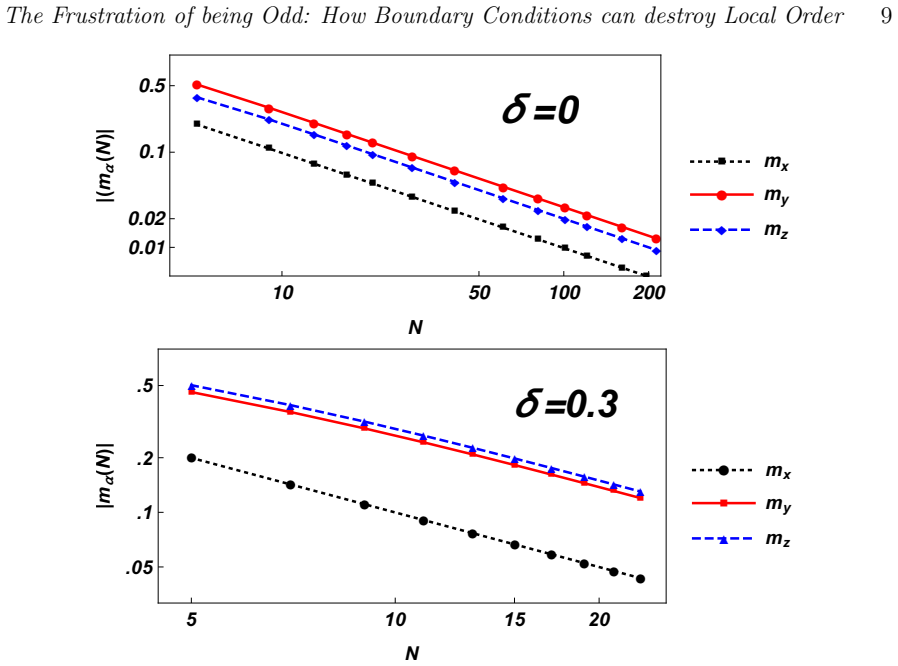
- The numerical results for $\delta\neq 0$ show the algebraic decay persists away from the free-fermion line, so the effect is not special to the exactly solvable XY point.
Reading between the lines
- Editorial inference: the limit-ordering question is not merely technical; under the conventional prescription of taking $N\to\infty$ first in the two-point function, the same model has $m_x=(1-\tan^2\phi)^{1/4}$ and the paradox disappears. The paper's case therefore stands or falls on whether the finite-size symmetry-broken state is the physically relevant one.
- Editorial inference: the non-staggered local moment coexists with a staggered two-point correlator at fixed $r$ in Eq. (10), so on an odd ring the one-point and two-point functions encode incompatible-looking orders; comparing them directly in a numerical or experimental setting would isolate which limiting prescription is realized.
- Editorial inference: the same parity-twist construction applies to any zero-field chain with three noncommuting parities, so other frustrated geometries, such as odd ladders or rings with a single defect, are natural places to look for the same boundary-induced destruction of local order.
Signed reviews
Editorial analysis
A structured set of objections, weighed in public.
Referee Report
Summary. The paper studies an odd-length spin-1/2 XYZ ring with periodic boundary conditions and no external field, choosing parameters so that one coupling (x) is antiferromagnetic and the other two are ferromagnetic. In the xAFM phase (φ in (-π/4,0]), the authors construct finite-size parity-projected states |g_α> via Eq. (9) and compute the one-point magnetizations. For the XY case δ=0 they use a Jordan-Wigner mapping and express the magnetizations as Toeplitz determinants, obtaining asymptotic formulas m_x ~ (1/N)(1-tan^2 φ)^{1/4}, m_y ~ (2/N)(1-tan φ)^{1/4}(1+tan φ)^{-3/4}, and m_z=2/N; for δ≠0 they provide exact diagonalization data up to N=23. They conclude that in the frustrated AFM phase all spontaneous magnetizations decay algebraically to zero and are not staggered, a behavior they call 'ferromagnetic mesoscopic magnetization' (MFM), and they interpret this as evidence that frustrated boundary conditions destroy local order in the thermodynamic limit. In the yFM phase they recover the standard finite magnetizations. The supplementary material contains the determinant representations, the asymptotic results quoted from the companion paper [54], and a perturbative kink calculation near the Ising point.
Significance. If the central claim were established, this would be a striking counterexample to the standard assumption that boundary conditions cannot affect local bulk order parameters. The paper has real strengths: the finite-N determinant representation for the XY case is exact and parameter-free, the results are cross-checked numerically, and the perturbative analysis in Appendix A.6 provides an independent consistency check. However, the physical conclusion depends on a nonstandard definition of the order parameter: the one-point function is evaluated in translationally invariant parity-projected states and then the thermodynamic limit is taken, rather than using the standard staggered-field symmetry-breaking protocol. The paper itself acknowledges that the standard N→∞-first prescription gives a finite staggered magnetization from Eq. (10). Therefore the significance is conditional on resolving this methodological issue.
major comments (3)
- [Section 4, Eq. (10) and following paragraph] The extraction of m_x from the antipodal value of Cxx(r) is internally inconsistent. Eq. (10) gives Cxx(r) ~ (-1)^r sqrt(1-tan^2 φ) (1-2r/N) for fixed r, and at r ≈ N/2 this is of order 1/N. If cluster decomposition were used, one would expect m_x^2 ~ Cxx(r≈N/2), yielding m_x ~ N^{-1/2}, not the quoted (1/N)(1-tan^2 φ)^{1/4}. The paper instead identifies the correlation value itself with m_x, and later notes that cluster decomposition is 'spoiled'. But then the quantity computed in Eq. (A.42) is not connected to the standard order parameter extracted from two-point correlations, and the antipodal argument does not support the claimed 1/N decay. This point needs to be resolved before the central claim can be assessed.
- [Section 4, Eq. (10); Section 1] The central claim that frustrated boundary conditions destroy local order rests on defining the order parameter as the thermodynamic limit of the one-point function in the finite-size parity-projected states |g_x> of Eq. (9). This is not the standard SSB definition for an antiferromagnet, which is m_s = lim_{h→0+} lim_{N→∞} (1/N) Σ_j (-1)^j ⟨σ^x_j⟩_h with a staggered field selecting one Néel state. On an odd ring a perfectly staggered field cannot be periodic, but a field with a single sign defect becomes a staggered field in the bulk; the paper does not compute this limit. Moreover, Eq. (10) shows that for fixed r the correlation has the staggered envelope (-1)^r and tends to a finite value if N→∞ first. Thus the evidence presented supports a finite staggered order under the standard protocol, and the paper's conclusion depends on a methodological choice that is asserted rather than derived.
- [Appendix A.6, Eqs. (A.56), (A.59), (A.60)] The perturbative calculation illustrates the same definitional issue. In the uniform kink superposition |s_{q=0}>, the local magnetization is 1/N (Eq. A.59), but a single-kink state |l> has ⟨σ^x_j|l> = (-1)^{l+j} or (-1)^{l+j+1} (Eq. A.56), which is staggered away from the defect and would give a finite bulk staggered magnetization in the N→∞ limit. The vanishing 1/N therefore arises from choosing the translationally invariant superposition of kinks, not from the impossibility of staggered order on an odd ring. The authors should justify why |s_{q=0}>, rather than a state with a localized symmetry-breaking defect, is the correct finite-size representative of the AFM phase.
minor comments (5)
- [Abstract] 'Central tenant' should be 'central tenet'.
- [Section 2] The sentence containing '([H, Πα])' is malformed; it should read [H, Πα]=0.
- [Appendix A.5, Eqs. (A.42)-(A.43)] The main asymptotic formulas are imported from the companion paper [54] without derivation or a statement of their regime of validity. Since these formulas carry the quantitative claim, the authors should either include a proof sketch or clearly state the theorem and its conditions in the main text.
- [Fig. 2 caption] 'gathered settings δ=0' should be 'gathered setting δ=0'; also the legend markers are described as dots, while filled squares, circles, and diamonds are used.
- [Appendix A.2, Eq. (A.10)] There is a typographical issue in the presentation of Cxx(r) = (-i)^r Δ(ρ_xx); please check the formatting of all determinant formulas for missing parentheses.
Circularity Check
No significant circularity: the central finite-size magnetization is derived from the Hamiltonian by exact fermionization and Toeplitz determinants, with an independent perturbative check.
full rationale
The paper's central result, Eq. (A.42) with mx ~ (1/N)(1 - tan^2 phi)^(1/4), is derived within the paper from the Hamiltonian by mapping to Majorana fermions, using Wick's theorem, and evaluating Toeplitz determinants. The state |g_x> in Eq. (9) is explicitly constructed from the Hamiltonian's zero-field degenerate ground states, and the one-point function is converted into the determinant of a finite matrix. This is not a fitted parameter, and the result is checked independently by both numerical diagonalization and by the perturbative kink calculation in Appendix A.6, where the same 1/N magnetization emerges from the exact classical ground-state subspace for phi -> 0. The citations to the authors' previous work are not circularly load-bearing: Ref. [54] is a parameter-free mathematical result about Toeplitz determinants with delta-function singularities, used as a lemma; Ref. [15] is cited for the physical motivation of evaluating correlations at antipodal points, but the paper does not rely on that citation for the proof of Eq. (A.42), which is worked out in the appendix. The paper also explicitly acknowledges the alternative standard prescription: 'using the standard prescription of taking N->infinity first, one would get mx = (1 - tan^2 phi)^(1/4)' and then explains the antipodal-point procedure. This is a transparent choice of limiting prescription and definition of the order parameter, not a hidden identification of output with input. Whether that choice is the physically correct order-parameter definition is a scientific judgment about the model, not a circularity in the derivation itself. Thus no step in the claimed derivation chain reduces by construction to its own inputs.
Assumptions & free parameters
assumptions (5)
- standard math Jordan-Wigner transformation and Wick's theorem apply to the XY/XYZ chain with odd periodic boundary conditions.
- domain assumption Asymptotic evaluation of Toeplitz determinants with delta-function singularities given in the companion paper [54] is correct.
- domain assumption The finite-size parity-projected states |g_alpha> are the appropriate symmetry-broken ground states whose N-to-infinity one-point functions define the order parameter.
- standard math Szego limit theorem and Wiener-Hopf method for Toeplitz determinants.
- domain assumption The algebraic decay observed for N up to 23 in the XYZ case continues to the thermodynamic limit.
Cite this review
Pith. "Pith review of The Frustration of being Odd: How Boundary Conditions can destroy Local Order." pith.science (2026). https://pith.science/paper/SWQGQCEM
@misc{pith2026190810876,
  author       = {Pith},
  title        = {Pith review of: The Frustration of being Odd: How Boundary Conditions can destroy Local Order},
  year         = {2026},
  howpublished = {\url{https://pith.science/paper/SWQGQCEM}},
  note         = {Machine review of arXiv:1908.10876}
}
read the original abstract
A central tenant in the classification of phases is that boundary conditions cannot affect the bulk properties of a system. In this work, we show striking, yet puzzling, evidence of a clear violation of this assumption. We use the prototypical example of an XYZ chain with no external field in a ring geometry with an odd number of sites and both ferromagnetic and antiferromagnetic interactions. In such a setting, even at finite sizes, we are able to calculate directly the spontaneous magnetizations that are traditionally used as order parameters to characterize the system's phases. When ferromagnetic interactions dominate, we recover magnetizations that in the thermodynamic limit lose any knowledge about the boundary conditions and are in complete agreement with standard expectations. On the contrary, when the system is governed by antiferromagnetic interactions, the magnetizations decay algebraically to zero with the system size and are not staggered, despite the AFM coupling. We term this behavior {\it ferromagnetic mesoscopic magnetization}. Hence, in the antiferromagnetic regime, our results show an unexpected dependence of a local, one--spin expectation values on the boundary conditions, which is in contrast with predictions from the general theory.
Figures


Reference graph
Works this paper leans on
-
[54]
Sachdev, Quantum Phase Transitions, Cambridge University Press (2011)
S. Sachdev, Quantum Phase Transitions, Cambridge University Press (2011)
work page 2011
-
[1]
Introduction Landau theory is one of the most impactful constructions of the last century. It allows distinguishing between different phases through different local order parameters, quantities which are finite or vanish depending on the phase of a system [1, 3, 2, 4]. Although the new century has taught us that this classification is not complete, because ce...
-
[2]
Crucially, we apply periodic boundary conditions σα j+N =σα j
The spin chains and their properties We consider an anisotropic spin– 1 2 chain with Hamiltonian H = N∑ j=1 cosδ ( cosφσx jσx j+1 + sinφσy jσy j+1 ) − sinδσz jσz j+1, (1) where σα j , with α = x,y,z , are Pauli operators and N is the number of lattice sites, which we henceforth set to be odd N = 2M + 1. Crucially, we apply periodic boundary conditions σα ...
-
[3]
and separates two phases characterized by a two–fold degenerate ground state. In particular, forφ∈ [−π/2,−π/4) the phase favors a ferromagnetic alignment along the y direction (yFM), while for φ∈ (−π/4, 0] the dominant interaction is AFM along the x direction (xAFM) and thus topologically frustrated. With no external field, all three parity operators along...
-
[4]
(1) and focus on the ferromagnetic region φ∈ [−π/2,−π/4)
The ferromagnetic case Let us now turn back to the system in eq. (1) and focus on the ferromagnetic region φ∈ [−π/2,−π/4). The (quasi–)long–range order represented by the order parameter can be extracted in two ways: either from the two–point function or by selecting a suitable superposition of states at finite sizes and then following their magnetization ...
-
[5]
The frustrated case We now turn to the case with ( φ∈ (−π/4, 0]), where the boundary conditions induce topological frustration. The effect of frustration has been recently studied in detail in Refs. [14, 15, 53]. For δ = 0, the model can be solved through the same steps used in the traditional cases and exactly mapped into a system of free fermions. In the...
-
[6]
Conclusions We have presented a comparative study of the ferromagnetic and AFM frustrated case for a XYZ chain, showing that, contrary to expectations, the boundary conditions are able to destroy local order. We have done so, by realizing that, with no external field, we can exploit particle/hole duality to construct an exact ground state at finite sizes th...
work page 2016
-
[7]
To overcome this problem, we proceed as in Ref
(A.28) The magnetization in the x direction, instead, is more complicated, because the generating function of the corresponding Toeplitz matrix has a non–zero winding number. To overcome this problem, we proceed as in Ref. [57] and notice that the determinant in eq. (A.26) can be seen as the minor of ∆ r+1(ρy) in eq. (A.27) obtained removing the first row ...
Show all 66 references
-
[8]
Landau, E.M
L.D. Landau, E.M. Lifshitz, & L.P. Pitaevskij, Statistical Physics, Pergamon Press, Oxford (1978)
1978
-
[9]
Chandler, Introduction to Modern Statistical Mechanics , Oxford University Press; 1 edition (1987)
D. Chandler, Introduction to Modern Statistical Mechanics , Oxford University Press; 1 edition (1987)
1987
-
[10]
Anderson, Basic Notions Of Condensed Matter Physics , Addison-Wesley (1997)
P.W. Anderson, Basic Notions Of Condensed Matter Physics , Addison-Wesley (1997)
1997
-
[11]
Coleman, Introduction to Many-Body Physics , Cambridge University Press (2016)
P. Coleman, Introduction to Many-Body Physics , Cambridge University Press (2016)
2016
-
[12]
Stone (Ed.), Quantum Hall Effect , World Scientific (1992)
M. Stone (Ed.), Quantum Hall Effect , World Scientific (1992)
1992
-
[13]
Wen, Quantum Field Theory of Many-body Systems: From the Origin of Sound to an Origin of Light and Electrons , Oxford University Press (2004)
X.-G. Wen, Quantum Field Theory of Many-body Systems: From the Origin of Sound to an Origin of Light and Electrons , Oxford University Press (2004)
2004
-
[14]
Nayak, S.H
C. Nayak, S.H. Simon, A. Stern, M. Freedman, & S. Das Sarma, Rev. Mod. Phys. 80, 1083 (2008). Non-abelian anyons and topological quantum computation
2008
-
[15]
Hasan & C.L
M.Z. Hasan & C.L. Kane, Rev. Mod. Phys. 82, 3045 (2010) Colloquium: topological insulators
2010
-
[16]
Fradkin, Field theories of condensed matter physics , Cambridge University Press (2013)
E. Fradkin, Field theories of condensed matter physics , Cambridge University Press (2013)
2013
-
[17]
B. A. Bernevig & T.L. Hughes, Topological Insulators And Topological Superconductors, Princeton University Press (2013). The Frustration of being Odd: How Boundary Conditions can destroy Local Order 23
2013
-
[18]
S. M. Giampaolo & B. C. Hiesmayr, Phys. Rev. A 92, 012306 (2015). Topological and nematic ordered phases in many–body cluster–Ising models
2015
-
[19]
Witten, Rev
E. Witten, Rev. Mod. Phys. ‘bf 88, 35001 (2016). Free fermions And Topological Phases
2016
-
[20]
B. Zeng, X. Chen, D.-L. Zhou, & X.-G. Wen, Quantum Information Meets Quantum Matter: From Quantum Entanglement to Topological Phases of Many-Body Systems , Springer (2019)
2019
-
[21]
J.-J. Dong, P. Li, & Q.-H. Chen, J. Stat. Mech. P113102 (2016) The A-Cycle Problem for Transverse Ising Ring
2016
-
[22]
S. M. Giampaolo, F. B. Ramos, & F. Franchini, J. Phys. Commun. 3, 081001 (2019) The Frustration in being Odd: Area Law Violation in Local Systems
2019
-
[23]
Affleck, Acta Phys
I. Affleck, Acta Phys. Polon B 26 , 1869 (1995) Conformal Field Theory Approach to the Kondo Effect
1995
-
[24]
Durganandini, Phys
P. Durganandini, Phys. Rev. B 53 , R8832(R) (1996). Kondo effect in a Luttinger liquid: A boundary-conformal-field-theory approach
1996
-
[25]
Cardy, Nucl
J. Cardy, Nucl. Phys. B 240 , 4 (1984) Conformal invariance and surface critical behavior
1984
-
[26]
Cardy, arXiv:hep-th/0411189 (2004)
J. Cardy, arXiv:hep-th/0411189 (2004). Boundary Conformal Field Theory
2004 arXiv
-
[27]
Di Francesco, P
P. Di Francesco, P. Mathieu, & D. Senechal, Conformal Field Theory , Springer (1999)
1999
-
[28]
Korepin, N.M
V.E. Korepin, N.M. Bogoliubov, & A.G. Izergin, Quantum Inverse Scattering Method and Correlation Functions, Cambridge University Press (1997)
1997
-
[29]
Korepin & P
V.E. Korepin & P. Zinn-Justin, J. Phys. A 33 , 7053 (2000) Thermodynamic limit of the six-vertex model with domain wall boundary conditions
2000
-
[30]
Zinn-Justin, (2002), arXiv:cond-mat/0205192 (2002)
P. Zinn-Justin, (2002), arXiv:cond-mat/0205192 (2002). The influence of boundary conditions in the six-vertex model
2002 arXiv
-
[31]
Colomo & A
F. Colomo & A. G. Pronko, J. Stat. Phys. 138, 662 (2010) The arctic curve of the domain-wall six-vertex model
2010
-
[32]
Bleher & K
P. Bleher & K. Liechty, Random Matrices and the Six-Vertex Model, CRM monographs series, vol. 32, American Mathematical Society, Providence (2013)
2013
-
[33]
Colomo & A
F. Colomo & A. Sportiello, J. Stat. Phys. 164, 1488 (2016) Arctic curves of the six-vertex model on generic domains: the Tangent Method
2016
-
[34]
Allegra, J
N. Allegra, J. Dubail, J.-M. St´ ephan, & J. Viti, J. Stat. Mech. 2016, 053108 (2016). Inhomogeneous field theory inside the arctic circle
2016
-
[35]
Reshetikhin & A
N. Reshetikhin & A. Sridhar, Commun. Math. Phys. 356, 535 (2017) Integrability of limit shapes of the six-vertex model
2017
-
[36]
Di Francesco & E
P. Di Francesco & E. Guitter, J. Phys. A: Math. Theor. 51, 355201 (2018) Arctic curves for paths with arbitrary starting points: a tangent method approach
2018
-
[37]
Colomo, A.G
F. Colomo, A.G. Pronko, & A. Sportiello, J. Stat. Phys. 174, 1 (2018) Arctic Curve of the Free-Fermion Six-Vertex Model in an L-Shaped Domain
2018
-
[38]
Toulouse, Commun
G. Toulouse, Commun. Phys. 2, 115 (1977) Theory of the frustration effect in spin glasses: I
1977
-
[39]
Vannimenus & G
J. Vannimenus & G. Toulouse, J. Phys. C 10, L537 (1977) Theory of the frustration effect. II. Ising spins on a square lattice
1977
-
[40]
M.M. Wolf, F. Verstraete & J.I. Cirac, Int. Journal of Quantum Information 1, 465 (2003) Entanglement and Frustration in Ordered Systems
2003
-
[41]
S. M. Giampaolo, G. Gualdi, A. Monras, & F. Illuminati, Phys. Rev. Lett. 107, 260602 (2011) Characterizing and quantifying frustration in quantum many-body systems
2011
-
[42]
Marzolino, S
U. Marzolino, S. M. Giampaolo, & F. Illuminati, Phys. Rev. A 88, 020301(R) (2013) Frustration, entanglement, and correlations in quantum many body systems
2013
-
[43]
J. F. Sadoc & R. Mosseri, Geometrical frustration. Cambridge University Press (2007)
2007
-
[44]
Lacroix, P
C. Lacroix, P. Mendels, & F. Mila (eds), Introduction to Frustrated Magnetism: Materials, The Frustration of being Odd: How Boundary Conditions can destroy Local Order 24 Experiments, Theory. Springer Series in Solid-State Sciences, Vol. 164 (2011)
2011
-
[45]
H. T. Diep, Frustrated Spin Systems, World Scientific (2013)
2013
-
[46]
Wannier, Phys
G.H. Wannier, Phys. Rev. 79, 357 (1950) Antiferromagnetism. The Triangular Ising Net
1950
-
[47]
Burkhardt & I
T.W. Burkhardt & I. Guim, J. Phys. A: Math. Gen 18, L33 (1985) Finite-size scaling of the quantum Ising chain with periodic, free, and antiperiodic boundary conditions
1985
-
[48]
Cabrera & R
G.G. Cabrera & R. Jullien, Phys. Rev. B 35 , 7062 (1987) Role of boundary conditions in the finite-size Ising model
1987
-
[49]
Campostrini, A
M. Campostrini, A. Pelissetto, & E. Vicari, Phys. Rev. E 91 , 042123 (2015) Quantum transitions driven by one-bond defects in quantum Ising rings
2015
-
[50]
Ercolessi, S
E. Ercolessi, S. Evangelisti, F. Franchini, & F. Ravanini, Phys. Rev. B 88, 104418 (2013) Modular invariance in the gapped XYZ spin- 1 2 chain
2013
-
[51]
Franchini, An introduction to integrable techniques for one-dimensional quantum systems , Lecture Notes in Physics 940, Springer (2017)
F. Franchini, An introduction to integrable techniques for one-dimensional quantum systems , Lecture Notes in Physics 940, Springer (2017)
2017
-
[52]
Mari´ c, S
V. Mari´ c, S. M. Giampaolo, D. Kui´ c, & F. Franchini, In preparation The Frustration in being Odd: Exact finite size degeneracies
-
[53]
Mari´ c, S
V. Mari´ c, S. M. Giampaolo, D. Kui´ c, & F. Franchini, In preparation The Frustration in being Odd: Can Boundary Conditions induce a Quantum Phase Transition?
-
[55]
Damski & M
B. Damski & M. M. Rams, J. Phys. A 47 , 025303 (2014) Exact results for fidelity susceptibility of the quantum Ising model: The interplay between parity, system size, and magnetic field
2014
-
[56]
E. Lieb, T. Schultz, & D. Mattis, Ann. of Phys. 16, 407-466 (1961) Two Soluble Models of an Antiferromagnetic Chain
1961
-
[57]
Jordan & E
P. Jordan & E. Wigner, Z. Phys. 47, 631 (1928) ¨Uber das Paulische ¨Aquivalenzverbot
1928
-
[58]
McCoy, Phys
B.M. McCoy, Phys. Rev. 173, 531 (1968) Spin Correlation Functions of the X-Y Model
1968
-
[59]
Barouch & B.M
E. Barouch & B.M. McCoy, Phys. Rev. A 3 , 786 (1971) Statistical Mechanics of the XY Model. II. Spin-Correlation Functions
1971
-
[60]
Dong & P
J.-J. Dong & P. Li, Mod. Phys. Lett. B 31 , 1750061 (2017) The a-cycle problem in XY model with ring frustration
2017
-
[61]
Mari´ c, & F
V. Mari´ c, & F. Franchini, Asymptotic behavior of Toeplitz determinants with delta function singularities , arXiv:2006.01922 (2020)
2020 arXiv
-
[62]
Mari´ c, S
V. Mari´ c, S. M. Giampaolo, & F. Franchini, In preparation The Frustration in being Odd: Resilience against perturbations
-
[63]
Hirschman, Jr., Amer
I.I. Hirschman, Jr., Amer. J. Math. 88, 577 (1966). The Strong Szeg¨ o Limit Theorem for Toeplitz Determinants
1966
-
[64]
Wu, Phys
T.T. Wu, Phys. Rev. 149, 380 (1966). Theory of Toeplitz Determinants and the Spin Correlations of the Two-Dimensional Ising Model. I
1966
-
[65]
Campostrini, A
M. Campostrini, A. Pelissetto, & E. Vicari, J. Stat. Mech. P11015 (2015) Quantum Ising chains with boundary fields
2015
-
[66]
McCoy & T.T
B. McCoy & T.T. Wu, The Two-Dimensional Ising Model , Harvard University Press (1973)
1973
Reviewed August 14, 2026 · model on record in the stance chip above.
Discussion (0). Continue with ORCID to comment.