REVIEW 3 major objections 4 minor 2 cited by
For one-dimensional critical systems, low-lying excited states corresponding to conformal-field-theory primary fields are accurately represented by a truncated basis of ground-state Schmidt vectors, with the accuracy controlled by the expon
Reviewed by Pith at T0; open to challenge. T0 means a machine referee read the full paper against a public rubric. the ladder, T0–T4 →
T0 review · deepseek-v4-flash
2026-08-03 21:04 UTC pith:SYHQ5LOJ
load-bearing objection Plausible CFT explanation of the stitched-MPS excited-state method with strong numerics, but the exponential-decay mechanism rests on an unproved O(1) bound that is likely not true in general. the 3 major comments →
Excited states from local effective Hamiltonians of matrix product states and their entanglement spectrum transition
The pith
A machine-rendered reading of the paper's core claim, the machinery that carries it, and where it could break.
Core claim
Central claim: in a 1D critical system described by CFT, low-lying excited states corresponding to primary fields are, to high accuracy, superpositions of the D dominant ground-state Schmidt vectors. Quantitatively, the excited-state reduced density matrix in the ground-state Schmidt basis is (M_a)_{αβ} = (1/Z) e^{-(π²/W)(h_α+h_β-c/12)} f^a_{αβ}(r), with h_α the conformal weights of the ground-state entanglement Hamiltonian and f^a_{αβ}(r) an order-one normalized annulus correlation function. The exponential factor suppresses high-α entries, so the truncated fidelity approaches unity at finite D, explaining the accuracy of 'stitched' excitations. The same expression predicts a reorganization
What carries the argument
The key machinery is the 'stitched excitation' ansatz combined with the modified fidelity R'_a(D) = Σ_{α<D} (M_a)_{αα}, where M_a is the excited-state reduced density matrix in the ground-state Schmidt basis. The CFT step identifies (M_a)_{αβ} as an annulus two-point function of the primary field, Eq. (29), with the exponential factor e^{-(π²/W)(h_α+h_β-c/12)} built from the entanglement-Hamiltonian eigenvalues h_α. This factor, together with the order-one correlation ratio f^a_{αβ}(r), is the engine that makes finite-D truncation accurate.
Load-bearing premise
The derivation assumes the conformal boundary conditions at the entanglement cuts are identical for ground and excited primary states, and that the normalized correlation ratio f^a_{αβ}(r) stays order one; if either fails, the exponential decay in Schmidt index does not follow.
What would settle it
Compute (M_a)_{αα} for an excited state that provably changes the entanglement boundary condition (e.g., a twist primary) in a small critical chain from exact diagonalization, and check whether its decay with α is governed by the ground-state entanglement-Hamiltonian weights h_α; a different decay rate or a non-O(1) f^a_{αβ} would falsify the central claim.
If this is right
- The ground-state MPS optimization already gives access to low-lying excitation spectra without separate excited-state algorithms, for any 1D critical chain described by a CFT.
- The accuracy of the method is controlled by the conformal-weight spectrum of the ground-state entanglement Hamiltonian; the larger the gaps in h_α, the faster the convergence with bond dimension D.
- Away from criticality the mechanism fails, explaining the empirically observed loss of accuracy in gapped phases.
- The excited-state entanglement spectrum reorganizes with the subsystem fraction r = L_A/L, at r=1/2 forming equally spaced conformal towers distinct from the ground-state ones, with finite-size scaling governed by 1/log N.
- Descendant states also appear numerically well captured, suggesting the CFT argument extends beyond primary fields.
Where Pith is reading between the lines
- This suggests a quantitative estimator: the required bond dimension D for a target accuracy in excited states could be predicted solely from the ground-state entanglement spectrum, since the decay rate is set by h_α.
- The entanglement-spectrum transition may offer a new probe of the operator content of an excited state: the tower structure at r=1/2 might encode the fusion of the primary field with the boundary condition, testable by extracting OPE coefficients from the off-diagonal f^a_{αβ}(r).
- A critical experiment in the field-theory sense: choose an excited state that provably changes the entanglement boundary condition (e.g., a twist primary) and check whether the exponential decay still tracks the ground-state h_α; the assumed universality of boundary conditions would be tested directly.
- The same CFT expression may give the explicit entanglement Hamiltonian of the excited state, enabling a 'conformal lens' that reads off quantum numbers of quasiparticles from the spectrum at r=1/2.
Editorial analysis
A structured set of objections, weighed in public.
Referee Report
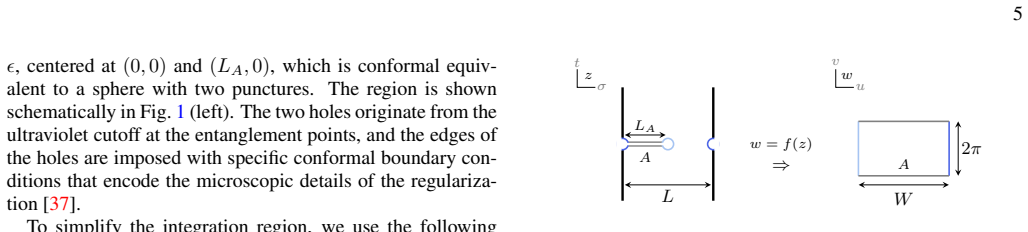
Summary. This paper addresses the widely observed but poorly understood fact that, for one-dimensional critical systems, the low-energy eigenvectors of the local effective Hamiltonian constructed from a ground-state MPS accurately reproduce physical excited states. The authors propose a CFT mechanism: truncating to the D largest ground-state Schmidt vectors restricts the excited-state reduced density matrix to a subspace in which its matrix elements decay as e^{-π²(h_α+h_β-c/12)/W} times a coefficient f^a_{αβ}(r) (Eq. (29)). They argue, from Eq. (32), that the diagonal elements decay exponentially with the ground-state entanglement Hamiltonian weight, so the fidelity R'_a(D) approaches unity at finite D. They further derive an r-dependence of the density matrix that predicts an entanglement-spectrum transition as the ratio r=L_A/L increases from small values to 1/2, and they present numerical evidence for this transition in the transverse-field Ising chain and the three-state clock model.
Significance. If the proof were complete, this would be a valuable theoretical foundation for a practical numerical method, connecting DMRG excited-state algorithms to boundary CFT and clarifying why the stitched-excitation ansatz works at criticality. The paper also introduces a new prediction—the r-dependent reorganization of the excited-state entanglement spectrum—with clean numerical verification in two models. The TFIC free-fermion calculations are exact and reproducible, and the clock-model MPS data support the qualitative picture. However, the central derivation relies on an unjustified bound on the correlator ratio f; this is the key weakness that prevents acceptance in the present form.
major comments (3)
- [Sec. III.B, after Eq. (32)] The sentence "Since the Schmidt vectors are normalized, the coefficient f^a_{αβ}(r) in Eq. (29) is (at most) of order O(1)" is a non sequitur. Normalization of the states does not bound matrix elements of the operator product \hat O_a^*(w_\infty)\hat O_a(w_{-\infty}); in CFT such matrix elements between descendant states can grow with h_α,h_β (e.g., polynomially in the conformal level), and the annulus two-point function in the denominator of Eq. (30) is a c-number that does not cancel this α-dependence. Since the exponential decay conclusion for (M_a)_{αα} and hence R'_a(D)→1 follows entirely from this O(1) assumption, the central theoretical mechanism is not established. Please provide a proof of a growth bound (polynomial growth would suffice because W∼log N) or explicitly reclassify the decay statement as a heuristic supported by numerics.
- [Sec. III.B, Eqs. (33)-(36)] The OPE expansion in powers of \tilde r^{2h_b} is used for r up to 1/2, where \tilde r=2πr=π. This is not a small parameter; the 'expansion' is uncontrolled and the statement that subleading terms can exceed the identity at r=1/2 is not derived. Consequently, the predicted entanglement-spectrum transition is not a rigorous consequence of the CFT calculation. The numerical evidence is supportive, but the theoretical prediction should be presented with this limitation stated or with a different argument.
- [Sec. III.A and footnote [36]] The derivation is performed on a circle (periodic boundary conditions), while the numerical simulations are for open-boundary chains. The assertion that changing to open boundary conditions modifies only subleading terms requires substantiation, especially because the identification of the Schmidt states |v_α⟩ with the eigenstates of H_CFT in Eq. (27) and the decomposition into conformal towers depend on the boundary conditions. Without further justification, the quantitative connection between Eq. (29) and the open-chain numerics (Tables I-II, Fig. 2) is not airtight. Please clarify or soften the comparison.
minor comments (4)
- [Sec. III.A, after Eq. (22)] The notation 'lower half cylinder t < 0−' and similar expressions is confusing; please use standard limits (e.g., t→0^-) to clarify the path-integral regions.
- [Table II] The table layout is garbled in the manuscript (columns and entries poorly aligned), making it hard to read which values refer to R_a(D) versus R'_a(D). Please reformat.
- [Eq. (A14)] The overlap formula for two Gaussian states is stated without derivation; a citation to [46] or a brief explanation of the determinant factor would help the reader.
- [Fig. 2(c)] The horizontal axis label 'r' should specify the range (r∈[0.05,0.5]), and the curves are hard to distinguish in grayscale; consider using different line styles.
Circularity Check
No significant circularity: the stitched-excitation analysis is a self-contained CFT calculation; the unproved O(1) bound on f is a soundness gap, not a circular reduction.
full rationale
The paper's central claim is not circular. The fidelities R_a(D) and R'_a(D) are defined directly from exact excited states and ground-state Schmidt vectors, and no parameter is fitted to the target fidelities or entanglement spectra. The CFT expression for (M_a)_{alpha beta} in Eq. (29) is derived in the text from a path-integral/operator calculation using standard CFT facts (state-operator correspondence, the Cardy-Tonni entanglement Hamiltonian, and annulus two-point normalization). The same-author citations ([19], [35]) are peripheral: [35] is listed alongside [26,34] as prior CFT technology, and the relevant formula is reproduced rather than imported as an unexamined ansatz. The r-dependence of the excited-state entanglement spectrum is explicitly attributed to Ref. [26], so it is not being relabeled as a new prediction. The paper's stated assumption that the conformal boundary conditions at the entanglement cuts are the same for ground and excited states is a genuine limitation, but it is an assumption, not a definitional identification of the conclusion with the premise. The step needing scrutiny is the assertion after Eq. (32) that f^a_{alpha beta}(r) is 'at most of order O(1)' because the Schmidt vectors are normalized; this is an unproved bound and a potential correctness gap, since CFT matrix elements of primary operators can grow with descendant level, but it is not a fitted input, a self-citation, or a constructional identity. The numerical checks (exact free-fermion calculations for the TFIC and DMRG for the clock model) are independent external benchmarks. Thus no circular step is exhibited.
Axiom & Free-Parameter Ledger
axioms (5)
- ad hoc to paper The conformal boundary conditions at the entanglement cuts are the same for the ground state and for excited states associated with CFT primary fields.
- ad hoc to paper The normalized correlation ratio f^a_{αβ}(r) is at most O(1) for all Schmidt indices α, β.
- ad hoc to paper The OPE expansion in powers of ̃r^{2h_b} is valid for r up to 1/2, i.e., ̃r=2πr up to π.
- standard math Standard CFT technology: state-operator correspondence, BCFT on a strip, annulus partition functions, and OPE coefficients.
- standard math Rayleigh-Ritz: if the exact low-lying states are nearly contained in the D²-dimensional subspace of ground-state Schmidt products, then eigenvectors of the projected effective Hamiltonian approximate them.
read the original abstract
Solving excited states is a challenging task for interacting systems. For one-dimensional critical systems, however, excited states can be directly accessed from the eigenvectors of the local effective Hamiltonian that is constructed from the ground state obtained by variational matrix product state (MPS) optimization. Despite its numerical success, the theoretical mechanism underlying this method has remained largely unexplored. In this work, we provide a conformal field theory (CFT) perspective that helps elucidate this connection. The key insight is that this construction effectively uses a truncated basis of ground-state Schmidt vectors to represent excited states, where the contribution of each Schmidt vector can be expressed as a CFT correlation function and shown to decay with increasing Schmidt index. The CFT analysis further predicts an entanglement-spectrum transition of excited states as the ratio of the subsystem size to the total system size is varied. Our numerical results support this picture and demonstrate a reorganization of the entanglement spectrum into distinct conformal towers as this ratio changes.
Figures


Forward citations
Cited by 2 Pith papers
-
Exclusive Scattering Channels from Entanglement Structure in Real-Time Simulations
Introduces an entanglement-based technique using Schmidt decompositions to isolate exclusive scattering channels in Matrix Product State simulations of quantum field theories, demonstrated for heavy particle detection...
-
The velocity dispersion function of red galaxies in four Hubble Frontier Fields galaxy clusters
Red cluster members in four Hubble Frontier Fields clusters have compatible Schechter velocity dispersion functions with positive faint-end slopes and characteristic log σ* ≈ 2.18–2.47, extended systematically to log ...
Reference graph
Works this paper leans on
-
[1]
S. R. White, Density matrix formulation for quantum renormal- ization groups, Phys. Rev. Lett.69, 2863 (1992)
1992
-
[2]
¨Ostlund and S
S. ¨Ostlund and S. Rommer, Thermodynamic limit of density matrix renormalization, Phys. Rev. Lett.75, 3537 (1995)
1995
-
[3]
Verstraete, D
F. Verstraete, D. Porras, and J. I. Cirac, Density matrix renor- malization group and periodic boundary conditions: A quantum information perspective, Phys. Rev. Lett.93, 227205 (2004)
2004
-
[4]
Perez-Garcia, F
D. Perez-Garcia, F. Verstraete, M. M. Wolf, and J. I. Cirac, Ma- trix Product State Representations, Quantum Inf. Comput.7, 401 (2007)
2007
-
[5]
Schollw ¨ock, The density-matrix renormalization group in the age of matrix product states, Ann
U. Schollw ¨ock, The density-matrix renormalization group in the age of matrix product states, Ann. Phys.326, 96 (2011)
2011
-
[6]
J. I. Cirac, D. P ´erez-Garc´ıa, N. Schuch, and F. Verstraete, Ma- trix product states and projected entangled pair states: Con- cepts, symmetries, theorems, Rev. Mod. Phys.93, 045003 (2021)
2021
-
[7]
Verstraete, V
F. Verstraete, V . Murg, and J. I. Cirac, Matrix product states, projected entangled pair states, and variational renormalization group methods for quantum spin systems, Adv. Phys.57, 143 (2008)
2008
-
[8]
J. I. Cirac and F. Verstraete, Renormalization and tensor product states in spin chains and lattices, J. Phys. A42, 504004 (2009)
2009
-
[9]
Or ´us, A practical introduction to tensor networks: Matrix product states and projected entangled pair states, Ann
R. Or ´us, A practical introduction to tensor networks: Matrix product states and projected entangled pair states, Ann. Phys. 349, 117 (2014)
2014
-
[10]
Silvi, F
P. Silvi, F. Tschirsich, M. Gerster, J. J ¨unemann, D. Jaschke, M. Rizzi, and S. Montangero, The Tensor Networks Anthology: Simulation techniques for many-body quantum lattice systems, SciPost Physics Lecture Notes , 008 (2019)
2019
-
[11]
Okunishi, T
K. Okunishi, T. Nishino, and H. Ueda, Developments in the Tensor Network — from Statistical Mechanics to Quantum En- tanglement, J. Phys. Soc. Jpn91, 062001 (2022)
2022
-
[12]
M. C. Ba ˜nuls, Tensor Network Algorithms: A Route Map, Annu. Rev. Condens. Matter Phys14, 173 (2023)
2023
-
[13]
Xiang,Density Matrix and Tensor Network Renormalization (Cambridge University Press, 2023)
T. Xiang,Density Matrix and Tensor Network Renormalization (Cambridge University Press, 2023)
2023
-
[14]
J. L. Cardy, Conformal invariance and universality in finite-size scaling, J. Phys. A: Math. Gen.17, L385 (1984)
1984
-
[15]
Holzhey, F
C. Holzhey, F. Larsen, and F. Wilczek, Geometric and renor- malized entropy in conformal field theory, Nucl. Phys. B424, 443 (1994)
1994
-
[16]
Vidal, J
G. Vidal, J. I. Latorre, E. Rico, and A. Kitaev, Entanglement in quantum critical phenomena, Phys. Rev. Lett.90, 227902 (2003)
2003
-
[17]
Calabrese and J
P. Calabrese and J. Cardy, Entanglement entropy and quantum field theory, J. Stat. Mech.2004, P06002 (2004)
2004
-
[18]
Q. Hu, A. Franco-Rubio, and G. Vidal, Emergent universality in critical quantum spin chains: entanglement virasoro algebra, arXiv:2009.11383 (2020)
Pith/arXiv arXiv 2009
-
[19]
Y . Liu, Y . Kusuki, J. Kudler-Flam, R. Sohal, and S. Ryu, Multi- partite entanglement in two-dimensional chiral topological liq- uids, Phys. Rev. B109, 085108 (2024)
2024
-
[20]
Verstraete and J
F. Verstraete and J. I. Cirac, Matrix product states represent ground states faithfully, Phys. Rev. B73, 094423 (2006)
2006
-
[21]
Chepiga and F
N. Chepiga and F. Mila, Excitation spectrum and density ma- trix renormalization group iterations, Phys. Rev. B96, 054425 (2017)
2017
-
[22]
A. A. Eberharter, L. Vanderstraeten, F. Verstraete, and A. M. L¨auchli, Extracting the speed of light from matrix product states, Phys. Rev. Lett.131, 226502 (2023)
2023
-
[23]
X. Li, Z. Zhou, G. Xu, R. Chi, Y . Guo, T. Liu, H. Liao, and T. Xiang, Accurate determination of low-energy eigenspec- tra with multitarget matrix product states, Phys. Rev. B109, 045115 (2024)
2024
-
[24]
Cocchiarella and M
D. Cocchiarella and M. C. Ba ˜nuls, Low-temperature gibbs states with tensor networks, Phys. Rev. Res.7, 033184 (2025)
2025
-
[25]
O. Kovalska, J. von Delft, and A. Gleis, Tangent space krylov computation of real-frequency spectral functions: Influence of density-assisted hopping on 2d mott physics, arXiv:2510.07279 (2025)
arXiv 2025
-
[26]
F. C. Alcaraz, M. I. Berganza, and G. Sierra, Entanglement of low-energy excitations in conformal field theory, Phys. Rev. Lett.106, 201601 (2011)
2011
-
[27]
M. I. Berganza, F. C. Alcaraz, and G. Sierra, Entanglement of excited states in critical spin chains, J. Stat. Mech.2012, P01016 (2012)
2012
-
[28]
Eisert, M
J. Eisert, M. Cramer, and M. B. Plenio, Colloquium: Area laws for the entanglement entropy, Rev. Mod. Phys.82, 277 (2010)
2010
-
[29]
M. B. Hastings, An area law for one-dimensional quantum sys- tems, J. Stat. Mech.2007, P08024 (2007)
2007
-
[30]
Vidal, Efficient classical simulation of slightly entangled quantum computations, Phys
G. Vidal, Efficient classical simulation of slightly entangled quantum computations, Phys. Rev. Lett.91, 147902 (2003)
2003
-
[31]
I. P. McCulloch, From density-matrix renormalization group to matrix product states, J. Stat. Mech.2007, P10014 (2007)
2007
-
[32]
Pfeuty, The one-dimensional ising model with a transverse field, Ann
P. Pfeuty, The one-dimensional ising model with a transverse field, Ann. Phys.57, 79 (1970)
1970
-
[33]
Fishman, S
M. Fishman, S. R. White, and E. M. Stoudenmire, The ITen- sor Software Library for Tensor Network Calculations, SciPost Phys. Codebases , 4 (2022)
2022
-
[34]
Cardy and E
J. Cardy and E. Tonni, Entanglement hamiltonians in two- dimensional conformal field theory, J. Stat. Mech.2016, 123103 (2016)
2016
-
[35]
Y . Liu, Y . Zou, and S. Ryu, Operator fusion from wave-function overlap: Universal finite-size corrections and application to the haagerup model, Phys. Rev. B107, 155124 (2023)
2023
-
[36]
Changing to open boundary conditions is expected to modify only subleading terms and therefore does not affect the qualitative behavior
For simplicity, we perform the CFT derivation with periodic boundary conditions. Changing to open boundary conditions is expected to modify only subleading terms and therefore does not affect the qualitative behavior
-
[37]
Ohmori and Y
K. Ohmori and Y . Tachikawa, Physics at the entangling surface, J. Stat. Mech.2015, P04010 (2015)
2015
-
[38]
A. M. L ¨auchli, Operator content of real-space entanglement spectra at conformal critical points, arXiv:1303.0741 (2013)
Pith/arXiv arXiv 2013
-
[39]
J. L. Cardy, Boundary conditions, fusion rules and the verlinde formula, Nucl. Phys. B324, 581 (1989)
1989
-
[40]
Y . You, E. Wybo, F. Pollmann, and S. L. Sondhi, Observing quasiparticles through the entanglement lens, Phys. Rev. B106, L161104 (2022)
2022
-
[41]
Zamolodchikov and V
A. Zamolodchikov and V . Fateev, Nonlocal (parafermion) cur- rents in two-dimensional conformal quantum field theory and self-dual critical points in zn-symmetric statistical systems, Sov. Phys. JETP62, 215 (1985)
1985
-
[42]
W. Li, S. Yang, H.-H. Tu, and M. Cheng, Criticality in translation-invariant parafermion chains, Phys. Rev. B91, 115133 (2015)
2015
-
[43]
Affleck, M
I. Affleck, M. Oshikawa, and H. Saleur, Boundary critical phe- nomena in the three-state potts model, J. Phys. A: Math. Gen. 31, 5827 (1998)
1998
-
[44]
Cocchiarella, M
D. Cocchiarella, M. Yang, Y . Zhang, M. C. Ba ˜nuls, H.-H. Tu, and Y . Liu, Excited states from local effective hamiltonians of matrix product states and their entanglement spectrum transi- tion [data set] (2025). 11
2025
-
[45]
Bravyi, Lagrangian representation for fermionic linear op- tics, Quantum Inf
S. Bravyi, Lagrangian representation for fermionic linear op- tics, Quantum Inf. and Comp.5, 216 (2005)
2005
-
[46]
Bravyi and D
S. Bravyi and D. Gosset, Complexity of quantum impurity problems, Commun. Math. Phys.356, 451 (2017)
2017
-
[47]
A. Y . Kitaev, Unpaired majorana fermions in quantum wires, Physics-Uspekhi44, 131 (2001)
2001
-
[48]
Peschel, Calculation of reduced density matrices from corre- lation functions, J
I. Peschel, Calculation of reduced density matrices from corre- lation functions, J. Phys. A36, L205 (2003)
2003
-
[49]
Fidkowski, Entanglement spectrum of topological insulators and superconductors, Phys
L. Fidkowski, Entanglement spectrum of topological insulators and superconductors, Phys. Rev. Lett.104, 130502 (2010). Appendix A: Free fermion technique
2010
-
[50]
(13) for the transverse-field Ising model using the free fermion technique, specifically, the covariance matrix method
Wavefunction overlap In this appendix, we explain how to computeR a(D)in Eq. (13) for the transverse-field Ising model using the free fermion technique, specifically, the covariance matrix method. The quantity of interest is the overlap(⟨vα|⊗⟨w β|)|Ψa⟩between an eigen- state|Ψ a⟩and ground-state Schmidt vectors|v α⟩ ⊗ |wβ⟩. To this end, we consider the ov...
-
[51]
(38) for the transverse-field Ising model using the covariance matrix method
Entanglement spectrum In this section, we explain how to compute the entanglement spectrum in Eq. (38) for the transverse-field Ising model using the covariance matrix method. As an example, we show how to obtain{s(0) α }α=0,1,···,2 NA −1 fromΓ ρA 0 . From Eq. (A11),ρ A 0 = QNA m=1 1 2 (1 +iγ m˜c2m−1˜c2m) and a general eigenstate|v α⟩ofρ A 0 satisfyi˜c2m−...
discussion (0)
Sign in with ORCID, Apple, or X to comment. Anyone can read and Pith papers without signing in.