REVIEW 4 major objections 7 minor 15 references
A two-stage framework distills reusable step-by-step guidelines from a model's successes and failures, then executes reasoning step by step with per-step refinement, claiming consistent wins over CoT and search-based baselines and parity wi
Reviewed by Pith at T0; open to challenge. T0 means a machine referee read the full paper against a public rubric. the ladder, T0–T4 →
T0 review · deepseek-v4-flash
2026-08-04 23:51 UTC pith:SZVOYTKK
load-bearing objection Average gains on selected tasks look real, but the 'learned guideline' core is a black box—the one example shown reads like a hand-written rubric. the 4 major comments →
From Implicit Exploration to Structured Reasoning: Leveraging Guideline and Refinement for LLMs
The pith
A machine-rendered reading of the paper's core claim, the machinery that carries it, and where it could break.
Core claim
On its own terms, the paper reports that a guideline-plus-refinement pipeline consistently outperforms standard CoT and few-shot CoT, as well as search-based frameworks (ReAct, ToT, Beats, FoT), across eight BBH subsets spanning mathematical, logical, and content-understanding tasks, and on GSM8K, MATH-500, MBPP, and HumanEval. The guidelines are claimed to be extracted automatically from correct and incorrect model trajectories by three abstract functions—f_ext, f_ref, and f_agg—producing a stepwise plan whose steps include the common mistakes and prevention strategies. At inference, each step's output is refined against those mistake patterns. Ablations attribute gains to stepwise executio
What carries the argument
The load-bearing mechanism is the two-loop framework: a guideline-learning loop (f_ext, f_ref, f_agg) that condenses many trajectories into a small set of step instructions, each annotated with common mistakes and prevention strategies, and an execution-refinement loop, where the model generates step r_t from guideline G_t, then a refinement function f_refine inspects r_t and applies a correction if it matches a listed mistake. The framework's central object is the structured guideline G_T itself—a reusable, tool-like prompt artifact meant to carry experience across tasks and models.
Load-bearing premise
The premise is that the guidelines are genuinely learned from the model's own trajectories rather than generic or hand-authored instructions, and that post-step refinement corrects errors rather than introduces them.
What would settle it
Take a challenging BBH subset, run the full framework, then replace the learned guideline with a generic task-appropriate rubric with the same step structure but no mistake patterns; if accuracy does not drop, the automatic extraction pipeline is not load-bearing. Conversely, count how often a refinement pass actually changes the final answer from wrong to right; if it almost never flips the final choice, the error-correction claim collapses.
If this is right
- Task structure becomes portable: once guidelines are distilled, they can be reused with different models and even transferred across domains, so teams can invest once in a guideline and deploy it widely without retraining.
- The refinement loop turns error correction into an inspectable step: mistakes are checked against a written set of prevention strategies, and the case study shows a mis-identified shape being corrected mid-reasoning.
- Calibration curves for step count and refinement rounds give practitioners a principled way to set these hyper-parameters for a given model; one or two refinements are enough on strong models.
- Inter-model collaboration provides an immediate practical recipe: pair a weak executor with a strong refiner rather than replacing the executor entirely.
- No parameter update is needed to inject the learned reasoning strategy, meaning the method can be applied to closed-weight models via prompts alone.
Where Pith is reading between the lines
- A direct comparison of the automatically extracted guideline against a carefully authored generic rubric would isolate how much of the gain comes from learning from trajectories rather than from having a structured plan at all.
- The paper's own LLaMA-3.1-8B results suggest refinement is a model-dependent regularizer: an adaptive policy that gates refinement by the refiner's confidence (or by model size) could yield the same gains without the observed degradation.
- The stepwise loop opens a natural combination with search: if a refined step scores lower than its predecessor, rolling back and branching would turn the framework into a small tree search, potentially improving worst-case tasks.
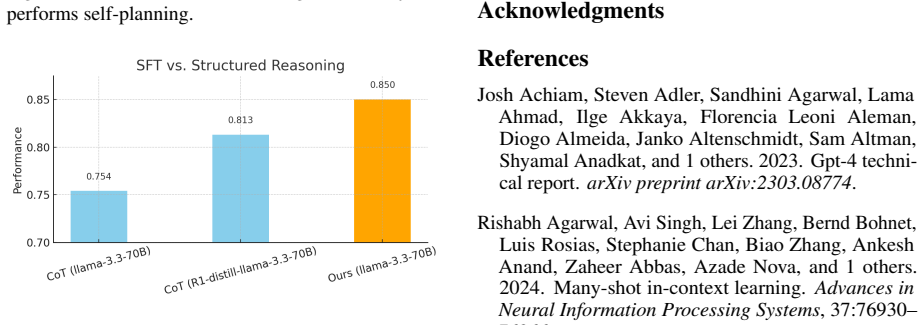
- The SFT-competitive result predicts a scaling trend: as model size grows, external scaffolding should matter less, so the gap between guideline-driven reasoning and fine-tuned models should narrow; testing on larger models would confirm whether guidelines are compensating for training weakness or genuinely adding structure.
Editorial analysis
A structured set of objections, weighed in public.
Referee Report
Summary. The paper proposes a two-stage framework for LLM reasoning: (1) offline guideline learning, in which successful and failed trajectories on 25% of each benchmark are distilled via unspecified functions f_ext, f_ref, f_agg into structured stepwise guidelines G_T; (2) guided execution with per-step refinement, in which the model follows G_T and applies f_refine after each step. Experiments on eight selected BBH tasks and four further benchmarks (GSM8K, MATH-500, MBPP, HumanEval) compare against CoT, Few-shot CoT, ReAct, ToT, Beats, and FoT across four models, plus transfer and SFT comparisons. The paper claims consistent improvements and matches/surpasses SFT.
Significance. The idea of extracting reusable, stepwise guidelines from reasoning traces and combining stepwise execution with corrective refinement is potentially valuable. The train/test split (25/75) is non-circular, and the paper evaluates multiple models and benchmarks, including transfer and cross-model collaboration. However, the core guideline-learning mechanism is not specified to the point of reproducibility, and the headline empirical claim is stronger than the tables support. If the missing details can be supplied and the evaluation tightened, the work could make a useful contribution to structured prompting methods.
major comments (4)
- [§3.1, Algorithms 1-2] The core contribution—guideline learning—is underspecified. f_ext, f_ref, and f_agg are never instantiated: no prompts, no implementation, and no raw input-output examples of extracted guidelines. Appendix Figure 9, the only artifact, is a generic five-step rubric for SVG shape classification that could have been hand-written; no evidence is provided that it arose from the training trajectories or that it differs from a task description. This is load-bearing: the claimed superiority over self-planning (Fig. 7) and the transfer results (Table 5) are meaningful only if the guidelines are genuinely learned from experience. Without this, the method reduces to stepwise prompting plus a refinement pass. Please provide the exact prompts/templates for f_ext, f_ref, f_agg, show extracted guidelines for multiple tasks, and include a control using generic instructions.
- [Tables 1-2 and Abstract] The claim of 'consistently outperforms' is contradicted by per-task results. For GPT-4o, Ours=0.963 on MA vs CoT=0.968 and Beats=0.989; NA=0.973 vs CoT=0.979; GS=0.711 vs FoT=0.738. GPT-4o-mini loses on MA, NA, CJ, FF, and LD to at least one baseline. Average-level gains are plausible, but 'consistent' is an overstatement. Also, no error bars or multiple runs are reported, so stability cannot be assessed. Please report per-task comparisons with variance/significance and revise the claim accordingly.
- [§4.4.1-4.4.2 and Figures 4-5] The number of reasoning steps and refinement rounds appear to be selected based on test-set performance (e.g., 'performance peaks after a single refinement' for 4o, two for mini). This introduces test-set tuning into the reported gains. Similarly, the choice of eight BBH tasks out of 23 is not justified. Please report selection on a validation split or show sensitivity to these hyperparameters; otherwise the reported numbers are optimistic rather than predicted.
- [Table 4 and §4.4.2] The refinement component degrades LLaMA-3.1-8B substantially: full config 0.584 vs stepwise no-refine 0.635 and single-step no-refine 0.650. The text dismisses this as a 'slight performance drop,' but the drop is larger than many of the claimed gains. This contradicts the claim that refinement 'improves performance across both stepwise and single-step execution.' Please characterize the conditions under which refinement helps versus hurts and adjust the general claim.
minor comments (7)
- [§3.2] The sentence 'the final output is derived as, where R=...' is incomplete; define f_final properly.
- [Notation] f_ext, f_ref, f_agg are introduced but never given concrete signatures beyond prose; consider formalizing their inputs/outputs.
- [Table 3] Only the mini model is reported on GSM8K/MATH-500/MBPP/HumanEval; specify why other models are omitted or add them for comparability.
- [Figure 3] The figure has no error bars, and the caption claims 'consistently superior performance' that is not visible per-task; clarify.
- [§4.4.6] The SFT baseline is underspecified (training data, epochs, template, compute); without these details the comparison is not interpretable.
- [References] In the related work, 'Auto-CoT (Zhang et al.)' lacks year/venue; other citations also need consistent formatting.
- [Appendix Figure 9] The 'learned guideline' should be accompanied by sample raw trajectories from which it was extracted, to demonstrate it is learned rather than authored.
Circularity Check
Partial circularity: the benefit of refinement is tuned on the evaluation set; the guideline-learning core is underspecified but not demonstrably circular.
specific steps
-
fitted input called prediction
[Section 4.4.1-4.4.2, Figures 4-5; main results in Table 4]
"For 4o, performance peaks after a single refinement, implying that one iteration of self-correction is sufficient for strong models to stabilize their reasoning. In contrast, Mini achieves optimal performance with two refinement rounds, indicating that moderately sized models benefit from additional correction to offset weaker initial outputs."
The main results (Table 4, 'Ours') include the refinement mechanism, but the number of refinement rounds is selected using test-set performance in Figure 5. Similarly, Figure 4 is used to identify that performance plateaus beyond five steps, while the main config's step count 'is not strictly fixed but varies by task, typically ranging from 6 to 10.' To the extent the full configuration adopts the peak settings discovered on the same held-out 75% used for evaluation, the reported accuracy is a test-set-tuned value rather than an unbiased held-out prediction; the benefit of refinement is partly forced by construction. This is a partial, not total, circularity because the 25%/75% split and external benchmarks retain some independence.
full rationale
The paper's central setup is a 25%/75% split, so guideline extraction on the training portion and evaluation on the held-out portion is non-circular in principle. However, the main BBH configuration is validated by varying step count (Figure 4) and refinement rounds (Figure 5) on the same 75% used for reporting; if the final config adopts the peak settings, the claimed gain from refinement is partly selected on the test set. Separately, f_ext, f_ref, and f_agg (Section 3.1) are never specified, and the only shown 'learned' guideline (Figure 9) reads like a hand-written rubric; this is a serious missing-support problem for the experience-learning claim, but it is not circularity by construction. The paper also honestly reports that refinement degrades LLaMA-3.1-8B (Table 4: 0.584 full vs 0.635/0.650 without refinement), which undercuts the universality claim but does not make the derivation circular. No self-citation is load-bearing; external benchmarks (GSM8K, MATH-500, MBPP, HumanEval) provide some independent support. Score 4 rather than 0 because one of the three advertised mechanisms—refinement—has its evaluation-set-tuned strength presented as a general result.
Axiom & Free-Parameter Ledger
free parameters (3)
- Reasoning step count per task =
6-10 steps, tuned per task (Fig. 4)
- Refinement rounds per model =
1 (GPT-4o), 2 (GPT-4o-mini), 0 or negative benefit (LLaMA-3.1-8B)
- BBH task subset =
8 of 27 BBH tasks (GS, MA, NA, CJ, FF, LD, HY, ST)
axioms (3)
- domain assumption f_ext, f_ref, f_agg can be implemented by an LLM to extract and aggregate generalizable guidelines without human oversight.
- domain assumption Stepwise refinement f_refine can reliably detect and correct errors without introducing new errors for all target models.
- standard math Accuracy on the held-out 75% test split with a single seed is representative of method performance.
invented entities (2)
-
Structured guideline steps G_T
no independent evidence
-
Mistake-aware reflections M
no independent evidence
Cite this review
Pith. "Pith review of From Implicit Exploration to Structured Reasoning: Leveraging Guideline and Refinement for LLMs." pith.science (2026). https://pith.science/paper/SZVOYTKK
@misc{pith2026250906284,
  author       = {Pith},
  title        = {Pith review of: From Implicit Exploration to Structured Reasoning: Leveraging Guideline and Refinement for LLMs},
  year         = {2026},
  howpublished = {\url{https://pith.science/paper/SZVOYTKK}},
  note         = {Machine review of arXiv:2509.06284}
}
read the original abstract
Large language models (LLMs) have advanced general-purpose reasoning, showing strong performance across diverse tasks. However, existing methods often rely on implicit exploration, where the model follows stochastic and unguided reasoning paths-like walking without a map. This leads to unstable reasoning paths, lack of error correction, and limited learning from past experience. To address these issues, we propose a framework that shifts from implicit exploration to structured reasoning through guideline and refinement. First, we extract structured reasoning patterns from successful trajectories and reflective signals from failures. During inference, the model follows these guidelines step-by-step, with refinement applied after each step to correct errors and stabilize the reasoning process. Experiments on BBH and four additional benchmarks (GSM8K, MATH-500, MBPP, HumanEval) show that our method consistently outperforms strong baselines across diverse reasoning tasks. Structured reasoning with stepwise execution and refinement improves stability and generalization, while guidelines transfer well across domains and flexibly support cross-model collaboration, matching or surpassing supervised fine-tuning in effectiveness and scalability.
Figures




Reference graph
Works this paper leans on
-
[5]
A survey on in-context learning. InProceedings of the 2024 Con- ference on Empirical Methods in Natural Language Processing, pages 1107–1128. Shibo Hao, Yi Gu, Haodi Ma, Joshua Hong, Zhen Wang, Daisy Wang, and Zhiting Hu
work page 2024
-
[6]
Rea- soning with language model is planning with world model. InProceedings of the 2023 Conference on Empirical Methods in Natural Language Processing, pages 8154–8173. Jie Huang and Kevin Chen-Chuan Chang
work page 2023
-
[8]
Takeshi Kojima, Shixiang Shane Gu, Machel Reid, Yu- taka Matsuo, and Yusuke Iwasawa
Mathprompter: Mathematical reasoning using large language models.arXiv preprint arXiv:2303.05398. Takeshi Kojima, Shixiang Shane Gu, Machel Reid, Yu- taka Matsuo, and Yusuke Iwasawa
-
[9]
Linzhuang Sun, Hao Liang, Jingxuan Wei, Bihui Yu, Conghui He, Zenan Zhou, and Wentao Zhang
Logic-lm: Empower- ing large language models with symbolic solvers for faithful logical reasoning.arXiv preprint arXiv:2305.12295. Linzhuang Sun, Hao Liang, Jingxuan Wei, Bihui Yu, Conghui He, Zenan Zhou, and Wentao Zhang
-
[10]
Beats: Optimizing llm mathematical capabilities with backverify and adaptive disambiguate based efficient tree search.arXiv preprint arXiv:2409.17972. Mirac Suzgun, Nathan Scales, Nathanael Schärli, Se- bastian Gehrmann, Yi Tay, Hyung Won Chung, Aakanksha Chowdhery, Quoc V Le, Ed H Chi, Denny Zhou, and 1 others
work page internal anchor Pith review Pith/arXiv arXiv
-
[11]
From few to many: Self-improving many-shot reasoners through iterative optimization and generation.arXiv preprint arXiv:2502.00330. Xuezhi Wang, Jason Wei, Dale Schuurmans, Quoc Le, Ed Chi, Sharan Narang, Aakanksha Chowdhery, and Denny Zhou
-
[12]
Self-consistency improves chain of thought reasoning in language models.arXiv preprint arXiv:2203.11171. Jason Wei, Xuezhi Wang, Dale Schuurmans, Maarten Bosma, Fei Xia, Ed Chi, Quoc V Le, Denny Zhou, and 1 others
-
[13]
Shunyu Yao, Dian Yu, Jeffrey Zhao, Izhak Shafran, Tom Griffiths, Yuan Cao, and Karthik Narasimhan
Beyond ex- amples: High-level automated reasoning paradigm in in-context learning via mcts.arXiv preprint arXiv:2411.18478. Shunyu Yao, Dian Yu, Jeffrey Zhao, Izhak Shafran, Tom Griffiths, Yuan Cao, and Karthik Narasimhan. 2023a. Tree of thoughts: Deliberate problem solving with large language models.Advances in neural information processing systems, 36:1...
-
[14]
Booststep: Boost- ing mathematical capability of large language models via improved single-step reasoning.arXiv preprint arXiv:2501.03226. Zhuosheng Zhang, Aston Zhang, Mu Li, and Alex Smola. Automatic chain of thought prompting in large language models. InThe Eleventh International Conference on Learning Representations. Wayne Xin Zhao, Kun Zhou, Junyi L...
work page internal anchor Pith review Pith/arXiv arXiv
-
[15]
M 20,40 L 50,10 L 80,40 L 20,40
A survey of large language models.arXiv preprint arXiv:2303.18223, 1(2). A Appendix A.1 Case Study: Structured Reasoning in Geometric Shapes Task All results in this case study are generated using GPT-4o. Figure 9 outlines the structured guideline learned for reasoning over geometric shapes based on SVG path representations. Figure 10 provides a step-wise...
-
[2020]
Guillaume Chaslot, Sander Bakkes, Istvan Szita, and Pieter Spronck
Language models are few-shot learners.Advances in neural information processing systems, 33:1877–1901. Guillaume Chaslot, Sander Bakkes, Istvan Szita, and Pieter Spronck
work page 1901
-
[2022]
arXiv preprint arXiv:2212.10403
To- wards reasoning in large language models: A survey. arXiv preprint arXiv:2212.10403. Shima Imani, Liang Du, and Harsh Shrivastava
-
[2023]
Gpt-4 techni- cal report.arXiv preprint arXiv:2303.08774. Rishabh Agarwal, Avi Singh, Lei Zhang, Bernd Bohnet, Luis Rosias, Stephanie Chan, Biao Zhang, Ankesh Anand, Zaheer Abbas, Azade Nova, and 1 others
-
[2024]
Forest-of-thought: Scaling test- time compute for enhancing llm reasoning.arXiv preprint arXiv:2412.09078. Tom Brown, Benjamin Mann, Nick Ryder, Melanie Subbiah, Jared D Kaplan, Prafulla Dhariwal, Arvind Neelakantan, Pranav Shyam, Girish Sastry, Amanda Askell, and 1 others
-
[2025]
arXiv preprint arXiv:2506.09080
Finhear: Human expertise and adaptive risk-aware temporal reasoning for financial decision-making. arXiv preprint arXiv:2506.09080. Damai Dai, Yutao Sun, Li Dong, Yaru Hao, Shuming Ma, Zhifang Sui, and Furu Wei
discussion (0)
Sign in with ORCID, Apple, or X to comment. Anyone can read and Pith papers without signing in.