REVIEW 2 major objections 4 minor 1 cited by
The hunt for new pulsating ultraluminous X-ray sources: a clustering approach
T0 review · 2 major / 4 minor · reviewed 2026-08-06 · deepseek-v4-flash
Pith's one-line read A clustering analysis singles out 85 ULXs that share the signature of known pulsating ULXs, making them prime targets for pulsation searches.
desk verdict Useful ranked list of ULX observations that resemble known PULXs, but the clusters track brightness and variability, not accretor type. read the letter →
The pith
A machine-rendered reading of the paper's core claim, the machinery that carries it, and where it could break.
The reading
What carries the argument
The engine of the analysis is a two-component Gaussian mixture model, run on scaled ULX observations of unknown accretor type; confirmed PULX observations are not used in the fit but are projected onto it to set the probability threshold (PULX ratio at least 0.99). A shallow decision tree then translates the cluster boundary into three observable cuts: broadband flux brighter than about $4\times10^{-13}\,\mathrm{erg\,cm^{-2}\,s^{-1}}$, peak flux $F_{\mathrm{peak}}$ brighter than about $1\times10^{-12}\,\mathrm{erg\,cm^{-2}\,s^{-1}}$, and a variability flag indicating intra-observational variability. $F_{\mathrm{peak}}$ is the load-bearing feature: the separation is much weaker without it, and it is what lets low-flux observations of known PULXs still be classified by the brightness of other epochs of the same source.
What would settle it
A coherent pulsation search on the 85 candidates using exposures with at least 10,000 photons per source, the known threshold for PULX detection, would settle the claim: if spin signals appear in a substantial subset, the cluster is accretor-selected; if none appear despite statistics equal to the confirmed PULX detections, the cluster is not identifying hidden pulsars. A cheaper cross-check is to run the same two-component Gaussian mixture on a luminosity- and distance-matched sample of known black-hole ULXs and see whether they too fall in the PULX cluster.
Extended reading notes
Core claim
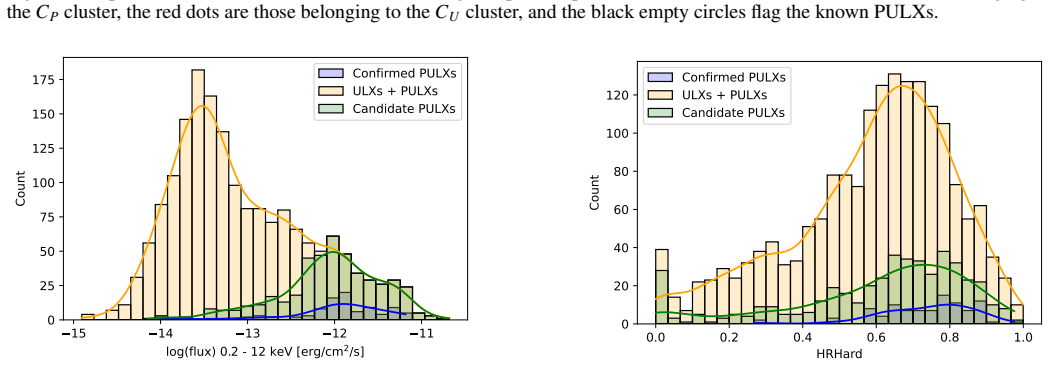
The central claim is that the known PULXs are not isolated outliers: a two-component Gaussian mixture, fitted only on ULXs of unknown accretor type and thresholded so that at least 99% of confirmed PULX observations fall on one side, places 355 observations of 85 additional ULXs in the same cluster. Those candidates include sources already suspected to be neutron-star accretors, such as NGC 7793 ULX-4 and NGC 4559 X7, as well as some sources previously interpreted as black-hole ULXs. The decisive feature is the maximum observed flux Fpeak: including it raises the uncertain-ratio metric from 0.10–0.11 to 0.79, while luminosity adds nothing. The authors also report that 19 of 22 QPO-bearing observations fall in the PULX cluster, which they read as supporting a link between mHz quasi-periodic oscillations and neutron-star accretors.
Load-bearing premise
The whole candidate list rests on the assumption that the two-cluster split separates neutron-star ULXs from black-hole ULXs rather than separating bright, well-observed sources from faint, poorly observed ones.
Editorial extensions
If this is right
- The 85 candidates become a prioritized sample for high-statistics pulsation searches; detecting a spin period in any of them would confirm that the cluster boundary tracks accretor type.
- The method stays stable when known PULX observations are removed one at a time or source by source (average PULX ratio around 97–99%), so new XMM-Newton ULX observations can be classified without refitting the mixture from scratch.
- Because most candidates have multiple observations and PULX pulsations are seen in only 31 of 95 known-PULX observations, roughly three well-spaced observations per source should give about a 70% chance of catching a pulse if the candidate population behaves like the confirmed one.
- The concentration of QPO-bearing ULXs in the PULX cluster implies that mHz quasi-periodic oscillations are a practical marker for identifying neutron-star accretors even before pulsations are found.
Reading between the lines
- Extension: if most of the 85 candidates are real PULXs, then the fraction of ULXs powered by neutron stars is far larger than the six confirmed cases suggest, and the super-Eddington neutron-star channel is a dominant, not exceptional, ULX mode.
- Extension: because the cluster boundary is set by brightness and variability rather than by spectral hardness, the same recipe could be transferred to Chandra and Swift ULX catalogues to build a larger cross-mission candidate list.
- Extension: the paper does not quantify how many of the 85 are bright black-hole ULXs; a matched control sample of spectroscopically identified black-hole ULXs, clustered in the same feature space, would give a direct contamination estimate.
Editorial analysis
A structured set of objections, weighed in public.
Referee Report
Summary. The paper applies an unsupervised Gaussian Mixture Model (GMM) to XMM-Newton observations of ultraluminous X-ray sources (ULXs) drawn from the Walton et al. (2022) catalogue, updated with 4XMM-DR13. The algorithm clusters the data into two components, and the cluster containing the known pulsating ULXs (PULXs) is identified by setting a probability threshold that recovers at least 99% of known PULX observations while maximizing the fraction of unknown ULXs placed in the other cluster. The pipeline selects hyperparameters and a threshold on the same dataset. The resulting PULX cluster contains 85 previously unknown candidate PULXs across 355 observations, with a decision tree explaining the classification through high broadband flux, high peak flux, and variability. A preliminary timing search finds no new pulsations in these candidates.
Significance. If the cluster assignment genuinely traces neutron-star accretors, the 85 candidates constitute a valuable, ranked target list for deep pulsation searches and would represent a major step toward quantifying the PULX fraction. The manuscript is transparently written, the pipeline is clearly specified, and the catalogue (Tables B.1 and C.1) is a useful community resource. However, the physical interpretation of the clusters is not established: the separation is driven by brightness and variability, which are the same factors that determine whether pulsations are detectable, and the paper's own internal checks do not rule out that the candidates are simply bright, variable, non-pulsating ULXs. The absence of any new pulsations in the timing search is consistent with this alternative interpretation.
major comments (2)
- [Section 2.3.2, Table 4, Fig. 3, Sect. 4.2] The central claim that the PULX cluster contains candidate neutron-star ULXs rests on the assumption that the two GMM components separate NS accretors from BH accretors. The evidence presented does not support this. The decision tree in Fig. 3 and the silhouette indices in Table 4 show that the separation is driven by EP_8_FLUX, Fpeak, and VAR_FLAG, while HRHard has a silhouette index of only 0.039, meaning hardness does not separate the clusters. Furthermore, Sect. 4.2 reports that literature-classified BH ULXs (Holmberg II X-1, NGC 5408 X-1, NGC 7793 P9, M31 ULX-1) fall inside the PULX cluster. The authors themselves note in Sect. 4.1 that all candidate PULXs have the highest Fpeak values in the dataset. These features (peak flux and variability) are exactly the selection function that determines whether pulsations are detectable, independent of accretor type. The paper therefore does not demonstrate that the 85 candidates are preferentially NS accretors; they may be bright, variable ULXs of any accretor type. To make the central claim load-bearing, the authors should show that the cluster separation persists when controlling for flux, distance, and observation count, or that physical spectral indicators (e.g., hardness, spectral shape) contribute beyond the detection-selection features. The current null result from the timing search, while preliminary, is fully consistent with the null hypothesis that the candidates are non-pulsating sources.
- [Section 2.3 (Pipeline), Eq. (2), Sect. 3] The probability threshold is selected on the same dataset that is used to evaluate the method: the pipeline (steps 2c and 3) chooses the threshold that maximizes UR subject to PR>=0.99 computed on the known PULX observations. Consequently, the reported PR is a design constraint rather than an independent measure of recall. The leave-one-out robustness checks in Sect. 4.1 only show that this imposed constraint is stable when a small fraction of PULX observations is removed; they do not test whether the cluster assignment generalizes to genuinely unseen sources. For a claim of predictive power and a candidate list that is meant to prioritize future observations, a proper validation scheme is required, for example holding out a random subset of known PULX observations for threshold selection and evaluating on the rest, or performing cross-validation. Without such a validation, the 85 candidates are the result of a model tuned to fit the known PULXs, and their status as robust predictions is unproven.
minor comments (4)
- [Sect. 2.2, Eq. (2)] The statement that PR is 'always ≥0.5 by definition' is correct only because the maximum is taken over clusters; this is worth stating more explicitly, since the reader may otherwise interpret PR as a genuine recall metric rather than a constrained optimization objective.
- [Sect. 4.2, last paragraph] The timing search is described as using HENaccelsearch with a first period derivative, but no sensitivity estimate (e.g., minimum detectable pulsed fraction as a function of photon count) is given. Reporting this would help the reader interpret the null result.
- [Table B.1] Several z-scores are given as '>8.00' or '-8.13' with no explanation of the clipping convention. It would be helpful to specify the range of z-scores considered and what values outside ±8 indicate.
- [Sect. 4.1, first paragraph] The statement that 'all candidate PULXs have the highest Fpeak values in the dataset' is a key caveat and should appear earlier, in the Results section, rather than only in the Discussion.
Circularity Check
No significant circularity: candidate PULXs are derived from an unsupervised GMM fit with threshold calibration on known PULXs; the central sample is not fitted to the labels.
full rationale
The derivation chain is: build feature vectors from 4XMM-DR13 fluxes (EP_n_FLUX, Fpeak, VAR_FLAG, HRHard); fit a two-component Bayesian GMM on the 640 ULXs of unknown nature only (Sect. 2.3.2); project known PULX observations onto this fixed density and choose a probability threshold maximizing UR subject to PR>=0.99 (Sect. 2.3, step 2c); and count unlabeled observations above the threshold as candidates. The GMM density is therefore independent of the PULX labels, and the 85-candidate count is an output of that density plus a calibrated threshold, not a parameter fitted to reproduce the PULX sample. The PR>=0.99 recovery of known PULXs is a constraint of the threshold choice, not an independent prediction, so it should not be read as evidence that the method 'retrieves' known PULXs; however, the candidate sample itself does not reduce to the input labels. The conclusion that candidates are 'similar' to known PULXs restates the membership rule used to define C_P, a wording limitation rather than a circular derivation. The self-citations (Imbrogno et al. 2024 and in prep. for the QPO hypothesis; Pinciroli Vago & Fraternali 2023 for unsupervised methods) are ancillary and not load-bearing for the main clustering result. The absence of new pulsations in the timing search is an external, albeit negative, check and does not create circularity.
Assumptions & free parameters
free parameters (3)
- GMM hyperparameter configuration =
MinMaxScaler, use_log=False, use_PCA=False, covariance_type='full'
- Probability threshold =
Not stated as a number; set by imposing PR>=0.99, roughly log(probability) ~ -0.04
- Number of clusters =
2
assumptions (4)
- domain assumption The two GMM clusters correspond to a physical NS-ULX vs BH-ULX split.
- domain assumption 4XMM catalogue fluxes, derived from a single absorbed power-law model with fixed NH and photon index, are adequate proxies for ULX spectral properties.
- domain assumption The six known PULXs are a representative sample of the pulsating ULX population.
- domain assumption Flux measurement uncertainties can be ignored, treating each value as perfect.
Cite this review
Pith. "Pith review of The hunt for new pulsating ultraluminous X-ray sources: a clustering approach." pith.science (2026). https://pith.science/paper/T23VCTTL
@misc{pith2026250715032,
  author       = {Pith},
  title        = {Pith review of: The hunt for new pulsating ultraluminous X-ray sources: a clustering approach},
  year         = {2026},
  howpublished = {\url{https://pith.science/paper/T23VCTTL}},
  note         = {Machine review of arXiv:2507.15032}
}
abstract
The discovery of fast and variable coherent signals in a handful of ultraluminous X-ray sources (ULXs) testifies to the presence of super-Eddington accreting neutron stars, and drastically changed the understanding of the ULX class. Our capability of discovering pulsations in ULXs is limited, among others, by poor statistics. However, catalogues and archives of high-energy missions contain information which can be used to identify new candidate pulsating ULXs (PULXs). The goal of this research is to single out candidate PULXs among those ULXs which have not shown pulsations due to an unfavourable combination of factors. We applied an AI approach to an updated database of ULXs detected by XMM-Newton. We first used an unsupervised clustering algorithm to sort out sources with similar characteristics into two clusters. Then, the sample of known PULX observations has been used to set the separation threshold between the two clusters and to identify the one containing the new candidate PULXs. We found that only a few criteria are needed to assign the membership of an observation to one of the two clusters. The cluster of new candidate PULXs counts 85 unique sources for 355 observations, with $\sim$85% of these new candidates having multiple observations. A preliminary timing analysis found no new pulsations for these candidates. This work presents a sample of new candidate PULXs observed by XMM-Newton, the properties of which are similar (in a multi-dimensional phase space) to those of the known PULXs, despite the absence of pulsations in their light curves. While this result is a clear example of the predictive power of AI-based methods, it also highlights the need for high-statistics observational data to reveal coherent signals from the sources in this sample and thus validate the robustness of the approach.
Figures


Figures from the paper (5 more)



Forward citations
Cited by 1 Pith paper
-
Neutron star envelopes with machine learning: a single-hidden-layer neural network application
A single-hidden-layer neural network reproduces the magnetized neutron star envelope Tb-Ts relation with roughly 3% error and is fast enough for 3D thermal evolution codes.
Reference graph
Works this paper leans on
-
[1]
2023, Machine Learning for Physics and Astronomy
Acquaviva, V . 2023, Machine Learning for Physics and Astronomy
2023
-
[2]
Agrawal, V . K. & Nandi, A. 2015, MNRAS, 446, 3926
2015
-
[3]
J., Abdalla, A., & Moustafa, A
Alashwal, H., El Halaby, M., Crouse, J. J., Abdalla, A., & Moustafa, A. A. 2019, Frontiers in Computational Neuroscience, 13
2019
-
[4]
Amato, R., Gúrpide, A., Webb, N. A., Godet, O., & Middleton, M. J. 2023, A&A, 669, A130
work page 2023
-
[5]
2012, WIREs Data Mining and Knowledge Discovery, 2, 340–350
Assent, I. 2012, WIREs Data Mining and Knowledge Discovery, 2, 340–350
work page 2012
-
[6]
Atapin, K., Fabrika, S., & Caballero-García, M. D. 2019, MNRAS, 486, 2766
work page 2019
-
[7]
Atapin, K., Vinokurov, A., Sarkisyan, A., et al. 2024, MNRAS, 527, 10185
work page 2024
-
[8]
Bachetti, M. 2018, HENDRICS: High ENergy Data Reduction Interface from the Command Shell, Astrophysics Source Code Library, record ascl:1805.019
work page 2018
Show all 83 references
-
[9]
A., Walton, D
Bachetti, M., Harrison, F. A., Walton, D. J., et al. 2014, Nature, 514, 202
2014
-
[10]
2024, The Journal of Open Source Software, 9, 7389
Bachetti, M., Huppenkothen, D., Stevens, A., et al. 2024, The Journal of Open Source Software, 9, 7389
2024
-
[11]
2024, A&A, 682, A94
Barra, F., Pinto, C., Middleton, M., et al. 2024, A&A, 682, A94
2024
-
[12]
2024, ApJ, 965, 78
Belfiore, A., Salvaterra, R., Sidoli, L., et al. 2024, ApJ, 965, 78
2024
-
[13]
2020, Knowledge-Based Systems, 194, 105532
Blanco-Justicia, A., Domingo-Ferrer, J., Martínez, S., & Sánchez, D. 2020, Knowledge-Based Systems, 194, 105532
2020
-
[14]
A., Fürst, F., et al
Brightman, M., Harrison, F. A., Fürst, F., et al. 2018, Nature Astronomy, 2, 312
2018
-
[15]
J., Xu, Y ., et al
Brightman, M., Walton, D. J., Xu, Y ., et al. 2020, ApJ, 889, 71
2020
-
[16]
2018, MNRAS, 476, L45
Carpano, S., Haberl, F., Maitra, C., & Vasilopoulos, G. 2018, MNRAS, 476, L45
2018
-
[17]
Colbert, E. J. M., Heckman, T. M., Ptak, A. F., Strickland, D. K., & Weaver, K. A. 2004, ApJ, 602, 231
2004
-
[18]
Colbert, E. J. M. & Mushotzky, R. F. 1999, ApJ, 519, 89 de Mijolla, D., Frye, C., Kunesch, M., Mansir, J., & Feige, I. 2020, Human- interpretable model explainability on high-dimensional data
1999
-
[19]
2019, Multimedia Tools and Applications, 78, 19305–19323 Article number, page 10 of 16 N
Deng, Y ., Tang, F., Dong, W., et al. 2019, Multimedia Tools and Applications, 78, 19305–19323 Article number, page 10 of 16 N. O. Pinciroli Vago et al.: The hunt for new PULXs: a clustering approach
2019
-
[20]
C., Griffiths, R
Dewangan, G. C., Griffiths, R. E., Choudhury, M., Miyaji, T., & Schurch, N. J. 2005, ApJ, 635, 198
2005
-
[21]
1989, ARA&A, 27, 87
Fabbiano, G. 1989, ARA&A, 27, 87
1989
-
[22]
N., Atapin, K
Fabrika, S. N., Atapin, K. E., Vinokurov, A. S., & Sholukhova, O. N. 2021, Astrophysical Bulletin, 76, 6 Fürst, F., Walton, D. J., Harrison, F. A., et al. 2016, ApJ, 831, L14 Fürst, F., Walton, D. J., Heida, M., et al. 2021, A&A, 651, A75 Fürst, F., Walton, D. J., Israel, G. L...
2021
-
[23]
C., Roberts, T
Gladstone, J. C., Roberts, T. P., & Done, C. 2009, MNRAS, 397, 1836 Gúrpide, A., Godet, O., Koliopanos, F., Webb, N., & Olive, J. F. 2021a, A&A, 649, A104 Gúrpide, A., Godet, O., Koliopanos, F., Webb, N., & Olive, J. F. 2021b, A&A, 649, A104
2009
-
[24]
M., Vaughan, S., & Roberts, T
Heil, L. M., Vaughan, S., & Roberts, T. P. 2009, MNRAS, 397, 1061
2009
-
[25]
Hu, C.-P., Kong, A. K. H., Ng, C. Y ., & Li, K. L. 2018, ApJ, 864, 64
2018
-
[26]
L., et al
Huppenkothen, D., Bachetti, M., Stevens, A. L., et al. 2019, ApJ, 881, 39
2019
-
[27]
E., Amato, R., et al
Imbrogno, M., Motta, S. E., Amato, R., et al. 2024, A&A, 689, A284 ISO. 2017, Standards by ISO/IEC JTC 1/SC 42 – Artificial Intelligence
2024
-
[28]
Jain, A. K. & Dubes, R. C. 1988, Algorithms for clustering data (Prentice-Hall, Inc.) Jr., F. J. M. 1951, Journal of the American Statistical Association, 46, 68
1988
-
[29]
Kaaret, P., Feng, H., & Roberts, T. P. 2017, ARA&A, 55, 303
2017
-
[30]
& Baym, G
Kalogera, V . & Baym, G. 1996, ApJ, 470, L61
1996
-
[31]
2012, A&A, 538, A49
Kaur, A., Henze, M., Haberl, F., et al. 2012, A&A, 538, A49
2012
-
[32]
A., Lien, A
Kennea, J. A., Lien, A. Y ., Krimm, H. A., Cenko, S. B., & Siegel, M. H. 2017, The Astronomer’s Telegram, 10809, 1
2017
-
[33]
2023, New A Rev., 96, 101672
King, A., Lasota, J.-P., & Middleton, M. 2023, New A Rev., 96, 101672
2023
-
[34]
R., Davies, M
King, A. R., Davies, M. B., Ward, M. J., Fabbiano, G., & Elvis, M. 2001, ApJ, 552, L109
2001
-
[35]
& Salzberg, S
Kingsford, C. & Salzberg, S. L. 2008, Nature Biotechnology, 26, 1011–1013
2008
-
[36]
2008, Encyclopedia of Public Health (Springer Netherlands), 1484–1484
Kirch, W., ed. 2008, Encyclopedia of Public Health (Springer Netherlands), 1484–1484
2008
-
[37]
J., et al
Kovlakas, K., Zezas, A., Andrews, J. J., et al. 2020, MNRAS, 498, 4790
2020
-
[38]
& Moitinho, A
Krone-Martins, A. & Moitinho, A. 2013, Astronomy & Astrophysics, 561, A57
2013
-
[39]
MacQueen, J. et al. 1967, Some methods for classification and analysis of mul- tivariate observations
1967
-
[40]
K., & Nandi, A
Majumder, S., Das, S., Agrawal, V . K., & Nandi, A. 2023, MNRAS, 526, 2086
2023
-
[41]
2014, A&A, 570, A13
Makarov, D., Prugniel, P., Terekhova, N., Courtois, H., & Vauglin, I. 2014, A&A, 570, A13
2014
-
[42]
1997, Future Generation Computer Systems, 13, 135–147
Michaud, P. 1997, Future Generation Computer Systems, 13, 135–147
1997
-
[43]
J., Sutton, A
Middleton, M. J., Sutton, A. D., Roberts, T. P., Jackson, F. E., & Done, C. 2012, MNRAS, 420, 2969
2012
-
[44]
2013, ApJ, 771, 133
Mineo, S., Rappaport, S., Steinhorn, B., et al. 2013, ApJ, 771, 133
2013
-
[45]
R., Cenko, S
Pasham, D. R., Cenko, S. B., Zoghbi, A., et al. 2015, ApJ, 811, L11
2015
-
[46]
2011, Journal of Machine Learning Research, 12, 2825 Pinciroli Vago, N
Pedregosa, F., Varoquaux, G., Gramfort, A., et al. 2011, Journal of Machine Learning Research, 12, 2825 Pinciroli Vago, N. O. & Fraternali, P. 2023, Neural Computing and Applications, 35, 19253–19277
2011
-
[47]
J., et al
Pinto, C., Soria, R., Walton, D. J., et al. 2021, MNRAS, 505, 5058
2021
- [48]
-
[49]
J., Kara, E., et al
Pinto, C., Walton, D. J., Kara, E., et al. 2020, MNRAS, 492, 4646
2020
-
[50]
2025, Astronomy & Astro- physics, 695, A238
Pintore, F., Pinto, C., Rodriguez-Castillo, G., et al. 2025, Astronomy & Astro- physics, 695, A238
2025
-
[51]
2018, MNRAS, 479, 4271
Pintore, F., Zampieri, L., Mereghetti, S., et al. 2018, MNRAS, 479, 4271
2018
-
[52]
2017, ApJ, 836, 113
Pintore, F., Zampieri, L., Stella, L., et al. 2017, ApJ, 836, 113
2017
-
[53]
G., & Abolmasov, P
Poutanen, J., Lipunova, G., Fabrika, S., Butkevich, A. G., & Abolmasov, P. 2007, MNRAS, 377, 1187 Pérez-Díaz, V . S., Martínez-Galarza, J. R., Caicedo, A., & D’Abrusco, R. 2024, Monthly Notices of the Royal Astronomical Society, 528, 4852–4871
2007
-
[54]
A., Gúrpide, A., Bachetti, M., & Fürst, F
Quintin, E., Webb, N. A., Gúrpide, A., Bachetti, M., & Fürst, F. 2021, MNRAS, 503, 5485
2021
-
[55]
M., Eikenberry, S
Ransom, S. M., Eikenberry, S. S., & Middleditch, J. 2002, AJ, 124, 1788
2002
-
[56]
2010, ApJ, 722, 620
Rao, F., Feng, H., & Kaaret, P. 2010, ApJ, 722, 620
2010
-
[57]
2009, Gaussian Mixture Models (Springer US), 659–663
Reynolds, D. 2009, Gaussian Mixture Models (Springer US), 659–663
2009
-
[58]
Reynolds, D. A. et al. 2009, Encyclopedia of biometrics, 741 Rodríguez Castillo, G. A., Israel, G. L., Belfiore, A., et al. 2020, ApJ, 895, 60
2009
-
[59]
Rousseeuw, P. J. 1987, Journal of Computational and Applied Mathematics, 20, 53–65
1987
-
[60]
E., et al
Sacchi, A., Imbrogno, M., Motta, S. E., et al. 2024, A&A, 689, A217
2024
-
[61]
P., Grisé, F., et al
Sathyaprakash, R., Roberts, T. P., Grisé, F., et al. 2022, MNRAS, 511, 5346
2022
-
[62]
P., Walton, D
Sathyaprakash, R., Roberts, T. P., Walton, D. J., et al. 2019, MNRAS, 488, L35
2019
-
[63]
Sen, S., Agarwal, S., Chakraborty, P., & Singh, K. P. 2022, Experimental Astron- omy, 53, 1–43
2022
-
[64]
V ., Scaife, A
Slijepcevic, I. V ., Scaife, A. M. M., Walmsley, M., et al. 2022, Monthly Notices of the Royal Astronomical Society, 514, 2599–2613
2022
-
[65]
2022, Scientific Reports, 12
Stoitsas, K., Bahulikar, S., de Munter, L., et al. 2022, Scientific Reports, 12
2022
-
[66]
Strohmayer, T. E. & Markwardt, C. B. 2011, The Astronomer’s Telegram, 3121, 1
2011
-
[67]
Strohmayer, T. E. & Mushotzky, R. F. 2009, ApJ, 703, 1386
2009
-
[68]
E., Mushotzky, R
Strohmayer, T. E., Mushotzky, R. F., Winter, L., et al. 2007, ApJ, 660, 580 Strüder, L., Briel, U., Dennerl, K., et al. 2001, A&A, 365, L18
2007
-
[69]
D., Roberts, T
Sutton, A. D., Roberts, T. P., & Middleton, M. J. 2013, MNRAS, 435, 1758
2013
-
[70]
J., Kennea, J
Townsend, L. J., Kennea, J. A., Coe, M. J., et al. 2017, MNRAS, 471, 3878
2017
-
[71]
2024, A&A, 681, A16
Tranin, H., Webb, N., Godet, O., & Quintin, E. 2024, A&A, 681, A16
2024
-
[72]
S., Doroshenko, V ., Lutovinov, A
Tsygankov, S. S., Doroshenko, V ., Lutovinov, A. A., Mushtukov, A. A., & Pouta- nen, J. 2017, A&A, 605, A39
2017
-
[73]
S., Gendreau, K
Vasilopoulos, G., Ray, P. S., Gendreau, K. C., et al. 2020, MNRAS, 494, 5350
2020
-
[74]
E., et al
Virtanen, P., Gommers, R., Oliphant, T. E., et al. 2020, Nature Methods, 17, 261
2020
-
[75]
J., Fürst, F., Heida, M., et al
Walton, D. J., Fürst, F., Heida, M., et al. 2018, ApJ, 856, 128
2018
-
[76]
J., Mackenzie, A
Walton, D. J., Mackenzie, A. D. A., Gully, H., et al. 2022, MNRAS, 509, 1587
2022
-
[77]
J., Pinto, C., Nowak, M., et al
Walton, D. J., Pinto, C., Nowak, M., et al. 2020, MNRAS, 494, 6012
2020
-
[78]
2024, IEEE Transactions on Pattern Analysis and Machine Intelligence, 46, 5362
Wang, L., Zhang, X., Su, H., & Zhu, J. 2024, IEEE Transactions on Pattern Analysis and Machine Intelligence, 46, 5362
2024
-
[79]
A., Coriat, M., Traulsen, I., et al
Webb, N. A., Coriat, M., Traulsen, I., et al. 2020, A&A, 641, A136
2020
-
[80]
2017, ApJ, 843, 69
Weng, S.-S., Ge, M.-Y ., Zhao, H.-H., et al. 2017, ApJ, 843, 69
2017
-
[81]
2017, ApJ, 846, 17
Wiktorowicz, G., Sobolewska, M., Lasota, J.-P., & Belczynski, K. 2017, ApJ, 846, 17
2017
-
[82]
A., Malacaria, C., Jenke, P
Wilson-Hodge, C. A., Malacaria, C., Jenke, P. A., et al. 2018, ApJ, 863, 9
2018
-
[83]
& Roberts, T
Zampieri, L. & Roberts, T. P. 2009, MNRAS, 400, 677 Article number, page 11 of 16 A&A proofs:manuscript no. aa53739-25 Appendix A: Observations of known PULXs Table A.1: The predictedz-scores for all the known PULXs in the dataset, grouped by name. OBS_ID Name 4XMMName Pulsati...
2009
Reviewed August 6, 2026 · model on record in the stance chip above.
Discussion (0). Continue with ORCID to comment.