REVIEW 2 major objections 2 minor 45 references
A Bayesian controller maintains belief over code correctness to decide dynamically when to verify or stop.
Reviewed by Pith at T0; open to challenge. T0 means a machine referee read the full paper against a public rubric. the ladder, T0–T4 →
T0 review · grok-4.3
2026-06-25 23:31 UTC pith:T2KXPEYM
load-bearing objection The paper turns coding-agent tool orchestration into cost-sensitive Bayesian sequential testing with a maintained belief state, but the independence and binary-correctness assumptions are the load-bearing part that needs checking. the 2 major comments →
Bayesian control for coding agents
The pith
A machine-rendered reading of the paper's core claim, the machinery that carries it, and where it could break.
Core claim
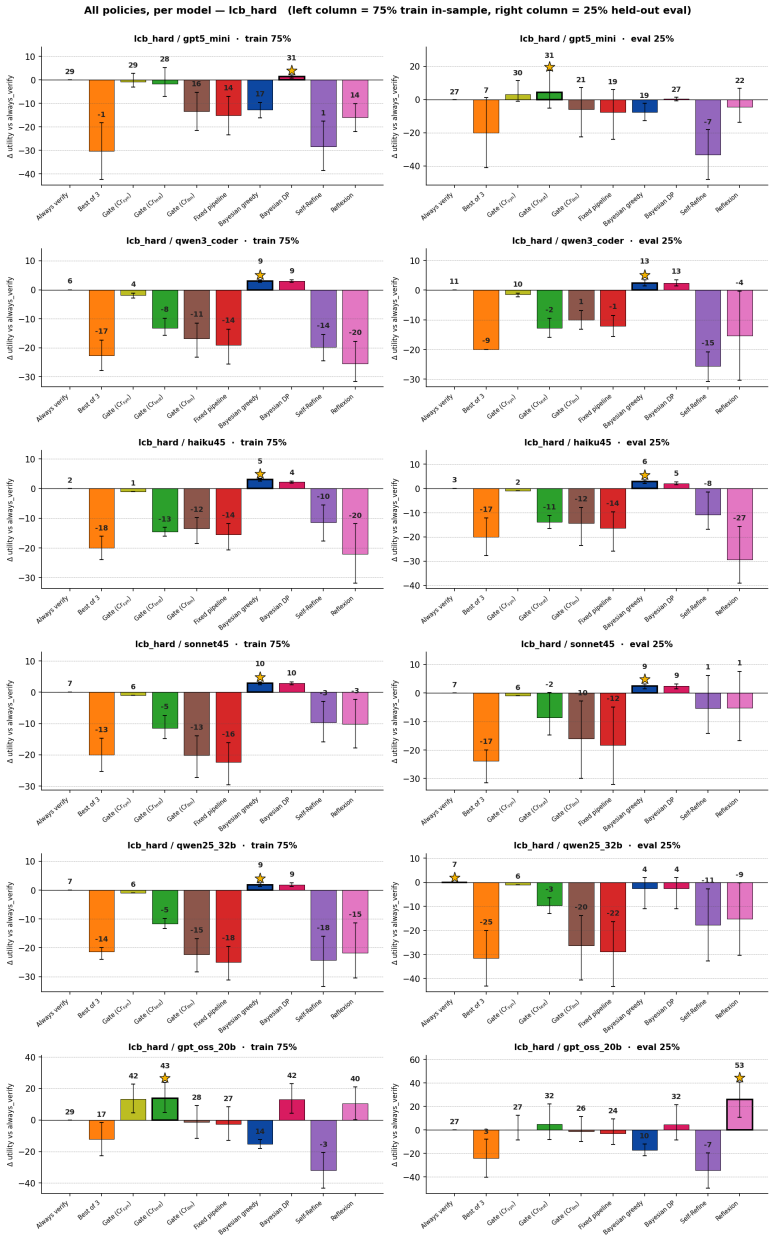
A Bayesian controller maintains a belief over the binary hypothesis of candidate correctness and uses cost-sensitive sequential testing to decide dynamically whether to gather evidence, refine, verify, or stop, yielding better performance on six generators and nine benchmarks when verification costs are high and critics are informative but imperfect.
What carries the argument
Bayesian controller that maintains and updates a belief distribution over binary correctness using conditionally independent signals from diagnostics and verifiers to minimize expected total cost.
Load-bearing premise
The diagnostics and verifiers supply signals whose informativeness can be captured by a simple Bayesian update over a binary correctness hypothesis.
What would settle it
A new benchmark or setting in which the Bayesian policy incurs higher total verification cost than a fixed-rule baseline while achieving equal or lower final accuracy.
If this is right
- Agents incur lower total verification cost while preserving solution accuracy across multiple generators and benchmarks.
- The maintained belief serves as a calibrated correctness score superior to token-probability and raw success baselines.
- Gains appear largest precisely when verification is costly and individual critics are informative but imperfect.
- Orchestration shifts from fixed rules to sequential, cost-aware decisions that stop early when belief is sufficiently high or low.
Where Pith is reading between the lines
- The same belief-maintenance structure could guide tool-use decisions in non-coding agent domains where actions carry different costs.
- If signal dependence is stronger than assumed, replacing the simple update with a joint model might further reduce cost.
- The correctness probability could be exposed to users or downstream systems as an explicit uncertainty flag.
- Extending the state to track multiple candidate solutions at once might allow parallel refinement under a shared budget.
Editorial analysis
A structured set of objections, weighed in public.
Referee Report
Summary. The paper formulates orchestration of LLM coding agents as cost-sensitive sequential hypothesis testing. A Bayesian controller maintains a posterior belief over a binary 'correct' hypothesis for candidate solutions and uses it to decide dynamically whether to collect more diagnostic evidence, refine the candidate, invoke an expensive verifier, or stop. Experiments across six generators and nine coding benchmarks show the controller is most valuable when verification is costly and critics are informative but imperfect; the resulting belief state also yields an interpretable correctness score that outperforms token-probability and raw tool-success baselines for uncertainty quantification.
Significance. If the modeling assumptions and empirical claims hold after validation, the work supplies a principled, uncertainty-aware alternative to fixed-rule orchestrators for tool-using coding agents. The explicit separation of control from generation and the use of the belief state for both stopping and UQ are potentially reusable contributions beyond the specific benchmarks.
major comments (2)
- [§3.2] §3.2 (Bayesian update): The controller relies on a simple sequential update that treats diagnostic and verifier signals as conditionally independent given the binary correctness hypothesis. No diagnostic checks, sensitivity analysis, or empirical tests for dependence or for the adequacy of the binary state are reported; if signals share latent failure modes or if partial correctness matters, both the cost-sensitive policy and the claimed UQ superiority would be miscalibrated.
- [§5] §5 (Experiments): The abstract states that Bayesian control 'proves to be most valuable' under specific conditions, yet the manuscript provides no pre-registered analysis plan, multiple-testing correction, or ablation isolating the contribution of the independence assumption versus other design choices. Without these, it is unclear whether the reported gains survive controls for benchmark selection and hyper-parameter tuning.
minor comments (2)
- Notation for the belief state and likelihood functions is introduced without a compact reference table; a single summary table would improve readability.
- Figure captions for the cost-sensitivity plots do not state the exact cost ratios used, making it hard to reproduce the 'most valuable when verification is costly' claim.
Simulated Author's Rebuttal
We thank the referee for the detailed and constructive comments. We address each major point below and indicate the revisions we will make to strengthen the manuscript.
read point-by-point responses
-
Referee: [§3.2] §3.2 (Bayesian update): The controller relies on a simple sequential update that treats diagnostic and verifier signals as conditionally independent given the binary correctness hypothesis. No diagnostic checks, sensitivity analysis, or empirical tests for dependence or for the adequacy of the binary state are reported; if signals share latent failure modes or if partial correctness matters, both the cost-sensitive policy and the claimed UQ superiority would be miscalibrated.
Authors: We agree that the conditional independence assumption merits explicit validation. In the revised version we will add a dedicated sensitivity analysis subsection that (i) derives the effect of pairwise signal dependence on the posterior trajectory under a simple correlation model and (ii) reports empirical posterior calibration on two benchmarks where both diagnostic and verifier outcomes are available for the same candidates. We will also clarify that the binary hypothesis is an operational abstraction chosen because the controller’s cost-sensitive stopping rule is defined with respect to the probability of a fully correct solution; partial correctness is already handled upstream by the generators and is not claimed to be modeled by the belief state itself. revision: partial
-
Referee: [§5] §5 (Experiments): The abstract states that Bayesian control 'proves to be most valuable' under specific conditions, yet the manuscript provides no pre-registered analysis plan, multiple-testing correction, or ablation isolating the contribution of the independence assumption versus other design choices. Without these, it is unclear whether the reported gains survive controls for benchmark selection and hyper-parameter tuning.
Authors: The experiments were exploratory and the primary claims rest on consistent qualitative patterns across six generators and nine benchmarks rather than on formal hypothesis tests. We acknowledge that a pre-registered analysis plan was not used. In revision we will (i) add an explicit ablation that replaces the independence assumption with a simple joint likelihood model on a subset of tasks and (ii) include a supplementary table that recomputes all headline metrics after re-tuning the controller hyper-parameters on a held-out benchmark split. We will also add a limitations paragraph discussing the absence of pre-registration and multiple-testing correction. revision: partial
Circularity Check
No circularity: standard Bayesian update applied to tool orchestration without self-referential fitting or load-bearing self-citations.
full rationale
The abstract formulates orchestration as cost-sensitive sequential hypothesis testing with a Bayesian belief over binary correctness, updated from diagnostics and verifiers. No equations appear that define a parameter from data and then rename its output as a prediction. No self-citation chains, uniqueness theorems, or ansatzes are invoked. The claimed superiority is presented as an empirical result across generators and benchmarks rather than a tautological consequence of the modeling assumptions. The reader's assessment of score 2 aligns with the absence of any load-bearing reduction; the modeling choice (conditional independence, binary state) is an explicit assumption open to falsification, not a hidden circularity.
Axiom & Free-Parameter Ledger
read the original abstract
Modern coding agents pair LLM generators with various tools, including cheap diagnostics and expensive verifiers. The tool-use decisions are typically governed by orchestrators that often use fixed rules and ignore uncertainty. We formulate orchestration as cost-sensitive sequential hypothesis testing: a Bayesian controller maintains a belief over candidate correctness and dynamically decides whether to gather more evidence, refine the candidate, verify it, or stop. Across six generators and nine coding benchmarks, Bayesian control proves to be most valuable when verification is costly and critics are informative but imperfect. Beyond control, the belief state yields an interpretable correctness score that outperforms token-probability and raw tool-success baselines for uncertainty quantification.
Figures




Reference graph
Works this paper leans on
-
[1]
Bei Chen, Fengji Zhang, Anh Nguyen, Daoguang Zan, Zeqi Lin, Jian-Guang Lou, and Weizhu Chen. 2023. CodeT : C ode generation with generated tests. In International Conference on Learning Representations (ICLR)
2023
-
[2]
Deepro Choudhury, Sinead Williamson, Adam Goli \'n ski, Ning Miao, Freddie Bickford Smith, Michael Kirchhof, Yizhe Zhang, and Tom Rainforth. 2026. BED-LLM : I ntelligent information gathering with LLM s and B ayesian experimental design. In International Conference on Learning Representations (ICLR)
2026
-
[3]
Marina Fomicheva, Shuo Sun, Lisa Yankovskaya, Fr \'e d \'e ric Blain, Francisco Guzm \'a n, Mark Fishel, Nikolaos Aletras, Vishrav Chaudhary, and Lucia Specia. 2020. Unsupervised quality estimation for neural machine translation. Transactions of the Association for Computational Linguistics, 8:539--555
2020
-
[4]
Ronald A. Howard. 1966. Information value theory. IEEE Transactions on Systems Science and Cybernetics, 2(1):22--26
1966
-
[6]
Lahiri, Madanlal Musuvathi, and Jianfeng Gao
Jeevana Priya Inala, Chenglong Wang, Mei Yang, Andres Codas, Mark Encarnaci \'o n, Shuvendu K. Lahiri, Madanlal Musuvathi, and Jianfeng Gao. 2022. Fault-aware neural code rankers. In Advances in Neural Information Processing Systems (NeurIPS)
2022
-
[7]
Naman Jain, King Han, Alex Gu, Wen-Ding Li, Fanjia Yan, Tianjun Zhang, Sida Wang, Armando Solar-Lezama, Koushik Sen, and Ion Stoica. 2025. Live C ode B ench: H olistic and contamination free evaluation of large language models for code. In The Thirteenth International Conference on Learning Representations (ICLR)
2025
-
[8]
Jimenez, John Yang, Alexander Wettig, Shunyu Yao, Kexin Pei, Ofir Press, and Karthik R
Carlos E. Jimenez, John Yang, Alexander Wettig, Shunyu Yao, Kexin Pei, Ofir Press, and Karthik R. Narasimhan. 2024. SWE-bench : C an language models resolve real-world Github issues? In International Conference on Learning Representations (ICLR)
2024
-
[9]
Littman, and Anthony R
Leslie Pack Kaelbling, Michael L. Littman, and Anthony R. Cassandra. 1998. Planning and acting in partially observable stochastic domains. Artificial Intelligence, 101(1--2):99--134
1998
-
[10]
Yujia Li, David Choi, Junyoung Chung, Nate Kushman, Julian Schrittwieser, R\' e mi Leblond, Tom Eccles, James Keeling, Felix Gimeno, Agustin Dal Lago, Thomas Hubert, Peter Choy, Cyprien de Masson d’Autume, Igor Babuschkin, Xinyun Chen, Po-Sen Huang, Johannes Welbl, Sven Gowal, Alexey Cherepanov, and 7 others. 2022. Competition-level code generation with A...
2022
-
[11]
Jiawei Liu, Chunqiu Steven Xia, Yuyao Wang, and Lingming Zhang. 2023. Is your code generated by ChatGPT really correct? rigorous evaluation of large language models for code generation. In International Conference on Neural Information Processing Systems (NeurIPS)
2023
-
[12]
Aman Madaan, Niket Tandon, Prakhar Gupta, Skyler Hallinan, Luyu Gao, Sarah Wiegreffe, Uri Alon, Nouha Dziri, Shrimai Prabhumoye, Yiming Yang, Shashank Gupta, Bodhisattwa Prasad Majumder, Katherine Hermann, Sean Welleck, Amir Yazdanbakhsh, and Peter Clark. 2023. Self- R efine: I terative refinement with self-feedback. In Advances in Neural Information Proc...
2023
-
[13]
Andrey Malinin and Mark Gales. 2021. Uncertainty estimation in autoregressive structured prediction. In International Conference on Learning Representations (ICLR)
2021
-
[14]
Niklas Muennighoff, Qian Liu, Armel Randy Zebaze, Qinkai Zheng, Binyuan Hui, Terry Yue Zhuo, Swayam Singh, Xiangru Tang, Leandro Von Werra, and Shayne Longpre. 2024. Octo P ack: I nstruction tuning code large language models. In International Conference on Learning Representations (ICLR)
2024
-
[15]
Theodore Papamarkou, Pierre Alquier, Matthias Bauer, Wray Buntine, Andrew Davison, Gintare Karolina Dziugaite, Maurizio Filippone, Andrew Y. K. Foong, Vincent Fortuin, Dimitris Fouskakis, Jes Frellsen, Eyke Hüllermeier, Theofanis Karaletsos, Mohammad Emtiyaz Khan, Nikita Kotelevskii, Salem Lahlou, Yingzhen Li, Fang Liu, Clare Lyle, and 11 others. 2026. Po...
2026
-
[16]
Narasimhan, and Shunyu Yao
Noah Shinn, Federico Cassano, Ashwin Gopinath, Karthik R. Narasimhan, and Shunyu Yao. 2023. Reflexion: L anguage agents with verbal reinforcement learning. In Advances in Neural Information Processing Systems (NeurIPS)
2023
-
[18]
Roman Vashurin, Ekaterina Fadeeva, Artem Vazhentsev, Lyudmila Rvanova, Daniil Vasilev, Akim Tsvigun, Sergey Petrakov, Rui Xing, Abdelrahman Sadallah, Kirill Grishchenkov, Alexander Panchenko, Timothy Baldwin, Preslav Nakov, Maxim Panov, and Artem Shelmanov. 2025. Benchmarking uncertainty quantification methods for large language models with LM - P olygrap...
2025
-
[19]
Abraham Wald. 1947. Sequential analysis. John Wiley & Sons
1947
-
[20]
Xu, Xiangru Tang, Mingchen Zhuge, Jiayi Pan, Yueqi Song, Bowen Li, Jaskirat Singh, Hoang H
Xingyao Wang, Boxuan Li, Yufan Song, Frank F. Xu, Xiangru Tang, Mingchen Zhuge, Jiayi Pan, Yueqi Song, Bowen Li, Jaskirat Singh, Hoang H. Tran, Fuqiang Li, Ren Ma, Mingzhang Zheng, Bill Qian, Yanjun Shao, Niklas Muennighoff, Yizhe Zhang, Binyuan Hui, and 5 others. 2025. Open H ands: A n open platform for AI software developers as generalist agents. In Int...
2025
-
[21]
Jimenez, Alexander Wettig, Kilian Lieret, Shunyu Yao, Karthik R
John Yang, Carlos E. Jimenez, Alexander Wettig, Kilian Lieret, Shunyu Yao, Karthik R. Narasimhan, and Ofir Press. 2024. SWE-agent : A gent-computer interfaces enable automated software engineering. In Advances in Neural Information Processing Systems (NeurIPS)
2024
-
[22]
Hashimoto, Mike Lewis, Wen-Tau Yih, Daniel Fried, and Sida I
Tianyi Zhang, Tao Yu, Tatsunori B. Hashimoto, Mike Lewis, Wen-Tau Yih, Daniel Fried, and Sida I. Wang. 2023. Coder reviewer reranking for code generation. In International Conference on Machine Learning (ICML)
2023
-
[23]
Andy Zhou, Kai Yan, Michal Shlapentokh-Rothman, Haohan Wang, and Yu-Xiong Wang. 2024. Language agent tree search unifies reasoning, acting, and planning in language models. In International Conference on Learning Representations (ICLR)
2024
-
[24]
2024 , publisher =
Du, Xueying and Liu, Mingwei and Wang, Kaixin and Wang, Hanlin and Liu, Junwei and Chen, Yixuan and Feng, Jiayi and Sha, Chaofeng and Peng, Xin and Lou, Yiling , title =. 2024 , publisher =
2024
-
[25]
and Yang, John and Wettig, Alexander and Yao, Shunyu and Pei, Kexin and Press, Ofir and Narasimhan, Karthik R
Jimenez, Carlos E. and Yang, John and Wettig, Alexander and Yao, Shunyu and Pei, Kexin and Press, Ofir and Narasimhan, Karthik R. , title =. International Conference on Learning Representations (ICLR) , year =
-
[26]
2023 , booktitle =
Liu, Jiawei and Xia, Chunqiu Steven and Wang, Yuyao and Zhang, Lingming , title =. 2023 , booktitle =
2023
-
[27]
Niklas Muennighoff and Qian Liu and Armel Randy Zebaze and Qinkai Zheng and Binyuan Hui and Terry Yue Zhuo and Swayam Singh and Xiangru Tang and Leandro Von Werra and Shayne Longpre , booktitle=. Octo
-
[28]
Competition-level code generation with
Li, Yujia and Choi, David and Chung, Junyoung and Kushman, Nate and Schrittwieser, Julian and Leblond, R\'. Competition-level code generation with. Science , publisher =. 2022 , pages =
2022
-
[29]
Advances in Neural Information Processing Systems (NeurIPS) , year =
Madaan, Aman and Tandon, Niket and Gupta, Prakhar and Hallinan, Skyler and Gao, Luyu and Wiegreffe, Sarah and Alon, Uri and Dziri, Nouha and Prabhumoye, Shrimai and Yang, Yiming and Gupta, Shashank and Majumder, Bodhisattwa Prasad and Hermann, Katherine and Welleck, Sean and Yazdanbakhsh, Amir and Clark, Peter , title =. Advances in Neural Information Pro...
-
[30]
and Yao, Shunyu , title =
Shinn, Noah and Cassano, Federico and Gopinath, Ashwin and Narasimhan, Karthik R. and Yao, Shunyu , title =. Advances in Neural Information Processing Systems (NeurIPS) , year =
-
[31]
Wald, Abraham , title =
-
[32]
, title =
Howard, Ronald A. , title =. IEEE Transactions on Systems Science and Cybernetics , volume =
-
[33]
Naman Jain and King Han and Alex Gu and Wen-Ding Li and Fanjia Yan and Tianjun Zhang and Sida Wang and Armando Solar-Lezama and Koushik Sen and Ion Stoica , booktitle=. Live
-
[34]
Papamarkou, Theodore and Alquier, Pierre and Bauer, Matthias and Buntine, Wray and Davison, Andrew and Dziugaite, Gintare Karolina and Filippone, Maurizio and Foong, Andrew Y. K. and Fortuin, Vincent and Fouskakis, Dimitris and Frellsen, Jes and Hüllermeier, Eyke and Karaletsos, Theofanis and Khan, Mohammad Emtiyaz and Kotelevskii, Nikita and Lahlou, Sale...
-
[35]
and Cassandra, Anthony R
Kaelbling, Leslie Pack and Littman, Michael L. and Cassandra, Anthony R. , title =. Artificial Intelligence , volume =
-
[36]
International Conference on Learning Representations (ICLR) , year =
Choudhury, Deepro and Williamson, Sinead and Goli. International Conference on Learning Representations (ICLR) , year =
-
[37]
Structured Uncertainty guided Clarification for LLM Agents
Suri, Manan and Mathur, Puneet and Lipka, Nedim and Dernoncourt, Franck and Rossi, Ryan A. and Manocha, Dinesh , title =. arXiv preprint arXiv:2511.08798 , year =
work page internal anchor Pith review Pith/arXiv arXiv
-
[38]
International Conference on Learning Representations (ICLR) , year =
Chen, Bei and Zhang, Fengji and Nguyen, Anh and Zan, Daoguang and Lin, Zeqi and Lou, Jian-Guang and Chen, Weizhu , title =. International Conference on Learning Representations (ICLR) , year =
-
[39]
Fault-aware neural code rankers , booktitle =
Inala, Jeevana Priya and Wang, Chenglong and Yang, Mei and Codas, Andres and Encarnaci. Fault-aware neural code rankers , booktitle =
-
[40]
and Lewis, Mike and Yih, Wen-Tau and Fried, Daniel and Wang, Sida I
Zhang, Tianyi and Yu, Tao and Hashimoto, Tatsunori B. and Lewis, Mike and Yih, Wen-Tau and Fried, Daniel and Wang, Sida I. , title =. International Conference on Machine Learning (ICML) , year =
-
[41]
AgentCoder: Multi-Agent-based Code Generation with Iterative Testing and Optimisation
Huang, Dong and Zhang, Jie M. and Luck, Michael and Bu, Qingwen and Qing, Yuhao and Cui, Heming , title =. arXiv preprint arXiv:2312.13010 , year =
work page internal anchor Pith review Pith/arXiv arXiv
-
[42]
International Conference on Learning Representations (ICLR) , year =
Zhou, Andy and Yan, Kai and Shlapentokh-Rothman, Michal and Wang, Haohan and Wang, Yu-Xiong , title =. International Conference on Learning Representations (ICLR) , year =
-
[43]
and Wettig, Alexander and Lieret, Kilian and Yao, Shunyu and Narasimhan, Karthik R
Yang, John and Jimenez, Carlos E. and Wettig, Alexander and Lieret, Kilian and Yao, Shunyu and Narasimhan, Karthik R. and Press, Ofir , title =. Advances in Neural Information Processing Systems (NeurIPS) , year =
-
[44]
Xu and Xiangru Tang and Mingchen Zhuge and Jiayi Pan and Yueqi Song and Bowen Li and Jaskirat Singh and Hoang H
Xingyao Wang and Boxuan Li and Yufan Song and Frank F. Xu and Xiangru Tang and Mingchen Zhuge and Jiayi Pan and Yueqi Song and Bowen Li and Jaskirat Singh and Hoang H. Tran and Fuqiang Li and Ren Ma and Mingzhang Zheng and Bill Qian and Yanjun Shao and Niklas Muennighoff and Yizhe Zhang and Binyuan Hui and Junyang Lin and Robert Brennan and Hao Peng and H...
-
[45]
Benchmarking uncertainty quantification methods for large language models with
Vashurin, Roman and Fadeeva, Ekaterina and Vazhentsev, Artem and Rvanova, Lyudmila and Vasilev, Daniil and Tsvigun, Akim and Petrakov, Sergey and Xing, Rui and Sadallah, Abdelrahman and Grishchenkov, Kirill and Panchenko, Alexander and Baldwin, Timothy and Nakov, Preslav and Panov, Maxim and Shelmanov, Artem , journal =. Benchmarking uncertainty quantific...
2025
-
[46]
International Conference on Learning Representations (ICLR) , year =
Andrey Malinin and Mark Gales , title =. International Conference on Learning Representations (ICLR) , year =
-
[47]
Transactions of the Association for Computational Linguistics , volume =
Unsupervised quality estimation for neural machine translation , author =. Transactions of the Association for Computational Linguistics , volume =. 2020 , publisher =
2020
discussion (0)
Sign in with ORCID, Apple, or X to comment. Anyone can read and Pith papers without signing in.