REVIEW 3 major objections 5 minor 125 references
Heavy-heavy and heavy-light mesons in cold nuclear matter
T0 review · 3 major / 5 minor · reviewed 2026-08-07 · deepseek-v4-flash
Pith's one-line read Heavy mesons from eta to Upsilon are predicted to form bound states with nuclei.
desk verdict Useful review of a long-running bound-state program, but the quantitative predictions rest on dropping the heaviest loops the authors themselves found dominant, and the two numerical solvers disagree more than the text admits. read the letter →
The pith
A machine-rendered reading of the paper's core claim, the machinery that carries it, and where it could break.
The reading
What carries the argument
The machinery is a hybrid: the quark-meson coupling (QMC) model, which gives density-dependent masses for mesons containing light u/d quarks by coupling those quarks to scalar and vector mean fields inside quark bags, plus an effective Lagrangian that lets a heavy meson fluctuate into a pair of lighter mesons (for example, J/psi into D Dbar, Upsilon into B Bbar, eta_b into B B*, B_c into B*D plus BD*, phi into K Kbar). The density dependence enters because the loop mesons' masses fall with density, enlarging the loop contribution and lowering the heavy meson's mass. That mass shift becomes the real part of a local meson-nucleus potential, and bound-state energies are obtained by solving the Klein-Gordon equation in momentum space.
What would settle it
Measure the J/psi mass shift in cold nuclear matter at saturation density, for instance through photoproduction on heavy nuclei: the central prediction is a downward shift of order 5 to 20 MeV depending on cutoff, so a measured shift near zero or positive would rule out the bound-state claim. Equivalently, a lattice QCD calculation of the N-J/psi interaction at physical pion mass that finds repulsion at all distances would contradict the attractive potential used here.
Extended reading notes
Core claim
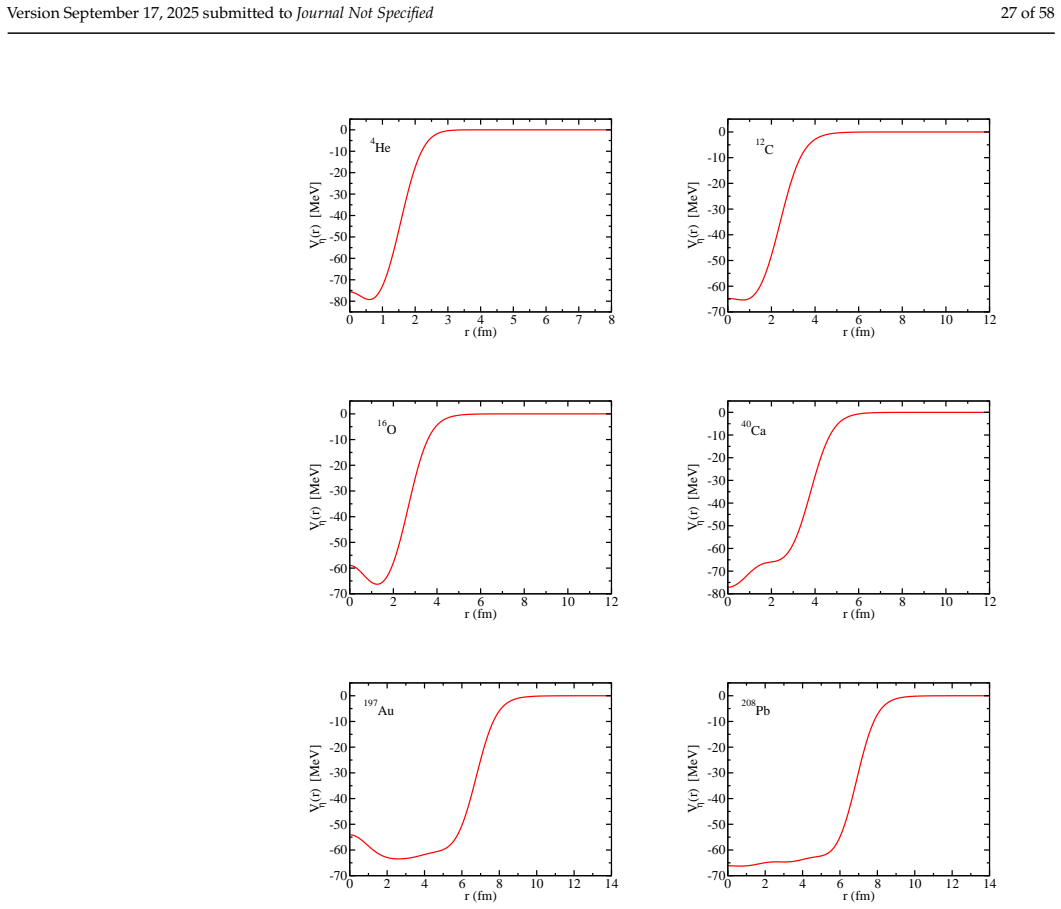
The central claim is that in symmetric nuclear matter all of the mesons considered acquire a negative mass shift, which acts as an attractive Lorentz scalar potential, and that the resulting potentials are strong enough to support bound states with nuclei from helium-4 to lead-208. The in-medium masses of light-quark mesons (K, K*, D, D*, B, B*, eta, eta prime) are computed in the quark-meson coupling model; for mesons with no light valence quarks, the medium effect enters through self-energy loops involving intermediate mesons that do contain light quarks, whose in-medium masses come from the same model. Solving the Klein-Gordon equation with these potentials, the authors find that eta, eta prime, phi, eta_c, J/psi, eta_b, Upsilon, and B_c all form bound states with the nuclei studied, with B_c-nucleus binding energies here presented for the first time.
Load-bearing premise
The predicted binding energies assume that truncating each heavy meson's self-energy to its lightest meson loop (D Dbar for J/psi, B Bbar for Upsilon) is harmless, even though earlier work found the heavier D* D*bar and B* B*bar loops give larger, unexpected contributions; if those loops belong in the calculation, the mass shifts that drive binding will change.
Editorial extensions
If this is right
- A J/psi or Upsilon produced nearly at rest inside a nucleus should form a quasibound state rather than simply scattering or being absorbed.
- The phi meson, despite broadening by an order of magnitude in medium, should still bind to medium and heavy nuclei when the cutoff is large enough, though its large width may hide the signal.
- Eta and eta prime mesic nuclei should exist even with absorption, with at least one bound state for the absorption strengths considered.
- The B_c meson, carrying both charm and bottom flavor, should bind to all nuclei studied, with 1s binding energies of roughly 50 to 100 MeV depending on the cutoff.
- Bound-state spectra become richer for heavier nuclei: about 70 states for Upsilon-208Pb and roughly 200 for eta_b-208Pb.
Reading between the lines
- If heavier loops such as D* D*bar and B* B*bar are physical, the predicted mass shifts and binding energies could be substantially larger than quoted, since the authors note those loops were found to give unexpectedly large contributions in earlier work.
- The same mechanism suggests that other two-heavy-flavor mesons, such as B_s and D_s, should also experience downward mass shifts in matter; the formulas here could be applied directly to those cases.
- A measurement of the phi meson's in-medium width, predicted to grow roughly tenfold at normal nuclear density, would test the mechanism without needing to resolve a bound state.
- The prediction that B_c binds more strongly than both eta_c and eta_b runs counter to naive interpolation between charm and bottom scales; if confirmed, it would point to the vector-meson structure of the loop, not simply quark mass, as the controlling factor.
Editorial analysis
A structured set of objections, weighed in public.
Referee Report
Summary. This paper combines the quark-meson coupling (QMC) model with an effective Lagrangian approach to compute in-medium mass shifts of light, heavy-light, and heavy-heavy mesons in symmetric nuclear matter, and from these shifts it constructs meson-nucleus potentials and bound-state energies for a range of nuclei. The mesons covered are K, K*, D, D*, B, B*, eta, eta', phi, eta_c, J/psi, eta_b, Upsilon, and B_c. The central claim, stated in Section 7, is that all the mesons studied are expected to form bound states with nuclei. The paper is largely a review of previous work by the same group, with the B_c-nucleus bound states (Tables 12-13) and some updated comparisons presented as new results.
Significance. If the predicted mass shifts and bound states were robust, the paper would provide a comprehensive survey of heavy-meson nuclear bound states and would be a valuable reference for experiments at J-PARC, JLab, and other facilities. The paper has clear strengths: it compiles a large set of numerical results, gives both real and imaginary parts of the potentials where relevant, presents coordinate-space wave functions in an appendix, and discusses cutoff dependence throughout. The new B_c-nucleus bound-state predictions extend the existing framework to a new system. However, the quantitative reliability of the predictions is limited by two issues: the systematic truncation of the heavy-meson self-energies to the lightest meson loops, which the text itself states excludes contributions previously found to be dominant, and the sizable differences between the two numerical methods used for the bound-state calculations. These issues do not necessarily invalidate the qualitative conclusion that attraction and binding occur, but they must be addressed before the quantitative results can be taken at face value.
major comments (3)
- [Secs. 4.2-4.3, Eqs. (24)-(39)] The J/psi and Upsilon self-energies are restricted to the DD and BB loops, respectively, although the text explicitly states that the D*Dbar* loop gives 'larger contributions ... which is unexpected' (Sec. 4.2) and that the B*Bbar* loop gives an 'unexpectedly large contribution' (Sec. 4.3). The DD-only J/psi mass shift at rho0 ranges from -5 to -21 MeV over the cutoff range (Fig. 6, left), and the BB-only Upsilon shift ranges from -16 to -22 MeV (Fig. 7); the omitted loops could change these values by an amount that is not estimated. Since every bound-state energy in Tables 3-13 is derived from these mass shifts, the truncation introduces a systematic uncertainty that is not quantified and that could be larger than the cutoff dependence shown. The manuscript should either include the omitted loops with the same regularization scheme or provide a quantitative estimate of their effect on the mass shifts and bound-state energies.
- [Sec. 6, Tables 8-9] The two numerical methods, the Woods-Saxon Fourier transform and the direct Bessel transform, give materially different bound-state energies. For the eta_b-208Pb 1s state at Lambda=2000 MeV, Table 8 gives -74.7 MeV and Table 9 gives -61.4 MeV; for eta_b-48Ca 1s the difference is -76.7 MeV versus -63.9 MeV. These differences are an order of magnitude larger than the 'at most, few MeV difference' stated in Section 6, and they are comparable to or larger than the quoted cutoff uncertainties. The source of this method dependence should be identified and the disagreement resolved or explained before the individual bound-state energies can be considered reliable.
- [Table 5 and Sec. 7] The concluding claim that 'all the mesons studied are expected to form bound states with nuclei' is not supported by the J/psi-4He results: Table 5 shows no 1s bound state for Lambda_D=2000 and 3000 MeV, with the bound state appearing only for Lambda_D>=4000 MeV. The summary should be qualified to state that the existence of J/psi-nuclear bound states for 4He is cutoff-dependent. In addition, Table 5 is labeled as calculated with the Schrodinger equation, while Section 6 states the Klein-Gordon equation is solved; this inconsistency should be clarified.
minor comments (5)
- [Sec. 3, Fig. 1 caption] The caption and the text state the results are shown 'versus nuclear matter density rho0/rhoB', but the axes and the text elsewhere use rhoB/rho0; this should be corrected.
- [Sec. 4.5, Table 2] In Table 2, the row labeled 'gB*s BD' should read 'gB*c BD'; the subscript 'c' is missing.
- [Sec. 4.2, text near Eq. (18)] The text says the eta_c self-energy is computed with only the DD* loop and refers to Ref. [67] for details; since this is a review, a brief description of why the DD* loop is the leading one, rather than the D*D* loop, would help readers understand the truncation logic.
- [Sec. 6] The statement that the bound-state energies are 'similar, with, at most, few MeV difference' between the two numerical methods is contradicted by the entries in Tables 8-9 and should be revised.
- [Abstract] The abstract contains the typo 'emphasys' instead of 'emphasis'.
Circularity Check
No significant circularity: the in-medium mass shifts and bound-state energies follow from QMC couplings fixed to nuclear saturation and loop couplings fixed to vacuum observables, with bare masses set by vacuum renormalization.
full rationale
The derivation chain is not circular. The QMC couplings (g_q^sigma, g_q^omega, g_q^rho) are fixed by nuclear saturation energy, density, and symmetry energy (Section 2); the in-medium D, D*, B, and B* masses are outputs of the QMC model. The effective-Lagrangian couplings are fixed by vacuum decay data or SU(4)/SU(5) relations (for example, g_phi from Gamma(phi->KK) and g_UpsilonBB from Gamma(Upsilon->e+e-)), and the bare meson masses are fixed by reproducing the physical vacuum masses (e.g., Eqs. (23), (29), (36), and (43)). The in-medium mass shifts are genuine outputs of the loop self-energies evaluated with QMC in-medium intermediate masses. Bound-state energies are obtained by solving Eq. (53) with the potential set equal to the mass shift in the local density approximation; this is a model relation, but not a circular one, because the mass shifts are not fitted to any bound-state observable. The main caveat is model dependence, not circularity: Sections 4.2 and 4.3 state that the omitted D*Dbar* and B*Bbar* loops give 'larger contributions' that are 'unexpected' and are dropped 'for consistency.' This truncation is an unquantified systematic uncertainty that propagates into Tables 3-13, but the paper nowhere defines the predicted mass shift or binding energy in terms of the input data. Self-citations (Refs. [11, 37, 38, 67, 72, 75, 84, 100, 101, 115, 123]) are extensive but serve as sources of the reviewed calculations and methods, not as a uniqueness theorem or fitted input that forces the result.
Assumptions & free parameters
free parameters (6)
- Quark-meson coupling constants (g_q^sigma, g_q^omega, g_q^rho) =
(5.69, 2.72, 9.33)
- MIT bag constant B_p and zero-point parameter z_h =
Not given explicitly in this paper; fitted to free-space hadron masses
- eta-eta' mixing angle theta_P =
-11.3 degrees
- Form-factor cutoffs Lambda_K, Lambda_D, Lambda_B =
Varied: Lambda_K 1000-4000 MeV; Lambda_D 1500-6000 MeV; Lambda_B 2000-6000 MeV
- SU(4) breaking factor 0.6/sqrt(2) for g_eta_c DD* =
0.6/sqrt(2) ~ 0.424
- Absorption parameter gamma for eta and eta' widths =
0, 0.25, 0.5, 1.0
assumptions (6)
- domain assumption MIT bag model describes hadron structure with non-overlapping bags; heavy quarks (s,c,b) do not couple to the sigma, omega, rho mean fields
- domain assumption SU(2) isospin symmetry for u and d quarks, and symmetric nuclear matter with zero rho mean field in Hartree approximation
- domain assumption Effective Lagrangian approach treats mesons as point-like and uses SU(4) or SU(5) flavor symmetry to determine coupling constants
- domain assumption OZI rule suppresses direct quarkonium-nucleon interactions, so only light-meson loops mediate in-medium mass shifts
- domain assumption Local density approximation: meson-nucleus potential at position r equals the nuclear-matter mass shift at local baryon density rho_B(r)
- domain assumption Free-space quark masses (mq=5, ms=250, mc=1270, mb=4200 MeV) and nucleon bag radius R_N=0.8 fm
Cite this review
Pith. "Pith review of Heavy-heavy and heavy-light mesons in cold nuclear matter." pith.science (2026). https://pith.science/paper/T2S6NQJV
@misc{pith2026250608946,
  author       = {Pith},
  title        = {Pith review of: Heavy-heavy and heavy-light mesons in cold nuclear matter},
  year         = {2026},
  howpublished = {\url{https://pith.science/paper/T2S6NQJV}},
  note         = {Machine review of arXiv:2506.08946}
}
abstract
We review the in-medium modifications of effective masses (Lorentz scalar potentials or phenomenon of mass shift) of heavy-heavy and heavy-light mesons in symmetric nuclear matter and their nuclear bound states. We use a combined approach with the quark-meson coupling (QMC) model and an effective Lagrangian. As demonstrated by the cases of pionic and kaonic atoms, studies of meson-nucleus bound state can provide us with important information on chiral symmetry in dense nuclear medium. In this review, we treat the mesons, $K, K^*, D, D^*, B, B^*, \eta, \eta', \phi, \eta_c, J/\psi, \eta_b, \Upsilon$, and $B_c$, where our emphasys is on the heavy mesons. In addition, we also present some new results for the $B_c$-nucleus bound states.
Figures


Figures from the paper (17 more)




Reference graph
Works this paper leans on
-
[1]
A. Accardi, P . Achenbach, D. Adhikari, A. Afanasev, C. S. Akondi, N. Akopov, M. Albaladejo, H. Albataineh, M. Albrecht and B. Almeida-Zamora,et al.Eur. Phys. J. A60, 173 (2024) [arXiv:2306.09360 [nucl-ex]]
arXiv 2024
-
[2]
S. J. Brodsky, A. L. Deshpande, H. Gao, R. D. McKeown, C. A. Meyer, Z. E. Meziani, R. G. Milner, J. Qiu, D. G. Richards and C. D. Roberts, [arXiv:1502.05728 [hep-ph]]
- [3]
-
[4]
R. Alkofer and L. von Smekal, Phys. Rept.353, 281 (2001), [arXiv:hep-ph/0007355 [hep-ph]]
arXiv 2001
-
[5]
N. Brambilla, S. Eidelman, P . Foka, S. Gardner, A. S. Kronfeld, M. G. Alford, R. Alkofer, M. Butenschoen, T. D. Cohen and J. Erdmenger,et al.Eur. Phys. J. C74, 2981 (2014), [arXiv:1404.3723 [hep-ph]]
arXiv 2014
- [6]
-
[7]
I. C. Cloet and C. D. Roberts, Prog. Part. Nucl. Phys.77, 1 (2014), [arXiv:1310.2651 [nucl-th]]
arXiv 2014
- [8]
Show all 125 references
-
[9]
Krein, AIP Conf
G. Krein, AIP Conf. Proc.1701, 020012 (2016)
2016
-
[10]
Metag, M
V . Metag, M. Nanova and E. Y. Paryev, Prog. Part. Nucl. Phys.97, 199 (2017), [arXiv:1706.09654 [nucl-ex]]
2017 arXiv
-
[11]
Krein, A
G. Krein, A. W. Thomas and K. Tsushima, Prog. Part. Nucl. Phys.100, 161 (2018), [arXiv:1706.02688 [hep-ph]]
2018 arXiv
-
[12]
Hatsuda and T
T. Hatsuda and T. Kunihiro, Phys. Rept.247, 221-367 (1994), [arXiv:hep-ph/9401310 [hep-ph]]
1994 arXiv
-
[13]
Leupold, V
S. Leupold, V . Metag and U. Mosel, Int. J. Mod. Phys. E19, 147-224 (2010), [arXiv:0907.2388 [nucl-th]]
2010 arXiv
-
[14]
R. S. Hayano and T. Hatsuda, Rev. Mod. Phys.82, 2949 (2010), [arXiv:0812.1702 [nucl-ex]]
2010 arXiv
-
[15]
Nishiet al.[piAF], Nature Phys.19, 788 (2023), [arXiv:2204.05568 [nucl-ex]]
T. Nishiet al.[piAF], Nature Phys.19, 788 (2023), [arXiv:2204.05568 [nucl-ex]]
2023 arXiv
-
[16]
Schroedter, R
M. Schroedter, R. L. Thews, and J. Rafelski, Phys. Rev. C62, 024905 (2000), [arXiv:hep-ph/0004041 [hep-ph]]
2000 arXiv
-
[17]
Andronic, F
A. Andronic, F. Arleo, R. Arnaldi, A. Beraudo, E. Bruna, D. Caffarri, Z. C. del Valle, J. G. Contreras, T. Dahms, A. Daineseet al., Eur. Phys. J. C76, 107 (2016), [arXiv:1506.03981 [nucl-ex]]
2016 arXiv
-
[18]
Y. S. Li and X. Liu, Phys. Rev. D108, 093005 (2023), [arXiv:2309.08191 [hep-ph]]
2023 arXiv
-
[19]
C. Bird, P . Jackson, R. V . Kowalewski and M. Pospelov, Phys. Rev. Lett.93, 201803 (2004), [arXiv:hep-ph/0401195 [hep-ph]]
2004 arXiv
-
[20]
Altmannshofer and D
W. Altmannshofer and D. M. Straub, Eur. Phys. J. C75, 382 (2015), [arXiv:1411.3161 [hep-ph]]
2015 arXiv
-
[21]
A. J. Buras, J. Girrbach-Noe, C. Niehoff and D. M. Straub, JHEP02, 184 (2015), [arXiv:1409.4557 [hep-ph]]. Version September 17, 2025 submitted toJournal Not Specified 37 of 58 Table 11.Bound state energies ( E) and full widths ( Γ) of η′ meson in nucleus of mass number A obta...
2015 arXiv
-
[22]
Descotes-Genon, L
S. Descotes-Genon, L. Hofer, J. Matias and J. Virto, JHEP06, 092 (2016), [arXiv:1510.04239 [hep-ph]]
2016 arXiv
-
[23]
Dutta and A
R. Dutta and A. Bhol, Phys. Rev. D96, 076001 (2017), [arXiv:1701.08598 [hep-ph]]
2017 arXiv
-
[24]
Tumasyanet al.[CMS], Phys
A. Tumasyanet al.[CMS], Phys. Rev. Lett.129, 032001 (2022), [arXiv:2111.02219 [hep-ex]]. Version September 17, 2025 submitted toJournal Not Specified 38 of 58 Table 13.Bound state energies of B+c in nucleus of mass number A, obtained by the Direct Bessel transform method. All ...
2022 arXiv
-
[25]
Hadronic Cross Sections ofB c Mesons,
F. Akram, “Hadronic Cross Sections ofB c Mesons,” PhD Punjab U. (2013)
2013
-
[26]
M. A. K. Lodhi and R. Marshall, Nucl. Phys. A790, 323 (2007),
2007
-
[27]
M. A. K. Lodhi, F. Akram and S. Irfan, Phys. Rev. C84, 034901 (2011), [arXiv:1309.2912 [nucl-th]]
2011 arXiv
-
[28]
B. Wu, Z. Tang, M. He and R. Rapp, Phys. Rev. C109, 014906 (2024), [arXiv:2302.11511 [nucl-th]]
2024
-
[29]
Tumasyanet al.[CMS], Phys
A. Tumasyanet al.[CMS], Phys. Rev. Lett.128, 252301 (2022), [arXiv:2201.02659 [hep-ex]]
2022 arXiv
-
[30]
J. W. Harris and B. Müller, [arXiv:2308.05743 [hep-ph]]
-
[31]
Z. w. Lin and C. M. Ko, Phys. Lett. B503, 104 (2001), [arXiv:nucl-th/0007027 [nucl-th]]
2001 arXiv
-
[32]
A. M. Sirunyanet al.[CMS], Phys. Lett. B790, 270 (2019), [arXiv:1805.09215 [hep-ex]]
2019 arXiv
-
[33]
Aadet al.[ATLAS], Phys
G. Aadet al.[ATLAS], Phys. Rev. C107, 054912 (2023), [arXiv:2205.03042 [nucl-ex]]
2023 arXiv
-
[34]
Aboonaet al.[STAR], Phys
B. Aboonaet al.[STAR], Phys. Rev. Lett.130, 112301 (2023), [arXiv:2207.06568 [nucl-ex]]
2023
-
[35]
P . A. M. Guichon, Phys. Lett. B200, 235 (1988)
1988
-
[36]
S. J. Brodsky and G. A. Miller, Phys. Lett. B412, 125 (1997), [arXiv:hep-ph/9707382 [hep-ph]]
1997 arXiv
-
[37]
Krein, A
G. Krein, A. W. Thomas and K. Tsushima, Phys. Lett. B697, 136 (2011), [arXiv:1007.2220 [nucl-th]]
2011 arXiv
-
[38]
Tsushima, D
K. Tsushima, D. H. Lu, G. Krein and A. W. Thomas, Phys. Rev. C83, 065208 (2011), [arXiv:1103.5516 [nucl-th]]
2011 arXiv
-
[39]
C. M. Ko, P . Levai, X. J. Qiu and C. T. Li, Phys. Rev. C45, 1400 (1992)
1992
-
[40]
Asakawa, C
M. Asakawa, C. M. Ko, P . Levai and X. J. Qiu, Phys. Rev. C46, R1159 (1992)
1992
-
[41]
Friedman and G
E. Friedman and G. Soff, J. Phys. G11, L37 (1985)
1985
-
[42]
et al., Z
Yamazaki, T., Hayano, R.S., Itahashi, K. et al., Z. Physik A 355, 219 (1996)
1996
-
[43]
J. D. Davies, G. J. Pyle, G. T. A. Squier, C. J. Batty, S. F. Biagi, S. D. Hoath, P . Sharman and A. S. Clough, Phys. Lett. B83, 55 (1979)
1979
-
[44]
C. H. Lee, G. E. Brown, D. P . Min and M. Rho, Nucl. Phys. A585, 401 (1995), [arXiv:hep-ph/9406311 [hep-ph]]
1995 arXiv
-
[45]
T. M. Ito, R. S. Hayano, S. N. Nakamura, T. P . Terada, M. Iwasaki, D. R. Gill, L. Lee, A. Olin, M. Salomon and S. Yen,et al.Phys. Rev. C58, 2366 (1998)
1998
-
[46]
Curceanu, C
C. Curceanu, C. Guaraldo, M. Iliescu, M. Cargnelli, R. Hayano, J. Marton, J. Zmeskal, T. Ishiwatari, M. Iwasaki and S. Okada,et al. Rev. Mod. Phys.91, 025006 (2019)
2019
-
[47]
Hirenzaki, Y
S. Hirenzaki, Y. Okumura, H. Toki, E. Oset and A. Ramos, Phys. Rev. C61, 055205 (2000)
2000
-
[48]
R. S. Hayano, S. Hirenzaki and A. Gillitzer, Eur. Phys. J. A6, 99 (1999), [arXiv:nucl-th/9806012 [nucl-th]]
1999 arXiv
-
[49]
Tsushima, D
K. Tsushima, D. H. Lu, A. W. Thomas and K. Saito, Phys. Lett. B443, 26 (1998), [arXiv:nucl-th/9806043 [nucl-th]]
1998 arXiv
-
[50]
Tsushima, D
K. Tsushima, D. H. Lu, A. W. Thomas, K. Saito and R. H. Landau, Phys. Rev. C59, 2824 (1999), [arXiv:nucl-th/9810016 [nucl-th]]
1999 arXiv
-
[51]
S. J. Brodsky, I. A. Schmidt and G. F. de Teramond, Phys. Rev. Lett.64, 1011 (1990)
1990
-
[52]
S. H. Lee and C. M. Ko, Phys. Rev. C67, 038202 (2003), [arXiv:nucl-th/0208003 [nucl-th]]
2003 arXiv
-
[53]
Krein, J
G. Krein, J. Phys. Conf. Ser.422, 012012 (2013)
2013
-
[54]
Klingl, S
F. Klingl, S. s. Kim, S. H. Lee, P . Morath and W. Weise, Phys. Rev. Lett.82(1999), 3396;83, 4224 (1999), [arXiv:nucl-th/9811070 [nucl-th]]
1999 arXiv
-
[55]
Hayashigaki, Prog
A. Hayashigaki, Prog. Theor. Phys.101(1999), 923. [arXiv:nucl-th/9811092 [nucl-th]]
1999 arXiv
-
[56]
Kumar and A
A. Kumar and A. Mishra, Phys. Rev. C82, 045207 (2010), [arXiv:1005.2748 [nucl-th]]. Version September 17, 2025 submitted toJournal Not Specified 39 of 58 0 5 10 15 r[fm] 0 0.1 0.2 0.3 0.4 0.5 Ψl(r) 1s state 1p state B - c - 12 C (Λ= 2000 MeV) 0 5 10 15 r[fm] 0 0.1 0.2 0.3 0.4 ...
2010 arXiv
-
[57]
V . B. Belyaev, N. V . Shevchenko, A. I. Fix and W. Sandhas, Nucl. Phys. A780, 100 (2006), [arXiv:nucl-th/0601058 [nucl-th]]
2006 arXiv
-
[58]
Yokota, E
A. Yokota, E. Hiyama and M. Oka, PTEP2013, 113D01 (2013), [arXiv:1308.6102 [nucl-th]]
2013 arXiv
-
[59]
M. E. Peskin, Nucl. Phys. B156, 365 (1979)
1979
-
[60]
Kharzeev, Proc
D. Kharzeev, Proc. Int. Sch. Phys. Fermi130, 105 (1996), [arXiv:nucl-th/9601029 [nucl-th]]
1996 arXiv
-
[61]
A. B. Kaidalov and P . E. Volkovitsky, Phys. Rev. Lett.69, 3155 (1992)
1992
-
[62]
M. E. Luke, A. V . Manohar and M. J. Savage, Phys. Lett. B288(1992), 355. [arXiv:hep-ph/9204219 [hep-ph]]
1992 arXiv
-
[63]
G. F. de Teramond, R. Espinoza and M. Ortega-Rodriguez, Phys. Rev. D58, 034012 (1998), [arXiv:hep-ph/9708202 [hep-ph]]
1998 arXiv
-
[64]
Sibirtsev and M
A. Sibirtsev and M. B. Voloshin, Phys. Rev. D71, 076005 (2005), [arXiv:hep-ph/0502068 [hep-ph]]
2005 arXiv
-
[65]
M. B. Voloshin, Prog. Part. Nucl. Phys.61, 455 (2008), [arXiv:0711.4556 [hep-ph]]
2008 arXiv
-
[66]
Tarrús Castellà and G
J. Tarrús Castellà and G. Krein, Phys. Rev. D98, 014029 (2018), [arXiv:1803.05412 [hep-ph]]
2018 arXiv
-
[67]
J. J. Cobos-Martínez, K. Tsushima, G. Krein and A. W. Thomas, Phys. Lett. B811, 135882 (2020), [arXiv:2007.04476 [hep-ph]]
2020 arXiv
-
[68]
Yokokawa, S
K. Yokokawa, S. Sasaki, T. Hatsuda and A. Hayashigaki, Phys. Rev. D74, 034504 (2006), [arXiv:hep-lat/0605009 [hep-lat]]
2006 arXiv
-
[69]
Kawanai and S
T. Kawanai and S. Sasaki, Phys. Rev. D82, 091501 (2010), [arXiv:1009.3332 [hep-lat]]
2010 arXiv
-
[70]
Skerbis and S
U. Skerbis and S. Prelovsek, Phys. Rev. D99, 094505 (2019), [arXiv:1811.02285 [hep-lat]]
2019 arXiv
-
[71]
Chizzali, Y
E. Chizzali, Y. Kamiya, R. Del Grande, T. Doi, L. Fabbietti, T. Hatsuda and Y. Lyu, Phys. Lett. B848, 138358 (2024), [arXiv:2212.12690 [nucl-ex]]
2024 arXiv
-
[72]
G. N. Zeminiani, J. J. Cobos-Martinez and K. Tsushima, Eur. Phys. J. A57, 259 (2021), [arXiv:2012.11381 [hep-ph]]
2021 arXiv
-
[73]
G. N. Zeminiani, [arXiv:2201.09158 [nucl-th]]
-
[74]
Zeminiani, J
G. Zeminiani, J. J. Cobos-Martínez and K. Tsushima, PoSPANIC2021, 208 (2022), [arXiv:2109.08636 [hep-ph]]
2022 arXiv
-
[75]
J. J. Cobos-Martínez, G. N. Zeminiani and K. Tsushima, Phys. Rev. C105, 025204 (2022), [arXiv:2201.05696 [nucl-th]]
2022 arXiv
-
[76]
J. J. Aubertet al.[European Muon], Phys. Lett. B123, 275 (1983)
1983
-
[77]
For a review, D. F. Geesaman, K. Saito and A. W. Thomas, Ann. Rev. Nucl. Part. Sci.45, 337 (1995)
1995
-
[78]
Dieterich, P
S. Dieterich, P . Bartsch, D. Baumann, J. Bermuth, K. Bohinc, R. Bohm, D. Bosnar, S. Derber, M. Ding and M. Distler,et al.Phys. Lett. B500, 47 (2001), [arXiv:nucl-ex/0011008 [nucl-ex]]
2001 arXiv
-
[79]
Strauch (Jefferson Lab E93-049 Collaboration), Eur
S. Strauch (Jefferson Lab E93-049 Collaboration), Eur. Phys. J. A19, 153 (2004), S. Strauchet al., Phys. Rev. Lett.91, 052301 (2003). Version September 17, 2025 submitted toJournal Not Specified 40 of 58 0 5 10 15 r[fm] 0 0.1 0.2 0.3 0.4 0.5 0.6 Ψl(r) 1s state 1p state B - c -...
2004
-
[80]
Saito, K
K. Saito, K. Tsushima and A. W. Thomas, Prog. Part. Nucl. Phys.58, 1 (2007), [arXiv:hep-ph/0506314 [hep-ph]]
2007 arXiv
-
[81]
P . A. M. Guichon, A. W. Thomas and K. Tsushima, Nucl. Phys. A814, 66 (2008), [arXiv:0712.1925 [nucl-th]]
2008 arXiv
- [82]
-
[83]
P . A. M. Guichon, J. R. Stone and A. W. Thomas, Prog. Part. Nucl. Phys.100, 262 (2018)
2018
-
[84]
G. N. Zeminiani, S. L. P . G. Beres and K. Tsushima, Phys. Rev. D110, 094045 (2024), [arXiv:2401.00250 [hep-ph]]
2024 arXiv
-
[85]
Tsushima, K
K. Tsushima, K. Saito, A. W. Thomas and S. V . Wright, Phys. Lett. B429, 239 (1998), [erratum: Phys. Lett. B436, 453 (1998)], [arXiv:nucl-th/9712044 [nucl-th]]
1998 arXiv
-
[86]
Sibirtsev, K
A. Sibirtsev, K. Tsushima and A. W. Thomas, Eur. Phys. J. A6, 351 (1999), [nucl-th/9904016]
1999 arXiv
-
[87]
Sibirtsev, K
A. Sibirtsev, K. Tsushima, K. Saito and A. W. Thomas, Phys. Lett. B484, 23 (2000), [nucl-th/9904015]
2000 arXiv
-
[88]
Tsushima and F
K. Tsushima and F. C. Khanna, Phys. Lett. B552, 138 (2003), [nucl-th/0207036]
2003 arXiv
-
[89]
P . A. M. Guichon, K. Saito, E. N. Rodionov and A. W. Thomas, Nucl. Phys. A601, 349 (1996), [arXiv:nucl-th/9509034 [nucl-th]]
1996 arXiv
-
[90]
Tsushima, PTEP2022, 043D02 (2022), [arXiv:2008.03724 [hep-ph]]
K. Tsushima, PTEP2022, 043D02 (2022), [arXiv:2008.03724 [hep-ph]]
2022 arXiv
-
[91]
Review of Particle Physics,
R. L. Workmanet al.[Particle Data Group], “Review of Particle Physics,” PTEP2022, 083C01 (2022)
2022
-
[93]
Tanabashiet al.[Particle Data Group], Phys
M. Tanabashiet al.[Particle Data Group], Phys. Rev. D98, 030001 (2018)
2018
-
[94]
Okubo, Phys
S. Okubo, Phys. Lett.5, 165 (1963), Phys. Rev. D16, 2336 (1977); G. Zweig, CERN Report No. 8419 TH 412, 1964, (unpublished); J. Iizuka, K. Okada, and O. Shito, Prog. Theor. Phys.35, 1061 (1966), J. Iizuka, Prog. Theor. Phys. Suppl.37, 21 (1966)
1963
-
[95]
Tsushima, D
K. Tsushima, D. Lu, G. Krein and A. W. Thomas, AIP Conf. Proc.1354, 39 (2011), [arXiv:1101.3389 [nucl-th]]
2011 arXiv
-
[96]
Y. Lyu, T. Doi, T. Hatsuda and T. Sugiura, Phys. Lett. B860, 139178 (2025), [arXiv:2410.22755 [hep-lat]]
2025 arXiv
-
[97]
Y. Lyu, T. Doi, T. Hatsuda and T. Sugiura, [arXiv:2502.00054 [hep-lat]]
- [98]
-
[99]
Z. w. Lin, C. M. Ko and B. Zhang, Phys. Rev. C61, 024904 (2000), [nucl-th/9905003]
2000 arXiv
-
[100]
J. J. Cobos-Martínez, K. Tsushima, G. Krein and A. W. Thomas, Phys. Lett. B771, 113 (2017), [arXiv:1703.05367 [nucl-th]]
2017 arXiv
-
[101]
J. J. Cobos-Martínez, K. Tsushima, G. Krein and A. W. Thomas, Phys. Rev. C96, 035201 (2017), [arXiv:1705.06653 [nucl-th]]
2017 arXiv
-
[102]
J. J. Cobos-Martínez, K. Tsushima, G. Krein and A. W. Thomas, J. Phys. Conf. Ser.912, 012009 (2017), [arXiv:1711.06358 [nucl-th]]
2017 arXiv
-
[103]
J. J. Cobos-Martínez, K. Tsushima, G. Krein and A. W. Thomas, PoSHadron2017, 209 (2018), [arXiv:1711.09895 [nucl-th]]. Version September 17, 2025 submitted toJournal Not Specified 41 of 58 0 5 10 15 r[fm] 0 0.1 0.2 0.3 0.4 0.5 Ψl(r) 1s state 1p state B - c - 40 Ca (Λ= 2000 MeV...
2018 arXiv
-
[104]
J. J. Cobos-Martínez, K. Tsushima, G. Krein and A. W. Thomas, JPS Conf. Proc.26, 024033 (2019), [arXiv:1901.07404 [hep-ph]]
2019 arXiv
-
[105]
Lucha, D
W. Lucha, D. Melikhov, H. Sazdjian and S. Simula, Phys. Rev. D93, no. 1, 016004 (2016); Addendum: [Phys. Rev. D93, 019902 (2016)], [arXiv:1506.09213 [hep-ph]]
2016 arXiv
-
[106]
Z. w. Lin and C. M. Ko, Phys. Rev. C62, 034903 (2000), [nucl-th/9912046]
2000 arXiv
-
[107]
Hayashigaki, Phys
A. Hayashigaki, Phys. Lett. B48796 (2000), [arXiv:nucl-th/0001051 [nucl-th]]
2000 arXiv
-
[108]
Azizi, N
K. Azizi, N. Er and H. Sundu, Eur. Phys. J. C74, 3012 (2014), [arXiv:1405.3058 [hep-ph]]
2014 arXiv
-
[109]
Z. G. Wang, Phys. Rev. C92, 065205 (2015), [arXiv:1501.05093 [hep-ph]]
2015 arXiv
-
[110]
Suzuki, P
K. Suzuki, P . Gubler and M. Oka, Phys. Rev. C93, 045209 (2016), [arXiv:1511.04513 [hep-ph]]
2016 arXiv
-
[111]
A. Park, P . Gubler, M. Harada, S. H. Lee, C. Nonaka and W. Park, Phys. Rev. D93, 054035 (2016), [arXiv:1601.01250 [nucl-th]]
2016 arXiv
-
[112]
Gubler, T
P . Gubler, T. Song and S. H. Lee, Phys. Rev. D101, 114029 (2020), [arXiv:2003.09073 [hep-ph]]
2020 arXiv
-
[113]
Hilger, R
T. Hilger, R. Thomas and B. Kampfer, Phys. Rev. C79, 025202 (2009), [arXiv:0809.4996 [nucl-th]]
2009 arXiv
-
[114]
T. F. Caramés, C. E. Fontoura, G. Krein, K. Tsushima, J. Vijande and A. Valcarce, Phys. Rev. D94, 034009 (2016), [arXiv:1608.04040 [hep-ph]]
2016 arXiv
-
[115]
G. N. Zeminiani, J. J. Cobos-Martínez and K. Tsushima, [arXiv:2406.11114 [nucl-th]]
-
[116]
Saito, K
K. Saito, K. Tsushima and A. W. Thomas, Nucl. Phys. A609, 339 (1996), [arXiv:nucl-th/9606020 [nucl-th]]
1996 arXiv
-
[117]
Saito, K
K. Saito, K. Tsushima and A. W. Thomas, Phys. Rev. C56, 566 (1997), [nucl-th/9703011]
1997 arXiv
-
[118]
Y. R. Kwan and F. Tabakin, Phys. Rev. C18, 932 (1978)
1978
-
[119]
Buhleret al., Prog
P . Buhleret al., Prog. Theor. Phys. Suppl.186, 337 (2010)
2010
-
[120]
Ohnishiet al., Acta Phys
H. Ohnishiet al., Acta Phys. Polon. B45, 819 (2014)
2014
-
[121]
Csörg˝ o, M
T. Csörg˝ o, M. Csanád and T. Novák, Proceedings, 10th Workshop on Particle Correlations and Femtoscopy (WPCF 2014) : Gyöngyös, Hungary, August 25-29, 2014, SLAC-econf-C140825.8
2014
-
[122]
https://www.jlab.org/exp_prog/PACpage/PAC42/PAC42_FINAL_Report.pdf
-
[123]
J. J. Cobos-Martinez and K. Tsushima, Phys. Rev. C109, 2 (2024), [arXiv:2308.07836 [nucl-th]]
2024 arXiv
-
[124]
J. J. Cobos-Martinez, K. Tsushima, G. Krein and A. W. Thomas, PoSCHARM2020, 041 (2021), [arXiv:2109.10995 [nucl-th]]
2021 arXiv
-
[125]
Cobos Martinez, K
J. Cobos Martinez, K. Tsushima, G. Krein and A. W. Thomas, PoSPANIC2021, 199 (2022), [arXiv:2111.13820 [nucl-th]]. Version September 17, 2025 submitted toJournal Not Specified 42 of 58 0 5 10 15 r[fm] 0 0.1 0.2 0.3 0.4 0.5 Ψl(r) 1s state 1p state B - c - 48 Ca (Λ= 2000 MeV) 0 ...
2022 arXiv
-
[126]
Navas et al
S. Navas et al. (Particle Data Group), Phys. Rev. D110, 030001 (2024). Disclaimer/Publisher’s Note:The statements, opinions and data contained in all publications are solely those of the individual author(s) and contributor(s) and not of MDPI and/or the editor(s). MDPI and/or ...
2024
Reviewed August 7, 2026 · model on record in the stance chip above.
Discussion (0). Sign in to comment.