REVIEW 3 major objections 4 minor 116 references
AI Ethics and Social Norms: Exploring ChatGPT's Capabilities From What to How
T0 review · 3 major / 4 minor · reviewed 2026-08-16 · deepseek-v4-flash
Pith's one-line read This paper claims that a mixed-method study of ChatGPT users and experts identifies six ethical dimensions of AI, with transparency and bias in data collection as the most salient concerns.
desk verdict Useful cross-country perception data; the inferential statistics are currently uninterpretable due to an undefined grouping variable. read the letter →
The pith
A machine-rendered reading of the paper's core claim, the machinery that carries it, and where it could break.
The reading
What carries the argument
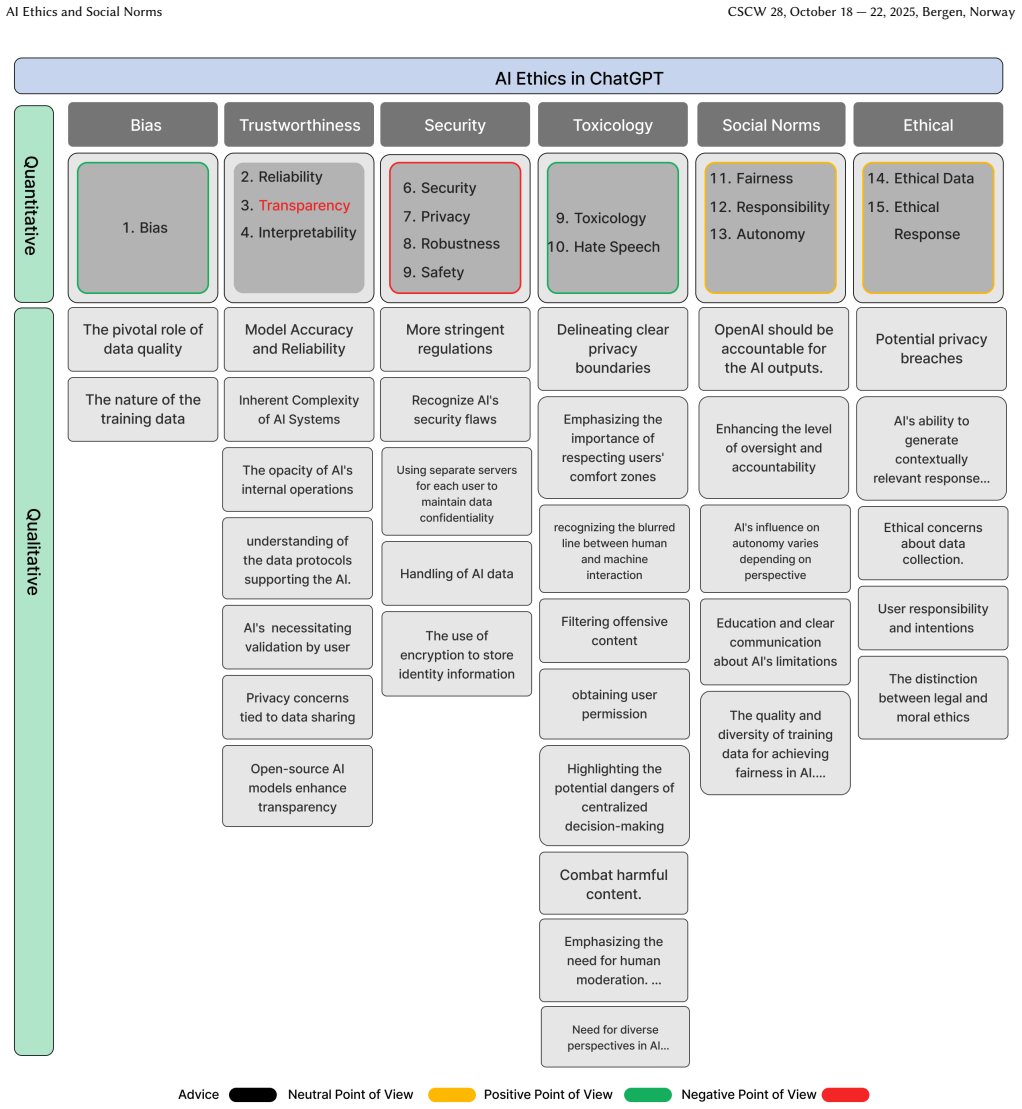
The central object is a taxonomy of six AI-ethics dimensions—bias, trustworthiness, security, toxicology, social norms, and ethical data—with fourteen sub-dimensions and twenty-two Likert-scale questions. The argument is carried by triangulating a quantitative survey with a qualitative interview study, and the quantitative inference that perceptions vary across groups rests on the Kruskal-Wallis $H$ test, a non-parametric rank test for differences among independent groups. The machinery also includes thematic analysis of 38 expert interviews, coded by two researchers, which supplies the reasons behind the survey numbers.
What would settle it
Re-analyze the survey with the Ethic grouping variable explicitly defined; if the five groups cannot be specified from the questionnaire or the identified p-values for Trustworthiness, Security, Toxicology, and Social Norms do not reproduce, the claim of significant cross-group differences collapses.
Extended reading notes
Core claim
The paper's central claim is that a six-part taxonomy captures the ethical and social-norm concerns people actually have about ChatGPT, and that within that taxonomy the dominant perceived failures are transparency and bias from unsupervised data collection. On the survey, a majority of participants disagreed that an outside observer can understand how ChatGPT's results are produced, and a large share expressed uncertainty about whether the data behind ChatGPT were collected ethically. The Kruskal-Wallis $H$ test is then used to claim that perceptions differ significantly across groups for trustworthiness, security, toxicology, and social norms, but not for bias, which the authors take as evidence that ethics judgments are context-dependent and require qualitative follow-up. From the expert interviews, the paper further claims that bias is experienced differently by region—users in Iran emphasize data and access limitations, while users in the US and Germany emphasize gender and race—and that trust hinges on transparency, reliability, and open data practices.
Load-bearing premise
The quantitative finding that perceptions differ across groups depends on the five levels of a grouping variable called Ethic in the Kruskal-Wallis test, but the paper does not say what those five groups are, how participants were sorted into them, or whether the samples are independent.
Editorial extensions
If this is right
- If the taxonomy and findings are correct, transparency about training-data collection and output generation is the first thing to fix in LLM-based tools.
- Because trustworthiness, security, toxicology, and social norms showed significant cross-group differences, ethics guidelines that are uniform across countries and user groups will miss real variation in perception.
- The lack of a significant difference for bias means bias may be a constant concern across groups, so it needs different detection methods than the other dimensions.
- The regional pattern in the interviews suggests that mitigation should be localized, for example by including non-Western training data and addressing access restrictions.
- The six-dimension structure gives subsequent studies a ready-made questionnaire for evaluating ChatGPT and other LLMs.
Reading between the lines
- The same survey instrument could be applied to other LLMs to test whether the transparency-and-bias gap is ChatGPT-specific or common to all large language models, a question the paper raises but does not answer.
- The reported country differences imply that ethics benchmarks for chatbots should be validated per culture rather than once globally, for example by building country-specific bias test sets.
- A behavioral extension would ask participants to identify biased or non-transparent ChatGPT outputs in a controlled prompt set, connecting self-reported perceptions to measurable system behavior.
Signed reviews
Editorial analysis
A structured set of objections, weighed in public.
Referee Report
Summary. The paper reports a mixed-method study of user and expert perceptions of AI ethics and social norms in ChatGPT. The quantitative component is an online Likert-scale survey of 111 participants in Germany, Iran, and the US, organized around six categories: bias, trustworthiness, security, toxicology, social norms, and ethical data. The qualitative component consists of semi-structured interviews with 38 experts from the same three countries. The authors claim that their quantitative results, analyzed with Kruskal-Wallis tests, show significant differences across ethical categories, and that the interview analysis supports a six-category taxonomy of ethical concerns, with transparency and bias in unsupervised data collection identified as major issues. The paper presents a questionnaire in the appendix, a thematic analysis of expert interviews, and a proposed framework for evaluating LLM ethics.
Significance. If the findings are valid, the study would provide a useful cross-country, perception-based taxonomy of ChatGPT ethics and a set of user- and expert-identified concerns, including transparency, bias, data collection, and social norms. The qualitative corpus—38 experts interviewed in three languages and three countries—is a valuable resource, and the inclusion of the full questionnaire in the appendix is a reproducible feature. The mixed-method design is appropriate in principle. However, the abstract overstates the evidence by claiming the study evaluates whether ChatGPT itself "operates following ethics," when only perceptions were measured. More importantly, the only inferential statistical analysis, the Kruskal-Wallis tests in Table 3, is uninterpretable as reported because the grouping variable is undefined and the independence assumption is not established. These issues are load-bearing because the abstract and Discussion rely on the significant p-values to support the taxonomy claim.
major comments (3)
- [Section 4.1.2, Table 3] The Kruskal-Wallis analysis is the only quantitative inferential evidence for the claim that perceptions vary across ethical categories, but the grouping variable "Ethic" is never defined. The text says the test assessed differences among "five independently sampled groups," yet no group membership, sample sizes, or sampling procedure are reported. If the five groups are the ethical categories measured on the same 111 participants, the independence assumption is violated and the correct test would be Friedman's; if the groups are something else (e.g., countries or user subgroups), the label "Ethic" and df=4 do not match the reported design. Consequently, the p-values (e.g., Trustworthiness H=31.243, p=.000; Social Norms H=19.037, p=.001) cannot be checked, and the claims in the abstract and Section 5.1 that significant differences were found are not supported as reported. The authors must specify the grouping, justify independence, report group sizes, and either use an appropriate test or remove the inferential claim. Relatedly, Table 3 omits the Ethical Data category even though the text claims it presents statistics for each of the six categories.
- [Abstract and Section 5.1] The abstract states that the study "aims to evaluate whether ChatGPT in an empirical context operates following ethics and social norms," and the conclusion describes obstacles "identified as ChatGPT's ethical concerns." The data, however, are self-reported Likert-scale opinions from 111 participants and semi-structured expert interviews; the study does not directly probe ChatGPT's outputs or behavior. The title's "From What to How" and the Discussion's claims about ChatGPT's capabilities therefore overreach what the design can show. These findings should be framed as perceptions, concerns, or reported experiences of users and experts, not as direct evidence about whether ChatGPT itself follows ethics. This is a load-bearing distinction because the paper's central contribution is presented as an evaluation of ChatGPT's ethical operation rather than a study of user and expert perceptions.
- [Sections 3.1.2, 3.3, and 4.2] The qualitative analysis is described as "guided by both deductive and inductive reasoning," but Figure 2 lists principal themes (Generalization, Challenges, Social Norms, Toxicology, Trustworthiness, Bias, Security) that map closely onto the survey's six categories. It is not explained how the deductive coding into the survey categories interacted with the inductive coding, whether the codebook allowed new categories to emerge, or how disagreements between the two coders were resolved. Without this information, the qualitative results risk simply confirming the authors' own framework rather than providing independent evidence for the taxonomy. The authors should report the coding protocol, the distribution of codes across themes, and any inductive themes that arose outside the original six categories; at minimum, an intercoder reliability statistic or a description of the adjudication process would strengthen the validity claim.
minor comments (4)
- [Section 3.2.1] The participant description is internally inconsistent: the text says "60% females and 40% males" and then reports "56.76% female, 43.24% male," and it says 112 individuals completed the survey while the analysis uses 111. These figures should be reconciled.
- [Sections 3.1.2 and 3.3] The phrase "quantitative interview study" appears in both places and appears to be a typo for "qualitative interview study." Similarly, Section 3.3 says "both the quantitative survey study and the quantitative interview study" when the latter is qualitative.
- [Section 4.1.1, Q6] The reporting of the transparency item is confusing: Q6 states that "understanding how ChatGPT's results were generated is somewhat challenging," but the text says 12.9% agreed with the ease of comprehension and 65.1% "indicated trust that the results . . . cannot be explained." The direction of the percentages appears to be reversed or the coding of the item is unclear; please clarify what the reported percentages represent.
- [References] Several reference entries are incomplete or contain informal metadata, including [69], [72], and [82]. A full reference cleanup is needed before publication.
Circularity Check
The six-category ethics taxonomy is pre-loaded into the survey and interview coding, so its 'identification' is partly by construction; the empirical perception findings remain data-grounded.
-
self definitional
[Abstract; Section 3.1.2 (Qualitative Study); Section 3.3 (Testing Material)]
"The findings of this study provide initial insights into six important aspects of AI ethics, including bias, trustworthiness, security, toxicology, social norms, and ethical data. ... We divided the questions into six categories, mirroring the online survey: Bias, Trustworthiness, Security, Toxicology, Social Norms, and Ethical Data. ... The investigation employed a systematic methodology, categorizing data into seven principal themes: Generalization, Challenges, Social Norms, Toxicology, Trustworthiness, Bias, and Security."
The six-category taxonomy presented as a finding is the same six-category taxonomy used to construct the instruments. The survey was explicitly built around bias, trustworthiness, security, toxicology, social norms, and ethical data; the interview guide divided questions into those same six categories; and the thematic coding used the same categories deductively. Consequently, the qualitative 'identification' of these six aspects is built into the research design rather than independently derived from the data. The abstract and discussion present these categories as if they were outputs of the study, but they are inputs imported from prior literature (notably Weidinger et al.).
full rationale
The paper is an empirical mixed-method study, not a predictive derivation, so most circularity patterns (fitted parameters renamed as predictions, ansatz smuggled via citation, uniqueness theorems imported from authors) do not apply. The taxonomy is explicitly traced to prior literature, which the paper acknowledges rather than hiding. The only notable circularity is the self-definitional structure of the qualitative coding: interviewees were asked questions organized into the six target categories, and transcripts were coded deductively into a scheme containing those same categories, so the 'six important aspects' claim is partly an artifact of the instrument and coding frame rather than an emergent result. The empirical perception findings—for example, concerns about transparency, bias, and unsupervised data collection—are grounded in the survey and interview data and are not circular. Separately, the Kruskal-Wallis test in Section 4.1.2 and Table 3 is difficult to interpret because the grouping variable 'Ethic' is never defined, the number of groups (df=4) is unexplained, and Ethical Data is absent from the table; however, this is a statistical reporting and correctness concern, not a circularity concern, since no fitted value is being relabeled as a prediction. The self-citation [95] is a peripheral reference to the authors' earlier work and is not load-bearing for the central claims. Overall, the central empirical content retains independent support, but the taxonomy-level claim is partially circular, giving a score of 4.
Assumptions & free parameters
assumptions (5)
- domain assumption Participants' self-reports on Likert scales and in interviews are truthful and reflect their actual experience with ChatGPT.
- domain assumption The six literature-derived categories of bias, trustworthiness, security, toxicity, social norms, and ethical data are the appropriate dimensions for evaluating chatbot ethics.
- domain assumption Machine translation and proofreading preserved the meaning of Persian and German interviews.
- domain assumption The Kruskal-Wallis grouping variable used in Table 3 is meaningful and the five groups are independent samples.
- standard math Kruskal-Wallis H is a valid non-parametric test for comparing ordinal Likert responses across independent groups.
Cite this review
Pith. "Pith review of AI Ethics and Social Norms: Exploring ChatGPT's Capabilities From What to How." pith.science (2026). https://pith.science/paper/T3JEZ3B7
@misc{pith2026250418044,
  author       = {Pith},
  title        = {Pith review of: AI Ethics and Social Norms: Exploring ChatGPT's Capabilities From What to How},
  year         = {2026},
  howpublished = {\url{https://pith.science/paper/T3JEZ3B7}},
  note         = {Machine review of arXiv:2504.18044}
}
read the original abstract
Using LLMs in healthcare, Computer-Supported Cooperative Work, and Social Computing requires the examination of ethical and social norms to ensure safe incorporation into human life. We conducted a mixed-method study, including an online survey with 111 participants and an interview study with 38 experts, to investigate the AI ethics and social norms in ChatGPT as everyday life tools. This study aims to evaluate whether ChatGPT in an empirical context operates following ethics and social norms, which is critical for understanding actions in industrial and academic research and achieving machine ethics. The findings of this study provide initial insights into six important aspects of AI ethics, including bias, trustworthiness, security, toxicology, social norms, and ethical data. Significant obstacles related to transparency and bias in unsupervised data collection methods are identified as ChatGPT's ethical concerns.
Figures


Figures from the paper (1 more)
Reference graph
Works this paper leans on
-
[1]
Malak Abdullah, Alia Madain, and Yaser Jararweh. 2022. ChatGPT: Fundamen- tals, applications and social impacts. In 2022 Ninth International Conference on Social Networks Analysis, Management and Security (SNAMS) . IEEE, 1–8. https://doi.org/10.1109/SNAMS58071.2022.10062688
arXiv 2022
-
[2]
Muhammad Azeem Akbar, Arif Ali Khan, and Peng Liang. 2023. Ethical Aspects of ChatGPT in Software Engineering Research. arXiv preprint arXiv:2306.07557 (2023). https://doi.org/10.48550/arXiv.2306.07557
-
[3]
Mamtaj Akter, Leena Alghamdi, Dylan Gillespie, Nazmus Sakib Miazi, Jess Kropczynski, Heather Lipford, and Pamela J. Wisniewski. 2022. CO-oPS: A Mobile App for Community Oversight of Privacy and Security. In Companion Publication of the 2022 Conference on Computer Supported Cooperative Work and Social Computing (Virtual Event, Taiwan) (CSCW’22 Companion). ...
arXiv 2022
-
[4]
Paula Akemi Aoyagui, Sharon Ferguson, and Anastasia Kuzminykh. 2024. Ex- ploring Subjectivity for more Human-Centric Assessment of Social Biases in Large Language Models. arXiv preprint arXiv:2405.11048 (2024)
work page Pith review arXiv 2024
-
[5]
Kristian González Barman, Nathan Wood, and Pawel Pawlowski. 2024. Beyond transparency and explainability: on the need for adequate and contextualized user guidelines for LLM use. Ethics and Information Technology 26, 3 (2024), 47
2024
-
[6]
Kristen Barta and Nazanin Andalibi. 2021. Constructing Authenticity on TikTok: Social Norms and Social Support on the" Fun" Platform. Proceedings of the ACM on Human-Computer Interaction 5, CSCW2 (2021), 1–29. https://doi.org/10.1145/ 3479574
2021
-
[7]
William A Bauer. 2020. Virtuous vs. utilitarian artificial moral agents. AI & SOCIETY 35, 1 (2020), 263–271
2020
-
[8]
Sarah Joy Bennett. 2019. Investigating the role of moral decision-making in emerging artificial intelligence technologies. In Companion Publication of the 2019 Conference on Computer Supported Cooperative Work and Social Computing . 28–32
2019
Show all 116 references
-
[9]
Nattapat Boonprakong, Gaole He, Ujwal Gadiraju, Niels van Berkel, Danding Wang, Si Chen, Jiqun Liu, Benjamin Tag, Jorge Goncalves, and Tilman Dingler
-
[10]
Josip Bozic and Franz Wotawa. 2018. Security testing for chatbots. In IFIP International Conference on Testing Software and Systems. Springer, 33–38. https: //doi.org/10.1007/978-3-319-99927-2_3
2018 doi
-
[11]
Adam Briggle and Carl Mitcham. 2012. Ethics and science: An introduction . Cambridge University Press. https://doi.org/10.1017/CBO9781139034111
2012 doi
-
[12]
Jan Broersen, Mehdi Dastani, Joris Hulstijn, Zisheng Huang, and Leendert van der Torre. 2001. The BOID architecture: conflicts between beliefs, obligations, intentions and desires. In Proceedings of the fifth international conference on Autonomous agents. 9–16. https://doi.org...
2001
-
[13]
James Brusseau. 2022. Acceleration AI Ethics, the Debate between Innovation and Safety, and Stability AI’s Diffusion versus OpenAI’s Dall-E. arXiv preprint arXiv:2212.01834 (2022). https://doi.org/10.2139/ssrn.4293514
2022 arXiv
-
[14]
David Cecchini, Arshaan Nazir, Kalyan Chakravarthy, and Veysel Kocaman. 2024. Holistic evaluation of large language models: Assessing robustness, accuracy, and toxicity for real-world applications. In Proceedings of the 4th Workshop on Trustworthy Natural Language Processing (...
2024
-
[15]
Sonali Chandel, Yuan Yuying, Gu Yujie, Abdul Razaque, and Geng Yang
-
[16]
Bicchieri Cristina. 2006. The Grammar of Society: The Nature and Dynamics of Social Norms. (2006). https://doi.org/10.1017/cbo9780511616037
2006 doi
-
[17]
Mithun Das, Saurabh Kumar Pandey, and Animesh Mukherjee. 2023. Evaluating ChatGPT’s performance for multilingual and emoji-based hate speech detection. arXiv preprint arXiv:2305.13276 (2023)
2023 arXiv
-
[18]
Mithun Das, Saurabh Kumar Pandey, and Animesh Mukherjee. 2024. Evaluating ChatGPT against Functionality Tests for Hate Speech Detection. In Proceedings of the 2024 Joint International Conference on Computational Linguistics, Language Resources and Evaluation (LREC-COLING 2024)...
2024
-
[19]
Kramer, Laura A
Sauvik Das, Adam D.I. Kramer, Laura A. Dabbish, and Jason I. Hong. 2015. The Role of Social Influence in Security Feature Adoption. In Proceedings of the 18th ACM Conference on Computer Supported Cooperative Work & Social Computing (Vancouver, BC, Canada) (CSCW ’15). Associati...
2015
-
[20]
Marco Tulio Daza and Usochi Joanann Ilozumba. 2022. A survey of AI ethics in business literature: Maps and trends between 2000 and 2021. Frontiers in Psychology 13 (2022), 1042661. https://doi.org/10.3389/fpsyg.2022.1042661
2022
- [21]
-
[22]
Loraine Devos-Comby and Thierry Devos. 2001. Social norms, social value, and judgments of responsibility. Swiss Journal of Psychology/Schweizerische Zeitschrift für Psychologie/Revue Suisse de Psychologie 60, 1 (2001), 35. https: //doi.org/10.1024/1421-0185.60.1.35
2001 doi
-
[23]
Virginia Dignum. 2017. Responsible artificial intelligence: designing AI for human values. (2017). https://api.semanticscholar.org/CorpusID:158378636
2017
-
[24]
Virginia Dignum, Matteo Baldoni, Cristina Baroglio, Maurizio Caon, Raja Chatila, Louise Dennis, Gonzalo Génova, Galit Haim, Malte S Kließ, Maite Lopez-Sanchez, et al . 2018. Ethics by design: Necessity or curse?. In Pro- ceedings of the 2018 AAAI/ACM Conference on AI, Ethics, ...
2018
-
[25]
So what if ChatGPT wrote it?
Yogesh K Dwivedi, Nir Kshetri, Laurie Hughes, Emma Louise Slade, Anand Jeyaraj, Arpan Kumar Kar, Abdullah M Baabdullah, Alex Koohang, Vishnupriya Raghavan, Manju Ahuja, et al. 2023. “So what if ChatGPT wrote it?” Multidisci- plinary perspectives on opportunities, challenges an...
2023
-
[26]
Olaniyi Evans, Olawale Wale-Awe, Emeka Osuji, Olawale Ayoola, Raymond Alenoghena, and Sesan Adeniji. 2023. ChatGPT impacts on access-efficiency, employment, education and ethics: The socio-economics of an AI language model. BizEcons Quarterly 16, 1 (2023), 1–17
2023
-
[27]
Mirko Farina, Petr Zhdanov, Artur Karimov, and Andrea Lavazza. 2024. AI and society: a virtue ethics approach. AI & SOCIETY 39, 3 (2024), 1127–1140
2024
-
[28]
Ethan Fast and Eric Horvitz. 2017. Long-term trends in the public perception of artificial intelligence. 31, 1 (2017). https://doi.org/10.1609/aaai.v31i1.10635 AI Ethics and Social Norms CSCW 28, October 18 — 22, 2025, Bergen, Norway
2017 doi
-
[29]
Casey Fiesler, Amy Bruckman, Robert E Kraut, Michael Muller, Cosmin Munteanu, and Katie Shilton. 2018. Research ethics and regulation: An open forum. In Companion of the 2018 ACM Conference on Computer Supported Coop- erative Work and Social Computing . 125–128
2018
-
[30]
Fleischmann, Sherri R
Kenneth R. Fleischmann, Sherri R. Greenberg, Danna Gurari, Abigale Stangl, Nitin Verma, Jaxsen R. Day, Rachel N. Simons, and Tom Yeh. 2019. Good Systems: Ethical AI for CSCW. In Companion Publication of the 2019 Conference on Computer Supported Cooperative Work and Social Comp...
2019
-
[31]
Luciano Floridi. 2019. Translating principles into practices of digital ethics: Five risks of being unethical. Philosophy & Technology 32, 2 (2019), 185–193. https://doi.org/10.1007/s13347-019-00354-x
2019 doi
-
[32]
Ben Goertzel. 2014. Artificial general intelligence: concept, state of the art, and future prospects. Journal of Artificial General Intelligence 5, 1 (2014), 1. https://doi.org/10.2478/jagi-2014-0001
2014 doi
- [33]
-
[34]
Judy Goldsmith and Emanuelle Burton. 2017. Why teaching ethics to AI practi- tioners is important. 31, 1 (2017). https://doi.org/10.1609/aaai.v31i1.11139
2017 doi
-
[35]
Naveen Sundar Govindarajulu, Selmer Bringsjord, Rikhiya Ghosh, and Vasanth Sarathy. 2019. Toward the engineering of virtuous machines. In Proceedings of the 2019 AAAI/ACM Conference on AI, Ethics, and Society . 29–35
2019
-
[36]
Marcello Guarini. 2012. Conative dimensions of machine ethics: A defense of duty. IEEE Transactions on Affective Computing 3, 4 (2012), 434–442
2012
-
[37]
Thilo Hagendorff. 2020. The ethics of AI ethics: An evaluation of guidelines. Minds and machines 30, 1 (2020), 99–120. https://doi.org/10.1007/s11023-020- 09517-8
2020 doi
-
[38]
Thilo Hagendorff. 2022. A virtue-based framework to support putting AI ethics into practice. Philosophy & Technology 35, 3 (2022), 55. https://doi.org/10.1007/ s13347-022-00553-z
2022
-
[39]
Jaana Hallamaa and Taina Kalliokoski. 2022. AI ethics as applied ethics.Frontiers in computer science 4 (2022), 776837. https://doi.org/10.3389/fcomp.2022.776837
2022
-
[40]
Martin Hasal, Jana Nowaková, Khalifa Ahmed Saghair, Hussam Abdulla, Václav Snášel, and Lidia Ogiela. 2021. Chatbots: Security, privacy, data protection, and social aspects. Concurrency and Computation: Practice and Experience 33, 19 (2021), e6426. https://doi.org/10.1002/cpe.6426
2021 doi
-
[41]
Hauptman, Wen Duan, and Nathan J
Allyson I. Hauptman, Wen Duan, and Nathan J. Mcneese. 2022. The Components of Trust for Collaborating With AI Colleagues. In Companion Publication of the 2022 Conference on Computer Supported Cooperative Work and Social Computing (Virtual Event, Taiwan) (CSCW’22 Companion) . A...
2022
-
[42]
Daniel M Hausman. 2008. Fairness and social norms. Philosophy of science 75, 5 (2008), 850–860. https://doi.org/10.1086/594529
2008 doi
-
[43]
Erik Hermann. 2022. Leveraging artificial intelligence in marketing for social good—An ethical perspective. Journal of Business Ethics 179, 1 (2022), 43–61. https://doi.org/10.1007/s10551-021-04843-y
2022 doi
-
[45]
Shuyue Hu and Ho-fung Leung. 2018. Do Social Norms Emerge? The Evolu- tion of Agents’ Decisions with the Awareness of Social Values under Iterated Prisoner’s Dilemma. In 2018 IEEE 12th International Conference on Self-Adaptive and Self-Organizing Systems (SASO). IEEE, 11–19. h...
2018
- [46]
-
[47]
Xiaowei Huang, Wenjie Ruan, Wei Huang, Gaojie Jin, Yi Dong, Changshun Wu, Saddek Bensalem, Ronghui Mu, Yi Qi, Xingyu Zhao, et al. 2024. A survey of safety and trustworthiness of large language models through the lens of verification and validation. Artificial Intelligence Revi...
2024
-
[48]
Anna Jobin, Marcello Ienca, and Effy Vayena. 2019. The global landscape of AI ethics guidelines. Nature machine intelligence 1, 9 (2019), 389–399. https: //doi.org/10.1038/s42256-019-0088-2
2019 doi
-
[49]
Vera Liao, Min Kyung Lee, Mina Lee, and Hariharan Subramonyam
Chinmay Kulkarni, Tongshuang Wu, Kenneth Holstein, Q. Vera Liao, Min Kyung Lee, Mina Lee, and Hariharan Subramonyam. 2023. LLMs and the Infrastructure of CSCW. In Companion Publication of the 2023 Conference on Computer Sup- ported Cooperative Work and Social Computing (Minnea...
2023
- [50]
-
[51]
Amanda Lagerkvist, Matilda Tudor, Jacek Smolicki, Charles M Ess, Jenny Eriks- son Lundström, and Maria Rogg. 2024. Body stakes: an existential ethics of care in living with biometrics and AI. AI & SOCIETY 39, 1 (2024), 169–181
2024
-
[52]
Dave Lauer. 2021. You cannot have AI ethics without ethics. AI and Ethics 1, 1 (2021), 21–25. https://doi.org/10.1007/s43681-020-00013-4
2021 doi
-
[53]
Yoonjoo Lee, Kihoon Son, Tae Soo Kim, Jisu Kim, John Joon Young Chung, Eytan Adar, and Juho Kim. 2024. One vs. Many: Comprehending Accurate Information from Multiple Erroneous and Inconsistent AI Generations. In The 2024 ACM Conference on Fairness, Accountability, and Transpar...
2024
-
[54]
David Leslie. 2019. Understanding artificial intelligence ethics and safety. arXiv preprint arXiv:1906.05684 (2019). https://www.turing.ac.uk/news/publications/ understanding-artificial-intelligence-ethics-and-safety
2019 arXiv
-
[55]
Hanlin Li, Leah Ajmani, Moyan Zhou, Nicholas Vincent, Sohyeon Hwang, Tiziano Piccardi, Sneha Narayan, Sherae Daniel, and Veniamin Veselovsky. 2022. Ethical tensions, norms, and directions in the extraction of online volunteer work. In Companion Publication of the 2022 Conferen...
2022
-
[56]
Paul Pu Liang, Chiyu Wu, Louis-Philippe Morency, and Ruslan Salakhutdinov
-
[57]
Gabriel Lima, Nina Grgić-Hlača, and Meeyoung Cha. 2021. Human perceptions on moral responsibility of AI: A case study in AI-assisted bail decision-making. In Proceedings of the 2021 CHI Conference on Human Factors in Computing Systems. 1–17. https://doi.org/10.1145/3411764.3445260
2021
-
[58]
Wolf, Jeanette L
Daria Loi, Christine T. Wolf, Jeanette L. Blomberg, Raphael Arar, and Margot Br- ereton. 2019. Co-Designing AI Futures: Integrating AI Ethics, Social Computing, and Design. InCompanion Publication of the 2019 on Designing Interactive Systems Conference 2019 Companion (DIS ’19 ...
2019
-
[59]
Madaio, Luke Stark, Jennifer Wortman Vaughan, and Hanna Wallach
Michael A. Madaio, Luke Stark, Jennifer Wortman Vaughan, and Hanna Wallach
-
[60]
Suvradip Maitra. 2020. Artificial intelligence and indigenous perspectives: Protecting and empowering intelligent human beings. In Proceedings of the AAAI/ACM Conference on AI, Ethics, and Society . 320–326
2020
-
[61]
Robert W McGee. 2023. Is chat gpt biased against conservatives? an empirical study. An Empirical Study (February 15, 2023) (2023). https://doi.org/10.2139/ ssrn.4359405
2023
-
[62]
Patrick E McKight and Julius Najab. 2010. Kruskal-wallis test. The corsini encyclopedia of psychology (2010), 1–1
2010
-
[63]
David Mhlanga. 2023. Open AI in education, the responsible and ethical use of ChatGPT towards lifelong learning. Education, the Responsible and Ethical Use of ChatGPT Towards Lifelong Learning (February 11, 2023) (2023). https: //doi.org/10.2139/ssrn.4354422
2023 doi
-
[64]
Maad M Mijwil, Kamal Kant Hiran, Ruchi Doshi, Manish Dadhich, Abdel- Hameed Al-Mistarehi, and Indu Bala. 2023. ChatGPT and the future of academic integrity in the artificial intelligence era: a new frontier. Al-Salam Journal for Engineering and Technology 2, 2 (2023), 116–127....
2023 doi
-
[65]
James H Moor. 1995. Is ethics computable? Metaphilosophy 26, 1/2 (1995), 1–21. https://www.jstor.org/stable/24439044
1995
-
[66]
Jessica Morley, Caio CV Machado, Christopher Burr, Josh Cowls, Indra Joshi, Mariarosaria Taddeo, and Luciano Floridi. 2020. The ethics of AI in health care: a mapping review. Social Science & Medicine 260 (2020), 113172. https: //doi.org/10.1016/j.socscimed.2020.113172
2020
-
[67]
Kathryn Muyskens, Yonghui Ma, and Michael Dunn. 2024. Can an AI- carebot be filial? Reflections from Confucian ethics. Nursing Ethics (2024), 09697330241238332
2024
-
[68]
Yair Neuman and Yochai Cohen. 2023. AI for identifying social norm violation. Scientific Reports 13, 1 (2023), 8103. https://doi.org/s41598-023-35350-x
2023
-
[69]
O Oviedo-Trespalacios, AE Peden, T Cole-Hunter, A Costantini, M Haghani, S Kelly, and G Reniers. [n. d.]. The risks of using ChatGPT to obtain common safety-related information and advice, 2023. A vailable At SSRN 4346827 ([n. d.]). https://doi.org/10.1016/j.ssci.2023.106244
2023
-
[70]
Andreas Poller, Laura Kocksch, Sven Türpe, Felix Anand Epp, and Katharina Kinder-Kurlanda. 2017. Can Security Become a Routine? A Study of Organiza- tional Change in an Agile Software Development Group. In Proceedings of the 2017 ACM Conference on Computer Supported Cooperativ...
2017
-
[71]
Luka Poslon and Anto Čartolovni. [n. d.]. Outpacing the Trustworthiness in LLM Use in Medicine by Addressing Opacity and Enhancing Explainability. Frontiers of Artificial Intelligence—Philosophical Explorations ([n. d.]). CSCW 28, October 18 — 22, 2025, Bergen, Norway Veisi et al
2025
-
[72]
Majdi Quttainah, Vinaytosh Mishra, Somayya Madakam, Yotam Lurie, Shlomo Mark, et al. 2024. Cost, Usability, Credibility, Fairness, Accountability, Trans- parency, and Explainability Framework for Safe and Effective Large Language Models in Medical Education: Narrative Review a...
2024
-
[73]
Partha Pratim Ray. 2023. ChatGPT: A comprehensive review on background, applications, key challenges, bias, ethics, limitations and future scope. Internet of Things and Cyber-Physical Systems (2023). https://doi.org/10.1016/j.iotcps. 2023.04.003
2023 doi
-
[74]
Anaïs Rességuier and Rowena Rodrigues. 2020. AI ethics should not remain toothless! A call to bring back the teeth of ethics. Big Data & Society 7, 2 (2020), 2053951720942541. https://doi.org/10.1177/2053951720942541
2020 doi
-
[75]
Pablo Rivas and Liang Zhao. 2023. Marketing with chatgpt: Navigating the ethical terrain of gpt-based chatbot technology. AI 4, 2 (2023), 375–384. https: //doi.org/10.3390/ai4020019
2023 doi
-
[76]
Lisa R Roberts and Jerry W Lee. 2014. Autonomy and social norms in a three factor grief model predicting perinatal grief in India. Health Care for Women International 35, 3 (2014), 285–299
2014
-
[77]
Francesca Rossi and Nicholas Mattei. 2019. Building ethically bounded AI. In Proceedings of the AAAI Conference on Artificial Intelligence , Vol. 33. 9785–9789. https://doi.org/10.1609/aaai.v33i01.33019785
2019 doi
-
[78]
Mark Ryan and Bernd Carsten Stahl. 2020. Artificial intelligence ethics guide- lines for developers and users: clarifying their content and normative implica- tions. Journal of Information, Communication and Ethics in Society 19, 1 (2020), 61–86. https://doi.org/10.1108/jices-...
2020 doi
-
[79]
Matthew Sag. 2023. Copyright safety for generative ai. Hous. L. Rev. 61 (2023), 295
2023
-
[80]
Henrikki Salo-Pöntinen. 2021. AI Ethics-Critical Reflections on Embedding Ethical Frameworks in AI Technology. InInternational Conference on Human- Computer Interaction. Springer, 311–329. https://doi.org/10.1007/978-3-030- 77431-8_20
2021 doi
- [81]
-
[82]
Pamela Samuelson. 2023. Generative AI meets copyright. Science 381, 6654 (2023), 158–161
2023
-
[83]
Fernando Santos, Jorge Pacheco, and Francisco Santos. 2018. Social norms of cooperation with costly reputation building. In Proceedings of the AAAI Conference on Artificial Intelligence, Vol. 32. https://doi.org/10.1609/aaai.v32i1. 11582
2018 doi
-
[84]
Ari Schlesinger, Kenton P O’Hara, and Alex S Taylor. 2018. Let’s talk about race: Identity, chatbots, and AI. In Proceedings of the 2018 chi conference on human factors in computing systems . 1–14. https://doi.org/10.1145/3173574.3173889
2018
-
[85]
Hua Shen, Chieh-Yang Huang, Tongshuang Wu, and Ting-Hao Kenneth Huang
-
[86]
Yiqiu Shen, Laura Heacock, Jonathan Elias, Keith D Hentel, Beatriu Reig, George Shih, and Linda Moy. 2023. ChatGPT and other large language models are double-edged swords. , e230163 pages. https://doi.org/10.1148/radiol.230163
2023 doi
- [87]
-
[88]
Donghee Shin. 2020. User perceptions of algorithmic decisions in the personal- ized AI system: Perceptual evaluation of fairness, accountability, transparency, and explainability. Journal of Broadcasting & Electronic Media 64, 4 (2020), 541–565. https://doi.org/10.1080/0883815...
2020
-
[89]
Kari Steen-Johnsen and Bernard Enjolras. 2016. The fear of offending: Social norms and freedom of expression. Society 53 (2016), 352–362. https://doi.org/ 10.1007/s12115-016-0044-2
2016 doi
-
[90]
In Companion Publication of the 2023 Conference on Computer Supported Cooperative Work and Social Computing (Minneapolis, MN, USA) (CSCW ’23 Companion)
ConvXAI: Delivering Heterogeneous AI Explanations via Conversations to Support Human-AI Scientific Writing. In Companion Publication of the 2023 Conference on Computer Supported Cooperative Work and Social Computing (Minneapolis, MN, USA) (CSCW ’23 Companion). Association for ...
2023 doi
-
[91]
Petros Terzis. 2020. Onward for the freedom of others: marching beyond the AI ethics. In Proceedings of the 2020 Conference on Fairness, Accountability, and Transparency. 220–229
2020
-
[92]
Scott Thiebes, Sebastian Lins, and Ali Sunyaev. 2021. Trustworthy artificial intelligence. Electronic Markets 31 (2021), 447–464. https://link.springer.com/ article/10.1007/s12525-020-00441-4
2021 doi
-
[93]
Suzanne Tolmeijer, Markus Christen, Serhiy Kandul, Markus Kneer, and Abra- ham Bernstein. 2022. Capable but amoral? Comparing AI and human expert collaboration in ethical decision making. (2022), 1–17. https://doi.org/10.1145/ 3491102.3517732
2022
-
[94]
Daniel Varona and Juan Luis Suárez. 2022. Discrimination, bias, fairness, and trustworthy AI. Applied Sciences 12, 12 (2022), 5826. https://doi.org/10.3390/ app12125826
2022
-
[95]
Ludovic Tanguy, Nikola Tulechki, Assaf Urieli, Eric Hermann, and Céline Raynal
-
[96]
Jessica Vitak, Katie Shilton, and Zahra Ashktorab. 2016. Beyond the Belmont principles: Ethical challenges, practices, and beliefs in the online data research community. In Proceedings of the 19th ACM conference on computer-supported cooperative work & social computing . Assoc...
2016
-
[97]
Wong, and Yaxing Yao
Jessica Vitak, Michael Zimmer, Anna Lenhart, Sunyup Park, Richmond Y. Wong, and Yaxing Yao. 2021. Designing for Data Awareness: Addressing Privacy and Security Concerns About “Smart” Technologies. InCompanion Publication of the 2021 Conference on Computer Supported Cooperative...
2021
-
[98]
Rosalie Waelen. 2022. Why AI ethics is a critical theory.Philosophy & Technology 35, 1 (2022), 9. https://doi.org/10.1007/s13347-022-00507-5
2022 doi
-
[99]
Jindong Wang, Xixu Hu, Wenxin Hou, Hao Chen, Runkai Zheng, Yidong Wang, Linyi Yang, Haojun Huang, Wei Ye, Xiubo Geng, et al. 2023. On the robustness of chatgpt: An adversarial and out-of-distribution perspective. arXiv preprint arXiv:2302.12095 (2023). https://doi.org/arXiv.2302.12095
2023 arXiv
- [100]
-
[101]
Du, Gunnar Stevens, and Alexander Boden
Omid Veisi, Khoshnaz Kazemian, Farzaneh Gerami, Mahya Mirzaee Kharghani, Sima Amirkhani, Delong K. Du, Gunnar Stevens, and Alexander Boden. 2025. User Narrative Study for Dealing with Deceptive Chatbot Scams Aiming to Online Fraud. In Proceedings of the Extended Abstracts of t...
2025
-
[102]
Ruchen Wen, Ryan Blake Jackson, Tom Williams, and Qin Zhu. 2019. Towards a role ethics approach to command rejection. In HRI Workshop on the Dark Side of Human-Robot Interaction
2019
-
[103]
Wong, Karen Boyd, Jake Metcalf, and Katie Shilton
Richmond Y. Wong, Karen Boyd, Jake Metcalf, and Katie Shilton. 2020. Beyond Checklist Approaches to Ethics in Design. In Companion Publication of the 2020 Conference on Computer Supported Cooperative Work and Social Computing (Vir- tual Event, USA) (CSCW ’20 Companion). Associ...
2020
-
[104]
Xun Yi, Yiming Ye, Chee Kheong Siew, and Mahbubur Rahman Syed. 2003. Privacy and Authentication for Agent Supported Cooperative Work. Agent Supported Cooperative Work (2003), 273–294
2003
-
[105]
Leyuan You. 2023. The impact of social norms of responsibility on corporate social responsibility short title: The impact of social norms of responsibility on corporate social responsibility. Journal of Business Ethics (2023), 1–18. https: //doi.org/10.1007/s10551-023-05417-w
2023 doi
-
[106]
Jizhi Zhang, Keqin Bao, Yang Zhang, Wenjie Wang, Fuli Feng, and Xiangnan He. 2023. Is chatgpt fair for recommendation? evaluating fairness in large language model recommendation. arXiv preprint arXiv:2305.07609 (2023). https: //doi.org/10.48550/arXiv.2305.07609Focustolearnmore
2023 doi
-
[107]
Laura Weidinger, John Mellor, Maribeth Rauh, Conor Griffin, Jonathan Uesato, Po-Sen Huang, Myra Cheng, Mia Glaese, Borja Balle, Atoosa Kasirzadeh, et al
- [108]
-
[109]
Terry Yue Zhuo, Yujin Huang, Chunyang Chen, and Zhenchang Xing. 2023. Ex- ploring ai ethics of chatgpt: A diagnostic analysis.arXiv preprint arXiv:2301.12867 (2023). https://www.arxiv-vanity.com/papers/2301.12867/
2023 arXiv
-
[110]
John Zoshak and Kristin Dew. 2021. Beyond kant and bentham: How ethical theories are being used in artificial moral agents. (2021), 1–15. https://doi.org/ 10.1145/3411764.3445102 AI Ethics and Social Norms CSCW 28, October 18 — 22, 2025, Bergen, Norway A APPENDIX: QUESTIONNAIR...
2021
-
[114]
Junhua Zhu. 2022. AI ethics with Chinese characteristics? Concerns and preferred solutions in Chinese academia. AI & society (2022), 1–14. https: //doi.org/10.1007/s00146-022-01578-w
2022 doi
-
[115]
Qin Zhu, Tom Williams, Blake Jackson, and Ruchen Wen. 2020. Blame-laden moral rebukes and the morally competent robot: A Confucian ethical perspective. Science and Engineering Ethics 26, 5 (2020), 2511–2526
2020
-
[2016]
Computers in Industry 78 (2016), 80–95
Natural language processing for aviation safety reports: From classification to interactive analysis. Computers in Industry 78 (2016), 80–95
2016
-
[2019]
In Intelligent Computing: Proceedings of the 2018 Computing Conference, Volume 1
Chatbot: efficient and utility-based platform. In Intelligent Computing: Proceedings of the 2018 Computing Conference, Volume 1 . Springer, 109–122. https://doi.org/10.1007/978-3-030-01174-1_9
2018 doi
-
[2020]
InProceedings of the 2020 CHI Conference on Human Factors in Computing Systems (Honolulu, HI, USA) (CHI ’20)
Co-Designing Checklists to Understand Organizational Challenges and Opportunities around Fairness in AI. InProceedings of the 2020 CHI Conference on Human Factors in Computing Systems (Honolulu, HI, USA) (CHI ’20). Association for Computing Machinery, New York, NY, USA, 1–14. ...
2020
-
[2021]
In International Conference on Machine Learning
Towards understanding and mitigating social biases in language models. In International Conference on Machine Learning . PMLR, 6565–6576
-
[2023]
In Companion Publication of the 2023 Conference on Computer Supported Cooperative Work and Social Computing (Minneapolis, MN, USA) (CSCW ’23 Companion)
Workshop on Understanding and Mitigating Cognitive Biases in Human- AI Collaboration. In Companion Publication of the 2023 Conference on Computer Supported Cooperative Work and Social Computing (Minneapolis, MN, USA) (CSCW ’23 Companion). Association for Computing Machinery, N...
2023
Reviewed August 16, 2026 · model on record in the stance chip above.
Discussion (0). Continue with ORCID to comment.