REVIEW 5 major objections 7 minor 1 cited by
Score-Regularized Joint Sampling with Importance Weights for Flow Matching
T0 review · 5 major / 7 minor · reviewed 2026-08-03 · deepseek-v4-flash
Pith's one-line read The paper claims that jointly drawing diverse samples from a flow-matching model need not bias expectation estimates: if one learns a residual velocity field that reproduces the non-IID sampler's marginal distribution, importance weights ca
desk verdict First importance-weighting scheme for non-IID flow samples; the idea is new and the toy results hold up, but the unbiased-estimation claim is untested on real models because the residual flow is never trained at scale. read the letter →
The pith
A machine-rendered reading of the paper's core claim, the machinery that carries it, and where it could break.
The reading
What carries the argument
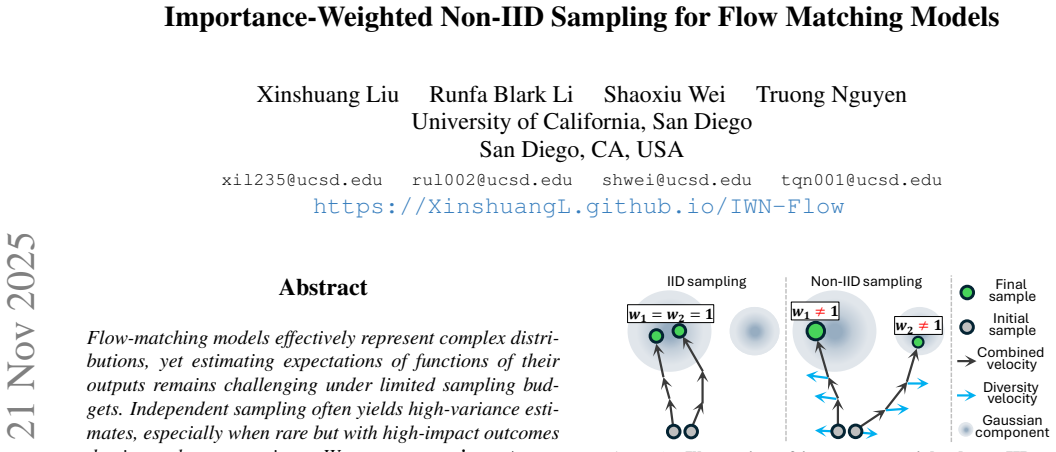
The load-bearing objects are the residual velocity r_phi and the trajectory-based weight dynamics. r_phi is trained so the ODE Ẋ = v + r_phi reproduces the joint sampler's marginal, letting p/p'' stand in for the true weight p/p'. Theorem 2 gives the ODE for log w along a real trajectory; for rectified flows the score identity s(x,t) = (t v(x,t) − x)/(1−t) turns all score terms into closed-form expressions in r_phi, u and v (Corollary 1), so no learned score network is needed. A second mechanism, score-based regularization, projects each diversity gradient against the score direction, damping or zeroing moves that reduce log-density—keeping spread while staying on-manifold.
What would settle it
On the Gaussian-mixture test bed, check the score identity directly: draw (X0, X1) pairs, condition on intermediate Xt, compare the empirical conditional mean E[X1 − X0 | Xt = x] to the formula (t v − x)/(1−t); a mismatch shows Corollary 1's dynamics does not compute log(p/p''). At scale: train a residual velocity for a large conditional model, estimate E[f(X)] by trajectory-weighted non-IID samples and by a far larger IID ground truth; they should agree within Monte Carlo error while equal-weight diverse samples remain biased.
Extended reading notes
Core claim
On its own terms, the discovery is that importance weights for non-IID flow samples are computable even though the joint sampler's marginal is never observed: a lightweight residual velocity r_phi is trained so that the ODE v + r_phi reproduces that marginal, and the log ratio log p/p'' is evolved along each real trajectory (Theorem 2), which for rectified flows becomes closed-form in r_phi, u, and v alone (Corollary 1). Integrating along the path gives per-sample weights making the weighted average unbiased for the true expectation. The same score function regularizes the diversity velocity, damping pushes that would leave the manifold. On a Gaussian mixture the weights beat density baselin
Load-bearing premise
The load-bearing premise is that v + r_phi is close enough to an ideal rectified flow that the closed-form score identity holds at every intermediate time along the path—an assumption validated only on a synthetic mixture, since the paper does not train the residual velocity for the large image models.
Editorial extensions
If this is right
- If v + r_phi approximates the joint sampler's marginal well, the weighted estimator (1/n) Σ w_i f(X_i) is unbiased for E[f(X)], so diversity-enhanced batches can be used for estimation, not just qualitative coverage.
- Trajectory-based integration of the weight ODE avoids feeding r_phi out-of-distribution inputs (final samples evaluated at early times), which the paper shows empirically yields better weight estimates than fixed-position integration.
- The closed-form rectified-flow score identity means the whole weighting scheme runs with only the existing velocity evaluations plus a small network r_phi, so unbiased non-IID estimation costs little beyond the diversity sampling itself.
- Score-based regularization improves sample quality (log-density, RMSE to mode) while keeping joint mode coverage essentially unchanged across all tested diversity objectives, shrinking the diversity-quality trade-off.
- On text-to-image and inpainting models, score-regularized diverse batches achieve lower representation error than IID batches of the same size, meaning fewer wasted samples under a fixed budget.
Reading between the lines
- Editor's inference, not the paper's claim: if the residual-velocity construction transfers to large models—the paper leaves this untested—the same weighting scheme would give a practical route to risk-sensitive expectations (safety-critical tail events) for production-scale conditional generation, where rare-but-high-impact outputs currently dominate estimator variance.
- Editor's inference: the trajectory-integration design principle—evolve the weight along the actual sampling path rather than evaluating density ratios at fixed endpoints—plausibly generalizes beyond rectified flows to any sampler whose marginal can be represented by a learnable ODE, such as diffusion models, at the price of learning a score function for the perturbed flow.
- Editor's inference: a direct testable extension is to train r_phi at scale on one conditional model and compare weighted non-IID expectation estimates against a much larger IID ground truth; the paper explicitly leaves large-scale training of r_phi to future work, so this remains open.
Signed reviews
Editorial analysis
A structured set of objections, weighed in public.
Referee Report
Summary. The paper proposes a framework for non-IID, jointly drawn samples from flow-matching models, with two components: (i) score-based regularization of diversity velocities to keep samples on-manifold, and (ii) importance weighting of the resulting non-IID samples by learning a residual velocity field whose marginal matches the joint sampler, then evolving log-importance weights along sample trajectories. The method is developed for rectified flows, where the score is obtained from the velocity in closed form. Theorems 1 and 2 derive the weight dynamics from the continuity equation, and Corollary 1 specializes to rectified flows. Experiments on a Gaussian mixture evaluate diversity, quality, importance-weight accuracy, and expectation estimation, while Stable Diffusion 3.5 and FLUX.1 experiments evaluate only diversity/quality via representation error. The paper emphasizes that residual velocity training for large models is left to future work.
Significance. If the theoretical claims held in practice, the paper would offer a useful contribution: a principled way to debias jointly sampled, diversity-enforced flow outputs, which is relevant to risk-sensitive estimation and coverage-oriented sampling. The derivations from the continuity equation are a strength, and the trajectory-based estimator (Theorem 2 / Corollary 1) is well motivated and avoids the out-of-distribution issue of the fixed-position variant. The toy experiments show that the proposed residual-flow weight estimator outperforms density baselines. However, the load-bearing unbiasedness claim rests on the assumption that the learned velocity plus residual is an exact rectified flow, and this is neither established theoretically nor tested at scale; the large-model experiments do not train the residual velocity at all. The result is a promising method with an unquantified approximation gap rather than a fully established unbiased estimator.
major comments (5)
- [Sec. 3.2, Corollary 1 and Eq. (23)] Corollary 1 replaces the two scores in Theorem 2 with the rectified-flow identity s(x,t)=(tv(x,t)-x)/(1-t) for both v and v+r_phi. This identity is exact only when the velocity is the true conditional expectation E[X1-X0 | Xt=x]. In practice, v is a finite-capacity pretrained network and r_phi is a small network trained only with the endpoint-marginal objective (23). No error bound, monotonicity, or regularity condition links the (23) loss to error in the weight integral. The unbiasedness claim in Eq. (3) and Table 3 therefore holds only under an idealization that is not quantified; without such a bound, the reported improvements on the toy example cannot be extrapolated.
- [Sec. 4.3, 4.4 and Limitations] For Stable Diffusion 3.5 and FLUX.1-Fill, no residual velocity r_phi is trained; the paper states this explicitly. Tables 4 and 5 therefore evaluate only the score-regularized diversity sampler, not the importance-weighting component. The central claim of 'accurate importance-weight estimates and debiased expectation estimates' is thus untested for real flow models. This is not a presentation issue but a gap between the stated contribution (first importance-weighting method for non-IID flow samples) and the experiments supporting it.
- [Sec. 4.2 and Sec. F] The 'ground-truth' importance weights in Table 2 are themselves obtained by Local-Likelihood Density Estimation (LLDE) from pooled non-IID samples, not from the exact marginal density p'_1 of the coupled sampler. This means the evaluation target is an estimate, and any error in the LLDE density appears as error in the reported SE/ranking metrics. The conclusions about superiority of the trajectory-based estimator are plausible, but the claim would be stronger if the toy setup allowed an exact or quasi-exact weight computation (e.g., by enumerating the joint sampler's symmetry or using a much larger reference set with a known density), or if sensitivity to the LLDE bandwidth choice were reported.
- [Sec. 3.3, Eq. (25)] The fixed-position variant (Eq. 25) is argued to be problematic because inputs (X_1, t) for small t are out-of-distribution for r_phi. This is an intuitive explanation, but the paper does not quantify how often such points occur or provide a concrete diagnostic (e.g., norm of r_phi on those inputs). Since the trajectory-based estimator is recommended largely on this basis, a direct comparison with controlled removal of low-t inputs or a visualization of r_phi's behavior would strengthen the argument.
- [Sec. 3.1, Eq. (18)] The soft regularization strength alpha(t)=sqrt(1-t) is introduced and used in experiments, but the text does not specify how alpha(t) interacts with the normalization of g_reg or with the global diversity strength lambda in Eq. (14). The soft variant appears to give consistently worse RMSE than hard in Table 1, yet remains included as a recommended choice. Clarifying the tuning of alpha(t) and its sensitivity would make the contribution easier to reproduce.
minor comments (7)
- [Abstract and Sec. 1] The phrase 'first approach for importance weighting of non-IID flow samples' is a strong novelty claim; the paper should state what exactly distinguishes it from existing importance-sampling methods for deterministic transforms, and ideally give a brief citation to classical change-of-variable weighting approaches.
- [Sec. 2.1, Eq. (10)] Equation (10) is stated as an approximation without a formal statement of when it is exact. Since it is used later in the main theorems, a short remark on the ideal-rectified-flow setting and finite-capacity effects would be useful.
- [Sec. 4.1.1] The phrase '8-D near-planar distribution' is confusing because the distribution is a 10-component Gaussian mixture in the first two dimensions with tiny variance in the remaining six; the term 'planar' may mislead readers into expecting an exactly low-dimensional manifold. Suggest rephrasing.
- [Table 2] The notation Ours and Ours† is not explicitly defined in the caption. The text says † denotes the fixed-position variant, but the caption should state this directly.
- [Sec. 4.3] The typo in prompt T4 ('a releastic cat') is likely intentional to test robustness to typos, but the paper does not say so. Please clarify.
- [Sec. F] The LLDE construction is described in detail but the resulting density is still only an estimate. A short discussion of the bias-variance trade-off of LLDE in this 10-dimensional setting (e.g., number of samples per kNN ball) would help the reader judge the reliability of the ground-truth weights.
- [Sec. 3.2, Definition 3] Definition 3 uses dXt = (v+r_phi) dt, but the paper elsewhere uses X_0 ~ p_0 and time in [0,1]. It would be clearer to explicitly state that the same time interval and base distribution are used.
Circularity Check
No definitional circularity: Theorems 1-2 and Corollary 1 follow from the continuity equation and an explicit rectified-flow assumption, not from fitted values. One mild construction-dependence: the predicted importance weights are by construction ratios to the fitted residual-flow marginal, and the validation target is itself an LLDE estimate of p'; the paper's own Limitations leave large-scale r
-
fitted input called prediction
[Sec. 3.2 (Definition 3, Eqs. 20 and 23); Sec. 4.2 and Sec. F (LLDE ground truth)]
"Definition 3: "We denote its probability density as p''_phi,t(x). We train r_phi such that p''_phi,1(x) ≈ p'_1(x)". Eq. (20): w(x) = p1(x)/p''_phi,1(x). Eq. (23): min_phi E[||(X1-X0)-v(Xt,t)-r_phi(Xt,t)||^2], with "X1 is sampled from the diversity-enhanced non-IID sampler". Sec. 4.2: "The ground-truth importance weights are computed as the ratio between the original density and the non-IID marginal estimated via Local-Likelihood Density Estimation (LLDE)"."
By construction, the estimated weight is the density ratio to the marginal of the fitted residual flow: Eq. (20) defines w = p1/p''_phi,1, and Definition 3/Eq. (23) train r_phi using X1 drawn from the very non-IID marginal p'_1 that the weights are meant to correct. The trajectory evolution (Theorem 2, Corollary 1) telescopes to the endpoint value log p1(X1) - log p''_phi,1(X1), so the 'predicted' weights are fully determined by the fitted field; the Table 2 accuracy claim largely restates whether r_phi generalizes to fresh joint sets. The validation target is itself an estimate (LLDE of p'), not an exact density, and no r_phi is trained for the large image models (Limitations). This construction-dependence is intrinsic to importance sampling and is transparently stated, so it is a mild, p
full rationale
The central derivation chain is self-contained and does not reduce to its inputs. Theorems 1 and 2 follow from the continuity equation (Eq. 8) and the chain rule (Supp. C) with no fitted quantities entering the algebra. Corollary 1's closed-form score identity s(x,t) = (t v(x,t) - x)/(1-t) is introduced under an explicit assumption ("Suppose v and v+r_phi are rectified flows") and is re-derived in Supp. B from the rectified-flow conditioning property; the rectified-flow concept is external, published work ([16], no author overlap with this paper), so no load-bearing self-citation exists anywhere in the reference list. In the ideal limit, the rectified-flow objective of Eq. (23) makes v+r_phi exactly the transport velocity for the non-IID marginal, so the theory is internally consistent. The one flagged pattern is the mild construction-dependence noted above: the weight estimate is, by definition, the ratio to the marginal of the fitted residual flow, and the reported 'ground-truth' weights are themselves an LLDE estimate of that same marginal rather than an exact density. Additionally, the paper's Limitations state that "we leave large-scale training of r_phi to future work," so the unbiased-estimation claim is untested on Stable Diffusion 3.5 and FLUX; that is an unquantified approximation/validation gap (correctness risk), not a circular reduction. Because the bias-correction theorems retain independent mathematical content and the Gaussian-mixture expectation result is checked against 1,000,000 IID samples, the finding is a low partial construction-dependence (score 2), not evidence that the derivation reduces to its inputs.
Assumptions & free parameters
free parameters (2)
- Diversity strength λ =
1.0 (Gaussian mixture), 0.1 (text-to-image), 0.3 (inpainting)
- Score-regularization mode α(t) =
soft (sqrt(1-t)) or hard (0)
assumptions (4)
- domain assumption The trained velocity v and v+r_phi are optimal rectified flows, so the closed-form score identity s=(t v−x)/(1−t) is valid.
- ad hoc to paper The residual flow r_phi trained by Eq. (23) makes the marginal of v+r_phi at t=1 match the marginal of the coupled non-IID sampler.
- standard math The continuity equation describes density evolution of the coupled and marginal ODEs exactly, ignoring Euler discretization errors.
- domain assumption The joint sampler is exchangeable in sample index, so a single marginal p'(x) defines all per-sample weights.
Cite this review
Pith. "Pith review of Score-Regularized Joint Sampling with Importance Weights for Flow Matching." pith.science (2026). https://pith.science/paper/T3UTE2U5
@misc{pith2026251117812,
  author       = {Pith},
  title        = {Pith review of: Score-Regularized Joint Sampling with Importance Weights for Flow Matching},
  year         = {2026},
  howpublished = {\url{https://pith.science/paper/T3UTE2U5}},
  note         = {Machine review of arXiv:2511.17812}
}
read the original abstract
Flow matching models effectively represent complex distributions, yet estimating expectations of functions of their outputs remains challenging under limited sampling budgets. Independent sampling often yields high-variance estimates, especially when rare but high-impact outcomes dominate the expectation. We propose a non-IID sampling framework that jointly draws multiple samples to cover diverse, salient regions of a flow matching model's generative distribution. To balance diversity and quality, we introduce a score-based regularization for the diversity mechanism (SR), which uses the score function, i.e., the gradient of the log probability, to ensure samples are pushed apart within high-density regions of the data manifold, mitigating off-manifold drift. To enable unbiased estimation when desired, we further develop an approach for importance weighting of non-IID flow samples by learning a residual velocity field that reproduces the marginal distribution of the non-IID samples and by evolving importance weights along trajectories. Empirically, our method produces diverse, high-quality samples and accurate importance-weight estimates and debiased expectation estimates, advancing the reliable characterization of flow matching model outputs.
Figures


Figures from the paper (1 more)

Forward citations
Cited by 1 Pith paper
-
Consistency-Preserving Diverse Video Generation
A flow-matching video sampler uses latent-space embeddings to raise cross-video diversity and a regulated gradient to keep within-video consistency, shown on Wan 2.1.
Reference graph
Works this paper leans on
-
[1]
Bishop and Nasser M
Christopher M. Bishop and Nasser M. Nasrabadi.Pattern Recognition and Machine Learning.J. Electronic Imaging, 16(4):049901, 2007. 7, 4
2007
-
[2]
Jaakkola
Gabriele Corso, Yilun Xu, Valentin De Bortoli, Regina Barzilay, and Tommi S. Jaakkola. Particle guidance: non- i.i.d. diverse sampling with diffusion models. InThe Twelfth International Conference on Learning Representa- tions, ICLR 2024, Vienna, Austria, May 7-11, 2024. Open- Review.net, 2024. 2, 3
2024
-
[3]
Scaling rec- tified flow transformers for high-resolution image synthesis
Patrick Esser, Sumith Kulal, Andreas Blattmann, Rahim Entezari, Jonas Müller, Harry Saini, Yam Levi, Dominik Lorenz, Axel Sauer, Frederic Boesel, Dustin Podell, Tim Dockhorn, Zion English, and Robin Rombach. Scaling rec- tified flow transformers for high-resolution image synthesis. InForty-first International Conference on Machine Learn- ing, ICML 2024, V...
2024
-
[4]
Gian Mario Favero, Parham Saremi, Emily Kaczmarek, Brennan Nichyporuk, and Tal Arbel. Conditional diffusion models are medical image classifiers that provide explain- ability and uncertainty for free.CoRR, abs/2502.03687,
-
[5]
Splatflow: Multi- view rectified flow model for 3d gaussian splatting synthesis
Hyojun Go, Byeongjun Park, Jiho Jang, Jin-Young Kim, Soonwoo Kwon, and Changick Kim. Splatflow: Multi- view rectified flow model for 3d gaussian splatting synthesis. InIEEE/CVF Conference on Computer Vision and Pattern Recognition, CVPR 2025, Nashville, TN, USA, June 11-15, 2025, pages 21524–21536. Computer Vision Foundation / IEEE, 2025. 1
2025
-
[6]
Nils Lid Hjort and M. C. Jones. Locally parametric non- parametric density estimation.Annals of Statistics, 24(4): 1619–1647, 1996. 6, 3
1996
-
[7]
Classifier-free diffusion guidance.CoRR, abs/2207.12598, 2022
Jonathan Ho and Tim Salimans. Classifier-free diffusion guidance.CoRR, abs/2207.12598, 2022. 3
arXiv 2022
-
[8]
The treatment of ties in ranking prob- lems.Biometrika, 33(3):239–251, 1945
Maurice G Kendall. The treatment of ties in ranking prob- lems.Biometrika, 33(3):239–251, 1945. 7, 5
1945
Show all 31 references
-
[9]
John Wiley & Sons, New York, 1965
Leslie Kish.Survey Sampling. John Wiley & Sons, New York, 1965. 4
1965
-
[10]
Determinantal point pro- cesses for machine learning.Foundations and Trends® in Machine Learning, 5(2–3):123–286, 2012
Alex Kulesza, Ben Taskar, et al. Determinantal point pro- cesses for machine learning.Foundations and Trends® in Machine Learning, 5(2–3):123–286, 2012. 2, 3
2012
-
[11]
Alina Kuznetsova, Hassan Rom, Neil Alldrin, Jasper R. R. Uijlings, Ivan Krasin, Jordi Pont-Tuset, Shahab Kamali, Ste- fan Popov, Matteo Malloci, Alexander Kolesnikov, Tom Duerig, and Vittorio Ferrari. The open images dataset V4. Int. J. Comput. Vis., 128(7):1956–1981, 2020. 8
1956
-
[12]
FLUX.1 kontext: Flow matching for in-context image generation and editing in latent space
Black Forest Labs, Stephen Batifol, Andreas Blattmann, Frederic Boesel, Saksham Consul, Cyril Diagne, Tim Dock- horn, Jack English, Zion English, Patrick Esser, Sumith Ku- lal, Kyle Lacey, Yam Levi, Cheng Li, Dominik Lorenz, Jonas Müller, Dustin Podell, Robin Rombach, Harry Sa...
2025 arXiv
-
[13]
Om- niflow: Any-to-any generation with multi-modal rectified flows
Shufan Li, Konstantinos Kallidromitis, Akash Gokul, Zichun Liao, Yusuke Kato, Kazuki Kozuka, and Aditya Grover. Om- niflow: Any-to-any generation with multi-modal rectified flows. InIEEE/CVF Conference on Computer Vision and Pattern Recognition, CVPR 2025, Nashville, TN, USA, ...
2025
-
[14]
Divergence measures based on the shannon en- tropy.IEEE Trans
Jianhua Lin. Divergence measures based on the shannon en- tropy.IEEE Trans. Inf. Theory, 37(1):145–151, 1991. 7
1991
-
[15]
Yaron Lipman, Ricky T. Q. Chen, Heli Ben-Hamu, Maxim- ilian Nickel, and Matthew Le. Flow matching for genera- tive modeling. InThe Eleventh International Conference on Learning Representations, ICLR 2023, Kigali, Rwanda, May 1-5, 2023. OpenReview.net, 2023. 1, 3
2023
-
[16]
Flow straight and fast: Learning to generate and transfer data with rectified flow
Xingchao Liu, Chengyue Gong, and Qiang Liu. Flow straight and fast: Learning to generate and transfer data with rectified flow. InThe Eleventh International Conference on Learning Representations, ICLR 2023, Kigali, Rwanda, May 1-5, 2023. OpenReview.net, 2023. 2, 3, 4
2023
-
[17]
Clive R. Loader. Local likelihood density estimation.Annals of Statistics, 24(4):1602–1618, 1996. 6, 3
1996
-
[18]
A non- parametric estimate of a multivariate density function.The Annals of Mathematical Statistics, 36(3):1049–1051, 1965
Don O Loftsgaarden and Charles P Quesenberry. A non- parametric estimate of a multivariate density function.The Annals of Mathematical Statistics, 36(3):1049–1051, 1965. 6, 4
1965
-
[19]
Decoupled weight decay regularization
Ilya Loshchilov and Frank Hutter. Decoupled weight decay regularization. In7th International Conference on Learning Representations, ICLR 2019, New Orleans, LA, USA, May 6-9, 2019. OpenReview.net, 2019. 3
2019
-
[20]
Chapman and Hall/CRC, 2002
John C Mason and David C Handscomb.Chebyshev polyno- mials. Chapman and Hall/CRC, 2002. 3
2002
-
[21]
A flexible framework for offline effectiveness met- rics
Alistair Moffat, Joel Mackenzie, Paul Thomas, and Leif Az- zopardi. A flexible framework for offline effectiveness met- rics. InSIGIR ’22: The 45th International ACM SIGIR Con- ference on Research and Development in Information Re- trieval, Madrid, Spain, July 11 - 15, 2022, p...
2022
-
[22]
Morshed and Vishnu Boddeti
Mashrur M. Morshed and Vishnu Boddeti. Diverseflow: Sample-efficient diverse mode coverage in flows. In IEEE/CVF Conference on Computer Vision and Pattern Recognition, CVPR 2025, Nashville, TN, USA, June 11-15, 2025, pages 23303–23312. Computer Vision Foundation / IEEE, 2025. 2, 3
2025
-
[23]
High-resolution image synthesis with latent diffusion models
Robin Rombach, Andreas Blattmann, Dominik Lorenz, Patrick Esser, and Björn Ommer. High-resolution image synthesis with latent diffusion models. InProceedings of the IEEE/CVF Conference on Computer Vision and Pattern Recognition (CVPR), pages 10684–10695, 2022. 3
2022
-
[24]
Silverman.Density Estimation for Statistics and Data Analysis
Bernard W. Silverman.Density Estimation for Statistics and Data Analysis. Springer, 1986. 7, 4
1986
-
[25]
Kingma, Ab- hishek Kumar, Stefano Ermon, and Ben Poole
Yang Song, Jascha Sohl-Dickstein, Diederik P. Kingma, Ab- hishek Kumar, Stefano Ermon, and Ben Poole. Score-based generative modeling through stochastic differential equa- tions. In9th International Conference on Learning Rep- resentations, ICLR 2021, Virtual Event, Austria, May 3-7,
2021
-
[26]
The proof and measurement of associa- tion between two things.The American journal of psychol- ogy, 100(3/4):441–471, 1987
Charles Spearman. The proof and measurement of associa- tion between two things.The American journal of psychol- ogy, 100(3/4):441–471, 1987. 7, 5 9
1987
-
[27]
Note on the consistency of the maximum likelihood estimate.The Annals of Mathematical Statistics, 20(4):595–601, 1949
Abraham Wald. Note on the consistency of the maximum likelihood estimate.The Annals of Mathematical Statistics, 20(4):595–601, 1949. 4
1949
-
[28]
M. P. Wand and M. C. Jones.Kernel Smoothing. Chapman and Hall/CRC, London, 1995. 4
1995
-
[29]
Flowram: Ground- ing flow matching policy with region-aware mamba frame- work for robotic manipulation
Sen Wang, Le Wang, Sanping Zhou, Jingyi Tian, Jiayi Li, Haowen Sun, and Wei Tang. Flowram: Ground- ing flow matching policy with region-aware mamba frame- work for robotic manipulation. InIEEE/CVF Conference on Computer Vision and Pattern Recognition, CVPR 2025, Nashville, TN,...
2025
-
[30]
a realistic photo,
Zebin Xing, Xingyu Zhang, Yang Hu, Bo Jiang, Tong He, Qian Zhang, Xiaoxiao Long, and Wei Yin. Goalflow: Goal- driven flow matching for multimodal trajectories generation in end-to-end autonomous driving. InIEEE/CVF Conference on Computer Vision and Pattern Recognition, CVPR 20...
2025
-
[2021]
OpenReview.net, 2021. 4
2021
Reviewed August 3, 2026 · model on record in the stance chip above.
Discussion (0). Continue with ORCID to comment.