REVIEW 4 major objections 5 minor 61 references
Learning the best thermoelectric nanoscale heat engines through evolving network topology
T0 review · 4 major / 5 minor · reviewed 2026-08-14 · deepseek-v4-flash
Pith's one-line read This paper shows that machine-trained patterns of electron-electron interaction can raise the thermoelectric figure of merit and power factor by orders of magnitude, making the Carnot efficiency approachable at nonzero power.
desk verdict The finite-size discovery is real and worth refereeing; the asymptotic-Carnot conclusion is a fitted extrapolation, not demonstrated. read the letter →
The pith
A machine-rendered reading of the paper's core claim, the machinery that carries it, and where it could break.
The reading
What carries the argument
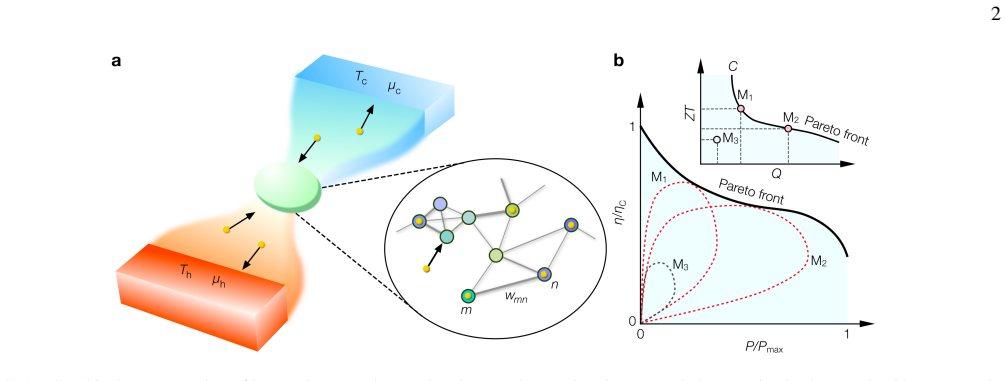
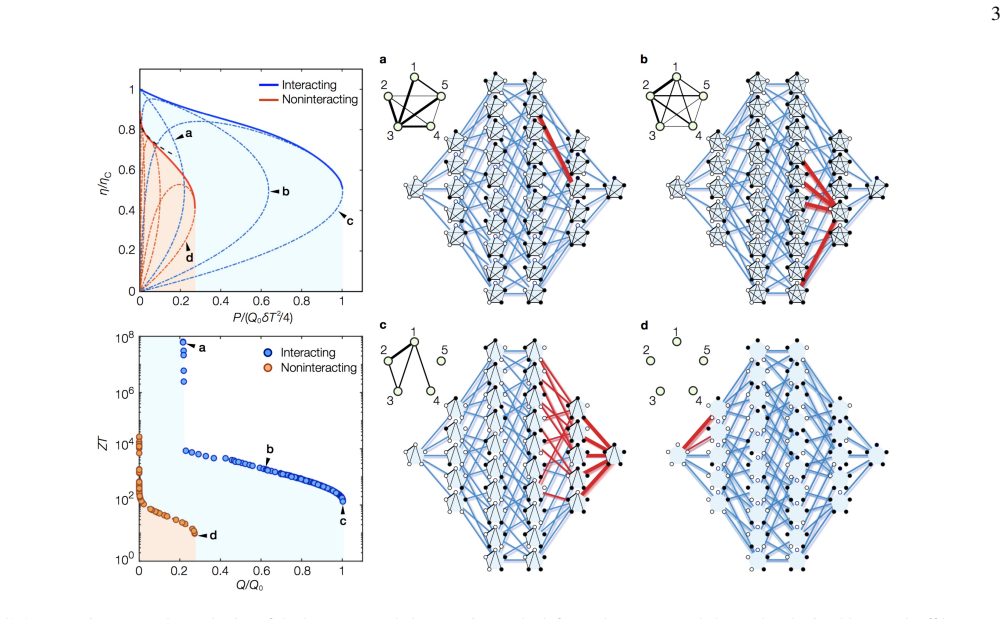
The load-bearing picture is a network. Nodes are single-particle levels and edges are two-body interaction strengths w_lm≥0, so the full many-body Hamiltonian becomes a graph whose topology and weights are trained by differential evolution. Transport is then analyzed on a second graph, the state-transfer network, whose $2^{{N_f}}$ nodes are many-body Fock states and whose edges are the allowed single-electron tunnelings; the optimal engines activate many of these edges by making single-hole excitations degenerate while leaving hole-hole interactions sparse. The other essential element is the unicyclic structure of the probability flow: by isolating a pair of many-body states, the dynamics enforce the tight-coupling condition J∝J_q, which drives ZT to diverge. The linear-response formula η(P)/η_C = (P/($QδT^{2}$/4))/(2[1+2/ZT∓√(1−P/($QδT^{2}$/4))]) converts the optimized pair (Q, ZT) into the full power-efficiency tradeoff, and the ground voltage is chosen near the value that maximizes power for a degenerate single-hole manifold.
What would settle it
Measure the electronic and phononic thermal conductance separately in a quantum-dot array built to satisfy the three optimality conditions, and evaluate ZT = $σS^{2}$T/(κ_e+κ_ph); if the enhancement over the best noninteracting engine disappears for any realistic κ_ph, the central claim fails. Alternatively, a numerical scan that adds a fixed phonon conductance to the Onsager coefficients and re-runs the differential evolution would settle it within the model.
Extended reading notes
Core claim
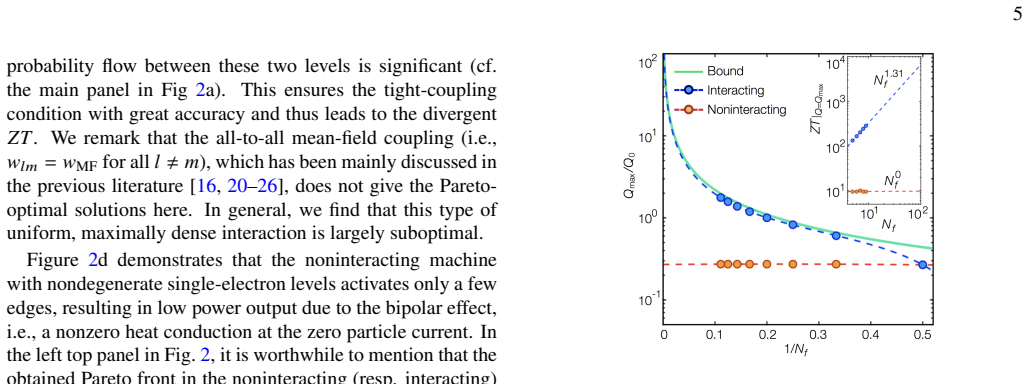
On the paper's own terms, the central result is that many-body interactions, optimized as a network, enlarge the Pareto front of thermoelectric performance far beyond what noninteracting systems allow. For the highest-power engine, the power factor per level asymptotically reaches the ideal unicyclic bound Qmax/Nf → ξ k_B T γ_hγ_c/(γ_h+γ_c) with ξ≃0.439, so Qmax diverges linearly with the number of levels, while the associated figure of merit grows as ZT|Q=Qmax ∝ $N_f^{{1.31}}$ (fitted). A divergence in both quantities lets the engine approach Carnot efficiency η(P)→η_C as N_f→∞ while supplying subextensive power P∝N_f^ζ with 1/2<ζ<1, whose fluctuation δP∝√N_f is negligibly small relative to the mean. The paper also states a three-part conjecture for the optimal topology—degenerate single-hole excitation energies, at most N_f−1 nonzero interaction parameters, and ground voltage v_g=e_h+αk_BT with α≃2.40—and confirms it numerically up to $2^{{N_f}}$=512 states. In contrast, noninteracting engines with generic nondegenerate levels have small, size-independent Q and ZT.
Load-bearing premise
The results assume the lattice/phonon part of thermal conduction is absent from the model; a real material's total thermal conductance includes phonons, and once they are added the reported ZT and the claimed order-of-magnitude gains would shrink, possibly below the noninteracting benchmark.
Editorial extensions
If this is right
- Interacting engines can outperform noninteracting ones even with unequal, generic level spacings, so the demanding condition of perfectly degenerate single-particle levels is no longer necessary for high performance.
- Because the optimal power factor per level saturates a fundamental bound set by ideal unicyclic machines, scaling from tens to hundreds of levels yields proportionally more power rather than saturation.
- The asymptotic-Carnot regime requires tuning the chemical potential to the stopping value with relative accuracy that improves as 1/N_f^{1−ζ}; for N_f=20 and ζ=0.6 the paper reports η/η_C≈0.90 at about 8% control accuracy.
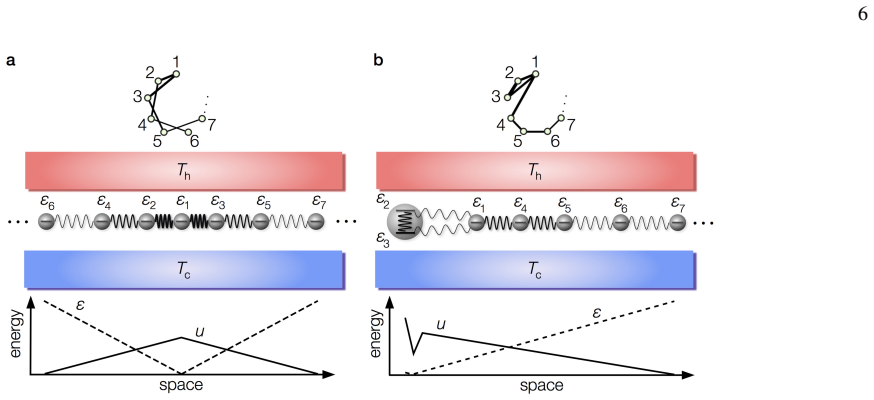
- The design rule has many solutions for any level set, which translates into flexible physical implementations—distance-tuned quantum-dot arrays, nanoporous molecular networks, or nanoparticle assemblies—rather than a single fragile geometry.
- At low power, the Pareto front of the interacting engines obeys 1−η/η_C∝P whereas the noninteracting engines follow ∝√P, a qualitative difference that experiments on quantum-dot arrays could probe directly.
Reading between the lines
- One testable extension the paper leaves implicit: the same learning protocol, applied to driven or disordered versions of the model, could reveal whether the sparse-topology optimum survives symmetry-breaking perturbations such as magnetic fields or on-site disorder.
- The fitted exponent ZT∝N_f^{1.31} has no derived value; if the divergence is weaker at larger sizes than numerically accessible, the asymptotic-Carnot scenario would still work but would require slower power growth, so the robustness of the exponent matters for quantitative predictions.
- Because the paper excludes phonons by construction, a natural next step is to include a finite phonon conductance κ_ph in the definition of ZT and re-run the optimization; the optimal topologies may shift toward designs that suppress phonon transmission, and only then can the order-of-magnitude claim be tested in real materials.
- The stability argument assumes fluctuations scale as √N_f, the usual thermodynamic scaling; any additional 1/f or charge-noise contribution that grows like the mean power would invalidate the 'stable power' part of the claim, so the paper's promise rests on a noise model that should be checked experimentally.
Signed reviews
Editorial analysis
A structured set of objections, weighed in public.
Referee Report
Summary. This manuscript studies thermoelectric transport through interacting fermionic systems in the linear-response regime, using a classical master equation with sequential single-electron tunneling. The authors map two-body interactions to a network and use differential evolution to optimize the ground voltage and interaction strengths for systems up to N_f=9 single-particle levels. They report order-of-magnitude enhancements of the power factor Q and figure of merit ZT relative to noninteracting systems, identify sparse interaction networks that degenerate single-hole excitations and activate many transfer paths, and conjecture sufficient conditions (i)-(iii) for maximum-power engines. Extrapolating finite-size data, they claim Q_max is proportional to N_f and ZT at Q=Q_max is proportional to N_f^{1.31}, which would realize asymptotic Carnot efficiency at nonzero, stable power, and they propose quantum-dot-array implementations.
Significance. If the extrapolated scaling and the optimality conjecture held, the paper would establish that many-body interactions can be engineered to substantially improve thermoelectric power and efficiency in nanoscale devices, with a simple design principle (degenerate hole excitations, sparse interaction graphs) and concrete experimental proposals. The master-equation and Onsager framework is standard, and the supplementary material gives detailed search protocols and explicit interaction parameter sets for two array geometries, which are valuable for reproducibility. The result would be a significant advance in the quest for high-power near-Carnot nanoscale engines. However, the asymptotic and 'maximum possible' claims rest on heuristic optimization and finite-size fits rather than on derivation or certified global optimality, so the significance is conditional on those extrapolations being verified.
major comments (4)
- [The asymptotic Carnot efficiency at nonzero power; Fig. 4] The central asymptotic claim rests on Eq. (5) and the inset of Fig. 4. The evidence is a four-parameter fit of Qmax/Q0 to N_f=3,...,9 (at most seven points) and a fitted power-law ZT|Q=Qmax proportional to N_f^{1.31}; no residuals, error bars, or independent verification are provided. The optimality conditions (i)-(iii) are explicitly called a conjecture and are checked only up to 2^N_f=512 states, and the differential-evolution search is a global heuristic without a certificate of optimality. Since both the divergent power factor and the divergent ZT are needed for the Carnot-at-nonzero-power conclusion, this extrapolation is load-bearing. I ask the authors to test the explicit chain parameters in Supplementary Eqs. (S10)-(S12) for N_f=10-16 and report whether Q/N_f and ZT follow the same trends, and to provide fit uncertainties; otherwise the claim should be reformulated as a numerical conjecture for finite sizes.
- [Interacting systems linked with network topology] The definition of ZT in Eq. (3) uses only the electronic thermal conductance kappa, and the text states that the phonon contribution is not included because it is external to the electronic system. In a real thermoelectric, ZT=sigma S^2 T/(kappa_el+kappa_ph); including a finite phonon conductance would reduce the reported ZT values and could erase the claimed order-of-magnitude enhancement and the asymptotic Carnot scenario. This is a legitimate scope choice for an electronic-interaction study, but the abstract and conclusions should state explicitly that all ZT values and scaling claims refer to the electronic contribution only.
- [Learning the power-efficiency tradeoff; conjecture (i)-(iii)] The paper claims enhancements for 'generic single-electron levels', but the numerical examples are all performed with equally spaced levels epsilon_l=l*Delta. Equally spaced levels are nondegenerate but form a measure-zero subset, and the proposed construction works by compensating the spacing with interactions. No proof or numerical evidence is given that for arbitrary nondegenerate level spacings one can satisfy conditions (i)-(iii) with at most N_f-1 nonzero couplings and a single tuned voltage. The term 'generic' should therefore be weakened to 'nondegenerate levels of the equally spaced type used in the simulations' unless existence for arbitrary spacings is established.
- [Power-efficiency tradeoff and Pareto-optimal thermal machines; Supplementary global optimization section] The differential evolution algorithm is a stochastic global optimizer, and the supplementary text notes that brute-force search is infeasible. Therefore the Pareto fronts in Figs. 2 and 3 are lower bounds to the true Pareto front, not the full set of Pareto-optimal machines. The abstract's 'maximum possible values' is not supported unless accompanied by an optimality certificate or a rigorous bound. The authors should either add such a certificate for the finite-size cases or consistently use 'best found' in describing their results.
minor comments (5)
- [Fig. 4] Please report the fitted coefficients a_i and the fitted ZT exponent with confidence intervals, and indicate the goodness of fit; currently the reader cannot assess the quality of the extrapolation.
- [Optimality conditions (i)-(iii)] The value alpha approximately 2.40 in condition (iii) is given without derivation or sensitivity analysis; please state how it was obtained and whether it depends on N_f or on the level spacing.
- [Eq. (4)] The +/− sign in Eq. (4) should be explained; as written it is not clear which branch corresponds to physically allowed delta_mu values.
- [Asymptotic Carnot engine section] The stability argument uses delta P proportional to sqrt(N_f), but no derivation or reference specific to the present master-equation setting is given; please add a reference or show the calculation.
- [Supplementary Eqs. (S10)-(S12)] The proposed interaction parameters are not evaluated numerically for N_f>9 in the main text; reporting Q and ZT from these explicit parameters at larger sizes would strengthen the paper and would also address the extrapolation concern.
Circularity Check
No significant circularity: the paper's claims are numerical and conditional, and the finite-size extrapolation is a robustness concern rather than a construction.
full rationale
This paper's derivation chain is not circular in the sense used here. The central result—that optimized sparse interaction networks enhance ZT and Q relative to noninteracting systems—is obtained by differential evolution applied to master-equation transport coefficients, and it is benchmarked against noninteracting results and known scaling behavior; no fitted parameter is used as an input to define the target quantities. The finite-size scaling in Fig. 4 is an extrapolation from a fitted form Qmax/Q0 = sum_i a_i N_f^{i-3}, and the reported thermodynamic-limit divergence Qmax proportional to N_f is indeed the linear term of that fit evaluated in the limit. However, this is a statistical extrapolation rather than a circular construction: the fit does not define Qmax, and the asymptotic constant xi = 0.439 is tied to an external ideal-unicyclic bound (ref. [30]) rather than being merely a renamed fit coefficient. The fitted ZT exponent N_f^{1.31} is not needed for the Carnot conclusion, which only requires ZT to diverge; that divergence is already visible in the raw finite-size data. The optimality conditions (i)-(iii) are explicitly introduced as a conjecture ('we now conjecture') and checked only within the same numerical data; the authors do not present this as an independent derivation, so there is no hidden circularity. The phonon contribution is removed by an explicit scope assumption ('the phonon contribution to heat flow is not included as it is external to the electronic system'), not by defining the prediction in terms of the output. No load-bearing self-citation is present: the only self-citation, ref. [59] in the Supplementary Materials, concerns numerical solvers and is not used to justify the physical conclusions. The main weaknesses—small system sizes up to 512 states, reliance on a heuristic global optimizer, and the phonon-exclusion assumption—are robustness and correctness risks, not circularity by construction.
Assumptions & free parameters
free parameters (3)
- Alpha in ground voltage condition =
2.40
- Extrapolation coefficients a_i for Q_max =
a_1,...,a_4 fitted to finite-size data
- ZT scaling exponent =
1.31
assumptions (7)
- domain assumption Sequential tunneling master equation description
- domain assumption Energy-independent tunneling rates
- domain assumption No phonon contribution to thermal conductance
- domain assumption No electron-phonon transitions inside the system
- domain assumption Repulsive interactions only
- ad hoc to paper Optimality conjecture conditions (i)-(iii)
- standard math Linear response and Onsager coefficient evaluation
Cite this review
Pith. "Pith review of Learning the best thermoelectric nanoscale heat engines through evolving network topology." pith.science (2026). https://pith.science/paper/T46RG4V5
@misc{pith2026190804866,
  author       = {Pith},
  title        = {Pith review of: Learning the best thermoelectric nanoscale heat engines through evolving network topology},
  year         = {2026},
  howpublished = {\url{https://pith.science/paper/T46RG4V5}},
  note         = {Machine review of arXiv:1908.04866}
}
read the original abstract
The quest to identify the best heat engine has been at the center of science and technology. Thermoelectric nanoscale heat engines convert heat flows into useful work in the form of electrical power and promise the realization of on-chip power production. Considerable studies have so far revealed the potentials to yield an enhanced efficiency originating from quantum confinement effects and energy-dependent transport properties. However, the full benefit of many-body interactions in thermoelectric is yet to be investigated; identifying the optimal interaction is a hard problem due to combinatorial explosion of the search space, which makes brute-force searches infeasible. Here we tackle this problem with reinforcement learning of network topology in interacting electronic systems, and identify a set of the best thermoelectric nanoscale engines. Harnessing many-body interactions, we show that the maximum possible values of the thermoelectric figure of merit and the power factor can be enhanced by orders of magnitudes for generic single-electron levels. This allows for simple and flexible design of realizing the asymptotic Carnot efficiency with subextensive, but still nonzero and stable power. To realize the optimal nanoscale engines, we propose concrete physical setups based on quantum-dot arrays. The developed framework of reinforcement learning through evolving network topology thus enables one to identify full potential of nanoscale systems.
Figures

Figures from the paper (2 more)
Reference graph
Works this paper leans on
-
[1]
and Curzon-Ahlborn [2] are two specific examples of a more general set of the multiobjective-optimal heat engines. Thermoelectric heat engines in the linear-response regime can be fully characterized by the figure of merit ZT and the power factor Q, which are related to the maximum possible values of efficiency and power, respectively. Thus, we can reduce a ...
work page Pith review arXiv 1908
-
[2]
Reflexions sur la puissance motrice du feu et sur les machines propres a developper cette puissance
Carnot, S. Reflexions sur la puissance motrice du feu et sur les machines propres a developper cette puissance. In Annales sci- entifigues de l’École Normale Supérieure, vol. 1, 393–457 (So- ciété mathématique de France, Paris, 1872)
-
[3]
Curzon, F. & Ahlborn, B. Efficiency of a Carnot engine at max- imum power output. Am. J. Phys. 43, 22–24 (1975). 7
work page 1975
-
[4]
Vineis, C. J., Shakouri, A., Majumdar, A. & Kanatzidis, M.G. Nanostructured thermoelectrics: big efficiency gains from small features. Adv. Mater.22, 3970–3980 (2010)
work page 2010
-
[5]
Dubi, Y . & Ventra, M. D. Colloquium: Heat flow and thermo- electricity in atomic and molecular junctions. Rev. Mod. Phys. 83, 131–155 (2011)
work page 2011
-
[6]
Sound and heat revolutions in phononics
Maldovan, M. Sound and heat revolutions in phononics. Nature 503, 209–217 (2013)
work page 2013
-
[7]
Sothmann, B., Sánchez, R. & Jordan, A. N. Thermoelec- tric energy harvesting with quantum dots. Nanotechnology 26, 032001 (2015)
work page 2015
-
[8]
Hicks, L. D. & Dresselhaus, M. S. Effect of quantum-well structures on the thermoelectric figure of merit. Phys. Rev. B 47, 12727 (1993)
work page 1993
Show all 61 references
-
[9]
C., Taylor, P
Harman, T. C., Taylor, P. J., Walsh, M.P. & LaForge, B. E. Quantum dot superlattice thermoelectric materials and devices. Science 297, 2229–2232 (2002)
2002
-
[10]
& O’Quinn, B
Venkatasubramanlan, R., Siivola, E., Colpitts, T. & O’Quinn, B. Thin-film thermoelectric devices with high room-temperature figures of merit. Nature 413, 597–602 (2001)
2001
-
[11]
Boukai, A. I. et al., Silicon nanowires as efficient thermoelectric materials. Nature 451, 168–171 (2008)
2008
-
[12]
& Tanino, T
Sawaragi, Y ., Nakayama, H. & Tanino, T. Theory of multiob- jective optimization. (Academic Press, New York, 1985)
1985
-
[13]
Mahan, G. D. & Sofo, J. O. The best thermoelectric. Proc. Natl. Acad. Sci. USA 93, 7436–7439 (1996)
1996
-
[14]
Whitney, R. S. Finding the quantum thermoelectric with maxi- mal efficiency and minimal entropy production at given power output. Phys. Rev. B 91, 115425 (2015)
2015
-
[15]
& Price, K
Storn, R. & Price, K. Differential evolution–a simple and effi- cient adaptive scheme for global optimization over continuous spaces. Tech. Rep. TR-95-012 (1995)
1995
-
[16]
& Tirronen, V
Neri, F. & Tirronen, V . Recent advances in differential evolu- tion: a survey and experimental analysis. Artif. Intell. Rev. 33, 61–106 (2010)
2010
-
[17]
Beenakker, C. W. J. Theory of Coulomb-blockade oscillations in the conductance of a quantum dot. Phys. Rev. B 44, 1646– 1656 (1990)
1990
-
[18]
& Whitney, R
Benenti, G., Casati, G., Saito, K. & Whitney, R. S. Fundamen- tal aspects of steady-state conversion of heat to work at the nanoscale. Phys. Rep. 694, 1–124 (2017)
2017
-
[19]
Network theory of microscopic and macro- scopic behavior of master equation systems
Schnakenberg, J. Network theory of microscopic and macro- scopic behavior of master equation systems. Rev. Mod. Phys. 48, 571–585 (1976)
1976
-
[20]
Stochastic thermodynamics, fluctuation theorems, and molecular machines
Seifert, U. Stochastic thermodynamics, fluctuation theorems, and molecular machines. Rep. Prog. Phys. 75, 126001 (2012)
2012
-
[21]
Coulomb oscillations in the electron thermal con- ductance of a dot in the linear regime
Zianni, X. Coulomb oscillations in the electron thermal con- ductance of a dot in the linear regime. Phys. Rev. B 75, 045344 (2007)
2007
-
[22]
& Xie, X
Liu, J., Sun, Q.-F. & Xie, X. C. Enhancement of the thermo- electric figure of merit in a quantum dot due to the Coulomb blockade effect. Phys. Rev. B 81, 245323 (2010)
2010
-
[23]
& Barna ´s, J
Trocha, P. & Barna ´s, J. Large enhancement of thermoelectric effects in a double quantum dot system due to interference and Coulomb correlation phenomena. Phys. Rev. B 85, 085408 (2012)
2012
-
[24]
Stochastic thermodynamics in many-particle sys- tems
Imparato, A. Stochastic thermodynamics in many-particle sys- tems. New. J. Phys. 17, 125004 (2015)
2015
-
[25]
Erdman, P. A. et al. Thermoelectric properties of an interacting quantum dot based heat engine.Phys. Rev. B95, 245432 (2017)
2017
-
[26]
Esposito, M
Vroylandt, H. Esposito, M. & Verley, G. Collective effects en- hancing power and efficiency. EPL 120, 30009 (2017)
2017
-
[27]
Thingna, J
Herpich, T. Thingna, J. & Espositio, M. Collective power: min- imal model for thermodynamics of nonequilibrium phase tran- sitions. Phys. Rev. X 8, 031056 (2018)
2018
-
[28]
& Mejia-Monasterio, C
Benenti, G., Casati, G. & Mejia-Monasterio, C. Thermoelectric efficiency in momentum-conserving systems. New. J. Phys. 16, 015014 (2014)
2014
-
[29]
& Wang, J
Luo, R., Benenti, G., Casati, G. & Wang, J. Thermody- namic bound on heat-to-power conversion.Phys. Rev. Lett.121, 080602 (2018)
2018
-
[30]
& Moore, J
Murphy, P., Mukerjee, S. & Moore, J. Optimal thermoelec- tric figure of merit of a molecular junction. Phys. Rev. B 78, 161406(R) (2008)
2008
-
[31]
& Broeck, C
Esposito, M., Lindenberg, K. & Broeck, C. V . Thermoelectric efficiency at maximum power in a quantum dot.EPL 85, 60010 (2009)
2009
-
[32]
Broeck, C. V . Thermodynamic efficiency at maximum power. Phys. Rev. Lett. 95, 190602 (2005)
2005
-
[33]
Whitney, R. S. Most efficient quantum thermoelectric at finite power output. Phys. Rev. Lett. 112, 130601 (2014)
2014
-
[34]
R., Horowitz, J
Gingrich, T. R., Horowitz, J. M., Perunov, N. & England, J. L. Dissipation bounds all steady-state current fluctuations. Phys. Rev. Lett. 116, 120601 (2016)
2016
-
[35]
& Seifert, U
Pietzonka, P. & Seifert, U. Universal trade-off between power, efficiency, and constancy in steady-state heat engines. Phys. Rev. Lett. 120, 190602 (2018)
2018
-
[36]
& Fazio, R
Campisi, M. & Fazio, R. The power of a critical heat engine. Nat. Commun. 7, 11895 (2016)
2016
-
[37]
& Ryabov, A
Holubec, V . & Ryabov, A. Work and power fluctuations in a critical heat engine. Phys. Rev. E 96, 030102(R) (2017)
2017
-
[38]
& Tasaki, H
Shiraishi, N., Saito, K. & Tasaki, H. Universal trade-off relation between power and efficiency for heat engines. Phys. Rev. Lett. 117, 190601 (2016)
2016
-
[39]
& Esposito, M
Polettini, M. & Esposito, M. Carnot efficiency at divergent power output. EPL 118, 40003 (2017)
2017
-
[40]
Pavesi, L. et al. Optical gain in silicon nanocrystals.Nature 408, 440–444 (2000)
2000
-
[41]
Klappenberger, F. et al. Tunable quantum dot arrays formed from self-assembled metal-organic networks. Phys. Rev. Lett. 106, 026802 (2011)
2011
-
[42]
Piquero-Zulaica, I. et al. Precise engineering of quantum dot array coupling through their barrier widths. Nat. Commun. 8, 787 (2017)
2017
-
[43]
Bose, S. K. et al. Evolution of a designless nanoparticle network into reconfigurable Boolean logic. Nat. Nanotechnol. 10, 1048– 1052 (2017)
2017
-
[44]
Sothmann, B., Sànchez, R., Jordan, A. N. & Büttiker, M. Recti- fication of thermal fluctuations in a chaotic cavity heat engine. Phys. Rev. B 85, 205301 (2012)
2012
-
[45]
& Casati, G
Benenti, G., Saito, K. & Casati, G. Thermodynamic bounds on efficiency for systems with broken time-reversal symmetry. Phys. Rev. Lett. 106, 230602 (2011)
2011
-
[46]
& Seifert, U
Brandner, K., Saito, K. & Seifert, U. Strong bounds on On- sager coefficients and efficiency for three-terminal thermoelec- tric transport in a magnetic field. Phys. Rev. Lett. 110, 070603 (2013)
2013
-
[47]
Scully, M. O. et al. Quantum heat engine power can be in- creased by noise-induced coherence.Proc. Natl. Acad. Sci. USA 110, 070603 (2013)
2013
-
[48]
Resistance minimum in dilute magnetic alloys
Kondo, J. Resistance minimum in dilute magnetic alloys. Prog. Theor. Phys. 32, 37 (1964)
1964
-
[49]
Wilson, C. J. et al. Biomolecular assemblies: moving from ob- servation to predictive design. Chem. Rev. 118, 11519–11574 (2018)
2018
-
[50]
& Wang, K
Dömling, A., Wang, W. & Wang, K. Chemistry and biology of multicomponent reactions. Chem. Rev. 112, 3083–3135 (2012)
2012
-
[51]
Schaller, R. D. & Klimov, V . I. High efficiency carrier multi- 8 plication in PbSe nanocrystals: implications for solar energy conversion. Phys. Rev. Lett. 92, 186601 (2004). 9 Supplementary Materials Stochastic thermodynamics of nanothermoelectric heat engines Here we describ...
2004
-
[52]
Effect of electron-phonon coupling on the thermoelectric efficiency of single-quantum-dot devices
Zianni, X. Effect of electron-phonon coupling on the thermoelectric efficiency of single-quantum-dot devices. Phys. Rev. B 82, 165302 (2010)
2010
-
[53]
& Imry, Y
Jiang, J.-H., Entin-Wohlman, O. & Imry, Y . Thermoelectric three-terminal hopping transport through one-dimensional nanosystems. Phys. Rev. B 85, 075412 (2012)
2012
-
[54]
& Zhang, Q
Wang, Y ., Cai, Z. & Zhang, Q. Differential evolution with composite trial vector generation strategies and control parameters. IEEE Trans. Evol. Comput. 15, 55–66 (2011)
2011
-
[55]
L., Madeira, J
Custòdio, A. L., Madeira, J. F. A., Vaz, A. I. F. & Vicente, L. N. Direct multisearch for multiobjective optimization. SIAM J. Optim. 21, 1109–1140 (2011)
2011
-
[56]
& Schittkowski, K
Hock, W. & Schittkowski, K. A. comparative performance evaluation of 27 nonlinear programming codes. Computing. 30, 335–358 (1983)
1983
-
[57]
& Powell, M
Fletcher, R. & Powell, M. J. D. A rapidly convergent descent method for minimization. Computer J. 6, 163–168 (1963)
1963
-
[58]
A., Morales, J
Waltz, R. A., Morales, J. L., Nocedal, J. & Orban, D. An interior algorithm for nonlinear optimization that combines line search and trust region steps. Math. Program. 107, 391–408 (2006)
2006
-
[59]
Efficient simulation of one-dimensional quantum many-body systems
Vidal, G. Efficient simulation of one-dimensional quantum many-body systems. Phys. Rev. Lett. 93, 040502 (2004)
2004
-
[60]
Ashida, Y . et al. Solving quantum impurity problems in and out of equilibrium with the variational approach.Phys. Rev. Lett.121, 026805 (2018)
2018
-
[61]
J., Vinyals, O
Goodfellow, I. J., Vinyals, O. & Saxe, A. M. Qualitatively characterizing neural network optimization problems. In ICLR 2015 (2015)
2015
Reviewed August 14, 2026 · model on record in the stance chip above.
Discussion (0). Continue with ORCID to comment.