REVIEW 4 major objections 5 minor 3 references
PS-PPO: Prefix-Sampling PPO for Critic-Free RLHF
T0 review · 4 major / 5 minor · reviewed 2026-08-02 · deepseek-v4-flash
Pith's one-line read PS-PPO claims that sampling a per-trajectory cutoff and reweighting the truncated gradient by inclusion probability reproduces the full critic-free update in expectation, cutting update-stage training time and memory at equal accuracy.
desk verdict Solid engineering result with a correct unbiasedness proof for the pre-clipping gradient; the practical claim rests on an empirical prefix-predictiveness assumption that is acknowledged but not fully stress-tested, and the main tables lack error bars. read the letter →
The pith
A machine-rendered reading of the paper's core claim, the machinery that carries it, and where it could break.
The reading
What carries the argument
The load-bearing object is the prompt-conditioned cutoff distribution with survival probabilities ξ_t = Pr(H ≥ t | x), paired with the inclusion-probability reweighted truncated estimator bG = (1/K) Σ_k Σ_{t≤H_k} (1/ξ_t) g_t(k). The reweighting is what makes truncation unbiased; the design problem for ξ makes it efficient. Two forward-only surrogates let the cutoff distribution be computed without extra backpropagation: the output-head score norm γ_t, expressed in closed form from hidden states and two log-sum-exp reductions, and the reward-uncertainty proxy u_t, an upper bound on Var(R | s_t) estimated from the K rollouts. A pooling (PAV) step enforces the monotone prefix form ξ_1 ≥ ... ≥ ξ
What would settle it
Construct or collect a reasoning task where the decisive step is always in the final 10% of the completion, so that prefix-conditioned success at 75% progress is near chance. Run PS-PPO with its default B=128 and K=8 and compare against a full-trajectory baseline at the same number of steps; if accuracy falls materially while the baseline improves, the central premise fails. A cheaper check is to plot prefix-conditioned success rates on such tasks: the method has no useful signal to exploit when prefixes do not predict the outcome.
Extended reading notes
Core claim
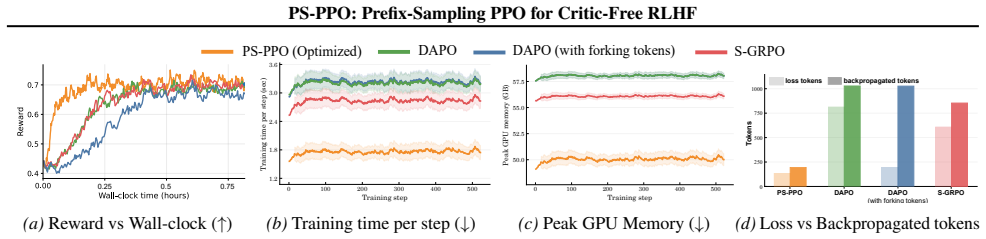
PS-PPO claims that backpropagating through an entire long completion is often unnecessary. It samples a cutoff H per rollout from a prompt-conditioned distribution ξ, updates only tokens t ≤ H, and reweights kept gradients by 1/ξ_t. Because E[1{t ≤ H}|x] = ξ_t, the truncated update equals the full broadcast update in expectation (Appendix B). The paper picks ξ by minimizing induced gradient variance under a budget, using forward-only proxies (output-head score norm, reward-uncertainty bound). It reports accuracy close to full-update baselines on math reasoning while cutting update-stage time by 33–45% and peak GPU memory by 15–17%.
Load-bearing premise
The load-bearing premise is that prefix states usually determine the final outcome, so the two forward-only proxies, estimated from only eight rollouts per prompt, pick cutoffs that drop mostly redundant tokens; if a task rewards late corrections or the proxies mis-rank timesteps, truncation removes useful suffix tokens and the compute saving turns into an accuracy loss.
Editorial extensions
If this is right
- If PS-PPO is right, update-pass cost no longer scales with the full generated token count; at maximum completion length 4096 it reports 2.8–3.3× faster update steps than masking-only alternatives.
- Accuracy parity with full-trajectory critic-free updates on math benchmarks becomes achievable at roughly two-thirds of the update-stage compute and 15–17% lower peak GPU memory.
- Because the estimator is unbiased for any positive cutoff distribution, the same recipe transfers to general terminal rewards, including continuous learned rewards; the paper demonstrates this on text-generation tasks.
- The budget parameter B is an explicit trade-off dial: smaller B trades accuracy and estimator variance for speed, while larger B approaches full-trajectory cost; the reported default is B=128.
- The efficiency gap widens with maximum completion length, which is the regime where long chain-of-thought RLHF becomes most expensive.
Reading between the lines
- If the prefix-predictability finding extends beyond mathematical reasoning, the method should pay off most on tasks where early reasoning commits the answer and least on tasks with frequent late-stage correction; this is a testable prediction, not one the paper makes.
- The truncated estimator's variance grows as 1/ξ_t, so aggressive truncation at small budgets combined with small group sizes may make updates noisy; an adaptive budget rule driven by an online variance estimate is a natural extension.
- The design objective keeps only diagonal covariance terms, dropping cross-timestep covariances of autoregressive gradients; accounting for those could yield cutoff distributions with even lower variance at the same compute budget.
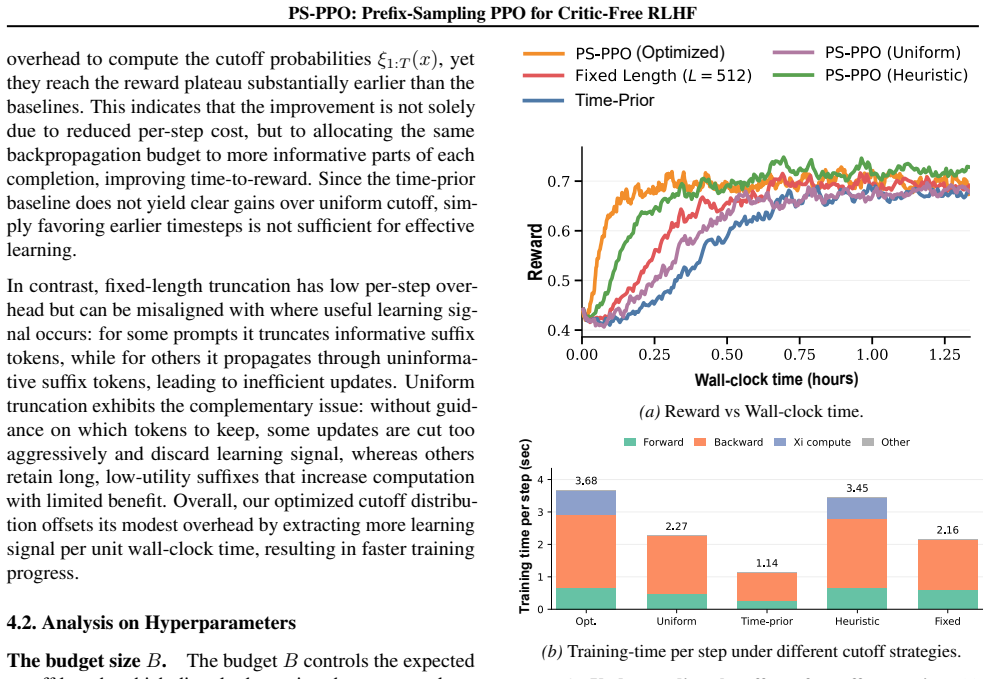
- Both proxies are empirical surrogates: if the output-head score-norm correlation or the mean-field reward-uncertainty bound degrades on new tasks, the optimized cutoff could underperform simple uniform or time-prior fallbacks.
Signed reviews
Editorial analysis
A structured set of objections, weighed in public.
Referee Report
Summary. The paper proposes PS-PPO, a critic-free RLHF method that reduces the cost of policy updates by sampling a cutoff timestep for each trajectory and backpropagating only through the resulting prefix. An inclusion-probability reweighting is used so that the truncated gradient estimator is unbiased with respect to the full-trajectory broadcast update in expectation. The cutoff distribution is chosen by solving a budget-constrained convex program that minimizes a variance surrogate, using forward-only proxies for per-timestep gradient norms and reward uncertainty. Experiments on mathematical reasoning (MATH500, AIME, AMC, etc.) and on continuous-reward text generation report 33–45% reductions in update-stage training time and 15–17% peak memory reductions while claiming accuracy comparable to GRPO, DAPO, and S-GRPO.
Significance. If the empirical claims are sustained, PS-PPO is a practically valuable contribution: it offers a principled way to avoid backpropagating through long, largely predictable reasoning traces, which is a major bottleneck in critic-free RLHF. The core unbiasedness derivation (Appendix B) for the pre-clipping policy gradient is simple and correct, and the inclusion-probability reweighting is a clean idea that does not rely on extra rollouts or auxiliary value models. The paper also provides detailed appendices, a public repository, and experiments across multiple backbones and benchmarks. However, the central theoretical guarantee is established only for the unclipped per-timestep gradient, not for the clipped PPO objective actually used in training, and the empirical 'optimized cutoff' rests on proxy assumptions whose validity during training is not fully demonstrated.
major comments (4)
- [§3.2, Algorithm 1, Eq. (9) vs Eq. (1)] Unbiasedness is proved for the pre-clipping gradient sum G(θ)=Σ g_t with g_t = A_t ∇ log π, but the actual PPO update uses the clipped surrogate objective in Eq. (1). The gradient of the clipped objective is not equal to g_t for timesteps where the importance ratio leaves [1−ε, 1+ε]. Therefore bG in Eq. (9) is not, in general, an unbiased estimator of the gradient of the full clipped PPO objective. The paper must either prove unbiasedness for the clipped objective (which appears difficult due to the nonlinear clipping) or explicitly restate the contribution as an unbiased estimator of the unclipped policy gradient, with clipping treated as an additional heuristic. As written, the claim that PS-PPO 'preserves the full-sequence update in expectation' is stronger than what Appendix B demonstrates.
- [§3.3 and Appendix F, Eq. (8)] The optimization problem includes the constraints ξ_1 ≤ 1 and 1 ≥ ξ_1 ≥ ... ≥ ξ_T > 0, but the proposed PAV procedure as described only enforces monotonicity. The unconstrained Lagrangian solution ξ_t = B·sqrt(w_t)/Σ sqrt(w_j) can exceed 1, and the blockwise optimum in Eq. (32) does not incorporate the upper-bound constraint. The text mentions KKT saturation only in passing, but the main algorithm does not describe how it is implemented. Please specify a complete algorithm that returns a feasible monotone sequence satisfying 0 < ξ_t ≤ 1 and the budget Σ ξ_t = B, or prove that the PAV output always satisfies these constraints.
- [§4, Tables 2, 4, 5] The central empirical claim is that PS-PPO maintains accuracy comparable to baselines. However, Table 2 (and Tables 4–5) report only means over three runs, without standard deviations, confidence intervals, or significance tests. Many differences are small (e.g., MATH500 Qwen: PS-PPO 85.0 vs DAPO 85.2; AIME25 Llama: both 3.3). Without error bars, 'comparable accuracy' is not statistically established. Please report per-run values or error bars for all main accuracy numbers, and provide a pairwise comparison or significance test for the key PS-PPO vs DAPO/GRPO differences.
- [§3.3, Appendix A, Appendix H, §4.2] The compute–accuracy trade-off rests on the assumption that prefix states are strongly predictive of the final reward and that the output-head score norm and reward-uncertainty proxy are faithful. Appendix A measures late recovery on greedy completions of the base model (7–9% late recovery at the 75% prefix), and Appendix H shows correlation on Qwen2.5-Math-7B. During RL training the policy changes, and the late-recovery rate may increase, especially at T_max=4096; the proxies are estimated from only K=8 rollouts and can be degenerate when all rollouts share the same outcome. Unbiasedness does not mitigate this: a single update may omit informative suffix tokens, and over training this can manifest as an accuracy drop. Please provide evidence that the proxies remain reliable on the policy during training (e.g., measure prefix-conditioned success or oracle-cutoff comparisons at intermedia
minor comments (5)
- [Contribution bullet, §3.3, Algorithm 1] The bullet 'computationally truncates forward and backward computation beyond the cutoff' is not fully supported by Algorithm 1: computing γ_t in step 7 requires hidden states h_t and logits for all timesteps, which either requires a full forward pass or cached activations from the rollout. Please clarify how these quantities are obtained at low overhead, and adjust the cost breakdown and wording accordingly.
- [Eq. (4), §3.3] The 'optimized' cutoff minimizes a diagonal-trace surrogate that ignores cross-timestep covariance terms. This is acknowledged, but the term 'optimized' should be consistently qualified as 'surrogate-optimized' to avoid overstating the theoretical optimality of the cutoff distribution.
- [Table 1 and Figure 2] The timing breakdown shows a 0.43s cost for computing ξ_{1:T}; please state explicitly whether this includes a full forward pass over the rollout to obtain the output-head activations or is computed from scalars cached during generation. This is important for reproducing the reported savings.
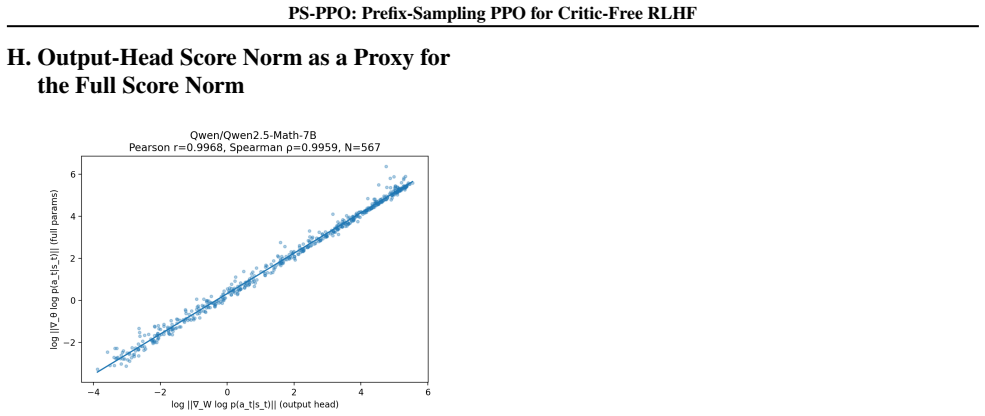
- [Appendix H, Figure 4] Report the numerical correlation coefficient (Pearson and/or Spearman) for the output-head score-norm proxy, rather than only a scatter plot, so that the strength of the proxy can be quantitatively assessed.
- [General notation] In Eq. (8), the symbol t is used both as a summation index and as an argument in ¯γ_t(x,t); rename to avoid confusion. Also, 'PA V' appears with an odd spacing in several places; use 'PAV' consistently.
Circularity Check
No significant circularity: the truncated estimator is unbiased by standard importance-weighting construction, and the cutoff-proxy claims rest on independent empirical support rather than on the target results.
full rationale
The load-bearing estimator in Eq. (9) is self-contained. Appendix B proves unbiasedness by conditioning on the sampled trajectories and using E[I_t^(k)|x] = ξ_t; this is a textbook importance-weighting identity and does not assume the conclusion or the optimality of the cutoff distribution. The cutoff-design objective in Eq. (8) is derived as a variance surrogate, and its proxy components are supported independently: the output-head score norm is validated by the correlation analysis in Appendix H, and the reward-uncertainty bound u_t is derived as an upper bound in Appendix E rather than fitted to the outcome. There are no self-citations, no imported uniqueness theorems, and no ansatz smuggled in via citation. The only mild concern is that the default budget B=128 was selected by sweeping on the same evaluation benchmarks (Table 4) and then compared against baselines on those benchmarks (Table 2); this is an evaluation-protocol weakness, not a by-construction circularity, because the compute savings are measured and the accuracy numbers are not forced by the estimator's definition. Overall, no claimed prediction reduces to its own inputs.
Assumptions & free parameters
free parameters (3)
- Budget B =
128
- Group size K =
8
- top-k for u_t estimation =
16
assumptions (5)
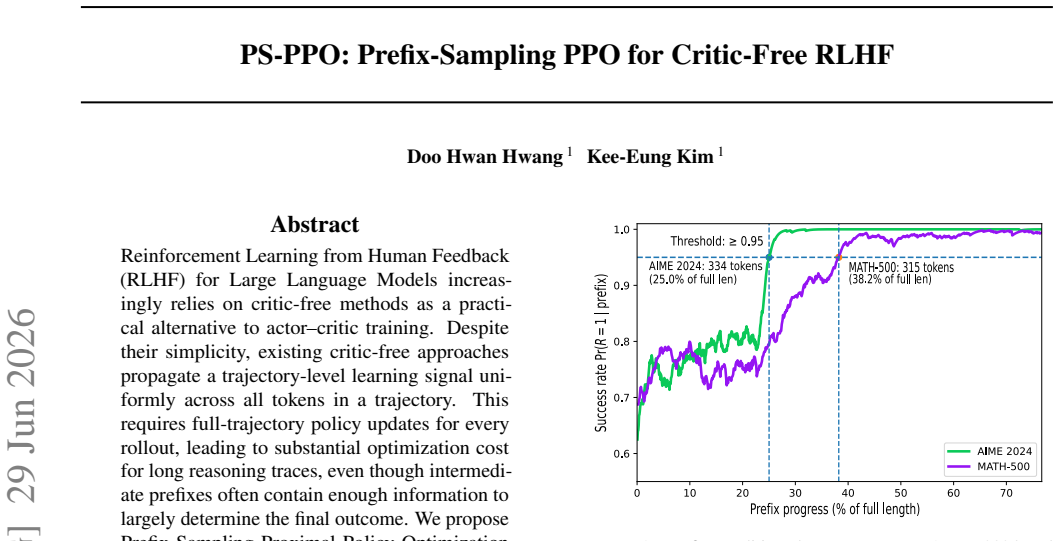
- domain assumption Prefix-conditioned success rates saturate before the end of the completion for reasoning tasks.
- ad hoc to paper The output-head score norm ∥∇_{θ_out} log π∥ is a faithful proxy for the full-parameter score norm ∥∇_θ log π∥.
- ad hoc to paper The trace/diagonal surrogate that ignores cross-timestep covariance terms is a good stand-in for the exact cutoff-induced variance.
- domain assumption Finite-sample estimates of p(x), π_G, and π_B from K rollouts approximate the true reward and state distributions.
- standard math PAV returns the globally optimal solution to the monotone budgeted design problem.
Cite this review
Pith. "Pith review of PS-PPO: Prefix-Sampling PPO for Critic-Free RLHF." pith.science (2026). https://pith.science/paper/T4MAKGGR
@misc{pith2026260629758,
  author       = {Pith},
  title        = {Pith review of: PS-PPO: Prefix-Sampling PPO for Critic-Free RLHF},
  year         = {2026},
  howpublished = {\url{https://pith.science/paper/T4MAKGGR}},
  note         = {Machine review of arXiv:2606.29758}
}
read the original abstract
Reinforcement Learning from Human Feedback (RLHF) for Large Language Models increasingly relies on critic-free methods as a practical alternative to actor--critic training. Despite their simplicity, existing critic-free approaches propagate a trajectory-level learning signal uniformly across all tokens in a trajectory. This requires full-trajectory policy updates for every rollout, leading to substantial optimization cost for long reasoning traces, even though intermediate prefixes often contain enough information to largely determine the final outcome. We propose Prefix-Sampling Proximal Policy Optimization (PS-PPO), a compute-efficient critic-free method for RLHF that exploits this temporal redundancy. PS-PPO introduces a prompt-conditioned cutoff distribution and samples a cutoff timestep for each trajectory. During the update pass, PS-PPO backpropagates only through the sampled prefix of each trajectory and applies an importance-weighting correction so that the resulting truncated gradient estimator remains unbiased with respect to the full-trajectory objective. Experiments on mathematical reasoning and RLHF benchmarks show that PS-PPO achieves large reductions in training compute and peak GPU memory, while maintaining accuracy comparable to strong critic-free baselines.
Figures
Figures from the paper (1 more)
Reference graph
Works this paper leans on
-
[3]
URL https://aclanthology.org/2024. acl-long.510/. Wang, S., Yu, L., Gao, C., Zheng, C., Liu, S., Lu, R., Dang, K., Chen, X., Yang, J., Zhang, Z., Liu, Y ., Yang, A., Zhao, A., Yue, Y ., Song, S., Yu, B., Huang, G., and Lin, J. Beyond the 80/20 rule: High-entropy minority tokens drive effective reinforcement learning for LLM reasoning.CoRR, abs/2506.01939,...
-
[2024]
Draft/online book. Lee, A. and Tong, H. Token-efficient RL for LLM reason- ing, 2025. URL https://arxiv.org/abs/2504. 20834. Lewkowycz, A., Andreassen, A., Dohan, D., Dyer, E., Michalewski, H., Ramasesh, V ., Slone, A., Anil, C., Schlag, I., Gutman-Solo, T., Wu, Y ., Neyshabur, B., Gur- Ari, G., and Misra, V . Solving quantitative reasoning problems with ...
arXiv 2025
-
[2026]
Accessed: 2026-01-04. Bai, Y ., Jones, A., Ndousse, K., Askell, A., Chen, A., Das- Sarma, N., Drain, D., Fort, S., Ganguli, D., Henighan, T., et al. Training a helpful and harmless assistant with reinforcement learning from human feedback, 2022. Brown, T., Mann, B., Ryder, N., Subbiah, M., Kaplan, J. D., Dhariwal, P., Neelakantan, A., Shyam, P., Sastry, G...
arXiv 2026
Reviewed August 2, 2026 · model on record in the stance chip above.
Discussion (0). Continue with ORCID to comment.