REVIEW 4 major objections 6 minor 1 cited by
Enhancing In-Hospital Mortality Prediction Using Multi-Representational Learning with LLM-Generated Expert Summaries
T0 review · 4 major / 6 minor · reviewed 2026-08-12 · deepseek-v4-flash
Pith's one-line read The paper claims that fusing LLM-generated expert summaries with vital-sign time series and raw clinical notes improves in-hospital mortality prediction, reaching an AUROC of 0.8955 and an AUPRC of 0.6156.
desk verdict A clean, small-scale empirical study: LLM summaries add a few points to ICU mortality prediction, but the gain is fragile without faithfulness checks and error bars. read the letter →
The pith
A machine-rendered reading of the paper's core claim, the machinery that carries it, and where it could break.
The reading
What carries the argument
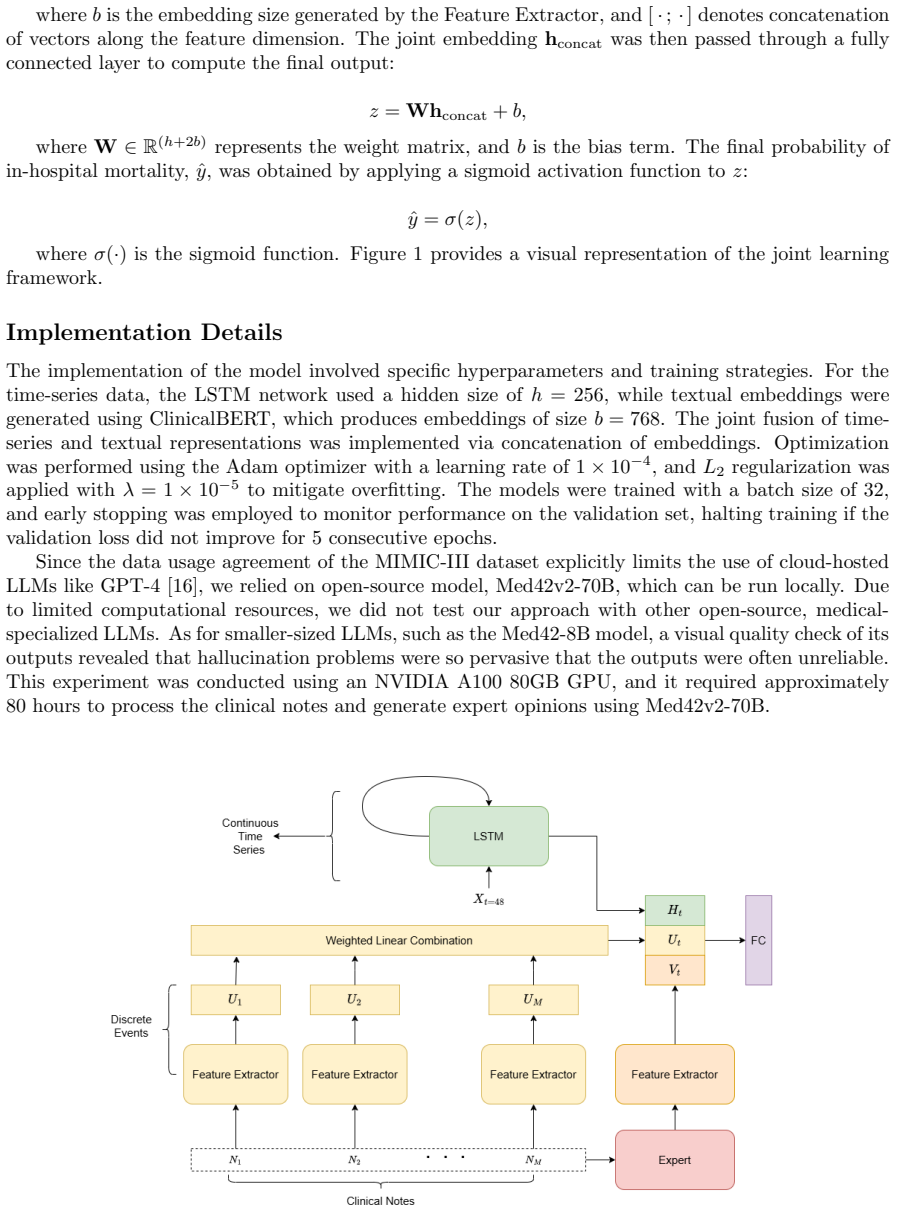
The load-bearing mechanism is the Expert-Based Clinical Representation (EBCR): each patient's notes are concatenated in chronological order, an LLM is prompted to produce a structured expert summary, and that summary is embedded with a clinically pretrained transformer. Raw-note embeddings are aggregated per hour with an exponential decay weighting by chart time, and the summary embedding is fused with the LSTM's final time-series hidden state by concatenation before a sigmoid output layer. The design deliberately keeps the LLM out of the prediction path, using it only to produce a distilled textual input.
What would settle it
Generate expert summaries with a deliberately corrupted or hallucination-prone LLM on the same cohort; if the joint-fusion model still shows the same AUPRC gains, the summaries' specific content is not the active ingredient. More directly, retrain the pipeline on an external ICU dataset from another institution; the central claim would be falsified if the AUPRC gain from adding summaries does not reproduce outside the original cohort.
Extended reading notes
Core claim
The central claim is that transforming a patient's chronologically concatenated 48-hour clinical notes into an expert summary with a medical LLM, then embedding that summary and fusing it with time-series physiology and note embeddings, yields the best in-hospital mortality prediction among the configurations tested. The authors report that the expert-summary-only representation beats both raw notes and time-series alone, and that adding the summary to the joint fusion improves AUROC by 1.15% and AUPRC by 1.65% over the same fusion without it. Performance gains are consistent across racial and ethnic subgroups in the test set. The authors frame the result as evidence that LLM-generated expert summaries, introduced as auxiliary representations rather than as direct predictors, capture complementary prognostic information and mitigate the uncertainty-quantification and interpretability problems of end-to-end LLM prediction.
Load-bearing premise
The framework assumes the medical LLM's expert summaries faithfully condense the clinical notes; if the summaries introduce hallucinations or spurious patterns that happen to correlate with mortality, the reported gains will not transfer to new data.
Editorial extensions
If this is right
- If replicated, LLM-generated summaries can be treated as a cheap auxiliary modality that improves mortality-risk stratification over physiology-only and note-only models.
- Because the summary alone outperforms raw notes alone, distillation is doing work beyond simple compression of the note text.
- The fusion gains mean that combining modalities is more useful than relying on any single representation, and simple concatenation is sufficient to realize most of the gain.
- Consistent gains across demographic subgroups suggest the auxiliary summaries do not amplify baseline disparities in this cohort.
Reading between the lines
- We infer that a direct testable extension would swap the summary generator for a smaller or general-purpose LLM; if the gains shrink or vanish, the specific medical pretraining, not summarization per se, carries the value.
- Because the summaries are generated from the full 48-hour window, the design is not yet a real-time early-warning system; adapting the LLM to generate summaries from a sliding partial window could extend the approach to continuous monitoring.
- We infer that if summary embeddings capture the same signal as raw notes, the small AUROC gain over the note-fused model may be partly due to the LLM implicitly normalizing style or noise; an ablated version using a deterministic extractive summarizer would separate extraction from generation.
Editorial analysis
A structured set of objections, weighed in public.
Referee Report
Summary. The paper proposes a multi-representational learning framework for in-hospital mortality prediction from MIMIC-III ICU data, integrating (i) 48-hour physiological time series encoded by an LSTM, (ii) clinical notes encoded by ClinicalBERT with exponential time decay, and (iii) LLM-generated 'expert summaries' (EBCRs) produced by Med42-v2 70B from the concatenated notes and encoded as a single ClinicalBERT embedding. The authors report that the joint model achieves AUROC 0.8955 and AUPRC 0.6156, outperforming time-series-only and notes-plus-time-series baselines, and they present subgroup analyses across racial groups. The central claim is that LLM-generated summaries add complementary predictive signal beyond raw notes and vitals without relying on direct LLM predictions.
Significance. If the central claim is established, the work would provide a practical template for using open-source, locally hosted medical LLMs to distill clinical notes into predictions, which is relevant given data-use restrictions on cloud LLMs for MIMIC. The authors deserve credit for being transparent about the hallucination problems of Med42-8B, for selecting Med42-v2 70B for that reason, and for framing EBCRs as auxiliary representations rather than as direct LLM predictions. The main scientific value depends on two things that are not yet demonstrated: the statistical robustness of the reported performance differences and the faithfulness of the summaries actually used. The reported improvements are plausible but, on the current evidence, not conclusively attributable to the summaries' medical content.
major comments (4)
- [Results, Table 2] The central claim that expert summaries add complementary signal rests on a small absolute improvement: AUROC +1.15% and AUPRC +1.65% over the time-series-plus-notes model. The paper reports a single random split with no confidence intervals, no standard deviations, and no significance tests for any of the metric differences in Table 2. Given that the differences are small and the baselines already incorporate substantial textual information, the stated improvement cannot be distinguished from random split variation. Please report metrics across multiple seeds or bootstrap resamples, with CIs, and a paired significance test (e.g., DeLong for AUROC, bootstrap for AUPRC) for the comparison that supports the paper's main claim.
- [Implementation Details; Limitations and Future Work] The paper's own text states that Med42-8B outputs had hallucinations 'so pervasive that the outputs were often unreliable' and concedes that 'any biases or errors in the LLM-generated summaries could impact model performance.' Yet the 70B summaries used in the experiments receive no faithfulness evaluation, manual or automated. Because the EBCR gain could arise from hallucinated or shortcut features rather than from faithful medical distillation, the load-bearing assumption is unverified. Please add (a) a quantitative faithfulness check on a sample of 70B summaries (e.g., clinical-entity overlap, manual review with inter-annotator agreement), and (b) a control experiment in which the 'expert summary' is replaced by an extractive or non-expert summarizer to see whether the gain is specific to expert medical knowledge.
- [LLM-Generated Summary Embedding; Joint Learning, Eq. (7) and Eq. (9)] The summary embedding Vt is defined as a single FeatureExtractor(Nexpert) applied to the whole 48-hour summary and then concatenated with Ht and Ut at every time step in hconcat. In contrast, the note representation Ut uses an exponential time decay, so the summary stream can pool information from the entire 48-hour window and inject it at every LSTM time step, giving it a structural advantage unrelated to domain knowledge. This asymmetry could explain part of the observed gain. Please clarify whether Vt is time-invariant in the implementation, and if so, run an ablation that either applies the same whole-sequence pooling to the raw notes (e.g., a time-independent note embedding) or restricts the summary embedding to the final time step, so that the comparison is fair.
- [Results, Table 3] The subgroup analysis in Table 3 is used to claim that improvements 'were consistent across demographic groups' and that the framework has 'equitable application potential.' However, the full cohort sizes for Hispanic/Latino (456), Asian (362), and Declined to Answer (166) are small, and the test subset is a 20% split, yielding very few positive cases for mortality; the reported AUPRC values of 0.92 for Asian and 0.50 for Hispanic/Latino are therefore unstable. No confidence intervals or event counts are provided. Please report the number of patients and mortality events per subgroup, or aggregate small groups, and add uncertainty estimates before making equity claims.
minor comments (6)
- [Abstract and Results] The abstract states improvements of +36.41% AUPRC and +7.64% AUROC over the time-series-only baseline. These are relative improvements; the absolute AUPRC gain is 0.1643 and the absolute AUROC gain is 0.0635. Please state both or clarify that the percentages are relative, as the current phrasing can mislead.
- [Materials and Methods, Table 1] Table 1 reports 'Median Age [IQR] 66.96 [18.08, 90.0]'. The bracket appears to be a min-max range rather than an interquartile range, which typically spans the 25th to 75th percentile. Please verify the reported values or relabel the column.
- [T extual Representations Embedding] There is a typo in the section heading 'T extual Representations Embedding'; it should be 'Textual Representations Embedding'. Also, in the baseline equation, 'andbm' should be 'and b m'.
- [Implementation Details] The prompt used to generate the expert summaries is said to be in the supplementary materials, but no supplementary materials are included in the submission. Please include the exact prompt template, including any instructions about format and length, because summary quality and faithfulness depend critically on the prompt.
- [Data Availability] The paper states code will be released 'upon the paper's acceptance'. For reproducibility of the preprocessing, prompt, and training pipeline, please make the code available at least in a public repository at revision time, or justify why it cannot be shared.
- [Discussion, t-SNE visualizations] Figure 2's t-SNE plots are qualitative and not quantified. If they are used to support the claim that EBCRs are more separable, consider reporting a quantitative cluster-separation metric (e.g., silhouette score) computed on held-out data rather than on the same data used to fit the representations.
Circularity Check
No circularity found: LLM summaries are a deterministic transform of input notes, not of the mortality label; all reported metrics are held-out test evaluations.
full rationale
The paper's derivation chain is self-contained. Time-series data enter an LSTM, raw clinical notes enter ClinicalBERT with a time-decayed aggregation, and the LLM-generated expert summary is explicitly defined as N_expert = f_LLM(N_T), a deterministic transformation of the same clinical notes rather than of the mortality label. The joint model simply concatenates the three embeddings and applies a linear layer followed by sigmoid. No fitted parameter is renamed as a prediction: the decay hyperparameter lambda is tuned on the validation set, and the reported AUROC/AUPRC values in Table 2 are computed on the held-out test set. The paper contains no self-citations, no invoked uniqueness theorem from the authors' prior work, and no ansatz smuggled in through citation. The main limitation—that summaries inherit any errors or biases from the LLM—is a generalizability and faithfulness risk, not circularity, because the summaries are still derived from input notes rather than from the outcome variable. The measured gains may reflect redundancy or compression effects, but that is an empirical question and does not make the derivation circular.
Assumptions & free parameters
free parameters (7)
- Temporal decay hyperparameter lambda =
Not reported (optimized on validation set)
- Maximum note concatenation length =
4096 tokens
- LSTM hidden size =
256
- Learning rate =
1e-4
- L2 regularization coefficient =
1e-5
- Batch size =
32
- Early stopping patience =
5 epochs
assumptions (5)
- domain assumption MIMIC-III records accurately reflect patient physiology and outcomes.
- domain assumption The 48-hour observation window and 10 preprocessed variables are sufficient for IHM prediction.
- domain assumption ClinicalBERT embeddings preserve clinically meaningful information from both raw notes and LLM summaries.
- domain assumption Med42-v2 70B summaries are accurate and free of hallucinated content.
- domain assumption The single 60/20/20 random split is representative, and the reported metrics are stable.
Cite this review
Pith. "Pith review of Enhancing In-Hospital Mortality Prediction Using Multi-Representational Learning with LLM-Generated Expert Summaries." pith.science (2026). https://pith.science/paper/T4N3YFXI
@misc{pith2026241116818,
  author       = {Pith},
  title        = {Pith review of: Enhancing In-Hospital Mortality Prediction Using Multi-Representational Learning with LLM-Generated Expert Summaries},
  year         = {2026},
  howpublished = {\url{https://pith.science/paper/T4N3YFXI}},
  note         = {Machine review of arXiv:2411.16818}
}
read the original abstract
In-hospital mortality (IHM) prediction for ICU patients is critical for timely interventions and efficient resource allocation. While structured physiological data provides quantitative insights, clinical notes offer unstructured, context-rich narratives. This study integrates these modalities with Large Language Model (LLM)-generated expert summaries to improve IHM prediction accuracy. Using the MIMIC-III database, we analyzed time-series physiological data and clinical notes from the first 48 hours of ICU admission. Clinical notes were concatenated chronologically for each patient and transformed into expert summaries using Med42-v2 70B. A multi-representational learning framework was developed to integrate these data sources, leveraging LLMs to enhance textual data while mitigating direct reliance on LLM predictions, which can introduce challenges in uncertainty quantification and interpretability. The proposed model achieved an AUPRC of 0.6156 (+36.41%) and an AUROC of 0.8955 (+7.64%) compared to a time-series-only baseline. Expert summaries outperformed clinical notes or time-series data alone, demonstrating the value of LLM-generated knowledge. Performance gains were consistent across demographic groups, with notable improvements in underrepresented populations, underscoring the framework's equitable application potential. By integrating LLM-generated summaries with structured and unstructured data, the framework captures complementary patient information, significantly improving predictive performance. This approach showcases the potential of LLMs to augment critical care prediction models, emphasizing the need for domain-specific validation and advanced integration strategies for broader clinical adoption.
Figures

Forward citations
Cited by 1 Pith paper
-
OC-Distill: Ontology-aware Contrastive Learning with Cross-Modal Distillation for ICU Risk Prediction
Ontology-aware contrastive pretraining plus note-to-vitals distillation improves MIMIC ICU risk and length-of-stay prediction using only vital signs at inference.
Reference graph
Works this paper leans on
-
[1]
Publicly available clinical bert embeddings
Emily Alsentzer, John R Murphy, Willie Boag, Wei-Hung Weng, Di Jin, Tristan Nau- mann, and Matthew McDermott. Publicly available clinical bert embeddings. arXiv preprint arXiv:1904.03323, 2019. 8
arXiv 1904
-
[2]
Clinical decision support for early recognition of sepsis
Robert C Amland and Kristin E Hahn-Cover. Clinical decision support for early recognition of sepsis. American Journal of Medical Quality , 31(2):103–110, 2016
work page 2016
-
[3]
Hudson, Ehsan Adeli, Russ Altman, Simran Arora, Sydney von Arx, Michael S
Rishi Bommasani, Drew A. Hudson, Ehsan Adeli, Russ Altman, Simran Arora, Sydney von Arx, Michael S. Bernstein, Jeannette Bohg, Antoine Bosselut, Emma Brunskill, Erik Brynjolfsson, Shyamal Buch, Dallas Card, Rodrigo Castellon, Niladri Chatterji, Annie Chen, Kathleen Creel, Jared Quincy Davis, Dora Demszky, Chris Donahue, Moussa Doumbouya, Esin Durmus, Ste-...
work page 2022
-
[4]
Tom B. Brown, Benjamin Mann, Nick Ryder, Melanie Subbiah, Jared Kaplan, Prafulla Dhariwal, Arvind Neelakantan, Pranav Shyam, Girish Sastry, Amanda Askell, Sandhini Agarwal, Ariel Herbert-Voss, Gretchen Krueger, Tom Henighan, Rewon Child, Aditya Ramesh, Daniel M. Ziegler, Jeffrey Wu, Clemens Winter, Christopher Hesse, Mark Chen, Eric Sigler, Mateusz Litwin...
2020
-
[5]
Aakanksha Chowdhery, Sharan Narang, Jacob Devlin, Maarten Bosma, Gaurav Mishra, Adam Roberts, Paul Barham, Hyung Won Chung, Charles Sutton, Sebastian Gehrmann, Parker Schuh, Kensen Shi, Sasha Tsvyashchenko, Joshua Maynez, Abhishek Rao, Parker Barnes, Yi Tay, Noam Shazeer, Vinodkumar Prabhakaran, Emily Reif, Nan Du, Ben Hutchinson, Reiner Pope, James Bradb...
work page 2022
-
[6]
Med42–evaluating fine-tuning strategies for medical llms: Full-parameter vs
Cl´ ement Christophe, Praveen K Kanithi, Prateek Munjal, Tathagata Raha, Nasir Hayat, Ronnie Rajan, Ahmed Al-Mahrooqi, Avani Gupta, Muhammad Umar Salman, Gurpreet Gosal, et al. Med42–evaluating fine-tuning strategies for medical llms: Full-parameter vs. parameter-efficient approaches. arXiv preprint arXiv:2404.14779 , 2024
arXiv 2024
-
[7]
The relationship between precision-recall and roc curves
Jesse Davis and Mark Goadrich. The relationship between precision-recall and roc curves. In Proceedings of the 23rd international conference on Machine learning , pages 233–240, 2006
work page 2006
-
[8]
Marzyeh Ghassemi, Marco Pimentel, Tristan Naumann, Thomas Brennan, David Clifton, Peter Szolovits, and Mengling Feng. A multivariate timeseries modeling approach to severity of illness assessment and forecasting in icu with sparse, heterogeneous clinical data. In Proceedings of the AAAI conference on artificial intelligence , volume 29, 2015
work page 2015
Show all 17 references
-
[9]
Icda: a platform for intelligent care delivery analytics
David Gotz, Harry Stavropoulos, Jimeng Sun, and Fei Wang. Icda: a platform for intelligent care delivery analytics. In AMIA annual symposium proceedings , volume 2012, page 264. American Medical Informatics Association, 2012. 9
2012
-
[10]
Multitask learning and benchmarking with clinical time series data
Hrayr Harutyunyan, Hrant Khachatrian, David C Kale, Greg Ver Steeg, and Aram Galstyan. Multitask learning and benchmarking with clinical time series data. Scientific data, 6(1):96, 2019
2019
-
[11]
Long short-term memory
Sepp Hochreiter and J¨ urgen Schmidhuber. Long short-term memory. Neural computation , 9(8):1735–1780, 1997
1997
-
[12]
Mimic-iii, a freely accessible critical care database
Alistair EW Johnson, Tom J Pollard, Lu Shen, Li-wei H Lehman, Mengling Feng, Mohammad Ghassemi, Benjamin Moody, Peter Szolovits, Leo Anthony Celi, and Roger G Mark. Mimic-iii, a freely accessible critical care database. Scientific data , 3(1):1–9, 2016
2016
-
[13]
Biobert: a pre-trained biomedical language representation model for biomedical text mining
Jinhyuk Lee, Wonjin Yoon, Sungdong Kim, Donghyeon Kim, Sunkyu Kim, Chan Ho So, and Jaewoo Kang. Biobert: a pre-trained biomedical language representation model for biomedical text mining. Bioinformatics, 36(4):1234–1240, 2020
2020
-
[14]
Attend and diagnose: Clinical time series analysis using attention models
Huan Song, Deepta Rajan, Jayaraman Thiagarajan, and Andreas Spanias. Attend and diagnose: Clinical time series analysis using attention models. In Proceedings of the AAAI conference on artificial intelligence , volume 32, 2018
2018
-
[15]
Learning tasks for multitask learning: Het- erogenous patient populations in the icu
Harini Suresh, Jen J Gong, and John V Guttag. Learning tasks for multitask learning: Het- erogenous patient populations in the icu. In Proceedings of the 24th ACM SIGKDD International Conference on Knowledge Discovery & Data Mining , pages 802–810, 2018
2018
-
[16]
Gpt responsible use
PhysioNet Team. Gpt responsible use. https://physionet.org/news/post/ gpt-responsible-use, 2024
2024
-
[17]
Katherine Tian, Eric Mitchell, Allan Zhou, Archit Sharma, Rafael Rafailov, Huaxiu Yao, Chelsea Finn, and Christopher D. Manning. Just ask for calibration: Strategies for eliciting calibrated confidence scores from language models fine-tuned with human feedback, 2023. 10
2023
Reviewed August 12, 2026 · model on record in the stance chip above.
Discussion (0). Continue with ORCID to comment.