REVIEW 4 major objections 7 minor 8 references
RecBayes: Recurrent Bayesian Ad Hoc Teamwork in Large Partially Observable Domains
T0 review · 4 major / 7 minor · reviewed 2026-08-15 · deepseek-v4-flash
Pith's one-line read This paper shows that a recurrent classifier trained only on the ad hoc agent's own partial-observation trajectories can identify known teams and tasks in real time, reaching near-optimal assistance without ever seeing environment states…
desk verdict RecBayes is a credible step forward for partial-observability ad hoc teamwork, with a real distribution-shift gap that needs analysis but is not fatal. read the letter →
The pith
A machine-rendered reading of the paper's core claim, the machinery that carries it, and where it could break.
The reading
What carries the argument
The load-bearing object is the recurrent Bayesian classifier $\hat{p}_{\theta}$, a recurrent network trained with categorical cross-entropy on labelled trajectories to output a distribution over team-tasks. It stands in for the exact Bayesian update of Equation 1, which would require transition and observation probabilities for every candidate POMDP and is infeasible for large spaces. The classifier's belief $\hat{p}_{\theta}(k \mid \phi(z_t), h_t)$ is combined in Equation 3 with the best-response policy $\pi_{\psi_k}$ for each known team-task to form the agent's mixed policy. Relaxing observations to arbitrary features $\phi(z_t)$ is what removes the need for a tabular model.
What would settle it
Retrain or evaluate RecBayes in a moderately sized partially observable domain where the exact posterior of Equation 1 can be computed from the POMDP models; if the classifier's belief consistently lags behind or disagrees with the exact posterior, or if normalized performance drops below the 0.90 near-optimal threshold when training and evaluation policies differ, the approximation claim would be falsified.
Extended reading notes
Core claim
The central claim is that a recurrent Bayesian classifier trained on trajectories of the form $\tau=(a_0,z_1,a_1,\ldots,a_{L-1},z_L)$, collected while the ad hoc agent explored each known team-task under partial observability, approximates the exact Bayesian posterior over team-tasks that Equation 1 would compute with full POMDP models. At run time the classifier's output distribution over team-tasks weights the best-response policies of all known team-tasks, producing the mixed policy of Equation 3. Because the classifier consumes arbitrary features $\phi(z_t)$ of the observation rather than a tabular entry, the approach scales to domains with roughly $970{,}200$ states and $2^{125}$ observations. The paper presents evidence that this identifies the correct team-task on the fly in both team-identification and task-identification settings, and that the resulting assistance is near-optimal in most evaluated cases.
Load-bearing premise
The method assumes that trajectories collected while the agent is learning with exploratory policies are representative enough for the classifier to keep identifying team-tasks at evaluation time, when the agent is instead executing the mixed policy and thereby changing what it observes.
Editorial extensions
If this is right
- An ad hoc agent that has only ever seen its own past interactions with a team can later assist that same team without any privileged state information being available during training or deployment.
- The tabular bottleneck of earlier partial-observability approaches, which were limited to domains of a few thousand states, is broken; the same pipeline applies to much larger state and observation spaces as long as trajectories can be collected.
- The team-task identification problem is reduced to recurrent sequence classification, so the classifier and the best-response policies can be trained independently and combined only at run time.
- Because the method never needs teammate actions, it applies to settings where other agents' decisions are private or unobservable, which is the rule in many real-world deployments rather than the exception.
Reading between the lines
- Beyond the paper's own experiments, an immediate test of the underlying approximation is to compare the classifier's belief trajectory with the exact posterior of Equation 1 in a small domain where that posterior is computable; a systematic divergence would mean the method succeeds despite, not because of, its Bayesian justification.
- The paper trains the classifier on trajectories collected under exploratory policies and evaluates it under the mixed policy of Equation 3; retraining on evaluation-policy trajectories would test whether that distribution shift matters for identification accuracy.
- Because the classifier accepts arbitrary observation features $\phi(z_t)$, a natural next step is high-dimensional or continuous observations, such as raw images; the algorithm itself would not need to change.
- A scaling stress test the paper does not report is holding the domain fixed while increasing the number of known team-task combinations; identification accuracy should degrade with more alternatives, and the rate of that degradation would guide practical use.
Signed reviews
Editorial analysis
A structured set of objections, weighed in public.
Referee Report
Summary. This paper proposes RecBayes, an ad hoc teamwork method for partially observable environments. RecBayes trains a recurrent classifier on trajectories collected during previous interactions with known team-task combinations, where the agent uses only its own partial observations and actions; at deployment, the classifier's output is used as an approximate posterior over known team-tasks to weight a library of best-response policies. The paper claims that this is the first approach that never requires states of the environment or teammates' actions at any stage and that can scale to large domains, and it evaluates on Level-Based Foraging and Predator-Prey with up to 970,200 states and 2^125 observations, reporting near-optimal normalized performance in most settings.
Significance. If the empirical results hold, RecBayes is a practically useful contribution: it removes the privileged-information requirement and the tabular-model bottleneck of prior ad hoc teamwork methods, and the experimental protocol—including normalization against original teammate and random policies, two domains, and three identification sub-problems—is a reasonable first test. The paper also discloses hyperparameters and reports a large number of trials. The key open question is whether the learned recurrent classifier is a reliable substitute for the exact Bayesian update under the deployment policy, and the current evidence does not yet establish that beyond the tested settings.
major comments (4)
- [Section 4, Algorithms 1 and 3] The training and deployment distributions over the agent's own actions differ: Algorithm 1 collects trajectories by executing the dedicated policy π_ψk for each team-task, whereas Algorithm 3 executes the mixture π_t = Σ_k p_t(k) π_ψk, which itself depends on the posterior being estimated. Because the action a_t is part of the evidence fed to p̂_θ, any early error changes future actions and therefore future observations, creating a closed-loop covariate shift. The paper does not analyze this shift or report calibration or classification accuracy on evaluation-distribution prefixes; without such evidence, the central claim that p̂_θ approximates Eq. (1) 'well enough' in general is not supported.
- [Section 4, Algorithm 2] Algorithm 2 states only that the cross-entropy loss is computed on complete trajectories τ_i, and it does not specify whether the loss is applied at every recurrent step or only after the full sequence. Algorithm 3, however, queries p̂_θ after each prefix (a_0, z_1, ..., a_{t-1}, z_t) and uses those intermediate outputs as the posterior for the mixture policy. If the classifier is trained only on full-sequence logits, the intermediate beliefs are never directly supervised, and the online posterior updates may be miscalibrated. Please clarify the training objective for prefixes and report prefix-level accuracy or calibration.
- [Section 6] The evaluation compares RecBayes only against general RL baselines, the original teammate, and random actions; it does not compare against any existing ad hoc teamwork algorithm such as ATPO, PO-GPL, FEAT, or ODITS. Since the paper's stated contribution is to overcome the limitations of these methods (tabular modeling and privileged information), a direct comparison on the 7x7 settings, where ATPO is feasible, is necessary to validate the claimed advantage over the state of the art.
- [Section 6.1, Table 2] The near-optimality claim is based on normalized means with no confidence intervals or statistical tests. Table 2 reports a single number per condition, and the text asserts 'no statistically significant differences' without any test. Given the small number of trials and the high standard deviations in Table 1, values such as 0.86 and 0.85 in the 10x10 Task Identification rows may not be reliably below or above the 0.90 threshold; please add error bars or significance tests.
minor comments (7)
- [Section 5.1] The observation space is described as 2^125, but this is only an upper bound on the 5x5x5 tuple observation space; the reachable observation distribution is far smaller, and the phrase 'up to 2^125 observations' may overstate the actual diversity. Please clarify.
- [Section 4 and Algorithm 3] The initial prior p_0 is never defined; please state how it is initialized (for example, as uniform over the K team-tasks).
- [Eq. (1)] The factor π_t(a_t | h_t) appears inside the sum in Eq. (1), but since it is independent of k it cancels in the normalization constant ρ; removing it would make the update easier to read.
- [Eqs. (2) and (3)] The sums run from k=0 to K, while the team-tasks are indexed k ∈ {1,...,K}; this off-by-one notation should be corrected.
- [Figure 4] The belief curves appear to be averaged over episodes, but the figure does not report error bars, the number of episodes, or per-episode classification accuracy; the statement that 'all team and tasks were in the end correctly classified' is stronger than what the averaged curves show.
- [Section 6.1] The sentence 'All three non-optimal cases were related with Task Identification' should be quantified as two cases for RecBayes-MF and one for RecBayes-MB, based on the Table 2 values.
- [Abstract and Introduction] The phrase 'arbitrarily large' is too strong for an empirical evaluation up to 970,200 states; suggest replacing it with 'substantially larger' or another more precise qualifier.
Circularity Check
No circularity: the recurrent classifier is openly trained on labeled trajectories and evaluated on fresh episodes.
full rationale
RecBayes does not present a derivation that reduces to its own inputs. The paper's stated hypothesis is that trajectories from past interactions contain enough information to approximate the Bayesian update of Eq. 1 by framing team-task identification as recurrent classification. This is an empirical claim, not a mathematical reduction. The posterior p̂_θ is trained with categorical cross-entropy against ground-truth team-task labels (Algorithm 2), and the final policy of Eq. 3 simply mixes pre-trained best-response policies with the classifier's output. Nothing in Eq. 3 is a fitted parameter renamed as a prediction; the classifier is explicitly a learned estimator, and the evaluation in Section 6 tests it on held-out interaction episodes. All cited prior work, including the authors' own ATPO, is used only as motivation, baseline, or normalization convention, and none of these citations carries the weight of the paper's central claim. The self-citations are contextual and not load-bearing. The train/evaluation distribution shift highlighted by the reader is a genuine generalization concern about covariate shift, but it is not circularity: the target labels do not depend on the fitted parameters, and the evaluation performance is not forced by construction.
Assumptions & free parameters
free parameters (2)
- GRU and MLP classifier architecture dimensions =
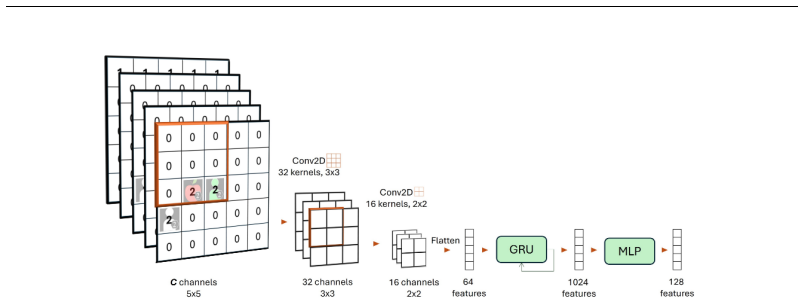
Unknown from text; partially indicated in Figure 3, full values in unavailable hyperparameters.yaml
- PPO and DreamerV3 hyperparameters =
Fine-tuned with Optuna; exact values in unavailable hyperparameters.yaml
assumptions (5)
- domain assumption The set of known team-task combinations K is fixed and known in advance, and the ad hoc agent only needs to identify among them.
- domain assumption Training trajectories collected by the ad hoc agent's own policies are sufficient experience to define the team-task models.
- domain assumption Partial observations are of fixed 5x5x5 tuple shape with five channels and a limited field of view.
- domain assumption The statistical standard for effective identification is that the belief for the correct team-task eventually becomes the most-likely, without formal error bars or significance tests.
- standard math Standard RL assumptions for PPO and DreamerV3 to compute near-optimal best-response policies.
invented entities (1)
-
Recurrent Bayesian classifier p_theta
Cite this review
Pith. "Pith review of RecBayes: Recurrent Bayesian Ad Hoc Teamwork in Large Partially Observable Domains." pith.science (2026). https://pith.science/paper/T74N3RRR
@misc{pith2026250615756,
  author       = {Pith},
  title        = {Pith review of: RecBayes: Recurrent Bayesian Ad Hoc Teamwork in Large Partially Observable Domains},
  year         = {2026},
  howpublished = {\url{https://pith.science/paper/T74N3RRR}},
  note         = {Machine review of arXiv:2506.15756}
}
read the original abstract
This paper proposes RecBayes, a novel approach for ad hoc teamwork under partial observability, a setting where agents are deployed on-the-fly to environments where pre-existing teams operate, that never requires, at any stage, access to the states of the environment or the actions of its teammates. We show that by relying on a recurrent Bayesian classifier trained using past experiences, an ad hoc agent is effectively able to identify known teams and tasks being performed from observations alone. Unlike recent approaches such as PO-GPL (Gu et al., 2021) and FEAT (Rahman et al., 2023), that require at some stage fully observable states of the environment, actions of teammates, or both, or approaches such as ATPO (Ribeiro et al., 2023) that require the environments to be small enough to be tabularly modelled (Ribeiro et al., 2023), in their work up to 4.8K states and 1.7K observations, we show RecBayes is both able to handle arbitrarily large spaces while never relying on either states and teammates' actions. Our results in benchmark domains from the multi-agent systems literature, adapted for partial observability and scaled up to 1M states and 2^125 observations, show that RecBayes is effective at identifying known teams and tasks being performed from partial observations alone, and as a result, is able to assist the teams in solving the tasks effectively.
Figures


Figures from the paper (1 more)

Reference graph
Works this paper leans on
-
[4]
Helping people on thefly: Ad hoc teamwork for human-robot teams
João G Ribeiro, Miguel Faria, Alberto Sardinha, and Francisco S Melo. Helping people on thefly: Ad hoc teamwork for human-robot teams. InProgress in Articial Intelligence: 20th EPIA Con- ference on Articial Intelligence, EPIA 2021, Virtual Event, September 7–9, 2021, Proceedings 20, pp. 635–647. Springer,
work page 2021
-
[5]
Making friends in the dark: Ad hoc teamwork under partial observability
João G Ribeiro, Cassandro Martinho, Alberto Sardinha, and Francisco S Melo. Making friends in the dark: Ad hoc teamwork under partial observability. InECAI 2023, pp. 1954–1961. IOS Press, 2023a. João G Ribeiro, Gonçalo Rodrigues, Alberto Sardinha, and Francisco S Melo. Teamster: Model- based reinforcement learning for ad hoc teamwork.Articial Intelligenc...
work page 2023
-
[2010]
International Foundation for Autonomous Agents and Multiagent Systems. ISBN 978-0-9826571-1-9. URL http://dl.acm.org/citation.cfm?id=1838206.1838223. Peter Stone, Gal A Kaminka, Sarit Kraus, and Jeffrey S Rosenschein. Ad hoc autonomous agent teams: Collaboration without pre-coordination. InTwenty-F ourth AAAI Conference on Articial Intelligence,
-
[2016]
A survey of ad hoc teamwork: Definitions, methods, and open problems.arXiv preprint arXiv:2202.10450,
11 Reuth Mirsky, Ignacio Carlucho, Arrasy Rahman, Elliot Fosong, William Macke, Mohan Sridharan, Peter Stone, and Stefano V Albrecht. A survey of ad hoc teamwork: Definitions, methods, and open problems.arXiv preprint arXiv:2202.10450,
- [2021]
-
[2022]
Proximal policy optimization algorithms.arXiv preprint arXiv:1707.06347,
John Schulman, Filip Wolski, Prafulla Dhariwal, Alec Radford, and Oleg Klimov. Proximal policy optimization algorithms.arXiv preprint arXiv:1707.06347,
-
[2023]
DOI: 10.48550/ARXIV .2301.04104. F. Melo and A. Sardinha. Ad hoc teamwork by learning teammates’ task.Autonomous Agents and Multi-Agent Systems, 30(2):175–219,
-
[2024]
Centralized Training with Hybrid Execution in Multi-Agent Reinforcement Learning
Pedro P Santos, Diogo S Carvalho, Miguel V asco, Alberto Sardinha, Pedro A Santos, Ana Paiva, and Francisco S Melo. Centralized training with hybrid execution in multi-agent reinforcement learning.arXiv preprint arXiv:2210.06274,
Reviewed August 15, 2026 · model on record in the stance chip above.
Discussion (0). Continue with ORCID to comment.