REVIEW 4 minor 2 cited by
Caustic formation in DBI models: Wave propagation on planar domain walls
T0 review · 0 major / 4 minor · reviewed 2026-07-13 · grok-4.5
Pith's one-line read DBI waves on planar domain walls stay caustic-free while hyperbolic; only loss of hyperbolicity produces cusps.
desk verdict Clean analytic proof that hyperbolic DBI stays caustic-free for generic waves, including under the three deformations that matter for domain walls. read the letter →
The pith
A machine-rendered reading of the paper's core claim, the machinery that carries it, and where it could break.
The reading
What carries the argument
The method of characteristics for the first-order system that governs the field derivatives τ and χ. In pure two-dimensional DBI the phase velocities ξ± depend only on their own characteristic parameter, forcing ∂²t/∂ω₊∂ω₋ = 0 and thereby forbidding caustics. With a source Q independent of second derivatives the same mixed derivative becomes proportional to (∂t/∂ω₊)(∂t/∂ω₋), turning the evolution of each first derivative into a linear ODE whose uniqueness still precludes caustics.
What would settle it
A numerical evolution of the full DBI equation (or of its spherical/expanding/linearly-deformed versions) that begins with smooth, strictly hyperbolic initial data and develops a finite-time caustic while the sound speed remains positive would falsify the claim.
Extended reading notes
Core claim
In the hyperbolic regime, scalar DBI remains free of caustics for generic waves both in two-dimensional Minkowski space (where same-family characteristics remain parallel) and under the physically relevant source terms that appear for spherical waves, cosmic expansion, and linear wall-annihilation deformations; the only caustics that can form are those associated with loss of hyperbolicity and they possess a cusp profile.
Load-bearing premise
The extra source term that appears once the problem leaves pure two-dimensional flat space is assumed not to depend on second derivatives of the wall field; that assumption turns the evolution equation into a linear ODE whose uniqueness blocks caustics.
Editorial extensions
If this is right
- Particle emission from planar domain walls is expected only where hyperbolicity is lost, i.e., at cusps where the sound speed vanishes.
- Realistic characteristic geometry (expansion, spherical waves, annihilation term) can either create or suppress cusps relative to the flat two-dimensional idealization, so conclusions drawn from the simplified model need re-examination.
- The same uniqueness argument extends immediately to any curved two-dimensional background that produces a source independent of second derivatives.
- Melting domain walls, which live effectively in Minkowski space and need no annihilation term, should exhibit a different cusp pattern from constant-tension walls.
Reading between the lines
- Because the proof is limited to spherical symmetry in D>2, a fully three-dimensional non-spherical wave packet could still form hyperbolic caustics and would be the natural next numerical target.
- If cusps are the dominant particle-production channel, the abundance of closed wall loops or the gravitational-wave spectrum from domain-wall networks should correlate with the rate at which sound speed reaches zero.
- The linear uniqueness argument may fail for higher-order corrections that reintroduce second-derivative dependence into the source, offering a concrete way to test the robustness of the no-caustic statement.
Signed reviews
Editorial analysis
A structured set of objections, weighed in public.
Referee Report
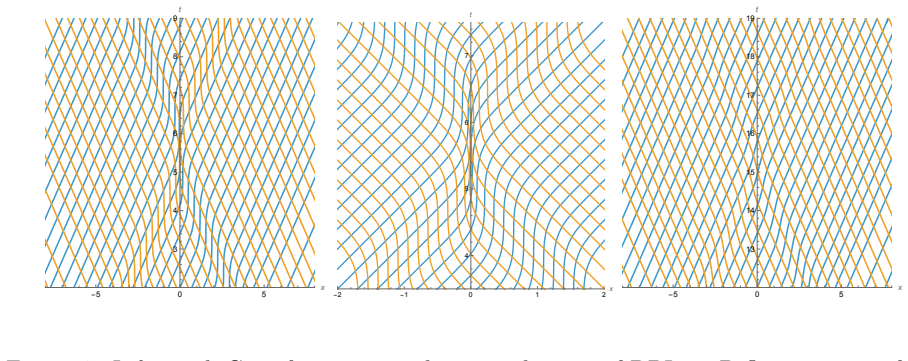
Summary. The paper studies generic wave propagation on thin planar domain walls in the scalar DBI model, with emphasis on caustic formation. In 2D flat spacetime it proves that, for smooth initial data in the hyperbolic regime, same-family characteristics remain parallel (ξ_{+} = ξ_{+}(ω_{+}), ξ_{-} = ξ_{-}(ω_{-})) even though they are not straight lines; consequently ∂^{2}t/∂ω_{+}∂ω_{-} = 0 and ∂t/∂ω_{+} cannot vanish at later times, so no caustics form. Beyond this setting—spherical waves in D > 2, an expanding FLRW background, and the minimal linear deformation of DBI that solves the domain-wall problem—the characteristics cease to be globally parallel, yet the paper shows that the mixed derivative still forces a linear first-order ODE for ∂t/∂ω_{+} along each characteristic; uniqueness then precludes caustics from smooth data. The only remaining singularities are therefore non-hyperbolic cusps (c_s = 0), whose formation is shown to be sensitive to the non-trivial characteristic structure uncovered in the deformed cases.
Significance. The result supplies a parameter-free analytic demonstration that hyperbolic DBI is caustic-free for generic waves under the deformations most relevant to cosmology. This sharpens the physical picture of particle emission from domain walls: emission is expected only when hyperbolicity is lost and cusps form. The exact solvability of 2D DBI, the transparent use of Riemann invariants and characteristic coordinates, and the explicit comparison of cusp formation with and without expansion or a linear term constitute clear technical advances over earlier simple-wave analyses. The work therefore strengthens the theoretical foundation for both domain-wall network simulations and the broader study of caustics in P(X) theories.
minor comments (4)
- Abstract and Sec. 1: a few typographical slips remain (“waveson”, “a row of physically relevant situations”). A light copy-edit would remove them.
- Figs. 1–4: the captions state the functional forms of the Riemann invariants and the value of ϵ or H, but do not record the numerical integrator or the precise initial data for ϕ itself. Adding a short sentence or an appendix note would make the illustrations fully reproducible.
- Eq. (56) and the paragraph that follows: the assumption that Q is independent of first derivatives of τ and χ is verified case-by-case, yet a single clarifying sentence early in Sec. 6 would help the reader see that the linear ODE structure is not accidental.
- Appendix A: the conformal-gauge expansion (74)–(82) is useful; a brief remark on how the same cusp profile is recovered from the static-gauge Euler equation (64) would tighten the cross-check.
Circularity Check
No significant circularity: the no-caustic theorems are self-contained analytic derivations from the DBI Lagrangian and the method of characteristics.
full rationale
The paper derives the characteristic slopes ξ± from the DBI sound speed (Eqs. 21–31), obtains the key structural property ξ±=ξ±(ω±) that forces ∂^{2}t/∂ω_{+}∂ω_{-}=0 (Eqs. 34–43), and proves that ∂t/∂ω± cannot vanish later if it is non-zero on smooth initial data (Sec. 5). The same logic is extended to the deformed equation (53) by showing that the source Q produces a linear first-order ODE (57) whose uniqueness again forbids a zero of ∂t/∂ω_{+} once smooth initial data are imposed (Sec. 6). All three concrete sources Q (spherical, Hubble, linear annihilating term) are computed explicitly from the action and do not depend on second derivatives of φ. Self-citations (Babichev 2016, Mukohyama et al. 2016, etc.) supply only the background method of characteristics and earlier simple-wave results; they are not used as uniqueness theorems that force the present generic-wave statements. No parameters are fitted, no empirical pattern is renamed, and the open status of non-spherical D>2 is stated honestly. The derivation chain is therefore independent of its own conclusions.
Assumptions & free parameters
assumptions (4)
- domain assumption Thin-wall (Nambu–Goto) limit is an accurate effective description of domain walls when the wall width is much smaller than the curvature radius and Hubble scale.
- domain assumption Initial data for the DBI field are smooth (finite first and second derivatives).
- ad hoc to paper The inhomogeneous term Q that appears after including expansion, spherical geometry or a linear potential is independent of the first derivatives of au and heta.
- standard math Hyperbolicity is equivalent to heta_{+}
eq heta_{-} (or c_s^{2} > 0).
Cite this review
Pith. "Pith review of Caustic formation in DBI models: Wave propagation on planar domain walls." pith.science (2026). https://pith.science/paper/T7FPKUZH
@misc{pith2026260408142,
  author       = {Pith},
  title        = {Pith review of: Caustic formation in DBI models: Wave propagation on planar domain walls},
  year         = {2026},
  howpublished = {\url{https://pith.science/paper/T7FPKUZH}},
  note         = {Machine review of arXiv:2604.08142}
}
abstract
We investigate propagation of generic waves on thin planar domain walls effectively described by the scalar Dirac-Born-Infeld model (DBI). We pay a particular attention to the possibility of caustic formation - the process, which may lead to intensive particle emission by domain walls. It is demonstrated that no singularities arise in DBI in 2D flat spacetime in the hyperbolic case, if one starts from smooth initial conditions. Technically, this happens because the same family characteristics of the relevant partial differential equation remain parallel at all the times, albeit not being straight lines generically. Crucially, characteristic curves cease to be parallel beyond the simplified setup of DBI in 2D flat spacetime. In particular, this is shown to be the case in $D>2$ for spherical waves, in an expanding Universe, and in the case of a minimal deformation of DBI necessary for avoiding the domain wall problem in cosmology. However, we prove that DBI remains caustic free in the hyperbolic case in all these physically relevant situations. This strongly suggests that caustics can form on planar domain walls only due to the loss of hyperbolicity, and they have a cusp profile. We demonstrate, how the non-trivial structure of DBI characteristics beyond the 2D flat spacetime setup uncovered in this work can significantly affect cusp formation.
Figures


Figures from the paper (1 more)
Forward citations
Cited by 2 Pith papers
-
Cuspidal Singularities in Collapsing Domain Walls
Collapsing domain walls generically form cuspidal edge and vertex singularities captured by Nambu-Goto and eikonal approximations and reproduced in field theory simulations.
-
Domain walls through different cosmologies
Domain-wall network area scales as S ≈ 2ξV/τ with ξ≈1.2 across cosmologies from dust to near-Minkowski, so the particle horizon—not H⁻¹—sets the correlation length and GW peak.
Reference graph
Works this paper leans on
-
[1]
Yu. A. Kravtsov, Yu. I. Orlov,Caustics, Catastrophes and Wave Fields, Springer-Verlag Berlin Heidelberg 1993
1993
-
[2]
Y. B. Zeldovich,Gravitational instability: An Approximate theory for large density perturbations, Astron. Astrophys.5(1970), 84-89
1970
-
[3]
I., Shandarin S
Arnold V. I., Shandarin S. F., Zeldovich Ia. B.,The large scale structure of the universe I. General properties. One-and two-dimensional models, 1982, Geophys. and Astrophys. Fluid Dynamics, 20, no. 1-2, 111
1982
-
[4]
Born and L
M. Born and L. Infeld,Foundations of the new field theory, Proc. Roy. Soc. Lond. A 144(1934) no.852, 425-451
1934
-
[5]
P. A. M. Dirac,An Extensible model of the electron, Proc. Roy. Soc. Lond. A268(1962), 57-67
1962
-
[6]
Barbashov and N
B. Barbashov and N. Chernikov,Solution and Quantization of a Nonlinear Two- dimensional Model for a Born-Infeld Type Field, Sov. Phys. JETP23(1966) no.5, 861-868
1966
-
[7]
B. M. Barbashov and N. A. Chernikov,Solution of the Two Plane Wave Scattering Problem in a Nonlinear Scalar Field Theory of the Born-Infeld Type, Sov. Phys. JETP 24(1967) no.2, 437-442
1967
-
[8]
A. A. Tseytlin,Born-Infeld action, supersymmetry and string theory, [arXiv:hep- th/9908105 [hep-th]]
Show all 61 references
-
[9]
Y. B. Zeldovich, I. Y. Kobzarev and L. B. Okun,Cosmological Consequences of the Spontaneous Breakdown of Discrete Symmetry, Zh. Eksp. Teor. Fiz.67(1974), 3-11 SLAC-TRANS-0165. 27
1974
-
[10]
Vilenkin and E
A. Vilenkin and E. P. S. Shellard,Cosmic Strings and Other Topological Defects, Cam- bridge University Press, 2000
2000
-
[11]
Vachaspati,Kinks and Domain Walls : An Introduction to Classical and Quantum Solitons, Oxford University Press, 2007
T. Vachaspati,Kinks and Domain Walls : An Introduction to Classical and Quantum Solitons, Oxford University Press, 2007
2007
-
[12]
A. V. Frolov, L. Kofman and A. A. Starobinsky,Prospects and problems of tachyon matter cosmology, Phys. Lett. B545(2002), 8-16; [arXiv:hep-th/0204187 [hep-th]]
2002 arXiv
-
[13]
Alishahiha, E
M. Alishahiha, E. Silverstein and D. Tong,DBI in the sky, Phys. Rev. D70(2004), 123505; [arXiv:hep-th/0404084 [hep-th]]
2004 arXiv
-
[14]
W. H. Press, B. S. Ryden and D. N. Spergel,Dynamical Evolution of Domain Walls in an Expanding Universe, Astrophys. J.347(1989), 590-604
1989
-
[15]
Hiramatsu, M
T. Hiramatsu, M. Kawasaki and K. Saikawa,On the estimation of gravitational wave spectrum from cosmic domain walls, JCAP02(2014), 031; [arXiv:1309.5001 [astro- ph.CO]]
2014 arXiv
-
[16]
Dankovsky, S
I. Dankovsky, S. Ramazanov, E. Babichev, D. Gorbunov and A. Vikman,Cosmic do- main walls on a lattice: Illusive effects of initial conditions, Phys. Rev. D112(2025) no.12, 123521; [arXiv:2509.25367 [hep-ph]]
2025
-
[17]
Blasi, A
S. Blasi, A. Mariotti, A. Rase and M. Vanvlasselaer,Domain walls in the scaling regime: Equal Time Correlator and Gravitational Waves, [arXiv:2511.16649 [hep-ph]]
-
[18]
Dankovsky, E
I. Dankovsky, E. Babichev, D. Gorbunov, S. Ramazanov and A. Vikman,Revisiting evolution of domain walls and their gravitational radiation with CosmoLattice, JCAP 09(2024), 047; [arXiv:2406.17053 [astro-ph.CO]]
2024 arXiv
-
[19]
T. W. B. Kibble,Topology of Cosmic Domains and Strings, J. Phys. A9(1976), 1387- 1398
1976
-
[20]
Vachaspati and A
T. Vachaspati and A. Vilenkin,Gravitational Radiation from Cosmic Strings, Phys. Rev. D31(1985), 3052
1985
-
[21]
Vilenkin and T
A. Vilenkin and T. Vachaspati,Radiation of Goldstone Bosons From Cosmic Strings, Phys. Rev. D35(1987), 1138
1987
-
[22]
J. J. Blanco-Pillado and K. D. Olum,Stochastic gravitational wave background from smoothed cosmic string loops, Phys. Rev. D96(2017) no.10, 104046; [arXiv:1709.02693 [astro-ph.CO]]. 28
2017 arXiv
-
[23]
Baeza-Ballesteros, E
J. Baeza-Ballesteros, E. J. Copeland, D. G. Figueroa and J. Lizarraga,Particle and gravitational wave emission by local string loops: Lattice calculation, Phys. Rev. D112 (2025) no.4, 4; [arXiv:2408.02364 [astro-ph.CO]]
2025 arXiv
-
[24]
G. N. Felder, L. Kofman and A. Starobinsky,Caustics in tachyon matter and other Born-Infeld scalars, JHEP09(2002), 026; [arXiv:hep-th/0208019 [hep-th]]
2002 arXiv
-
[25]
Eggers and J
J. Eggers and J. Hoppe,Singularity formation for time-like extremal hypersurfaces, Phys. Lett. B680(2009), 274-278
2009
-
[26]
M. J. Eggers, J. Hoppe, M. Hynek, N. Suramlishvili,Singularities of relativistic mem- branes, Geometric Flows12015 17-33
-
[27]
J. J. Blanco-Pillado, D. Jim´ enez-Aguilar and O. Pujol` as,From cusps to swallowtails: Domain wall singularities in 2+1 dimensions, Phys. Rev. D112(2025) no.12, 123536; [arXiv:2509.19457 [hep-th]]
2025
-
[28]
Babichev,Formation of caustics in k-essence and Horndeski theory, JHEP04(2016), 129; [arXiv:1602.00735 [hep-th]]
E. Babichev,Formation of caustics in k-essence and Horndeski theory, JHEP04(2016), 129; [arXiv:1602.00735 [hep-th]]
2016 arXiv
-
[29]
Mukohyama, R
S. Mukohyama, R. Namba and Y. Watanabe,Is the DBI scalar field as fragile as other k-essence fields?, Phys. Rev. D94(2016) no.2, 023514; [arXiv:1605.06418 [hep-th]]
2016 arXiv
-
[30]
Deser, J
S. Deser, J. G. McCarthy and O. Sarioglu,’Good propagation’ constraints on dual invari- ant actions in electrodynamics and on massless fields, Class. Quant. Grav.16(1999), 841-847; [arXiv:hep-th/9809153 [hep-th]]
1999 arXiv
-
[31]
Boillat,Nonlinear electrodynamics - Lagrangians and equations of motion, J
G. Boillat,Nonlinear electrodynamics - Lagrangians and equations of motion, J. Math. Phys.11(1970) no.3, 941-951
1970
-
[32]
D. I. Blokhintsev and V. V. Orlov, Zh. Eksp. Teor. Fiz.25(1953) no.5, 513-526
1953
-
[33]
Tanahashi and S
N. Tanahashi and S. Ohashi,Wave propagation and shock formation in the most general scalar–tensor theories, Class. Quant. Grav.34(2017) no.21, 215003; [arXiv:1704.02757 [hep-th]]
2017 arXiv
-
[34]
Gregory, D
R. Gregory, D. Haws and D. Garfinkle,The Dynamics of Domain Walls and Strings, Phys. Rev. D42(1990), 343-348
1990
-
[35]
Bonjour, C
F. Bonjour, C. Charmousis and R. Gregory,The Dynamics of curved gravitating walls, Phys. Rev. D62(2000), 083504; [arXiv:gr-qc/0002063 [gr-qc]]. 29
2000 arXiv
-
[36]
J. J. Blanco-Pillado, A. Garc´ ıa Mart´ ın-Caro, D. Jim´ enez-Aguilar and J. M. Queiruga, Effective actions for domain wall dynamics, Phys. Rev. D111(2025) no.5, 056007; [arXiv:2411.13521 [hep-th]]
2025 arXiv
-
[37]
Courant and K
R. Courant and K. O. Friedrichs,Supersonic Flow and Shock Waves, Interscience Pub- lishers Inc., New York, 1948
1948
-
[38]
Courant and D
R. Courant and D. Hilbert,Methods of Mathematical Physics: Volume II: Partial Dif- ferential Equations, Interscience Publishers (Wiley), New York, 1962
1962
-
[39]
V. S. Vladimirov,Equations of mathematical physics, MIR, 1984
1984
-
[40]
Garriga and V
J. Garriga and V. F. Mukhanov,Perturbations in k-inflation, Phys. Lett. B458(1999), 219-225; [arXiv:hep-th/9904176 [hep-th]]
1999 arXiv
-
[41]
Majda,Compressible Fluid Flow and Systems of Conservation Laws in Several Space Variables; Springer New York, NY
A. Majda,Compressible Fluid Flow and Systems of Conservation Laws in Several Space Variables; Springer New York, NY
-
[42]
Afshordi, D
N. Afshordi, D. J. H. Chung and G. Geshnizjani, Phys. Rev. D75(2007), 083513; [arXiv:hep-th/0609150 [hep-th]]
2007 arXiv
-
[43]
Pasmatsiou,Caustic Formation upon Shift Symmetry Breaking, Phys
K. Pasmatsiou,Caustic Formation upon Shift Symmetry Breaking, Phys. Rev. D97 (2018) no.3, 036008; [arXiv:1712.02888 [hep-th]]
2018 arXiv
-
[44]
P. D. Lax,Development of singularities of solutions of nonlinear hyperbolic partial dif- ferential equations, Journal of Mathematical Physics5(5) (1964), 611–613
1964
-
[45]
P. D. Lax,Hyperbolic systems of conservation laws and the mathematical theory of shock waves, SIAM, 1973
1973
-
[46]
P. D. Lax,XII. The Initial Value Problem for Nonlinear Hyperbolic Equations in Two Independent Variables, in Contributions to the Theory of Partial Differential Equations (AM-33), Princeton University Press, 1955, pp. 211–230
1955
-
[47]
Babichev,Emergence of ghosts in Horndeski theory,JHEP07(2020), 038; [arXiv:2001.11784 [hep-th]]
E. Babichev,Emergence of ghosts in Horndeski theory,JHEP07(2020), 038; [arXiv:2001.11784 [hep-th]]
2020 arXiv
-
[48]
de Rham and H
C. de Rham and H. Motohashi,Caustics for Spherical Waves, Phys. Rev. D95(2017) no.6, 064008; [arXiv:1611.05038 [hep-th]]
2017 arXiv
-
[49]
Babichev and S
E. Babichev and S. Ramazanov,Caustic free completion of pressureless perfect fluid and k-essence, JHEP08(2017), 040; [arXiv:1704.03367 [hep-th]]. 30
2017 arXiv
-
[50]
J. J. Blanco-Pillado, D. Jim´ enez-Aguilar, J. M. Queiruga and J. Urrestilla,The dynam- ics of domain wall strings, JCAP05(2023), 011; [arXiv:2209.12945 [hep-th]]
2023 arXiv
-
[51]
L. M. Widrow,Dynamics of Thick Domain Walls, Phys. Rev. D40(1989), 1002
1989
-
[52]
Ramazanov, E
S. Ramazanov, E. Babichev, D. Gorbunov and A. Vikman,Beyond freeze-in: Dark matter via inverse phase transition and gravitational wave signal,Phys. Rev. D105 (2022) no.6, 063530; [arXiv:2104.13722 [hep-ph]]
2022 arXiv
-
[53]
Babichev, D
E. Babichev, D. Gorbunov, S. Ramazanov and A. Vikman,Gravitational shine of dark domain walls, JCAP04(2022) no.04, 028; [arXiv:2112.12608 [hep-ph]]
2022 arXiv
-
[54]
Dankovsky, S
I. Dankovsky, S. Ramazanov, E. Babichev, D. Gorbunov and A. Vikman,Numerical analysis of melting domain walls and their gravitational waves, JCAP02(2025), 064; [arXiv:2410.21971 [hep-ph]]
2025 arXiv
-
[55]
Babichev, S
E. Babichev, S. Ramazanov and A. Vikman,RecoveringP(X)from a canonical complex field,JCAP11(2018), 023; [arXiv:1807.10281 [gr-qc]]
2018 arXiv
-
[56]
Israel,Singular hypersurfaces and thin shells in general relativity, Nuovo Cim
W. Israel,Singular hypersurfaces and thin shells in general relativity, Nuovo Cim. B 44S10(1966), 1 [Erratum: Nuovo Cim.B 48, 463 (1967)]
1966
-
[57]
V. A. Berezin, V. A. Kuzmin and I. I. Tkachev,Dynamics of Bubbles in General Rela- tivity, Phys. Rev. D36(1987), 2919
1987
-
[58]
Deng and A
H. Deng and A. Vilenkin,Primordial black hole formation by vacuum bubbles, JCAP 12(2017), 044; [arXiv:1710.02865 [gr-qc]]
2017 arXiv
-
[59]
Deng,Primordial black hole formation by vacuum bubbles
H. Deng,Primordial black hole formation by vacuum bubbles. Part II, JCAP09(2020), 023; [arXiv:2006.11907 [astro-ph.CO]]
2020 arXiv
-
[60]
Poisson,A Relativist’s Toolkit: The Mathematics of Black-Hole Mechanics, Cam- bridge University Press, 2009
E. Poisson,A Relativist’s Toolkit: The Mathematics of Black-Hole Mechanics, Cam- bridge University Press, 2009
2009
-
[61]
Garriga and A
J. Garriga and A. Vilenkin,Perturbations on domain walls and strings: A Covariant theory, Phys. Rev. D44(1991), 1007-1014. 31
1991
Reviewed July 13, 2026 · model on record in the stance chip above.
Discussion (0). Continue with ORCID to comment.